



Abstract
Students often become homeless due to conventional, economic instability; however, they also become homeless from natural disasters. We provide initial empirical evidence comparing these pathways to homelessness in the context of Houston and Hurricane Harvey. Analyzing 7 years of data on 321,439 students using a comparative interrupted time-series approach incorporating student-level fixed effects, we find students who became homeless due to Harvey were more representative of district students overall and had more similar educational outcomes after the storm. Conversely, students who became homeless due to conventional reasons had more adverse outcomes, which improved after identification. We discuss these findings in light of the differential social constructions of these subgroups and conclude with implications for policy and practice.
In 2024, the United States experienced 27 separate natural disasters where overall damages reached or exceeded $1 billion, costing a total of $183 billion (Smith, 2025). Moreover, such phenomena are likely to worsen in intensity and geographic extent with climate change (U.S. Geological Survey, 2024). The financial and emotional toll of such disasters on communities may be widespread, but perhaps none experience it as acutely as children who lose their homes. This is particularly concerning given that vulnerability to these disasters is often inextricably intertwined with race and class (Bullard, 2000), meaning natural disasters may exacerbate already gaping educational inequities.
There is a relatively robust body of research on homelessness rooted in conventional economic instability, triggered by relatively common economic events, such as a job loss or medical debt (Buckner, 2013; Miller, 2011; Pavlakis, 2018). However, we know much less about the impacts of homelessness when the housing instability was attributable to natural disasters (Ward et al., 2008; see also Hallett et al., 2025). Moreover, no extant empirical work has directly compared the effects of these two pathways.
This study provides initial empirical insights into the effects of becoming homeless due to a natural disaster compared to conventional pathways in the context of Houston, Texas, which was hit by Hurricane Harvey in 2017. Using comparative interrupted time-series models incorporating student and school fixed effects, we find the impact of becoming homeless on educational outcomes varies by pathway to homelessness. We conclude with implications for educational policy and practice in preparation for, during, and after crises.
Background
Researchers have long studied student homelessness associated with conventional economic instability and related events, such as job loss and medical debt (Buckner, 2013; Miller, 2011; Pavlakis, 2018), including in the Houston Independent School District (HISD) specifically (Richards & Pavlakis, 2022). Although findings are mixed regarding the unique impact of homelessness above and beyond poverty, evidence suggests students experiencing homelessness tend to have lower attendance and test scores than their stably housed peers (Herbers et al., 2012; Miller, 2011; Richards & Pavlakis, 2022). For instance, Obradović et al. (2009) examined math and reading achievement and found that homeless and highly mobile students had lower achievement and slower growth in some cohorts than nonmobile, low-income, and all tested students. Cutuli et al. (2013) found that compared to reading, math achievement may be more impacted by disruptions in school attendance. Moreover, students experiencing homelessness are also disproportionately Black, Hispanic, and/or Native American and can face hostile racial environments that hinder identification and access to supports (Aviles de Bradley, 2015; Edwards, 2020; Hallett et al., 2025; SchoolHouse Connections, 2025).
We know less about students who specifically become homeless due to natural disasters, including hurricanes, floods, tornados, or fires (Ward et al., 2008). Buckner (2013) posited that natural disasters are “fairly indiscriminate” (e.g., multiple homes will be destroyed in a bad earthquake or flood) or random (e.g., the path of destruction left by a tornado) relative to other pathways to homelessness (p. 6). However, environmental justice frameworks (e.g., Bullard, 2000) suggest natural disaster events are not random (Chakraborty et al., 2014; Johnson, 2008). Reflecting America’s highly racialized geography, low-income families of color are more likely to live in areas at risk of disaster (Elliott & Pais, 2006; Hartman & Squires, 2006).
Extant research suggests natural disasters can adversely impact students’ educational outcomes and well-being (Kousky, 2016). For instance, students “displaced” by Hurricanes Katrina and Rita were more likely to exhibit negative behaviors and had slightly lower achievement than other students (Pane et al., 2008). Notably, adverse impacts were more prominent for students displaced for the entire school year (Pane et al., 2008). Likewise, previous exposure to stress and trauma, such as from poverty or food insecurity, may have a synergistic effect, worsening outcomes for students who experience natural disasters (Jaycox et al., 2010; Simmons & Douglas, 2018). Moreover, due to patterns of structural racism and differences in individual, family, and community resources, vulnerability to and recovery from natural disasters may be uneven and intertwined with income and race (Chakraborty et al., 2014; Johnson, 2008).
However, no known research has directly compared the educational outcomes of students who become homeless due to natural disasters versus the more studied conventional path of economic instability. Thus, this study addresses the following research question:
Research Question: How is pathway to homelessness (i.e., natural disaster vs. conventional) related to student educational outcomes (i.e., attendance and math and reading achievement)?
Theoretical Perspective
In considering the ways in which pathway to homelessness may impact educational outcomes, we adopt a social constructivist framework (Schneider et al., 2014). This framework foregrounds the role of social construction—or the stereotypes and images of subgroups of people—and how these constructions help shape how policies are designed to either benefit or punish the group. Policies are designed and resources allocated to subgroups based on their political power, such as their ability to mobilize their wealth, but also because of their social construction, the extent to which they are deemed “worthy and deserving” (Schneider et al., 2014, p. 110).
Subgroups with high power and positive social construction often benefit most from policies, and low political power and negative social construction target groups (“deviants”) tend to face the brunt of stigmatizing or punitive policies. Race, gender, class, disability, religion, and other factors all play a role—for instance, young Black males as a group have relatively low political power and negative social construction. “Dependents,” such as children, mothers, people experiencing homelessness, disaster victims, and families in poverty, can be seen as worthy of benevolence. However, they are often viewed as less deserving than advantaged groups, and their policy benefits may be more symbolic or first to be slashed in budget cuts (Schneider et al., 2014).
Social construction is also related to perceptions of personal responsibility and resource allocations, which may vary by pathway to homelessness. Homelessness is often viewed as a personal failure, particularly among adults, and thus unworthy of sympathy and aid (Pavlakis, 2021; Pavlakis et al., 2026). This leaves people experiencing housing instability vulnerable to stigmatizing policies, such as anti-loitering laws, and the use of hostile architecture in public spaces, such as leaning bars instead of benches in train stations (Hu, 2019). Conversely, victims of natural disasters are viewed as less responsible for their predicament and tend to have relatively positive social constructions and more robust resources and support (Birkland, 2004; Sapat & Esnard, 2012). It holds, therefore, that the differential social constructions of these pathways to homelessness and their associated policy benefits may be associated with differences in educational outcomes.
Method
We study the effect of homelessness pathways on student outcomes in the context of HISD, the nation’s seventh largest public school district, using a comparative interrupted time-series approach (Hallberg et al., 2018). In August 2017, Houston, and southeast Texas more broadly, was ravaged by Hurricane Harvey. The second-costliest storm on record in the United States, Harvey caused approximately $125 billion in damage overall and wiped out 25% of Houston’s affordable housing stock (Dickerson, 2018). Over 100 Texans died, and thousands in the Houston area became homeless as their residences, particularly in low-lying areas near the city’s famous bayous, were irreparably damaged or destroyed. Harvey was unprecedented in its geographic extent—with most of its damage outside the flood plains federally defined by the Federal Emergency Management Agency (FEMA; Hunn et al., 2018).
Harvey’s impact was particularly acute in schools: The Texas Education Agency (TEA) estimated over 1 million Texas students—20% of all students—were affected by the storm in some way (ABC News, 2017). For all HISD students, the start of classes was delayed by weeks. A handful of campuses were relocated for the entire school year, although nearly all schools sustained damage of some kind.
Data and Sample
Our study draws on HISD administrative data provided by the Houston Education Research Consortium. Our analyses include 321,439 total students enrolled in HISD from 2012–2013 (the earliest year data are available) to 2018–2019, including 33,060 students who experienced homelessness. We elect not to follow students from 2019–2020 onward because analyses would confound the effects of the hurricane with the COVID-19 pandemic. Because we have 7 years of data, we were able to analyze 5 years of data for students who became homeless due to Harvey in 2017–2018 (i.e., 3 years before becoming homeless and 2 years after becoming homeless), balanced panels for two comparison cohorts of students who became homeless in 2015–2016 and 2016–2017, and students who never experienced homelessness over that period.
To ensure we isolate the unique effects of becoming homeless due to Harvey, we exclude 1,111 students who had previously experienced homelessness, focusing on the 22,961 students who first became homeless due to Harvey in 2017. Although this provides a stronger basis for causal inference regarding the effects of Harvey, it necessarily neglects the potential compounding effects of chronic homelessness and natural disasters. We also exclude students who were homeless in 2017 for reasons other than Harvey (n = 5,929) because it would be impossible to empirically disentangle their experience of conventional homelessness from the possible spillover effects of Harvey in that year. Accordingly, we also limit our comparison cohorts to the 10,099 students who became homeless due to conventional pathways in the prior 2 years to exclude students who were also homeless in other years (n = 2,754). Our final sample, whose characteristics are described in Table 1, contains 33,060 total students who experienced homelessness and 288,379 students who were never homeless over that period.
Characteristics and Academic Outcomes of Students, by Homeless Pathway
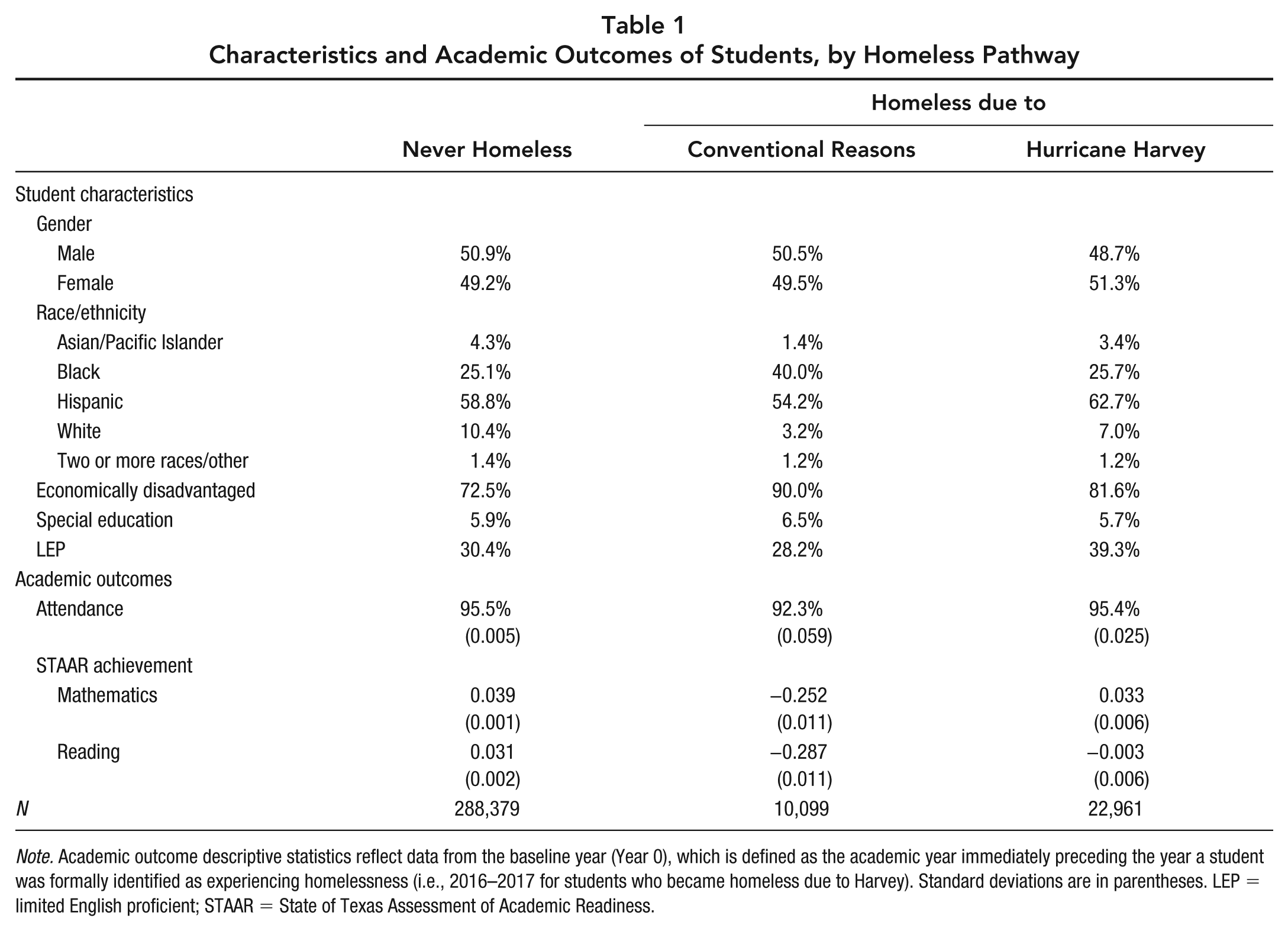
Note. Academic outcome descriptive statistics reflect data from the baseline year (Year 0), which is defined as the academic year immediately preceding the year a student was formally identified as experiencing homelessness (i.e., 2016–2017 for students who became homeless due to Harvey). Standard deviations are in parentheses. LEP = limited English proficient; STAAR = State of Texas Assessment of Academic Readiness.
Key Variables
Homelessness pathway
Our key independent variable for the study is student homelessness, disaggregated by pathway. 1 Because of the decentralized nature of administrative records, HISD reports homelessness in multiple data sets (captured at different points in time for different purposes). We count a student as experiencing homelessness at any point over the school year if they are coded as homeless in any of the data sets. 2 Unfortunately, none of these data sets provide information into the specific timing or duration of homelessness in the school year—thus, we can only ascertain that a student was homeless at some point during the school year, and our interrupted time series captures year-over-year change.
We classify all students who became homeless in 2015–2016 and 2016–2017 as homeless due to conventional reasons because there were no major natural disasters reported in the district in those years. For 2017–2018, we exclude students who became homeless due to reasons other than Harvey and include only students who were documented as homeless due to Harvey under TEA crisis codes. 3
Academic outcomes
We estimate the effects of homelessness on three core academic outcomes that have been the focus of prior research (e.g., Miller, 2011; Obradović et al., 2009; Richards & Pavlakis, 2022; Ward et al., 2008). We measure attendance as the percentage of enrolled school days per year a student is present. Achievement is measured as student performance on the State of Texas Assessments of Academic Readiness (STAAR) in reading and mathematics. Aligned with Ward and colleagues (2008), standardized tests scores in Grades 3 through 8 were chosen because they are taken by nearly all students in those grades, with few exceptions. They are also used frequently by advocates and practitioners to monitor progress (e.g., Institute for Children, Poverty, and Homelessness [ICPH], 2016; SchoolHouse Connections, 2025). We standardize achievement measures by grade and year for analysis and interpretation. 4
Analytic Strategy
As Table 1 demonstrates, students who experience homelessness differ from those who do not in ways that confound estimation of the relationship between homelessness and student outcomes. To address this endogeneity, we use a comparative interrupted time-series modeling strategy that incorporates student fixed effects. By estimating a separate intercept for each student, these models account for all non-time-varying sources of heterogeneity, both observed (e.g., race/ethnicity, special program enrollment) and unobserved (e.g., parental education, transportation). Our models take the following general form:

where Y is the educational outcome for student i at time t (i.e., attendance, standardized STAAR math or reading achievement) and α is the student fixed effect or intercept for each student i. The time fixed-effect dummy β1 is centered on the year the student became homeless (i.e., –2, –1, 0, +1, +2). The treatment effect of interest, β2, is captured by the interaction of the time indicator and a non-time-varying indicator of homelessness pathway (i.e., conventional, Harvey, or never homeless), for example, whether the effect of becoming homelessness on attendance varies for students homeless due to Harvey versus conventional reasons. Because homelessness pathway does not vary within students, its main effect is absorbed by the student intercepts. Accordingly, estimates are interpreted as within-student effects. As such, models assess change within students over time, not differences in group mean intercepts. Finally, δ is the fixed effect for each school d. All models are estimated via “xtreg” in Stata with robust standard errors clustered at the student level to account for serial autocorrelation (vce).
Findings
Table 1 provides the profile of our analytic sample disaggregated by pathway to homelessness. Notably, we observe systematic differences between students who became homeless due to Harvey and those experiencing homelessness for conventional reasons. Students who became homeless due to Harvey were more likely to be Hispanic (62.7% vs. 54.2%) and less likely to be Black (25.7% vs. 40.0%) relative to students who became homeless due to conventional reasons. Moreover, they tended to have higher attendance and achievement—on average, students who became homeless due to Harvey attended approximately 5.5 more school days than those who became homeless due to conventional reasons.
Indeed, students who became homeless due to Hurricane Harvey were overall more similar to never-homeless students—although they were slightly less likely to be White (7.0% vs. 10.4%), more likely to be Hispanic (62.7% vs. 58.8%), and more likely to be identified as limited English proficient (39.3% vs. 30.4%). This finding is consistent with the idea that Harvey was one of the most geographically dispersed storms in history—affecting not just vulnerable flood-prone areas but also areas thought to be safer (Hunn et al., 2018).
Table 2 and Figures 1 through 3 illustrate the adjusted relationship between becoming homeless by pathway on the core study outcomes (i.e., attendance, reading achievement, and math achievement) after accounting for student and school fixed effects. 5
Estimated Effects of Becoming Homeless on Educational Outcomes by Homeless Pathway
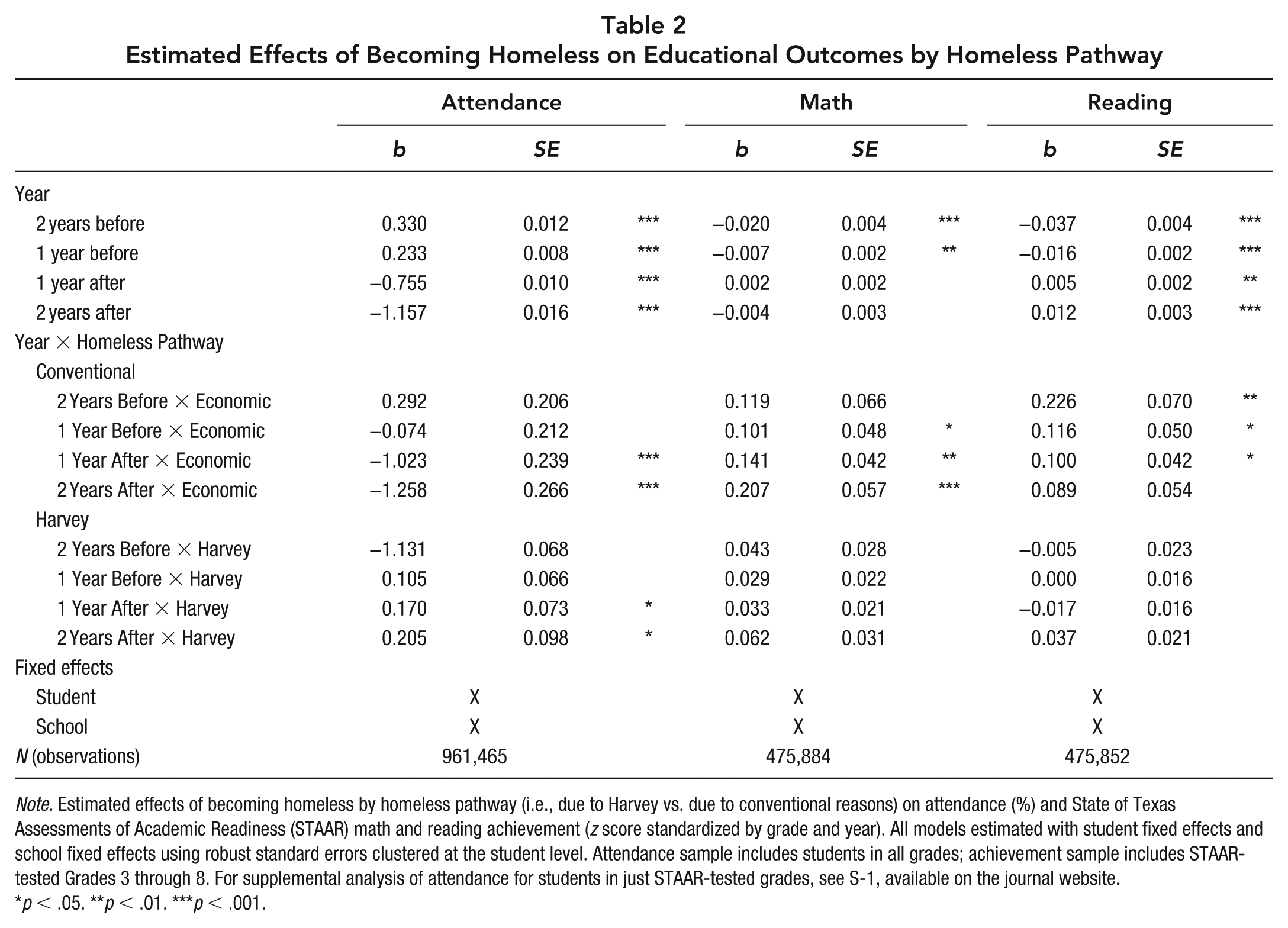
Note. Estimated effects of becoming homeless by homeless pathway (i.e., due to Harvey vs. due to conventional reasons) on attendance (%) and State of Texas Assessments of Academic Readiness (STAAR) math and reading achievement (z score standardized by grade and year). All models estimated with student fixed effects and school fixed effects using robust standard errors clustered at the student level. Attendance sample includes students in all grades; achievement sample includes STAAR-tested Grades 3 through 8. For supplemental analysis of attendance for students in just STAAR-tested grades, see S-1, available on the journal website.
p < .05. **p < .01. ***p < .001.
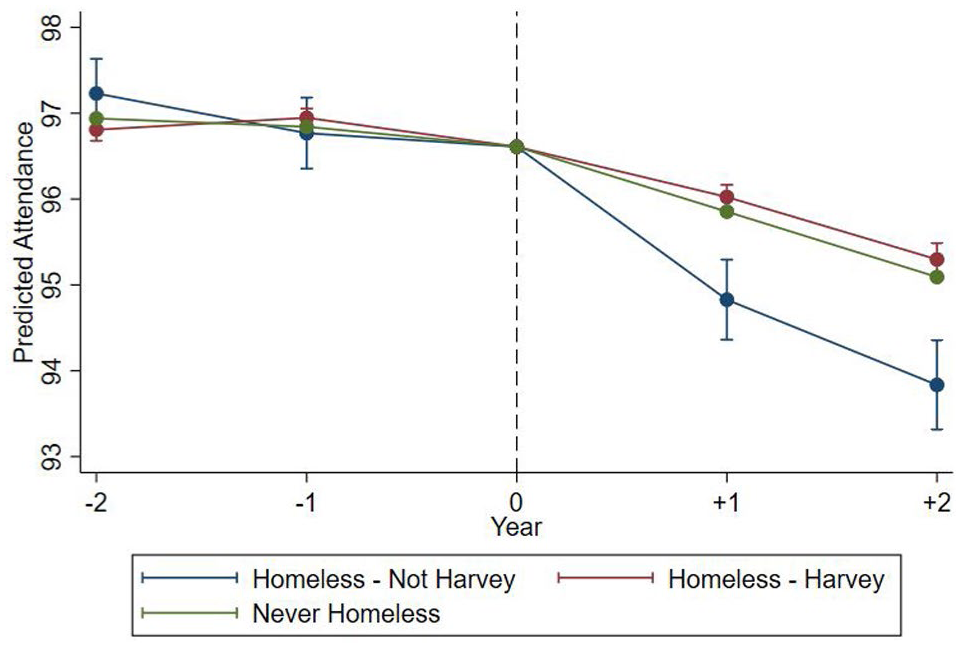
Predicted attendance (%) by homeless pathway compared to never homeless.
Attendance
Figure 1 demonstrates that students who became homeless due to both Harvey and conventional reasons had trajectories of baseline attendance that were nearly indistinguishable from those of never-homeless students in the years prior to becoming homeless, with attendance characteristically declining gradually as students age (i.e., the counterfactual trend).
In the year after they became homeless, students who became homeless due to Harvey continued their smooth and slight declines in attendance, although they had slightly smaller declines in attendance than students who never became homeless (i.e., than the counterfactual trend in student homelessness). In the year immediately following becoming homeless, a typical student who became homeless due to Harvey had a decline in attendance that was 0.17 percentage points smaller than that of a typical never-homeless student over the same period. In practical terms, this difference equated to roughly 0.3 days in a 180-day school year.
Students who became homeless for conventional reasons, however, experienced a clear negative discontinuity in their attendance trajectory in the year they became homeless. A typical student who became homeless for conventional reasons experienced a decline in attendance that was 1.02 percentage points or roughly 1.8 fewer school days larger than for a never-homeless student over that period. Moreover, this difference only continued to widen in the subsequent year, when conventional homelessness was associated with missing 2.3 more school days per year. 6
Achievement
Figures 2 and 3 reveal more nuanced patterns for math and reading achievement by homelessness pathway. Students who became homeless due to Harvey had trajectories of baseline achievement that were nearly indistinguishable from those of never-homeless students in the years prior to becoming homeless, with their achievement (cohort-mean centered) relatively stable over time (i.e., the counterfactual trend in student achievement).
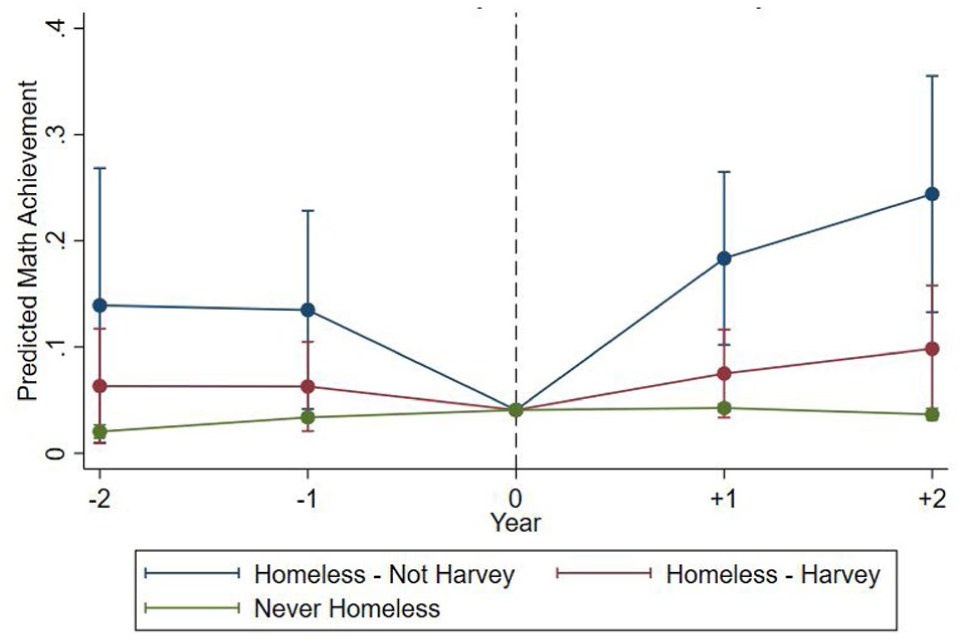
Predicted math achievement (z score) by homeless pathway compared to never homeless.
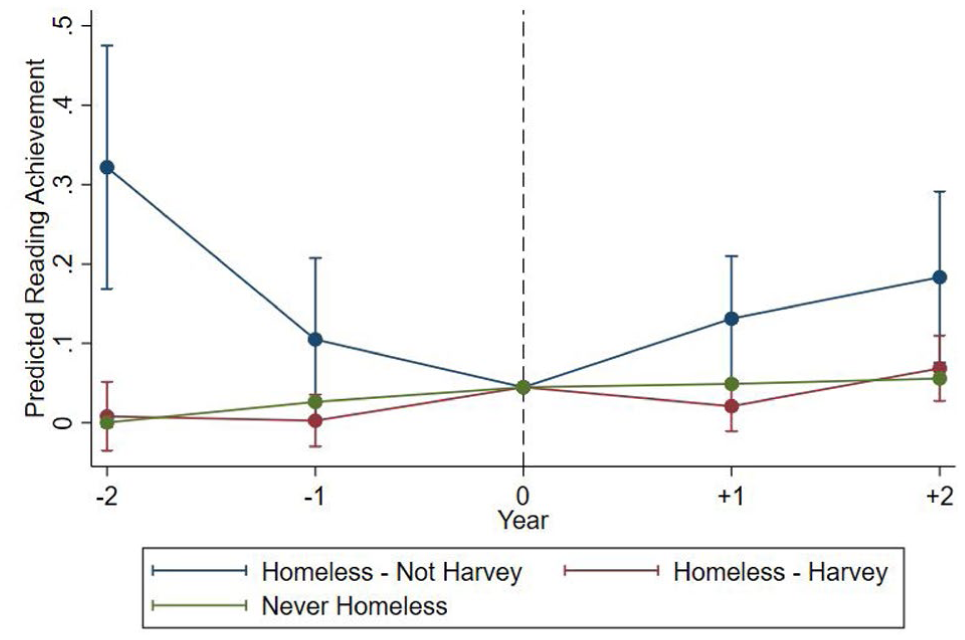
Predicted reading achievement (z score) by homeless pathway compared to never homeless.
Students who became homeless due to Harvey continued to have similar achievement trajectories to students who were never homeless in the years after they became homeless. Indeed, they had no statistically significant difference in either reading or math achievement gains relative to never-homeless students either 1 or 2 years after they became homeless.
It is possible our analyses failed to detect any significant effects of becoming homeless on student achievement due to Harvey owing to differential rates of participation in the STAAR exams. We conducted a robustness check to test this possibility. We find students who became homeless due to Harvey were just as likely to take the STAAR exams in the year before Harvey as their never-homeless peers and 5.6 percentage points more likely to take the STAAR exams in the year after Harvey. 7
It should also be emphasized that students who became homeless due to Harvey were a large and heterogeneous group, and aggregate effects reported here may mask considerable variability in student outcomes. Although most students who became homeless due to Harvey remained homeless for less than a year, some students (4.5%) remained homeless into the subsequent school year. Partially consistent with prior research (Pane et al., 2008), students who remained homeless 2 years after Harvey had steeper declines in attendance than students who experienced shorter stints of homelessness. Although this group also had larger declines in achievement, this effect was not statistically significant, meaning that this group had similar achievement outcomes. 8
Patterns are starkly different for students who became homeless for conventional reasons. First, it is important to note these students had substantially different baseline trends even before becoming homeless. Whereas other students had more stable achievement, students experiencing homelessness had declining achievement prior to being identified as homeless. This is particularly true for reading achievement, which declined approximately 0.11 SD per year in the years before becoming homeless. As we elaborate in the discussion, this may be due to worsening economic conditions in their families even before they were officially identified as homeless by the school district.
Because of the lack of parallel baseline trends between students experiencing homelessness due to conventional reasons versus Harvey versus never homeless, within-group trends for students in the conventional homelessness group are most appropriate for interpretation. Interestingly, although students who became homeless due to conventional reasons had declines in achievement in the years before becoming homeless, they had moderate increases in achievement immediately after being classified as homeless (0.14 SD in reading and 0.1 SD in math). As we explore at length in the following, this somewhat surprising finding may be due in part to delays in identification procedures and the provision of effective supports for these students under McKinney-Vento. They may also be due to reduced participation in STAAR exams: Supplemental analyses revealed that students who became homeless for conventional reasons were 15.5 percentage points less likely to take STAAR exams in the year after they became homeless. 9
Discussion
In this study, we foreground students who become homeless due to natural disasters and provide initial evidence disentangling the unique educational outcomes of students who became homeless due to Harvey compared to students who became homeless via more conventional pathways. In the following, we unpack findings for each pathway in turn, attending to implications for research and practice, before expanding on the limitations of our analyses. We conclude with broader connections to the social constructivism framework.
Homelessness due to Natural Disaster
Overall, becoming homeless due to Harvey was not consistently associated with adverse academic outcomes, particularly when compared to becoming homeless for conventional reasons. Although students who became homeless due to Harvey experienced small declines in attendance in the year of the hurricane, these declines were of the same magnitude as their never-homeless peers. Moreover, becoming homeless due to Harvey was associated with little change in either reading or math achievement for children in Grades 3 through 8, as measured by the Texas STAAR exams.
In contextualizing these findings, it is first important to note that students who became homeless due to Hurricane Harvey were fairly representative of HISD students—and they were substantially less likely to be Black and economically disadvantaged than students who became homeless due to conventional reasons. Damage from Harvey was widespread: It hit both more and less advantaged communities owing to the unprecedented geographic extent of the storm coupled with historical patterns of residential segregation and the unique configuration of the city’s bayous. For example, Kolter Elementary, nestled between Brays Bayou and Willow Waterhole Bayou, was one of seven HISD schools forced to relocate due to storm damages. However, in the year before the storm, only 26% of Kolter’s student body were classified as economically disadvantaged compared to 77% of the district overall (TEA, 2017).
The pattern of devastation in Houston is perhaps surprising to those familiar with prior storms like Hurricane Katrina, which disproportionately devastated Black and low-income communities (Elliott & Pais, 2006). However, it is consistent with Buckner’s (2013) notion of natural disasters as “fairly indiscriminate” relative to conventional forms of homelessness. For this reason, it is likely that our findings may have more limited generalizability to natural disaster contexts in which vulnerability may be more tightly coupled with student race/ethnicity and economic disadvantage, such as in communities affected by Hurricane Katrina. However, our findings may be more generalizable to disasters where damage is more widespread, such as the Los Angeles wildfires of 2025.
Alternately, the lack of acute negative outcomes for students experiencing homelessness due to Harvey may also be attributable, at least in part, to effective school and community responses (Buckner, 2012; Pavlakis et al., 2026). First, many students who were identified as homeless under TEA crisis codes received emergency assistance via FEMA in addition to McKinney-Vento assistance and other community supports. Prior research underscores the importance of schools in preparation for, response to, and recovery efforts in the aftermath of natural disasters and housing instability (Mutch, 2015; Simmons & Douglas, 2018). Schools provide stability, routine, and safety that allow parents more time to address basic needs at home during a crisis. Likewise, through partnerships with nonprofits and cross-systems collaborations, schools and districts can better identify and connect students and families to resources and supplies they may need (Cutuli et al., 2024; Hallet et al., 2025; National Center for Homeless Education, 2015; Simmons & Douglas, 2018). Our qualitative work has highlighted potential protective factors, external and internal to the district (Pavlakis et al., 2026). For example, HISD personnel reported that they received, both locally and from all over the country, large injections of resources after the hurricane.
Homelessness via Conventional Pathways
Concerningly and consistent with prior research (e.g., Herbers et al., 2012; Miller, 2011; Obradović et al., 2009; Richards & Pavlakis, 2022), we find that students who became homeless due to conventional reasons had uniquely adverse educational outcomes. Notably, they had particularly large declines in attendance the years after becoming homeless. Although our data es not permit us to track students more than 2 years after becoming homeless, this is particularly troubling given that chronic absenteeism is a strong predictor of long-term student success on both academic and socioemotional indicators (Gottfried, 2014).
Reflecting variation in the extant literature (e.g., Obradović et al., 2009; Richards & Pavlakis, 2022), findings for academic achievement are more nuanced: Students who became homeless for conventional reasons had declining academic achievement in the years before they were identified as homeless, which rebounded after they were identified as homeless. Indeed, these students recovered much of their losses in achievement in 2 years. This aligns with research such as Rafferty and colleagues (2004) and others who found that the association between homelessness and declines on standardized tests waned over time. Moreover, it is not unusual for students to experience a period of housing instability, economic distress, or other family disruptions even before becoming officially homeless—these disruptions may manifest in the bellwether of lower test scores that we observe here. The observed increases in achievement in the year after students are officially identified as homeless may in part reflect the buffering effects of students receiving McKinney-Vento resources and services and the other supports it triggered, such as automatic qualification for free and reduced-price lunch, highlighting the continued need for these programs. However, they may also be attributable to reduced participation in testing—in the year after they were identified as homeless, students were also 15 percentage points less likely to participate in state STAAR exams.
Limitations
In considering these findings, it is important to make explicit some of the broader limitations of our analyses and data. First, as we allude to previously, our models provide a stronger basis for confidence in comparing the effect of homelessness by pathway when baseline equivalence among groups is clearly established. In the case of attendance, the baseline trajectories in attendance were clearly parallel, suggesting a stronger but by no means airtight case that observed effects were due to the differential effects of pathway. In the case of achievement, we find less evidence of parallel pathways—as such, we interpret these estimates with more caution.
Second, even in the case of parallel paths, although our comparative interrupted time-series design incorporating student and school fixed effects efficiently account for all non-time-varying sources of endogeneity in estimates of the relationship between homelessness and academic outcomes, there may be some time-varying dimensions not addressed. For example, students may experience changes in family economic status, parental divorce, or even the death of a parent, which may be related to why students became homeless. To the extent that future research can explore time-varying dimensions and family/parent circumstances, it would deepen understanding of housing instability and educational outcomes. To date, it is an empirical challenge to disentangle the causal effects of homelessness per se from these other economic factors (Buckner, 2012; Richards & Pavlakis, 2022).
A few other notes are warranted. It should be acknowledged that we focus on a relatively narrow range of student outcomes tightly aligned to student academic success (Cutuli et al., 2013; Herbers et al., 2012; Obradović et al., 2009). Other less measurable indicators that dive more deeply into student mental health, socioemotional well-being, and even behavioral outcomes may help provide a more comprehensive picture. For example, Labella et al. (2016) found that higher parent negativity in the context of homelessness was linked to lower prosocial behaviors in children. Likewise, Pavlakis and colleagues (2026) found that education leaders reported students often crying at school whenever it started to rain. Further research should focus on social and emotional outcomes, which may also portend future academic problems.
It is also important to note that our data almost certainly underestimate the true prevalence of homelessness, which is often the case due to lack of awareness and stigma (Hallett et al., 2025). This may be particularly true for conventional homelessness relative to students affected by Harvey owing to the more positive social construction of storm victims. As we note previously, because we have only annual indicators of student homelessness, our data are not well situated to answer nuanced questions about homelessness exposures that are less than a year. Moreover, future work may seek to examine differences within conventional pathways to homelessness (e.g., jobless vs. health issues vs. incarceration). Improved data systems would be necessary to enable more nuanced research studies in these veins in the future. To isolate the unique effect of becoming homeless, we limit our analyses to the first time a student became homeless; as such, our findings are likely more representative of students experiencing episodic rather than chronic homelessness, although we do probe into students who remained homeless after Harvey (see Gould & Williams, 2010). Furthermore, it may be that homelessness impacts achievement scores more in high school (ICPH, 2016) than the elementary and middle grades we examined. Future research should examine additional outcome variables and grade levels.
Theoretical Implications
We find that students who became homeless due to Harvey tended to have less adverse educational outcomes than students who became homeless for conventional reasons. Viewed through the lens of the social constructivism framework (Schneider et al., 2014), this may be due both to the relative power and social characteristics of these subgroups of students and the way in which they were framed as particularly “worthy” of sympathy, aid, and resources.
Harvey and its associated “Houston strong” mantra captured the attention of the community and the nation, with donations flowing in from celebrities and grassroots social media fundraising campaigns (Oswald, 2017). Harvey’s homeless were publicly framed as “worthy” of federal and local support (Birkland, 2004; Chokshi & Astor, 2017; Pavlakis et al., 2026; Sapat & Esnard, 2012). These families had access to recovery resources—such as storm shelters and FEMA aid, like Housing Assistance funds and Other Needs Assistance, which helped with expenses like cleaning supplies—that were only applicable to those with proof of occupancy before the storm (Henderson, 2017). By contrast, students experiencing homelessness via conventional pathways are often framed as more culpable for their homelessness and less worthy of support (Aviles de Bradley, 2015; Pavlakis et al., 2026; Schneider et al., 2014). Exacerbating this differential social construction in Houston’s case are the characteristics of these students—students who became homeless due to conventional reasons were disproportionately Black, economically disadvantaged, and enrolled in special education.
Conclusion
Our work continues to chip away at the monolithic paradigm of student homelessness, highlighting how the pathway by which students become homeless is linked to their educational outcomes—and to social constructions of students who became homeless due to Harvey as more deserving than students who became homeless due to their family’s economic situation. It is critical that we reject these false narratives of “worth” (see Thiele, 2002) and ensure that policy discussions frame basic needs, such as access to food and housing, not as an act of charity but as a human right (Aviles de Bradley, 2015). Although social constructions are stubborn, they can change and be changed over time (Schneider et al., 2014).
Supplemental Material
sj-pdf-1-edr-10.3102_0013189X261441610 – Supplemental material for Educational Outcomes of Natural Disaster Versus Conventional Pathways to Homelessness: Evidence from Hurricane Harvey
Supplemental material, sj-pdf-1-edr-10.3102_0013189X261441610 for Educational Outcomes of Natural Disaster Versus Conventional Pathways to Homelessness: Evidence from Hurricane Harvey by Meredith P. Richards, Alexandra E. Pavlakis, Cheyenne Phillips and J. Kessa Roberts in Educational Researcher
Footnotes

Notes
Authors
References
Supplementary Material
Please find the following supplemental material available below.
For Open Access articles published under a Creative Commons License, all supplemental material carries the same license as the article it is associated with.
For non-Open Access articles published, all supplemental material carries a non-exclusive license, and permission requests for re-use of supplemental material or any part of supplemental material shall be sent directly to the copyright owner as specified in the copyright notice associated with the article.
