




Abstract
Despite considerable and growing interest in college students’ sense of belonging, its relationship with postsecondary credential attainment remains poorly understood. Here, in a nationally representative sample of U.S. undergraduates who matriculated in 2011–2012 (N = 21,700), first-year belonging was longitudinally associated with attainment: a 1-point increase on the 5-point scale corresponded to a 3.4 percentage-point increase in 4-year attainment and a 2.7 percentage-point increase in 6-year attainment. These descriptive findings offer large-scale evidence linking college students’ belonging to their receipt of a degree and underscore the continued need to foster students’ belonging and measure it well.
Keywords
Students’ sense of belonging—their perception of being included in their educational environment—is theorized to be a fundamental psychological need (Baumeister & Leary, 1995) and key academic mindset (Farrington et al., 2012). When students feel they belong, they more readily seek help, embrace challenges, use campus resources, and build relationships—supporting academic performance and persistence (Farrington et al., 2012; Strayhorn, 2018; Walton et al., 2023) and potentially improving graduation outcomes. Indeed, in a past Educational Researcher brief (Gopalan & Brady, 2020), we found that first-year sense of belonging was positively associated with campus engagement, mental health, and persistence up to 2 years later for students who began their postsecondary educations at 4-year institutions.
However, the association between belonging and ultimate postsecondary credential attainment remains an open question; one that this study aims to address. Attainment is a critical outcome for both students and society, linked to better employment outcomes, greater well-being, and increased civic engagement (Ma & Pender, 2023). Accordingly, we draw on more recent data from the same nationally representative survey of U.S. college students used in our prior work (Gopalan & Brady, 2020) to examine whether, where, and for whom first-year college belonging predicts subsequent attainment.
Methods
We used data from the Beginning Postsecondary Students Longitudinal Study, a nationally representative survey of U.S. first-time, first-year undergraduate students in 2011–2012, with transcript data collected 6 years later (N = 21,700). In the spring of their first and third years of college, students reported their sense of belonging at school on one item (“I feel that I am a part of [SCHOOL]”; 1 = strongly disagree, 5 = strongly agree), similar to the first item on the most popular scale of school belonging (Goodenow, 1993).
We examined covariate-adjusted associations between first-year belonging and subsequent attainment of any postsecondary credential by 2015 (Year 4) and 2017 (Year 6). Specifically, for each year, we created indicator variables denoting credential attainment. Students who attained a credential (degree or certificate) were coded as 1. All students without a credential were coded as 0, whether they were still enrolled, not enrolled but considering returning, or not enrolled with no intention of returning.
We also explored moderation by key student and institutional factors and whether change in belonging was associated with attainment. Table 1 reports descriptive statistics. The Appendix, available online at the journal website, provides additional methodological information and supplemental analyses. Results are robust to alternative specifications.
Descriptive Statistics
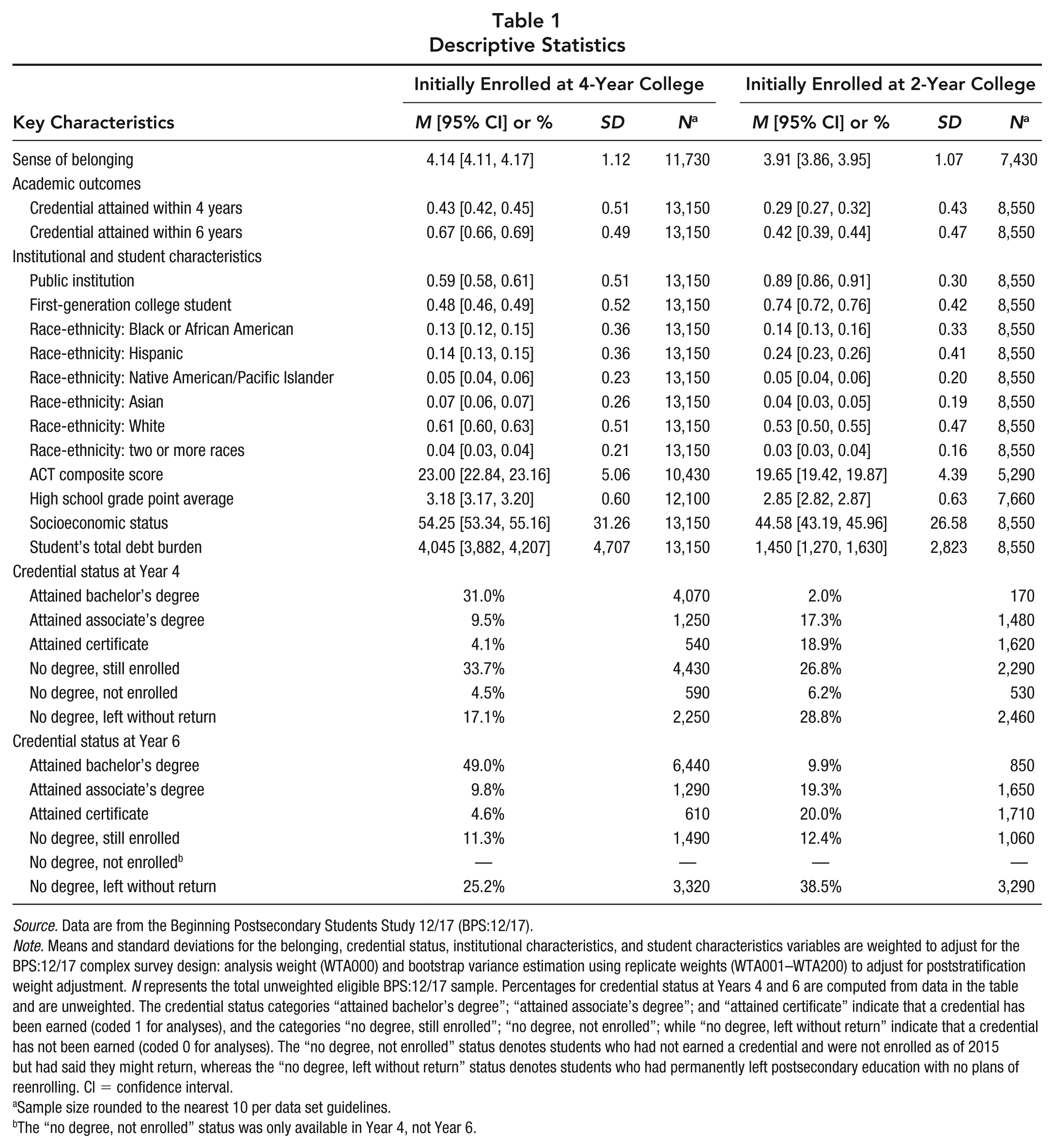
Source. Data are from the Beginning Postsecondary Students Study 12/17 (BPS:12/17).
Note. Means and standard deviations for the belonging, credential status, institutional characteristics, and student characteristics variables are weighted to adjust for the BPS:12/17 complex survey design: analysis weight (WTA000) and bootstrap variance estimation using replicate weights (WTA001–WTA200) to adjust for poststratification weight adjustment. N represents the total unweighted eligible BPS:12/17 sample. Percentages for credential status at Years 4 and 6 are computed from data in the table and are unweighted. The credential status categories “attained bachelor’s degree”; “attained associate’s degree”; and “attained certificate” indicate that a credential has been earned (coded 1 for analyses), and the categories “no degree, still enrolled”; “no degree, not enrolled”; while “no degree, left without return” indicate that a credential has not been earned (coded 0 for analyses). The “no degree, not enrolled” status denotes students who had not earned a credential and were not enrolled as of 2015 but had said they might return, whereas the “no degree, left without return” status denotes students who had permanently left postsecondary education with no plans of reenrolling. CI = confidence interval.
Sample size rounded to the nearest 10 per data set guidelines.
The “no degree, not enrolled” status was only available in Year 4, not Year 6.
Results
Overall, belonging was positively associated with students’ likelihood to earn a credential. In the full sample, a 1-point increase on the belonging scale (e.g., from slightly agree to strongly agree; approximately 1 SD) was associated with a 3.4 percentage-point increase in the 4-year attainment rate and a 2.7 percentage-point increase in the 6-year rate (Table 2). Although there were no interactions between institution type (2- vs. 4-year) and belonging in predicting attainment, we report the remaining results separately by institution type to maintain consistency with our previous work (Gopalan & Brady, 2020).
College Belonging and Attainment: Coefficients and Standard Errors from Multivariate Regressions
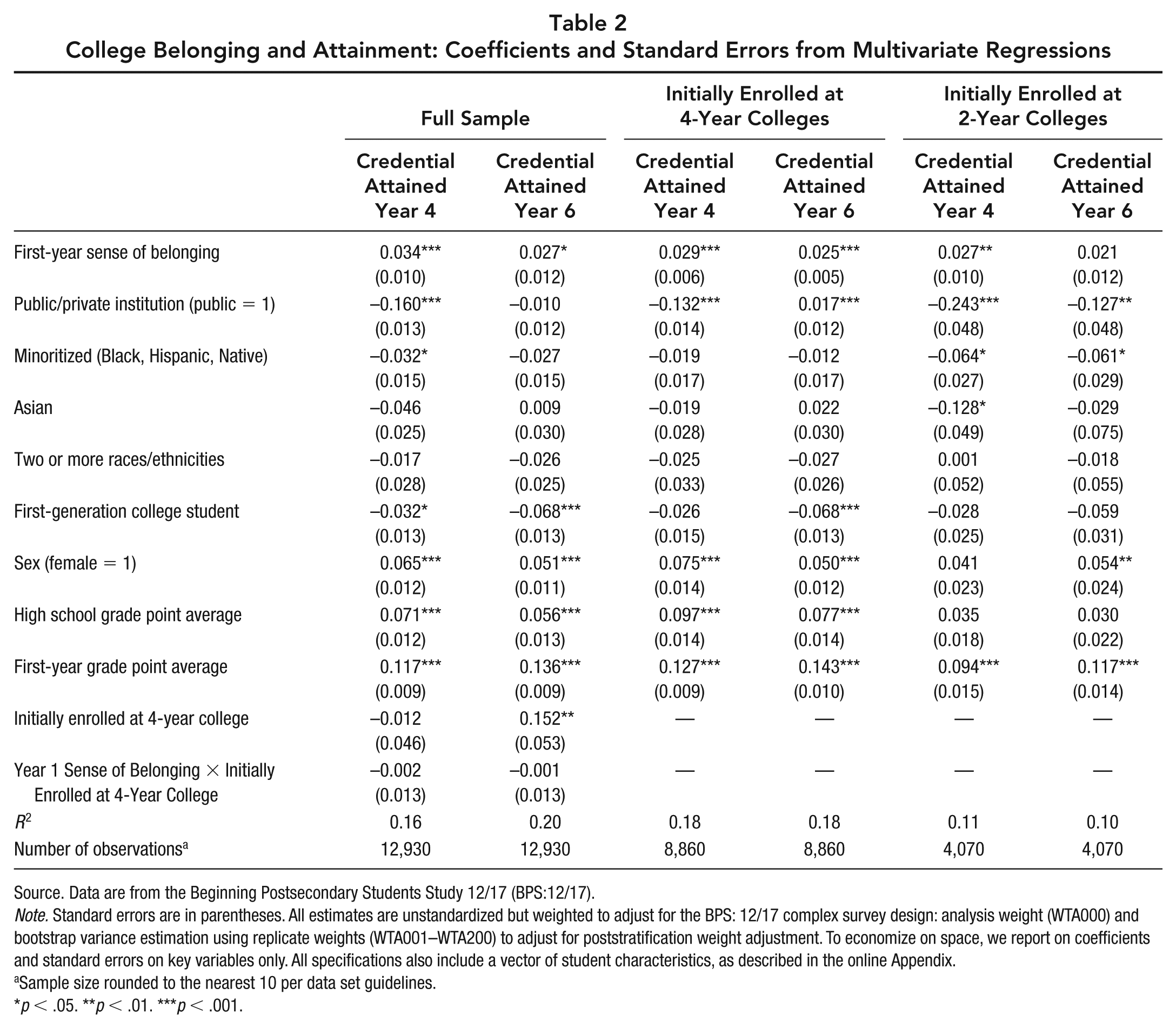
Source. Data are from the Beginning Postsecondary Students Study 12/17 (BPS:12/17).
Note. Standard errors are in parentheses. All estimates are unstandardized but weighted to adjust for the BPS: 12/17 complex survey design: analysis weight (WTA000) and bootstrap variance estimation using replicate weights (WTA001–WTA200) to adjust for poststratification weight adjustment. To economize on space, we report on coefficients and standard errors on key variables only. All specifications also include a vector of student characteristics, as described in the online Appendix.
Sample size rounded to the nearest 10 per data set guidelines.
p < .05. **p < .01. ***p < .001.
For students who began at 4-year colleges, first-year belonging predicted credential attainment at both 4 and 6 years (Table 2). Moreover, in models that included first-year belonging and change in belonging, both predicted attainment at 4 and 6 years (Table A2, online Appendix). Point estimates were positive for nearly all demographic subgroups but differed in magnitude and precision (Tables A5 and A6, online Appendix). There were only two statistically significant interactions between belonging and any demographic or institutional variables. The association between belonging and 4-year attainment was stronger for continuing-generation college students than for their first-generation peers. The association between belonging and 6-year attainment was weaker for Asian students than for non-Asian students. Institutional selectivity did not moderate effects (Table A7, available on the journal website).
For students who began at 2-year colleges, belonging significantly predicted 4-year attainment but not six-year attainment (p = .07; Table 2). In most models that included both first-year belonging and change in belonging, one or both were predictive of attainment (Table A2, online Appendix), but due to considerable missingness on the change variable, relationships varied by model specification. There were no statistically significant interactions with any demographic variables (Tables A5 and A6, online Appendix).
Discussion
Credential attainment is arguably postsecondary education’s most consequential outcome (Ma & Pender, 2023). Although we previously found that a 1-point increment in first-year sense of belonging was associated with a 1 to 2 percentage-point increase in 3-year persistence for students who initially began at 4-year colleges (Gopalan & Brady, 2020), we found slightly larger and more consistent associations in this study. Regardless of institution type, a 1-point increase in belonging is associated with a 2 to 3 percentage-point increase in 4-year and 6-year attainment. Still, there are indications that associations between belonging and attainment may be less robust for students who begin at 2-year colleges. Although descriptive, these findings align with randomized trials showing that belonging interventions causally improve leading indicators of credit attainment (Walton et al., 2023).
Among students who begin at 4-year colleges, change in belonging appears to matter independently of first-year belonging. Although the data are correlational and subject to nonresponse bias, this suggests that what happens after students’ first year can shape their feelings of belonging and later outcomes.
In offering a broad picture of belonging across colleges in the United States, our findings underscore the value of measuring belonging in large-scale data sets. To facilitate more robust conclusions, we strongly recommend that a brief multi-item scale be developed, validated extensively for making comparisons across contexts and time, and then implemented broadly. In addition, nuanced measures for particular contexts, populations, and purposes could add valuable depth to our understanding of belonging (Matthews et al., 2024). Future research should examine the present finding that the belonging-credential relationship is less consistent for first-generation students and for Asian students in ways that overcome the statistical power limitations faced here. Indeed, many students from these groups may experience circumstances (e.g., financial, cultural, or academic) that could modulate the relationship (Hsin & Xie, 2014; Strayhorn, 2018).
Still, our nationwide, longitudinal analysis suggests broadly shared and lasting protective effects of belonging for college students. However, institutions should recognize that no one-size-fits-all approach exists for fostering belonging. Sometimes, developing belonging may conflict with other valued goals, such as solidarity with marginalized groups or maintaining uniqueness (Matthews et al., 2024), or students’ nonbelonging may reasonably reflect inadequate institutional practices (Walton et al., 2023). Institutions should therefore collect data to understand whom they serve well and whom they do not, remembering the diversity within demographic groups. They should listen to students about what facilitates or thwarts belonging, compensate them for this feedback, and then use these insights—together with empirical evidence—to design, test, and refine structural, pedagogical, and psychological approaches to support inclusion and connectedness.
Supplemental Material
sj-pdf-1-edr-10.3102_0013189X251393248 – Supplemental material for College Students’ Sense of Belonging: A Graduation Update
Supplemental material, sj-pdf-1-edr-10.3102_0013189X251393248 for College Students’ Sense of Belonging: A Graduation Update by Shannon T. Brady and Maithreyi Gopalan in Educational Researcher
Footnotes

Notes
Authors
SHANNON T. BRADY, PhD, is an associate professor of psychology at Wake Forest University, Greene Hall, Room 444, Winston-Salem, NC 27109;
MAITHREYI GOPALAN, PhD, is Petrone professor and associate professor at the College of Education at the University of Oregon, 102B Lokey Education Building, 5277 University of Oregon, Eugene, OR 97403;
References
Supplementary Material
Please find the following supplemental material available below.
For Open Access articles published under a Creative Commons License, all supplemental material carries the same license as the article it is associated with.
For non-Open Access articles published, all supplemental material carries a non-exclusive license, and permission requests for re-use of supplemental material or any part of supplemental material shall be sent directly to the copyright owner as specified in the copyright notice associated with the article.
