




Abstract
Using individual-level administrative data from California linked to survey data, this study explores how and why recent high school graduates’ college trajectories may have been altered by the pandemic. We find sizable negative effects on college enrollment for the California high school graduating class of 2020. Similar to national trends, we find these enrollment declines were largest in the community college sector and for underrepresented minority students, low-income students, and students from high schools with low college-sending rates. At the same time, enrollment in the highly selective University of California system increased. These enrollment gains were concentrated among Asian and White students and those who attended high schools that historically send a large share of their graduates to college. Thus, the pandemic appears to have worsened inequalities not only in overall college enrollment but also in access to more elite institutions.
Keywords
Total undergraduate enrollment in the United States is nearly 8% below prepandemic levels, representing nearly 1 million fewer students attending college (Causey et al., 2023). Declines in college enrollment have not been evenly distributed. Community colleges have been hit hardest by the pandemic, experiencing a near 15% enrollment decline since 2019. Declines were larger for men than women and largest for Black students compared to all other racial/ethnic groups (Causey et al., 2023). The economic and social consequences of students’ suspending or abandoning their educational goals due to the pandemic are enormous, particularly for low-income students, whose families and communities have been disproportionately impacted by the pandemic in other dimensions (Center for Community College Student Engagement, 2021; Goldrick-Rab et al., 2020; Office for Civil Rights, 2021; Reed et al., 2021; Rodriguez et al., 2024) and for whom higher education represents a key mechanism for economic mobility (Chetty et al., 2017).
Policymakers continue to grapple with how to support students whose educational plans have been disrupted by the pandemic. Congress allocated billions of dollars in aid to support college students via the Higher Education Emergency Relief Fund. In addition to providing direct aid to students, colleges have ramped up mental health services and other supports to address the many challenges college students have faced (Browning et al., 2021; Logel et al., 2021; Rodríguez-Planas, 2022). Yet given the uncertainty experienced by young adults at this time, many students have simply abandoned—at least temporarily—college altogether.
This article investigates college-going patterns among students in California’s high school class of 2020 compared to cohorts that graduated prior to the onset of the pandemic. We ask: Who went to college, and where and how did enrollment changes compare by student and high school characteristics? To better understand the reasons behind these changes, we also present data from a large-scale survey of students from the class of 2020 that asks about their college plans, including challenges and obstacles, and how these may have changed because of the pandemic.
Conceptual Framing
Despite the work documenting the pandemic experiences of students thus far, relatively little has been done to specifically investigate how the pandemic affected high school students’ transition to college. We focus on the high school class of 2020 for two reasons. First, this was the last cohort whose high school experience was largely unaffected by the pandemic; they attended high school under “normal” circumstances for all but a few months and would largely have submitted both college and financial aid applications before the pandemic began. This allows us to examine how college-going patterns changed with the pandemic net of most of the effects of the pandemic on students’ high school experiences. Second, the initial college enrollment decisions of the class of 2020 might have been especially affected by the pandemic because many colleges were partially or entirely remote in fall 2020, whereas subsequent terms generally saw a gradual return to in-person instruction and campus life. Finally, we match survey data to enrollment data to unpack students’ reported concerns during the pandemic and how these may have influenced enrollment decisions.
Conducting this analysis in California is valuable for several reasons. First, most obviously, the sheer size of the state means that patterns observed in California will have an important influence on national trends. Second, the geographic, racial/ethnic, and economic diversity of California’s students also makes it important to study and provides us with large samples that allow us to disaggregate changes across student subgroups and postsecondary sectors. Finally, national data show that the largest enrollment declines occurred at community colleges, and California relies much more on community colleges—both as a pathway to BA completion and for undergraduate education more generally—than other states. Thus, to understand how the pandemic altered college plans of high school seniors, it is useful to understand what happened in California.
We briefly review the existing research on enrollment declines during the pandemic and the documented challenges and precarities reported by students during the pandemic.
College Enrollment in the Pandemic
College enrollment during the pandemic dropped by 1.3 million students (9.4%) compared to prepandemic levels. Data from the National Student Clearinghouse’s Stay Informed series suggests that declines were largest within the 2-year sector (16.5% drop), with a particularly acute effect on traditionally aged students between ages 18 and 24 (19.4% drop) (Causey et al., 2023). Data from a national household survey conducted in October 2020 revealed that more than 40% of respondents who reported that at least one member of their household had “plans for community college” also reported that the prospective student was canceling all plans for college enrollment (more than twice the rate for the canceled college plans among those planning to attend a 4-year college); another 15% were either taking fewer classes or switching programs. Reasons for changing enrollment plans included changes to the format and content of college classes, concern about the virus, and the affordability of school. Low-income prospective community college students were approximately 3 times more likely than high-income prospective students to cancel all community college plans (Belfield & Brock, 2020). A study of Virginia community college students found that the shift to remote instruction in the early stages of the pandemic resulted in a 4.9 percentage point decrease in course completion, largely driven by new students and students with lower prior performance (Bird et al., 2022).
California, with the nation’s largest community college system, reported sharp declines in community college enrollment (Bulman & Fairlie, 2022; Burke, 2021; Linden et al., 2022; Schanzenbach & Turner, 2022), among the steepest drops relative to other states (Causey et al., 2023). Other research into college enrollment for California students during the pandemic also found that Free Application for Federal Student Aid (FAFSA) submissions were down overall during the pandemic (DeBaun, 2021; Gurantz & Wielga, 2021). California college students surveyed in the first year of the pandemic reported substantial stress associated with financing college, online learning, and home and school life (Reed et al., 2020a). Notably, these reported stressors were more severe among during the pandemic ( students enrolled at community colleges than those enrolled at 4-year institutions (Reed et al., 2021).
College Students’ Stressors and Uncertainties
College students across the nation faced substantial uncertainties about their health and safety, financial stability, learning environments, and family and social connections—all critical inputs for success in college (Aucejo et al., 2020; Belfield & Brock, 2020; Center for Community College Student Engagement, 2021; Reed et al., 2021). National, state, and institutional surveys of college students during the pandemic reveal increased levels of food and housing insecurity, anxiety and mental health issues, difficulty concentrating on school, and worries about academic progression (Browning et al., 2021; Center for Community College Student Engagement, 2021; Goldrick-Rab et al., 2020; Logel et al., 2021; Reed et al., 2021; Rodríguez-Planas, 2022; Son et al., 2020; Soria et al., 2020; Wilson et al., 2021). Additionally, studies documenting K–12 school closures during the pandemic highlighted the challenges students experienced in access to instruction and other services, including mental health and college and career counseling (Cullinan et al., 2021; Grissom & Condon, 2021; Grooms & Childs, 2021; Harris et al., 2020; Hurtt et al., 2022), all of which could influence students’ postsecondary trajectories.
We build on this work by documenting the pandemic experiences of California students who were just finishing high school as the pandemic began. First, we examine the class of 2020’s college enrollment trajectories in the year following high school graduation. By focusing on the college enrollment decisions of the high school graduates of 2020, we capture the behaviors of students in the earlier stages of the pandemic before vaccines were available and when the majority of in-person universities activities were still effectively “shut down” and universities were instead mainly operating remotely. At the same time, some of the key college-planning steps—namely, admissions and financial aid applications—would have been completed for this cohort before the pandemic hit. As such, the pandemic would mainly have affected college enrollment of the class of 2020 by either changing out-of-school circumstances (e.g., health or financial concerns) or because students (correctly) anticipated major disruptions to college on-campus operations in the 2020–2021 academic year. 1 We then use survey data linked to administrative data to better understand how and why students’ college trajectories may have been altered by the pandemic. Specifically, we examine the relationship between college enrollment outcomes and measures of stress students experienced as a result of the pandemic and that the literature has highlighted as being among the challenges students faced in the pandemic. Of course, the college enrollment patterns and experiences for more recent cohorts may be different because of both the stages students were in for the pandemic during high school and how higher education institutions adjusted in later years of the pandemic.
Data and Measures
Our study links data on high school graduates from 2016 to 2020 from the California Department of Education (CDE) to college enrollment records from the National Student Clearinghouse (NSC). We also link these CDE data to data from the California Student Aid Commission (the state agency that executes state and federal financial aid programs) to obtain additional information about college intending students who submit the FAFSA. 2 Across all cohorts, approximately 58% of students are identified as socioeconomically disadvantaged, over half are Latinx, and approximately one-quarter are White (see Appendix Table A1, available on the journal website). We analyze overall college enrollment and enrollment for each of the four sectors of colleges that California public high school graduates attend: California Community Colleges (CCCs; 2-year), California State Universities (CSUs; 4-year), the University of California (UC; 4-year), and private or out-of-state colleges (virtually all 4-year). We focus on spring enrollment to allow changes in enrollment dynamics triggered by the pandemic to “play out” for one full semester of the pandemic (results for fall enrollments are included in Appendix Tables A3–A20, available on the journal website). 3 To explore heterogeneity in the enrollment changes, we stratify our results by race, socioeconomic status, standardized test scores, and high school college-going rates.
To understand how enrollment changed relative to prepandemic trends, in Figures 1 through 5, we report the changes in spring college enrollment for the high school classes of 2019 and 2020 compared to the pooled mean of the classes of 2016, 2017, and 2018. Whether COVID affected student enrollment for the 2019 high school class (for whom the pandemic began in the spring following their high school graduation) is an empirical question with no clear answer in our data. If the enrollment declines seen for the class of 2019 (e.g., the 2.8% decline seen in Figure 1c) could be completely attributed to COVID, then to calculate the effect of COVID in the spring of 2021 on the high school class of 2020, we could simply compare enrollment for the class of 2020 to the average enrollment of the classes of 2016 through 2018 and report the 10.4% decline in enrollment seen in Figure 1c. However, the enrollment declines for the class of 2019 may have been caused by underlying trends rather than the pandemic. One way to account for such trends is to calculate the difference between the 2020 and 2019 results and report this difference as the “treatment effect.” 4 In this case, we would find that there are 7.6% (–10.4% – –2.8%) fewer students enrolled due to COVID for the 2020 graduates. Assuming that COVID had nothing to do with the class of 2019 enrollment declines likely underestimates COVID’s effect on enrollment, but because in general, it is the assumption that produces the most conservative estimates, it is the assumption we maintain moving forward.
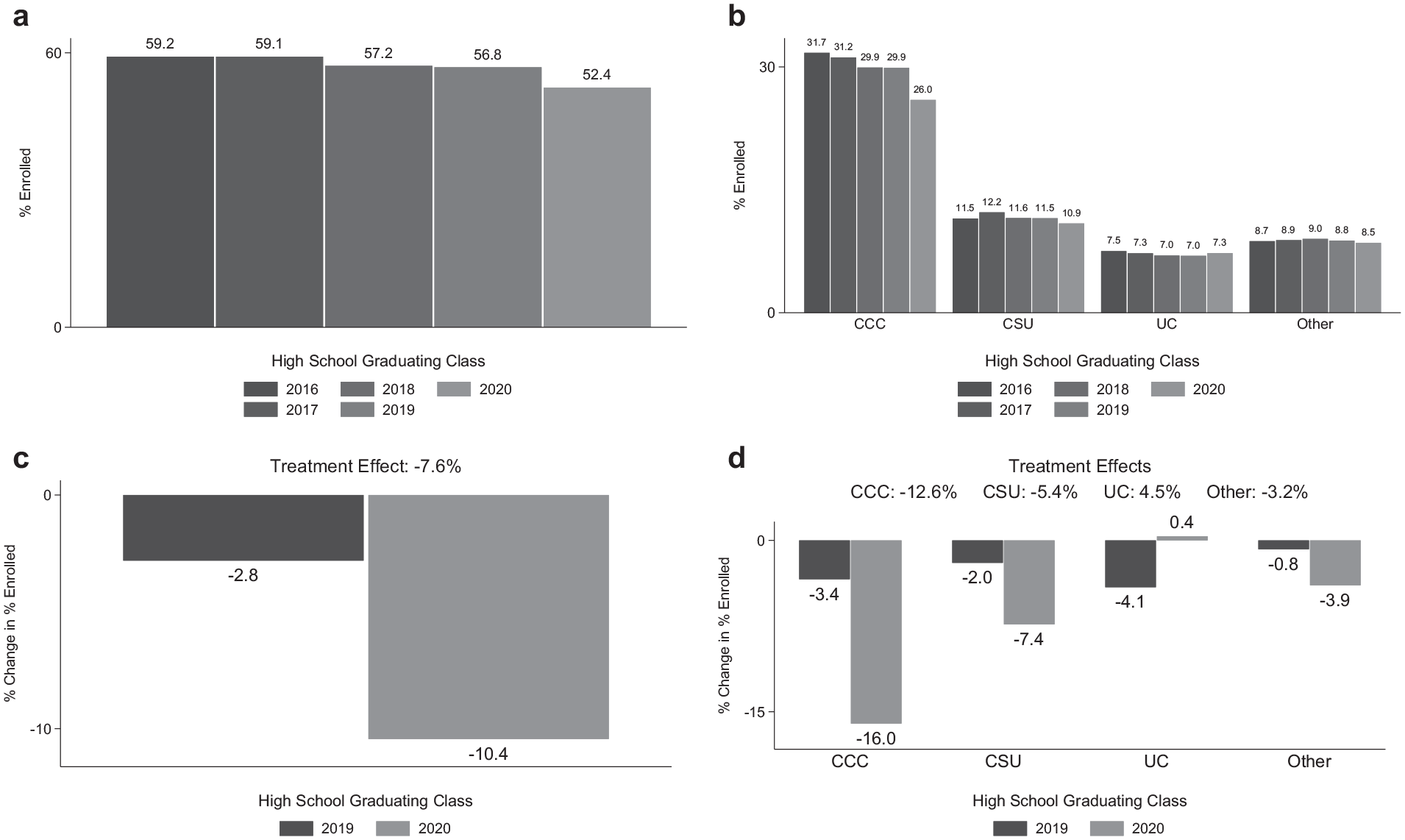
College Enrollment of California Public High School Students.
To investigate possible mechanisms for enrollment decisions of the class of 2020, we draw on data collected from a survey we conducted in the spring of 2020 in partnership with the California Student Aid Commission (CSAC). The survey was administered to a random sample of California high school seniors who filed the FAFSA or the California Dream Act Application for the 2020–2021 academic year. The survey asked participants how COVID-19 has impacted their college plans (among other dimensions). More than 16,000 high school seniors completed the survey, resulting in a response rate of 11%. We then link these survey responses to students’ actual enrollment behavior.
Findings
Figures 1a 5 and 1c show that overall spring college enrollment for high school graduates was declining slightly between 2016 and 2019 and then fell sharply with the onset of the pandemic (frequencies by year, for fall, by subgroups, and across sector are reported in the Appendix, available on the journal website). According to our model, COVID lowered overall enrollment by 7.6%.
Figures 1b and 1d show that reductions in 2-year college enrollment drive much of the overall enrollment decline. Figure 1b shows the distribution of enrollment across sectors; for the 2016–2018 cohorts, 30.9% attended a CCC; 19.0% attended an in-state, public 4-year college; and 8.9% of students enrolled in either an in-state private institution or an out-of-state institution. By spring 2021, CCC enrollment had dropped 12.6% due to COVID. Although less affected, both the CSU system (5.4% drop) and private or out-of-state institutions (3.2% drop) also showed meaningful declines in enrollment by spring 2021. Perhaps surprisingly, enrollment in the UC system actually increased for the class of 2020, suggesting that the COVID pandemic increased enrollment for California public high school students at the UC by 4.5%. This is due to the reversal of the previous trend of declining enrollment at the UC prior to the pandemic. Although our data limit our ability to examine this fully, the increase in enrollment at the UCs was likely driven by an increase in the acceptance rate of in-state applicants because out-of-state and international student enrollments declined as a result of the pandemic. International student enrollment fell 18% in the fall of 2020 relative to the fall of 2018 (University of California Office of the President, 2023). 6
Figures 2 examines overall enrollment changes by socioeconomic status characteristics. These results show a clear pattern: Overall declines in college enrollment were much steeper for low-income students. We measure a student’s socioeconomic status in two ways. The first is whether a student is considered socioeconomically disadvantaged (SED) while in high school. SED students are defined by the CDE as students who either qualify for free or reduced lunch or who do not have a parent who graduated from high school. For the second measure of socioeconomic status, we use information taken from the FAFSA about family income. We divide students into three categories: students who are Pell eligible with a zero expected family contribution (EFC), students who are Pell eligible but with a nonzero EFC, and students who are not Pell eligible. The SED indicator is relatively coarse, but it is available for virtually all students in our sample. The income information from the FAFSA is much more detailed, but it is only available for students who submitted the FAFSA with complete income information (about two-thirds of students). Results show that by spring 2021, COVID had driven down enrollment among SED students by 10.3%, compared to 4.8% for non-SED students. Similarly, by spring 2021, both groups of Pell-eligible students saw large declines in college enrollment, with a 7.1% decline for those with a zero EFC and a 7.0% decline for those with a nonzero EFC, compared to a 3.9% decline for students who were not Pell eligible. Notably, these declines were not evenly distributed across college sector. For low-income students, the largest declines in enrollment were at the CCCs. For higher income students, the largest enrollment declines were at the CSUs.
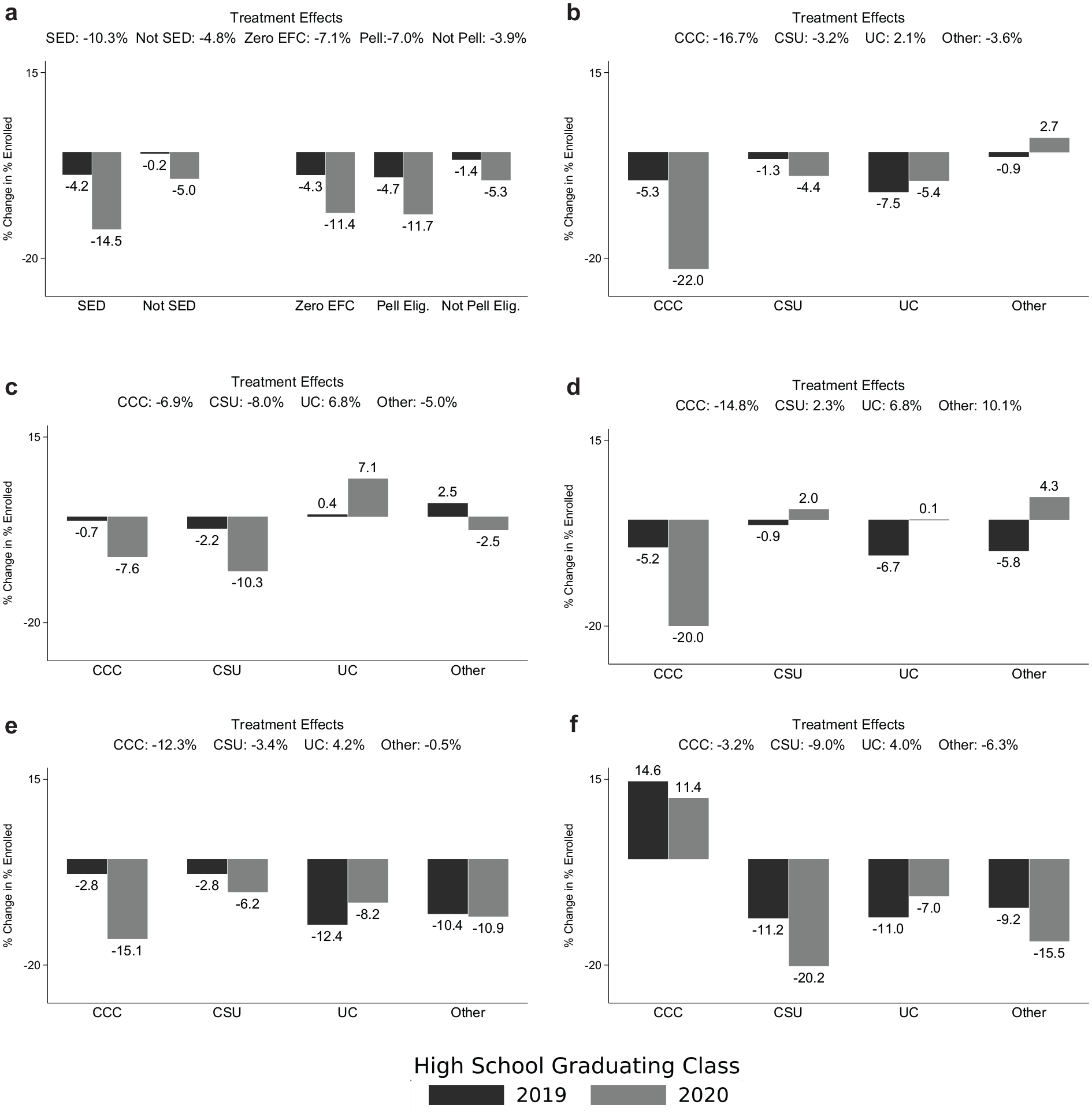
College Enrollment by Income.
Figure 3 examines overall enrollment changes by race. The results show a clear pattern with Black and Latinx student enrollment declining at higher rates than Asian and White student enrollment. Specifically, college enrollments fell by 13.3% for Black students and 9.3% for Latinx students compared to 2.3% for Asian students and 6.8% for White students. Again, these declines by demographic groups were not evenly distributed across each college sector. For Asian, Black, and Latinx students, the largest declines in enrollment were at the CCC level (7.2%, 22.1%, and 14.8%, respectively), whereas the largest enrollment declines for White students (10.5%) happened at the CSUs. Enrollment increases at the UCs were driven by Asian and White students (7.4% and 4.1%, respectively), with the increase in enrollment smallest for Latinx students (1.6%).
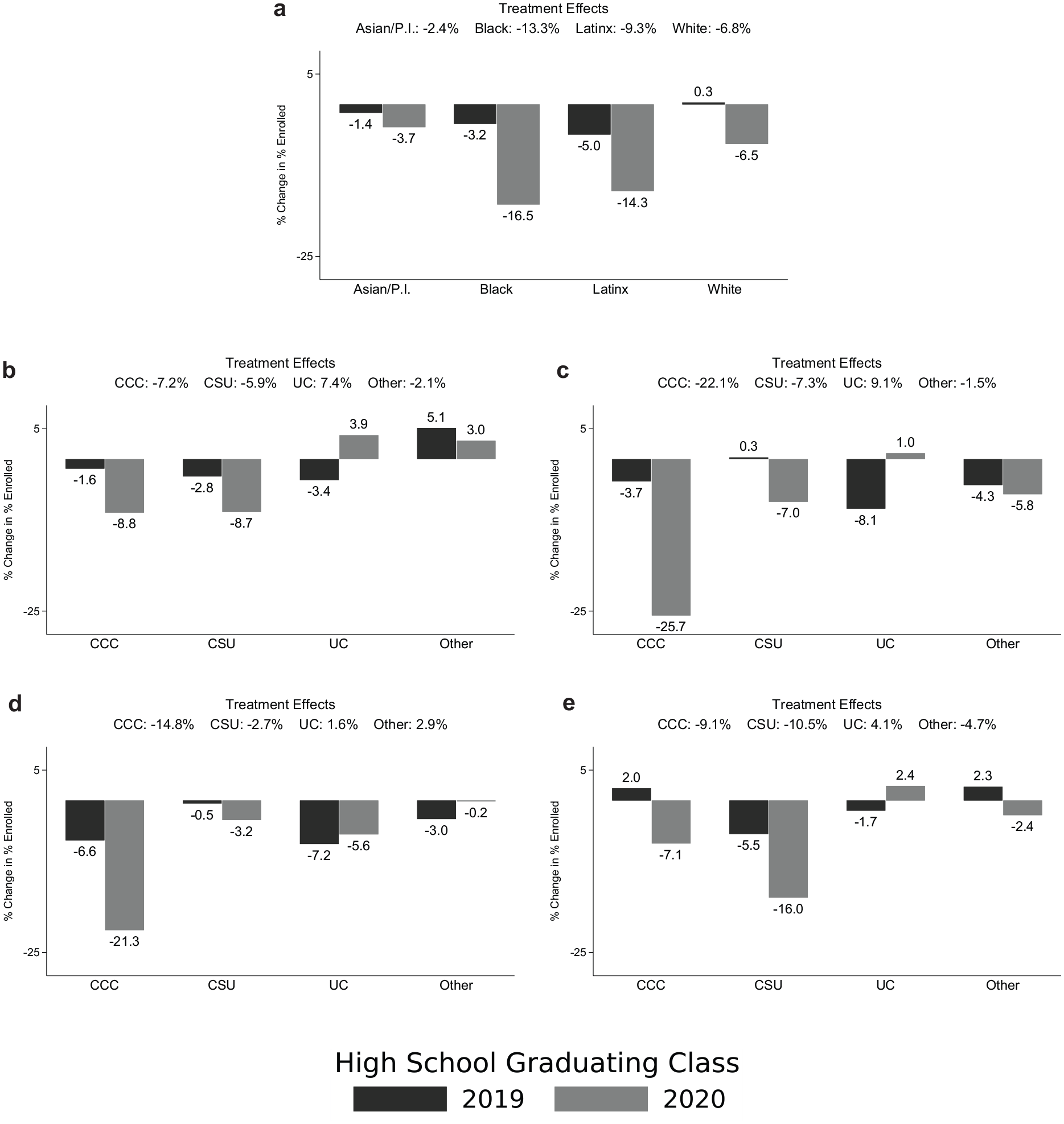
College Enrollment by Race.
In Figure 4, we examine enrollment declines by individual levels of college preparedness, as measured by scores on California’s 11th-grade standardized assessments. California uses assessments aligned with Common Core State Standards, and only 29% of 2016 to 2020 high school graduates scored at or above the “proficiency” performance level in both math and English. Thus, it is not surprising that many students enroll in college despite not meeting proficiency on the state’s standardized assessments, particularly in California’s large open-access community college system. Nonetheless, college enrollment declines were more than threefold for those students who scored below proficient in math and English language arts (ELA; 11.7%) compared to students deemed proficient (3.7%). Likewise, results show that the overall declines at the CCCs were almost entirely driven by students who scored below proficient in math and ELA. This suggests that lower achieving students were less likely to attempt college during the pandemic relative to their higher achieving peers.
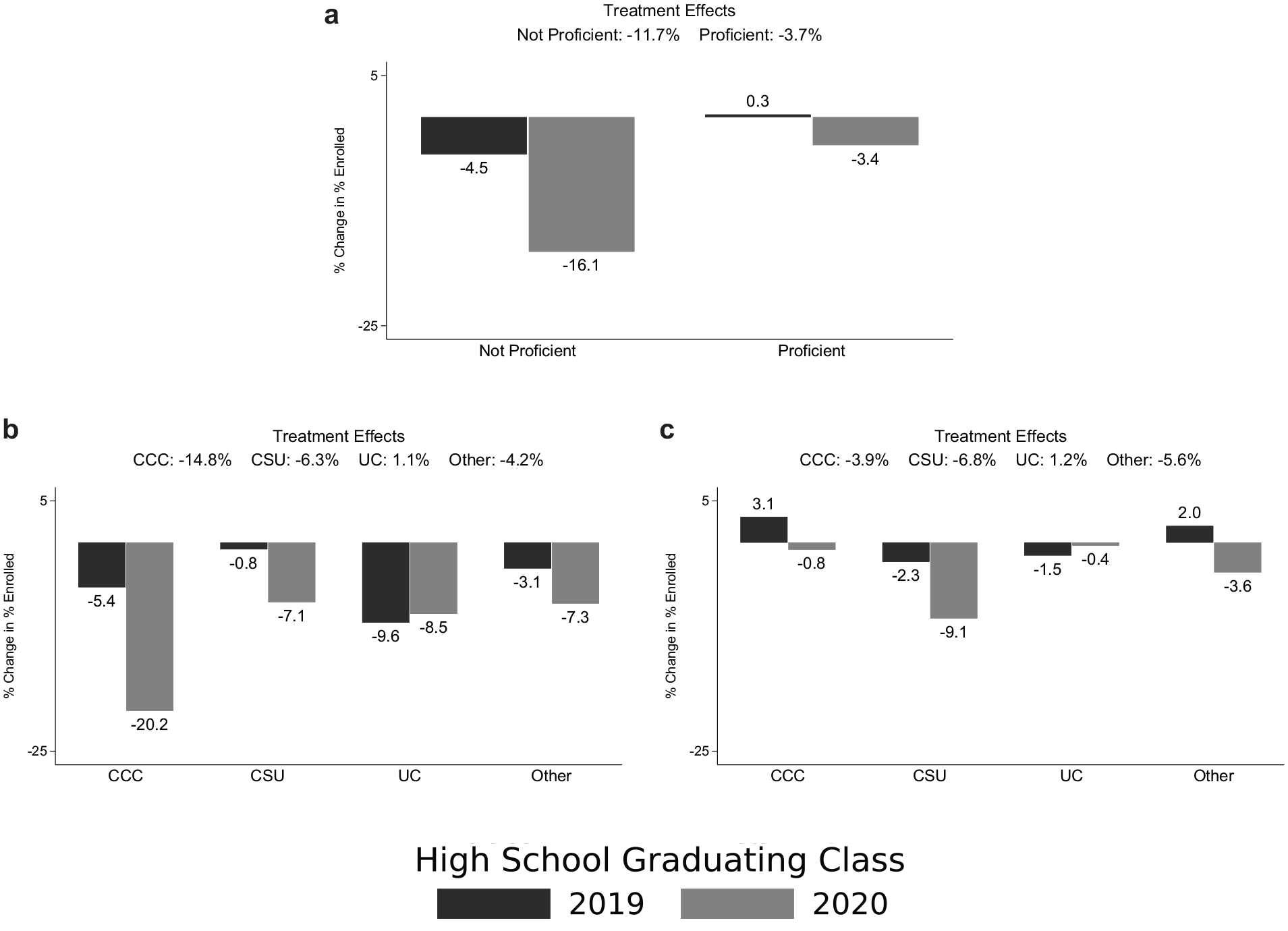
College Enrollment by Standardized Test Scores.
Finally, we examine enrollment changes by the characteristics of each student’s high school. Specifically, Figure 5 shows that students attending schools that had the college enrollment rates below the median suffered the largest declines. At the same time, students attending schools that had prepandemic college enrollment rates above the median enrolled at the UCs at higher rates than they did before the pandemic. Hence, these results suggest that COVID exacerbated existing disparities in college enrollment across high schools in California.
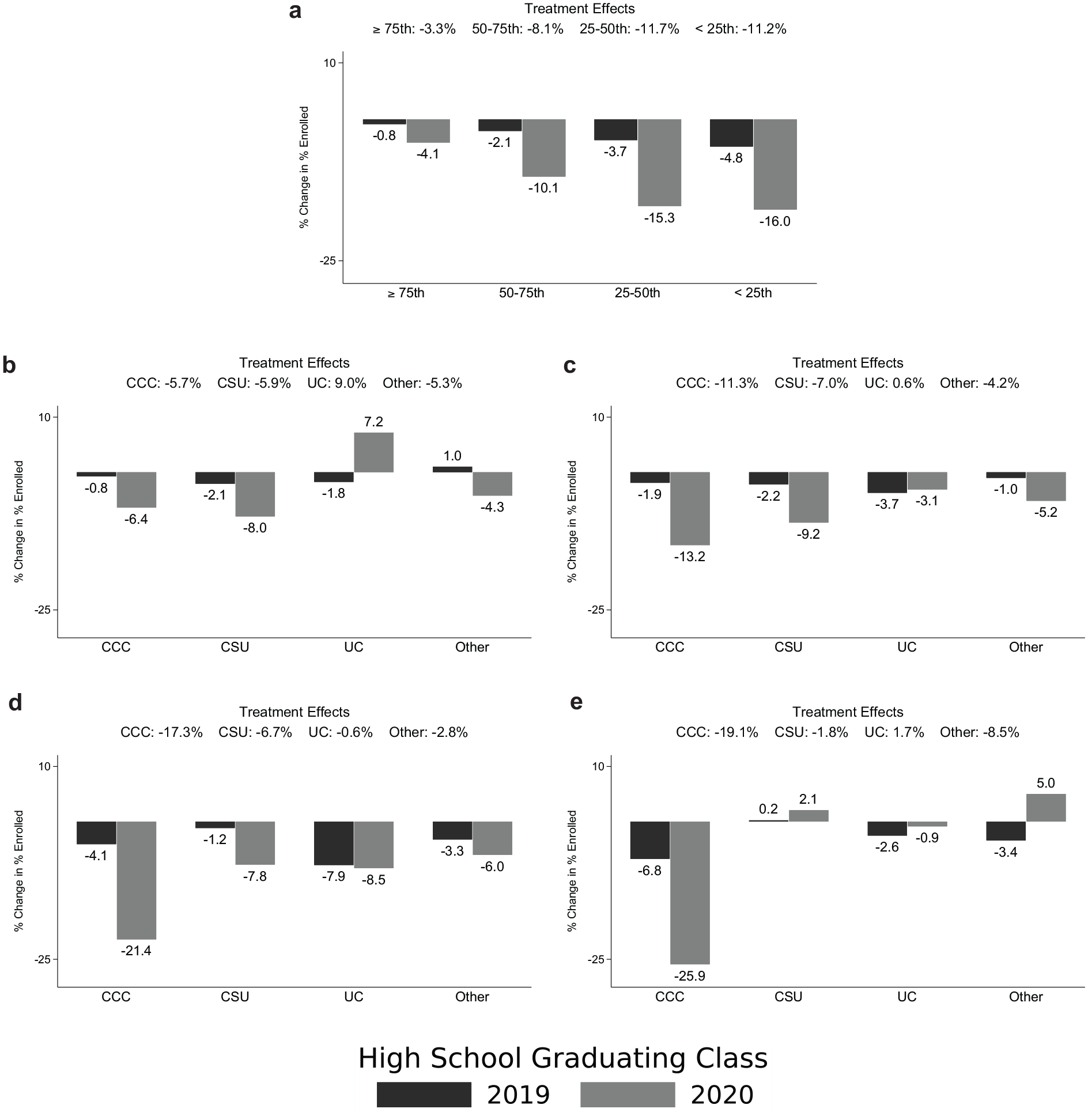
College Enrollment by Student’s High School College-Going Percentile.
One note of caution: It is not possible to know the “fundamental” source of the heterogeneity we find. In other words, we cannot tell whether the enrollment declines are larger for SED students because the pandemic had differential effects by socioeconomic status or because it had differential effects with a factor correlated with SED, such as academic achievement or school context.
Discussion: Exploring Possible Mechanisms
Why did so many high school graduates of the class of 2020 not enroll in college? To explore potential explanations for students’ enrollment decisions, we analyze data from a survey we administered in partnership with the CSAC. In May of 2020, we collaborated with the CSAC to survey to a random sample of students statewide who submitted either the FAFSA or California Dream Act application (for undocumented students) for intended college enrollment in the 2020–2021 academic year. More than 16,000 high school seniors completed the survey, resulting in a response rate of 11%. 7 The survey combined Likert scale, selected response, and open-ended questions. High school students who had applied for financial aid overwhelmingly (70%) reported concern about their financial situation and their family’s hardship during the pandemic (Reed et al., 2020a).
We link the data from survey respondents to their CDE and NSC records to better understand whether seniors’ concerns in the pandemic predict their enrollment decisions (i.e., Are those with higher level of concern more likely to not enroll in college?). The survey asked a series of questions about students’ college plans and their worries about college in light of COVID (e.g., Now, as a result of COVID, how worried are you about . . . .). We created a worry index by summing the students’ responses on eight Likert scale survey questions that investigate different types of perceived worries (e.g., financial hardship, personal health, care for family members, taking classes online) students confronted. 8
We begin the analysis by showing differences in the worry index across key student subgroups. Figure 6a shows that worries were higher among low-income students, students of color (relative to White students), and students with lower test scores. Importantly, the groups that reported higher rates of worries are also those that tended to experience larger enrollment declines. These patterns are similar when the individual components of the index are examined. In particular, “paying for tuition and fees,” “taking a full load of class,” and “personal health and well-being” were the components students most worried about, whereas students found “paying for transportation,” “paying for technology or internet access,” and “paying for health care,” the least worrisome.
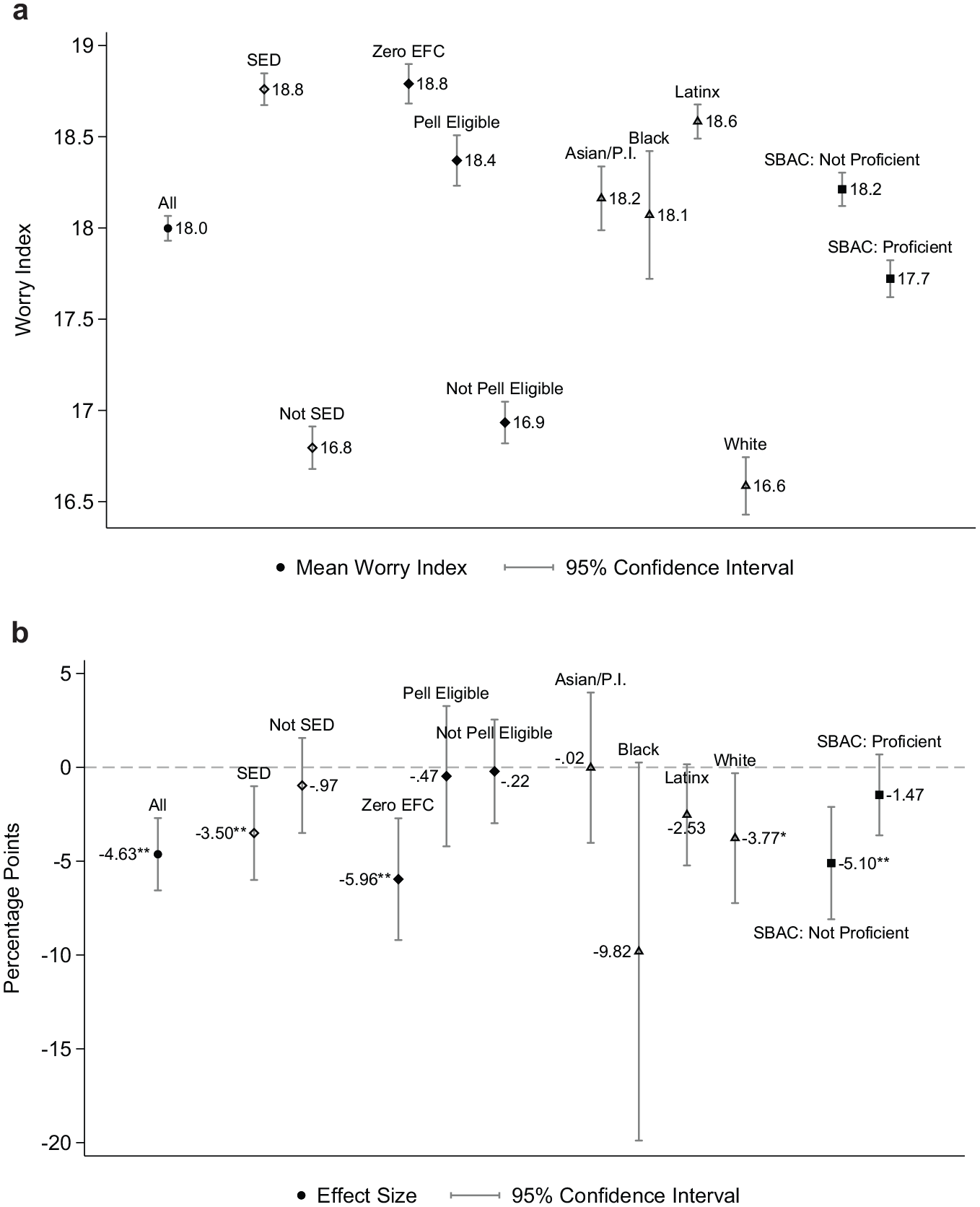
California Student Aid Commission Survey.
Next, we use the matched survey-NSC data to determine whether a student’s perceived increase in worries due to COVID correlates with changes in the student’s enrollment behavior. Specifically, we regress an indicator for any postsecondary enrollment on the worry index, controlling for the college plans the student reported having prior to the pandemic (i.e., no college, planned 2-year enrollment, or planned 4-year enrollment). 9 The estimate of the coefficient on the worry index from this regression is hard to interpret directly. A 1-unit increase in any index based on set of Likert scale questions does not have a natural interpretation. To better interpret the impact associated with an increase in the worry index, we use the results from this regression to calculate the effect of decreasing a student’s worry level from the 90th percentile to the 10th percentile, assuming our model captured all relevant factors. We then fit this model separately for all subgroups reported on previously. Figure 6b plots these effect sizes with their corresponding confidence intervals. For the full sample, moving from the 90th percentile of the worry index to the 10th percentile is associated with a 4.63 percentage point decline in enrollment. This suggests that students’ worries about COVID, conditional on pre-COVID enrollment plans, may have contributed to the aggregate declines in college enrollment described earlier. Furthermore, the estimated effect sizes tend to be larger for groups with larger enrollment declines (i.e., the students with the greatest precarity: those who are economically disadvantaged, have highest financial need, or who are not proficient on standardized tests). We cannot reject equal coefficients due to limited statistical power, but the magnitudes of the point estimates are meaningfully different between some groups. For instance, the effect size is associated with a decrease of 5.96 percentage points for zero EFC students (i.e., those from the lowest income families), in contrast with a 0.22 percentage point decrease for non-Pell-eligible students (i.e., the most affluent students who applied for financial aid). Our results are consistent with pandemic-related concerns contributing to subgroup differences in enrollment declines.
Our results on students’ reported stress corroborate other studies documenting the uncertainties and challenges college students faced in the early stages of the pandemic (Browning et al., 2021; Jaeger et al., 2021; Logel et al., 2021; Rodríguez-Planas, 2022). But few prior studies document the experiences of high school students in the early stages of the pandemic. More broadly, our results by high school college-sending rates are consistent with other studies that document the uneven responses across K–12 schools to the unprecedented challenges around access to instruction and services during the pandemic (Cullinan et al., 2021; Harris et al., 2020; Hurtt et al., 2022). For example, Harris et al. (2020) found that the strongest predictor of school activities was the education level of parents and other adults in schools and neighborhoods and access to remote instruction options and connectivity. Thus, lack of access to school resources, including college counseling, and weak connectivity may have particularly affected low-income students and students attending high schools that sent a low percentage of students to college.
Conclusion
Using individual-level administrative data from California, this study provides a comprehensive analysis of college enrollment changes driven by the pandemic for recent high school graduates. We find sizable negative effects on college enrollment for the California high school graduating class of 2020. Similar to national trends, we find these enrollment declines were largest in the community college sector and for underrepresented minority students, low-income students, and students from high schools with low college-sending rates. At the same time, enrollment in the highly selective UC system increased slightly. These enrollment gains were concentrated among Asian and White students and those students who attended schools that historically sent a large share of their graduates to college. Thus, the pandemic appears to have worsened inequalities not only in overall college enrollment but also in access to more elite institutions.
Further analysis is required to fully understand the mechanisms driving these results and their impact on the composition of California’s higher education systems. However, our matched survey analysis suggests that students’ worries as a result of the pandemic (e.g., financial hardships, health, family well-being, and concerns about online learning) likely contributed to their enrollment behaviors. Moreover, the influence of these hardships appears to be bigger drivers in the decision to not enroll in college for California high school seniors from the lowest income families.
Additional work is needed to determine whether experiences of students in other states mirror those we report here for California. Instruction in California public postsecondary institutions was nearly fully remote throughout the 2020–2021 school year, and California generally maintained social distancing measures longer than many other states. On the other hand, California shares aggregate patterns seen in national data on college enrollment changes, including declines that are largest for men, socioeconomically disadvantaged students, racially minoritized groups and declines that are by and large concentrated in community colleges. This suggests that many of the challenges faced by students in California were also felt throughout the country. Furthermore, in addition to California’s size and diversity, understanding the experiences in California is important because it has been at the forefront of policy efforts to help postsecondary institutions recover from the pandemic. For instance, California policymakers have passed new legislation requiring all high school seniors to submit a FAFSA, expanded the state’s financial aid entitlement programs, and further increased resources to community colleges (beyond federal aid) to help them recover enrollment lost during the pandemic. Whether these policies and investments recover the enrollment losses of the pandemic remains to be seen. Nevertheless, it is clear that the declines in college enrollments for the class of 2020 will likely have important short- and longer-term consequences on individuals and families’ livelihoods and broader economic and social impacts on society. A college degree remains a key vehicle to economic security, better health outcomes, and greater social mobility (Chetty et al., 2017). Moreover, the need for skilled jobs continues to rise, and thus, fewer college degree earners may have serious consequences on the economy at large.
Supplemental Material
sj-pdf-1-edr-10.3102_0013189X251357674 – Supplemental material for College Canceled: What Happened to California’s High School Graduating Class of 2020?
Supplemental material, sj-pdf-1-edr-10.3102_0013189X251357674 for College Canceled: What Happened to California’s High School Graduating Class of 2020? by Scott Carrell, Kramer Dykeman, Michal Kurlaender and Paco Martorell in Educational Researcher
Footnotes

Notes
Authors
References
Supplementary Material
Please find the following supplemental material available below.
For Open Access articles published under a Creative Commons License, all supplemental material carries the same license as the article it is associated with.
For non-Open Access articles published, all supplemental material carries a non-exclusive license, and permission requests for re-use of supplemental material or any part of supplemental material shall be sent directly to the copyright owner as specified in the copyright notice associated with the article.
