



Abstract
This article is a review of current research on Black women preservice teachers (BWPSTs) in the United States. This review explores teacher education literature, focusing on how Black women have been characterized. In particular, this review found that BWPSTs have occupied an absent presence in teacher education literature by often being present in articles—especially those that focus on “teachers of color—while their identities and experiences as Black women have been absent. This article ends with recommendations for new directions for teacher education scholars to center BWPSTs.
Teacher education programs are intended to foster the growth of all teacher candidates (Harmon & Horn, 2021). However, these programs have historically centered on the challenges faced by White teachers in educational settings, often neglecting the needs of Black teachers (Aronson et al., 2020; Brown, 2014; Gist, 2014). This emphasis on White educators mirrors the current demographics in K–12 schools. As reported by the National Center for Education Statistics (2023), during the 2020–2021 school year, White teachers comprised 80% of the teaching workforce, and Black teachers accounted for only 6%. This gap is widening because the number of Black teachers continues to decrease (Samuels et al., 2021).
The attrition of Black teachers is not a new phenomenon because conditions throughout history have contributed to the decreasing number of Black teachers. A primary example includes the legacy of desegregation that displaced Black teachers after Brown v. Board of Education (Foster, 1997), which, in turn, led to the deprofessionalization of teachers of color in the workplace (Acosta et al., 2018). This factor helps us understand how the percentage of Black teachers has not surpassed 9% in the last 30 years and has declined in comparison to other teachers of color (Farinde-Wu & Griffin, 2019).
In response to the demographic reality, policymakers have advocated for hiring more teachers of color to promote “racial matching” as a means to enhance the achievement of racially minoritized students (Gershenson et al., 2021). There are significant reasons for supporting racial matching: Black teachers can serve as important role models for Black students, especially as they explore and identify with their racial identity (Nguyen & Le, 2023, p. 394). Additionally, teachers of color may be viewed more positively by students of color due to stronger cultural alignment (Easton-Brooks, 2021). Black teachers are also known for recognizing the potential and intellectual capabilities of their Black students and are dedicated to their success (Tillman, 2004). Building on the insights from these studies, the common remedy is to significantly boost the number of Black teachers as quickly as possible (Harmon & Horn, 2021).
Even though the data show the positive impact of teachers of color, efforts to enhance teacher diversity highlight the advantages for students while failing to adequately address the developmental needs, histories, and experiences of minoritized teachers (Harmon & Horn 2021). In recent years, calls to increase teacher diversity have largely been unsuccessful even though teacher education programs have increasingly incorporated culturally relevant pedagogies (Romijn et al., 2021). Because the primary beneficiaries of these changes have been White teachers, the proportionate number of teachers of color—specifically, Black women—remains low (Harmon & Horn 2021; Philip, 2011). The goal of this critical literature synthesis is to take stock of current research on teacher education to ascertain what it would mean to center the needs of Black women preservice teachers (BWPSTs) to sustain them in the profession. This synthesis builds on and extends foundational education research centered on Black preservice teachers (Acosta et al, 2018; Jackson et al., 2017), Black women in-service teachers (Beauboeuf-Lafontant, 2002; Dillard, 2021; Dixson, 2003), and Black women teacher educators (Berry, 2005; Gist, 2014), emphasizing the necessity for further scholarship dedicated to BWPSTs to gain a deeper understanding of the current teaching demographics.
Because contemporary efforts to diversify the teaching workforce have largely been unsuccessful, many researchers have focused on different points along the teacher pipeline. One point is teacher education because the quality of a teacher education program can be a determining factor for the retention and success of in-service teachers (Jackson, 2015). Specifically, to develop Black female teachers, “Teacher preparation programs, whether traditional or alternative, must be comprehensive and enact and promote advanced pedagogy such as culturally responsive teaching” (Gay, as cited in Farinde-Wu & Griffen, 2019). However, research on teacher candidates of color is limited (Chávez-Moreno et al., 2022), and scholars have described the research base on the preparation of teachers of color as narrow and not all-encompassing (Mensah, 2019). Although research on preservice teachers of color is small, the research base on BWPSTs is even smaller.
I have two purposes for this critical literature synthesis. First, I hope that it will catalyze other scholarship centering BWPSTs. To diversify the teaching force, teacher education must focus on groups that have often been excluded. By prioritizing BWPSTs’ experiences, “teacher education programs can gain insight on how to better serve Black women and by doing so, potentially improve the field of education at large by retaining more Black women educators” (Farinde-Wu & Griffen, 2019). Second, by shifting the focus to BWPSTs, the perspectives offered here aim to sustain and retain them in the profession. To meet these goals, I explore the following questions:
Research Question 1: How has teacher education literature characterized Black women?
Research Question 2: How does current literature conceptualize BWPSTs’ learning and development?
Theoretical Framework
To engage in this synthesis, I used an intersectional (Hill Collins & Bilge, 2016) lens to analyze each study. Intersectionality helps us see beyond the broad categorization of teachers of color, which is often evident in the literature. By aggregating Black women’s experience alongside the unique and differing histories of other racially minoritized groups, the conflation of “teachers of color” with “Black teachers” in teacher education research denies the long history of anti-Blackness and intersectional oppression of gender and their impact on Black women teachers.
Intersectionality underscores a more comprehensive understanding of how “race, class, gender, sexuality, dis/ability, and age function not as separate and distinct categories, but rather intersect and interact” (Hill Collins & Bilge, 2016, p. 4), shaping the experiences and outcomes of Black women. For example, Gholson (2016) outlined the experiences of Black girls in math classrooms: “Perceptions of Black girls and women, such as being confident, assertive, or argumentative—often referred to pejoratively as ‘being loud’—run orthogonal to modes of white femininity, but parallel to masculine attributes associated with success and participation in mathematics” (p. 291). Similarly, BWPSTs’ femininity is often illegible in White-dominated spaces like teacher education. As Gholson argued, Black women’s ways of being are not accepted in the same ways that White women or Black and White men, leaving their experiences ignored and undertheorized.
As noted by Crenshaw (2013), this ignoring and “not knowing” basic information about BWPSTs’ subjectivity leads to “not caring,” perpetuating a vicious cycle in which knowledge production excludes Black girls and women (Gholson, 2016), giving rise to their absence in teacher education literature. Intersectionality helps unpack BWPSTs’ complex identities, illuminating the ways that multiple oppressions work simultaneously to impact their experiences in teacher education. I used an intersectional lens to read and categorize each article to understand how the authors discussed the identities of their Black women participants.
Methods
To explore how Black women are portrayed in teacher education literature in the United States, I conducted a critical literature synthesis. This process involved applying systematic review techniques to analyze the existing research. I used (a) transparent search strategies with consistent inclusion and exclusion criteria and (b) structured coding and analysis (Onwuegbuzie et al., 2016).
Search and Screening Strategy
This critical literature synthesis was conducted using a three-phase process: literature search, abstract review, and full-text analysis. To compile literature, I conducted searches across four databases, including ERIC, ProQuest, JSTOR, and Google Scholar, and included literature published between 1990 and 2024. My search included combinations of the following keywords: (a) Black woman/women, African American woman/women, women of color, and teachers of color and (b) pre-service teacher, preservice teacher, teacher education, and teacher candidate (see Table 1). I chose to include “women of color” and “teachers of color” in the initial search because this description typically includes all non-White women. Many of these texts include Black women as participants, so I wanted those articles included in the first screening. These searches resulted in 1,150 sources.
Search Terms and Results
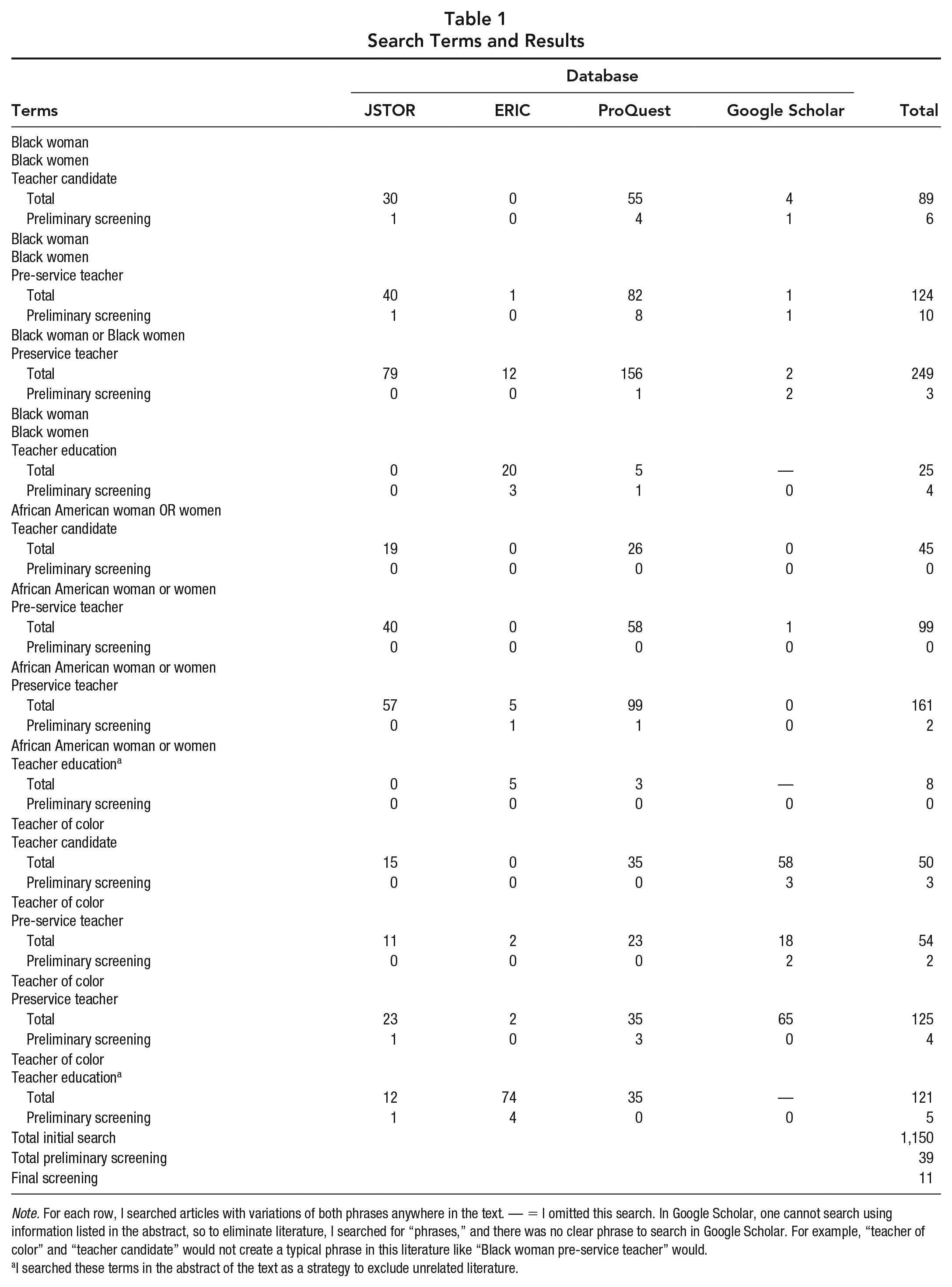
Note. For each row, I searched articles with variations of both phrases anywhere in the text. — = I omitted this search. In Google Scholar, one cannot search using information listed in the abstract, so to eliminate literature, I searched for “phrases,” and there was no clear phrase to search in Google Scholar. For example, “teacher of color” and “teacher candidate” would not create a typical phrase in this literature like “Black woman pre-service teacher” would.
I searched these terms in the abstract of the text as a strategy to exclude unrelated literature.
Next, I reduced this list through an iterative process of screening abstracts, eliminating articles that did not explicitly focus on BWPSTs (e.g., they focused on Black women teacher educators, in-service teachers, teachers of color broadly). At this point, I narrowed the list down to 39 sources. Next, I engaged in a full-text screening process by reading each article closely. After the full-text screening, 11 sources qualified for this study. To analyze the remaining articles, I created a table to track key information from each article. Using intersectionality as a frame, I included the following information for each article: research questions, components of the theoretical or conceptual framework, descriptions of how the authors characterized Black women, and how they conceptualized BWSPTs’ learning development. Intersectionality provided a lens for me to investigate how each article engaged Black women’s identities. If the article did not explicitly mention BWPSTs, then it was eliminated. After this process, 11 articles met the complete criteria. Acknowledging that the four databases previously listed are not exhaustive, I also reviewed the references from all 11 articles to check for additional articles excluded from the original search. No additional articles met the criteria.
Coding and Analysis
To identify themes in the research literature, I employed a constant comparative analysis (Onwuegbuzie et al., 2012). After closely reading each article, I created a brief synthesis using a spreadsheet and basic open-coding techniques (Miles et al., 2013) to distill the main findings/ideas in each piece. For instance, for Haddix (2012), I noted, This author focuses on the linguistic approaches of two BWPSTs. She highlighted the ways they used silence and how they choose to communicate in different spaces to preserve themselves in their programs. They chose when to engage in conversations about race and they waited to talk to other Black women when they did not agree with other classmates.
Using an intersectional lens to guide my reading and analysis, I paid particular attention to how each author engaged the participants’ sociopolitical identities and positions. Next, I grouped my syntheses using codes, either adopting existing ones or creating new ones as needed throughout the screening process. In instances in which codes overlapped, I made coding decisions based on the primary argument of the article, how the author(s) discussed the identity markers of BWPSTs, and BWPSTs’ experiences in teacher education (Alvarez, 2020). I streamlined codes and subsequently identified three major themes from the literature. They are (a) missing identity: Who are these Black women?; (b) experiences of BWPSTs in inadequate teacher education programs; and (c) limited transformative learning environments.
Findings: Exploration of Black Women Preservice Teachers in Current Teacher Education Literature
Answering the first research question (How has teacher education literature characterized Black women?), I argue that Black women occupy an “absent presence” in current teacher education literature. Gill and Erevelles (2017) coined this term to describe the experiences of Elsie Lacks, Henrietta Lacks’s daughter. Henrietta Lacks was a working-class Black woman whose cancer cells were extracted from her cervix and used for research unbeknownst to her and her family (Gill & Erevelles, 2017). Her daughter, Elsie, “who was institutionalized and underwent ‘treatments’ that eventually killed her” (Gill & Erevelles, 2017, p. 124), also has a chilling story involving medical systems using her body for “research.” Her story assumes absent presence because unlike Henrietta Lacks, Elsie Lacks’s cells did not serve scientists (i.e., the group with power) with a foundation for cancer research; therefore, her story and existence often goes untold and unacknowledged. In accounts of Elsie Lacks, “Her less-privileged narrative . . . nevertheless continues to ‘haunt’ not just the text but also the historical and contemporary contexts that connect to other narratives of exploitation, racial segregation, incarceration (institutionalization of disabled people), and sterilization” (Gill & Erevelles, 2017, p. 124). Her untold story is important because she reflects many intersections of Black women; yet because her story, like those of many Black women, has not served the interest of powerful groups, it is ignored.
Although ignored in current literature, the representations of her experiences are nonetheless present: Elsie’s story reflects the position of BWPSTs in contemporary U.S. society. Like Elsie Lacks, BWPSTs’ stories have been absent from traditional literature and scholarship yet present as they shine light on many different forms of intersectional oppression that impact their experiences in the contemporary United States, including education. In education, we see disproportionate representation in suspension and expulsion data in K–12 schooling (Morris, 2016), discrimination through standardized testing (Petchauer et al., 2018), and maintenance of whiteness in teacher education (Sleeter, 2017), all of which contribute to the pushout of Black women and girls from the teacher pipeline.
To demonstrate how the experiences of BWPSTs have been absently present in teacher education literature, I unpack themes that emerged throughout this critical synthesis. These themes include (a) missing identity: Who are these Black women?; (b) experiences of BWPSTs in inadequate teacher education programs; and (c) limited transformative learning environments. Although the first theme explicitly demonstrates how Black women are often absent present in the literature, the second and third themes provide a foundation for centering Black women as subjects rather than objects. The authors in the second and third sections push us toward presence, but because there are so few articles, Black women are still absently present in overall teacher education literature.
Who Are These Black Women?
Black women have been uniquely positioned throughout their long, tumultuous history in the United States, impacting how they engage in the work of teaching. In two articles, the authors included Black women participants but did not position them socially, culturally, politically, or historically. For example, Bangou and Waterhouse (2008) “explored the processes of ‘becoming’ technologically literate of two pre-service second language teachers, a Latina woman and an African American woman, who learned how to use computer technology to teach Spanish at a large Midwestern university” (p. 445). The authors’ goal was to learn how teacher education programs can support racially minoritized candidates in their development as technologically literate educators. Bangou and Waterhouse selected Andrea, a Black woman, to participate in their study. Their case selection logic was explained as follows: The students who allowed for a greater variability and balance were selected to be part of the study. For instance, since there were two African American students, the one whose personal technology information and perception of computers was the most different from the other participants was chosen. (p. 448)
The researchers chose to focus on Andrea because of how she compared to the other students rather than to explore the salience of her identity and intersectional experiences as a Black woman. As a result, she is used as a comparative study object rather than as a subject with particular experiences, leaving readers to fill in who Andrea is based on generalizations or stereotypes.
Occasionally, Bangou and Waterhouse (2008) mentioned her identity. For instance, describing her experiences in her student teaching placement in a predominately White suburb, they state that, “Andrea’s reading of the world as the school environment contributed to her personal literacy; her reading of self as a teacher of color. This is a reading informed by experience at the intersection of gender, race, class, and power” (p. 451). This description of the way Andrea “reads” the world was in response to a realization about the resources at her placement site being more plentiful than other schools she had encountered. In doing so, the authors conflated her socioeconomic experience with her racial experience, adding to a widespread conflation of the two. Even to the extent that they mentioned that her reading of the world is informed by gender, race, class, and power, they did not unpack what that means for Andrea as a Black woman in particular, let alone what it means for her growth as a teacher. Small-n case studies distinctly afford scholars the opportunity to investigate such details. However, by not unpacking her identity, the authors contributed to the absent presence of Black women by including Andrea as an object in the study to be used for comparison to other students in her program while not fully engaging her particular Black womanness or centering the implications of her experiences for her developmental needs.
Although this article made limited mention of participants’ identities, other articles did not mention participants’ identities at all. For example, Quinlan (2020) included four BWPSTs in this article outlining schema theory to understand transfer in argumentation in a teacher education program. In the methods section, it is mentioned that “the participants in this study were four female African American preservice students (with the pseudonyms Joy, Rhonda, Faith, and Daniella) enrolled in a master’s degree programme in elementary education at a Historically Black College and University” (p. 1214). Aside from this sentence, these women’s identities are left out of the analysis, again contributing to Black women’s absent presence. That is, these women are present because they are the objects of the study, but their identities and perspectives are absent.
Inadequate Teacher Education Programs
When researchers engage Black women’s identities more fully, they often identify ways that teacher education programs have been inadequate in meeting their needs. Multiple authors provide us with a foundation to explore the experiences of BWPSTs. For example, Farinde-Wu and Griffen (2019) found four ways that their participants’ teacher education programs underprepared them. These included (a) limited knowledge of special education requirements and documentation, (b) limited culturally responsive teaching techniques and strategies, (c) lack of preparation for teaching underserved students of color, and (d) inadequate length of teacher prep programs. Similarly, Bell and Busey (2021) described how financial barriers for Ayana almost pushed her out of the program. Even past the traditional teacher education classroom, Pham (2018) highlighted how student teaching placements can also be sites for inadequacy for learning development for BWPSTs. The shortcomings that these BWPSTs identified are particularly important because the curriculum of a teacher education program can impact teacher preparedness for classroom teaching and therefore influence teacher retention (Darling-Hammond et al., 2005). Black women teachers should not have to persevere in classrooms due to inadequate teacher preparation, especially when Black female teachers are at higher risk of stress than their White counterparts (Fitchett et al., 2017) largely due to the intersectional oppression that Black women teachers have endured both historically and contemporarily.
Although many teacher education programs continue to focus on the needs of White women teachers, Black women have been finding ways to advocate for themselves in these harmful spaces. Haddix (2012) described the experiences of two BWPSTs and their use of linguistic strategies to sustain themselves in their teacher education program. She found that two focal BWPSTs, Natasha and Latoya, used deliberate silences to preserve their identities and voices in their program. They were deliberate about what they talked about, when, and with whom (p. 174). They navigated spaces by using their voices (or not) in different ways to sustain themselves. As Haddix described, “being silent also allowed for their cultural and linguistic selves to emerge from this dominant context unharmed and unscathed” (p. 175). Similarly, Ayana (Bell & Busey, 2021) cited feelings of isolation when her peers and instructors would frame minoritized schools and communities negatively. She would choose not to engage in these conversations because of the ignorant comments expressed during these discussions. Ultimately, these women had to protect themselves in programs that did not see them or their needs.
Similarly, Mensah (2019) described the experiences of a Black woman teacher called Michele. Mensah chronicles Michele’s experiences in teacher education, student teaching, and her in-service classroom. Initially, she struggled finding her voice in her program because she found herself trying to be someone she was not. Eventually, Michele had a Black woman professor who encouraged her to consider science education. This professor helped Michele use her voice to teach science in liberatory ways despite roadblocks in the program and the schools she taught. She gained confidence to advocate for herself in different spaces while sustaining her identity and purpose as a teacher.
In each of these studies, BWPSTs’ Blackness and to varying degrees, womanness were central to the analysis. By centering their experiences, researchers uncovered how the BWPSTs implemented protective strategies to survive their teacher education programs. Their programs did not systemically support them; instead, they had to build individual protective strategies to be successful. In these articles, these women were regarded as subjects, and the authors took care to unpack their identities to report about their experiences. These case studies provide a foundation for future scholars to disrupt the absent presence in teacher education literature. By centering these women, we can begin to unpack their individual strategies of preservation as a glimpse into how to think about systemic changes in teacher education programs across the country.
Transformative Learning Environments
Although research that meaningfully centers Black women’s identities helps illuminate their subpar experiences in teacher education programs, there were instances in which Black women had transformative courses and mentors (McCray et al., 2002) who changed their trajectory. One common aspect of their transformative experience was finding community outside of the white gaze. No matter how small, these women relied on their communities to navigate their programs. These communities provided spaces to discuss their issues and reflect on strategies for survival.
For instance, Wynter-Hoyte et al. (2020) found that their participants cultivated a sisterhood, formed intergenerational alliances between Black faculty and students, and learned the most with intersectional learning engagements: The sisterhood these women created, along the lines of Blackness and femaleness, produced a bond that enabled them to connect with each other on an emotional level. This explained the shedding of tears as each woman shared her counterstory. Each student understood that, in the same manner, our individual stories about race and racism produce collective stories, our individual tears produce collective tears. (p. 354)
Their community served as a place of healing (Harmon & Horn, 2021) because they were able to display their individual feelings among a collective. Wynter-Hoyte et al. used the concept of the “kitchen table,” a space for Black women, to frame their findings and to show the importance of these spaces for BWPSTs. Similarly, Haddix (2012) discussed how the two women in her study formed a bond with each other in the program as students and how they all built a relationship (students and professor) forming an intergenerational bond (Wynter-Hoyte et al., 2020). Pham (2018) outlined how the two participants, Delilah and Robin, developed a trusting relationship outside of their student teaching sites to share their observations, perspectives, and inquiries, helping them to develop their pedagogies.
In addition to finding community, the BWPSTs outlined in these articles had transformative learning experiences with Black professors who reinforced their belonging in their programs. Woodson (2017) described her experience with Danitra, a Black woman student, who initially struggled on a critical historiographies assignment. She was tasked with writing a history unit using the following identity markers: Black, lesbians, antebellum period. Danitra struggled because she could not find any stories of Black lesbians in the antebellum period, so she questioned her capacity to be a history teacher and her skills as a student. Woodson, the professor, helped her to critically examine traditional archives, textbooks, and accounts from that time period as a way to explain why she might not find these stories easily. Although this was a difficult assignment at first, Danitra’s eyes were opened to critical histories and her duty as a history teacher to redefine the curriculum for her students and illuminate histories that have often been silenced. This experience gave her confidence in her abilities, allowing her to work through her insecurities as a history teacher.
Similarly, Mensah (2019) chronicled Michele’s story as an aspiring teacher that fell in love with science through a course taught by a Black woman professor: Science methods became the counter-narrative to previous teacher education experiences and was transformative for Michele in many ways. Michele, for example, talked about her new relationship with science, which was not an easy undertaking. She had to rethink, reconceptualize, and reimagine herself in science and as a female African American science teacher. She had few opportunities to build on her personal experiences and to examine issues of identity prior to the science methods course. (p. 1432)
This professor helped her to see herself in the curriculum and gave her confidence to pursue her dreams and advocate for herself.
The common thread among these women is their specific instances of learning growth typically spurred by a Black teacher educator. These instances of learning development should not be contingent on having a particular educator; these opportunities should be woven into the fabric of the program overall.
In this section, it became evident that teacher education programs have a responsibility to better support the developmental needs of BWPSTs. From having inadequate learning opportunities to having limited transformative experiences, Black women’s learning experiences and needs have been overlooked in teacher education literature. It is no longer adequate to just include Black women in education studies. These women need to be centered as subjects of the work, building on the research corpus described here.
Conclusion: Implications for Extending the Literature on BWPSTs
This synthesis highlights the limitations and possibilities for research that centers BWPSTs. In this critical literature synthesis, I outlined three themes of teacher education literature, that is, (a) missing identity: Who are these Black women?; (b) experiences of BWPSTs in inadequate teacher education programs; and (c) limited transformative learning environments.
In the end, if we want to take seriously the calls to increase the number of Black women in the workforce, these findings emphasize some directions for future scholarship and practice that would make BWPSTs subjects—and not objects—of research. First, future work should avoid the problem of absent presence and center the Black women in more teacher education scholarship. Often in scholarship and practice, we use general terms such as “teachers of color” and “BIPOC” teachers to refer to all non-White teachers. Although these terms are inclusive and highlight marginalization across groups, they have the potential to promote absence and neutrality, leading to inaction and complacency. As teacher educators and researchers, when we claim to focus on teachers of color, we must ask ourselves, how are we acknowledging an individual’s unique history and sociopolitical position? By using specific language, we can design for and with specific groups, allowing for nuanced approaches in teacher education rather than pedagogy developed around assumptions, stereotypes, and erasure.
Second, teacher educators and administrators should identify ways to deliberately restructure teacher education to better prioritize the needs of Black women and ultimately, all teacher candidates. Teacher education programs can center the historical traditions of Black teachers by rejecting curricula that have mainly been steeped in White, male, heteronormative norms. Many scholars discussed here have laid a strong foundation for uplifting the voices and experiences of BWPSTs. We have a base for understanding some of the obstacles they face in these programs and as their strategies for overcoming them. Teacher educators have an opportunity to extend their influence by embracing criticality and creativity in an effort to build opportunities for teacher candidates to learn historical pedagogies of Black teachers and other minoritized groups. By bringing these pedagogies to our present classrooms, we provide our preservice teachers with a more expansive lens to see themselves as liberatory educators and support their diverse student populations.
Finally, as highlighted in this synthesis, the scholarship that focuses on Black women’s learning development is limited. Although we understand how teacher education has often come up short in supporting Black women, we do not have enough scholarship that shines light on programs that intentionally make space for the unique experiences and learning needs of BWPSTs. We need more scholarship on understanding how teacher educators and programs can leverage the unique sociopolitical and historical positions of BWPSTs to design curricula and learning activities that push their development as liberatory educators.
As the literature continues to grow, exploring the learning development of Black women will be imperative. For instance, although many argue that Black women teachers possess valuable cultural resources in educating students from diverse backgrounds, these teachers’ strengths need to be acknowledged, enhanced, and developed as pedagogical tools in teacher preparation programs (Farinde-Wu & Griffen, 2019). Black women teachers must be provided opportunities to transfer their rich prior knowledge of culture to pedagogical content knowledge (Farinde-Wu & Griffen, 2019). Black women are not meant to be mere policy solvers; their humanity should be respected and uplifted as learners and professionals with developmental needs. Centering their development can drastically change the landscape of teacher education making it more humanizing for all teacher candidates.
