




Abstract
Despite the growing availability of classroom measures, such measures rarely attended to the embodied nature of learning. This article describes the collaborative development of a practical measure to capture embodied participation in mathematics classrooms with four elementary school teachers—working with students at the intersections of multiply marginalized identities: students of color, emergent bilinguals, and students with disabilities—who informed the measure design and ensured that the data were actionable in their contexts. This article contributes to existing research on classroom measures by highlighting the value of attending to embodied learning through multiple modalities and representations of student participation. We further highlight how such a measure provides practical insights into participation that extend beyond verbal only measures.
Keywords
Drawing from critical theory and embodiment pedagogy, this article problematizes whose knowledge is centered in mathematics education research, for what purposes, and how measurement systems narrow our field’s conceptions of student engagement. Recognizing that social contexts influence the knowledge, practices, and identities that are constructed in a classroom, we attend to how the body, gestures, tools, and peers serve as resources for learning and communicating knowledge. We focus specifically on measures of student engagement that can be used to support changes in teacher practice, called “practical measures” (Bryk et al., 2011). Our goal is to better understand how classroom measures can account for these myriad social and interactional factors that mediate students’ learning, thus broadening conceptions of student competence in mathematics classrooms.
To make progress toward this goal, we leveraged and customized an existing equity-focused observation tool, EQUIP (Equity QUantified In Participation; Reinholz & Shah, 2018). The observation tool, EQUIP, tracks patterns of classroom interaction and disaggregates students’ participation by social markers such as race, gender, and/or disability, making it a productive tool for identifying and addressing inequities. Yet similar to most practical measures of classroom interactions, the observation tool has been used primarily to capture verbal participation. Capturing verbal participation (e.g., talk, English) alone can reify racialized, gendered, and ableist perspectives, ignoring how an individual’s “bodymind” uses varied modes of expression to learn in context (Annamma et al., 2013; Siebers, 2013; Yeh et al., 2021).
Our article describes a collaboratively redeveloped practical measure to capture embodied participation in mathematics classrooms. Our research team collaborated with four elementary school teachers—working with students at the intersections of multiply marginalized identities (Annamma & Morrison, 2018): students of color, emergent bilinguals, and students with disabilities. In this article, we describe the collaborative redesign of the measure and the components of the embodied participation measure and provide a brief sample of data to showcase its potential utility.
Background
Mathematics education has evolved from a focus on individuals (and their cognitive functioning) to studying engagements within “complex systems in which any individual participation occurs in relation to other people and material objects” (Sinclair & de Freitas, 2019, p. 229). Thus, to conceptualize embodiment in mathematics, we consider both individual learners and how they engage with others (i.e., peers, the teacher, and mathematical tools and resources) through sensorimotor mathematical engagement. In this section, we summarize the evolution of embodiment theory (e.g., de Freitas & Sinclair, 2013; Lakoff & Núñez, 2000) and embodiment literature that attends to socio-material constructs such as gender, race, language, and disability (Annamma & Morrison, 2018; Miller et al., 2022; Siebers, 2013; Sinclair & de Freitas, 2019).
Broadly defined, embodied participation concerns learners who are holistically engaged and intertwined in their social and material surroundings (see e.g., ZDM special issue on embodiment with Sinclair & de Freitas, 2019). Theories of embodiment (Lakoff & Núñez, 2000) have claimed that conceptual knowledge is mapped onto the sensory-motor system in which the human body—that is, the learner’s body—is actively engaged in learning processes. Radford (2009) further developed this approach and proposed cognition as a construct for studying a more multimodal conception of learning, extending the mappings of Lakoff and Núñez (2000) beyond the role of the body to examine the coordination of speech, body, gestures, symbols, and tools. Our approach to embodiment builds on the entangled nature of mathematics learning and the new materialist ontology (de Freitas & Sinclair, 2013). New materialism embraces “the body of the mathematician as well as the body of her tools/symbols/diagrams, in the ‘dance of agency’ that make up mathematical activity” (de Freitas & Sinclair, 2013, p. 454).
Yet in current pedagogical practice, mathematics is often presented as disembodied, separating students from opportunities to utilize their bodies, their peers, and tools as sense-making resources (Yeh et al., 2020). As Sinclair and de Freitas (2019) argued, “bodies are situated in multiple space-time contexts, each operating according to different material conditions . . . different bodies matter differently, and are produced, positioned, and enabled through their engagement in different milieus” (p. 227). By ignoring the importance of bodies, identities, contexts, and cultures, disembodied framings limit access to mathematics, especially for multiply marginalized children (Annamma & Morrison, 2018). Such children encounter multiple intersecting oppressions in which macro-sociopolitical systems (e.g., ableism, linguicism, racism) manifest within the micro-interactional (e.g., access to agentive and rigorous mathematics curriculum) classroom interactions (Tan et al., 2022; Yeh, 2023).
Macro-sociopolitical oppressions are woven through the fabric of society and, therefore, present in education (Calabrese Barton & Tan, 2020). Students are measured against discursive norms of whiteness (Leonardo & Broderick, 2011) or what is considered “normal” (Annamma et al., 2013) regarding learning, talking, and being. For multiply marginalized youth, issues with access to mathematics begin in early childhood, in learning environments where their resources and contributions are easily dismissed, erased, or excluded; their moving bodies are more harshly managed; and their vocally and physically expressive cultural practices may be seen as behaviors to be policed rather than as resources for mathematics learning (Benneke et al., 2024; Yeh, 2023). Consequently, hegemonic modes of expression (e.g., spoken language, English, withholding language and communication support tools) perpetuate harm (Miller et al., 2022; Siebers, 2013).
Our focus on “embodied participation” highlights varied modes of expression, communicative mediums, and the collective nature of learning (e.g., with peers, tools, and resources in the room). In doing so, we depart from traditional classroom measures focused entirely on spoken or written language from individual students. Narrow measures imply that learning is a solitary act and may fail to capture the mathematical engagement of multilingual students, students with disabilities, and students whose communication preferences may not be verbal or written (Yeh et al., 2020). Fortunately, a growing repertoire of classroom observation tools have been developed that identify critical features of successful mathematics learning environments for students who have historically been underserved and marginalized. For example, the Equity and Access Rubrics for Mathematics Instruction (Wilson, 2022) identifies teaching practices from conceptually oriented classrooms that promote African American student success. The Culturally Responsive Mathematics Teaching Tool (Zavala & Aguirre, 2020) identifies productive classroom characteristics serving culturally and linguistically diverse students in which one dimension focuses on affirming multilingualism. Both measures attend to the embodied and collective nature of learning (e.g., with peers, tools, and resources in the room).
Although there are growing repositories of existing practical measures (e.g., WestEd Practical Math Measurement; WestEd, n.d.), most identified are classroom observation or student survey-based tools that do not provide a disciplined attention to embodied engagement. The unit of analysis has largely been at the classroom level instead of on the students, which obscures differences in classroom experiences for individual students and particular social marker groups (e.g., Black boys, disabled girls). Putting embodied student participation in conversation creates space to utilize students’ expressive cultural practices as resources for mathematics learning. In the following, we share the collaborative design of a practical measure that captures embodied student participation.
Collaborative (Re)Design Context
Context and Participants
Our work arose from a research-practice partnership with four elementary school teachers from Newland Schools (pseudonym) in California, a district—serving racially, ethnically, and linguistically diverse communities—experiencing increased racial tension. The prior spring, families, teachers, and community members organized and spoke to the school board for changes in curricular and disciplinary practices, demanding for diversity, equity, and inclusion educator training and the hiring of more educators of color in leadership positions. The project formed as a school-research partnership of researchers, teachers, and county leaders with eight of the nine partnership team members living, teaching, and organizing in the community. The hope was to identify change within classrooms and within the research process itself.
Within this larger effort, our work was driven by an interest between the teachers and researchers in examining measures. The district-wide mathematics benchmark assessments and readiness measures and milestones used verbal and written output measures centered on vocabulary recognition and mathematics timed tests, privileging White, middle-class perspectives (Nieto, 2021). Student performance on benchmark assessments and readiness measures led to children’s placement decisions. Consequently, children of color, particularly those from additional marginalized backgrounds (e.g., children experiencing poverty, multilingual children, disabled students), were more likely to be pushed into mathematics remediation. The teacher partners were already leaders at their site; each with 10+ years of teaching experience, prior mathematics professional learning, and commitments to addressing racial inequities in their classrooms and schools. Two teachers were selected from each school to enable site partners to provide a critical reflection and collegial support partner. At Adams Elementary school, minority enrollment exceeds 85% (majority Hispanic), which is greater than the California average of 78% (majority Hispanic). White students account for roughly 70% of enrollment at Harbor View Elementary, and Hispanic students account for approximately 15%. The selection of two sites with differing student demographics was also intentional to capture the challenges and tensions at each site.
Collaborative (Re)Design Process
Our collaborative (re)design process leveraged a customizable practical measure, EQUIP, for tracking patterns of inequity in classroom interactions (Reinholz & Shah, 2018). Within the practical measure framework, our team selected social markers (e.g., race, gender, disability and language status) and discourse dimensions (e.g., type of teacher question, quality of student talk, teacher response to student talk) to generate data capable of illuminating racialized, gendered, and ableist patterns of classroom participation. Unlike rubric-based tools, the observation tool captures discrete classroom events, with a student “contribution” to the class discussion as the unit of analysis. This was typically defined as all uninterrupted verbal talk by a single student. In our (re)development of the EQUIP tool (Reinholz, & Shah, 2018), we made two major changes to capture embodied engagement: We captured (a) “beyond verbal” contributions and (b) how students used each other as resources. We consider each of these and the role of teachers in the redesign process described in the following.
Partnership activities require careful attention to historicity, power, and relationality (Calabrese Barton & Tan, 2020), so we spent 6 months building relationships before the measure redesign. The first few months of partnership focused on deepening trust and understanding of contextual and historical aspects of schooling in the community. We visited teacher classrooms virtually—the project started right as schools were returning to in-person instruction from the COVID pandemic—and also spent time together outside of school settings to learn about teacher concerns, problems of practice, struggles, and hopes for teaching and learning in their classrooms.
To redesign EQUIP, the group met bimonthly throughout the school year with the teachers video recording their classroom mathematics lessons between meetings (90 minutes per meeting). For each teacher, we had four recorded lessons, spanning 1 academic year. We collected student rosters with demographic information about their student populations, including name, gender, race, disability status, and language status. We examined whole-class discussions given ease of recording (i.e., to truly create a practical measure) and because the public nature of whole-class discussions makes them an important site for identity development. 1 Video-recorded lessons were coded, and we generated data analytics of student participation. Teachers chose which focal lessons they wished to record (recording time: M = 21.4 minutes, SD = 9.75). A formal report summarizing classroom interactions through descriptive statistics was sent to each teacher between meetings. During meetings, data grounded conversations around equitable student participation.
During the first data-driven session, we used the off-the-shelf version of the observation tool. This provided data about the quantity and quality of verbal participation in teachers’ classrooms, distributed by social marker groups (i.e., race, gender, disability, language). These were intended as a starting point for collaborative revision. During the meeting, we discussed what data teachers thought would capture their students’ participation and support their instructional goals. Different members of the research team sat with each teacher in a semiprivate space to support processing and to solicit recommendations.
This process spurred our redesign. One of the special educators with students who used assistive technology to communicate stated that student engagement in her classroom—and her pedagogical moves in response to that engagement—was not captured in the data. The report made it look like her students “hadn’t done anything” mathematically. We then discussed what types of data would be needed to capture the richness of students’ participation. From this initial discussion, our research team analyzed recorded vignettes of classroom practice to develop beyond verbal codes. Iterative qualitative analyses helped to develop a way to capture what was happening. Although our work was driven by theory, it was grounded in practical data and conversations with teachers.
Beyond verbal dimensions
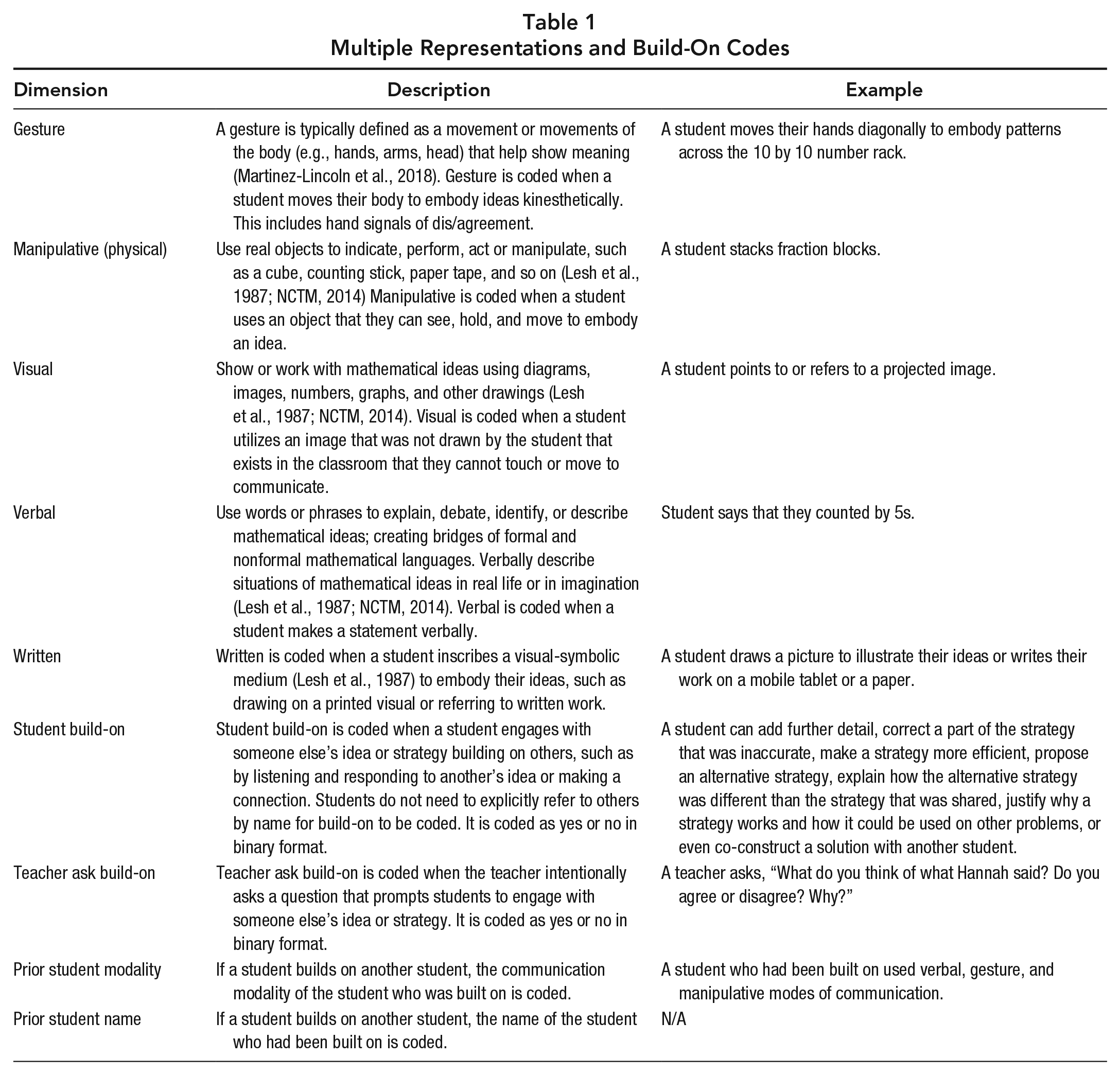
We added codes to capture embodied participation: the gestures, material resources, and interactions students referenced during communication (see Table 1). Specifically, we customized the observation tool to capture beyond verbal dimensions of contributions, aligned with representations of mathematics concepts (National Council of Tearchers of Mathematics, 2000): gesture, manipulative, verbal, visual, and written. 2 Except for verbal only contributions, all other representations were labeled as “beyond verbal” contributions, recognizing that student engagement exists beyond the purely verbal. If a student communicated using multiple representations simultaneously, then multiple dimensions were coded (e.g., a student could gesture alongside their verbal explanation).
Multiple Representations and Build-On Codes
Building on dimensions
Once we refined the beyond verbal codes, we recoded the entire data set. During this process, we noticed that students seemed to engage more with peers who were contributing beyond verbally. Theoretically, this aligned with conceptualizations of embodiment extended beyond individual bodies to encompass materials and people within a space (Sinclair & de Freitas, 2019). We created build-on codes to capture how teachers prompted building on, how students took it up, and the embodied modalities involved (see Table 1).
Illustration of the Measure
In this section, we illustrate the development and application of our measure: (a) identifying embodied participation, (b) interrater reliability, and (c) a brief and illustrative set of descriptive statistics of the data set.
Identifying Embodied Participation
We illustrate the process of identifying embodied participation with two vignettes of practice. Teacher and student pseudonyms are used for both vignettes. The first lesson was taught in Maura Cabatan’s first-grade classroom. The class student demographics include 71.4% Latine/Hispanic, 23.8% White, 4.8% Asian; 57.1% identified as English learner; and 23.8% have an individualized education program (for classroom demographics, see Table 2). The lesson concerned the number rack, which consists of 10 rows of 10 movable, colored beads in two sets of five beads (half red, half white) per row. The number rack provides a visual model to encourage building numbers in groups of 5 and 10, using doubling and halving strategies, and counting on from known relationships to develop more advanced counting strategies. In the lesson, Ms. Cabatan was orienting students to the structure of the number rack; they would use the tool to model addition and subtraction problems later in the week.
Gloria, you have a noticing?
I noticed all of these are 100. [Gloria brushes her right hand down the rows of her number rack]. [Verbal; gesture, manipulative]
And how did you count that?
I counted by 10s. [Verbal]
Can you come up here and show us how to do that?
[Gloria walks up to the teacher at the front of the room holding a larger number rack.]
[Counts out loud while touching each row of the teacher’s number rack.] 10, 20, 30, 40, 50, 60, 70, 80, 90, 100. [Verbal; gesture, manipulative]
Can someone revoice? How did Gloria count, Jaden? [Teacher ask build-on]
She counted by 10s [Student build-on; verbal]
Jaxon, did you have a different noticing?
Gloria’s contribution consists of Lines 2, 4, and 6, 3 which were coded with three modalities of verbal, manipulative, and gesture. All three modalities were present both in the use of her own number rack (Line 2) and in using the teacher’s number rack (Line 6), where she counts out loud by 10s as she touches each row (see Figures 1a and 1b). In Line 7, the teacher asks for a student to revoice; so, she is soliciting a student to build on to the contribution. Jaden (Line 8) verbally repeats what Gloria said and enacted with gestures on the manipulative (see Figure 1c). Next, the teacher asks Jaxon for a different noticing. This was not coded as a build on because it was not related to the prior contributions.
Participants and Classroom Demographics
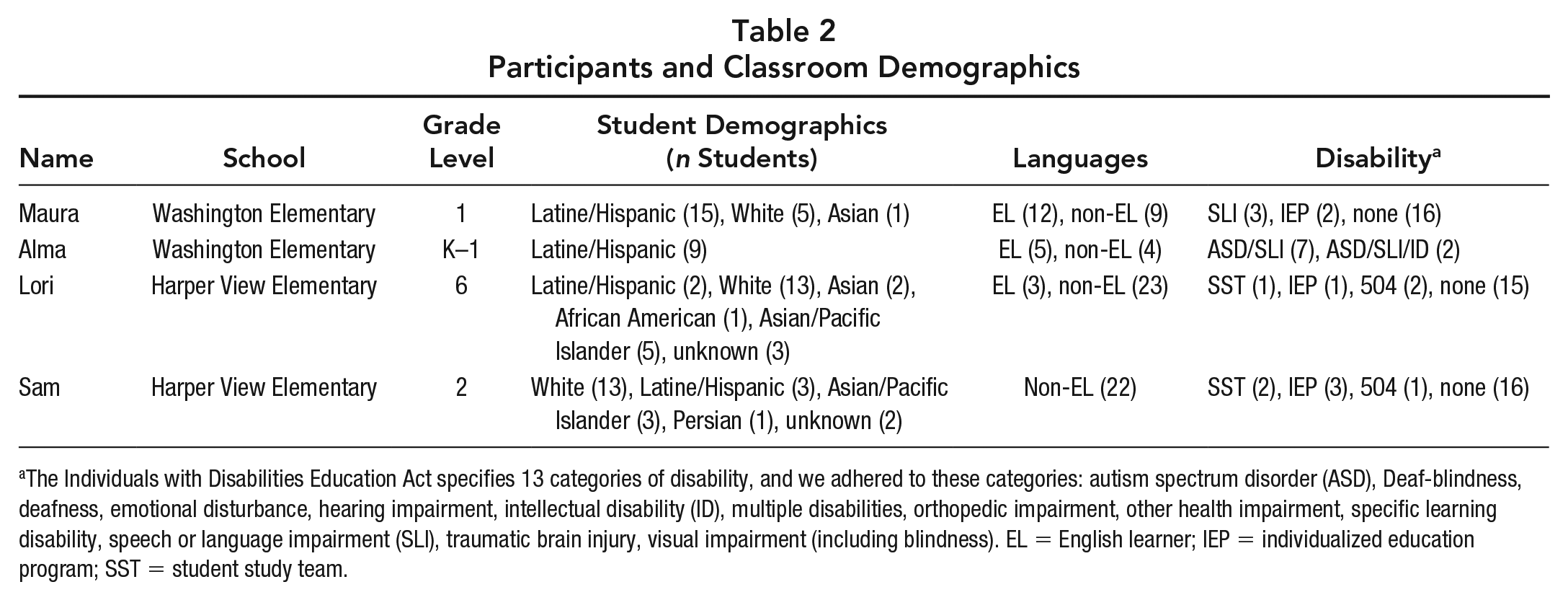
The Individuals with Disabilities Education Act specifies 13 categories of disability, and we adhered to these categories: autism spectrum disorder (ASD), Deaf-blindness, deafness, emotional disturbance, hearing impairment, intellectual disability (ID), multiple disabilities, orthopedic impairment, other health impairment, specific learning disability, speech or language impairment (SLI), traumatic brain injury, visual impairment (including blindness). EL = English learner; IEP = individualized education program; SST = student study team.
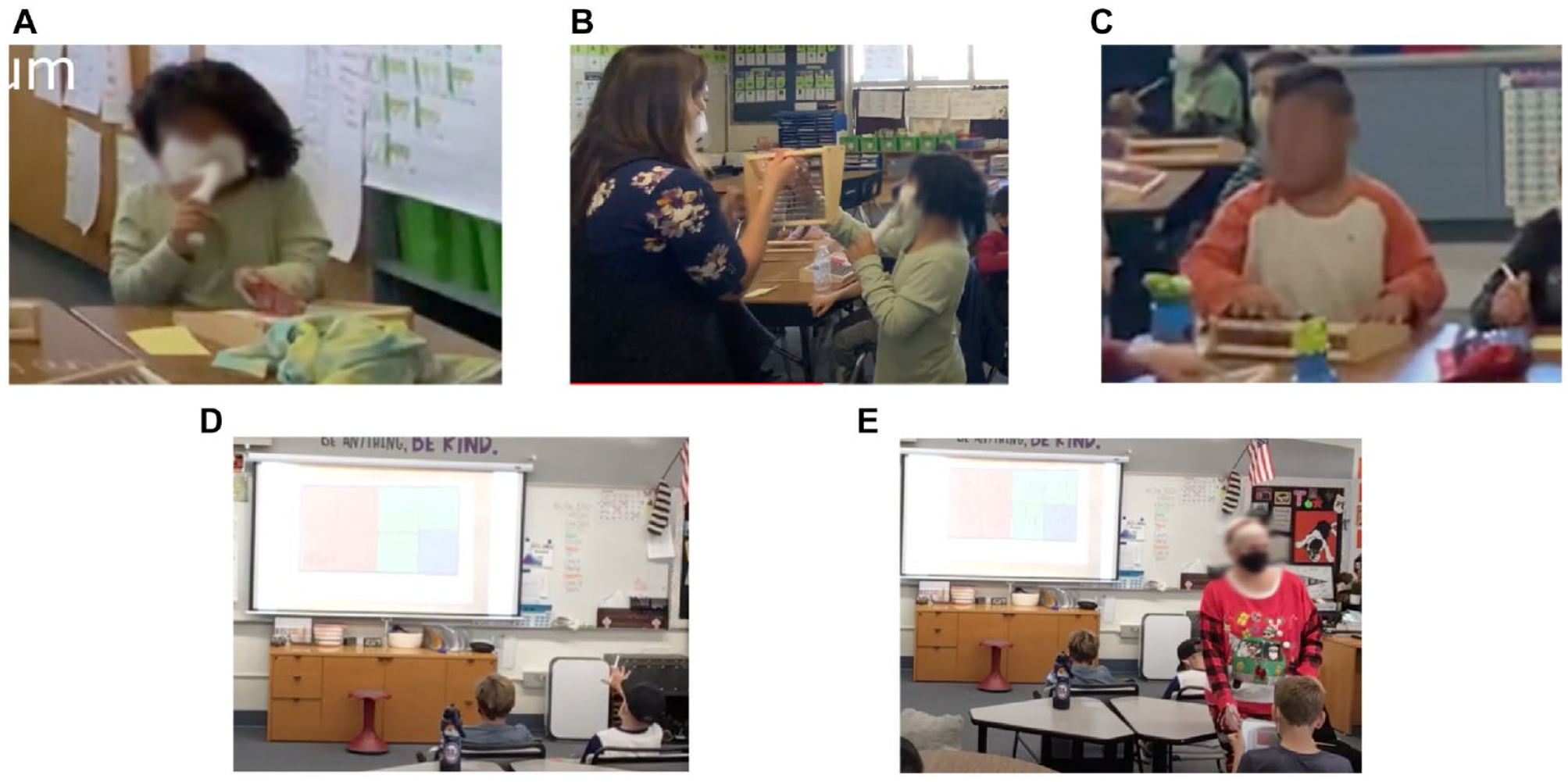
Screenshots from focal vignettes.
The second vignette captures a fraction lesson in Lori Rainier’s sixth-grade classroom. The class student demographics include 7.7% Latinx/Hispanic, 50% White, 7.7% Asian, 19% Pacific Islander, 11.5% mixed race; 11.5% identified as English earner; and 19% have an individualized education program (for classroom demographics, see Table 2). In the lesson, students examined fraction constructs within a part-whole relationship. A common misconception is that a fraction whole or part tells its size rather than the relationship between the part and the whole (e.g., ⅓ of a large pizza can be bigger in size than ½ of a medium pizza, although ½ is greater than ⅓). To support exploration of part-whole relationships, the teacher shifted the size of the whole (e.g., red, green, or blue region as one whole) and asked students to give and justify the fraction of other parts. The following is a lesson excerpt:
Who can do the blue? What fraction of the full is the blue? [Teacher points to the screen with the fraction image on display.]
I believe it is ⅛. The reason behind it is I used the blue and green, making it a square. . . . I just divided into four parts. [Teacher brings the iPad to Santiago with the fraction image on screen. Santiago draws and partitions the green square into fourths.] So I knew that would be four parts. The other side is a half. I do not know how to explain it properly. I just made it into fourths. And I know there is eight in total [Santiago points to the fraction image on screen and traces the lines drawn in the air] and the blue would represent ⅛ (see Figure 1d). [Verbal, written, gesture]
Would anybody like to restate what Santiago shared? James. [Teacher ask build-on]
[James uses the iPad to partition the larger rectangular shape into eighths.] So I think what he was saying is that he used this red square that is ½ and this is ⅛ [James points to ¼ of the partitioned red square; see Figure 1d]. [Verbal, written, gesture, student build-on]
Any questions on blue? Do we all agree it is ⅛? Let’s move on to the green. What fraction of the whole is the green?
Santiago’s contribution (Line 2) was coded as verbal, written, and gesture. In this case, Santiago was pointing to the projected image, which constituted a gesture. We coded this as written because Santiago was annotating the image by drawing a quadrant over the blue and green sections on the iPad. According to our coding scheme, this was not coded as visual, which was reserved only for visual images that a student could not manipulate. James builds on by revoicing Santiago’s thinking, and James’s work is coded as written, gesture, and verbal because, like Santiago, he is annotating and pointing to the image alongside his verbal explanation.
Interrater Reliability
Our aim was to create a measure that could be used reliably between raters to help ensure that the practical data we generate could be scaled and used with consistency by educators to support teaching and research goals across contexts. Establishing interrater reliability was an iterative process in which two raters each independently coded an identical portion of the data set and met to discuss their coding and calibrate their scoring procedures. During the calibration phase, a codebook was developed that included a definition for each dimension and included examples of what the code does and does not include. The raters consulted with the collaborating teachers to align with their understanding of the codes to ensure clarity and alignment with teachers’ goals. For example, we made the decision to distinguish written from visual contributions to classify visuals as artifacts in the room that students could not physically manipulate or annotate. As shared previously, the coding scheme evolved throughout the calibration process. After final calibration, we randomly selected four videos that each rater double-coded. These 248 double-coded contributions constituted 38% of the entire data set (N = 657). We calculated Krippendorf’s alpha using R Statistics to establish interrater reliability over eight coded dimensions. All dimensions achieved reliability of α >.95, indicating excellent reliability between the raters for the coding scheme. The remainder of the data set was coded independently by a single rater.
Descriptive Statistics
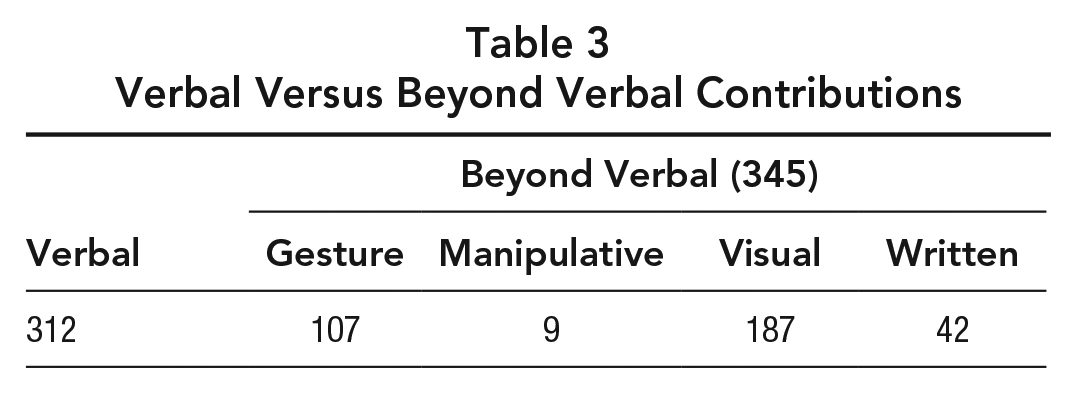
Here, we provide a brief set of descriptive statistics for the fully coded data set (all four teachers). Table 3 shows that 52% of contributions were beyond verbal. Across the data set, we identified a total of 50 instances in which students built on the idea of another student. In only 18 of these instances (32%) did a student build on verbal only contributions. In the other 32 instances (64%), students were building on a beyond verbal contribution. Reciprocally, there were 60 instances in which the teachers asked students to build on one another’s ideas, and only 25% were verbal only contributions, with 75% including beyond verbal components. Consistent with our hypothesis, this highlights the relationship between embodied participation through multiple modalities and the use of peers and classroom math materials as resources. A full set of results from the measure will be explored in a future article.
Verbal Versus Beyond Verbal Contributions
Discussion and Conclusions
We build on strengths-based approaches to teaching and learning that problematize deficit-based assumptions about multiply marginalized students (e.g., Annamma et al, 2013; Calabrese Barton & Tan, 2020). Our work recognizes the consequences of race, class, and other power asymmetries that impact classroom interactions and examines the potential for creating a practical measure—a classroom observation tool—that recognizes students’ bodyminds and the diverse ways of engaging with peers to learn mathematics. This article illustrates how teachers and researchers can work collaboratively to redesign an existing measure of participation to capture embodied engagement. An important component of the project was to privilege the teacher perspective. Our collaborative (re)design process conducted alongside teachers provides a greater likelihood that this measure will generate useful classroom data for teachers in other contexts. We briefly illustrated the coding process so that others can apply this measure to their contexts; excellent interrater reliability indicates the potential for others in adopting these methods. The goal of a practical measure is to support scalability and use across context. One of the challenges with this tool as currently operationalized is the human coding to generate results—which is time-consuming. We imagine the potential of artificial intelligence and computer adaptive coding of video images as possible solutions for overcoming this barrier but also caution that technology is not seen as a panacea to improving education.
This article addresses the gap in available practical measures for capturing embodied mathematical student engagement. This embodied measure makes an important contribution to the literature by creating new opportunities for the quantification of participation beyond just verbal and written forms and mathematics engagement beyond individual students alone, which helps broaden conceptions of student mathematical competences. Thus, our contribution complements existing studies of embodiment that have been historically dominated by qualitative research, opening opportunities for mixed-methods research and professional development. Although it is beyond the scope of this article to explore results from the coding, our brief presentation of descriptive statistics suggests our measure captured a considerable amount of beyond verbal embodied engagement that would have been missed by traditional measures.
This study suggests that new possibilities open when we begin the discussion of addressing educational inequities with the school community as codesigners. There is much fertile research ground to be explored in understanding how to engage with students, teachers, and the broader school community in co-constructing culturally responsive, engaging learning environments. Emerging forms of research-practitioner partnerships offer promising approaches for drawing on the expertise of teachers to inform educational design and research. In such an approach, students, teachers, and the school community are no longer problems to be fixed but, rather, codesigners, coresearchers, and educational leaders in transforming the mathematics educational systems toward equity.
Footnotes

This material is based on work supported by the National Science Foundation under Grant Nos. 1943146 and 2302773.
Notes
Authors
CATHERY YEH, PhD, is an assistant professor at the University of Texas at Austin, Department of Curriculum and Instruction, 1912 Speedway D5700, Austin, TX 78712;
DANIEL LEE REINHOLZ, PhD, is professor at San Diego State University, Department of Mathematics and Statistics, 5500 Campanile Dr, San Diego, CA 92182;
HAKEOUNG HANNAH LEE, MS, is a PhD candidate in STEM education at the University of Texas at Austin, 1912 Speedway Stop D5700, Austin, TX 78712;
MARIAH MOSCHETTI, MA, is a PhD candidate in mathematics and science education jointly at San Diego State University and the University of California, San Diego, 5500 Campanile Dr, San Diego, CA 92182;