Abstract
Building from established literature and his research, Milner introduces a framework for designing consequential research. The framework is constructed to help researchers design, identify, and assess research as potentially consequential. In particular, the framework is developed for researchers to intentionally include essential elements that might lead to consequentiality: research worth conducting because it identifies problem spaces with an explicit aim to solve, address, and improve them. Six interrelated principles shape the framework in designing consequential research: (a) understand and connect history, (b) respond to and advance knowledge base, (c) amplify researcher positionality, (d) reject essentializing and polarizing, (e) prioritize voices of those most marginalized, and (f) consider multiple dissemination outlets.
In this article, based on my analysis of extant literature and my own research, I introduce a framework, “designing consequential research,” and advance essential elements of it. This framework begins with several interrelated conjectures:
To design consequential research, we must understand and identify established research that has been, arguably, consequential.
Designing consequential studies necessitates a view toward how established research impacts how we think about and conceptualize what counts as research.
Research can be consequential whether intentionally designed for such a purpose or not.
In designing consequential research, it is essential to investigate how research has been conducted (process), with whom, and under what researcher relation to what has been studied (positionality), what has been studied, for what period of time, and under what conditions (priority), why research has been conducted (rationale), what has been learned from research (knowledge construction), potential implications and recommendations for research, theory, policy, and practice from research (actions and outcomes), as well as where and how findings, new, and expanded knowledge have been shared (knowledge dissemenation).
Consequential research outcomes are relative and must be ultimately decided by those who find value in them.
I argue “design” and “consequential” are and should be inextricably linked as we, as researchers, work to co-construct with those impacted by our study ways to address pressing challenges inside and outside of education. By design research, I mean systematic inquiry coplanned and coenacted with study communities to intentionally improve how research as a process is conducted and what is learned through careful study as knowledge is constructed to potentially transform outcomes of practice and policy. Although I have not explicitly referred to my work as design research over the years, I believe my research has been akin to design-based approaches and methods (Alvarez & Milner, 2018; Milner, 2005, 2006, 2008, 2011, 2016; Milner & Bennett, 2022; Milner & Smithey, 2003; Milner & Woolfolk Hoy, 2003; Murray & Milner, 2015). As president of the American Educational Research Association (AERA), the largest educational research organization in the world, I wanted to learn more about design research, my interest in consequentiality, and how I might learn from, critique, and contribute to a body of work that I have admired over the years. Years ago, very early in my career, Paul Cobb, design researcher and mentor, suggested that I was engaging in a form of design research—even before I attempted to name aspects of it as such. The appeal of design research for me was captured in how A. Collins et al. (2004) described goals of design research: The need to address theoretical questions about the nature of learning in context. The need for approaches to the study of learning phenomena in the real world rather than the laboratory. The need to go beyond narrow measures of learning. The need to derive research findings from formative evaluation. (p. 16)
Cobb et al. (2003) delineated five “crosscutting features that collectively differentiate design experiments from other methodologies” (p. 9), and these researchers stressed the centrality and salience of theory building in design experiments. Indeed, with colleagues and especially with communities, I have attempted to build theory, study real-world phenomena, and expand tools to study reality.
Designing consequential research is an ongoing cycle with researchers and research communities before, during, and after (Jackson, 1968) 1 studies. When we think about desired results from inquiry, a backward design approach (Wiggins & McTighe, 1998) helps researchers aim toward outcomes that can improve human social, affective, cognitive, psychological, and behavioral experience. For instance, researchers have advanced knowledge and its relevance through design research to address diversity and equity (Gutiérrez, 2015, 2016; Lee, 2010; Nasir, 2024; Pinkard et al., 2017).
This article has potential to support research and practice communities in at least two interrelated ways. First, as an epistemological framework, I invite researchers to evaluate, assess, and interpret existing research designs as (potentially) consequential. Second, researchers will be able to adopt and adapt the framework or elements of it in designing research studies committed to policies and practices of influence—those improve lives.
I am a Black man. I am a husband, father, professor, researcher, and teacher. I aspire for my research to be consequential in and with the lives of those most marginalized in society and education because I have experienced firsthand how structural and institutional inequity stifle educational opportunity. Throughout this article, I refer to four constructs with related importance. As a former high school English teacher, a former substitute teacher, and a former community college instructor teaching courses in developmental studies of reading and writing, I turn to the etymology of these important constructs.
“Consequential” is an adjective that describes or delineates a noun or object. In this regard, designing consequential research in the social sciences involves inquiry that through intentionality has a real bearing on what happens in action, such as resulting policy and practice.
“Consequence,” “consequentialism,” and “consequentiality” are nouns and can be considered actions and outcomes emerging and evolving from a process such as design research. In this way, consequential design research as a noun is a process that may result in consequence, consequentialism, and consequentiality, such as policy and practice of influence, action, or outcome.
With a discussion of how consequential, consequence, consequentialism, and consequentiality will be used throughout this article, in the next section, I focus on consequential research across disciplines as I attempt to introduce a framework for designing consequential research.
Consequential Research Across Disciplines
A wide range of disciplines has intentionally conceptualized and framed research for consequentialism. In the field of ethics, consequential research has been discussed as a moral act that might lead to positive or negative results. Philosophers have cautioned against designing studies for consequentialism because, in philosopher James Lenman’s (2000) words, “it is impossible to know the future” (p. 342). However, although we cannot know exactly what our futures hold, designing consequential research requires that we rely on the best of what we already know in our attempts to improve human conditions.
In health sciences, oncologists must consider cancer treatments based on patients’ health history and established research about health outcomes for practice. Researchers design studies to impact medical practices for life-enduring outcomes. Researchers in cancer research, for instance, design and examine what they called “theory-informed decision science” (Gillman & Ferrer, 2021, p. 2055) to assist in patient care. We can readily see and understand the necessity for designing consequential research when our health is on the line. I argue similar imperatives must be considered in the work of education and related disciplines.
Environmental economists Herriges et al. (2010) considered what they called consequences of consequentiality. They learned in a study about the potential relevance of a survey that participants found survey research useful to the degree that they believe in what surveys may tell us about knowledge and knowing. The point here is researchers have found that perceptions of relevance, benefit, effectiveness, and meaningfulness of consequential research depend on our views about tools, frames, interventions, theories, and processes used through inquiry. For instance, if as a research community we do not believe in what survey research can tell us, our interpretation of outcomes from that survey will be informed by that worldview or belief system. Similarly, if researchers do not believe in what deeply contextual case studies tell us about knowledge and knowing, the potential consequentiality of those case studies will be informed by our prejudgment and biases against that knowledge construction. Thus, designing consequential research requires broadening our worldview about what research tools can tell us about people, places, times, experiences, and possibilities for change.
Literature on consequential research and consequentialism consider subjective and objective ways of knowing, naming, and making sense of phenomena (Sosa, 1993). Political theorists have pushed discussions beyond localized contexts to include global consequentialism (Pettit & Smith, 2000). Furthermore, through quantitative and qualitive paradigms, researchers of finance and accounting examine “consequential loss” (Kylén, 1982, p. 98) in understanding what is necessary to build knowledge for both research and practice communities. In finance and accounting, design principles are necessary to ensure returns on investment portfolios. If investment bankers do not consider potential long-term risks, clients could lose money, and outcomes could have severe consequences to financial portfolios. Determining potential consequential effects of finance requires designing for and analyzing quantitative and qualitative data. Moreover, consequentialism and consequentiality are concerned with “needs and interests of those with whom [we] share [our] life” (Lenman, 2000, p. 370). Thus, designing consequential research demands that researchers interrogate the people with whom they associate, value, relate to, and care about – outside and inside their discipines and professions. Such an emphasis leads us as researchers to ask questions like “With whom do I share my life?” “Who do I relate to in the social world and why?” “With whom am I in community?” and “What community do I prioritize as a site for understanding and advancing consequential research for consequentiality?”
In sum, based on my review of literature across disciplines, I uncovered several themes: (a) Consequential research does not have to be designed to be consequential in process, knowledge construction, or outcome; (b) designing consequential research requires that researchers intentionally consider why they do the work that they do; (c) designing consequential research demands that we consider and uncover our beliefs and worldviews in our work; (d) structures and systems are essential to interrogate when designing consequential research; (e) designing consequential research in education seems necessary and applicable in quantitative and qualitative studies; (f) intentionally designing consequential studies can help minimize and avoid harm and risk to communities; (g) researchers stand to gain skills, knowledge, and tools in designing consequential research from studying local and global issues; (h) design research involves identifying root causes of challenges; (i) uncovering root causes of challenges are used to construct, test, and iteratively improve designs; and (j) consequential research as process may result in “good,” “mixed,” and/or unforeseen “bad” outcomes.
Examples of Research That Has Been Consequential
In this section, from my view, I discuss research that has been consequential. These studies do not necessarily draw from design principles; however, these studies have arguably produced a level of consequentiality in terms of how we might think about research and outcomes that have emerged in policy and practice because of research. As argued, consequential research may manifests whether designed to be or not. Although some consequential research has had obvious deleterious effects on educational progress from some communities, other research of consequence and influence has had more mixed outcomes, and still other research has had promising effects.
Next, I describe research that, arguably, has been consequential but also potentially harmful to particular communities. For example, research on the “bell curve” (Herrnstein & Murray, 1994)—what might be considered consequential research—contributed to a eugenics movement. This consequential research further exacerbated deeply troubling false accounts and narratives of intellectual and cognitive inferiority of Black people. In the 1940s, Kenneth and Mamie Clark conducted a series of doll tests (Legal Defense Fund, 2024) that brought about important awareness of early childhood racial identity development of Black children while simultaneously reifying arguably a fallacy that Black children rejected their racial identity due to color preference (white or lighter skin for many) of doll color pigmentation. These color pigmentation preferences were presumed to embody how Black children felt about their own and others’ skin tones and potential race. I argue that although these studies were important to bring awareness to the ways in which racism and threats of identity inferiority are “in the air” (Delpit, 2012; Steele, 1997), the consequential studies produced a kind of Black self-hate thesis, which has been difficult to overcome in theory, research, practice, and policy (consequentialism). For instance, in terms of policy, the doll tests were used to make the case for de-segregation in the Brown v. Board decision.
Another example of consequential research was that of the acting-white body of inquiry that perpetuated a narrative that Black students equated academic achievement with “acting white” (Fordham & Ogbu, 1986). This research sparked fierce debates and interests, querying whether – or at best – to what degree Black children (and by consequence, Black communities) valued education or academic achievement. In both examples of policy and practice recommendations emerging from the doll tests and acting-white studies, mainstream communities were able to place a locus of control and onus on Black and other minoritized communities and blame them for lack of success rather than deeply ingrained inequities and injustices within and outside of education.
Hart and Risley (1995) focused on literacy access and vocabulary access in homes and communities to address what they described as disparities in vocabulary development among young people from lower social economic status. This research was consequential and suggested that a major reason for lower vocabulary development of young children with fewer financial resources was a result of minimal exposure to vocabulary outside of school. Often criticized for feeding into and reifying a deficit view of communities, this research would suggest that somehow children with fewer financial resources were language and vocabulary deficient because their families did not expose them to a socially constructed robust vocabulary, which hindered their academic success. Although this study rightfully argued against a thesis that these students were inherently inferior, the researchers failed to recognize that these students were forcefully engaged in literacy development as families interacted with their children. However, families may not have been engaging with their children in a way that researchers would view as additive to their academic success in schools.
Consequential research can result in movements. For example, building on the work and genesis of Black and ethnic studies, multicultural education research resulted in a movement and helped inform, transform, advance, and improve policy and practice in curriculum, instruction, policy, assessment, leadership, special education, and teacher education. This work has been exceptionally consequential in how we conceptualize, study, and talk about cultural, racial, historic, linguistic, and contextual aspects and issues in education and beyond (Ball, 2009; Boutte, 2016; Delpit, 1995; Duncan-Andrade, 2016; Emdin, 2016; Foster, 1997; Gay, 2018; Harper, 2021; Irvine, 1990; Ladson-Billings, 2006; Lee, 1995; Love, 2019; Milner, 2020b, Milner, 2024; Muhammad, 2020; Price-Dennis & Sealey-Ruiz, 2021). Although not all consequential research will result in a movement, it has the potential to result in consequentiality to improve human conditions. Building on Black-centered histories, frameworks, and tools (Anderson, 1988; Fenwick, 2022; Shockley & Lomotey, 2020; Spencer & Dowd, 2024; Walker, 1996), researchers and scholars of the multicultural education movement made it possible for scholars—many placed on the margins—who pushed against traditional, Eurocentric, and Westernized ways of knowing to produce, publish, and gain funding for their programs of research. Multicultural education research (Banks, 1992; Gay & Banks, 1975, Grant, 2014; Howard, 2020; Sleeter, 2014) has been pivotal in the examination of race, class, and gender (independently and in confluence) toward opportunity structures in school and broader communities.
This body of research has been consequential for many reasons. For one, prior to these studies, it can be argued that mostly White and male researchers dominated discourses about what was essential to study, why, and how, as well as in what outlets. These mostly White, male social science researchers controlled publication outlets—such as journals—and funding mechanisms to support research and innovation. Pushing back against and disrupting Westernized cannons of knowledge construction and knowing – the idea that objective, quantitative studies were the only ones that mattered, researchers have helped expand our ontological, axiological, and epistemological (Banks, 1998; P. H. Collins, 2000; Dillard, 2000; Frierson, 1990; King, 2017; Ladson-Billings & Donnor, 2005; Milner, 2007; Milner et al, 2024a.; Sheurich & Young, 1997; Tillman, 2004) frameworks, tools, and ways of knowing and knowledge construction.
The multicultural education movement also helped shepherd researchers into adopting and advancing critical race theory from critical legal studies into education as an essential conceptual tool (Ladson-Billings, 2004; Ladson-Billings & Tate, 1995; Lynn & Dixson, 2022; Solorzano, 1998)—critiquing a race, gender, and class analysis for a more concentrated focus on race. Scholars found that an interrogation of race alone was necessary to theorize about because the field was undertheorized related to race and often conflated important issues. To be clear, from my view, consequential design research has much to learn from the consequential research described in previous paragraphs in this section.
Design Research
My review of extant literature regarding design research reveals that the majority of studies have been about learning and from learning scientists with a range of disciplinary expertise. My gaze of my research has not been learning and the learner for most of my career but teaching and teachers—although there are obvious connections between and among learning and teaching theory. I have learned that researchers, drawing from the work of Ann Brown (1992) and Allan Collins (1992), may refer to the essence of their work as “design experiments,” whereas others refer to the nature of their research as “design-based research” (Sandoval & Bell, 2004).
Although design-based researchers or design experimenters may conduct their research in an urban context, like my work over the years, rarely do they draw on the work of those who center equity, with exceptions, of course (e.g., Gutiérrez, 2023; Nasir, 2024). In this way, my desire is to marry or bridge elements of design-based research with urban education and equity research and theory. I have described elements of inequity in urban contexts as opportunity gaps (Milner, 2020b), and I have attempted to co-construct ways of testing mechanisms to address opportunity gaps as opportunity-centered policies and practices. (Milner, 2023). Design-based researchers and experimenters seem to have similar intentions—to identify challenges, build tools to improve those challenges, and test those tools to determine their effectiveness and relevance for potential transferability to other contexts.
Design researchers point out the messiness and difficulties of design-based research. Cobb et al. (2003) expressed the possibility of the approach to research, describing it “with high promise but also with a host of characteristic difficulties that researchers need to manage effectively to achieve that promise” (p. 13). In this way, the framework I present in this article likely has promise—even amid critiques that likely will emerge from its introduction and advancement. Still, I press forward because I believe in the potential to help researchers work with communities to get better; I want our work in education to have far more impact than an intellectual exercise to benefit those in the academy.
In making sense of design research, I draw from Jackson’s (1968) work in Life in Classrooms, which served as a forerunner in research on educator planning. I began my research as a doctoral student at The Ohio State University, examining how teachers designed curriculum practices with young people racially, ethnically, and social economically different from them. Jackson identified cognitive and conceptual differences in planning of educators before (preactive), during (interactive), and after (postactive or reflective) classroom interaction. Planning, designing and implementing research follow similar phases: preparation before a study, enactment of a study, and analyses and reflections of a study. The preactive phase—the early aspects of research and design features of research—involves a process of institutional review of human “subjects,” constructing research teams, systematically reviewing literature of a topic, identifying research questions, and recruiting research participants.
An interactive phase of research concerns processes of implementing and carrying out research. This interactive and interative work may include analyses of documents, interviewing, (participant/researcher) observations through video, and field notes. The interactive phase of research is where data collection is taking place and researchers are making concretized decisions about questions they pose in interviews, which questions to reorganize and revise based on what they learn from observations, and what documents would be essential for them to study. This iterative phase also involves designing, redesigning, and testing conjectures toward improvement.
The postactive and reflective phase of research includes the ongoing process of organizing, analyzing, and interpreting data from data collection phases, the interactive phase of research. 2 The postactive phase of research often involves systems researchers put in place to organize, sort, and write up findings from a study. It is important to understand that these phases of research design and enactment are interrelated. Furthermore, the postactive phase of one research study informs the preactive phase of another, where new questions are posed and carried forward in the same or a new study. As I introduce a framework in designing consequential research, I hope readers will consider Jackson’s (1968) three phases of planning (preactive, interactive, and postactive) as necessary aspects of research design.
A Framework for Designing Consequential Research
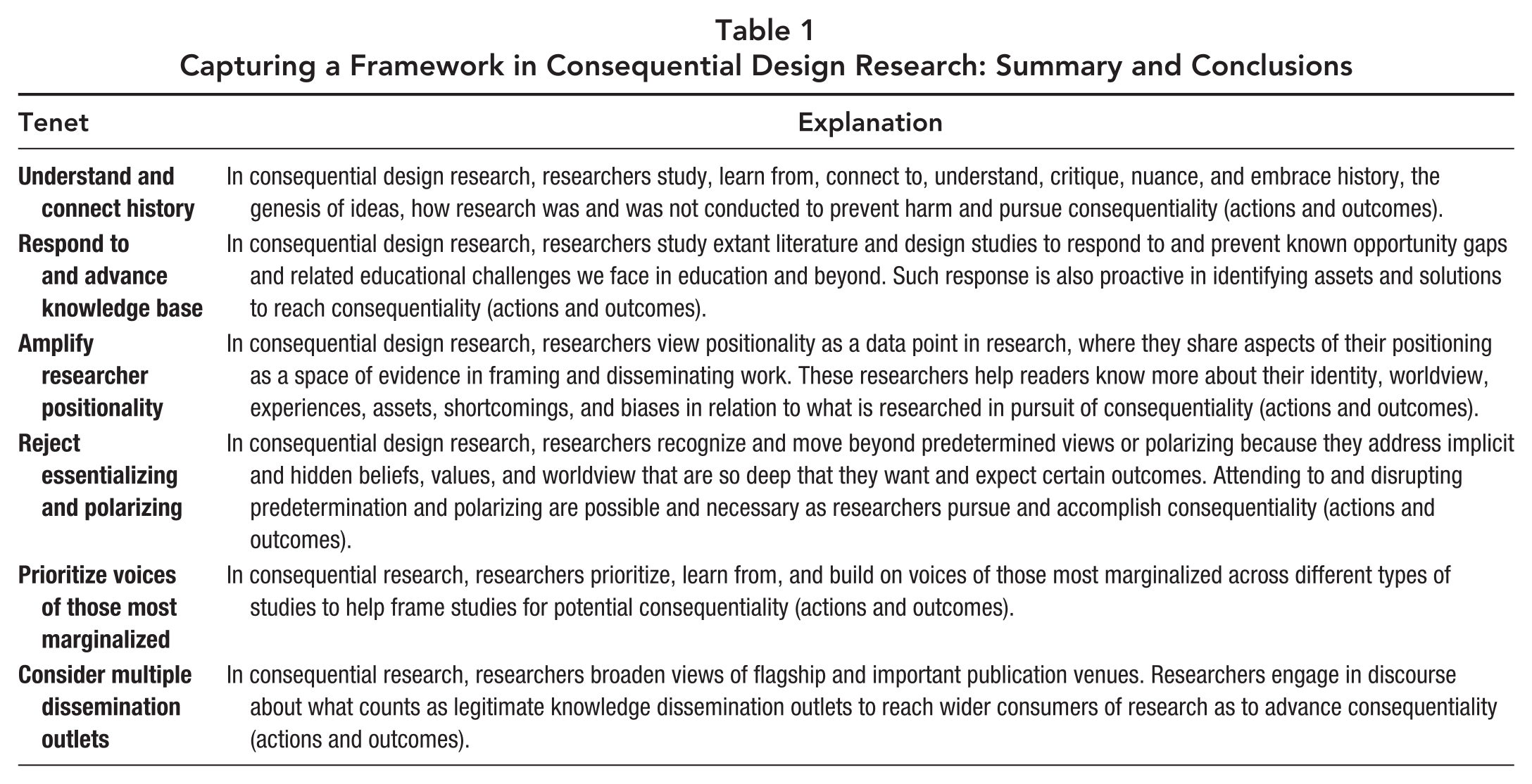
What tenets propel researchers in deliberately designing consequential studies that help build and improve structures, systems, organizations, and institutions—those that improve lives, experiences, and outcomes especially with those most grossly underserved and marginalized inside and outside of education? I am hopeful that this framework, drawing from the work of others and my own research, helps us as a research community build and advance research studies that make a difference in outcomes. I detail six interconnected tenets for identifying, assessing, naming, and designing consequential research: (a) understand and connect history, (b) respond to and advance knowledge base, (c) amplify researcher positionality, (d) reject essentializing and polarizing, (e) prioritize voices of those most marginalized, and (f) consider multiple dissemination outlets.
I invite researchers to design, evaluate, and assess existing research as (potentially) consequential as articulated through the tenets herein. Moreover, the framework invites researchers to adopt, adapt, and design research studies building on the features discussed here. In this way, researchers may develop interview protocols, survey instruments, observation tools, and document analyses, among other techniques, in pursuit of designing consequential research for consequence, consequentialism, and consequentiality. More than a set of predetermined research methods, designing consequential research is a way of thinking and viewing research through a worldview of co-constructing questions, problems, and issues worthy of investigation with communities most directly impacted by problem spaces.
Designing consequential research begins with the premise that research must attempt to be harm preventive. Although it is impossible to know to what degree, if any, designing consequential research will improve or cause harm, researchers must engage with communities to do everything possible to prevent harm. It is important to note that institutional review boards provide one layer of protection against harm in research; however, when attempting to identify and improve some of our most pressing challenges, researchers must be intentional in harm prevention as well. Arguably, understanding and operationalizing tenets of this framework can help mitigate and circumvent harm in designing research.
Understand and Connect History
Historicizing is germane to harm prevention. Drawing from years of research, Gutiérrez (2023) explained why designing for and documenting student learning includes “historicizing concepts and ideas through readings” (p. 92). Gutiérrez wrote: “Understanding the past can serve as a resource in the present—an understanding that can help us design our futures as individuals in collectives, to design collectives in which individuals flourish” (p. 85). Furthermore, building on years of research on learning and design research, Brown (1992) emphasized the need for future work to connect “history of prior attempts to reorganize school and work environments” (p. 174).
Understanding history, the genesis of ideas, how research was and was not conducted, and what problems have been studied and those that have not and analyzing findings from existing studies help design researchers situate and advance principles, conjectures, and experiments for potential improvement. Historian James Anderson (1988), when discussing educational experiences of Black children, wrote: Black [people] emerged from slavery with a strong belief in the desirability of learning to read and write. This belief was expressed in the pride with which they talked of other ex-slaves
3
who learned to read or write in slavery and in the esteem in which they held literate Black [people]. It was expressed in the intensity and the frequency of their anger at slavery for keeping them illiterate. (p. 5)
As a point of explanation, research designs about literacy (reading, talking, and writing), then, necessitates a survey of historical trends regarding Black people and literacy. Focusing on historical assets, as Anderson described from his deep archival research, is important. Although understanding sociopolitical contexts of studies and not essentializing are necessary, design researchers pressing toward consequentiality do not advance studies without reading carefully, widely, and deeply about historical interconnectedness to their current research.
Furthermore, extant history literature tells us Mexican Americans have not been well portrayed in social science research. Romano-V (1968) explained that social science[s] . . . have dealt with Mexican-Americans as an ahistoric people — with a place in history reserved for them only when they undergo some metamorphosis usually called acculturation. Consequently, Mexican-Americans are never seen as participants in history, much less as generators of the historical process. (p. 13)
Where consequentiality of learning is concerned, Hall and Jurow (2015) stressed the need to historicize, to change practices in communities, and engage with “people and tools over time and across settings” (p. 176).
Especially in policy, history shows the 1954 Brown v. Board of Education of Topeka decision, which ended legal segregation in the United States, was highly consequential in education (W. T. Trent, personal communication, 2022) for those most marginalized in society. Fenwick (2022), Walker (2020), and Spencer and Dowd (2024) found devastating effects of the decision, particularly for Black communities. For instance, Ladson-Billings (2004) described the Brown decision as “landing on the wrong note,” and Tillman (2004) detailed “unintended consequences” of the decision. Design researchers must be diligent in reading, understanding, and drawing from history. In short, studying history helps design researchers understand and name how their current study is contextual; design researchers can identify and build questions to explore as they research what has and has not been centered in the past.
Respond to and Advance Knowledge Base
In addition to being harm preventive through grounding studies in history, consequential design research should be responsive to what is worth studying and potentially consequential. Based on what we know from research, what are salient and essential areas to address opportunity gaps and center opportunity practices and policies, for instance? I argue we need robust, persistent, deliberate, and unapologetic consequential designs to address, disrupt, and redress gaps and challenges, such as (a) disproportionate referrals of Black and other minoritized students to the office to punish them for “misbehavior” (Milner, 2017; Skiba et al., 2002; Winn, 2018); (b) disproportionate suspensions and expulsions of Black and other minoritized students, such as those with disabilities and living below the poverty line (Williams, 2024); (c) serious negative effects of poverty on student outcomes (Lareau, 2003; Noguera, 2011); (d) intensified marginalization of LGBTQIA+ students (Brockenbrough, 2016; Leyva, et al., 2022); (e) poor and inadequate funding (Milner 2015); (f) underrepresentation and underenrollment of Black and other minoritized students in STEM areas (Joseph, 2022; Martin, 2009; McGee, 2020; Moore, 2016); (g) low numbers of Black students in gifted and talented programs (Ford, 2013, 2015; Pearman & McGee 2022; Wallace et al., 2018); (h) overrepresentation of students of color and other minoritized students in special education (Artiles et al., 2006; Blanchett, 2006; Morgan, 2020); (i) inadequate collaborations and partnerships between schools and the families and communities they serve (Delale-O’Connor et al., 2020; Edwards, 2016); (j) low and declining numbers of teachers of color in the teaching profession (Bristol, 2020; Farinde-Wu & Fitchett, 2018); (k) myths about achievement and socialization of Asian American students as “models” (Milner, 2023); (l) cradle-school-to-prison intersection (Milner, 2020a); (m) unresponsive and inadequate leadership practices (Milner, 2023); (n) underdeveloped mental health services in schools and communities (Milner, 2023); (o) narrowing of curriculum that pushes out the arts and physical education (Milner, 2023); and (p) amplification of curriculum censorship (Abrams, 2023).
In short, desinging consequetial research demands that we respond to and advance knowledge. We respond to and advance knowledge base through our study of existing literature and history. The issues I share in this section provide a snapshot of focal areas essential, from my view, to penetrate ongoing challenges we face in education. A central question to ponder in designing consequential research is: Based on known problems, injustices, inequities, strenghts, assets, and solutions in education, what is necessary for researchers to address to [further] improve outcomes for our collective wellbeing?
Amplify Researcher Positionality
I argue positionality should be viewed as a data point within itself in research, related to the problem spaces explored. Researcher positionality involves researchers sharing aspects of their positioning as a space of evidence that helps readers know more about their identity, worldview, experiences, assets, shortcomings, and biases in relation to what is researched. Researcher positionality is not a static statement that is copied and pasted from one research study to another. Research has the potential to be consequential when researchers consistently engage with positionality to situate themselves in research they are conducting. For instance, knowing more about past experiences and connections researchers have had related to an issue, understanding researchers’ worldview, and studying researchers’ motivation for investigating an issue can help consumers of research better capture what they read and come to understand. Much has been written about the role and salience of researcher positionality and what has been conceptualized as researcher standpoint emerging from Marxism and feminism (Harding, 1991; hooks, 1984). Building on this work, I argue all researchers and publication outlets should reimagine and amplify the role of researcher positionality in research—not just qualitative researchers and outlets publishing qualitative research. Through researcher positionality in the context of designing consequential research, we must ask questions like Who am I as a researcher? How do I enter in this world and work, with whom, on whose behalf, and why? Is researcher positionality among researchers detailed in research design and research dissemination? What does knowing and understanding researcher positionality tell us about the research being conducted and what is and is not discovered through the study? Overall, the framing question is: Where is the researcher in designing consequential research?
Researchers are not void of privileges, joys, strains, stresses, expectations, and pressures of the world. Because they are not robots, researchers are impacted by their social reality, which shapes the questions they pose, with whom, why, for how long, and on whose behalf. Increasingly, journal editors are requesting and/or requiring researchers to include what they call positionality “statements” in the submissions and publications of manuscripts (see e.g., Journal of Diversity in Higher Education, School Psychology, Urban Education, and Journal of Educational Psychology). Although these statements are indeed a step in the right direction in the journey to help consumers of research identify, make sense of, critique, and understand researchers’ roles in research, positionality sharing should be much more robust and not just a statement (Boveda & Annamma, 2023; Milner et al., 2024a).
Some may push back against the idea that positionality be seen as a data point because other fields do not centralize researcher positionality in this way. But if we lead and not follow other fields, we can be trendsetters in how research communities understand the role and possibility of designing research centering positionality as a central feature. If as researchers we are sharing our identity and positioning as we concurrently share what we learn from a policy analysis, a set of qualitative interviews and observations, or a regression analysis, we have the potential to understand a deeply conceptual and contextual layer of why questions were posed, how, with whom, and what was learned from the study—potentially contributing to consequentiality.
Researcher positionality as a data point means that we consider the roles of researchers in (a) what we choose study; (b) the nature and essence of research questions we pose; (c) the methods and methodologies we employ; (d) recruitment strategies and populations sampling; (e) data collection tools we employ; (f) documents, such as policies, legislations, and laws, we analyze; (g) interpretation of findings; and (g) with whom and how—that is, the dissemination outlets we choose to share our research.
Reject Essentializing and Polarizing
It is critical that designing consequential research does not engage in essentializing and polarizing. Put simply, individuals and communities of people are not a monolith. Designing consequential research demands that researchers pose questions that lead us to answers to questions that are not predetermined or polarizing because our beliefs, values, and worldview are so deep that we want and expect certain outcomes. Although it is common and appropriate for social scientists to begin research studies with a set of hypotheses or conjectures, positioning and centralizing our worldview can be a challenge if we essentialize and view any person, institution, community, or situation as all the same. Moreover, in designing consequential research, we must work against outcomes that do not emerge from carefully coconstructed studies.
Through frameworks of essentializing and polarization, people are viewed as either good or bad or right or wrong, and policy and practice are viewed as either effective or ineffective. Similarly, people are either “criminals” or not, and it is difficult to understand how multiple views and realities can and do live in and through one person, place, or entity under study. In other words, designing consequential research requires that we work intentionally to avoid essentializing and polarizing as we attempt to build and advance knowledge with communities.
Prioritize Voices of Those Most Marginalized
Designing consequential research also necessitates that we prioritize, learn from, and build on voices of those most marginalized. As researchers, we must prioritize voices of those most vulnerable as we identify problem spaces necessary to investigate even when our research is not directly tied to interview or voice-related studies. In other words, when designing for consequentiality, we can gain insights about survey construction, document analyses, or systematic observations, for example, by talking to people who know about policies, practices, contexts or situations in real time or based on their experience. Prioritizing voice can help throughout an entire design research enterprise. Cobb et al. (2003) centralized the role of preservice and in-service teachers as essential to design experiments. In this sense, teachers as part of a research team or collaborators in design research can help bring issues on the margins to the center of what might be consequential. In essence, as researchers inside (emic) and oustide (etic) of a research process, we can miss important insights, experiences, interactions, movements, and moments; learning from those placed on the margins can be powerfully educative when we view and honor their voice as legitimate and needed to know more. An important question is: Does or how might designing consequential research draw from and learn with individuals and communities of those most often placed on the margins?
Attempting to prioritize the role of those too often marginalized and unheard in schools and society, Laura Fittz (doctoral student), Dena Lane-Bonds (former postdoctoral fellow and assistant director at the Initative for Race Research and Justice at Vanderbilt University), and I codesigned a study where we investigated perspectives of high school students from across an urban emergent community (Milner, 2012). In this cross-community dialogue study, students represented a range of different school types, including public schools, public charter schools, independent schools, and public magnet schools. As the United States becomes increasingly politically and socially polarized, the aim of this study was to examine student developmental interest and capacity to civilly engage with others on topics that we struggle with most as adults. Centralizing student voice, we attempted to design a consequential study to support young people in (a) developing leadership skills and ability to facilitate tough conversation, (b) fostering and modeling civil discourse, (c) building cross community friendships with diverse others, and (d) cultivating a toolkit with strategies to talk with others about issues that can be difficult to discuss and potentially divisive.
In essence, what we have learned from this cross-community dialogue study was young people tend to be ready to talk about difficult issues and to move our lives and work forward to make our world better while adults, quite often, struggle because of their prejudice, privileges, and fear of losing what they believe they have rightfully earned (Parks & Milner, 2024 in review). But to be sure, marginalized voices that are most relevant are contextual: These voices may be community members, those in the carceral system (Milner et al, 2024b), teachers, family members, and/or parents. Designing consequential research counts the voices of the marginalized as central to knowledge construction. Researchers might ponder whether any study can result in consequentiality without learning from and centralizing those most marginalized. The point is researchers across disciplines, paradigms, and contexts engage those most marginalized in design research.
Consider Multiple Dissemination Outlets
Designing consequential research requires that we maintain scholarly, rigorous engagement with each other through peer review in academic outlets while broadening our view of what counts as legitimate knowledge dissemination outlets. As we pursue consequentiality, we must ask how the American Educational Research Association (AERA) has fared in accepting and publishing articles focusing on those most marginalized. For instance, publications about Black children and Black communities have not always been well represented in AERA-sponsored outlets; when Black communities have been units of analysis in these outlets, they have often been presented in troubling, pathological ways. In AERA and at the time of the publication of this article, we have seven journals: (a) the American Educational Research Journal (founded in 1964), (b) Educational Researcher (founded in 1972), (c) Educational Evaluation and Policy Analysis (founded in 1979), (d) AERA Open (founded in 2015), (e) Journal of Educational and Behavioral Statistics (founded in 1976), (f) Review of Educational Research (founded in 1940), and (g) Review of Research in Education (founded in 1973). An examination of these “flagship” journals regarding publications focused on Black communities reveals some troubling trends. For instance, since its inception, the Journal of Educational and Behavioral Statistics has had almost no publications with the following titles and keywords: Negro, African American, Black, White, whiteness, race, racism, disadvantage, at risk, marginalized, color, of color, urban, minority, minoritized, and marginalized, followed by Educational Evaluation and Policy Analysis.
With the lack of knowledge construction in these areas and the number of fiscal resources made from testing and evaluation companies, it is shameful that the knowledge base (at least with these keywords and in certain journals) has not kept pace. An essential question for us to ponder in designing consequential research is: Does and to what degree do we consider multiple modes of knowledge sharing from research, particularly when some of our most rigorous and well respected journal outlets have not published and will not publish research essential for the advancement of knowledge in some communities? In short, although we should pursue high-quality research outlets for our research, to achieve consequentiality, we must publish our work in practitioner outlets, newspapers, blogs, and other outlets. Journal editors can be gatekeepers of knowledge and knowing, and we need to help ensure a more balanced corpus of research is published in our field. Our knowledge dissemination as well can manifest through other modalities, such as art, oral presentations, podcasts, music, films, and theatre.
However, this tenet of designing consequential research goes for naught if those decision makers in institutions, because individuals make systems, do not see benefits of multiple modalities of knowledge sharing. For our worldview of dissemination to shift for broader consequentiality, those in decision-making spaces must embrace multiple outlets for broader consumption.
In Table 1, I attempt to summarize and capture explanations of the presented tenets of this framework of designing consequential research. I argue that (a) to be a quantitative researcher is not enough; (b) to be a qualitative researcher is not enough; (c) to be a theorist is not enough; (d) to be a producer of scholarship is not enough; (e) to find fault and blame everywhere outside of our research, policy, and practice communities is not enough; (f) to be critical is not enough; and (g) to be “woke” is not enough. We should be pursuing consequentiality in our work because researchers have potential to identify, with communities, some of the most critical aspects in education and society to help improve and make the world a better place for all of us. Although we are facing political, policy, and practice challenges unlike any some of us have experienced in our lifetime, we must keep pressing as we pursue a true democracy designed such that each of us can live full and meaningful lives.
Capturing a Framework in Consequential Design Research: Summary and Conclusions