



Abstract
This article shares our university center’s efforts to act as a boundary spanner supporting colleagues across our university to contribute collectively to more equitable educational opportunities for local K–12 students and their teachers. We focus here on the ongoing critical reflection and collaboration needed to tap such university resources to support K–12 students typically underresourced and underserved in K–12 systems. We consider examples and challenges of our work through five equity-oriented principles. We seek to highlight the role of research-practice teams on campuses that help (or could help) university partners contribute to local K–12 schools, programs, and systems with equity in mind. Finally, we hope to convince other higher education institutions to leverage their resources more to grow K–12 education opportunities locally where needs are greatest.
Colleges and universities are filled with people who are not education researchers but have much to offer local K–12 teaching and learning. We thus ask a pointed question in this conversation starter. How can university-based teams of education researchers and K–12-focused expert practitioners 1 help leverage campus partners in other fields, roles, and disciplines to contribute to more equitable and enriched learning opportunities for local K–12 students and their teachers? Specifically, how can such work be shaped purposefully for equity—to better support students particularly underserved in K–12 systems and underrepresented in higher education?
Universities have much to offer in a necessary quest: improving local access to high-quality K–12 opportunities to learn. Deep funds of knowledge exist in every household and neighborhood (Moll et al., 1992). Yet structural inequalities persist along many dimensions, with many low-income students, students of color, and immigrant students experiencing particularly insufficient access to needed and enriching opportunities to learn in school classrooms and courses, extracurriculars, libraries, museums, nonprofits, and internships (Carter & Merry, 2021; L. Darling-Hammond, 2010). These disparities limit local pathways to college and careers (National Academies of Sciences, Engineering, and Medicine, 2019), stunting the local “prosperity grid” for all (Reno & Gumus-Dawes, 2010). In any location, a key aspect of equity effort is proactively expanding access to high-quality learning opportunities in schools and informal settings ( K. Darling-Hammond et al., 2022; Noguera et al., 2015; National Research Council, 2009; Pinkard, 2019), making more inspiring, rigorous, and community-relevant opportunities to counter local opportunity insufficiencies (Pollock, 2017). Such opportunity expansion ultimately seeks to enhance collective well-being (powell, 2023), as more local youth pursue degrees and related careers and people learn to improve opportunity together in shared schooling systems.
So, how can universities contribute? Our university-based center (Center for Research on Educational Equity, Assessment, and Teaching Excellence [CREATE]) has asked this question generally for 25 years as a campus “boundary spanner” organization (Weerts & Sandmann, 2010) working with K–12 regional, district, and school leaders, teachers, and informal education providers to pursue more equitable K–12 college preparation in our large Southern California region. Our center was charged by the state university system to support local K–12 student preparation toward equitable college access for low-income, first-generation, underrepresented college-goers
2
(Mehan et al., 2010; Quartz et al., 2017). Today, our center houses federal- and state-funded college access programs supporting local student college preparation, regional professional development (PD) organizations supporting K–12 in-service teachers, and researchers committed to local K–12 research-practice partnerships (Penuel et al., 2020; Peurach et al., 2022). As a center with “equity” literally in our name (
At the time, our K–12 partners often asked us for university contacts in specific disciplines for their grants, programming, and teacher PD efforts. Campus partners were talking separately about how K–12 preparation affected both college success and local employment. And crucially, we realized that large funding organizations were already driving broader university faculty interest in K–12 contributions. A key example was the National Science Foundation’s (NSF) long-standing requirement that scientists and engineers engage in “broadening participation” and “broader impact” (BI) efforts to communicate research and engage the public in learning opportunities (Advancing Research Impact on Society [ARIS], 2020; Komoroske et al., 2015; Lupia, 2021; Woodson et al., 2021) while also improving pathways to degrees and career fields. 3 We realized that such expectations could build will and funding for potentially sustained K–12 projects and contributions by many on our campus.
So, for the past decade, learning how to support other campus colleagues (from STEM fields particularly) to make greater K–12 contributions has become a deliberate focus of our work. And as equity-oriented education researchers ourselves, we have worked specifically to learn how colleges and universities might play a larger role than some currently do in supporting local students typically underserved and underresourced in K–12. Although we know well that such university contributions cannot remedy all structural K–12 inequalities, we now believe strongly that carefully maximizing a university’s collective K–12 contributions can make a campus an even more valuable community asset. We describe a key realm of university-wide contributions here: contributing to K–12 teaching and learning.
Many other researchers have also argued that in addition to producing public knowledge, universities, as local “anchor institutions” (Birch et al., 2013; Porter et al., n.d.), should be obliged to use their resources for improving local well-being, including growing more local talent (Dostillo, 2017; Walshok, 1995). Some argue that large public universities funded by taxpayer dollars and private universities that should better support local economic development are particularly obliged (Hatcher et al., 2020, p. 36; Marginson, 2014). Scholars calling for “P–20 partnerships” emphasize “the responsibility that higher education has to improve the public good” through supporting local equity-oriented college preparation efforts particularly (Núñez & Oliva, 2009, p. 333). Many education researchers pursue robust local partnerships in their own work, engaging deep questions about how education researchers can participate in truly equitable K–12 opportunity expansion (e.g., Bang et al., 2010; Clarke et al., 2022; Peurach et al., 2022; Pinkard, 2019). For a decade, our work as a team of education researchers has focused on collectively leveraging for student benefit an additional undertapped resource: K–12 contributions from university colleagues from other disciplines, roles, and fields. 4
We note before proceeding further that our large university’s localized focus is both typical and not. Our university is explicitly charged with serving the state (Mehan et al., 2010). Our very large region is both segregated and highly diverse, with low-income/first-generation students, often predominantly students of color, often clustered in specific schools, neighborhoods, and districts. Furthermore, approximately one in five of our undergraduates is prepared locally, with their K–12 preparation a concern for all campus sectors. Our university also values faculty contributions to diversity and community in promotion processes, supports several formal partner schools (including one on campus) preparing all low-income/first-generation youth for college (Mehan, 2012), and was led throughout the decade described by a community-oriented chancellor committed to campus accessibility, including via increased scholarships for low-income students (Johnson, 2019). Many campuses nationwide also seek to contribute locally for similar reasons, including student preparation, recruitment, community engagement, and public relations (Weerts & Sandmann, 2010), as seen, for example, in the growing field of community engagement professionals in higher education (Dostillo, 2017) and the world of service learning and in a growing variety of institutional initiatives more proactively linking universities and K–12 (Núñez & Oliva, 2009; William T. Grant Foundation, n.d.). We have found that many colleagues on campuses are also authentically excited about contributing to local education or are already doing so—and funders’ (and local employers’) hopes for “outreach” efforts, “broader impact” (ARIS, 2020), and K–12 preparation increasingly incentivize such contributions.
So, how might education research-practice teams help maximize contributions from other campus colleagues so they benefit local young people, particularly those most underserved in local systems and underrepresented on college campuses? We present this conversation starter as thought partners considering how any campus might leverage its full range of offerings to contribute more to local K–12 learning opportunities with equity in mind. Given space constraints, we cannot fully honor countless others’ field leadership in each aspect of education work and researcher-K–12-community collaboration traced in the following. 5 We seek specifically to demonstrate how a strategically positioned campus team of equity-oriented education researchers and practitioners can raise foundational questions about leveraging their university’s resources to support K–12 equity efforts in any field.
Case Study: Expanding University-Generated Contributions to Local K–12 Teaching and Learning
In 2013, our center proposed a novel role for ourselves: We asked the university to fund three center positions to consult with campus researchers, staff, and students on how to better leverage their resources for education equity “K–20” and specifically in and with the K–12 community. While supporting campus-focused equity projects, 6 our center would explicitly act as a campuswide boundary spanner (Weerts & Sandmann, 2010) proactively linking interested campus actors with K–12 practitioners with underresourced students and systems as our priority. We would help identify local K–12 learning priorities, match these with resources that university colleagues could potentially offer, and then help campus and K–12 colleagues codesign grants and service projects—and if funded, help execute and assess university contributions to K–12 schools and districts. We argued that this labor could increase campus resources for research and education through more successfully funded grant proposals and fund K–12 efforts from those grants. Through supporting often-required grant and program evaluations, we also could help colleagues monitor whether activities and programming benefited K–12 participants as intended.
Our center was well positioned for this boundary spanner role because our K–12-facing work already had us in roles that Weerts and Sandmann (2010) called key to campus-based boundary spanner work to engage communities: “community-based problem solver, technical expert, internal engagement advocate, and engagement champion” (p. 642). Many of our center’s diverse professionals held education-related research doctorates or were pursuing them; all had deep equity and anti-racism commitments and years embedded in K–12 practice and/or projects, often including subject-area teaching practice. We had ready access to both university peers/campus administration and K–12/community partners, affording us knowledge about community and K–20 needs. Perhaps most importantly, we were known locally as an equity-driven organization, and our K–12 social networks and ongoing programming included deeply committed, diverse K–12 educators (e.g., teachers, superintendents, and community leaders) themselves spearheading equity efforts to improve K–12 teaching and learning. Our center was essentially an “intermediate”-level organization positioned between school-level and system-level actors (Cobb & Willhelm, 2022) and an entity linking campus to community through our own work. We emphasized our readiness and existing assets (Table 1) to help campus colleagues carefully design grants, education plans, research/evaluation projects, and outreach and community service welcomed locally.
Center Acts as “Boundary Spanner”
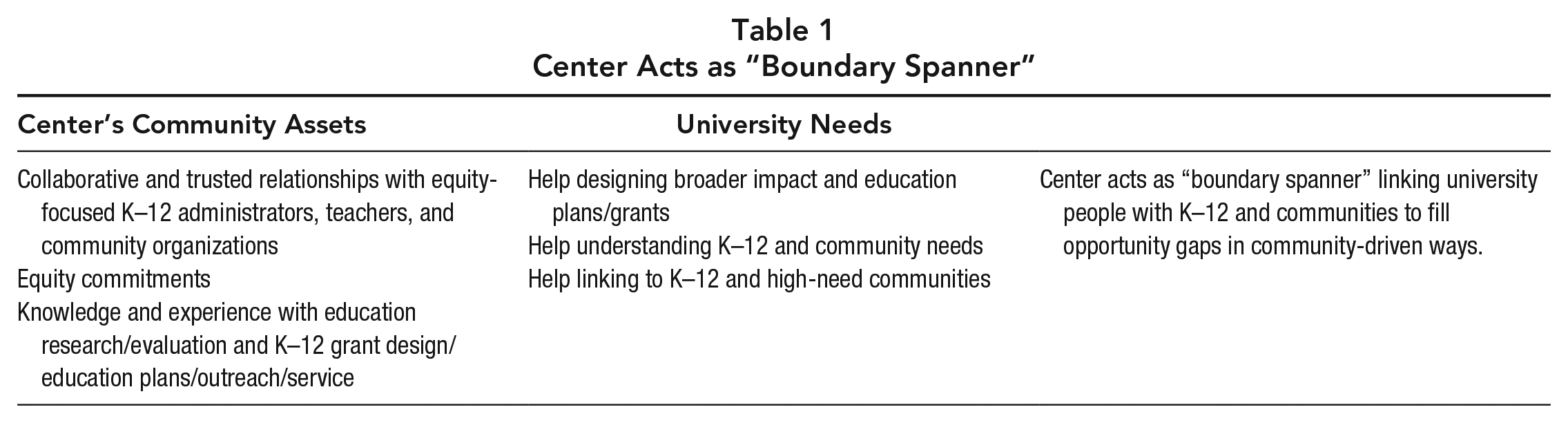
We offered specifically to help colleagues develop university contributions to local STEM learning opportunities—a particular campus grant-seeking engine, pipeline concern, and local K–12 priority. After assembling internal and external advisory boards, respectively, of campus faculty/administrators and local superintendents, we formally proposed a campus CREATE STEM Success Initiative (CSSI) and received university funding for three full-time equivalent positions in 2013. Now that we were essentially a university-funded K–12-university support team, we alerted faculty campuswide that we were available to codesign and support projects needing BI plans, education programming, evaluation plans, or research partnerships to secure funding or execute.
Since 2013, the CSSI has funded Authors 2 through 5 in whole or in part to advise campus researchers, staff, and students in STEM disciplines particularly who aim to contribute their research, funding, energy, and time to K–12 district-, school-, and community-organization-led learning opportunities for local K–12 students and their educators in addition to supporting campus students. Given the brevity of this conversation starter, we link here to our public annual reports, 7 which show glimpses of these codesigned efforts. Over the first near-decade, our small center team supported hundreds of campus faculty, staff, and student organizations plus community partners to conceptualize, develop, expand, or join K–12-facing education efforts. We helped construct outreach/education, BI, and evaluation plans for STEM grants to also support low-income, first-generation students and their teachers in learning opportunities desired by local K–12 and community partners. We helped faculty partners codesign more than 125 NSF grant efforts, both BI and K–20 STEM education grants. Overall, as boundary spanners, we documented thousands of CSSI staff efforts supporting both campus and community partners in planning, studying, joining, and/or executing grants and projects with education equity components. 8 In this, we conducted more than 110 funded evaluations on projects supporting K–20 students and educators and advised many more. We also invited university faculty into K–12-driven grants and tapped funding for center staff to help execute hundreds more CSSI-aligned K–12 teacher- and student-focused learning efforts ourselves, reaching many thousands of people directly. We helped partners win an estimated $140 million in grants for campus and community projects/research. In each effort to “leverage” others’ offerings, we have emphasized moving the needle toward equity—toward increasing high-quality learning opportunities and broadening college access to help “maximize the use of the community’s resources toward the full development of each youth’s potential” (Pinkard, 2019, p. 54).
The scale at which our CSSI efforts grew at times overwhelmed us—and we recognized the risk of sacrificing quality for quantity and coherence for incoherence. Thus, we realized that at root, this type of work requires constant collective questioning about contributing usefully to K–12 with university resources. That realization drove us here: Our purpose in the remainder of this conversation starter is to convey some of the basic, ground-level reflection and self-critique we undertake and foster when codesigning such projects with care and coherence for improving education opportunities for students often undersupported in local systems.
Our process started with reflecting on “broader impact.” As BI options, NSF often encourages academics to leverage their research projects to support K–12 students and/or teachers and to prioritize underresourced communities of all ages for greater societal benefits (MacFadden, 2019). Many observers have urged stretching beyond small/short-term efforts and largely academic audiences (Gould et al., 2019; Lima, 2017) toward deeper engagement in underrepresented communities, including K–12 (Nadkarni & Stasch, 2013a, 2013b). Like others, we have found the BI push creates a stream of faculty seeking potentially equity-oriented K–12 applications for their work—requiring supports for effective design (ARIS, 2020; Roberts, 2009). Others have noted that without supports to pursue K–12 equity with university offerings, academics’ outreach activities can overlook local community needs (Komoroske et al., 2015), exacerbate inequalities when benefits do not reach excluded populations (Woodson et al., 2021), and even promote incoherent and inequitable instructional changes (W. R. Penuel, personal communication, 2023).
Indeed, as others have emphasized (Diamond, 2021), more university-connected education work in local K–12 schools does not necessarily contribute to equity. K–12 student or teacher time is not well used on just any activity academics might envision; new grant monies do not serve community partners if projects distract from more important work or if partners do not prioritize or cannot absorb the new work proposed. Furthermore, many “outreach” opportunities (and even K–12-centered grants) reach only high-opportunity communities. Although some equity-committed and well-informed academics just needed connections to key K–12 partners to expand already well-established programs or STEM education efforts, other STEM professors, with cutting-edge research and real dollars to contribute to K–12 systems, told us they often executed BI by going to a single local classroom to lecture, often their higher-income child’s. Many said they had few contacts in the broader community; one admitted a “something is better than nothing” approach to K–12 project design. They, too, wanted to explore how university offerings could better support K–12 education in our region.
We focus now on sharing the principles we have come to use as rudders as we try to help steer university resources collectively toward equity in K–12. As researchers, we, of course, can study outcomes best when grants include substantive research or evaluation dollars. Some do: In this initiative, we have advised, led, and collaborated on many formative and summative evaluations addressing project-specific equity goals and many deeper research projects. Many grants and projects do not fund robust study, an inherent problem; even so, we still use our research-practice-partnership skills to leverage the energy of many. And in all efforts, we have asked a guiding equity question and key equity subquestions (each a principle) when considering with partners how to maximize the benefits of every project: Do university contributions to K–12 support equity? Are we designing high-quality learning opportunities actually desired and valued locally, specifically to improve opportunity access for those most often excluded?
There are many ways these questions might guide actual decisions. What follows are some examples of ways we have used these questions to guide our efforts to tap university resources for K–12. We delve into specific domains of work to flesh out particular principles, core tensions (Pollock, 2017), and deep challenges inherent to such efforts.
Guiding Question: Do University Contributions to K–12 Support Equity?
Weerts and Sandmann (2010) noted that “universities are transitioning away from a one-way dissemination paradigm (outreach) toward a two-way constructivist model (engagement) in their work with communities” (p. 640; Hatcher et al., 2020; Tiller & Ness, 2020). As boundary spanners, we actually lead a “three-way” model of engagement, braiding K–12 and community partners’ desires and needs, university people’s desires and needs, and our own equity commitments and research-practice knowledge into projects working to contribute to K–12 opportunities to learn.
When university colleagues (faculty, staff, or even student organizations) approach us as they seek to incorporate K–12 education programming, we always discuss not only what education research generally might recommend but also what local K–12 and community colleagues are asking for particularly to support the low-income, underrepresented students in our region. We discuss even more specific subgroups who our local collaborators state have insufficient opportunities and access in a range of educational areas (e.g., English learners, Black girls, foster youth, incarcerated youth specifically). Campus colleagues approaching us typically welcome this foundational equity-minded question. Many are asking it already. This guiding question has helped us, for example, (a) support engineering faculty who wanted to extend earthquake outreach beyond affluent communities into additional schools serving low-income students, (b) help computer science faculty focus PD on K–12 teachers of English learners typically overlooked, and (c) encourage professors to make local community college students also eligible for coveted university summer internships in nanoengineering (Estrada et al., 2016; Yong et al., 2023). As seen in the following, our “make more” equity orientation focuses new opportunity creation on such subgroups to level the opportunity playing field and to collectively pursue improvements ultimately improving education for all (powell, 2023).
Our guiding question also keeps us continually asking about specific ways that efforts can be shaped further for equity (Pollock, 2017), considering, for example, the experiences of local Black students too rarely encouraged to take mathematics in the fourth year of high school or low-income students needing transportation to access summer programming designed for girls. Although partners are not always receptive to every idea for more equity-oriented contribution (e.g., some principal investigators declined to include community college internships or fund transportation), we carry the requests of K–12/community partners into conversations with campus colleagues and ask the “who” and “how” equity questions constantly. Who could particularly benefit from which expanded opportunity access, adapted how to best serve each new community?
We then ask five principled subquestions as we pursue equity with university contributions.
Principle 1: Does This Contribution Prioritize Necessary Opportunities to Learn?
University projects that take K–12 students’ or teachers’ time for unclear reasons or impose unwanted priorities do not serve K–12 students or educators well. But university partners need support to codesign campus contributions that local communities prioritize.
To understand local priorities, we listen. We continually invest in strengthening our trusted network of diverse, equity-focused K–12 collaborators themselves working to improve inquiry-oriented instruction, courses, programs, and outcomes in K–12 systems, schools, and community organizations serving high-poverty communities. As boundary spanners, CSSI team members have been asked to serve on advisory boards for such schools, districts, and community organizations and on university committees discussing key needs in preparing all youth for campuses like our own. While reading research, we regularly visit schools and districts, convene grade-level and content-area teacher leaders, and participate in regional, statewide, and national educator networks and community initiatives to tap into K–12 needs and education trends. We hold quarterly internal advisory board meetings with campus administrative/faculty representatives and external advisory board meetings with diverse district leaders focused on optimally serving students in their systems. We have provided stipends to key personnel from local districts to regularly share their districts’ priorities and concerns with us; many of our projects engage youth to advise as co-researchers (Yonezawa et al., 2021). While we struggle to share all of this information efficiently within our organization, we rely on this consistent communication with K–12 and community partners to advise our university partners when codesigning outreach and education components of grants or enacting and expanding already-funded K–12-facing projects.
In these ongoing conversations, we listen for possible connections between, for example, what faculty have to offer (astronomy expertise, excitement about computer game design or the physics of music, and 3D printers are recent examples) and what K–12 and community partners are working on, while prioritizing local K–12 needs and research understanding about college/career pathways for all. Identifying shared snags in K–20 academic pathways is also crucial (Bryk et al., 2015), and sometimes, K–12 and university partners are aligned on necessary focus areas. For example, countless partners (and funders) have agreed for a decade that K–12 mathematics learning deserves as much attention as possible because math hinders pathways to and through college (and then careers) regardless of major, often most egregiously harming low-income and underrepresented youth. In conversations about STEM opportunity needs, we thus have often suggested and seeded a focus on math if partners are both equipped and interested, for example by working with oceanographers to invite math teachers to NSF-funded workshops on the physics of ocean waves, designing K–12 tutoring classes tapping undergrads to offer support specifically in Algebra II/Integrated 3, tapping grants for a public K–16 conference on those pivotal precollege math courses, and writing research grants with social scientists to study local K–12-to-college mathematics struggles. This “think about the math” emphasis has resulted in an increasingly collective improvement effort (Peurach et al., 2022) as we have turned K–12, university, and funding partners’ attention to specific issues in local math education. As one example, after helping to select faculty speakers for a school-district-sponsored event for Black students exploring college pathways, we surveyed student attendees and sounded the alarm that district Black high schoolers were disproportionately not taking a fourth year of mathematics, jeopardizing college admission and retention. Since then, we have supported multiple grants funding work on more fourth-year math course-taking in local high schools.
One consistent challenge of realizing this principle of pinpointing “necessary opportunity” is that not all locally prioritized learning needs are easily supportable by university efforts. For one, elementary mathematics, named as crucial by all, is often not an obvious domain for STEM colleagues’ contributions; funders and even local families are often more excited about makerspaces or coding. We often call math “the forgotten M of STEM.” But because expanding college access is our priority, we often help to strategically integrate math into projects focused on other things. For example, we have invited math teachers to vet engineers’ outreach and to add key sixth-grade math concepts into summer makerspace camp curricula for fifth-grade girls.
A deeper core tension of this principle is the risk of underattending to crucial opportunity gaps while focusing on currently prioritized needs. Should dollars be spent on makerspaces or 3D printers versus more PD in math or literacy? Indeed, our STEM focus itself has for a decade risked underattending to crucial K–12 needs in the humanities, social studies, and the arts. We thus attempt to support interdisciplinary projects whenever possible; we have added writing/literacy development and climate justice issues to grants engaging children and teachers in climate science, for example, and promoted broader college and career planning via adding college counseling sessions to student STEM fairs. We also, of course, spend time supporting projects outside of STEM altogether. And we keep asking ourselves: Which opportunity contributions are critical?
Principle 2: Does This Contribution Prioritize Mutually Beneficial Learning Opportunities Supporting Many People?
Our second principle is supporting projects that strategically address many people’s needs simultaneously. Fueled by research on belonging (Strayhorn, 2012) and a vision of “culturally and community-based science programming” (see Bang et al., 2010, p. 578), one author routinely invites both community college and campus underrepresented STEM students to codesign community-relevant (and often bilingual) STEM outreach lessons on the biochemistry behind tortilla making, the physics and hydraulics of low-rider cars, the structural engineering of local bridges, and other locally resonant science and engineering phenomena. Leveraging grant funds, his team repeats these lessons for thousands of K–12 students annually in public street fairs, engaging university presenters alongside local industry and community organizations, and in sustained science clubs hosted by schools serving low-income communities. Because research would suggest one science festival likely will not transform children’s paths, the goal (as in many others’ work; e.g., Lima, 2017) is to strategically increase the equity effects of any effort by pursuing simultaneous mutual benefit: K–12 students (and families) meet older peers pursuing STEM pathways, community college students build connections to transfer to our university, and campus STEM students practice public STEM communication, foster STEM belonging, and stay inspired. Over time, this author has tapped local foundations to employ high school students, too, in supporting younger students’ learning, broadcasting further that all can “belong in STEM.”
Another example of pursuing mutual benefit is our support of NSF CAREER grants. These are prestigious awards that enhance early career faculty chances for tenure and place a high priority on BI and broadening participation. Typically, CAREER grants afford minimal budgets for education/outreach, itself a core tension. Still, with all CAREER education projects we codesign, we seek to increase grants’ impact through strategic investments benefiting multiple stakeholders. For instance, an author trained in learning sciences research helped one chemistry professor’s CAREER grant fund a campus-based science course for 3 years in which 33 university students designed and led inquiry-based, hands-on, youth-oriented science lessons for 150 low-income/first-generation high school students (plus their teachers) from our campus’s TRIO Upward Bound program (McElroy & Armesto, 1998). Although our numbers felt small in this labor-intensive project, it pursued K–20 student learning and growth, and years later, some participating undergraduates are now teachers, some former TRIO high school students are campus biology undergraduates, and online lessons have hundreds of teacher downloads. This professor also continued the approach independently in subsequent grants, allowing us to turn our attention to new faculty collaborators.
However, this professor has continued his course only in years when he has grants, indicating another key equity problem that continually plagues university-generated K–12 contributions: Grants run out, often severely testing community-campus relationships. This brings us to our next principle.
Principle 3: Does This Contribution Pursue Sustained Opportunity Creation?
Repeating community-approved public events can shape a community’s perception of the university campus as a sustained partner; we also encourage campus projects toward vibrant community organizations already sustaining crucial “supplementary” education outside of the school day (Pinkard, 2019). 9 Our center most prioritizes K–12 school-based work that might improve the instructional core of students’ school day longer-term. The underlying principle is sustained contribution, also a field priority (Peurach et al., 2022). In considering any university contribution with K–12 and community partners, we ask, early on and explicitly: If the program’s contributions are meaningful to K–12 educators’ practice, district systems, communities, and students, what strategic efforts could help sustain the work? Can the efforts be supported by the district/school sites/institution/others after grants end? Our university and K–12 partners typically embrace this principle of sustainability because they, too, want lasting contributions.
As one example, one local K–12 district asked CSSI team members to partner on a U.S. Department of Education grant to help build third- through eighth-grade computer science (CS) pathways for their students. Prior principles discussed so far held. The project pursued more equitable access to career-buoying CS learning for low-income students, and the work was mutually beneficial: The district wanted to pay once for curriculum for everyone, and the grant funded university faculty to help design open-source curriculum that (if successful) other districts—locally or nationally—could also use for free. Given district-level prioritization (Penuel et al., 2022), within a year, the new, free CS curriculum was being field-tested in multiple grade levels and afforded to 79 elementary schools, with tentative plans to bring successful units to all of the district’s more than 150 elementary schools by 2025. The grant thus was deemed a high performer by its funder, which encouraged the team to pursue additional larger awards—potentially sustaining next K–12 CS projects by funding more district staff as well as university faculty, undergraduates, and graduate students.
Sustaining an ever-growing array of projects still presents major challenges as efforts scale. For ultimate sustainability on the K–12 side, we also attempt whenever possible to invest in K–12 educators themselves. As described next, we, like so many in our field, see such investment in K–12 educator capacity as fundamental to directly improving local teaching and learning for all and core to maximizing projects’ potential K–12 equity benefits.
Principle 4: Does This Contribution Pursue High-Quality Teaching and Learning?
When consulting with university faculty, we often suggest investing in co-learning opportunities for K–12 educators, particularly alongside teachers working in high-need communities, so investment reaches many more students over time and can support the 8 a.m. to 3 p.m. compulsory school day. We call this investment “the multiplier effect.” We ask: How can investing in educator learning and leadership benefit many students in the long term?
When faculty are both appropriately equipped and interested, PD leaders in our center often work with them to shape grants to bring K–12 educators together with university faculty to learn from each other and focus on improving instruction. We are hardly the first to design such collaborations (see e.g., Warwick et al., 2020, and the cautions of Blanchard et al., 2009); we just have offered our entire center as “intermediate” expert supporters in between teachers and university faculty, shepherding K–12-driven use of university resources for longer-term teaching improvement (see also Cobb & Willhelm, 2022). As one example, center PD experts have worked with dozens of faculty and K–12 educators to fund lesson study efforts through faculty STEM grants, codesigning ways to engage diverse K–12 learners in enticing research-based scientific phenomena through iterative design and live testing of lessons with students (Takahashi & McDougal, 2016). Stipended K–12 teacher-leaders lead 1- to 2-day dialogues with faculty, their graduate students, and K–12 teachers, codesigning lessons for real K–12 teaching contexts (existing pedagogies, standards, assessments, reforms, curriculum, needed resources, and student needs). In one grant funded by the Office of Naval Research (ONR), more than 18 campus and local industry STEM researchers worked with six lead district teachers and 80 high school science teachers from four large school districts that serve 44% of the region’s low-income youth. Stipended teacher teams designed and practiced lessons with their K–12 students, showcased the teacher-designed research-informed lessons in a public conference, and took modules back to their classrooms, departments, schools, and districts. Tapping research on social networks, we strategically invited highly networked teachers, department chairs, coaches, and resource teachers who would deliberately share learning with others (Rodway et al., 2021). The ONR grant also sufficiently funded evaluation, and teachers reported significant increases in content knowledge, rejuvenated excitement about teaching science after rekindling their own scientist identities, and ability to implement the Next Generation Science Standards (NGSS) while K–12 students demonstrated NGSS-aligned engagement and learning.
We shaped and studied this investment in K–12 teaching and learning through also considering Principles 1 through 3. Per our principle of mutual benefit, university faculty, postdocs, and graduate students reported learning interactive inquiry pedagogy from K–12 teachers, thereby benefiting university faculty and students. Regarding pursuing necessary opportunities, researchers explored their work’s value to specific teaching and learning prioritized by K–12 partners and students, also increasing their own “impact identities” (Risien & Storksdieck, 2018). Regarding sustainability, K–12 teachers’ new skills and pedagogical inquiry habits have outlived specific lessons, and collaborations have shaped educators’ professional trajectories longer-term. Some teacher participants have become district leaders of science instruction, further scaling the work. Crucially, we have met professors particularly inspired by working with teachers; some have written subsequent grants with us, funding more PD opportunities, and some have moved to sustaining and growing K–12 connections on their own.
In this work, we ourselves have learned a lot about maximizing university investments in teacher capacity. We have found K–12-resonant frameworks and student-resonant subjects (e.g., climate) that can link disparate scientific phenomena, increasing coherence over multiple projects. We have found colleagues who want to codesign large STEM education grants enabling sustained focus. We have learned to structure more collective and efficient efforts engaging multiple faculty in larger workshops where many teachers can participate simultaneously, also mitigating individual teacher burnout and mobility. To scale the learning further, we also have learned to strategically include educators at the district or county level. This brings us to our final principle, which focuses us on larger systems.
Principle 5: Does This Contribution Pursue Systemic K–12 Opportunity Creation?
The University of California Office of the President has long supported systemic outreach efforts through the portfolio of campus-housed programs called “SAPEP P20” (Student Academic Preparation and Educational Partnerships P20). 10 SAPEP programs, including our center’s, aim to tackle systemic educational equity problems toward college access, preparation, and completion. So within this context, we have long asked: How can university contributions invest in more systemic efforts to improve K–12 learning opportunities? To pursue this principle, we often invest in district projects and regional educator networks (Rodway et al., 2021, 2022), beyond individual educators or schools (Penuel et al., 2022). For example, some of our most productive teacher-focused efforts have focused on including district resource teachers who could take new practices districtwide, “infrastructuring” ongoing instructional improvement (Penuel, 2019), and county and district administrators who could create new course options or PD initiatives for all. We have also pursued a smaller number of multistate projects, with larger funding.
Key CSSI initiatives have particularly demonstrated this principle of investing in systemic change. One example is our work to support more K–12 CS opportunities across our region. Over nearly a decade, we have found university faculty who wanted to secure multiyear education-related grants (e.g., NSF, Department of Defense, U.S. Department of Education, philanthropic) and collaborated to fund systems-level K–12 partnerships. In consecutive CS grants, we first helped CS faculty offer PD workshops to teachers and then supported administrators in local high-need districts to develop and offer new CS courses. We structured one grant for simultaneous CS course creation across districts, supporting local educators to navigate complicated state processes for course approval together while rallying others around the value of CS. With sufficient funding for evaluation built into several large grants, we have studied how pedagogical efforts supported teacher/student learning and how districts scaled and sustained CS offerings. Across the project, CS courses expanded from few to many high schools, with significant participation by women of color as both instructors and students. To pursue equity beyond course availability only (Pollock et al., 2019), subsequent grants have pursued next collective priorities often advised by K–12 students themselves, like getting representative numbers of English learners, young women, and minoritized youth enrolling and succeeding in courses now available to all.
Principle Challenges
These equity principles are starting points: We ask ourselves continuously if efforts could be improved and opportunities maximized. Should we invest time in completely new faculty program ideas or braid university colleagues into existing center efforts? Should partners fund events inviting crucial relationships across hundreds of teachers or stipend a smaller, sustained group of teachers to hone a pedagogical skill? Should we emphasize depth (seed more work in existing K–12 locations or with already committed individuals) or breadth (invite in new K–12 partners)? How much should we prioritize BI support, encouraging many faculty to contribute to K–12 throughout their careers, versus write large K–12-focused grants with key individuals? In a decade of focus on STEM opportunities, have we underemphasized other crucial issues affecting students’ pathways to college and career? Does our very quest to “leverage a university” inadvertently privilege university people’s value or risk sending too many university people into K–12 systems without careful researcher monitoring? We have suggested here that such ongoing and collective principled questioning is what allows our work to have equity potential (Pollock, 2017) and coherence. And we are certain of one thing: Universities can contribute far more to local K–12 opportunity than they typically do. But they need both guidance and support to do so in partnership with communities and schools.
Every University as a K–12 Contributor
Many large research universities describe their mission as some combination of “teaching, research, and public service” (American Association of Universities, 2014). How might universities contribute more locally in these ways? We propose that local K–12 students and teachers in particular could be greater direct beneficiaries and that entire universities can advance their own research, teaching, and service missions while supporting the work of K–12 partners. We have shared some foundational principles that we use in ongoing collective reflection about codesigning equity-driven local K–12 contributions.
We see our work as a tiny part of a much broader discussion about the role of higher education in contributing locally, including via funders’ BI requirements and education grant streams, in combination with other crucial forms of local community-engaged research and teaching, financial investment, educator preparation, and P–20 partnership underway on many campuses. Regarding STEM and BI specifically, many others have called for campus contributions to reach often-excluded local participants (Komoroske et al., 2015; Lima, 2017; Woodson et al., 2021) and flagged the benefits of collaboration with social scientists and outreach specialists, including in collective agendas (Nadkarni & Stasch, 2013b). Others lead such work nationally: NSF-funded ARIS at the University of Missouri, for example, has long supported academics in STEM fields to consider how they might more substantively support K–12 (ARIS, 2020), and countless model efforts exist on other campuses. What we offer to this national conversation is excitement about K–12-connected, equity-driven support teams of education researchers and expert practitioners on campuses directly partnering with K–12, community, and campus colleagues to codesign, coexecute, and costudy university contributions from all fields that are desired and needed locally. We further propose that funders and campuses should fund more such campus teams of diverse, experienced, equity-focused professionals to work with partners on developing K–12 contributions and to pair campus projects with actual community needs and people (Lima, 2017; Roberts, 2009). Such work to collectively leverage university resources well is worth funding.
Fortunately for us, our campus provided a decade of concrete financial support for center-based staff positioned to link university efforts to K–12 partners. As a final dilemma for us to consider, our own campus has now asked us to fund our team’s support to others in part through more direct payment from the partners supported, launching a newly “monetized” way of working as K–12-university boundary spanners that may fail or if successful, ultimately be more replicable. After a decade of turning any interested partner’s attention to K–12 equity possibilities, we are pivoting to partner with people who already have high energy or likely funding for such work—both a wise investment and a loss of unrealized potential.
In closing, we propose that large research universities can be reimagined as places where faculty, staff, and students in every field and discipline might co-contribute to local K–12 learning as part of advancing their own work. Our final suggestion is that more education-related research PhDs be developed, encouraged, and employed to help university partners contribute to K–12 systems. Such education researchers can use their degrees and equity commitments to push universities beyond discussions of K–12 education’s opportunity problems and toward concrete roles in K–12 opportunity creation and spread. We ourselves have much more to learn about how to do this. We invite ongoing dialogue with colleagues who lead such work so that collectively, we can better leverage universities for the public good.
