




Abstract
This synthesis examines recent science education research on multilingual students’ experiences with language-rich science practices. Adopting a translanguaging lens, we explore how researchers’ language conceptualizations impact the science practices they study and the ways multilingual students are positioned. This analysis helps us understand the extent to which recent research is disrupting, or sustaining, minoritizing narratives about multilingual students and how they sensemake in science. Based on our findings, we suggest researchers: (1) reflect upon and expand their views of language, which will enable the field to develop more nuanced understandings of how language use across linguistic and multimodal resources permeates all science practices, and (2) consider how to expand multilingual students’ language repertoires for sensemaking while also valuing students’ existing language resources and practices.
Keywords
Expecting and praising learning aligned to the practices of White, Western, English-speaking, upper-middle-class individuals has perpetuated long-standing inequities in education for students from minoritized groups (National Academies of Sciences, Engineering and Medicine [NASEM], 2018; Warren et al., 2020). Within the context of science learning, this has been particularly the case for multilingual students, partly due to dominant ideas around what counts as language in science and related views around how students should use language for disciplinary work (González-Howard et al., 2023; Lemmi et al., 2019). Current science standards (i.e., the Next Generation Science Standards [NGSS] Lead States, 2013) emphasize language-rich disciplinary practices as central to how students engage in sensemaking to construct knowledge (Lee & Stephens, 2020; Grapin et al., 2022b), an emphasis that has continued an upward trend of research focused on multilingual students’ learning via science practices. This research trend has the potential to help transform science classrooms into more equitable environments if researchers elevate the brilliant ways multilingual students use wide-ranging language resources to grapple with, make sense of, and communicate understandings about natural phenomena (Bang et al., 2017; Grapin et al., 2023; Rosebery et al., 2010; Warren et al., 2020).
However, if instead researchers hold narrow and restrictive views around language, it is likely these students’ language resources and practices for meaning-making will continue being studied and described in limited and limiting ways (González-Howard & Suárez, 2021). As such, the purpose of this article is twofold. First, we review recent research focused on multilingual students’ experiences with science practices to understand the direction the field has been moving since the release of the NGSS. Specifically, we examine how researchers have conceptualized language and the impact that these conceptualizations have had on their research, including which science practice(s) they focused on and how multilingual students’ language resources and practices were positioned for engaging in this type of sensemaking work (Berland et al., 2016). This analysis helps us understand the extent to which recent research is disrupting, or sustaining, minoritizing narratives about multilingual students and the ways they sensemake in science. Secondly, we use this literature synthesis to offer concrete directions for future research, hoping to expand views around whose and which language resources and practices are recognized and valued as scientific sensemaking repertoires.
To achieve these goals, this piece is structured as follows. We begin by clarifying our commitments to and use of the term multilingual to describe students in this work. Then, we detail current science education reforms that emphasize student sensemaking through science practices, particularly focusing on the role of language within these practices. Next, we describe the theoretical lens that guided our analysis, explaining why and how translanguaging (García & Wei, 2014; Otheguy et al., 2015) was an appropriate critical lens for examining literature focused on the nexus of science practices, language, and multilingual students. We then explain our methods for collecting and analyzing relevant literature through a translanguaging lens. Finally, we share research trends from the past decade, first unpacking how researchers’ conceptualizations of language relate to the science practice(s) they studied and then illustrating how multilingual students’ language and language practices have been positioned in this scholarship. Based on these findings, we end with suggested directions for future science education research with and for multilingual students that honor and build upon these students’ language for sensemaking.
Our Commitments to Multilingual Students
We intentionally use the asset-oriented term multilingual to highlight students’ multiple sensemaking and communicative resources and abilities to use named language(s) (e.g., Spanish, Cantonese, Arabic) as part of a broader repertoire that includes English (García & Wei, 2014). Multilingual students are usually labeled with terms like “English learners,” which originate from legal documents, national laws, and individual state statutes (Gutiérrez & Orellana, 2006). However, these labels tend to be more harmful than helpful, often interpreted to mean that multilingual students’ education should focus on them developing a certain English proficiency considered a prerequisite for rigorous learning experiences (Gutiérrez & Orellana, 2006). We recognize that individuals identified (by themselves or others) as multilingual have complexly heterogeneous, intersecting identities across many facets, including—but not limited to—race, socioeconomic backgrounds, schooling experiences, sexual orientation and gender identity, where they live geographically, and migrational histories, all of which influence the ways they view themselves (and are viewed by others) as well as how they make sense of and operate in the world (González-Howard & Suárez, 2021). In common, however, are the minoritizing experiences multilingual students have when learning and doing science in school, often positioned and treated in discriminatory ways (NASEM, 2018). These experiences manifest as multilingual students being “othered” because their language resources and practices are viewed as “fundamentally discontinuous” with scientific knowledge and ways of knowing (Warren et al., 2001) or go unnoticed altogether (Suárez, 2020). Thus, our use of the term multilingual acts to recognize and make visible the myriad language resources and practices these students draw upon to do, communicate, and learn science (González-Howard & Suárez, 2021).
Language-Rich Science Practices Within Current Science Education Reform
The current wave of science education reform in the United States was guided by A Framework for K-12 Science Education (National Research Council [NRC], 2012). Grounded in an extensive review of science education research, the Framework offered recommendations for developing standards that describe significant science learning goals and experiences. These recommendations took form as the Next Generation Science Standards (NGSS Lead States, 2013). Embodying contemporary understandings of how scientists make sense of the world and around how children learn science, the NGSS emphasizes students engaging in practices authentic to and common among the sciences (e.g., planning and carrying out investigations, analyzing and interpreting data, constructing explanations) to figure out phenomena (NGSS Lead States, 2013). Positioning students as capable doers of science, the eight science practices promoted in the NGSS support student sensemaking as they develop rich understandings of phenomena (for a detailed review of these practices, see Berland et al., 2016; Lee, 2018; and Lee et al., 2013).
Engaging in science practices requires students to mobilize language resources in specialized ways (Grapin et al., 2023; Pierson & Grapin, 2021). For instance, some researchers argue that how students use named language(s) to partake in science practices becomes more complex across grades, particularly regarding use of science terminology and more disciplinary use of syntax and grammatical features across talk and writing (Lee, 2018; Lee et al., 2013). However, the rigor of these language demands goes beyond how language is dominantly viewed in and for school (i.e., written and spoken “academic” English) (González-Howard et al., 2023; Lee & Stephens, 2020). In addition to linguistic resources like named languages, students also employ multimodal means of communication when sensemaking via science practices, such as graphs, models, charts, drawings, gestures, and symbols (Grapin et al., 2022b; Suárez, 2020). All these language resources (linguistic and multimodal) are equally critical to and necessary for engagement in science practices (Pierson & Grapin, 2021).
There is potential for science learning environments to become more equitable when students are encouraged to develop and draw upon multiple meaning-making resources—including their full language repertoire—to investigate and explain natural phenomena via science practices (Bang et al., 2017). This potential is particularly important for multilingual students, whose language resources are often unrecognized because of a hyperfocus on their perceived language needs and how those needs relate to dominant language views and privileged language practices in schools (Lemmi et al., 2019). Similarly, there is potential for science education research to become more equitable if researchers recognize the rich ways multilingual students use language for sensemaking (Rosebery et al., 2010; Suárez & Otero, 2023; Warren et al., 2001). Such research could help change the narrative of what multilingual students are capable of while also disrupting notions of how students should engage in disciplinary practices and which language resources they should draw upon to do so (Warren et al., 2020). Working toward transformative, equity-oriented science education research (Grapin et al., 2023) that elevates myriad ways that disciplinary practices could be enacted (Warren et al., 2020), we next describe the theoretical lens that guided our analysis of current research on multilingual students’ experiences with language-rich science practices.
Theoretical Lens Guiding This Synthesis
Translanguaging theory and pedagogy—originally studied and developed by sociolinguists and bilingual and multilingual education scholars—is critical of dominant language ideologies and associated practices permeating school spaces that privilege narrow forms of language use (García & Wei, 2014; Otheguy et al., 2015; Wei, 2018). Translanguaging has been defined as the process by which multilingual individuals fluidly use multiple discursive practices to make meaning and communicate ideas in ways that transcend socially constructed boundaries (García & Wei, 2014). These boundaries often map onto what are conventionally viewed as distinct named languages (e.g., Spanish, English, or Tagalog) with rigid grammatical structures (Otheguy et al., 2015). Rejecting such barriers, the prefix “trans” calls for views of language resources and practices that transcend arbitrarily defined language systems and hierarchies (Wei, 2018), placing attention instead on how individuals leverage diverse language resources for communicative and meaning-making purposes. In line with our views of and commitments to multilingual students’ strengths and resources, we draw from translanguaging research conducted by Ofelia García and collaborators as a productive lens through which to understand how multilingual students use language to partake in science practices.
Applied to science education research, translanguaging recognizes the heterogeneous language resources and practices multilingual students have, develop, and use for sensemaking rather than focusing on what they “should” use and do, which leads to deficit-based perspectives of these students’ capabilities and experiences (Suárez, 2020). A disciplinary perspective of translanguaging in science education (Pierson & Grapin, 2021) specifically attends to how multilingual students mobilize their entire language repertoire (i.e., linguistic and multimodal resources) when sensemaking via science practices. Thus, taking a disciplinary translanguaging perspective, we define language as both linguistic and multimodal. Specifically, linguistic resources students might draw upon while sensemaking encompass named language(s), registers, or grammatical and structural forms of language (Otheguy et al., 2015), including those that students are commonly introduced to when engaged in science practices (e.g., claim-evidence-reasoning; González-Howard & McNeill, 2016). Just as critical to this sensemaking work are multimodal resources, including charts, graphs, symbols, and models (Pierson et al., 2021), and embodied actions, like gestures (Suárez, 2020) and sounds (Suárez & Otero, 2023). Thus, we argue that translanguaging offers an expansive framework for studying multilingual students’ language in vivo and in situ, allowing researchers to develop a robust sense of how students develop and use varied and complex language to explain natural phenomena (González-Howard et al., 2023).
If our goal as a field is to develop asset-oriented scholarship that highlights what students can do, both in terms of conceptual understanding and ways they might use language to sensemake (Berland et al., 2016), then it is crucial to build on a theoretical framework that challenges deficit-oriented and assimilationist agendas (González-Howard et al., 2023). We posit that adopting a translanguaging lens in educational research holds the power to be transformational for multilingual students’ schooling experiences (García & Wei, 2014; Wei, 2018). Without doing so, we run the risk of (re)producing seemingly benevolent scholarship that views multilingual students as English-speaking Eurocentric scientists-in-potential rather than scholarship that recognizes the expertise with which these individuals leverage their meaningful ways of communicating to partake in science practices (González-Howard & Suárez, 2021). As such, we believe that translanguaging was appropriate for helping us understand how educational researchers have examined multilingual students’ experiences with science practices and to imagine possibilities for future justice-oriented work on this topic that pushes upon notions of what counts as language, and whose language counts, for scientific sensemaking (Wei, 2018).
Methods for Collecting and Analyzing the Literature
Given this article’s purpose, our synthesis was guided by the following questions: (1) How do researchers’ conceptualizations of language relate to the science practice(s) they studied? (2) How are multilingual students’ language resources and language practices positioned? In determining research studies for inclusion in this synthesis, we used the following criteria: studies directly focused on multilingual students’ experiences with science practices (as defined and operationalized by the Framework and the NGSS) published since the release of the Framework through the beginning of June 2023 when analysis was completed. Given these criteria, the process of gathering relevant literature was carried out as follows. First, using the databases Academic Search Complete, Education Source, ERIC, and PsychINFO, we searched the subject terms of peer-reviewed journal articles with the following keywords: SU (“science education” OR “science teaching” OR “science learning” OR “science instruction” OR “stem education”) AND SU (bilingual* OR “multilingual*” OR ELL OR “english language learner*” OR “second language” OR LEP OR “limited english” OR ESL OR “english second language” OR TESOL OR “linguistic* divers*”). This search resulted in 830 potential pieces of literature.
Next, we screened the potential literature. Studies were excluded if they were not peer-reviewed empirical articles that reported upon research findings. While there is value in conceptual pieces, book chapters, and practitioner-oriented articles, we specifically focused on empirical studies because we wanted to explore possible connections between researchers’ conceptualizations of language use for science practices and the ways these conceptualizations impacted their research. After removing the aforementioned literature types and duplicates of empirical articles, we conducted a first screening in which we reviewed titles and abstracts and then completed a second screening in which we read pieces more closely. Throughout this process, studies were excluded if researchers did not explicitly name or describe how multilingual students learned about or used at least one of the eight science practices (NRC, 2012) in their title, abstract, literature review, and/or research questions. Excluded studies tended to describe “inquiry” or “hands on instruction” and were not explicit about how science practices related to those terms or only mentioned science practices within the instructional context. We met and discussed any disagreements around articles to include until an agreement was reached. Two of the authors created a detailed annotated bibliography for the final 28 articles ultimately included.
We used the annotated bibliography to organize information about each article into a summary table (Miles et al., 2020). The table columns included details about (1) how researchers described language; (2) the focal science practice(s); (3) whose language resources and practices were focused on and why; (4) data collection and analysis descriptions; and (5) key research findings. For the first phase of analysis, which aimed to identify researchers’ language conceptualizations, we returned to our theoretical lens, a disciplinary perspective on translanguaging (Pierson & Grapin, 2021). This perspective elevates the linguistic and multimodal resources multilingual students mobilize to engage in science practices (Suárez, 2020). As such, we further analyzed the table column focused on how researchers described language, coding for the type of language resources on which they focused: linguistic, multimodal, or linguistic and multimodal (which we termed “expansive”), and what aspect(s) of these language resources they attended to (e.g., written named languages, gestures, drawings, onomatopoeia). Two of the authors independently coded this information, met to discuss codes, and returned to the larger group for needed discussion until consensus was established for all articles (Miles et al., 2020).
To answer our first guiding question, we created a matrix with information about each study’s language code (linguistic, multimodal, or expansive) and focal science practice(s) (Miles et al., 2020). Sorting the studies within this matrix by language code enabled us to identify patterns between how researchers conceptualize language and the science practice(s) on which they focused. To answer the second guiding question, we examined how multilingual students were positioned relative to whose language resources and practices were centered in the research. Through multiple discussions that encompassed iterative examinations and triangulation between each study’s full manuscript, our annotated bibliography, and our summary table (Miles et al., 2020), we identified that researchers positioned multilingual students two different ways. Some researchers focused on how multilingual students develop new or additional language resources and practices for engaging in science practices, specifically resources and practices researchers described as akin to those of scientists (we coded such articles as scientist-centered). Other researchers centered on multilingual students, examining how these students mobilize their existing language resources and practices when doing this kind of sensemaking work (we coded such articles as student-centered). In particular, we noticed a trend around how this positioning varied relative to researchers’ language conceptualizations.
Due to the conceptual nature of this literature synthesis, when unpacking the findings, we provide representative examples of articles instead of describing each article in detail. Representative articles are not meant to critique any researcher or group’s work but instead speak to larger trends in science education research focused on multilingual students’ experiences with science practices. That said, when possible, many relevant articles are cited to substantiate the findings. Finally, although we applied a translanguaging lens to analyze and synthesize the literature, we only use this term in our findings if researchers themselves described their work as ascribing to translanguaging theory and/or pedagogy.
Findings From the Literature Synthesis
With our synthesis, we aimed to understand the extent to which recent research is disrupting or reproducing minoritizing narratives about multilingual students and how these students use language to engage in science practices. Toward this aim, it was important to identify which science practices researchers have examined as their rationale is telling of how they conceptualize language and what they view as the relationship between language and science practices. Furthermore, the ways researchers position multilingual students in their work reveal whose language resources and practices are really privileged for disciplinary practices. We present our findings in two parts, with each part responding to a guiding question.
Part 1—How Do Researchers’ Language Conceptualizations Relate to the Science Practice(s) Studied?
To respond to this question, we first needed to identify what science education researchers think counts as language. Our analysis revealed that researchers have conceptualized language in one of two ways in their work, which we have classified as either linguistic or expansive. Importantly, these classifications reflect how researchers conceptualized language in the context of a given study and, therefore, may not represent a researcher’s full or current language conceptualizations. For this reason, researchers might be listed in both rows of Table 1 or in a row no longer aligned with their current views (as is the case with our work; e.g., González-Howard & McNeill, 2016; González-Howard et al., 2017). In half the studies, researchers took a linguistic view of language (see first row of Table 1). From this view, language was defined in terms of the named language(s) students knew and/or were developing proficiency in (González-Howard & McNeill, 2016; Licona & Kelly, 2020; Swanson et al., 2014), along with features of these named languages, like vocabulary terms (Relyea et al., 2022), lexical density (Symons, 2017), and language structures used for particular practices (González-Howard et al., 2017; Lee & Paz, 2021; Rodriguez-Mojica, 2019).
Overview of Findings
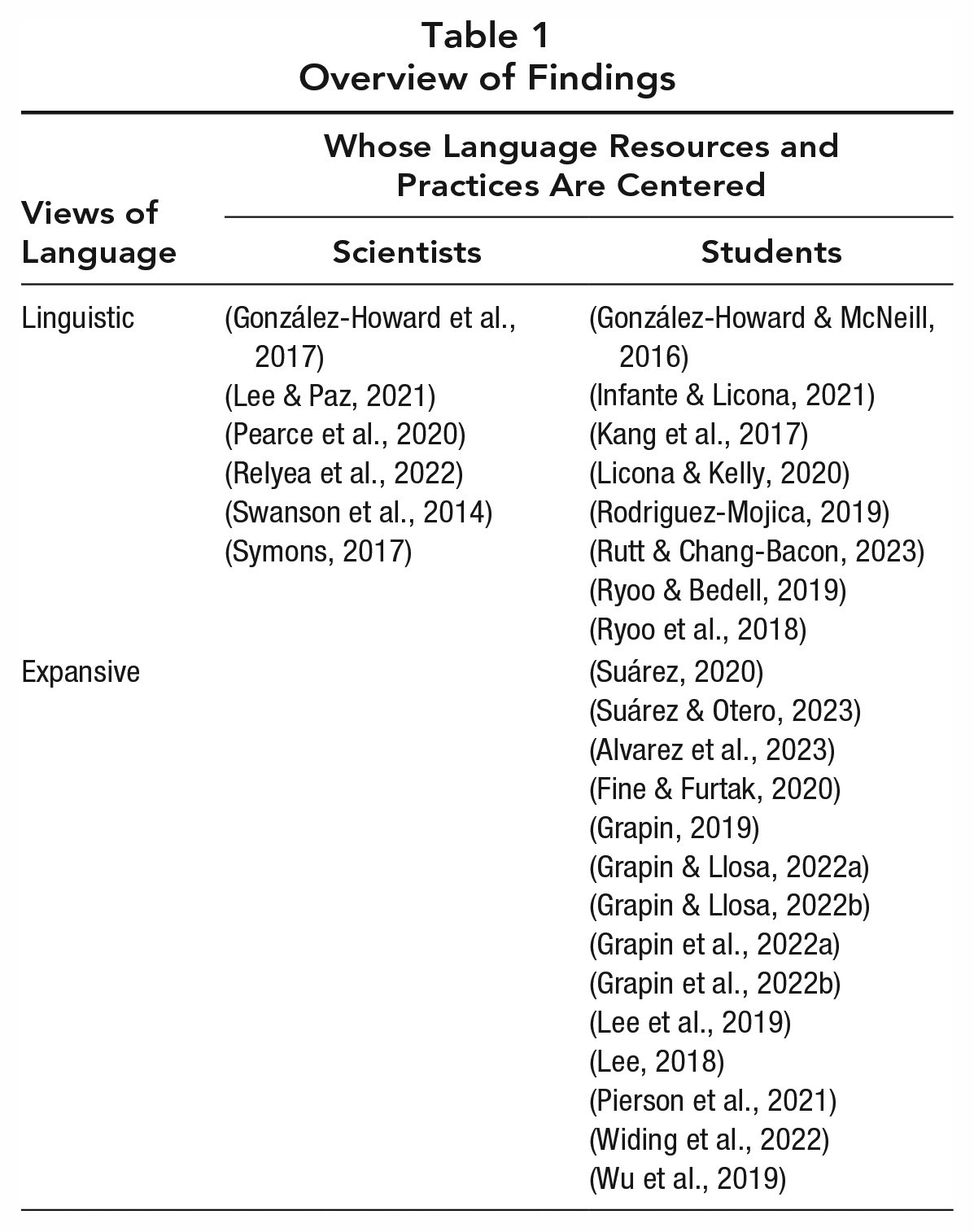
In the remaining studies, researchers took an expansive view of language (see second row of Table 1). Aligned with translanguaging scholars (García & Wei, 2014; Otheguy et al., 2015; Wei, 2018), an expansive view of language transcends the boundaries of named languages and their features to include and, importantly, equally value multimodal language resources. Thus, researchers with an expansive view conceptualized language as encompassing a range of communicative resources in addition to students’ repertoires of named language(s), including—but not limited to—gesture (Grapin & Llosa, 2022a; Suárez, 2020), modeling and drawing (Grapin et al., 2022b; Pierson et al., 2021), mathematical expressions (Wu et al., 2019), and sound symbolism (e.g., onomatopoeia; Suárez & Otero, 2023). While researchers in this latter group may have each focused on different multimodal language resources, they all described language expansively as being linguistic and multimodal.
With a sense of how science education researchers conceptualize language, we now turn to patterns between researchers’ language conceptualizations and the science practice(s) under study. As shown in Table 2, most of the studies examined multilingual students’ experiences with argumentation (e.g., Alvarez et al., 2023; González-Howard et al., 2017), modeling (e.g., Widing et al., 2022; Pearce et al., 2020; Ryoo et al., 2018), and/or explanation (e.g., Kang et al., 2017; Rutt & Chang-Bacon, 2023; Ryoo & Bedell, 2019), in that order of frequency.
Science Practice(s) Foci by Article
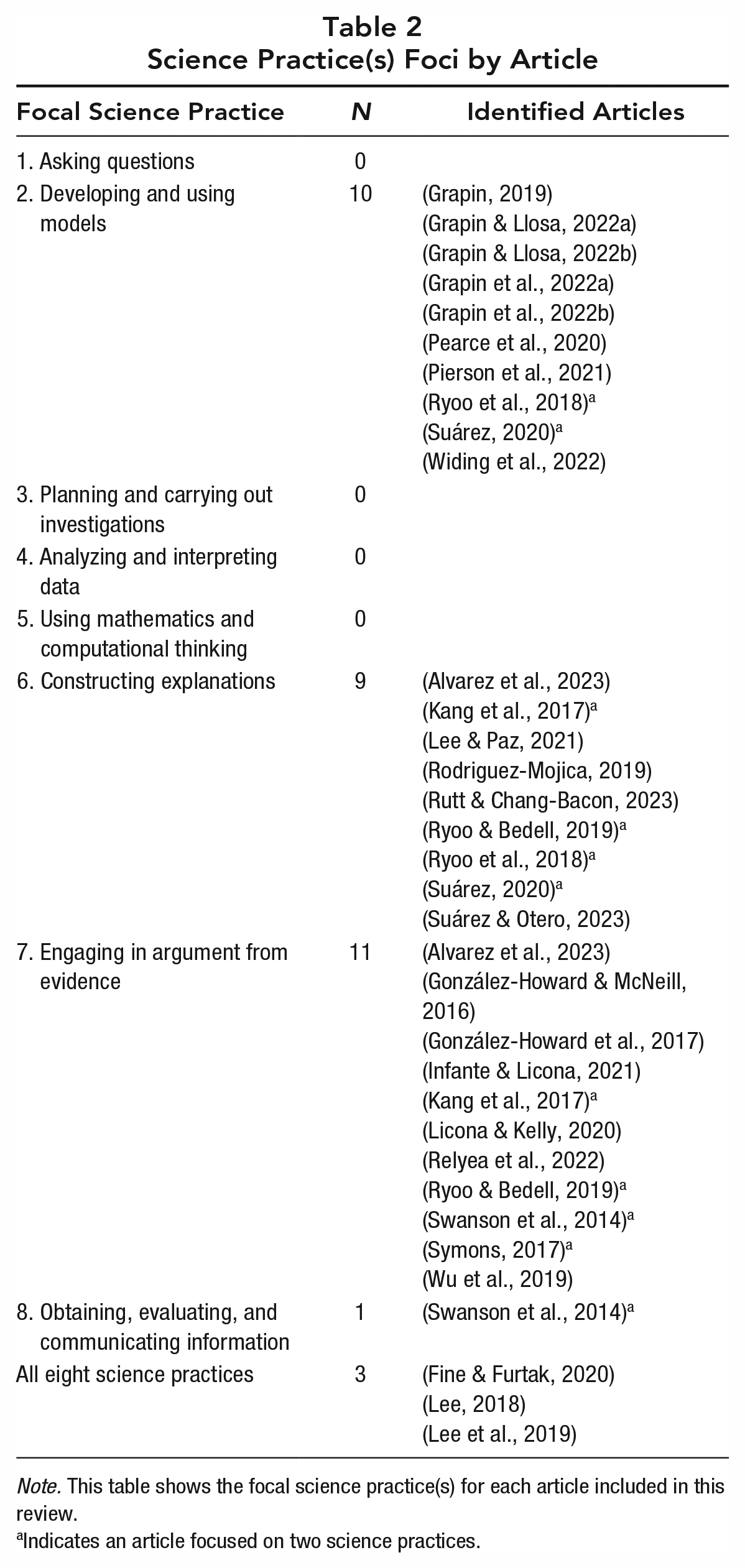
Note. This table shows the focal science practice(s) for each article included in this review.
Indicates an article focused on two science practices.
Though 19 of the 28 articles reviewed focused on a single science practice, others examined a combination of practices: six focused on two practices, and three cut across all eight science practices (see note under Table 2). The most frequent combinations of science practices examined were those of explanation and argumentation (Alvarez et al., 2023; Kang et al., 2017; Ryoo & Bedell, 2019) and explanation and modeling (Ryoo et al., 2018; Suárez, 2020).
Moreover, we noticed patterns between the reasons researchers offered for examining particular practice(s) and their language conceptualizations. Figure 1 helps us illustrate these patterns by representing the number of articles focused on each science practice according to whether researchers took a linguistic or expansive view of language.
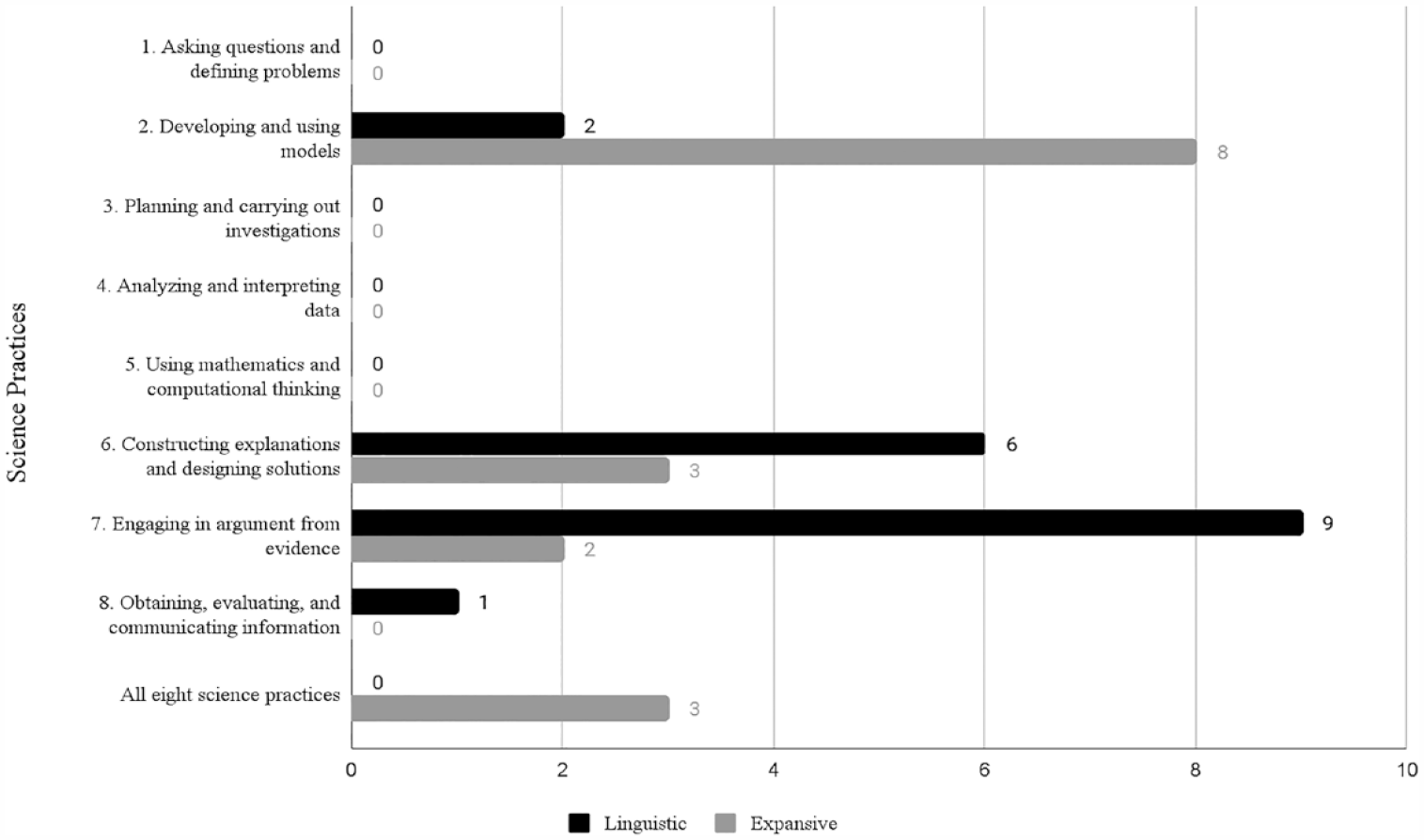
Focal science practice(s) by language conceptualization.
Researchers who took a linguistic view mostly focused on the practices of argumentation or explanation and, to a much lesser extent, on modeling. The main reason researchers offered for studying multilingual students’ experiences with argumentation and explanation was that these practices are more language-intensive, with speaking, writing, and reading described as the primary modes through which students sensemake and express ideas when engaged with these practices (e.g., González-Howard & McNeill, 2016; Infante & Licona, 2021; Lee & Paz, 2021; Rodriguez-Mojica, 2019). Meanwhile, researchers who shared an expansive view of language focused primarily on the practice of modeling and, to a lesser extent, on explanation or argumentation. Those who focused on modeling provided the rationale that it is important to target practices that require students to carry out new epistemically rich roles in the science classroom as they publicly do and communicate knowledge-construction work (Grapin et al., 2022a; Suárez, 2020; Wu et al., 2019). These researchers also explained that because modeling is inherently multimodal, it offers multiple entry points for engagement and spaces to leverage multilingual students’ many language resources (Grapin, 2019; Pierson et al., 2021). Importantly, these trends serve to highlight how our language views can impact what we choose to focus on in our work but also where there are gaps in what has been explored thus far—the implications of which we unpack in our Directions for Future Research. With these trends in mind, we now unpack how multilingual students have been positioned in recent research.
Part 2—How Are Multilingual Students’ Language Resources and Practices Positioned?
Our analyses revealed that researchers with linguistic views of language were more likely to center how scientists use language, while researchers with an expansive view of language tended to center multilingual students’ language resources and practices for sensemaking. We unpack these two trends and provide illustrative examples.
Trend 1: Centering the Language of “Scientists.”
Researchers with linguistic views of language often centered their work around how “scientists” use language for sensemaking through science practices, describing the language of scientists as one that is highly specialized in terminology, form, and function (González-Howard et al., 2017; Lee & Paz, 2021; Pearce et al., 2020; Relyea et al., 2022; Swanson et al., 2014; Symons, 2017; see middle column of Table 1). In the focal research, this manifested as studying how multilingual students used named languages (primarily standardized “academic” English), modes (e.g., writing, reading, and speaking), registers (e.g., everyday vs. “scientific”), structures (e.g., writing an evidence-based claim), and terms or vocabulary labeled as “academic” or “scientific.”
For example, in one of the focal studies, Swanson et al. (2014) explored how a teacher and her multilingual students took up the science practices of argumentation and obtaining, evaluating, and communicating information through talk and writing. Findings revealed the teacher supported students in many ways, including by encouraging them to use Spanish when carrying out science practices. Through such support, students were able to identify claims and evidence across arguments and have rich conversations about the phenomena being explored. However, despite students’ rich sensemaking via talk, researchers ultimately evaluated students’ ability to engage in the focal practices against features of “scientific writing” (p. 54–55), such as the use of “science-specific, rather than commonsense, vocabulary” (p. 55); lexical density; and authoritative tone. These narrow views of language that center scientists’ ways of using language for science practices (primarily via writing) resulted in researchers describing multilingual students’ sensemaking through these two science practices as “incomplete” (p. 56).
To further illustrate this trend, while also showing the nuanced ways it played out in research, we describe scholarship by Symons (2017). That study illustrated that when teachers drew students’ attention to how authors of informational texts use words related to the usuality or likelihood of a scientific phenomenon when offering evidence and making predictions about potential outcomes, students recognized that such particularities are important to consider in written arguments. This understanding helped multilingual students write evidence-based claims that included counter-evidence and critiques of other arguments. Though this study also focused on how scientists use language, it differs from the previous example in that researchers’ goals were to expand students’ language repertoire so students could determine how and when to employ different language resources and practices when generating arguments.
Across all studies that centered on scientists’ language, there was an emphasis on multilingual students’ developing new or additional language resources and/or practices, which were often compared to scientists’ ways of sensemaking via science practices. As a result, much of this research (often implicitly and likely unintentionally) positioned multilingual students’ existing language resources and practices as less than or nonscientific by emphasizing the need to support students’ writing, reading, and talking in particular forms of English. We discuss the potentially harmful implications of such a focus in the conclusion.
Trend 2: Centering the Language of Students
A second trend that emerged from our analysis was that all fourteen studies in which researchers took an expansive view and eight of fourteen studies in which researchers took a linguistic view (see far right column of Table 1) positioned students’ existing language resources and practices as central to and essential for scientific sensemaking. In the context of these studies, researchers with linguistic views of language elevated the ways multilingual students mobilized their existing language, such as communicating by layering linguistic resources associated with named languages (González-Howard & McNeill, 2016; Kang et al., 2017; Rutt & Chang-Bacon, 2023). For instance, Kang et al. (2017) explored the learning experiences of seventh-grade students during a plate tectonics unit that emphasized the science practices of argumentation and explanation. They found that multilingual students benefited from encouragement to use named languages spoken at home, along with their developing English, to make sense of natural phenomena with peers. This work highlighted how students were better able to articulate initial ideas about the science topic in Spanish, which they extended into English as their understanding of the scientific phenomena grew. Across these studies, researchers found that leveraging multilingual students’ named languages allowed them to engage in richer sensemaking.
Turning to researchers who took expansive views of language, some highlighted how students can use multimodalities when sensemaking, such as communicating an explanation using both writing and drawing (e.g., Alvarez et al., 2023; Grapin, 2019; Grapin & Llosa, 2022a, 2022b; Grapin et al., 2022b; Lee, 2018; Lee et al., 2019; Wu et al., 2019). For example, Grapin and colleagues (2022a) investigated multilingual students’ language use for modeling. Findings revealed that intentionally adopting expansive, multimodal language views enabled researchers to better recognize the sophistication of how multilingual students used myriad language resources for sensemaking when modeling. Particularly, Grapin et al. (2022a) explain that they would have missed this sophistication had they only focused on students’ writing in their models.
While relatively new to science education, some researchers with expansive language views have explicitly studied multilingual students’ translanguaging when engaged in science practices (e.g., Fine & Furtak, 2020; Infante & Licona, 2021; Licona & Kelly, 2020; Pierson et al., 2021; Suárez, 2020). For example, Suárez (2020) drew upon translanguaging theory to explore how multilingual students mobilized their full language repertoire (namely, linguistic resources alongside different types of gestures) with each other and the instructor as they constructed models explaining various electrical phenomena. Findings emphasized the importance of desettling what counts as productive forms of communication in science by eschewing pedagogy that polices discursive boundaries, encouraging and valuing multilingual students’ existing language for doing and communicating science. In another study, Fine and Furtak (2020) highlighted how a translanguaging lens can help the field reimagine assessments for all eight science practices. Specifically, they illustrated how inviting students to use all their existing language resources and practices to demonstrate what they have learned, or are in the process of learning, can disrupt current assessment practices that sustain minoritizing narratives about what multilingual students know and can do.
In most of the studies reviewed (22 out of 28), multilingual students’ language for sensemaking was centered in the research. Taken together, this research illustrated the rich ways multilingual students engage in science practices and how studying and learning from students’ existing language resources and practices can help the field develop more nuanced understandings of what disciplinary practices could entail.
Directions for Future Research
Aiming to inform more equitable and transformative science learning experiences for multilingual students (Bang et al., 2017; Grapin et al., 2023), we examined recent science education research on these students’ sensemaking through language-rich science practices (Lee, 2018; Suárez, 2020). Adopting a translanguaging lens (García & Wei, 2014; Otheguy et al., 2015) enabled us to explore researchers’ language conceptualizations and how these views influenced their scholarship. Specifically, we identified how linguistic or expansive views of language impacted the science practice(s) researchers studied, as well as how multilingual students’ language resources and practice were positioned for this sensemaking work (Berland et al., 2016).
The totality of language resources that individuals employ for sensemaking via science practices encompasses both linguistic (e.g., speaking, writing) and multimodal (e.g., gestures, graphs, drawings) forms of communication (Pierson & Grapin, 2021). Yet, in science classrooms, the latter forms are largely overlooked or considered supplementary (Suárez, 2020), a trend we found to also exist in science education research in which researchers exhibited linguistic views of language. Our synthesis revealed that researchers’ language views may inadvertently be limiting the scope of their work. Indeed, both researchers who took linguistic and expansive views of language tended to cluster around the same few practices in ways that both aligned with and also reinforced those views (as shown in Figure 1 and Table 2). As such, we encourage researchers to reflect upon their language ideologies (Lemmi et al., 2019) and to consider how their ideas around what counts as language influences their research. As scholars whose views continue to evolve as a result of ongoing reflection and (un)learning, we urge our community to help normalize and also engage in such critical work (González-Howard & Suárez, 2021). Relatedly, we recommend researchers develop more expansive views of language—acknowledging the equal value of linguistic and multimodal resources for sensemaking (Wei, 2018)—and, in turn, to apply such expansive views to future research that examines multilingual students’ learning through science practices (González-Howard et al., 2023). As a promising direction forward, science education researchers could tap into and learn from decades of work around translanguaging (García & Wei, 2014; Otheguy et al., 2015). Through a translanguaging perspective, we can begin critiquing and deconstructing language hierarchies that have and continue having power over how multilingual students’ language is viewed and treated in science education. Moreover, expansive views of language could help researchers develop more nuanced understanding of how language use permeates all science practices, not a select few.
Our findings also revealed discrepancies in recent research around whose language resources and practices are centered in scholarship. Some studies have centered on the language of “scientists,” with research focused on supporting multilingual students in developing those language resources to “successfully” engage in science practices (see middle column in Table 1). The idea of there being a language of scientists can be problematic. By prioritizing students’ ability to approximate or appropriate scientist’s language resources and practices, these particular forms of language are framed as both prerequisites to authentic science learning and as a goal for multilingual students to master. This practice could send students the message that their existing language resources and practices are discontinuous with scientific sensemaking (Warren et al., 2001), impacting how multilingual students view themselves in science. This practice also leaves the discipline itself unquestioned and obscures opportunities for epistemic heterogeneity (i.e., having students engage in knowledge construction in ways that are authentic and meaningful to them; Warren et al., 2020).
Signaling what we hope to be a promising trend, the majority of the studies reviewed centered on multilingual students’ language for sensemaking. We recommend future research continue to center on multilingual students, unpacking the sophisticated ways these students use their language resources and practices for sensemaking. Starting with multilingual students’ language at the center of our work, we can support students in expanding their sensemaking and communicative repertoires, building upon what they already know and can do in science (Bang et al., 2017; González-Howard et al., 2023). Critically, such work would need to be done in ways that do not suppress multilingual students’ existing language nor solely privilege the language practices of White, Western, English-speaking, upper-middle-class individuals (NASEM, 2018). Expanding multilingual students’ language for sensemaking while positioning their existing language resources and practices as generative and valuable can open up disciplinary possibilities (Berland et al., 2016; Warren et al., 2020) that shine a light on multilingual students’ brilliance.
Footnotes

Note
This work was supported by the National Science Foundation under NSF Grant # 1942912—CAREER: Developing elementary preservice teachers’ understandings and abilities to support emerging bilingual students’ scientific sensemaking. Any opinions expressed in this work are those of the authors and do not necessarily represent those of the funding agency; The University of Texas at Austin; or the University of Massachusetts, Amherst.