




Abstract
In this brief, we use a nationally representative sample of ever-English learners (ELs; N = 783) to examine relations between EL concentration within classrooms and reading growth between kindergarten and Grade 5. Piecewise growth models were used to estimate relations for four developmental periods (K–1, Grades 1–2, Grades 2–3, and Grades 3–5). Results indicate nonsignificant, trivially sized relations for classroom EL concentration across periods, with and without controls for school concentration and student characteristics. Results were robust across multiple specifications. Findings call into doubt the academic benefits of the common practice of grouping ELs together in particular classrooms.
Keywords
Multilingual students classified as English learners (ELs) are often concentrated within particular classrooms and schools (Gándara & Orfield, 2012; National Academies of Sciences, Engineering, and Medicine, 2017). This concentration reflects a variety of structural and geographic factors, but it also results from intentional efforts to group students into particular classrooms based on their language needs (e.g., Estrada et al., 2020). The rationale for grouping ELs together within schools is that doing so will allow for more targeted and effective language instruction than would be possible in linguistically heterogeneous classrooms. This rationale results, in part, from an interpretation of policy mandates, including those in the Every Student Succeeds Act and its precursors, to provide special services to ELs. Such mandates rarely specify isolated instruction for ELs, but they frequently lead educators to group ELs together to provide them mandated services (e.g., Estrada et al., 2020; Gándara & Orfield, 2012). This practice may also stem from educators’ interpretation of guidelines advising targeted language instruction for ELs (e.g., Baker et al., 2014). If delivering such targeted services in concentrated classrooms is effective, it may be most consequential for reading, as English reading development (from early foundational skills to reading comprehension) involves linguistic processes that depend heavily on English language comprehension (August & Shanahan, 2006).
Despite the common practice of grouping ELs into specific classrooms, a wealth of theory and research has criticized such efforts as harmful for academic and social outcomes (Estrada et al., 2020; Gándara & Orfield, 2012). Theories of second-language development and socialization (e.g., Ellis, 2005; Wong Fillmore, 1991) have emphasized the importance of interaction with more proficient peers for language learning. Similarly, models of reading development (e.g., RAND Reading Study Group, 2002) acknowledge the sociocultural context—including classroom composition—as key to reading growth. Empirical work by Estrada and colleagues (2020) demonstrated that ELs in elementary California classrooms with higher proportions of ELs had lower performance on state tests of English language arts, math, and English language proficiency, controlling for various covariates. Such research and theory have called into question the effectiveness of this pervasive policy.
Current Study
This study examined whether classroom EL concentration could predict ever-ELs’ reading growth between kindergarten and Grade 5, using a nationally representative sample of ever-ELs (N = 783) drawn from the Early Childhood Longitudinal Study-Kindergarten 2011 Cohort (ECLK:2011; Tourangeau et al., 2019). (Data are available at https://nces.ed.gov/ecls/kindergarten2011.asp.) Ever-ELs were identified as students whose kindergarten teacher reported that they “participate[d] in an instructional program designed to teach English language skills to children with limited English proficiency” (National Center for Educational Statistics, 2011, p. 13). Consistent with the ever-EL or total-EL framework (e.g., Hopkins et al., 2013), students remained in the longitudinal sample in later grades, even if they were no longer enrolled in EL services (see robustness checks regarding this decision in Supporting Online Material [SOM]). Sample descriptives are provided in SOM Table S1.
The outcome measure was an adaptive measure of overall reading achievement that emphasized basic reading skills in the early grades and reading comprehension in Grades 3–5 (Najarian et al., 2019; see SOM). Classroom EL concentration was reported by teachers. We controlled for administrator-reported school EL concentration as well as student and school characteristics. Student controls included socioeconomic status (ECLS-K:2011 composite), English oral proficiency, teacher-reported social-emotional skills (externalizing behaviors, internalizing behaviors, social skills), and executive functioning (cognitive flexibility, working memory, teacher-reported attentive behavior and inhibitory control). School controls included percentage receiving free or reduced lunch and percentage of students of color. All controls were measured in the same or a previous year to EL concentration.
We first described school and classroom concentration of ever-ELs. Then, using latent growth modeling with clustered standard errors to account for nesting of students within schools, we examined whether classroom concentration predicted each slope in our best fitting piecewise model. We compared results in uncontrolled models and in models controlling for student and school covariates. Finally, we conducted a series of robustness checks to test alternative specifications. Based on prior theory and empirical work (e.g., Estrada et al., 2020; National Academies of Sciences, Engineering, and Medicine, 2017), we hypothesized that classroom EL concentration would negatively predict later growth in reading.
Results
Preliminary Analyses
The average ever-EL attends a school that enrolls 36%–40% ELs (depending on grade) and is enrolled in a classroom that enrolls 41%–60% ELs (SOM Table S2). By contrast, the average never-EL attends a school with much lower school EL concentrations (9%–11% ELs) and classroom EL concentrations (7%–15% ELs). Given the evidence of high EL concentration both the school level and classroom levels, we controlled for school EL concentration in our models to account for the contextual factors that may have driven classroom EL concentration and to isolate (to some extent, at least) the effects of intentional grouping.
Preliminary unconditional growth modeling indicated that a four-slope piecewise model provided the best fit to the data (see SOM). As shown in Figure 1, this model included separate slopes from fall, kindergarten to fall, Grade 1; from fall, Grade 1 to fall, Grade 2; from fall, Grade 2 to spring, Grade 3; and from spring, Grade 3 to spring, Grade 5. The average reading trajectory demonstrated a trend of decelerating growth over time, as found in prior research with ECLS-K and other data sets (e.g., Kieffer, 2011; Relyea & Amendum, 2020).
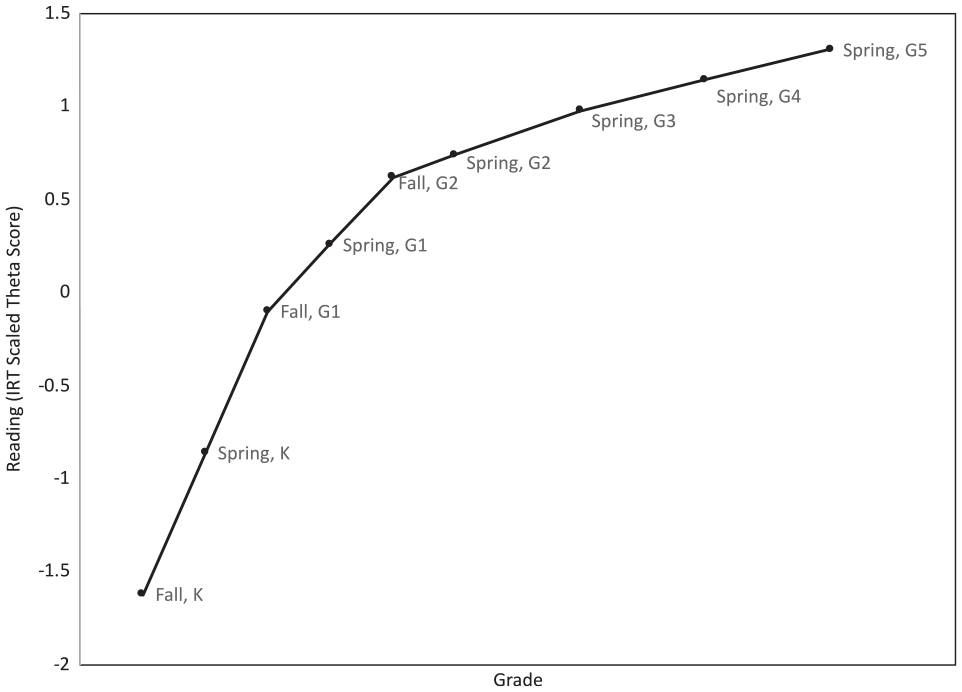
Fitted trajectory for reading growth for all ever-ELs, illustrating four-slope piecewise growth model (N = 783).
Classroom English Learner Composition Predicting Reading Growth
Classroom EL concentration (measured toward the beginning of each of the four time periods) did not significantly predict any of the four slopes for reading growth (all ps > .05). As shown in Table 1, these results were the same regardless of whether we controlled for school EL concentration along with student and school characteristics. The standardized path coefficients for classroom EL concentration were all trivial to small in magnitude (–0.082 to 0.084), and the standard errors were relatively small, indicating good precision for these null effects (see Figure 2).
Standardized Path Coefficients and Standard Errors for Relations Between Classroom EL Concentration and Reading Growth, With and Without Controls (N = 783)
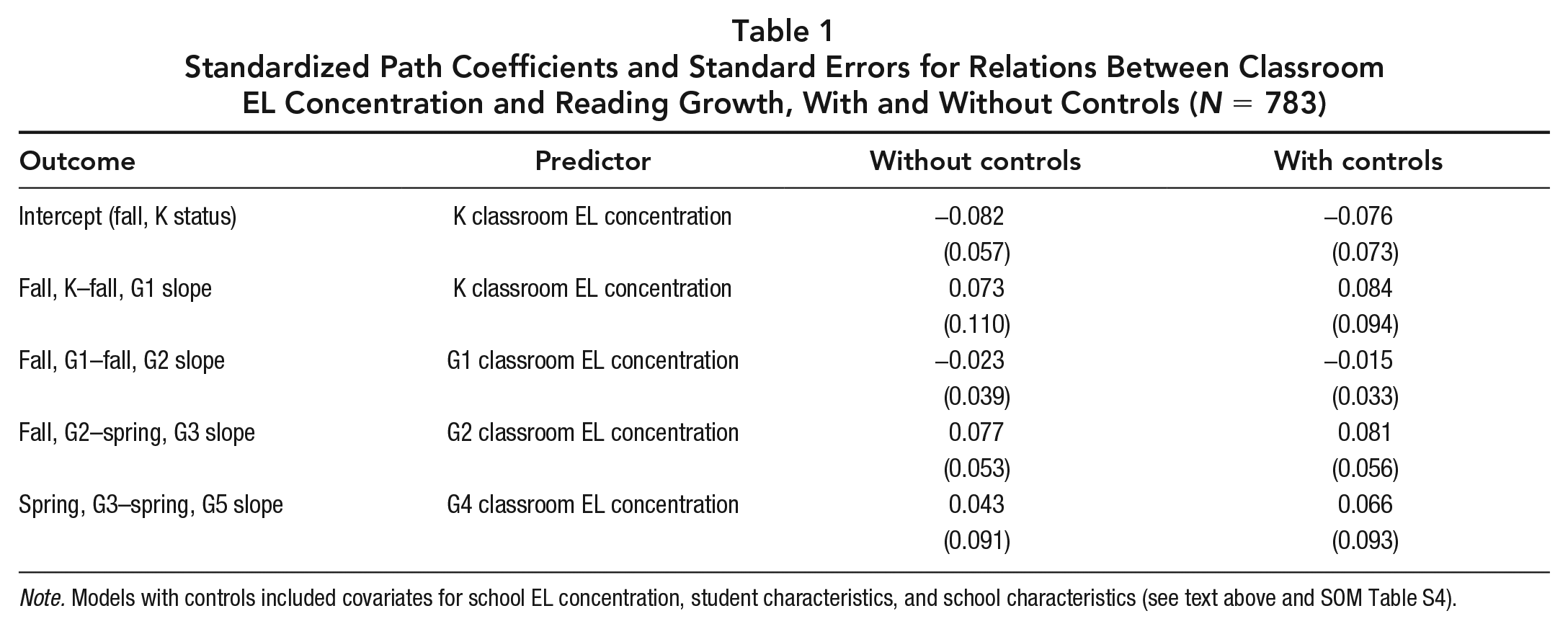
Note. Models with controls included covariates for school EL concentration, student characteristics, and school characteristics (see text above and SOM Table S4).
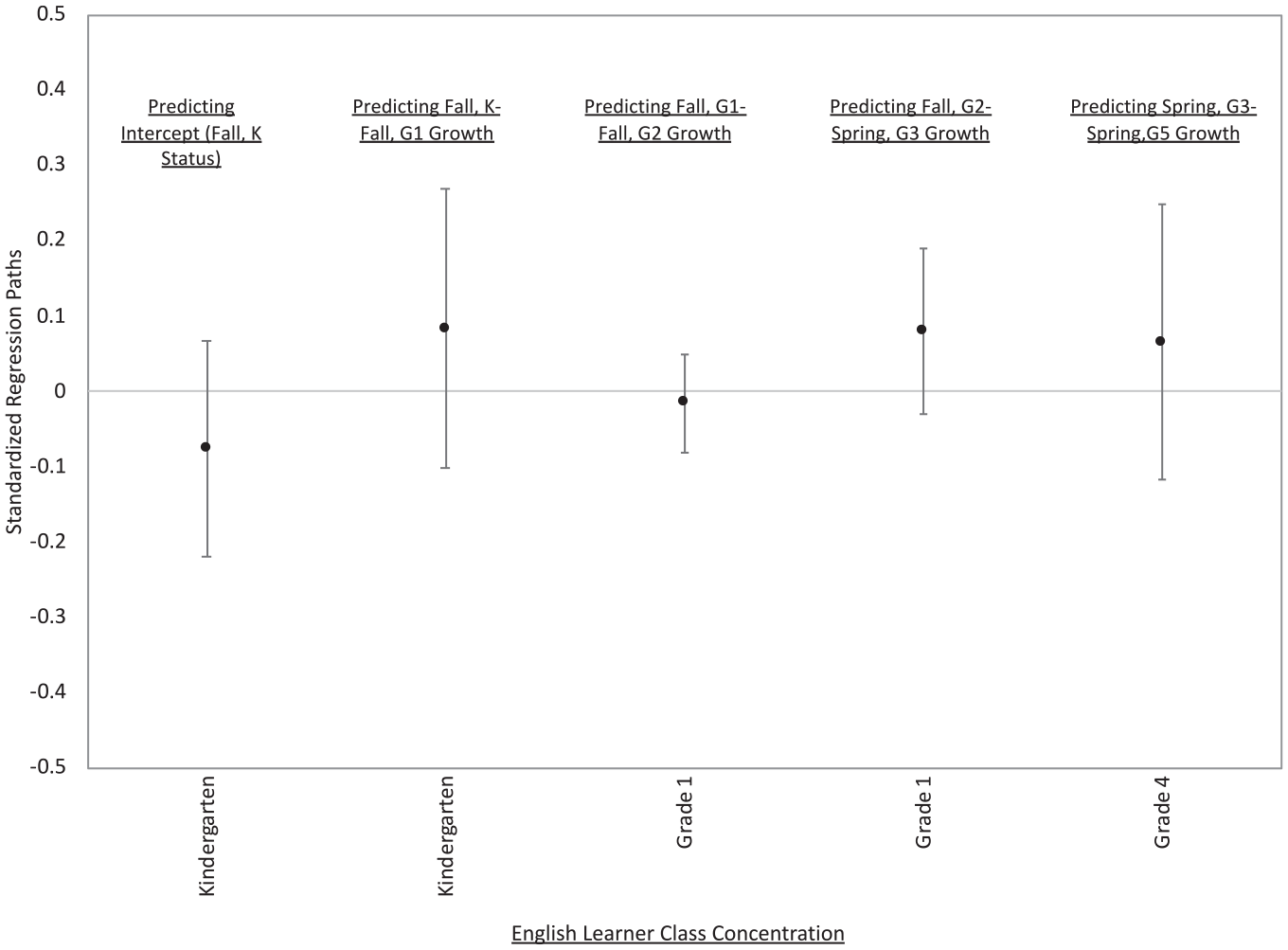
Effect size estimates and associated 95% confidence intervals for relations between EL classroom concentration and reading growth (N = 783).
Robustness Checks
Results were robust to the inclusion of various student and school controls, interactions with the class language program (i.e., English as a second language, bilingual programming, or no services), and different specifications for the relations between slopes and intercept (see SOM). In addition, because our “ever-EL” specification combined current and former ELs in a way that may have diluted the link between EL concentration and English reading, we tested interactions to see whether the class EL concentration effects were different for current ELs in the most relevant grade for a given slope, compared to ever-ELs; these interactions were all nonsignificant, indicating that the effects were not different for current ELs (p > .05; see SOM Table S7).
Discussion
In this study, we explored the relations between classroom EL concentration and reading growth in the elementary grades. Consistent with prior research (e.g., Estrada et al., 2020; National Academies of Sciences, Engineering, and Medicine, 2017), we found evidence of high concentration of ELs within particular classrooms, higher than we would have expected based on school EL concentration alone. Based on arguments about the harms of segregation of various kinds (e.g., Gándara & Orfield, 2012) and about the importance of interaction with more proficient peers for language learning (e.g., Ellis, 2005; Wong Fillmore, 1991), we hypothesized that higher EL concentrations would be associated with slower reading growth. However, we found no evidence for such a negative effect. Rather, we found consistent null effects across four developmental periods. Given our large sample size, all the effects had relatively small standard errors, indicating “well-measured zeros” and providing good confidence that any effects we could not detect as statistically significant would be small or trivial in magnitude. Results were robust across a variety of alternative specifications. Despite the surprising lack of negative effects, the absence of positive effects raises questions about the common assumptions that underlie educators’ efforts to separate ELs into distinct classrooms.
Our null effects have multiple plausible explanations, each of which raises questions for future research. In interpreting these effects, we draw on ecological theories of language learning (e.g., Kramsch, 2002; van Lier, 2004) that emphasize that all environments have particular affordances for language learning and related reading development. Although non-EL peers are one such affordance, others may be equally or more important. One possibility is that there are positive and negative effects of the various affordances that come with classroom EL concentration that cancel each other out. For instance, the positive affordance of more targeted language instruction in high-EL classrooms might be a benefit that is counteracted by the lack of interaction with non-EL peers. Another possibility is that the quality of instruction (which we could not observe) is more predictive than the composition of the classroom. We found no interactions between EL concentration and the classroom language program (i.e., English as a second language, bilingual instruction, or no services), but these are relatively coarse categories. High-quality language instruction (or the lack thereof) may take place to a similar extent in classrooms with high and low EL concentration. Finally, it is possible that simply enrolling ELs with non-ELs in the same classrooms is necessary but insufficient for reading growth, especially if ELs are not provided with many opportunities to interact with their non-EL peers during instruction, given the importance of such interaction for language learning (e.g., Ellis, 2005).
Well-intentioned educators separate ELs from non-ELs for instruction on the premise that doing so will facilitate more targeted language instruction and result in more rapid progress in reading and other areas. Our findings do not support this premise. Although we do not disagree with the research base regarding targeted language instruction for ELs (e.g., Baker et al., 2014), our findings suggest that educators should be cautious in assuming that such instruction should be provided in isolated settings. Even if academic harms may not result, concentrating ELs in particular classrooms may have negative social effects, restricting ELs’ access to the linguistic, social, and cultural capital offered by their non-EL peers (e.g., Estrada et al., 2020; Gándara & Orfield, 2012).
This study has several limitations to note. First, although we conducted a variety of robustness checks, there was limited information in the ECLS-K:2011 data set for investigating some hypotheses. For instance, we suspect that higher EL concentrations may be associated with more EL-specific resources (e.g., specialized EL curricula or bilingual paraprofessionals), but the ECLS-K:2011 data set did not provide data to explore these questions. Second, although our data suggested greater classroom EL concentration than we would have expected based on school EL concentration, our data did not allow us to fully isolate the extent to which this concentration was due to intentional grouping as opposed to other factors. Our findings were robust to the inclusion of school EL concentration as a control, but further research on how educators make decisions to group ELs is warranted. Third, the available data on EL status and classroom EL concentration were teacher-reported and therefore prone to human error. Fourth, we focused on English reading because of its heavy English-language demands, but further analyses in other subject areas are warranted. Fifth, future research should investigate other outcomes beyond academic performance, such as socioemotional skills and student self-concept, which may be more susceptible to EL concentration effects. Finally, future work is needed using multiple-group approaches to measure academic growth (Kohli et al., 2015; Sullivan et al., 2017) to investigate the effects of EL concentration on students who are never ELs as compared to effects on ever-ELs.
Despite these limitations, this study provides valuable new evidence on the relations between EL concentration and reading growth. It calls into question the logic of educators’ widespread practices of separating ELs from non-ELs for instruction.
Supplemental Material
sj-pdf-1-edr-10.3102_0013189X231203646 – Supplemental material for Classroom Concentration of English Learners and Their Reading Growth
Supplemental material, sj-pdf-1-edr-10.3102_0013189X231203646 for Classroom Concentration of English Learners and Their Reading Growth by Michael J. Kieffer and Andrew W. Weaver in Educational Researcher
Footnotes

Notes
This study was supported, in part, by the Institute of Education Sciences, U.S. Department of Education, through grant R305A200069 to New York University. Weaver’s work on this study was supported, in part, by the Institute of Education Sciences, U.S. Department of Education, through grant R305B140037 to New York University. The opinions expressed are those of the authors and do not represent views of the Institute or the U.S. Department of Education.
Authors
References
Supplementary Material
Please find the following supplemental material available below.
For Open Access articles published under a Creative Commons License, all supplemental material carries the same license as the article it is associated with.
For non-Open Access articles published, all supplemental material carries a non-exclusive license, and permission requests for re-use of supplemental material or any part of supplemental material shall be sent directly to the copyright owner as specified in the copyright notice associated with the article.
