




Abstract
This article studies state-developed courses in career and technical education (CTE) that offer students the opportunity to earn college credit during high school. Using a regression-discontinuity approach, we examine the effects of passing the end-of-course exam necessary to secure college credit on postsecondary enrollment and choice. We find that barely passing a CTE dual-credit exam increases the likelihood of attending a public, in-state, 2-year institution, with at least part of that increased propensity stemming from a reduction in the likelihood of attending a private in-state institution. Furthermore, we find suggestive evidence that the boost in the likelihood of attending a public, in-state, 2-year college is relatively larger for male compared to female students.
Keywords
Aspirations of college success among high school students have risen steadily over the past few decades, with over three quarters expecting to earn at least a 4-year degree (Goyette, 2008). However, completion rates among college enrollees remain low, at roughly 50% (National Center for Education Statistics [NCES], 2018). 1 Insufficient academic preparation is frequently cited as a culprit, especially in light of high rates of participation in remedial coursework by new college enrollees (NCES, 2012; Schneider, 2010). 2 Alongside concerns about preparation exist worries about timely progress through college (e.g., Scott-Clayton, 2015), excessive course-taking (Complete College America, 2011), and the financial burden of postsecondary study (e.g., Greenstone & Looney, 2012; Page & Scott-Clayton, 2016).
At the crossroads of these concerns are initiatives that aim to expose students to elements of the college experience prior to college—in order to bolster academic skills, increase knowledge about college-level expectations, and provide the opportunity to earn college credit while in high school (Bailey & Karp, 2003; Kirst & Venezia, 2004; Venezia, Kirst, & Antonio, 2003). “Credit-based transition programs,” like dual enrollment or dual credit, which offer students the chance to grow a nest egg of college credits as high schoolers, have become increasingly common. The broad hypothesis is that early credit-bearing opportunities like these may boost rates of college enrollment, improve college choice, reduce the financial burden of college, enhance early postsecondary performance, and ultimately accelerate time to degree. However, there is very little causal evidence on the degree to which these credit-based transition programs achieve these aims (Bailey & Karp, 2003; Evans, 2009).
The sparse evidence we do have focuses on either high-dosage models that fully embed 2 years of college within high school (e.g., Edmunds et al., 2013) or Advanced Placement (AP) courses (Avery et al., 2018; Conger et al., 2021; Gurantz, 2021; Smith et al., 2017), which have long been available to relatively high-achieving students. To meet the growing demand for workers capable of filling high-skill jobs (Autor, 2014; Carnevale & Rose, 2011, 2015), which typically require some form of postsecondary training, policy efforts must look outside the top performers in high school and beyond core academic subject areas. In particular, efforts to strengthen pathways to additional training that center on topics in career and technical education (CTE) may hold promise (Jimenez, 2020). We expand the scope of inquiry on dual-credit courses by focusing on CTE dual-credit courses, which attract a more diverse swath of students (Hemelt & Swiderski, 2022).
In 2012, the Tennessee Department of Education (TDOE) launched a “statewide dual-credit” (SDC) initiative that developed dual-credit courses across a range of subject areas. Each SDC course is designed by a team of secondary and postsecondary instructors who collaborate to define a set of learning objectives, ensure course alignment to college-level academic standards, and craft an end-of-course (EOC) exam intended to assess students’ mastery of the aligned content. Our focus is on this last component—the EOC “challenge” exam—because it is the element of each SDC course through which students can secure college credit while still in high school.
All SDC course participants are required to take their course-specific challenge exam with its own structure and passing score. Students who score at or above the cutoff earn three credits that are redeemable at any public postsecondary institution in Tennessee upon enrollment. In this sense, exam passers “bank” earned college credit—along with receipt of a signal of field-specific competence—in contrast to their SDC peers who score below the exam’s passing cutoff. Thus, we use a regression-discontinuity (RD) approach to estimate the causal effects of passing the challenge exam on measures of college enrollment and choice.
For students in dual-credit CTE courses, we find that barely passing the EOC exam increases the likelihood of attending a public, in-state, 2-year institution, with at least part of that increased propensity stemming from a reduction in the likelihood of attending a private in-state institution. Moreover, we find suggestive evidence of a relatively larger increase in the propensity to attend a public, in-state, 2-year college due to exam passage for male students compared to female students.
A central contribution of our work is to add to the limited literature on the effects of earning college credit in high school on the transition to college. To our knowledge, the only causal evidence on this question comes from research focused on AP courses (Gurantz, 2021; Smith et al., 2017), 3 which finds that earning a sufficiently high AP score boosts the likelihood of completing a bachelor’s degree within 4 years of high school graduation by 1 to 2 percentage points per exam. However, receipt of college credit in this context has no effect on the 6-year completion rate, suggesting that earning college credit in high school hastens time to degree with little influence on overall educational attainment. 4
It is not clear that many of the findings from the small, well-executed literature on AP exam performance would translate to the dual-credit students in our study, who often stand much more squarely on the margin of college attendance than their peers in AP courses. Figure 1 maps mean test scores of students who barely pass an AP math exam (i.e., scoring a 3), students who barely pass an SDC math exam, and students who barely pass an SDC exam in a CTE subject (i.e., scoring within +10 of the passing cutoff score) onto a common, baseline achievement distribution (i.e., standardized score on the Algebra I EOC exam). The student who barely passes a dual-credit CTE exam hails from a part of that distribution nearly 1 full standard deviation below the marginal AP math passer. 5 The encouragement/discouragement effect of barely passing/failing the challenge exam on the transition to college may be much more pronounced for middle-achieving students (Papay et al., 2016).
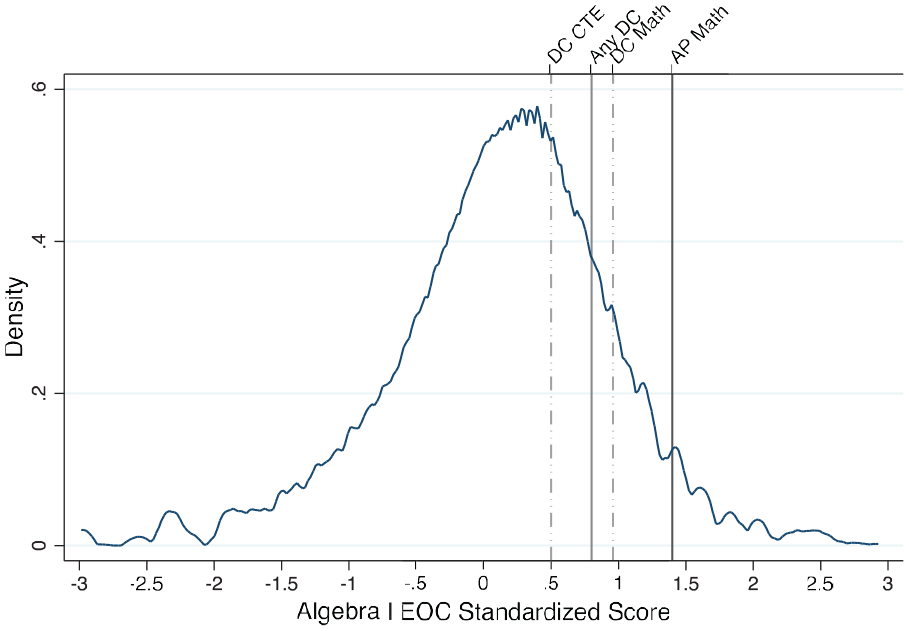
Baseline math performance for marginal passers of AP math, SDC math, and SDC CTE
A second contribution of our work is to expand the types of dual-credit courses on which we have causal evidence. The bulk of prior work on dual-credit and dual-enrollment courses, especially the limited literature that estimates plausibly causal effects of such courses on educational outcomes, has focused on traditional academic subjects such as math and English (e.g., Hemelt et al., 2020; Speroni, 2011). Thus, findings from our work speak to the intersection of the literature on CTE coursework and research on initiatives intended to improve the transition to a variety of forms of postsecondary study for students from a wider range of backgrounds.
The article proceeds as follows. In the next section, we describe the policy context in Tennessee along with the nuts and bolts of the statewide dual-credit initiative. We then discuss the data and empirical approach we use to answer our research question. Next, we present our findings and conclude with a discussion of takeaways and policy implications of the main results.
Policy Context in Tennessee
Tennessee’s SDC program was the first major effort to emerge from a larger policy agenda aimed at broadening and improving early postsecondary experiences for students in the state. 6 The SDC initiative is a collaboration between secondary and postsecondary educators in Tennessee (TDOE, 2017). Together, these educators developed high school courses that “incorporated college-level learning objectives” and content, aligning them to college-level standards.
Trained high school instructors teach these SDC courses in high schools after attending professional development training sessions over the summer. Each course includes an aligned “challenge” exam, a cumulative final assessment that is mandatory, taken online, and centrally graded. The exam is free, and students are allowed only one attempt. Students who score at or above a designated threshold earn three college credit hours redeemable at any public postsecondary institution in Tennessee. 7
Beginning in the 2013–2014 academic year, the consortium gradually rolled out courses in a variety of subjects. We focus on a subset of understudied dual-credit courses in CTE areas such as plant science, agricultural business, and criminal justice. 8 The largest of these CTE dual-credit courses, in terms of student enrollment and thus sample size, is Plant Science. 9 We further focus on the element of these dual-credit courses linked to hypotheses about their capacity to propel students into college (and possibly hasten their progress through college). We study this credit-bearing component using an RD approach to estimate the effects of barely passing an SDC exam on college enrollment and choice among students in CTE dual-credit courses in Tennessee.
Data and Empirical Approach
Data Sources, Analytic Sample, and Descriptive Statistics
We combine data from four different sources: (a) student-level SDC challenge exam records from TDOE; (b) administrative data that include measures of high school students’ demographics, course-taking, and test scores from the state’s longitudinal data system; (c) semester-level data from the Tennessee Higher Education Commission that cover students at public institutions in Tennessee; and (d) data from the National Student Clearinghouse (NSC), which allow us to capture enrollment in out-of-state and private postsecondary institutions. 10
To generate the analytic sample, we begin with deidentified challenge exam records provided by TDOE for exams taken up through 2016–2017. These records include score information for 10 of the 14 courses listed in Appendix Table A1 available on the journal website. We restrict the sample to students for whom we can observe college enrollment within 1 year following their expected, on-time high school graduation (i.e., Spring 2014 to Spring 2017). We then retain observations with nonmissing baseline demographic and achievement information, including gender, race and ethnicity, English language learner (ELL) status, and Algebra I EOC exam score. 11 Finally, we focus on three CTE courses, resulting in 2,681 student-exam observations in total, of which, 1,918 student-exam observations are in the Plant Science course. 12
Table 1 presents summary statistics on our analytic samples—the first sample includes students in all CTE dual-credit courses during our period, and the second restricts to the largest of those courses, Plant Science. Nearly 60% of the students in our analytic samples are male, over 93% are White, and the vast majority are in 11th or 12th grade. Given past work that finds different effects of CTE experiences on educational and labor market outcomes for males compared to females (e.g., Brunner et al., 2021; Hemelt et al., 2019), we pay close attention to treatment heterogeneity by gender throughout our analyses.
Summary Statistics on Students in SDC CTE Courses
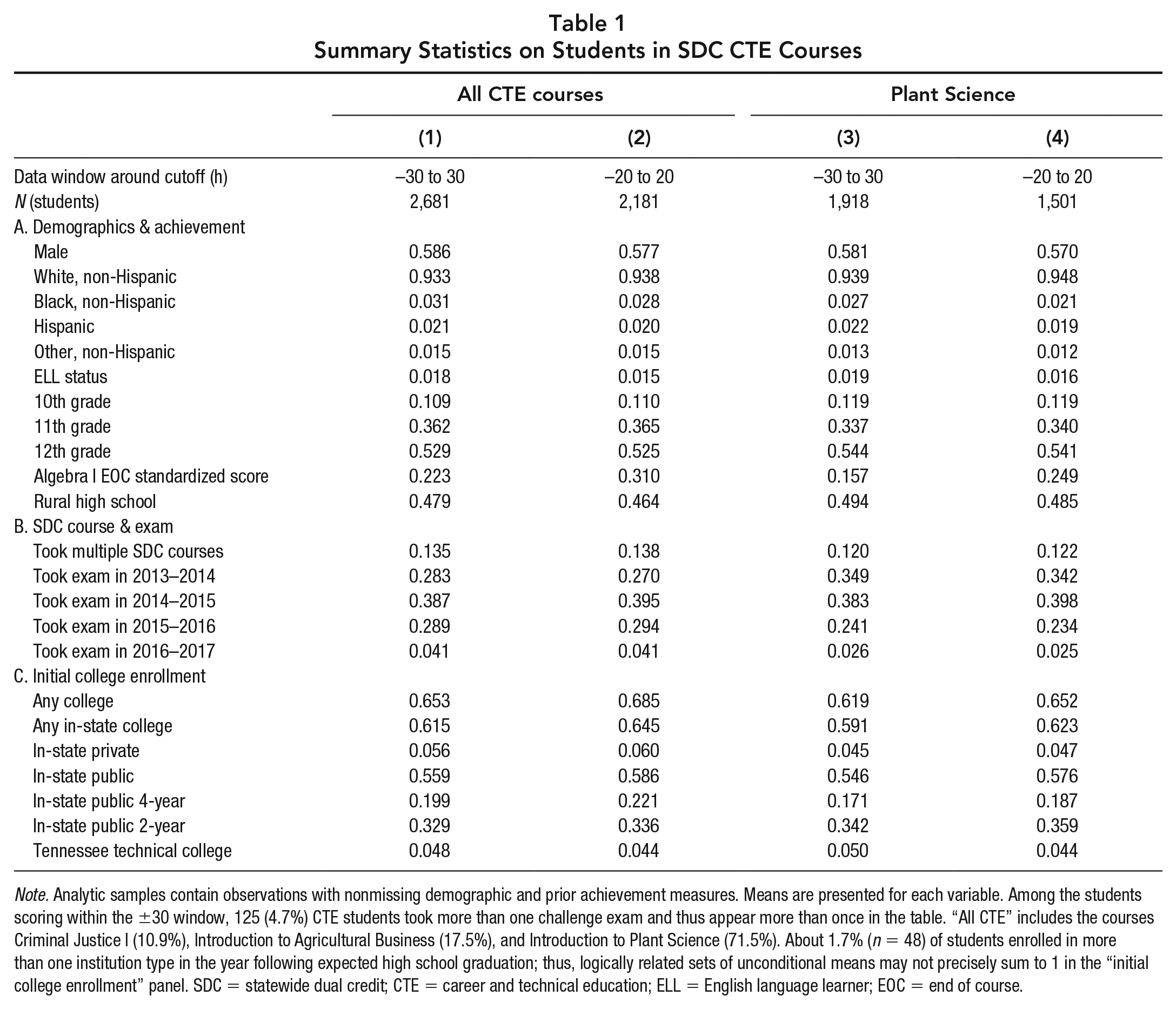
Note. Analytic samples contain observations with nonmissing demographic and prior achievement measures. Means are presented for each variable. Among the students scoring within the ±30 window, 125 (4.7%) CTE students took more than one challenge exam and thus appear more than once in the table. “All CTE” includes the courses Criminal Justice I (10.9%), Introduction to Agricultural Business (17.5%), and Introduction to Plant Science (71.5%). About 1.7% (n = 48) of students enrolled in more than one institution type in the year following expected high school graduation; thus, logically related sets of unconditional means may not precisely sum to 1 in the “initial college enrollment” panel. SDC = statewide dual credit; CTE = career and technical education; ELL = English language learner; EOC = end of course.
Table 1 shows that college-going rates for this population hover between 62% and 69%, depending on the sample and window around the passing threshold. College-goers from dual-credit CTE courses overwhelmingly attend in-state public institutions, mainly 2-year colleges. Nearly half (48%) of students in the sample attend rural high schools. Appendix Table A2 (available on the journal website) presents average pass rates on the EOC exams for the dual-credit CTE courses in our study. The average pass rate across all such courses over our full period is 30.7%, with course- and year-specific pass rates ranging from below 8% to over 51%. 13
Empirical Approach
We estimate the local average treatment effect of banking college credit on subsequent college enrollment and choice by focusing on the cut-score margin. We recenter all exam scores on zero, where scores greater than or equal to zero denote passing and those below zero denote failing.
We employ both parametric and nonparametric approaches; however, our preferred estimates come from parametric models of the following form:

Here, Passict is an indicator equal to 1 if student i in SDC course c taken in year t received a challenge exam score at or above the relevant passing threshold. The function f (Scoreict) represents the relationship between the assignment variable (i.e., the recentered challenge exam score) and the postsecondary outcome (Yict). We interact functions of this assignment variable with the Passict indicator to allow the relationship between the challenge exam score and the outcome to differ on either side of the cutoff, preferring a quadratic parameterization within a window of data surrounding the passing threshold that retains a reasonable portion of our modest sample size (i.e., ±20 points). 14 To assess robustness, in some specifications, we insert a vector of student-level controls, Xit, which includes gender, race and ethnicity, ELL status, standardized Algebra I EOC score, and an indicator denoting whether a student had previously taken an SDC exam, and SDC-course-by-year fixed effects (δct). 15 Finally, εict is the stochastic error term. Within this setup, β1 represents the effect of passing a challenge exam and thus earning transferable college credit, officially credited upon enrollment at a Tennessee public institution, on an outcome of interest.
Valid causal inference in the RD approach rests on two core assumptions. First, students (or teachers) must not be able to precisely manipulate scores near the threshold to ensure passage. 16 Second, in the neighborhood of the cutoff, we ought to be able to consider students on either side of the cutoff equivalent in all respects, observed and unobserved, except one: the opportunity to redeem college credit at a public institution in Tennessee. Panel A of Appendix Figure A1 (available on the journal website) interrogates the plausibility of the first assumption via density plots, displaying no concerning evidence of score manipulation (i.e., discontinuous clumps in counts of students just to the passing side of the cutoff). Panels B and C of Appendix Figure A1 and RD estimates in Appendix Table A3 (available on the journal website) demonstrate reasonable equivalence of students, in terms of observable characteristics, on each side of the cutoff—thereby lending support to the second assumption. In all analyses, we cluster standard errors at the school level because schools make decisions about dual-credit course offerings; however, patterns of results are unchanged if we instead use simple heteroskedasticity-robust standard errors.
Findings
We first consider the average effect of banking college credit in a CTE course on college enrollment and choice within 1 year of a student’s expected high school graduation. Panel A of Table 2 and Figure 2 present our key findings. We find that barely passing a CTE dual-credit exam (e.g., Plant Science) markedly increases the likelihood of attending a public, in-state, 2-year institution. Specifically, barely passing such an exam boosts the likelihood of attending an in-state public community college by between 8 and 11 percentage points.
Effect of Passing SDC Challenge Exam on College Enrollment and Choice
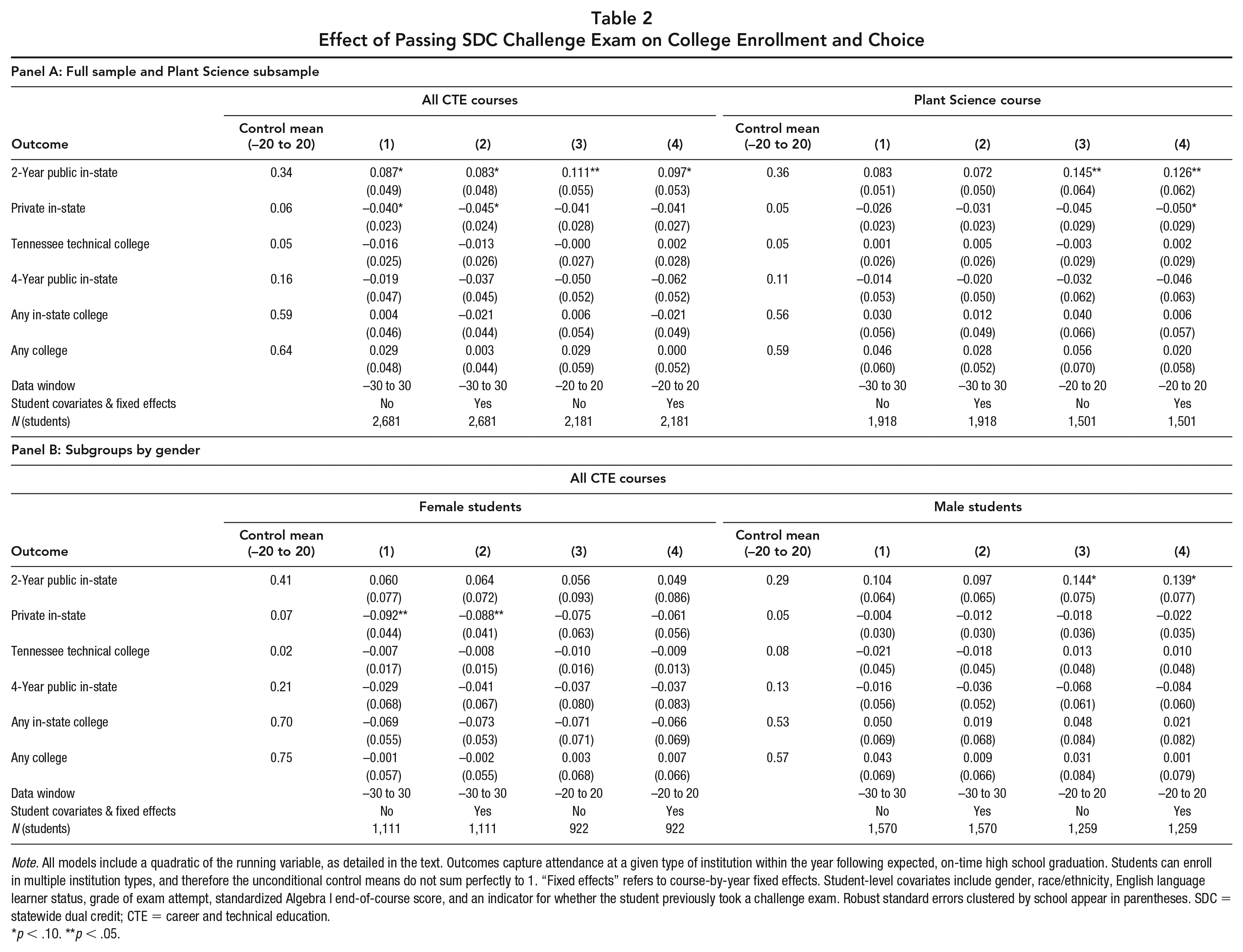
Note. All models include a quadratic of the running variable, as detailed in the text. Outcomes capture attendance at a given type of institution within the year following expected, on-time high school graduation. Students can enroll in multiple institution types, and therefore the unconditional control means do not sum perfectly to 1. “Fixed effects” refers to course-by-year fixed effects. Student-level covariates include gender, race/ethnicity, English language learner status, grade of exam attempt, standardized Algebra I end-of-course score, and an indicator for whether the student previously took a challenge exam. Robust standard errors clustered by school appear in parentheses. SDC = statewide dual credit; CTE = career and technical education.
p < .10. **p < .05.
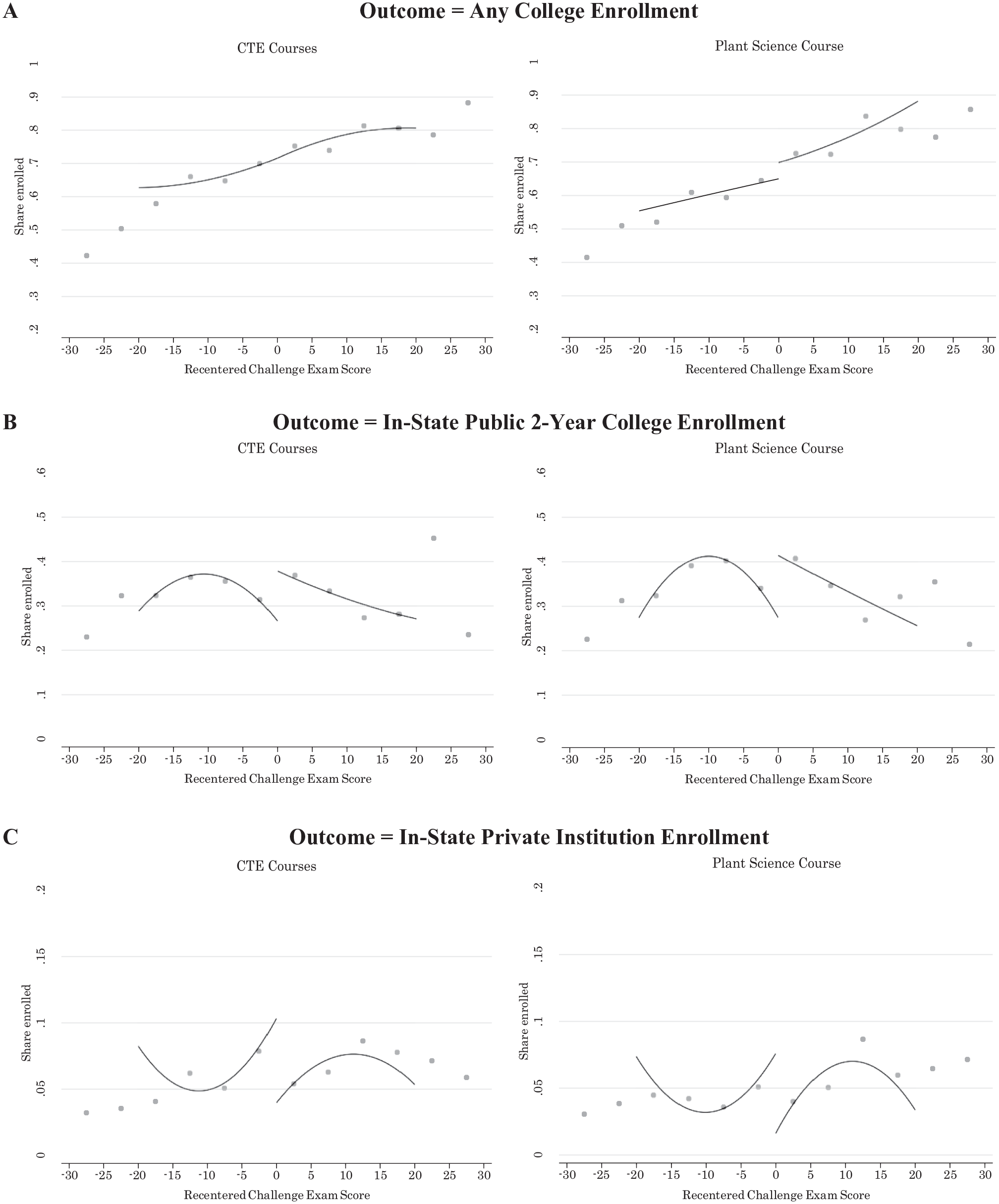
Effects of Earning Statewide Dual Credit in CTE Courses on College Enrollment and Choice: (A) Outcome = Any College Enrollment; (B) Outcome = In-State, Public, 2-Year College Enrollment; (C) Outcome = In-State Private Institution Enrollment
At least part of the increased propensity to attend such institutions comes from an offsetting negative effect of exam passage on the likelihood of enrollment in private in-state institutions. 17 Indeed, we find that exam passage decreases the likelihood of attending an in-state private institution by about 5 percentage points—which, relative to the mean share of the control group (i.e., those who barely fail the dual-credit challenge exam) attending such institutions, suggests that nearly none of the students who pass attend private in-state institutions. This result aligns with the initial messaging around Tennessee’s dual-credit courses and the letter of the law—namely, that passing scores must be accepted for degree-bearing, nonremedial credit at any in-state public institution.
Although statistically noisy and insignificant, we also see some suggestive evidence that part of the increased propensity to attend an in-state public community college may come from a reduction in the likelihood of enrolling in an in-state, public, 4-year university. Such a substitution of college choices is not an unreasonable possibility given that many of the dual-credit CTE courses, including Plant Science, are aligned to the community college level. Thus, a signal of competency in such a field might reasonably push students toward related programs of study at such institutions.
In support of the notion that signals of field-specific competency manifest in the form of encouragement (for those on the passing side of the cutoff) and discouragement (for those who barely fail), note that part of the college-choice effect we uncover at the cutoff—particularly in terms of the outcomes that measure enrollment in public, in-state, 2-year colleges and private in-state institutions—appears to stem from such a joint encouragement/discouragement effect (Figure 2, Panels B and C). That is, students who fail the CTE dual-credit exam are more likely to attend private in-state institutions rather than public in-state community colleges compared to their passing counterparts.
Panel B of Table 2 and Figure 3 explore heterogeneity by gender in the effects of passing a CTE dual-credit exam on college enrollment and choice, with Figure 3 highlighting enrollment in an in-state, public, 2-year college. We see some evidence that male students may experience a relatively larger increase in their propensity to attend in-state public community colleges as a consequence of passing a CTE dual-credit exam compared to their female peers. 18 An increase of between 10 and 14 percentage points in the likelihood of attending an in-state, 2-year, public college for a male student who barely passed a CTE dual-credit exam relative to his male counterpart who barley failed the exam is a sizeable increase given the control-group mean attendance rate of 29%. Potential differences by gender in the effects of banked CTE credits on college enrollment and choice are provocative. Suggestive evidence of relatively more positive outcomes for male students in CTE courses echoes other work at the K–12 level that has reached similar conclusions (e.g., Brunner et al., 2021; Hemelt et al., 2019). To the extent that the boost in 2-year, in-state, public college enrollment due to CTE dual-credit exam passage partially reflects an increase in overall rates of college enrollment for male students relative to a counterfactual outcome of not enrolling in college, we view such evidence as likely beneficial. However, we also document effects on college choice of banking college credit via CTE-focused high school courses. Downstream outcomes that capture credential attainment will shed additional light on whether one ought to interpret such shifts in college choices as beneficial to students. That is, if the push into public 2-year colleges in Tennessee (and perhaps related programs of study) resulting from banking CTE-focused college credits during high school carries through to greater rates of credential completion compared to if the student had attended an in-state private or public 4-year institution, then such evidence would point to a beneficial, longer-term effect of this initiative on students. 19 However, if the opposite pattern of depressed credential attainment rates were to materialize, such evidence would urge caution in the use of similar policy instruments to shift students’ post-high-school trajectories.
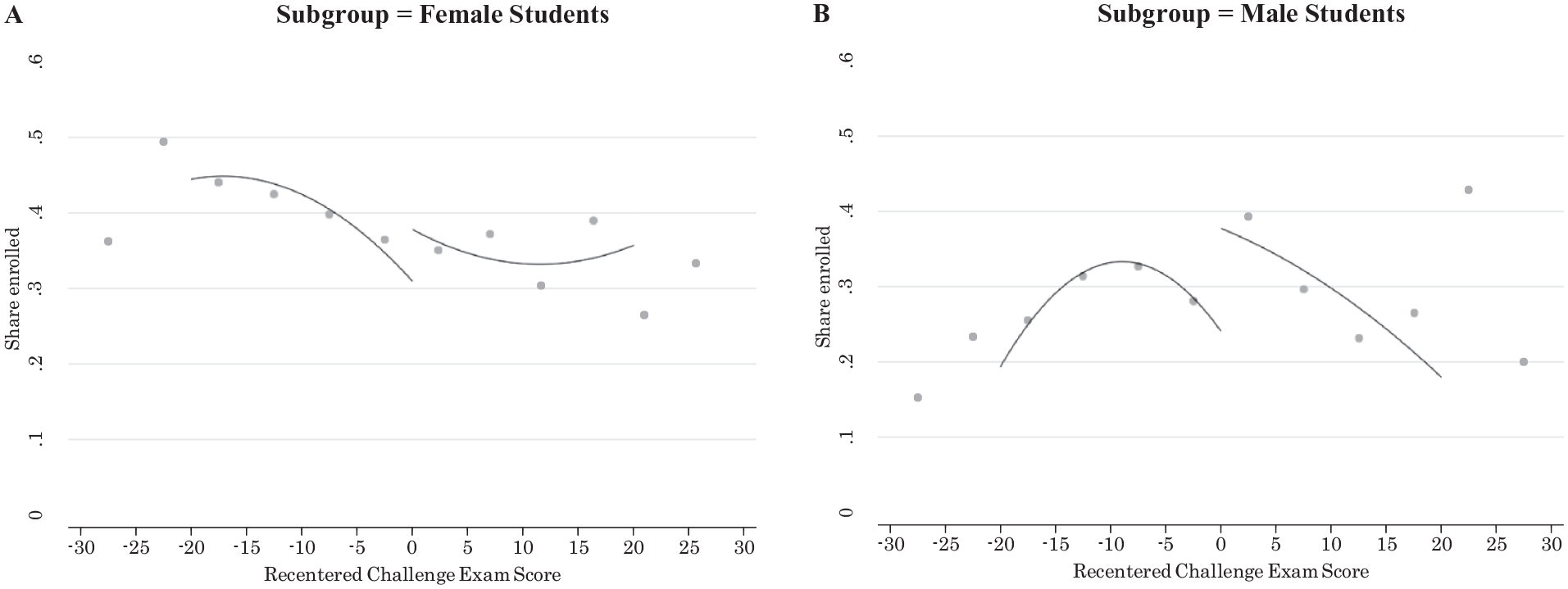
Effects of Earning Statewide Dual Credit in CTE Courses on In-State, Public, 2-Year College Enrollment, All CTE Courses, Subgroups by Gender: (A) Subgroup = Female Students; (B) Subgroup = Male Students
Conclusion
We study an innovative dual-credit initiative in Tennessee that offers high school students access to college-level coursework and awards college credits to those who pass EOC exams that are redeemable at any in-state public postsecondary institution. We focus on state-developed dual-credit courses in CTE areas because those courses most clearly expanded opportunities for college-level course-taking during high school to middle-achieving students (Hemelt & Swiderski, 2022). Moreover, we zero in on the component of these dual-credit courses through which students can secure college credit while still in high school: the EOC exam. Thus, unlike recent work that has explored the total effect of exposure to all elements of a dual-credit course, comparing enrollees to their nonparticipating counterparts in terms of subsequent outcomes (e.g., Conger et al., 2021; Hemelt et al., 2020), we compare outcomes for course enrollees who barely passed the EOC exam to their counterparts who barely failed. Hence, we isolate the effect of banking college credit in CTE dual-credit courses (among course enrollees)—and its attendant competency signal—on measures of college-going and choice.
We find that barely passing a CTE dual-credit exam increases the likelihood of attending a public, in-state, 2-year institution, with at least part of that increased propensity stemming from a reduction in the likelihood of attending a private in-state institution. In addition, we see some suggestive evidence that male students experience a relatively larger boost in the propensity to attend a public in-state community college due to exam passage compared to their female peers. Small sample sizes and limited outcome data impede our ability to produce credible estimates of the effects of exam passage on measures of early college performance. Moreover, given that we find exam passage influences college choice, any effects on early college performance outcomes will in part reflect such college choice effects, complicating their interpretation. Thus, such questions—along with efforts to examine the effects of similar initiatives on longer-run measures of postsecondary credential attainment (as discussed previously)—remain productive targets for future research.
As educational leaders consider the implications of these findings for policymaking around early postsecondary opportunities, we encourage careful thinking about how multiple policies in the same space with related aims might interact to shape student outcomes. In our setting, the Tennessee Promise, which guaranteed high school students the ability to enroll in an associate’s or certificate program with no out-of-pocket tuition costs, began with the high school class of 2015. Thus, the majority of our sample (i.e., three out of four high school cohorts) graduated during years when the Promise was operational. Hence, the fact that we find effects of passing a CTE dual-credit exam on college-going and choice during this period—particularly on enrollment in public community colleges—suggests that factors beyond tuition costs influence students’ decisions about college enrollment. 20 In particular, our findings underscore the role that signals about field-specific competency and nest eggs of college credit may play—over and above concerns about cost of attendance—in shaping students’ choices about where, if at all, to enroll in college. The choice of college is consequential for students because institutions differ widely in the availability and quality of academic programming, makeup of peers, links to thriving labor markets, completion rates, and a host of other factors that influence long-run outcomes for students.
In policy contexts like Tennessee, where the Promise has eased financial constraints related to community college enrollment, policymakers and educational leaders might productively focus their efforts related to dual-credit opportunities more squarely on improving the academic components of the experience—especially given relatively low pass rates on the EOC dual-credit exams (Hemelt & Swiderski, 2022) and evidence of positive effects on late high school course-taking and college choice of participation in dual-credit advanced algebra (Hemelt at al., 2020). Research that sheds light on the mediators within dual-credit course-taking experiences during high school—beyond college credit receipt—that shape early postsecondary success, especially for middle-achieving students, would go a long way toward improving dual-credit experiences for students.
Supplemental Material
sj-pdf-1-edr-10.3102_0013189X231195345 – Supplemental material for Banking on Dual Credit: Broadening Opportunities to Earn College Credit in High School and the Transition to College
Supplemental material, sj-pdf-1-edr-10.3102_0013189X231195345 for Banking on Dual Credit: Broadening Opportunities to Earn College Credit in High School and the Transition to College by Nicole M. V. Ross and Steven W. Hemelt in Educational Researcher
Footnotes

Notes
Authors
References
Supplementary Material
Please find the following supplemental material available below.
For Open Access articles published under a Creative Commons License, all supplemental material carries the same license as the article it is associated with.
For non-Open Access articles published, all supplemental material carries a non-exclusive license, and permission requests for re-use of supplemental material or any part of supplemental material shall be sent directly to the copyright owner as specified in the copyright notice associated with the article.
