




Abstract
The changing educational landscape requires new organizational frameworks to understand how schools and universities make sense of and respond to broader institutional forces like accountability, diversity, and the market. In this article, we draw on recent innovations in organizational theory to propose a model that identifies two general processes through which pressures from the environment shape educational practice in schools: filtering and local adaptation. We review three areas where researchers have studied filtering and local adaptation—routines, sensemaking, and networks—to illustrate how these processes are currently being applied in education and how this work can be extended. We also identify studies that have begun to integrate these different areas of scholarship and propose directions for future research. This article offers education researchers new to the field conceptual tools for guiding their analysis and assists more seasoned researchers in situating their studies in a broader context of institutional maintenance, change, and heterogeneity.
Schools are organizations that operate in a complex environment and must respond to the demands of diverse stakeholders. But for decades, the central paradigm used to understand the organizational workings of schools has been that of decoupling—the process by which schools insulate themselves from external pressures by separating their day-to-day activities of teaching and learning from more symbolic structural changes (Coburn, 2004; Meyer & Rowan, 1977). In response to a new district mandate, for example, schools may organize professional development workshops but avoid inspecting whether these new activities are actually implemented by teachers. The prevailing image of the school has been of the egg crate where teachers are isolated from each other, rarely observed or evaluated, and trusted to do their job appropriately (Lortie, 1975).
Although decoupling still occurs in schools (Ray, 2019), it has become harder for schools to insulate themselves from their external environment. There are a host of policies that schools and universities must now deal with, including COVID-19 regulations, legislation related to critical race theory and transgender students, and accountability standards. Schools also face pressures to respond to cultural and political forces, such as the call to reduce racial discipline disparities in K–12 (Welsh & Little, 2018) or to promote diversity in higher education (Berrey, 2015). The expansion of school choice has positioned schools as competitors in an educational marketplace (Jabbar, 2015); in the market of higher education, declining enrollments have forced dozens of small private colleges to close or merge in recent years (Chronicle of Higher Education, 2016). To help education researchers understand and study the multiple and competing external pressures that schools and universities must navigate today, we turn to the growing body of work in organizational theory that studies how organizations and the people in them confront the hard-to-reconcile expectations of diverse stakeholders (Greenwood et al., 2011).
In this article, we draw on recent innovations in organizational theory to propose a model that identifies two general processes through which pressures from the environment shape educational practice in schools: filtering and local adaptation. We review three areas where researchers have studied filtering and local adaptation—routines, sensemaking, and networks—to illustrate how these processes are currently being applied in education and how this work can be extended. We also identify studies that have begun to integrate these different areas of scholarship and propose directions for future research. Despite institutional theory’s early connections with education, education research has been slow to take up the growing body of institutional research that balances its traditional emphasis on conformity and stability with more recent interest in organizational heterogeneity and the role of agency, conflict, power, and meaning in shaping organizational action. We argue that educational scholarship can be strengthened by engaging more deeply with advances in organizational theory and that organizational theory can be strengthened by more precisely identifying the mechanisms by which schools respond to societal pressures.
Institutional Theory: From Isomorphism to Complexity
Institutional theory has been the dominant approach in contemporary organizational studies for understanding how organizations respond to their external environment (Greenwood et al., 2008). It emerged in the 1970s as a reaction against the then-dominant theoretical perspective that similarities in organizational structures were the result of organizations facing similar technical demands from their environment. 1 Institutional theorists added that besides adapting to technical ones, organizations adapt to institutional demands as well, remaining attentive to the “powerful organizational rules” (Meyer & Rowan, 1977, p. 343) that define culturally appropriate and legitimate forms of organizing (e.g., one schooling rule is that schools should organize students by age-specific grade levels). As organizations adapt to these institutional pressures to gain legitimacy and resources, they come to resemble each other through the process of institutional isomorphism (DiMaggio & Powell, 1983; Meyer & Rowan, 1977). These adaptations may not, however, be efficient solutions to organizational problems. For this reason, institutional theorists also posited that organizations may engage in a process of decoupling where they simultaneously gain legitimacy by symbolically adopting structures from the environment but prevent them from impacting everyday work.
Common to early studies on institutional pressures was a conceptualization of institutional fields as homogenous and impacting the organizations in them in a similar way (Boxenbaum & Johnsson, 2017). In the ensuing years, however, many institutional theorists have noted a trend in many fields toward heterogeneity and fragmentation with multiple (often incompatible) pressures emanating from a more diverse array of stakeholders, including the government, social movements, rating agencies, and consumer groups, among others (Greenwood et al., 2011; Kraatz & Block, 2008). One result is that modern organizations are increasingly pressured to adopt new structures related to goals not necessarily pertaining to their core mission, including diversity, equal opportunity, the environment, transparency, and accountability (Bromley & Powell, 2012). Moreover, it may be harder for modern organizations to decouple these newly adopted structures from their everyday practices because they frequently come with methods for measurement and accountability (Bromley & Powell, 2012). In turn, organizations become more internally complex as they adopt numerous, often inconsistent, structures in response to different institutional pressures.
Key to institutional theory’s growing focus on complexity in the institutional environment has been the concept of institutional logics, which can be thought of as overarching principles—sets of practices, assumptions, and values—that prescribe “how to interpret organizational reality, what constitutes appropriate behavior, and how to succeed” (Thornton, 2004, p. 70). Institutional logics can be found at the societal level (i.e., the family, community, religion, state, market, profession, and corporation) or can be more specific iterations of these, such as a logic of care, bureaucracy, or innovation (Thornton et al., 2012). The multiplicity of institutional logics has allowed researchers to combine the institutional understanding that organizations must conform to cultural templates to be seen as legitimate with the recognition that the environment of many organizations contains multiple cultural templates and pressures to adopt them.
Early studies of institutional complexity were typically historical accounts showing how organizations and industries shifted between dominant logics over time (for reviews of institutional complexity, see Greenwood et al., 2011; Yu, 2015). For example, Russell (2011) showed the shift over time in kindergarten education practices from a “developmental logic” emphasizing children’s socioemotional and cognitive development to an “academic logic” prioritizing academic skills and content.
Since then, however, the literature has seen two major changes. First, studying fields like health care, nonprofit, and social enterprise, researchers have come to see complexity as a stable feature of some institutional environments in which organizations must operate (e.g., Bromley et al., 2012; Dunn & Jones, 2010; Ebrahim et al., 2014). Second, work in institutional theory more broadly has increasingly emphasized agency and change and the processes through which organizational members and groups interpret, contest, and enact meanings from the larger environment (Powell & Rerup, 2017). 2 For example, Cobb (2017) found that different high schools refracted the logic of color-blindness in different ways, whereas Reyes (2015) demonstrated how colleges and universities enacted multiculturalism in organization-specific ways, producing divergent styles of political engagement among Latino students. The interrelation of these two trends has led to research that examines the different ways actors navigate and negotiate the tensions, contradictions, and dilemmas that inevitably arise as they go about their everyday work in situations of complexity.
The next phase in this work is to develop a more comprehensive and organized understanding of exactly how organizations and individuals navigate multiple institutional logics (Yu, 2015). Research in the field consists largely of unconnected case studies rather than systematic efforts to accumulate knowledge about the causes and consequences of heterogeneous responses to the same institutional context (Pache & Thornton, 2020). 3 Identifying the mechanisms that structure responses to complexity is still “in its infancy, and will provide a vibrant area of development for the future” (Ocasio et al., 2017, p. 516). In this article, we thus propose a framework that can assist researchers in more systematically studying how and why individuals and organizations respond in different ways to pressures in their environment.
A Framework for Studying Organizational Heterogeneity
We present a simplified model and visual representation for analyzing heterogeneous organizational responses to multiple institutional logics in the environment (Figure 1). 4 Synthesizing across multiple literatures, we highlight two central processes that researchers can use to study how institutional logics enter and shape organizations: filtering and local adaptation (e.g., Greenwood et al., 2011; Kraatz & Block, 2008; Lee & Lounsbury, 2015; Ocasio et al., 2015; Pache & Santos, 2013). Because processes of filtering and local adaptation have been studied in relation to routines, sensemaking, and networks, we integrate these concepts into our proposed model to offer tools to more systematically study how organizations respond to their environments.
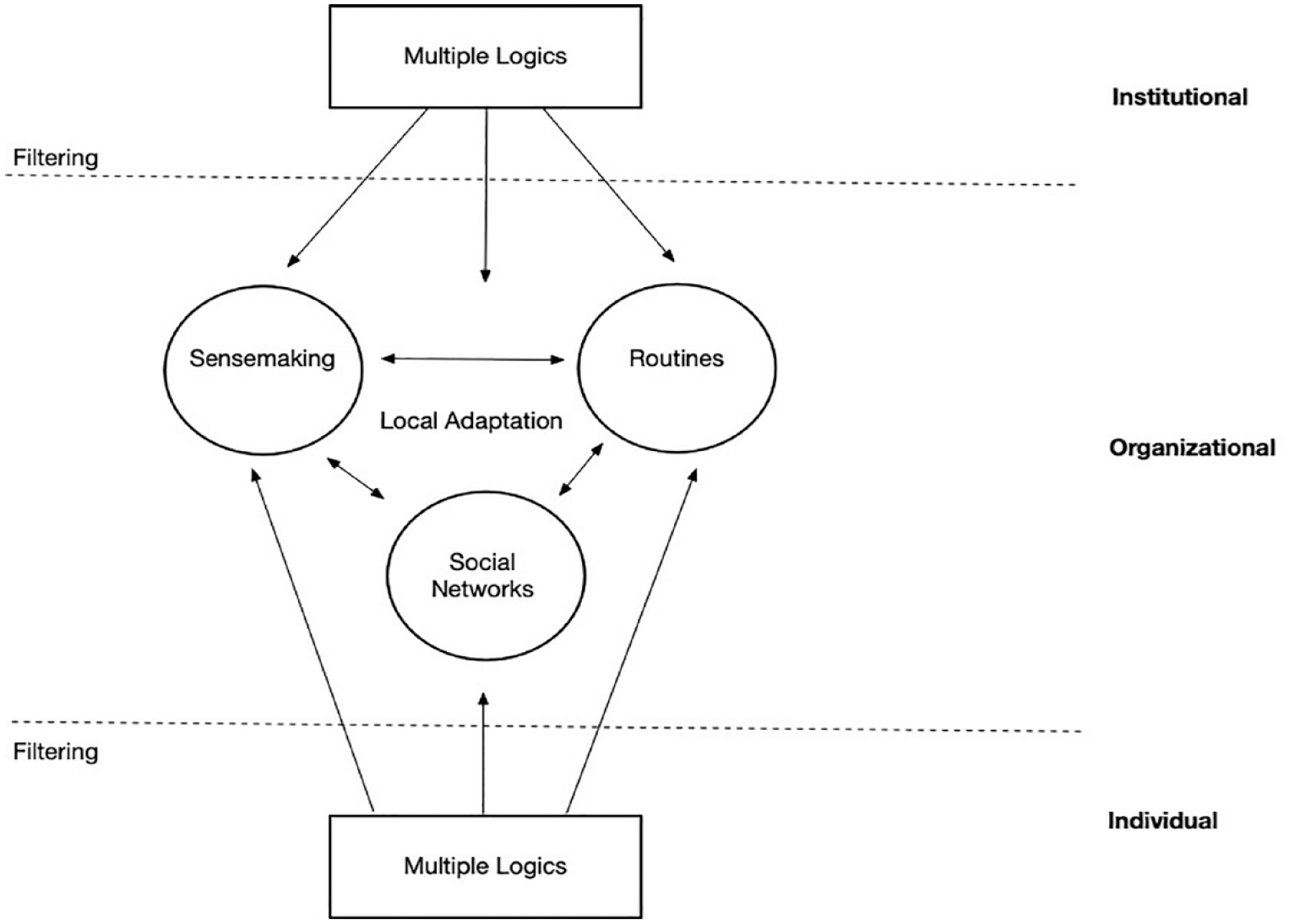
A model of heterogeneous responses to institutional pressures.
Filtering refers to the processes and decisions through which only select aspects of logics enter organizations to shape routines, sensemaking, and networks. As Figure 1 shows, institutional logics are filtered from the environment in two ways. As represented by the top dotted line, at the institutional level, filtering occurs as organizational gatekeepers selectively adopt, alter, or deflect policies, regulations, and broader discourses and norms. As represented by the bottom dotted line, filtering also occurs at the individual level as organizational members bring identities, goals, and habits with them into their work from previous socialization experiences. Which specific aspects of institutional logics are cued then shape actors’ perceptions and actions (e.g., Schilke, 2018). Thus, even when schools face similar pressures, the way those pressures enter organizations will be different depending on these filtering processes.
Second, schools are not just containers for aspects of the environment that have been filtered in. Rather, organizational actors make local adaptations to logics as they enact them in their everyday practice. Working out their meanings and implications becomes the basis for ongoing action, as can be seen in the center of Figure 1. Although studies have shown that individuals adapt new policies and practices based on their own interpretations and interactions with others (Hallett & Ventresca, 2006), we still have a limited understanding of how these processes are structured. We argue that each organization has a unique culture defined partly by a distinct configuration of routines, networks, and sensemaking processes that shapes how individuals navigate the relationships between institutional logics. The relationship between institutional logics is thus variable, dynamic, and locally instantiated.
Educational Applications and Extensions
Our aim in this section is to review literature on how institutional logics are filtered into organizations through routines, sensemaking, and networks, respectively, and the roles of routines, sensemaking, and networks in the local adaptation of logics. In doing so, we both summarize existing education research and point to ways education scholars can expand their work by drawing on trends in the broader field of organizational theory.
Routines
One of the most significant developments in institutional theory in recent years has been an effort to understand the role of routines in institutional reproduction and change (Smets et al., 2017). Routines are defined as “repetitive, recognizable patterns of interdependent action stretched across multiple people” (Feldman & Pentland, 2003, p. 95). In schools, common routines include teacher supervision and evaluation, classroom lessons, and staff meetings. Institutional logics introduce new organizational routines, and existing organizational routines also structure how logics are worked out in everyday practice. Studying routines is also a way to understand how organizations connect to and manage their institutional environment.
Routines and filtering
First, organizations select only particular routines, or parts of them, to instantiate in schools. Among education researchers, this process of filtering has most extensively been studied in terms of how policy demands from the logics of standards and accountability are reshaping schools through the introduction of new routines. For example, Spillane and colleagues (2011) documented how school leaders respond to changes in the institutional environment by designing organizational routines, including meetings for examining student performance data, teacher classroom evaluation systems, and protocols for working with coaches, that instantiate new accountability logics. In doing so, school leaders and other mediators of the environment use routines to selectively “recouple” higher-level institutional logics with the everyday activities of teachers (Hallett, 2010; Spillane et al., 2011; Woulfin, 2018). If teachers perceive these new routines as illegitimate, they may experience “epistemic distress” (Hallett, 2010). This feeling may in turn lead to resistance or attempts to negotiate the nature of the change. The impact on teachers is determined not only by this sense of (il)legitimacy, however, but also how central the routine is to the core work of the organization.
For this reason, the broader organization literature on routines points to the importance of studying the relationship between routines. Although routines are typically studied in isolation in educational literature, they are interconnected, with the results of one routine often becoming the resource for another, as when learnings from professional development influence classroom pedagogy (Sele & Grand, 2016). In this way, organizations are composed of networks of routines that provide a way for people to choreograph their actions with each other both in and across situations. How disruptive a new logic, filtered in the school via a new routine, will be depends partly on how connected or segmented it will be from existing routines. A diversity logic that is instantiated through a one-time professional development training will have a different effect on the school compared to the adoption of a new classroom assessment routine. Overall, which routines are filtered into the organization through selective adaptation and how they are connected to existing routines both help explain heterogeneity in organizational responses to the environment.
Routines and local adaptations
The aforementioned work describes routines as instantiations of specific logics. In contrast, routines can also be the locally worked-out result of emergent or planned blending of different logics (Cohen et al., 1996). As an example of emergent blending, Datnow and coauthors (2020) studied routines designed to foster teachers’ use of data in their classroom practice. They found that although the script associated with the data-use routine focused on instructional improvement, the actual performance of the routine was also shaped by accountability pressures associated with high-stakes testing. Blending also results from teachers’ own institutional backgrounds. Golann (2018), for example, demonstrated how teachers adapt school expectations and norms for strict discipline based on their personal styles of communication and classroom management. Similarly, Diehl (2021a) showed how teachers adapt the institutional reform routine of student advisory differently depending on how consistent it is with their existing practical dispositions for interacting with students. The disciplinary and advisory routines that were enacted were thus a blend of the logics like those of care, control, and professionalism.
The broader organizational literature also demonstrates how organizations can more intentionally create new routines for the purpose of finding a compromise between the divergent expectations of different logics (e.g., Battilana et al., 2015). Rather than actors idiosyncratically navigating between logics, organizations create routines that formalize relationships between them. Battilana and Dorado (2010), for example, studied commercial microfinance firms that sought to combine the seemingly contradictory logics of development and banking. To do so, the firm brought together workers with both social work and banking backgrounds and created socialization routines, including training, promotion, and incentive systems, that reinforced a hybrid organizational identity that combined providing financial services to those typically unable to receive them with a banking logic that required making a profit. In another study, Battalina and coauthors (2015) examined social enterprises that pursued social missions while supporting their work through commercial ventures. They found that the organizations dealt with the conflict between social welfare and commercial logics by assigning related activities to different groups, thereby largely keeping them separated. The organizations then created formal routines (what they called “spaces of negotiation”) to deal with tensions between the groups. Research on education can benefit by likewise studying how organizations use structures and practices to ease tensions between different logics.
Sensemaking
Whereas research on routines emphasizes everyday behavior, sensemaking studies emphasize the role of cognition and how actors understand their own and others’ behavior and the organization’s structures and practices. Sensemaking is the major way researchers have studied the process by which individuals notice, interpret, and act on messages or events that are “novel, ambiguous, confusing, or in some other way violate expectations” (Maitlis & Christianson, 2014, p. 57). Sensemaking theories have been widely employed to understand how organizations make sense of unexpected or unusual events, such as crises or reforms, and how this process leads to organizational stasis or change. Sensemaking also takes the form of post hoc rationalizations that occur under conditions of continuity. As with routines, scholars of institutional complexity have drawn on the study of sensemaking to understand both how logics are filtered into schools and how sensemaking shapes the local adaptation of logics once there.
Sensemaking and filtering
Institutional logics enter organizations not only through new routines but also through new meanings and vocabularies. How these aspects of logics are filtered in depends partly on how they are framed by institutional gatekeepers such as principals, coaches, and other administrators. These gatekeepers can act as conduits for or barriers from exogenous institutional ideas and practices. The sensemaking literature has generated several related concepts, such as sensegiving, sensebreaking, and sensedemanding, to describe top-down attempts to construct a particular definition of the situation and accomplish certain goals. In the K–12 field, studies show how school administrators select and filter policies for teachers in different ways, leading to different interpretations and enactments of these reforms (Coburn, 2005; Spillane et al., 2002; Wong, 2019). For example, in a study of the Chicago Public Schools, Diamond and Spillane (2004) found that the same high-stakes accountability policy was communicated to teachers by principals as a threat in low-performing schools and as a motivation to improve instruction in high-performing schools. This led to a more superficial response focused on getting off probation in the low-performing schools and more substantive efforts at instructional improvement in the high-performing schools. School administrators’ partial and ambiguous sensegiving can also hamper effective reform by not clearly communicating the full meaning of the reform or sending mixed messages about how the reform should be implemented (Wong, 2019).
Although much of this research does not explicitly use an institutional logics framework, the viability of such sensegiving efforts depends on the degree to which they are understood by and meaningful to their audience and hence their connection to legitimate institutional logics. In this vein, Brown (2021), in a study of eight religious colleges and universities, found that university presidents framed new and potentially disruptive initiatives using the symbols and language of accepted professional, religious, and market logics to establish legitimacy for them. Large gifts from a new capital campaign, for example, were described as “God’s provision,” in line with the school’s religious logic.
Research in the broader field of organizational theory also demonstrates that, as with administrators, the preexisting institutional experiences of frontline workers like teachers influence their sensemaking processes, shaping what aspects of the environment are noticed and whether what is noticed is either rejected or selectively let into the organization (Cholakova & Ravasi, 2019). Members of professions are socialized into particular ways of thinking about their work through trainings, associations, and work experiences. These background experiences offer institutional frameworks, including vocabularies and identities, that provide rationales for action but constrain the variability in sensemaking (Diehl, 2021b; Jensen et al., 2009; Thornton et al., 2012; Weber and Glynn, 2006). Zilber (2002), for example, showed how the meaning of feminist practices in a rape crisis center changed as new volunteer and staff members connected the organization to a therapeutic logic filtered from the larger environment.
Sensemaking and local adaptations
As discussed previously, sensemaking processes shape what aspects of the institutional environment are filtered into the organization through both managers and workers. Once those aspects of the environment are inside the organization, sensemaking processes help reconcile differences between logics and adapt them to local circumstances. In education, most work in this area has examined how teachers interpret new reforms and initiatives through the lens of their preexisting knowledge, beliefs, values, and experiences. The result is that teachers adapt, assimilate, and selectively enact policies and initiatives to align with aspects of other logics they have been socialized into (Thornton et al., 2012). Because it is cognitively demanding to radically shift one’s way of thinking, it is more common to implement new reforms in superficial ways or to think of them as more aligned with one’s existing practices than they actually are (see Spillane et al., 2002). In studying shifting logics of reading instruction in California in the 1980s and 1990s, Coburn (2004), for example, found significant variation in the extent to which teachers implemented new reading practices based on their own worldviews and prior experiences with reforms. This body of work has been pivotal in explaining why teachers and schools so often fail to faithfully implement new reforms and policies.
Education researchers have only begun to study sensemaking and adaptation in the context of multiple logics (e.g., Bridwell-Mitchell & Sherer, 2017; Dulude & Milley, 2021; Rigby, 2014). The integration of sensemaking and logics is an area ripe for study because successful policy implementation often depends on the degree to which administrators and teachers recognize and understand the competing pressures in their environment. As an example, Glazer et al. (2019) found that charter networks tasked with turning around low-performing schools in the Tennessee Achievement School District initially failed to grasp the competing market, bureaucratic, and community logics that they were contending with, eventually adapting their market-based designs to accommodate state regulations and community resistance.
Social Networks
Social networks, the structural patterns of formal and informal relationships of people in and between organizations, is another conceptual tool that organizational scholars have used to study the relationship between the school and its institutional environment. More specifically, social network analysis has provided a useful lens to formally analyze how institutional logics diffuse both to and in a school and how the social context of teachers—their colleagues, principals, and administrators—shape the adoption and adaptation of those forces. In this way, interactions in social networks constitute institutions and transmit them. As described in the following, the interorganizational networks of both administrators and teachers help filter what aspects of logics make their way into the school, and the structure and dynamics of intraorganizational networks shape how those logics diffuse and are understood in the school.
Networks and filtering
As discussed in the section on sensemaking, institutional gatekeepers act as filters between the organization and its environment. Institutional-theory-inspired work has examined the role of gatekeepers’ interorganizational social networks in this process. Rigby (2016), for example, used qualitative social network analysis to examine how first-year principals encountered divergent institutional logics of instructional leadership. She found that the structure of their social networks influenced how institutionalized ideas about leadership spread from the macro-environment to principals. Examining a different type of institutional gatekeeper, Coburn and Woulfin (2012) found that instructional coaches were among the most important actors in mediating the institutional environment for teachers. Gatekeepers shape interaction not only by filtering vocabularies but also through the structuring of relationships and interactions. This structuring might be done by adopting new institutional routines that distribute teachers into different groupings or even physical locations in the school (Nelson, 2019). Research has shown that one potential unintended consequence of shaping teacher networks in this way is polarization and subgroup differences in terms of orientation toward institutional change (Frank et al., 2018).
Teacher networks also influence what and how institutional logics are filtered into schools. Teachers carry with them logics that they have internalized from prior training or work experiences. In the broader organizational literature, there is increasing recognition that these logics provide collective identities and relational models and norms about appropriate interactions and relationships that in turn shape the structure of social networks (Fuhse & Gondal, 2022). The professional logic, for example, offers a very different model of how teachers should interact (e.g., collegially) than the market logic (e.g., competitively). Teachers having gone through professional training, then, may bring different models of relationships with them into the school than those who have not. These relational models also shape who is in the network (Thornton, 2004), for instance, whether teachers see administrators as part of or separate from their professional network. The important distinction here is between seeing networks as “pipes” through which logics diffuse between and in organizations or seeing them as instantiations of models of relationships associated with different logics.
Networks and local adaptations
The study of intraorganizational networks has provided a useful method for analyzing how people use their existing relationships to interpret, negotiate, and enact aspects of institutional logics, including institutional routines (e.g., Kameo, 2015). For example, in studying the institutional influence of reading policy on teaching practices, Penuel et al. (2013) found that teacher practices did not conform to the new normative regime but were shaped by the local norms of practices in collegial subgroups. Other work has described similar relationships with informal social networks and communities of practice shaping how teachers experience institutional forces related to accountability and standards (e.g., Daly & Finnigan, 2010; Diamond & Spillane, 2004; Frank et al., 2020; Wilhelm et al., 2016). Furthermore, intraorganizational teacher social networks serve as a primary context for internalizing the identities, goals, habits, and schemas associated with different logics and shaping how teachers understand which of those available aspects are applicable in a given situation (Bridwell-Mitchell & Sherer, 2017). Networks may also be the site of conflict and tensions as different groups of teachers fight over the appropriate ways to manage divergent institutional expectations, channeling field-level fights into their schools.
In the broader organizational literature, there has been a growing effort in recent years to understand the role of culture and meaning in organizational network processes (Ferguson et al., 2017). Although social network analysis recognizes the importance of the structural connections between actors for explaining organizational phenomena, it has historically ignored the cultural content of those ties. The lack of attention to culture is changing, however, as the field has come to conceptualize network ties as cultural constructions composed of shared narratives, symbols, and expectations between people (Fuhse, 2009). For example, recent culture-inspired network research has shown that the kind of organizational fit that best predicts retention incorporates both social and cultural embeddedness, the former measured by social connections and the latter measured by the match between individual and organizational cultural styles of communication (Srivastava & Goldberg, 2017). Furthermore, researchers have begun to examine how the culture of network ties shapes the creation and dissolution of relationships (McFarland & Wolff, 2022) and facilitates the diffusion or blockage of ideas and practices between people (Pachucki & Breiger, 2010).
Integrating Concepts
Routines, sensemaking, and networks can each be used on their own as tools for understanding how institutional logics both enter and are managed in organizations. Indeed, this is typically what education and organization researchers have done. In this section, we argue that the interconnection between them is a largely unexplored frontier for education and organization scholars alike. That means that what follows is necessarily more speculative than the review of research so far.
The interrelation of routines, sensemaking, and social networks can help us study and understand heterogeneity in two ways: through maintenance and change. In terms of maintenance, the components can reinforce each other to create a stable internal dynamic. Routines, sensemaking, and social networks can all lead to convergence over institutional practices and meanings. More specifically, organizational routines can reinforce institutional meanings and social networks, sensemaking drawing on organizational vocabularies can be used to justify and explain organizational routines and relationships, and communication networks can confirm the organizational meanings drawn on in sensemaking and instantiated in routines. The particular configuration of routines, sensemaking, and networks being maintained will differ across schools, however, based on factors such as their unique histories, teacher composition, and leadership.
We can also understand more about organizational heterogeneity by looking at how the same institutional forces result in different change processes across organizations. A new routine may disrupt existing social networks (Coburn et al., 2013), for example, or the relationship between routines and the institutional language used to make sense of them becomes decoupled (Ocasio et al., 2015). When components of logics come into tension with one another, sensemaking may be triggered, enabling teachers and administrators to draw on multiple logics to reflect on and change familiar ways of behaving. As actors combine, reconfigure, or manipulate multiple logics to relieve tensions between competing demands and expectations, the results may include different logics being blended (Diehl, 2021a; Woulfin, 2016) or kept structurally or temporally separated (Diehl 2019; Ispa-Landa, 2017).
It is important to note that some existing work has already begun to look across routines, sensemaking, and networks. Work on routines and sensemaking, for example, has increasingly come to recognize the interactional dimension of both phenomena, especially as it relates to teachers’ social networks (e.g., Bridwell-Mitchell & Sherer, 2017; Stelitano et al., 2020). Going further, Rigby (2015) found that variation in principals’ implementation of a new teacher evaluation policy was based on their sense of their role, their collegial networks, and existing school routines in their school. It is precisely this type of interrelation we advocate here. As we discuss in our concluding section, however, moving past novel case studies and toward the process of accumulating knowledge will be aided by adopting similar frameworks.
Conclusion
Although scholars have recognized the role of accountability in reshaping the field of education (e.g., Coburn, 2004; Hallett, 2010; Spillane et al., 2011), education research has largely failed to follow the trend in organizational theory toward the study of heterogeneous responses to institutional complexity (for an exception, see Kim et al., 2016). Yet schools and universities are repeatedly described in the broader literature as prime examples of organizations operating in institutionally complex settings (e.g., Greenwood et al., 2011; Kraatz & Block, 2008). To address this gap, we have proposed a model that focuses on the role of routines, sensemaking, and social networks in studying how schools filter and locally adapt their institutional environment. Such a focus, we argue, would not only bring education back into the organizational conversation but also help organizational theory in its current effort to illuminate the intraorganizational dynamics of institutional complexity (Kraatz & Block, 2008; Pache & Santos, 2013). Doing so, however, will require education scholars to take a more systematic and comparative approach to the study of organizational responses to multiple institutional pressures.
To that end and drawing on existing work in the broader field of organizational theory, we suggest several concrete steps education researchers can take to apply our model to research studies. The goal is to provide a shared set of constructs that can be used toward the study of organizational heterogeneity that can facilitate the accumulation of theoretical knowledge across cases and studies.
The first step is to identify the organizational logics important for the phenomenon of interest. For example, extant education research has identified logics, including those of the market, profession, state, and color-blindness, in shaping schools (e.g., Bridwell-Mitchell & Sherer, 2017; Cobb, 2017). Researchers have used various methods to identify logics, including combinations of ethnography, interviews, textual analysis, and surveys (e.g., Battilana et al., 2015; Jay, 2013). Second, after identifying the important logics, the next step for the researcher is to identify the ways those logics are partially instantiated in the school through filtering. This might include studying how leaders, through their networks, choose particular routines and engage in sensegiving about them. It also might include how teachers bring logics into their work based on how compatible the identified logics are and how central they are to their identities (Besharov & Smith, 2014).
The next step involves studying processes of local adaptation. Researchers would use different methods to identify the expectations associated with different logics, the tensions and conflicts between them, and the responses to them. Here, researchers could examine routines, sensemaking, and networks not as instantiations of logics but as tools for negotiating differences between them. Finally, the researcher can strategically look at the interrelation between routines, sensemaking, and networks in the everyday work of the school. For example, if a school introduces a diversity training routine, is it separate from or connected to existing routines? Does it present a new model for social networks? Does it invoke sensemaking related to existing organizational policies?
By using a common approach to study the dynamics of heterogeneity across organizations, education scholars can not only further our understanding of how schools differentially manage competing institutional processes but also help organizational theorists answer some of the major outstanding questions in the field. How do micro-level changes in schools accumulate to alter the field of education? Under what conditions are teachers and administrators able to defy changing institutional pressures in favor of their own beliefs and interests? Why do individuals and organizations differ in their perception of how congruent or contradictory logics are? And perhaps, most importantly, can schools fulfill multiple purposes and achieve multiple goals while still maintaining legitimacy with diverse audiences?
In this article, we have reviewed research in education on institutional logics, routines, sensemaking, and social networks. This work can help us understand how the broader environment becomes meaningful for individual and organizational behavior. We have also highlighted recent developments and new directions in each of these areas. We have done so in hopes that education researchers can find useful tools in the recent developments in institutional theory. These various streams all share an effort to illuminate how organizational actors like teachers mediate, enact, interpret, and negotiate multiple, sometimes contradictory, institutional forces in their everyday work.
