




Abstract
This study applied Simulation Investigation for Empirical Network Analysis to disentangle friendship selection and influence regarding the academic achievement of Chinese adolescents in a 3-year longitudinal study of 880 middle school students (400 girls, Year 1 mean age = 13.33) and 525 high school students (284 girls, mean age = 16.45). Both peer selection and influence effects were obtained. Chinese adolescents preferred friendships with similarly achieving or higher achieving peers but avoided friendships with lower achieving peers. They increased achievement when they befriended high-achieving peers but decreased achievement when they befriended low-achieving peers. Influence but not selection was stronger for middle school students than for high school students. The results may be a function of the importance of academic success for Chinese students.
If someone asks children and adolescents what they most like about school, almost all will place their interactions with peers at the top of the list. Researchers have sought to understand the impact of these relationships on youth's academic adjustment. Berndt et al. (1990), for example, asked eighth-grade best friends to discuss hypothetical dilemmas, some of which pertained to academic behavior (e.g., going to see a rock band vs. studying for an exam). Following discussion, adolescents changed their opinions to conform to those of their friends.
Kandel (1978) conducted one of the earliest longitudinal studies of peer academic influence by following high school best friend dyads for 1 year. She found that stable friends were similar to each other in their academic aspirations and motivations. Kandel's work is particularly important because this extended her earlier work on similarity between friends in substance use to academic adjustment. This similarity, commonly referred to as “homophily,” has profound implications for peer influence (Brown et al., 2008).
Academic Homophily: Selection and Influence
Homophily can arise from selection, influence, or a combination of both. Adolescents may choose to befriend others that are similar to them with respect to academic achievement. Alternatively, adolescents may influence each other to alter their academic values or behavior. Researchers using multiple methodologies have explored the causes of academic homophily and sought to determine the extent that peers influence each other's academic behavior, motivations, and values (e.g., Kindermann, 1993, 2007; Ryan, 2001; Véronneau et al., 2010).
Kindermann (1993, 2007) examined peer selection and influence effects on academic motivation and engagement by conducting single academic year longitudinal studies. Selection was assessed by determining how changes in peer affiliations were associated with changes in adolescents’ academic motivation and engagement. In particular, he assessed influence by examining the extent to which group-level engagement and motivation scores in the fall predicted changes in children's engagement or motivation in the spring. Findings from these two studies revealed a combination of both selection and influence.
Several researchers have assessed academic selection and influence by applying cross-lagged modeling and multilevel modeling to longitudinal data. For example, Véronneau et al. (2010) followed Canadian students from second grade to seventh grade with the result that cross-lagged longitudinal analyses revealed the existence of peer selection but not peer influence. Using multilevel analyses, Ryan (2001) assessed peer group similarity in academic motivation and achievement and the extent to which peer group context influenced adolescent academic characteristics in a 1-year longitudinal sample of U.S. middle school students. Because the multilevel analyses require peer groups to be independent such that each student can only be assigned to one peer group, large social networks were divided into several nonoverlapping groups. They found that peer group average achievement in the fall significantly predicted changes in individual adolescent achievement in the spring, thus yielding evidence of peer influence.
Past studies of academic peer selection and influence have been characterized by several important methodological issues and limitations. First, earlier studies assessed the correlations between peer affiliations and outcomes using cross-sectional or short-term longitudinal designs. Second, selection and influence were often confounded. Because friends or peer group members at a previous time point may be different from friends or peer group members at later time points, it is unknown if the behavior of existing friends changed over time or if new friendships were formed. Consequently, researchers cannot determine if significant associations between previous affiliations and later academic achievement are due to selection (e.g., formation of new friendships) or influence (e.g., changes in academic achievement within existing friendships). Third, in many of these studies, peers were aggregated by computing mean scores. Adolescents, however, have multiple friends, and each may affect academic adjustment differently. In addition, adolescents may belong to several peer groups (e.g., friends, athletic teammates, neighborhood groups), and friends from these groups may have different influences on academic adjustment.
Longitudinal Social Network Analysis
Many of the methodological concerns pertaining to earlier studies of academic selection and influence have been addressed by the development of Simulation Investigation for Empirical Network Analysis (SIENA; Snijders et al., 2010), a stochastic actor-based modeling technique embedded with the R software framework. This method analyzes changes in network dynamics (e.g., friendship ties) and behavioral dynamics (e.g., academic achievement) across the network within a single model. This methodology allows researchers to disentangle the effects of peer selection and peer influence while controlling for multiple potential cofounding variables.
Unresolved Questions Pertaining to Peer Influence and Academic Success
Despite decades of research focused on understanding peer influence and academic adjustment, several questions remain to be answered. Addressing these is the focus of our current longitudinal study that explores peer relationship and academic achievement in Chinese middle and high school students. We specifically focused on three questions. First is the extent to which peer academic selection and influence are present in China. Given the importance of academic success for peer status in China, we hypothesized that both would be present. Second is the selection and influence effects of low- and high-achieving youth. Third is differences between selection and influence effects for middle and high school students. An overarching focus of this research is the possibility that selection and influence pertaining to peer relationships and academic achievement vary across cultures.
Academic Selection and Influence
Research using SIENA has yielded mixed findings regarding the relative importance of selection and influence pertaining to peers and academic success. Some researchers have found evidence of both selection and influence. For example, Stark et al. (2017) found both selection and influence for academic achievement in a sample of 13-year-old German students, and Burgess et al. (2020) similarly found both selection and influence effects for United Kingdom adolescent girls. In contrast, other researchers have found only selection or only influence. Flashman (2012) found a significant selection effect for academic achievement in a sample of seventh- through 12th-grade U.S. students from the National Longitudinal Study of Adolescent Health; academically advantaged students tended to affiliate with other high-achieving students, and academically disadvantaged students were more likely to make friends with low-achieving peers. Fortuin et al. (2016), in contrast, found influence but not selection in a sample of Dutch secondary school students.
Most SIENA studies of academic peer influence were conducted in Western countries, with only one study published study in Asia. Zhang et al. (2019) explored the role of peer status in youth's academic engagement in the United States and China using SIENA and found that Chinese adolescents with higher academic engagement were more likely to nominate peers they viewed as popular. The authors interpreted this finding by arguing that high peer status was more strongly associated with academic engagement and achievement in China. It is important to note, however, that Zhang et al. focused on the association between peer-nominated status and academic engagement and not friendship and academic achievement. To expand our knowledge of academic adjustment selection and influence, it is necessary to further explore the relative importance of peer selection and influence dynamics pertaining to academic achievement, especially in non-Western cultures, such as China.
Sex Differences in Selection and Influence
There have been inconsistent results from the three published SIENA studies that examined sex moderation of academic adjustment selection and influence processes. Shin and Ryan (2014b) found that the academic performance approach goals of sixth-grade U.S. boys were more strongly influenced by their friends than were those of girls. In contrast, Kretschmer et al. (2018) found no significant sex moderation for influence in German secondary schools but instead found that girls but not boys selected friends with similar academic achievement. Chow et al. (2018) found no sex differences in selection or influence with respect to Finnish high school students’ interest and values for different school subjects. In sum, two of the three studies found significant sex moderation, but the effects were opposite in direction.
Low- and High-Achieving Youth as Contributors to Selection and Influence
Although most prior research has focused on the presence or absence of selection and influence, it is important to learn more about who is doing the selection or influencing and who is being selected or influenced. We are particularly interested in addressing the relative contributions of high- and low-achieving youth to selection and influence.
Previous researchers using SIENA found that the tendency for low-achieving adolescents to select similarly low-achieving friends was stronger than or similar to the tendency for high-achieving adolescents to select similarly high-achieving peers (Flashman, 2012; Gremmen et al., 2017; Rambaran et al., 2017). Furthermore, the reluctance of low-achieving adolescents to nominate high-achieving peers was stronger than the tendency for high-achieving adolescents to avoid low-achieving friends (Gremmen et al., 2017).
Laninga-Wijnen et al. (2018, 2019) found that selection by high- and low-achieving peers varied as a function of the importance of academic success for peer status. In classrooms in which peer status in the form of popularity was positively associated with academic achievement and performance goals, similarity-based selection was particularly strong between high-achieving students. In contrast, in classrooms in which high academic competence and achievement goals were associated with lower popularity, low-achieving students were preferred as friends; high-achieving students, in contrast, were avoided by both low-achieving and high-achieving students.
Because of the importance of academic success in China, we expected high-achieving children to be both selectors and targets of selection. Academically successful Chinese students are admired by their peers, and students seek to befriend them (J. Li, 2012). High-achieving Chinese students are typically considered “cool,” prestigious, and popular. For example, Niu et al. (2016) found that popularity was positively correlated with academic achievement for Chinese adolescents (r = .25); in contrast, academic achievement has sometimes been found to be unrelated to popularity (e.g., Boyatzis et al., 1998; Gorman et al., 2002; Meijs et al., 2010; Schwartz et al., 2006) or negatively associated with the popularity of Western adolescents (rs = −.10 to −.17; Laninga-Wijnen et al., 2019).
Studies in Western countries have revealed inconsistent findings pertaining to the direction and strength of academic peer influence. Some researchers have found that peer influence was mostly beneficial and that students were more strongly influenced by high achievers (Gremmen et al., 2017; Rambaran et al., 2017). Stark et al. (2017), in contrast, showed that low-achieving students exerted greater influence and that adolescents were more likely to be influenced to decrease rather than increase in their achievement. Laninga-Wijnen et al. (2018) found significant peer influence only in classrooms where popularity was highly correlated with a focus on academic competence, and students were more likely to be influenced to decrease achievement when their friends were low-achieving than to increase achievement when their friends were high-achieving.
Because of the importance of academic success for peer status for Chinese adolescents, we anticipated that high-achieving students would have greater influence over their friends’ academic achievement than would lower achieving peers. We make this prediction tentatively given that no empirical study has assessed the direction of academic peer influence in China.
Age and Selection and Influence
Surprisingly, there have been no published studies on the relative strength of academic selection and influence as a function of the age of adolescents. Most SIENA studies of peers and academic adjustment have been conducted within single small networks with students from the same grade (e.g., Fortuin et al., 2016; Shin & Ryan, 2014a, 2014b; Stark et al., 2017). Although some researchers have included both middle and high school students in their samples (e.g., Burgess et al., 2020; Flashman, 2012), none of the researchers differentiated between middle and high school or examined age moderation. There have been many studies, however, of peer conformity and influence processes as a function of age that can inform predictions of whether academic selection and influence differs for middle and high school students.
The effects of peer influence during adolescence have been shown by some researchers to follow an inverted U-shape curve that peaks during midadolescence (e.g., Berndt, 1979; Costanzo & Shaw, 1966). Costanzo and Shaw (1966) used an experimental study adapted from Asch’s (1956) procedure and found 11- to 13-year-old participants showed the highest levels of conformity among all age groups (i.e., 7 to 21 years old). Steinberg and Monahan (2007) found that adolescents’ resistance to peer influence increased between age 14 and 18. After reviewing the results from multiple studies of peer influence, Brown et al. (2008) concluded that peer influence tended to peak in early adolescence and was stronger for antisocial than for prosocial and neutral actions. This contrasts with the results from a recent meta-analysis that revealed peer influence was not moderated by age (Giletta et al., 2021). This meta-analysis, however, was based on multiple studies that focused on diverse behavior, included studies with widely varying methodological rigor, and specifically excluded studies that used SIENA.
It is worthwhile to explore the extent to which peer influence pertaining to academic achievement varies by age. For reasons discussed above, we suggest that SIENA is useful for exploring these questions, and we are the first to use this to directly compare the relative strength of peer academic selection and influence processes in middle and high school students.
Peers and Academic Success in China
Almost all research exploring peer dynamics and academic adjustment has come from North America and Europe (e.g., Gremmen et al., 2017; Shin & Ryan, 2014a, 2014b). Exploring peer influence and academic adjustment in China is particularly interesting because of China's unique cultural history with norms and values associated with academic achievement that differ from those typical in the United States and other Western cultures. The two most important of these are the emphasis on academic engagement and success and the intense educational competition that exists in contemporary China.
Confucianism and Education in China
Confucianism places a strong emphasis on an academically based meritocracy (e.g., Yu & Suen, 2005). China implemented a civil service examination system (Keju; 科举) in the seventh century to promote education and identify individuals with intellectual competence (Yu & Suen, 2005). The Keju exam system enhanced the value of educational achievement and established shared beliefs of the importance of an academically based meritocracy that has continued into the present.
Chinese students are motivated to devote themselves to learning; consistent with the tenets of Confucianism, continuous self-striving through learning and high achievement are believed to be indicators of good virtues and morals (J. Li, 2012). Striving for high academic achievement and working toward longer term goals are thought to indicate the presence of other virtuous qualities, such as earnestness, sincerity, diligence, and perseverance.
Chinese parents show their love by providing financial and emotional support and sacrificing themselves to prioritize their children's educational needs (Leung & Shek, 2015). To repay their parents for their investment and sacrifice and to show their gratitude and love as emphasized by reciprocal filial piety, Chinese children are motivated to bring honor to their families through academic success (W. W. Chen & Wong, 2014; Zhou et al., 2020).
Educational Competition in Contemporary China
The competition for educational opportunities further contributes to the importance of academic achievement in contemporary China. Higher education opportunities in China are limited, and there is intense competition to attend quality high schools and colleges. Approximately 60% of Chinese middle school graduates attend academic high schools; the remainder attend vocational schools (Ministry of Education of the People's Republic of China, 2020). The gross enrollment ratio in higher education in China (i.e., the ratio of the number Chinese students enrolled in college relative to those eligible) was roughly 54.4%. Thus, only about half of eligible Chinese students can attend college (Ministry of Education of the People's Republic of China, 2020), and the competition to gain admission is severe.
The high value placed on academic achievement is also reflected in adolescent peer relationships. Because of the high academic pressure, Chinese adolescents spend much more time than do U.S. adolescents interacting with peers in school and in after-class educational programs (Fuligni & Stevenson, 1995). Academically successful youth enjoy high status in the peer group, as evidenced by their popularity and the desire of peers to be their friends and companions (J. Li, 2012; Niu et al., 2016).
Peer Academic Selection
There are two potential selection mechanisms by which Chinese adolescents choose friends based on academic achievement. These are similarity-based selection and high-performance preferred selection.
Similarity-based selection occurs when adolescents with similar levels of academic competence and achievement befriend each other (X. Chen et al., 2003, 2008). X. Chen et al. (2003, 2008) argued that there are two types of peer groups in China: good student groups and antisocial/delinquent groups. Members of high-achieving groups may share the common goal of pursuing academic achievement and participating in informal study groups. Low-achieving students, in contrast, may choose to socialize with others who hold negative attitudes toward schooling to gain social approval and encouragement.
It is also possible that adolescents choose to socialize with high-achieving students regardless of their own level of performance. High-achieving students are highly visible in Chinese classrooms. Academic grades are often posted in the classroom, and successful students are selected by teachers to be class leaders. Lower achieving students are often strongly encouraged by their teachers and parents to interact with and seek help from these role models. Although low-achieving peers may aspire to socialize with high-achieving peers, they may be unable to do so because high-achieving peers do not accept them.
We expected Chinese adolescents to select similarly or higher achieving peers as friends. Furthermore, high achievers were expected to nominate similarly high-achieving peers and to avoid nominating low-achieving peers as friends.
Peer Academic Influence
Confucius (1999) argued that people can be influenced by and learn from anyone around them: “When walking in a party of three, I always have teachers among them; I can select the good qualities of the one for imitation, and the bad ones of the other and correct them in myself (三人行, 必有我师焉; 择其善者而从之, 其不善者而改之)” (Analects, 7:21). In Chinese, classmates are described in the term Tongxue (同学) with two Chinese characters; the first (同) means together, and the second (学) means learning and refers to peers that study together and learn from each other.
Chinese teachers and parents actively promote peer learning (J. Li, 2012). Teachers utilize group learning and encourage classmates to correct others’ faults and build on others’ strengths. Chinese parents seek to enhance their children's academic success by encouraging them to study or play with high-achieving peers and to avoid interacting with low-achieving or delinquent peers. It is believed that individuals should stay near friends who are good influences and stay away from those who may bring bad influences: “near cinnabar, one becomes red; near pitch, one becomes black (近朱者赤, 近墨者黑)” (J. Li, 2012, p. 209). No prior studies, however, have examined the strength and direction of peer influence effects in China or other countries where academic achievement is strongly emphasized.
Empirical Studies of Academic Peer Influence in China
Only a few researchers have examined peer influence on academic outcomes in Chinese children and adolescents. Because of the methodological limitations of the research, the extent to which adolescents select and influence peers with respect to academic achievement remains unknown. X. Chen et al. (2003) found that Chinese peer groups were homogenous with respect to academic achievement and that group mean academic performance was positively associated with individual-level academic achievement. An (2022) found that students with higher academic rankings were likely to both send and receive more friendship nominations and that students with similar academic rankings were more likely to form friendships. None of these researchers used SIENA to disentangle selection and influence.
The Current Study
This study was designed to clarify how peer relationships are associated with the academic achievement of Chinese adolescents. Middle and high school students were followed for 3 academic years, and SIENA was used to evaluate peer selection and influence. We specifically focused on three questions.
The first question of interest pertained to the existence of peer selection and influence. In contrast to the inconsistent findings reported in other studies that have used SIENA, we expected to find both selection and influence effects.
Second, ego-alter selection and influence tables were used to assess the relative direction and strength of academic selection and influence. Because of the value placed on academic success for Chinese youth and its importance to peer status, perhaps academically successful students would be more strongly associated with both selection and influence than would low-achieving students. This contrasts with the results from previous studies conducted in Western countries in which the greater tendency of low-achieving students to select other low-achieving peers was stronger or equal to the tendency of high-achieving students to select other high-achieving students (Flashman, 2012; Gremmen et al., 2017; Rambaran et al., 2017). This contrasts with the inconsistent findings pertaining to the direction and strength of academic peer influence in Western countries (Gremmen et al., 2017; Rambaran et al., 2017; Stark et al., 2017).
Third, we compared academic selection and influence in middle and high schools. This is the first study to directly compare these age groups using SIENA. We hypothesized, based on past studies of peer conformity, that selection and influence would be stronger in middle school than in high school.
Method
Participants
Participants were recruited from typical urban academic middle schools and high schools (i.e., neither vocational nor prestigious) in Lanzhou, Gansu, China, from spring 2013 through spring 2015. Lanzhou, with a population of approximately 4 million, is the capital of Gansu province and an industrial center located in northwestern China.
The analyzed data set included 880 middle school students (400 girls, Year 1 mean age = 13.33, SD = 0.64) and 525 high school students (284 girls, Year 1 mean age = 16.45, SD = 0.70) who participated in at least 1 year of data collection of this 3 academic-year longitudinal study. Middle school students were in the seventh grade and high school students in the ninth grade when the study began in spring 2013 (Year 1). Of the analyzed sample, 96 middle school students and 46 high school students participated 1 year, 170 middle school students and 95 high school students participated 2 years, and 614 middle school students and 384 high school students participated 3 years.
There was a wide distribution of parental education levels; 55.4% of mothers and 51.8% of fathers had a junior high school education, 20.6% of mothers and 26.5% of fathers had a senior high school education, and 9.4% of mothers and 10.5% of fathers had a post-high school education. These education levels are consistent with the 10.4-year average educational level of the 1986–1990 Chinese urban birth cohort (Golley & Kong, 2013).
Measures
Academic Achievement
Final academic year grades in Chinese, mathematics, and English were obtained from school records. The means of these scores were computed and standardized within schools; αs = .70 to .84. Because SIENA requires the dependent variables to be categorical and ordinal (Ripley et al., 2021), the standardized academic scores were converted into five (0–4) categories using standard deviation units.
Friendship
Participants identified a maximum of five of their closest friends in their same grade. Students were asked not to include their relatives, cousins, or siblings.
Sex
Children’s sex was reported by their parents. Sex was coded as a dichotomous variable; boys were coded as 0, and girls were coded as 1.
Age
Age was coded as a dichotomous variable. Middle school students were coded as 0, and high school students were coded as 1.
Parental Education
Parents self-reported their educational level using four categories: 1 = less than a junior high school education, 2 = a junior high school education, 3 = a senior high school education, and 4 = a post-high school education. The means of mother's and father's education levels were used as an index of family socioeconomic status.
Analytic Plan
Longitudinal social network analyses were conducted using SIENA (Version 1.3.0 in R 4.1.0). Four sets of analyses that modeled network and behavioral changes were computed. For middle school, these included changes from seventh to eighth grade and from eighth grade to ninth grade. For high school, these included 10th to 11th grade and 11th to 12th grade. The two middle schools and two high schools were combined and analyzed simultaneously using the multigroup option because no significant differences between schools emerged in preliminary analyses.
The following parameters were assessed in each set of analyses. First, descriptive statistics included the Jaccard index, a measure of network stability. Second, the selection and influence processes regarding academic achievement and the structural features of the networks were estimated. After modeling selection and influence tendencies, follow-up analyses were conducted to investigate patterns of selection and influence by calculating ego-alter selection tables and ego-alter influence tables (Ripley et al., 2021). Third, sex and age moderation in selection and influence were examined. Sex moderation of the selection and influence processes was tested by including the sex by selection and sex by influence effects. Age differences in the selection and influence processes were examined by calculating the difference of the effect estimates divided by the pooled standard error of the estimates (Ripley et al., 2021). Parental education was included as a behavioral covariate in the SIENA models. Greater details pertaining to each of these components of the analysis will be discussed in the “Results” section.
Procedure
Data collection occurred annually in the spring from 2013 through 2015. Assessments were conducted in classroom groups under the supervision of undergraduate and graduate psychology research assistants. Parents and adolescents were provided with information about the study, and signed parental consent and adolescent assent were obtained using procedures approved by the Purdue University Institutional Review Board. There was an overall consent rate of 96%.
Results
Descriptive Statistics
Descriptive statistics for friendship network structure, behavioral assessment, and changes in friendship are presented in Table 1. The results from independent t tests revealed that girls had higher academic achievement than boys, but parental education did not differ by sex.
Means, Standard Deviations, and Sex Differences Including Effect Size for Academic Achievement and Parental Education
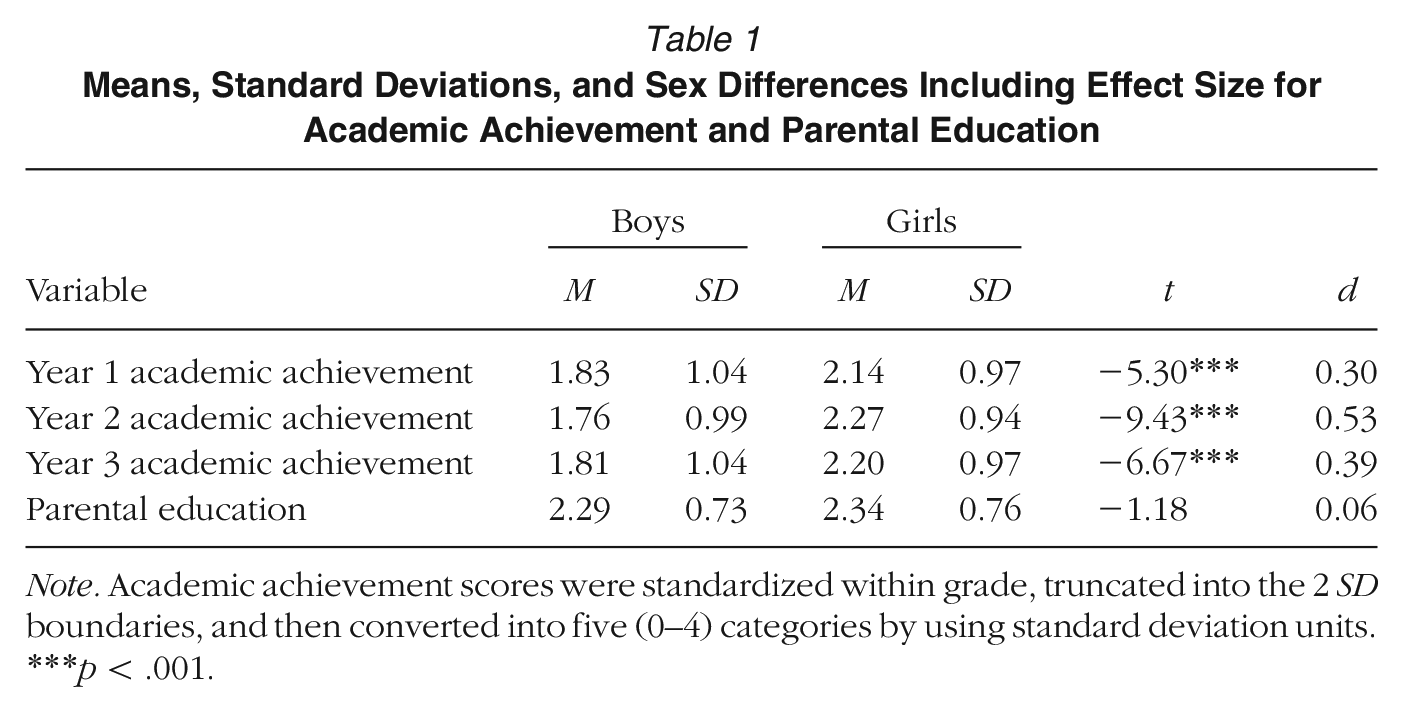
Note. Academic achievement scores were standardized within grade, truncated into the 2 SD boundaries, and then converted into five (0–4) categories by using standard deviation units.
p < .001.
In Table 2 are the correlations between academic achievement, friends’ academic achievement, and parental education. In the correlation analyses, friends’ academic achievement was calculated using the mean-aggregated scores of their mutual friends’ academic achievement. For both boys and girls, adolescent academic achievement was positively associated with their friends’ academic achievement across the 3 years, rs = .42 to .65. Both boys’ and girls’ academic achievement were also positively associated with parental education, rs = .13 to .20.
Correlations Among Academic Achievement, Parental Education, and Friends’ Academic Achievement Across Grades Separately for Boys and Girls (Respectively, Below and Above the Diagonal)
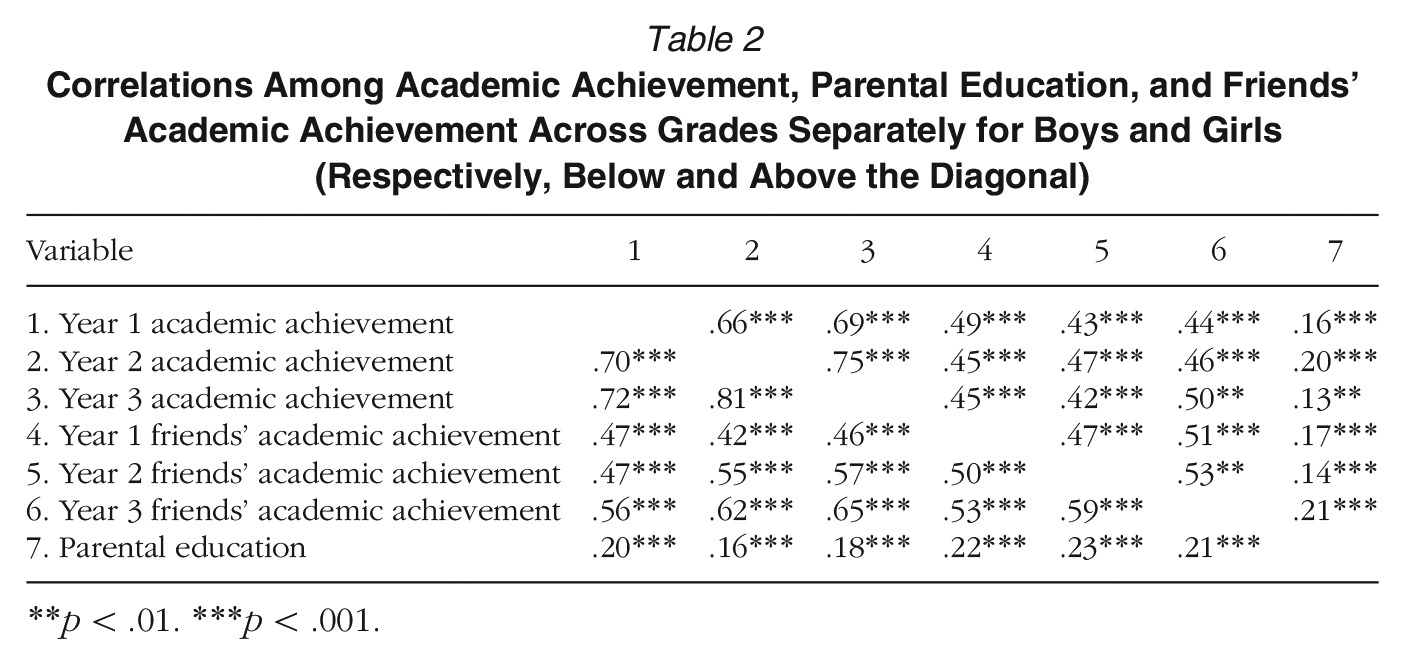
p < .01. ***p < .001.
Descriptions of the behavioral and network assessments are presented in Table 3. Hamming distance (an indicator of changes in friendship nominations between adjacent two waves) was between 940 and 1,632, indicating sufficient change in friendship ties to allow for SIENA analyses. The Jaccard index between .24 and .35 indicates that it is appropriate to use SIENA with our data.
Descriptive Behavioral and Network Assessment
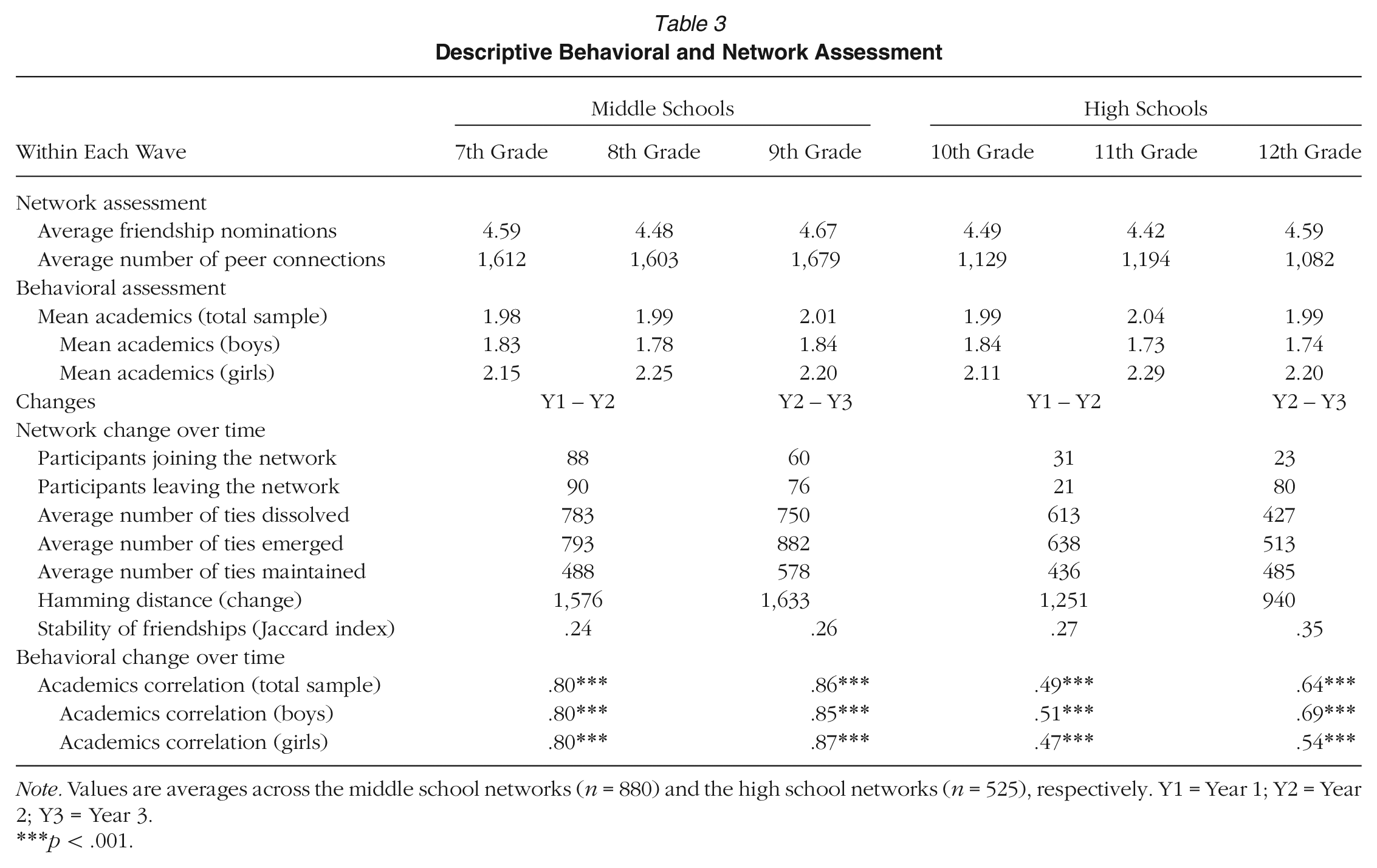
Note. Values are averages across the middle school networks (n = 880) and the high school networks (n = 525), respectively. Y1 = Year 1; Y2 = Year 2; Y3 = Year 3.
p < .001.
Longitudinal Social Network Analysis
The primary goal of this set of analyses was to estimate the effects of peer selection and influence for the academic achievement of Chinese adolescents. Table 4 presents the SIENA estimates for friendship network structure tendencies, behavioral tendencies, and peer selection and influence for middle school and high school students across both transitions (i.e., from Year 1 to Year 2 and from Year 2 to Year 3). To facilitate the interpretation of parameter estimates from SIENA, odds ratios were calculated for linear effects by taking the exponential function of the rescaled estimates (i.e., the estimates were divided by the number of points in the scale minus 1 to reflect the effect of a 1-unit change on the scale). Odds ratios were not calculated for nonlinear effects (i.e., quadratic shape effects).
Parameter Estimates for Selection, Influence, and Sex Effects Associated With Adolescents’ Academic Achievement After Accounting for Basic Network and Behavioral Parameters
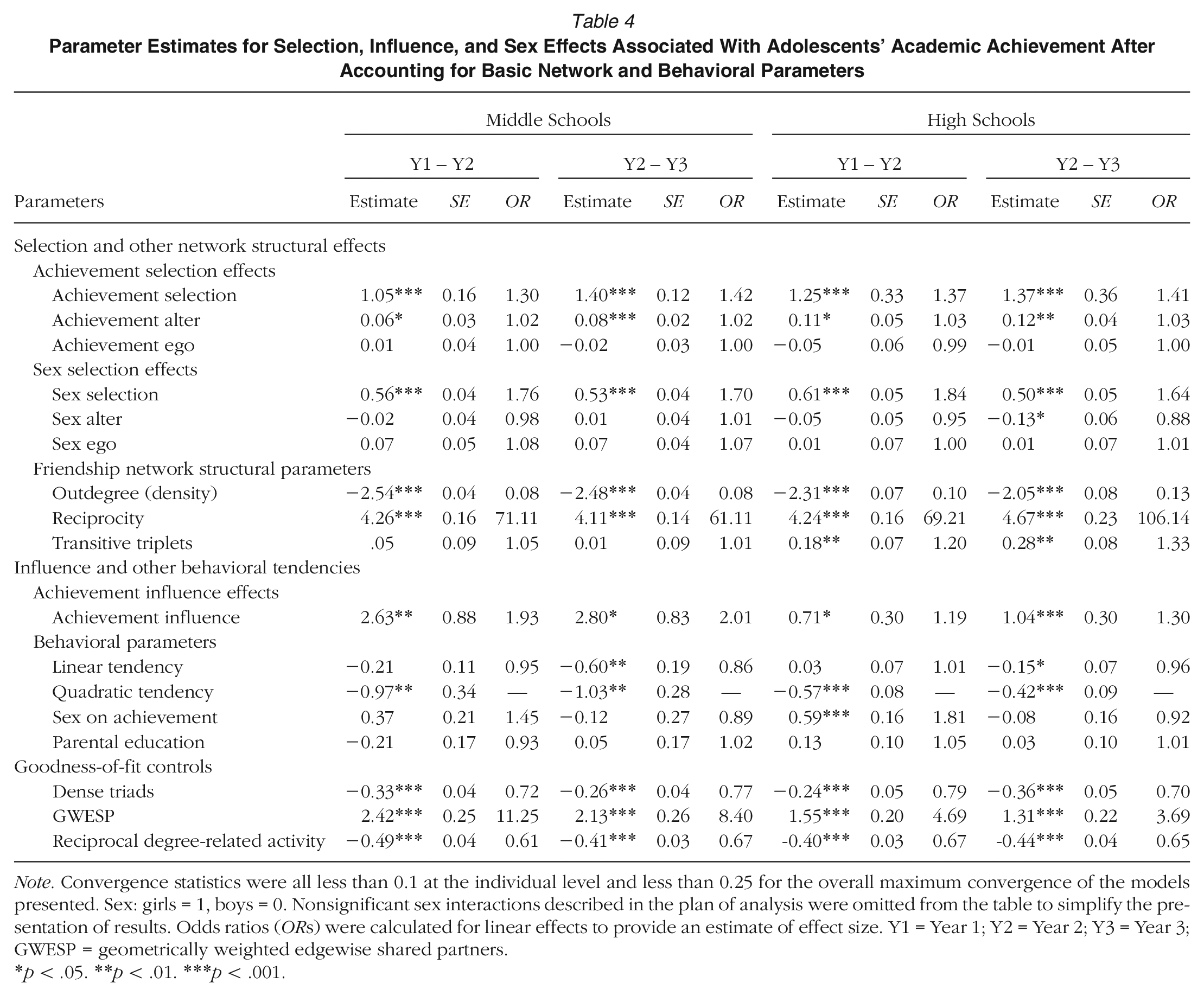
Note. Convergence statistics were all less than 0.1 at the individual level and less than 0.25 for the overall maximum convergence of the models presented. Sex: girls = 1, boys = 0. Nonsignificant sex interactions described in the plan of analysis were omitted from the table to simplify the presentation of results. Odds ratios (ORs) were calculated for linear effects to provide an estimate of effect size. Y1 = Year 1; Y2 = Year 2; Y3 = Year 3; GWESP = geometrically weighted edgewise shared partners.
p < .05. **p < .01. ***p < .001.
Selection and Network Structural Effects
Academic achievement selection effects
As expected, both middle and high school students selected friends similar to themselves in academic achievement (indicated by the achievement similarity selection estimates = 1.05 to 1.40). The significant and positive achievement alter effect (estimates = 0.06 to 0.12) revealed that students who had higher levels of academic achievement received more friendship nominations than others. There were no differences between high-achieving students and others in the number of friendship nominations they provided.
Follow-up analyses for academic achievement selection
The ego-alter selection tables (see Table 5) present the attractiveness for selecting peers of similar academic achievement. The rows list adolescents’ academic achievement, and the columns correspond to the academic achievement of their friends. The values in the diagonal represent the attractiveness between students with identical academic achievement. Table 5 shows that there were strong preferences for Chinese students in all grades to befriend peers with similar or slightly higher levels of academic achievement, whereas students less often selected peers lower than themselves in academic achievement. High-achieving students were more selective than were low-achieving students, as indicated by the larger differences between the highest and lowest values in bottom rows than in the top rows. It appeared that high-achieving students were more likely to become friends with similarly high-achieving peers (indicated by the increase in strength of effects across the diagonal in all networks). Moreover, the stronger gradients left of the diagonals compared to those right of the diagonals revealed that high achievers avoided nominating low-achieving peers as friends.
Ego-Alter Selection Table Regarding Academic Achievement
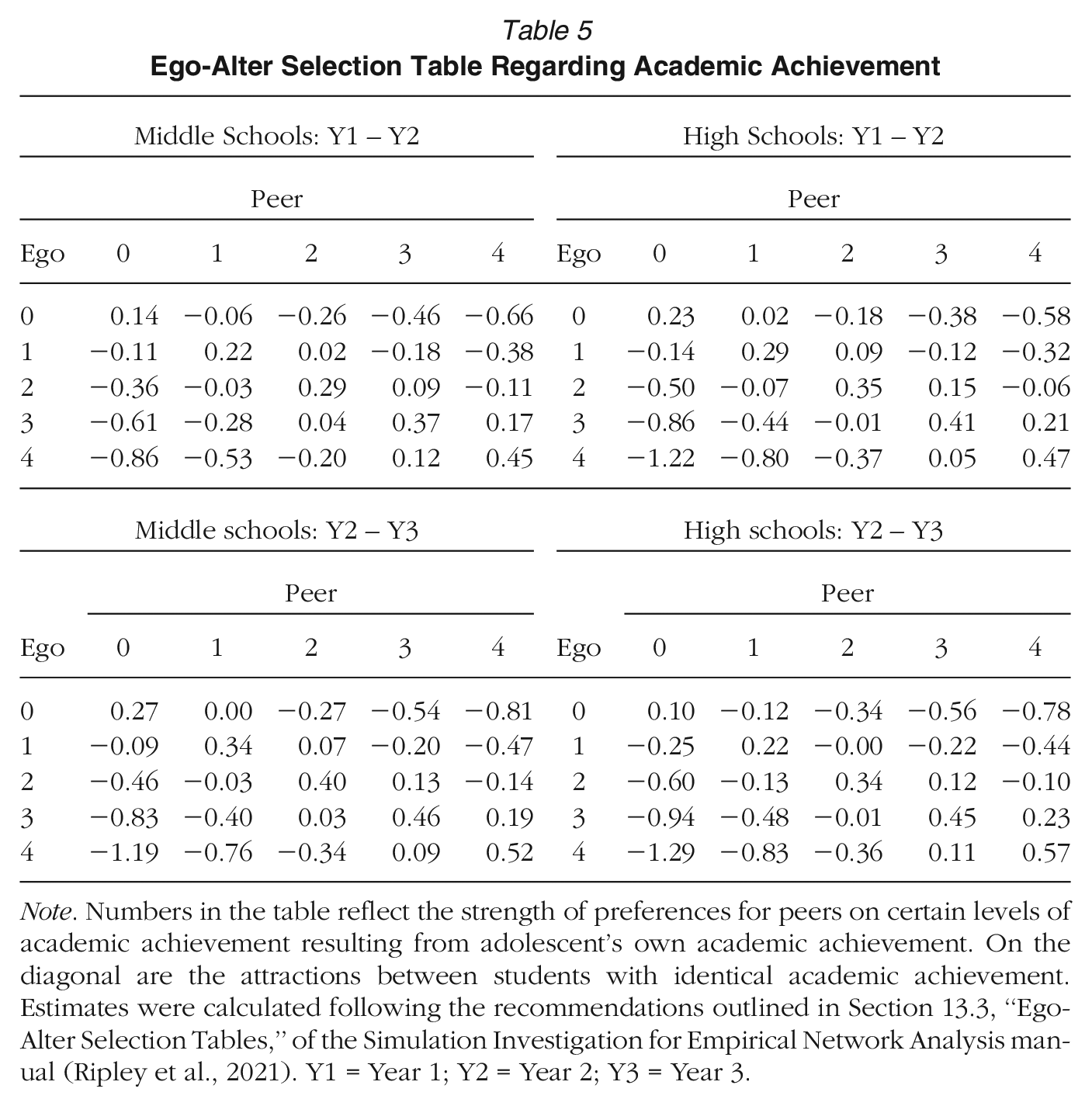
Note. Numbers in the table reflect the strength of preferences for peers on certain levels of academic achievement resulting from adolescent's own academic achievement. On the diagonal are the attractions between students with identical academic achievement. Estimates were calculated following the recommendations outlined in Section 13.3, “Ego-Alter Selection Tables,” of the Simulation Investigation for Empirical Network Analysis manual (Ripley et al., 2021). Y1 = Year 1; Y2 = Year 2; Y3 = Year 3.
Sex selection
The significant and positive sex similarity parameters (0.50 to 0.61) revealed that students preferred to befriend same-sex peers in both middle and high schools. High school girls received fewer friendship nominations than boys from 11th grade to 12th grade (indicated by the significant sex alter effect estimates = −0.13), with no difference between girls and boys in the other grades.
Friendship network structural parameters
The negative density effects (estimates = −2.54 to −2.05) revealed that neither middle school students nor high school students nominated friends at random. Instead, students favored mutual friendships (indicated by the significant reciprocity estimates = 4.11 to 4.67). High school students also nominated friends of their friends (indicated by the significant transitive triplet estimates = 0.18 to 0.28).
Influence and Behavioral Tendencies
Academic achievement influence
Friendship nominations were predictors, and academic achievement was the dependent variable in analyses of influence. The significant academic achievement average alter parameter (0.71 to 2.80) revealed that adolescents’ academic achievement was influenced by their friends’ academic achievement in both middle school and high school.
Follow-up analyses for academic achievement influence effects
To further inspect the strength and direction of friendship influence effects on academic achievement, ego-alter influence tables were constructed (see Table 6). Rows in Table 6 correspond to the average levels of friends’ academic achievement, and the columns correspond to adolescents’ own academic achievement. The values in the influence tables reflect the strength of friendship influence. The values at the diagonal were expected to be the maximum value in each row, which indicates that adolescents preferred to imitate and have the same level of academic achievement as their friends. The findings that top-row differences (i.e., rows for lowest friends’ academic achievement) were slightly larger than the bottom-row differences revealed that friends’ influence was stronger when they were low achieving than when friends were high achievers. Thus, students were more likely to decrease their academic achievement when their friends were low achieving than to increase their academic achievement when their friends were high achieving.
Ego-Alter Influence Table Regarding Academic Achievement
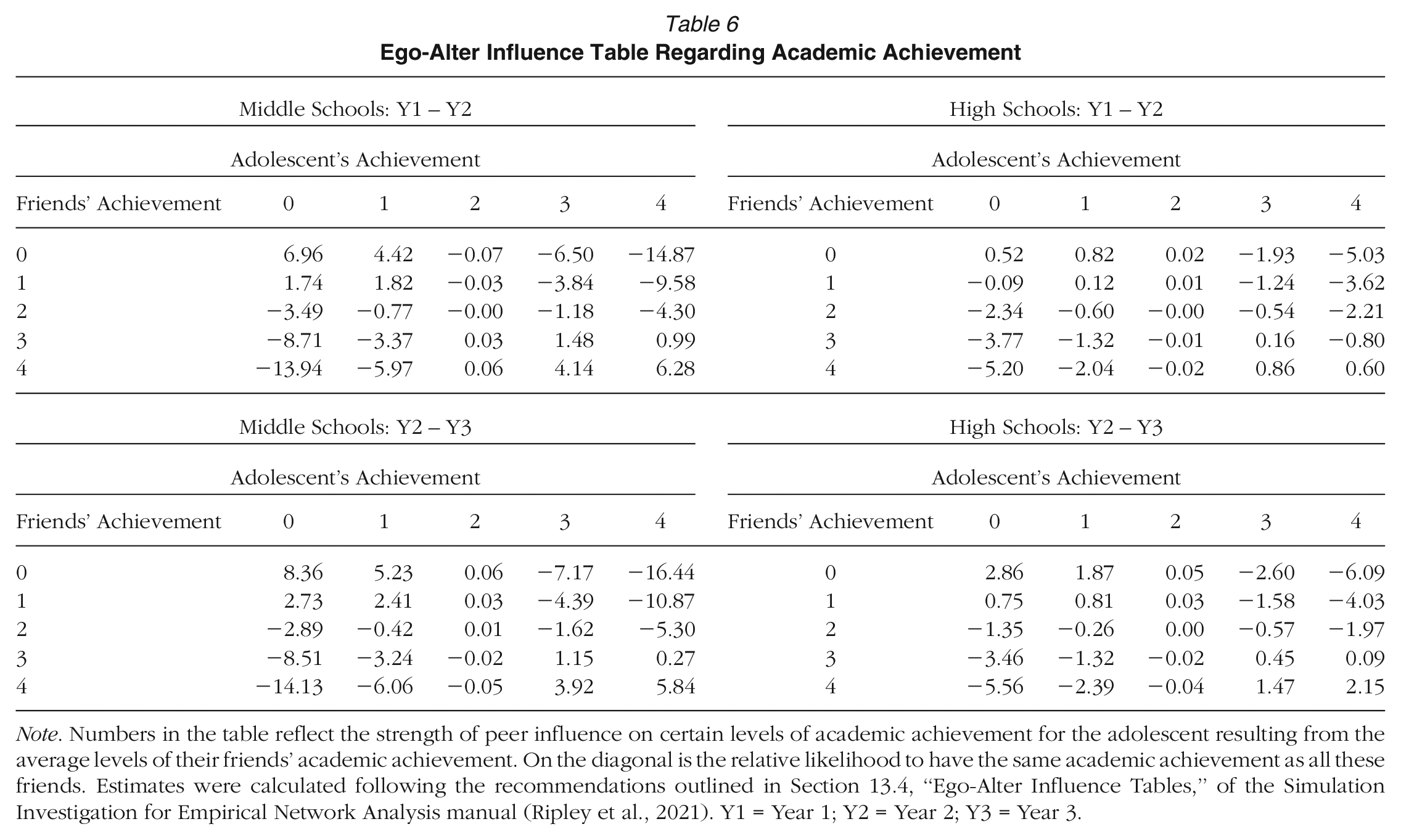
Note. Numbers in the table reflect the strength of peer influence on certain levels of academic achievement for the adolescent resulting from the average levels of their friends’ academic achievement. On the diagonal is the relative likelihood to have the same academic achievement as all these friends. Estimates were calculated following the recommendations outlined in Section 13.4, “Ego-Alter Influence Tables,” of the Simulation Investigation for Empirical Network Analysis manual (Ripley et al., 2021). Y1 = Year 1; Y2 = Year 2; Y3 = Year 3.
Behavioral tendency controls
The behavioral tendency parameters (i.e., linear and quadratic shape effects) and individual-level covariates (i.e., sex and parent education) were controlled. The negative linear tendency parameter for both middle school and high school students from Year 2 to Year 3 (–0.60 to −0.15) indicated that academic achievement declined during that period. The negative quadratic shape effect for academic achievement across all school years (–1.03 to −0.42) indicated that students high in academic achievement at the initial assessment tended to decline achievement, whereas those low in academic achievement tended to increase their achievement. Girls were higher in academic achievement than boys from 10th to 11th grade (indicated by a significant effect from sex on academic achievement estimate = 0.59). Parent's education was not associated with changes in academic achievement. Because these were control variables and unrelated to the hypotheses of this articles, these effects will not be discussed further.
Goodness-of-fit controls
The three supplementary network goodness-of-fit control covariates were significant and included in all models. These included dense triads, geometrically weighted edgewise shared partners, and reciprocal degree-related activity.
Sex moderation
Neither the sex by selection nor the sex by influence interactions was significant. These nonsignificant sex interactions were not included in the final models or Table 4 to simplify the presentation.
Middle school versus high school
Grade differences in academic achievement selection and influence were examined by calculating the differences of the effect estimates divided by the pooled standard errors of these estimates (Ripley et al., 2021). There were no significant selection differences between middle school and high school (estimate difference = −0.20, pooled SE = 0.37, z = −0.55, ns, from Year 1 to Year 2; estimate difference = 0.03, pooled SE = 0.38, z = 0.07, ns, from Year 2 to Year 3). The academic achievement influence effect was significantly stronger for middle school students than for high school students (estimate difference = 1.92, pooled SE = 0.92, z = 2.08, p < .05, from Year 1 to Year 2; estimate difference = 1.76, pooled SE = 0.88, z = 1.99, p < .05, from Year 2 to Year 3).
Discussion
This study was conducted to examine peer selection and influence pertaining to the academic achievement of Chinese middle school and high school students across 3 academic years. We focused on three major hypotheses. First, we expected to find significant academic selection and influence effects in China. Second, we hypothesized that contributions of high-achieving pupils to selection and influence would be greater than that of low-achieving peers. Third, we hypothesized that peer selection and influence would be stronger in middle school than in high school. We also anticipated that the results from China would be sufficiently divergent from those typically found in Western countries to suggest the possibility that cultural variation exists in the associations between peer relationships and academic adjustment.
Peer Academic Selection and Influence of Chinese Adolescents
In this section, we address the first question pertaining to the existence of academic selection and influence effects in China. Consistent with our hypotheses, we found both significant selection and influence effects in academic achievement of Chinese middle school and high school students.
Peer Academic Selection
The SIENA results revealed that academic achievement plays a role in Chinese adolescents’ nominations of friends. Both high-performance preferred selection and similarity-based selection were found for both middle school and high school students. High-achieving students received more friendship nominations than low-achieving peers and Chinese adolescents tended to select friends based on their similar academic achievement.
Chinese adolescents elected to be friends with high-achieving peers. This result is consistent with the hypothesis that academic achievement is highly valued in Chinese culture and that high achievers are often admired and popular (e.g., J. Li, 2012; Niu et al., 2016). This result is also consistent with An’s (2022) finding that top academically successful Chinese students received more friendship nominations than their classmates.
The finding that adolescents choose friends with similar achievement levels provides support for the hypothesis that peer selection is an important mechanism for understanding academic homophily. In prior studies that used traditional regression-based approaches instead of SIENA, estimates of selection were typically confounded with peer influence or established as a baseline control (e.g., Kindermann, 2007). The significant selection effects from the present study suggest that adolescents actively sort themselves into academically homogenous friendships.
Peer Academic Influence in China
The SIENA results suggest that Chinese adolescents and their friends influence each other with respect to academic achievement in both middle school and high school. The findings of significant peer influence effect for academic achievement are consistent with other results from studies that used both non-SIENA (e.g., Hamm et al., 2011; Ryan, 2001) and SIENA analytic methods in Western countries (e.g., Chow et al., 2018; Kretschmer et al., 2018; Stark et al., 2017).
The finding that Chinese adolescents’ academic achievement is influenced by their friends is consistent with Confucian ideas regarding the importance of peers. Chinese teachers and parents promote peer-supported learning, and high achievers are often identified as role models.
Sex Differences
There was no evidence from this study that sex moderates either selection or influence processes related to academic achievement in Chinese adolescents. This finding is consistent with X. Chen et al.’s (2003, 2008) reports that peer group influence effects on the development of social competence and academic performance were similar for Chinese boys and girls.
Although there was no significant sex moderation in the present study, it is premature to conclude that sex does not affect peer selection and influence processes pertaining to academic achievement in China. Sex differences in selection and influence may emerge as a function of not only children's sex but also the sex of their siblings. Although there is a preference for sons in traditional Chinese society, Chinese singleton girls may benefit from the “one-child policy” because parents tend to strongly invest in their only child regardless of their child's sex (e.g., B. B. Chen et al., 2022). Nevertheless, as the one-child policy is being relaxed, Chinese parents may distribute educational resources differently to their sons and daughters (Lei et al., 2017).
High- and Low-Achieving Students as Agents of Selection and Influence
Given the strong association between academic achievement and peer status in China, we hypothesized that high achievers would contribute more to the selection and influence processes than would low achievers. Our results were partially consistent with this hypothesis. High-achieving students were identified as selectors and targets of selection, but both high- and low-achieving students influenced their friends’ achievement. The negative influence from low achievers was stronger than the positive influence from high-achieving friends.
High-Achieving Students as “Gatekeepers”
The ego-alter selection tables revealed that Chinese students strongly preferred similarly achieving or slightly higher achieving peers over peers who were lower in academic success than themselves. Furthermore, high achievers were more selective in their friendship choices and unlikely to befriend peers lower than themselves in achievement.
Although it is possible that Chinese students prefer to interact with high-achieving students, high-achieving students may be “gatekeepers” that selectively choose other high-achieving classmates. Because low-achieving students may be less attractive to peers, they may befriend similarly rejected low-achieving classmates, in part because they have limited options. If low-achieving adolescents are disliked by their peers, they may establish friendships with others that are also rejected.
Peer Influence on Academic Achievement
The application of ego-alter influence tables allowed for the assessments of the direction and strength of peer influences on academic achievement rather than merely focusing on the presence or absence of influence. The results from these analyses revealed that academic peer influence can be both beneficial and detrimental. Adolescents moved upward in their academic achievement if they were friends with high-achieving peers but decreased their academic achievement when their friends were low achievers. The negative peer influence (i.e., the detrimental effect) was found to be slightly stronger than the positive effect.
The finding that influence effects can be both beneficial and detrimental provides further insight into the processes by which friends socialize each others’ academic behavior. High achievers may share academic resources such as notes with their friends and help them with homework or to prepare for exams (e.g., Azmitia & Cooper, 2001). Low achievers, in contrast, may distract their friends from schoolwork by encouraging problematic behavior and task avoidance (e.g., Geven et al., 2013). Future studies could compare friendship processes related to different directions of influence on achievement and investigate the protective factors that may help to reduce negative peer influences for future intervention efforts.
Middle School Versus High School
Academic achievement peer influence was stronger for middle school students than for high school students. This result is consistent with results from multiple studies of peer influence in general. Researchers have consistently found that adolescents’ conformity to peer pressure peaks at midadolescence (e.g., Berndt, 1979; Costanzo & Shaw, 1966; Steinberg & Monahan, 2007). The present study expands on these previous studies by using SIENA to compare the relative strength of academic peer selection and influence effects for middle school and high school students.
No significant differences between middle school and high school students in academic selection were found. One potential explanation for the similarly of academic selection effects were similarly strong in middle schools and high schools is that at both levels, students are highly achievement oriented because of the limited opportunities to gain access to high school and college education in China. The high school entrance exam is as competitive as the college entrance exam because the selection into key-point high schools is closely tied to college admission (Wu, 2017).
Cultural Variations in Peer Academic Selection and Influence
In this section, we explore the possibility that findings from the study of Chinese adolescents were different from those typically found in Western countries. There are two major inconsistencies between the findings from these previous studies and the current study with respect to selection. First, contrary to the stronger preferences among similarly low-achieving peers in Western countries (e.g., Flashman, 2012; Gremmen et al., 2017; Rambaran et al., 2017), this study revealed especially strong preferences for high-achieving Chinese students to befriend similarly high-achieving peers, but the attraction between low-achieving peers was weaker. Second, in contrast to the stronger reluctance of low-achieving adolescents to nominate high-achieving peers in Western countries (e.g., Gremmen et al., 2017), stronger avoidance patterns for high-achieving students to nominate lower achieving peers were found in the current study.
The discrepancies that emerged between the selection findings of previous studies and the current study may be attributed to two factors. First, as discussed in previous sections, Chinese youth strongly prefer to befriend high-achieving peers. This strong preference for friends who have high grades strengthened the attractions among high-achieving peers. Second, these inconsistencies may also be explained by the differences in popularity norms regarding academic achievement.
Consistent with the reputational salience hypothesis (Hartup, 1996), it is possible that the variations in the salience of academic achievement between Chinese and Western students explain the inconsistencies in selection processes. Academic achievement may be a more important contributor to popularity for Chinese adolescents than for Western adolescents. High academic achievement is typically regarded as an admired and desired characteristic of Chinese adolescents (e.g., X. Chen et al., 1997; Y. Li et al., 2012; Niu et al., 2016). Being friends with high-achieving students may bring strong social rewards to Chinese adolescents, such as higher popularity and greater peer acceptance. Chinese adolescents may avoid low-achieving students as potential friends because interactions with these students may put them at risk for decreased status among their peers.
The few studies that have used SIENA to examine the direction and strength of peer influence pertaining to academic achievement have yielded inconsistent findings (e.g., Gremmen et al., 2017; Laninga-Wijnen et al., 2018, 2019; Rambaran et al., 2017; Stark et al., 2017). Our findings that peer academic influence can be both beneficial and detrimental and that the negative peer influence (i.e., the detrimental effect) was found to be slightly stronger is partially in line with Laninga-Wijnen et al.’s (2018) results from the study of U.S. adolescents. They found that in classrooms in which academic mastery goals were highly correlated with popularity, the decreased achievement levels of students that had low-achieving friends was stronger than the tendency of students to increase academic achievement when they had high-achieving friends.
The detrimental peer influence from those who are lower in achievement is explainable using Confucian ideas toward learning. Chinese students are expected to collaborate with and learn from everyone around them, and high achievers are expected to remain humble and open-minded and seek knowledge from others, including those who are less sophisticated. For example, Koh and Wang (2012) found that asking questions and learning from others at a lower rank or at inferior positions than themselves was frequently mentioned as a moral virtue by Singaporean Chinese students. Thus, the focus on learning from everyone around them (including those academically inferior) may distract students from their focus on academic achievement.
The question of the uniqueness of selection and influence in Chinese adolescents cannot be answered from this study and necessarily requires expanded cross-cultural research. Perhaps similar results would emerge in countries, such as South Korea, Singapore, and Vietnam, that have been heavily influenced by China and Confucianism. Alternatively, it is possible that similar results would be found in schools in which students are highly motivated to succeed academically and peer status is strongly associated with academic success.
Limitations and Future Directions
The current study was an initial attempt to investigate peer selection and influence processes pertaining to academic achievement in Chinese adolescents, and several limitations are worth considering. First, the measure of friendship was limited to the same-grade peers in the same school. The friendship ties and the influence from friends in lower or higher grades or outside of their schools were not captured in this current study. Second, peer selection and influence effects were assessed only for academic subjects (i.e., Chinese, mathematics, and English). Finally, the data presented here were correlational, and thus, conclusions concerning causal directions need to be drawn with caution. Additional studies using experimental methods and qualitative interviews would be particularly useful to further clarify the role of peer relationships and culture in the development of academic achievement.
Practical Implications
The results from the current study revealed that low-achieving students may be avoided by high-achieving peers and that low-achieving students tend to select other low-achieving students as friends in Chinese schools. This selection bias may put low-achieving students at further disadvantage and at higher risk of being left behind.
The finding that peers influence academic achievement has multiple practical implications. Providing opportunities for pairing academically advantaged students with less advantaged students in collaborative learning may foster positive influence and provide support to these less advantaged students (Saner et al., 1994; Webb et al., 1998). Nevertheless, peers may also have a negative influence. High-ability students may not necessarily benefit from collaborative learning in heterogeneous groups as much as do low-ability students (e.g., Baer, 2003; Webb et al., 2002). The potential detrimental effects of influences and social pressures from low-achieving peers highlight the importance of guidance, supervision, and facilitation from teachers and parents in study groups, discussions, and other cooperative learning settings. Teachers’ interventions may be particularly helpful in promoting collaborative peer group work (e.g., Hamm & Adams, 2002), resolving potential contradictions or misconceptions (e.g., Brodie, 2000), and balancing peer resources and students’ independent thinking (e.g., Ding et al., 2007).
Conclusion
Although academic achievement is strongly emphasized in Chinese culture, peer influence on the academic achievement of Chinese adolescents has received surprisingly little attention. The current study provided novel information by assessing the coevolution in friendships and academic achievement of Chinese adolescents over 3 years. First, the findings from this current study provided some of the strongest evidence to date that both peer selection and peer influence are important in explaining the academic homophily of Chinese adolescents. Second, this study expands on the prior SIENA studies by showing that Chinese students preferred similarly achieving or slightly higher achieving friends, but lower achieving peers were avoided as potential friendship partners. Moreover, academically disadvantaged students may profit from interactions with high-achieving friends, but high-achieving students may encounter challenges that were potentially detrimental to their academic achievement by interacting with low-achieving friends. Third, the current study examined age differences in academic peer selection and influence. As expected, middle school adolescents were more strongly influenced by peers than were high school students, but no differences in selection were found. This study highlighted the importance of understanding how cultural norms and values, such as the intense emphasis on academic achievement in Chinese culture and the competitive nature of education in contemporary Chinese society, may jointly affect how friendships are related to the achievement of Chinese adolescents.
Footnotes
This research was competed in part as a PhD dissertation by Mengqian Shen submitted to Purdue University. The authors thank the members of her dissertation committee, Robert Duncan, Seungyoon Lee, and German Posada, for their insights pertaining to this research. The authors are particularly grateful for Dawn Delay for introducing us to Simulation Investigation for Empirical Network Analysis and providing consultation regarding this methodology.
M
D