



Abstract
This study explores preservice teacher attributions to children’s behaviors portrayed in specific emotion-laden school scenarios. Participants included 178 preservice teachers from three universities. The preservice teachers viewed video vignettes of Black and White child actors in six different school scenarios. Our team constructed two themes from the preservice teachers’ narratives about what they saw: (a) context matters (i.e., different scenarios activate different preservice teacher attributions), and (b) racialization evolves (i.e., preservice teachers make different attributions about Black and White boys engaged in the same behaviors). Findings underscore the importance of teacher education and professional development for novice teachers that address racial bias in attributions of student behaviors.
Nearly 50 years ago, the Children’s Defense Fund reported racial inequities in school disciplinary practices (Children’s Defense Fund, 1975). Today, U.S. educational research continues to document the evolving challenges of teaching and learning across the color line (Brown & Steele, 2015; Cooper et al., 2022; Harry & Anderson, 1994; S. A. Hughes, 2006; S. A. Hughes & Berry, 2012; Ladson-Billings, 1994; Skiba et al., 2001). The research reveals disproportionately negative academic and disciplinary consequences for students that teachers identify as African American or Black, versus European American or White (Halberstadt et al., 2022; S. A. Hughes, 2006; S. A. Hughes & Berry, 2012). When considered in tandem, previous research (a) reveals substantial and persistent differences in teacher expectations, referrals, and evaluations based on their identification of students as Black or White; and (b) indicates that these variations can persist over time and across contexts (Cooper et al., 2022; McGrady & Reynolds, 2013; Skiba et al., 2001, 2002; Tenenbaum & Ruck, 2007). For example, in some schools, Black children are likely to be underrepresented in gifted classes (Ford, 2013; Nicholson-Crotty et al., 2016) but overrepresented in special needs categories (e.g., Harry & Anderson, 1994; Harry et al., 2005). Black children are also more likely than their White peers to receive disciplinary referrals for subjective factors (e.g., disruptive behavior) in some elementary and middle schools, even after statistically controlling for the type of behavior (e.g., Skiba et al., 2011, p. 85).
White teachers represent approximately 80% of the public-school teaching force (National Center for Education Statistics, 2023). There is increasing evidence that some of these teachers have more conflict-laden and weaker relationships with Black versus White students (J. N. Hughes et al., 2005; Jerome et al., 2009; Murray & Murray, 2004). Conversely, additional research suggests that Black children can benefit from Black teachers who seem to build strong, nuanced, and productive academic relationships with them (Dee, 2004; Downey & Pribesh, 2004; Saft & Pianta, 2001). Differences may reflect the tendency of some teachers to misinterpret the behavioral displays of Black students as disrespectful and intentional rather than, as is sometimes the case, appropriate indicators of distress and/or frustration (Baker, 2019; Hill, 2004; Legette et al., 2023; Tyson, 2003). Notably, it is not uncommon for teachers and parents to differ in their interpretations of behaviors that represent social-emotional competence among Black children (Humphries et al., 2012; Lawson et al., 2017).
Evidence also suggests that teachers sometimes hold unconscious assumptions associated with “cultural deficit” thinking, which can result in negative assumptions about minoritized students’ academic abilities and behaviors. For example, one study suggests that when assessing videotaped behaviors of Black and White boys, teachers who endorse cultural deficit beliefs in general are especially likely to perceive Black boys’ behaviors as hostile, representative of a behavioral pattern, and serious, as compared to White boys’ behaviors (Legette et al., 2021). Not only might these beliefs relate to negative assumptions towards racially minoritized populations, they may also be associated with positive assumptions about White children’s behaviors. For instance, available data show that many teachers endorse a pro-White stance via explicit and implicit racial biases at levels comparable to those of individuals in the general population (Starck et al., 2020).
The primary purpose of the current study is to identify preservice teachers’ emotion-related attributions of Black versus White elementary school-age boys’ (mis)behaviors. In this research, we utilize a somewhat new methodological approach of asking preservice teachers to describe in detail what they see in videotaped scenarios of Black and White boys acting out what might be seen as mild to serious misbehaviors at school. We focus on preservice teachers for multiple reasons. First, the vast majority of preservice teachers enter the field with deficit thinking about students who are not White and middle income (Cochran-Smith & Villegas, 2016). Although we can educate preservice teachers about systematic racism, if we indeed find evidence of deficit-thinking in this teaching population, we can use these clear examples to help them become better aware of how they might themselves engage with this type of thinking during classroom encounters with racially minoritized students. This heightened awareness could result in an increased capacity to recognize their own deficit thinking and encourage a willingness to use supportive, authentic, and antiracist classroom instructional practices. This approach is important because many teachers begin their teaching careers with hesitancy about addressing race and ethnicity in their classrooms (Council for the Accreditation of Educator Preparation, 2022; Roegman et al., 2023), which can result in an inability to engage in the appropriate race work that can positively impact their teaching and students’ learning (Ladson-Billings, 1994; Yuen, 2010).
Importantly, preservice teachers may be more likely than in-service teachers to position themselves purposely as learners with regards to cultural and racial equity (Martin-Beltrán et al., 2023). Thus, we reasoned that the teacher preparation stage may be the best time to promote awareness about how attributions and emotions linked to teachers’ racial bias in classrooms and schools can result in inequities in learning and otherwise detract from a quality school experience for students of color. We also believe that identifying examples of racist thinking and practices, should these be identifiable in our data set, will have implications for the development of in-service professional development programs for practicing teachers who may not have had the benefit of diversity preparation (Mattison & Aber, 2007; View et al. 2020) and help to shape teachers’ awareness of teaching practices that either perpetuate or disrupt racialized (mis)interpretations of students’ emotions and behaviors.
Literature Review
Attributions
Our focus on attributions draws upon Causadias et al.’s (2018b) culturally framed application of attribution theory, which asserts that there is a tendency to perceive individuals of color as members of a minoritized group whose traits, beliefs, and behaviors are shaped primarily by cultural factors. In contrast, White individuals tend to be viewed as autonomous and independent actors whose behaviors are predominantly influenced by psychological processes, such as personality and cognitive factors. Hence, a general assertion is that the emotions and behaviors of minoritized racial and ethnic individuals are influenced primarily by group-level indicators of culture and that White individuals are guided principally by individual-level psychological processes. This notion is foundational to a culturally framed attribution theory (Causadias et al., 2018a, 2018b). Given that such beliefs are grounded in bias rather than actual data, unsubstantiated explanations for and treatment of individuals from particular racialized groups may be especially likely. As evidence, Black students are frequently the targets of attribution errors in the form of racial stigma, which can have adverse effects on academic identity, motivation, and learning outcomes (Graham, 2017, 2020; Heider, 1958; Pettigrew, 1979; Weiner, 2010). In the current study, we center preservice teachers’ conceptions of the emotion-related behaviors of Black versus White students and the attributions of intentionality and negativity that they ascribe to these behaviors.
Emotions
A focus on emotion is important because, as compared to other professionals, teachers experience high demands for understanding and regulating students’ emotions as well as their own (Näring et al., 2006). Expressing and observing emotions are central to the quality of social interactions and classroom relationships between students and teachers (Frenzel et al., 2009; Halberstadt et al., 2001; Halberstadt & Hall, 1980; Mayer & Salovey, 1997). Similarly, emotions are key to teachers’ understanding of students’ goals and feelings of self-efficacy in the school context (Garner, 2010; Meyer & Turner, 2002; Poulou et al., 2022). Effective teachers also understand that emotions are foundational to efforts to establish rapport and strengthen positive communication with students (Demetriou & Wilson, 2009).
Despite their center stage in the classroom, even prototypical expressions of emotions can be misinterpreted (Ekman et al., 1987). In fact, individuals who know each other are surprisingly inaccurate in perceptions and interpretations of one another’s emotions; even friends trying to ascertain each other’s thoughts and emotions appear to be accurate only about one-third of the time (Stinson & Ickes, 1992). Coaches are slightly better in their evaluations of athletes’ emotions, showing a 44% success rate (Lorimer & Jowett, 2010). For the most part, observers in these studies are typically tasked with identifying the emotions of only one person at a time. Schools, however, are complex spaces that require teachers to attend simultaneously to multiple students and classroom events, many of which are unpredictable and happening quickly (Doyle, 1986). As such, teachers frequently work in situations that call for swift and automatic processing of multiple students’ emotions. This divided attention may leave teachers particularly vulnerable to the influence of implicit biases affecting their perceptions of students’ emotions (e.g., Robinson & Darley, 2007).
Bias for Emotion-Related Behaviors in Black Individuals
Bias, however it is measured, is believed to be a factor in teachers’ perceptions of students’ classroom emotions and behaviors in the form of racialized interpretations of anger, frustration, and hostility. For instance, implicit bias in non-Black individuals is associated with (a) more readily perceiving the onset of anger in Black versus White phenotypic faces,(b) perceiving anger as longer lasting in Black than White faces, (c) tending to evaluate angry faces of ambiguous racial background to be Black rather than White, and (d) greater assessments of anger in Black compared to White faces (Hugenberg & Bodenhausen, 2003, 2004; Hutchings & Haddock, 2008). Likewise, individuals perceive anger more quickly and as more enduring when seen in young Black men than in young White men. However, findings from this same study suggest that individuals perceive neutral or positive emotions as emerging more quickly in young White men (Kang & Chasteen, 2009). Together, these findings suggest that conscious and unconscious bias may operate to reduce perceptions of anger in response to White faces. Additionally, adults tend to incorrectly associate negative emotions, particularly anger, with Black faces than with White faces, findings that emerge regardless of whether the persons judged are adults or children (e.g., Cooke & Halberstadt, 2021; Halberstadt, Castro, et al., 2018; Halberstadt et al., 2022; Pigott & Cowen, 2000; Rowley et al., 2014). These results are important because individuals who are perceived as angry tend to elicit harsh and punitive responses from others (Côté-Lussier, 2013). In other work, researchers found that preservice teachers who were randomly assigned to read a vignette about a Black child described as behaviorally challenged were more likely to evaluate that student as likely to engage in future misbehavior than teachers assigned to read a vignette about a White child engaged in the same behavior (Kunesh & Noltemeyer, 2019; Legette et al., 2021).
Much of the research on teacher bias, as it concerns children’s emotion-focused behaviors, adopts a quantitative approach to the measurement of the constructs of interest in this study. Although these studies have a strong capacity to demonstrate that children are being treated differently, a qualitative perspective can offer the opportunity to critically examine and understand more precisely how and why teachers respond differently to the emotions and behaviors of Black and White boys. Qualitative research also allows for a deeper inquiry and a more nuanced examination of bias and can provide a rich understanding of the processes by which racial disparities emerge (see Reich, 2021). To that end, we created and filmed a variety of storylines about older elementary school boys that could easily occur in their classrooms and typically result in active teacher involvement. Especially relevant to our research is that this methodology allows for a deep-rooted exploration of how varying types of contexts may activate unique racialized attributions. Importantly, we do not envision that all preservice teachers will respond unilaterally with racist tendencies in all contexts. Rather, we expect that racialized attributions will be more likely to slip through preservice teachers’“colanders” of good intentions in different ways and in dissimilar situations. Thus, it is important to probe preservice teachers about their reflections on student behaviors across multiple vignettes.
In sum, the current article aims to expand research and theory on racialized ways in which preservice teachers attribute emotions to students’ social behaviors. To meet these goals, we explore participants’ narrative responses to professionally filmed video vignettes of Black and White school-age boy actors engaging in different behaviors in school settings, an approach that maximizes participants’ identification with the video characters (Hillen et al., 2013). To our knowledge, only two published studies have taken this approach to understand teachers’ potential racial bias in responding to students’ behaviors and emotions (Gilliam et al., 2016; Owens, 2022), perhaps because these investigations are difficult and expensive to design and implement (Hillen et al., 2013). In our study, preservice teachers were tasked with watching six different scenarios of school events and each participant was randomly assigned half of these enacted by a White boy and half enacted by a Black boy. Responses to these video vignettes, in the form of participants’ open-ended text data, were then explored in order to capture subtle differences in teachers’ perceptions of students’ behavior, especially pertaining to possible racialized assumptions about the reasons for that behavior (Owens, 2022). These responses also afforded the opportunity to explore how preservice teachers’ attributions might vary across contexts (Aim 1), which preceded our exploration regarding in which types of situations teachers might be most likely to activate their racialized assumptions about students (Aim 2). We do not have any predictions about how varied the attributions would be across contexts. However, we include enough instances to explore the contextualized nature of the responses. We also hypothesize that preservice teachers will be especially inclined to describe the emotion-related behaviors of Black boys as hostile, serious, and intentional; whereas White boys will be described as teasers, prank-prone (excusable), and developmentally appropriate and normative.
Method
Participants
Participants were 178 undergraduate students preparing to be teachers recruited from teacher education programs at three public universities in Virginia and North Carolina during the late winter and early spring of the 2016–2017 academic year. Students were offered $25 as compensation for their participation in a study described as “Evaluations of Classroom Interactions” (Halberstadt et al., 2022). Demographic characteristics of the sample were largely representative of those of the current teaching workforce in those two states. Eighty-nine percent of the participants identified as female and the majority reported an intention to teach at the elementary school level. Regarding racial identity, approximately 67% of the participants self-identified as White, 5.6% as Black, 7.3% as biracial, and 20.2% as other racial/ethnic groups. The average age for participants was 22.48 years (range = 18 to 50 years). University programs required students to complete two courses concerned with social justice issues in educational systems. Although there were no prerequisites for these courses, most students enroll in them during their sophomore, junior, and senior years. The vast majority of participants were 3rd- and 4th-year university students (36% and 47%, respectively). Students reported their political identification on a 1 to 7 scale from strongly conservative to strongly liberal, with 16% indicating strongly or moderately conservative (a 1 or 2), 21% as “in the middle” (a 4), and 50% as strongly or moderately liberal (a 6 or 7). Approximately 60% of participants had formal classroom teaching experience as substitute teachers, teacher assistants, or student-teachers.
Researchers’ Positionality Statements
Because we recognize that social identities inform the theoretical and methodological approaches to our work (Milner, 2007), we provide information about our positionalities as authors. The first author, a Black man who grew up in a rural area in a southern state, experienced inequities and opportunities at the intersection of race, class, gender, and education and was educated in desegregated schools. He later witnessed those same inequities and opportunities while working with urban and rural public elementary school youth in multiple U.S. states. The second author is a bilingual Asian woman who grew up in urban and rural China and was educated in China and the United States. Her research centers around critical multicultural education and concerns about how the larger sociopolitical context shapes the experiences of racially and linguistically minoritized students. The third author is a Black woman from a working-class background educated in desegregated schools who was previously a social worker in poverty-stricken neighborhoods in the South. Her research considers children’s racialized emotional experiences with peers and teachers in schools and classrooms. The fourth author is a Black woman who was raised in a small, racially segregated town in the South. Her experiences in the school system as a student, pre-K educator, and school counseling intern at a Title One school shaped her awareness of racism and systemic oppression and the implications on students’ academic trajectories, interactions with schooling agents, and future discipline experiences. Her work is concerned with investigating and disrupting racial bias in children’s schooling experiences and development. The fifth author, a White Jewish woman, first became aware of discriminatory and inflammatory attitudes of White parents in elementary school around the topic of busing; this experience guided her interest in research on the intersection of emotion and race over the decades, with the latest iteration focused on racialized understanding of emotion and systemic racism in school settings.
Our team came together because of shared interests in exploring how and why racism continues to exist in schools and a commitment to understanding both the ways in which teachers have advanced more equitable responses to Black and White children and the ways in which they have not. The team operated consensually. During research meetings, the team addressed questions, issues with coding, and discussed issues related to patterns emerging from participants’ responses. Moreover, we were keenly aware of how our individual backgrounds and lived experiences could impact our interpretation of the data. Together, we discussed and challenged individual assumptions and our multiple positionalities provided opportunities to discover gaps in the knowledge base among the individual researchers in ways that ensured a holistic interpretation of teachers’ apparent and subtle verbal and nonverbal responses to Black and White students’ emotions and behavior (see Lorette, 2023). In some cases, this resulted in changes to our coding system and data interpretation, and this process allowed us to more carefully consider both in ways that improved confidence in our data.
Data Collection
Preservice teachers were recruited from classrooms in which the study was offered as one of several ways to earn credit toward a course requirement or from the preservice teacher listservs with $25 offered as compensation for their time. Individuals who agreed to participate received a link to the Qualtrics platform and were asked to complete the study by computer (not phone) in a quiet and private space. Participants were asked to reserve 90 minutes for the research tasks so that they could be completed in one session, although stretching and breaks were recommended. The tasks used in this study (collected as part of a larger study) were preceded by an emotion recognition task of children’s faces (Halberstadt et al., 2022) and a questionnaire that assessed how much the participant valued certain emotions for themselves and their future students (adapted from Tamir & Ford, 2012). Culturally framed theory and research on attributions suggest that White individuals are perceived in relation to individual characteristics, whereas non-White individuals are more likely to be understood in relation to cultural characteristics (Betancourt & López, 1993; Causadias et al., 2018b). Because Black and White boy actors were portrayed in multiple scenarios, we could examine whether teachers’ responses involved racialized identity and whether they differed with respect to unique situational and contextual conditions.
Faculty Appraisal of Impulsive Reactions (FAIR) Vignettes Task
Preservice teachers watched six professionally filmed video vignettes of Black and White boy actors committing different behaviors in school settings (see Table 1; Halberstadt, Castro, et al., 2018; Halberstadt, Garner, et al., 2018; Legette et al., 2021). The child actors recruited for the FAIR Task reflected common representations of “Black” and “White” with “phenotypic racial stereotypicality” (Kahn et al., 2016; Maddox, 2004). Great care was taken in filming the scenarios so that, for each of the six vignettes, the video of the Black boy and the video of the White boy were very similar (thus, we had six vignettes, each enacted by both a Black boy and a White boy, summing to 12 videos). Scripts were written by an elementary school teacher with professional film experience and vetted and revised by other teachers and a professional actor to ensure that the vignettes closely mimicked real-life school scenarios. Conceptually, the scenarios represented teacher-related, peer-related, and individual choice situations. During filming, which took place in an actual school, the scripts were followed verbatim with voice levels and intensities and body movements guided by the professionals directing and filming the action to maintain similarity. Editing was utilized to maintain the same length and vocal intensities of each scenario across actors’ racial identities. Lighting and school contexts were identical, and filming for each scenario was completed for each actor within one scenario before moving on to the next scenario. Additionally, each scenario included different actors (i.e., 12 target actors: 6 Black boys and 6 White boys and supporting actors). The end result included six different vignettes, each performed by a Black boy and also a White boy.
Details of FAIR Task Scenarios
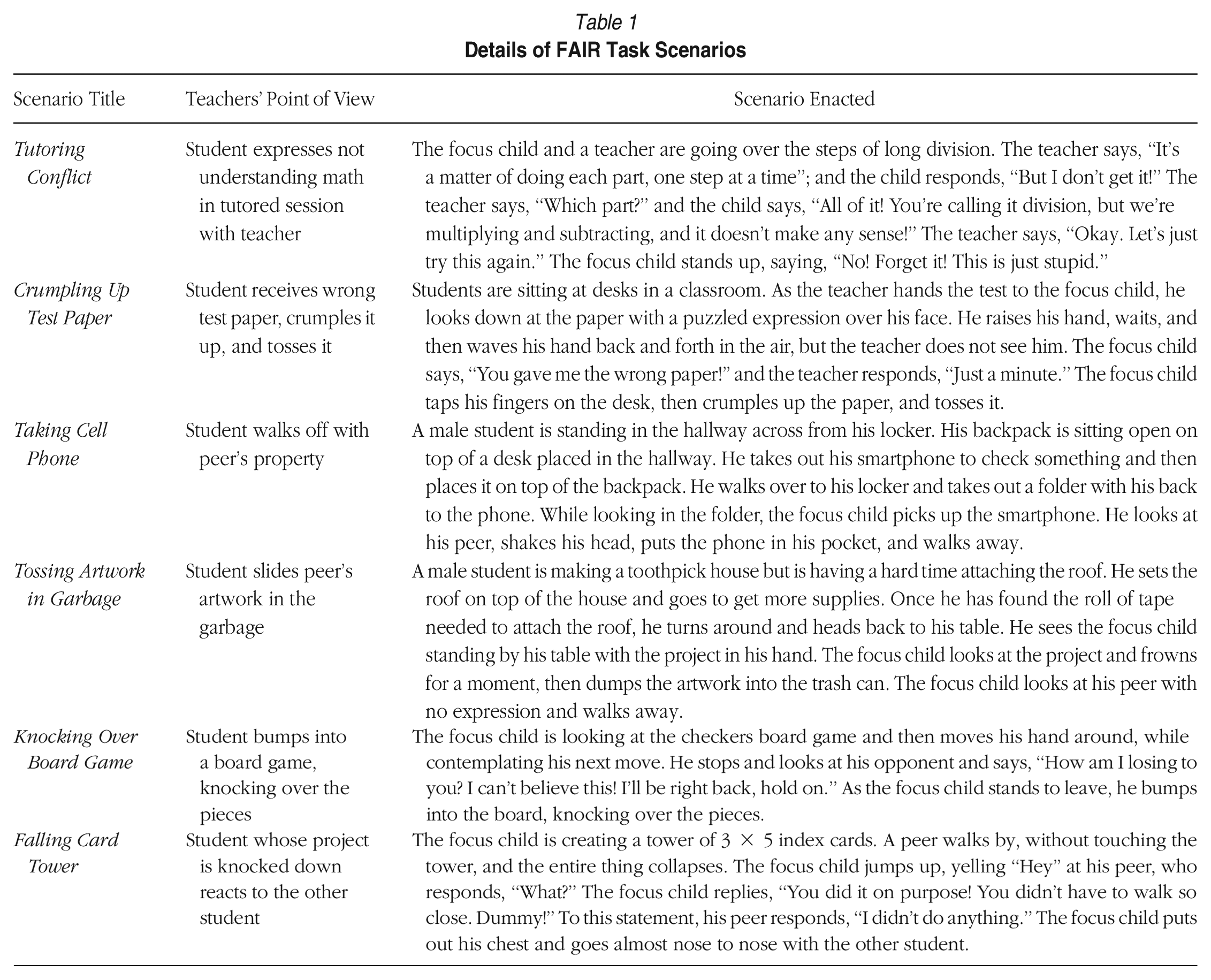
Participants were randomly assigned to watch either a Black or White child engaged in each of the six scenarios: (1) Tutoring Conflict, (2) Crumpling Up Test Paper, (3) Taking Cell Phone, (4) Tossing Artwork in Garbage, (5) Knocking Over Board Game, and (6) Falling Card Tower (see Table 1). Participants observed the scenarios in one of four random orders. Each of the four orders includes three scenarios acted by the Black boy and three scenarios acted by the White boy. Each participant viewed only one set of scenarios, which still allowed us to examine over 80 responses to each Black and White child within each video vignette. After viewing each vignette, participants were asked to write in three sentences or more what they saw in the scenario, which is the specific focus of the current article. They were also asked to write in a second set of three sentences or more how they might potentially respond if this occurred with their students. Participants were also offered the opportunity to comment on the study at its conclusion. Despite the length of the study, 24 students provided comments. One participant identified a technology issue preceding the vignettes, and 18 participants thanked the researchers for their interesting work. Of these, 3 responses were concerned with social justice issues, 5 wrote about how interesting the vignette task was, and 10 sent a general appreciation for the research.
Thematic Analysis
Our team used thematic analysis to search for patterns of (in)equity and to identify themes that emerged in preservice teachers’ responses to six video vignettes of Black and White boys’ emotions and behaviors. Thematic analysis necessitates a systematic, methodical, and critical search for patterns toward the identification of relevant themes. In our search for these patterns, we were guided by two overarching questions: “What are the kinds of attributions preservice teachers make about students’ emotions and their resulting judgments of them?” and “To what degree and in what contexts, are preservice teachers’ attributions and judgments racialized”?
Six Phases
To identify patterns and themes from participant responses, we applied six iterative phases of thematic analysis (Braun & Clarke, 2006). Throughout the process, team members provided checks and balances to ensure that the narratives provided sufficient validation for each code and theme in a manner that (a) augmented procedures of Parker et al. (2012) and (b) adhered to the rigor and trustworthiness criteria identified by Nowell et al. (2017), as described in more detail below.
Phase 1: Familiarization with the data included several initial forays into the data to develop familiarity and to discuss potential codes. One pair of authors explored 20 responses (each choosing random participants’ data) to generate their ideas. An independent set of researchers randomly selected two of the participants’ responses for a deep consideration of the potential meanings and possibilities in the data. The entire team then gathered to consider any patterns emerging from these two sets of preliminary open coding sessions for future application by the coding team. We used an Excel spreadsheet to log all raw data and to detail the team’s progress in collecting and converting raw data to text that could be subsequently analyzed.
Phase 2: Generating a comprehensive set of codes involved reviewing our work from Phase 1 toward developing a codebook. The team used the codebook to begin coding qualitative data from all participants through a deductive coding strategy with assistance from DeDoose qualitative software. The team had monthly and, sometimes, biweekly meetings to engage in peer debriefing and researcher triangulation, which ultimately involved revisions of the document that became our final codebook. The use of Microsoft Word’s Track Changes function produced an audit trail of code generation and reflexive journaling notes. Email exchanges and handwritten notes also provided a complete narrative of all team meetings and peer debriefings (Nowell et al., 2017). The team coded for as many potential patterns as possible and coded extracts of data inclusively. We also coded individual extracts of data as many times as necessary (Braun & Clarke, 2006). At the time of this research, DeDoose was particularly useful as the only Computer Assisted Qualitative Data Analysis Software (CAQDAS) available to the team for working together virtually in real time.
During this phase, Coder 1 coded data from Participants 1 through 60, Coder 2 coded data from Participants 61 through 120, and Coder 3 coded data from Participants 121 through 178. Approximately 2 months later, Coder 2 coded data from Participants 1 through 60 and Coder 1 coded data from Participants 61 through 178. Codes were not mutually exclusive and, thus, multiple codes could be coded for each participant’s response. By the end of this phase, team members reached a consensus regarding the codes ascribed to participant responses to the six video vignettes.
Phase 3: Searching for themes involved collating codes into categories, synthesizing categories into potential themes, and gathering all data extracts relevant to each potential theme (Braun & Clark, 2006; Lichtman, 2012). The team began to consider how different codes and categories might combine and recombine into robust themes. It was crucial at this phase to use a visual representation to help us sort the different codes (Braun & Clarke, 2006). The team developed an initial thematic map (see Figure 1) with four tentative themes.
Phase 4: Reviewing themes involved having the team confirm whether/how the themes worked in relation to the coded extracts and the entire data set. This phase of the analytic process (and throughout) involved a comprehensive inspection of our data, which led to a dynamic and shifting organizational structure. Research team members worked together to make final decisions as to the organizational structure of categories and themes. We revised and replaced initial themes in conjunction with our own notes, comments, and understandings, a process that required revisiting the transcripts frequently with an openness to novel ideas as well as disconfirmation of ideas that were not supported by the data (Parker et al., 2012). The syntheses of codes into themes, including any thematic additions or revisions generated during the process, necessitated rereading all 178 transcripts multiple times. The in-depth reading and lengthy discussions engaged during the process sometimes necessitated dropping, integrating, or reorganizing codes into revised themes whenever one or more of the first four authors argued convincingly that observed qualitative evidence did or did not support the particular theme(s) as initially constituted. At this point, we began to consider revisions to the thematic map to accommodate our increasing recognition of the importance of context and variability in preservice teachers’ attributions of emotions and behavioral judgments regarding the students’ behaviors.
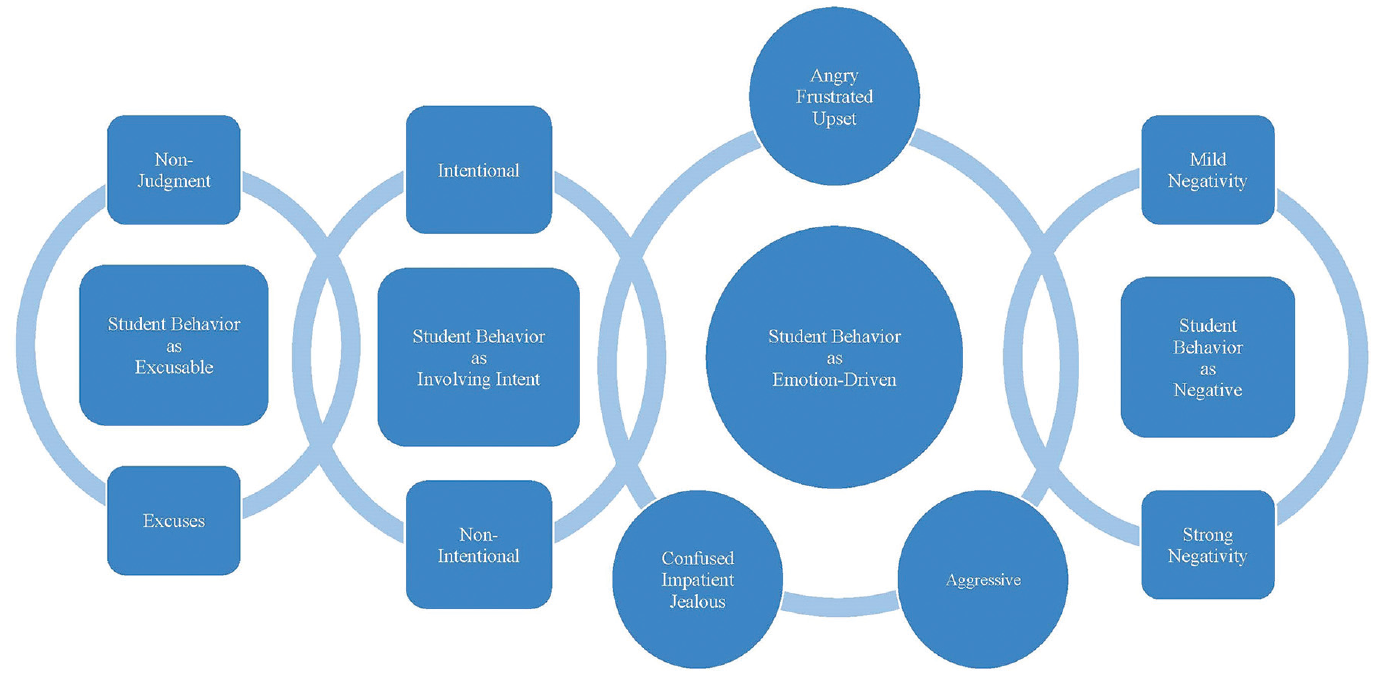
Initial thematic map.
Although the racial identity group membership of the children was obvious to participants, coders were unaware of which responses were a reflection of having seen the Black or White boy enacted vignettes. Knowledge of the boys’ racialized identities as seen by the preservice teachers was unknown to the coders until our team reached the critical analysis stage, which necessitated that information for final comparison. Our goal was to allow any racialization to emerge from the responses, thereby reducing social desirability and limiting any possibility that we inadvertently encouraged participants to respond in a particular way.
Phase 5: Defining and naming themes involved reexamining themes to determine whether participants responded disproportionately to Black versus White children. To facilitate this process and to determine whether and how often racial bias emerged, we revisited the data for patterns of descriptive emotion words that the preservice teachers used to assess emotions and behaviors for Black and White boys. This “analytic organization provided the framework for the interpretive report of the themes and evidence” and accompanying participant data represented exemplars supporting the final two identified themes (centered) with related categories (outside rings) as shown in Figure 2 (Parker et al., 2012).
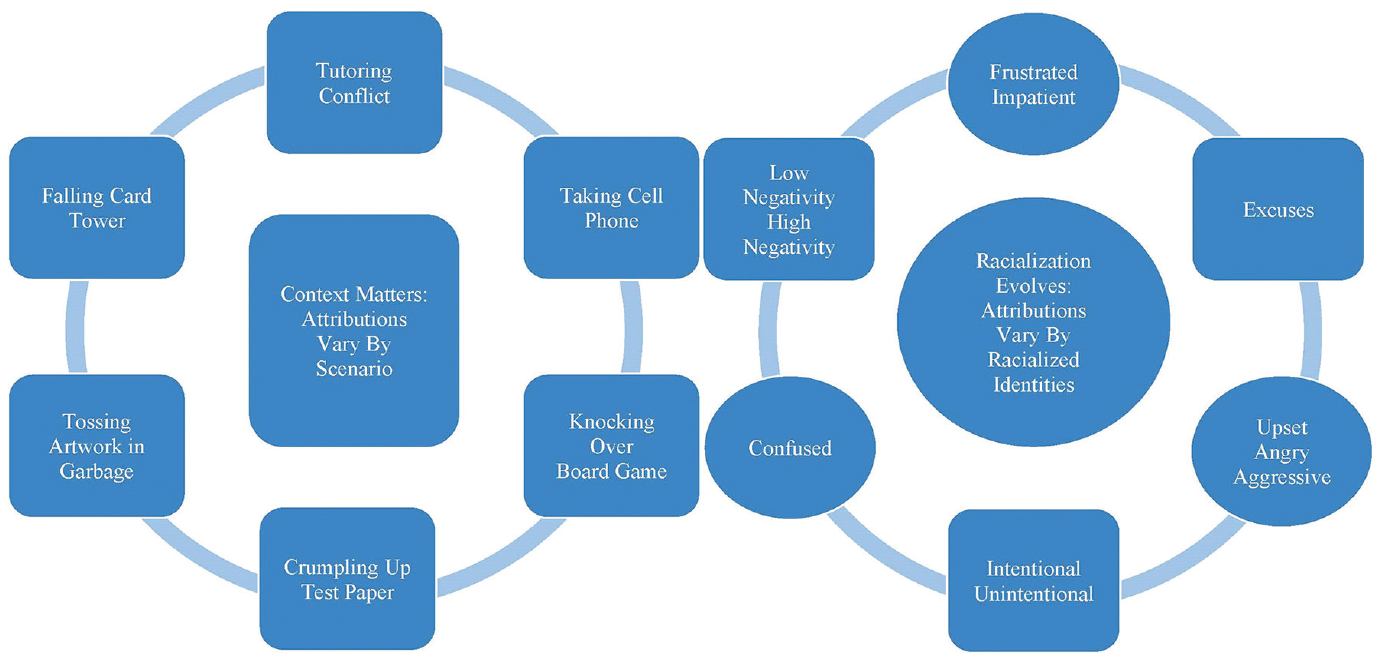
Final thematic map.
Phase 6: Producing the report represented the final element of the analytic process embodied by this article. Our process for identifying the themes reported was established by an iterative, democratic process involving numerous iterations of our coding structure based upon a reexamination of the evidence (Parker et al., 2012). As per Braun and Clarke (2016), the goal of this analysis was to generate sufficient data extracts to demonstrate the prevalence of each theme. To establish trustworthiness for the study, we used Carter et al.’s (2014) suggested avenues for both method and investigator triangulation. Establishing method triangulation requires the use of multiple means of data collection. In the current work, we first consulted the original responses to the vignettes. In terms of investigator triangulation, the purposeful compilation of the research team ensured that the researchers had the collective knowledge and experiences that were important for the development of the research questions and the interpretations of the data. In addition, all of the authors adjudicated coding perspectives and vetted areas of coding disagreement as previously described. In addition, two sets of coders involved in the coding process also operated to triangulate our analysis and strengthen the trustworthiness of our findings.
Results
Our overarching interest was in how racial bias might be manifested when preservice teachers describe children’s behavior in specific school-related contexts. We included multiple contexts for the scenarios because we wanted to examine the heterogeneity of day-to-day emotion-laden classroom events reflecting an academic focus, issues of power and success, and interpersonal relationships. As depicted in our final thematic map (Figure 2), we emerged with the understanding that different contexts do evoke different attributions from teachers. These are further differentiated into specific emotions (circles on the right side of the final thematic map), such as confusion, frustration, and anger; and also judgments (rectangles on the right side of the final thematic map) that include attributions about the child’s behavior in terms of negativity, excusability, and intentionality. These were then found to be racialized within many, but not all, contexts and sometimes in different ways. In this section, we situated the two identified themes and participant response data as exemplars supporting those themes. The two major themes that emerged were (a) Context matters: Attributions about student behaviors vary by scenario; and (b) Racialization evolves: Attributions for emotions and behaviors vary by racialized identity.
Theme 1: Context Matters: Attributions About Student Behaviors Vary by Scenario
Results suggested that the context of the scenario is important for influencing the emotions and degree of negativity that teachers attribute to students’ behavior. Because scenarios involved such different types of classroom contexts, we explored preservice teachers’ attributions about student behaviors within and across scenarios. Qualitative evidence indicated that each context of student transactions activated a unique set of attributions from participants.
Tutoring Conflict Scenario
The Tutoring Conflict scenario activated awareness of four specific student emotions (i.e., frustrated, angry, upset, and confused). In this context, preservice teachers frequently attributed frustration (67%) to the behavior of the focus child. For example, one participant offered the following description: “The child and teacher were doing math. The child became very frustrated. He lashed out because of his frustration.” Another participant explained,
The boy in the grey shirt is very frustrated because he does not get how to do the math. It seems as if he has been struggling before and this was the culmination of his reaction. The boy most likely wants to learn the material but is too frustrated.
Anger was attributed much less often (7%), followed by what preservice teachers described as upset (6%) and confused (6%).
For all scenarios, the coding team developed a code cluster of “negative judgment” and coded scripts that revealed preservice teachers’ negative judgments into “low” and “high” levels. Most preservice teachers (94%) attributed some level of general negativity to the focus child’s behavior. Some of them (53%) attributed a low level of negativity, while 41% attributed a high level of negativity to the focus child’s behavior. An example of a low level of negativity attribution was,
The teacher is attempting to break down a math problem into steps for the student. The student appears distraught as he looks over the problem. He then raises his voice and explains why the steps of the problem do not make sense. He uses “you” language. He then stands up and walks away, abandoning the problem and the teacher.
Another participant attributed a higher level of negativity to the child’s behavior: “Child gave up even though the teacher was very calm and tried to help him. He got up and stormed off and called the math work stupid.” Participants in the Tutoring Conflict scenario did not attribute intentionality or lack thereof (e.g., either describing the action of the focus child as intentional or not intentional) in their responses. However, they did occasionally make general excuses for the focus child’s behavior (14%). One participating preservice teacher excused the focus child’s behavior by attributing it to a lapse in prior assistance:
Despite the strong opposition, it is clear the child is struggling and in need of assistance. The fact that he is easy to give up and walk away tells me it’s possible he has always had problems concerning the material and no one has truly provided the help/assistance put in a way that he can understand.
Crumpling Up Test Paper Scenario
This scenario activated attributions to student behaviors reflecting four specific emotions: impatience (37%), frustration (34%), anger (27%), and confusion (11%). The vast majority of teachers (91%) also seemed to attribute negativity to the behavior of the focus child (34% low-level negativity but 57% high-level negativity), suggesting a slightly more negative assessment compared to the Tutoring Conflict scenario. In one attribution of low-level negativity, one participant explained, “He obnoxiously taps his fingers he calls out meanly that she gave him the wrong paper.” An example of high-level negativity from another participant is reflected in the following statement:
When the teacher told him to wait a moment, he became even more flustered, which tells me he is used to having someone answer him when he beckons. His patience is very thin. He is also a distraction to other students trying to take a test. He does not have much respect for other people’s belongings which he indicates by crumpling up the wrong test because it doesn’t belong to him.
Thirteen percent of participants also generated an attribution of emotional dysregulation in response to the vignette of the focus child crumpling up the test paper. Emotional dysregulation involves the inability to regulate one’s emotions in order to perform socially productive behaviors and return to an emotional baseline (Paulus et al., 2021). For example, one participant explained,
The student realizes he has the wrong paper, raises his hand to tell his teacher. When the teacher doesn’t respond as quickly as he desires he speaks out. When the issue isn’t fixed immediately he begins to huff and crumples his paper.
In another example of an attribution of emotional dysregulation, another participant explained,
The child is very nervous about the assignment he needed to complete. He also must be held to high standards at home for him to act out this way. He is clearly an emotional child because the outburst was not necessary.
Similar to the Tutoring Conflict, this scenario did not activate attributions of intentional or unintentional actions. However, 14% of preservice teachers made general excuses for the behavior of the focus child (Table 3), with one teacher commenting that “He seem[s] like he was scared of something. He seem[s] to be not on task.”
Taking Cell Phone Scenario
Participants rarely attributed any student emotions in this scenario. In fact, the percentages for confusion, frustration or impatience, and anger or aggression were almost nonexistent. However, two-thirds (66%) of the preservice teachers attributed general negativity to the focus child’s behavior (with 30% low negativity and 36% high negativity). One low-level negative attribution from a preservice teacher was, “The boy in the blue wasn’t paying attention to his stuff. The other boy took his phone without any remorse.” An example of a high-level negative attribution included not only more depth, but also substantial judgment:
The boy with the phone never thought that someone would steal it in just a few seconds while he was so close. The focus boy didn’t even think twice about taking it. It was there, and it was his. And his reaction expressed that he had no sympathy for the boy with the phone; rather, it was the boy’s fault that he left his phone sitting out. I feel like the focus boy feels little guilt for his actions. I am shocked at how quickly he made the decision to steal it.
Preservice teachers did attribute intentionality to the focus child’s behavior in this scenario, albeit at a relatively low frequency (7%). In addition to the example that also includes intentionality above, another participant explained,
The boy s[i]ts down his iPhone on his backpack. Then he goes to get something out of his locker and leaves his phone unattended. The boy in the striped shirt intentionally takes the phone that does not belong to him.
Another example is, “The boy in the blue leaves out his phone more like a calculator; the boy in stripe passes by and steals the boy’s phone on purpose and intentionally.” Participants did not offer any excuses for the observed behavior.
Tossing Artwork in Garbage Scenario
This scenario activated only one attribution of emotion about the focus child’s behavior and did so at a relatively low frequency (jealousy, 4%). An example of a preservice teacher’s attribution of jealousy stated, “Boy in the red t[-]shirt is walking around in the classroom. He feels lost about the assignment. Because of that, he is jealous of his other classmate and destroys it.” This scenario also activated preservice teachers’ attributions of negativity substantially, with 28% attributing low negativity and 30% reporting high negativity to the focus child’s behavior. An example of a low-level negative attribution involved a preservice teacher stating, “Then the boy in the dark green shirt comes along and just butts his nose in and take the boy’s toothpick house and throws it out.” An example of high-level negativity attribution occurs in the following statement, which adds depth and further accusation without further evidence,
The focus child seems to be bullying the other child. The reason is unclear and if it is to just this child or if the focus child is a bully to all children. The focus child looks bigger than the other boys, so this might be his way of trying to assert hi[s] dominance over rest of the boys in the classroom.
In this context, more than one third of the participants attributed intentionality to the focus child’s behavior (i.e., 33% with narratives suggesting the student intentionally threw the artwork in the trash). The following two examples represent preservice teachers’ typical attributions of intentions to the observed behavior of the focus child in this scenario. One preservice teacher stated, “The boy in the red could have thrown it away because he was cleaning up. However, by the amount of time he looked at it, he knew it was someone’s project. He intentionally threw it away to be cruel.” Another attributed intentionality similarly,
The child creating the toothpick house went to grab more supplies. The child in the red shirt [explored] that toothpick house and picked it up; waited for the other child to come back; and intentionally throw it in the trash and walked away. The child in the blu[e] shirt was offended and surprised.
Compared to the substantial attributions of negativity and intentionality, only a few (4%) of participating preservice teacher responses reflected an attempt to excuse the behavior. An example of excuse-making is,
The kid in the blue shirt is making a project but is having trouble. The kid in the red shirt is cleaning. When the blue shirt goes to get something to finish the project, the red shirt accidentally throws it away.
In another example, the participant comments,
A student was working on constructing a house. When he was gone to get more supplies, the boy in the green shirt threw away his project. The boy in the green seemed to just be cleaning up and did not throw it away to upset the boy.
Knocking Over Board Game Scenario
This scenario moderately activated teachers’ perceptions of students’ emotionality, with teachers perceiving the child as frustrated (17%), upset (16%), and angry (6%); but not confused, impatient, or aggressive. Emotionality overall was activated more so than in the Taking Cell Phone or Tossing Artwork in Garbage scenarios but less than in the Tutoring Conflict or Crumpling Up Test Paper scenarios. To illustrate, one participant wrote,
The child in the red shirt was playing chess with the child in the blue shirt. When he realized he was losing and will lose, he got frustrated and said he would be right back, but bumped the chess game, ruining it as he left.
An attribution of “upset” as the emotional cause of the observed behavior is reflected in preservice teachers’ responses like this one:
It seems to me that the focus child was upset that he was losing the game. It seems that he wanted to pick a better game that he was better at, so he could win. He also didn’t want to lose to that child he was playing against. The focus child seemed very [u]pset at the thought of losing to the opponent he was playing.
Finally, a few participants also attributed anger, such as in this comment: “The student was angry he lost. He left after messing up the board. It was unsafe for other students in the classroom because of his anger.”
Participants’ attributions in this scenario also reflected negativity (45% noting low-level negativity; and 38% high-level negativity). An example of low-level negative attributions is reflected in the following preservice teacher’s statement:
It was the student’s turn while they were playing chess. When the student realized that he did not have a way to win the game he pretended like he needed to go. When he stood up he knocked the pieces over, so that they are unable to finish the game. He de[m]onstrated a person who is very competitive and has trouble accepting a lose.
A high-level negativity for the scenario is reflected in this example of harsher preservice teacher comments:
… boy was about to lose a game of chess. He seemed to be disappointed in himself and his abilities. He created a strategy to destroy the game before it ended so he technically would not lose.
Preservice teacher descriptions in this vignette were judgmental and partial, with 45% noting mildly negative judgments, and 38% noting moderately negative judgments. This scenario activated the most attributions of intentionality to the focus child’s behavior than any other scenario. Many of the teachers (49%) attributed the behavior to an intentional act, whereas only a few (4%) attributed the behavior to an unintentional act. One exemplar of the attribution of intention was found in the following preservice teacher’s statement:
In this video the focus child was playing chess with another boy. When the focus child realized that he was losing the game he began reacting to the situation. At first, he made a comment saying, he didn’t understand how he was losing to that particular boy. Then the focus child said he would be right back and stood up in a way that intentionally knocked over the chess pieces. This was not an appropriate way to act when losing a game.
Preservice teachers did not try to excuse the child’s behavior in this scenario.
Falling Card Tower Scenario
This scenario activated attributions of three specific emotions to the focus child’s behavior: (a) anger, (b) aggression, and (c) upset. In fact, this scenario activated more attributions of anger (42%) and aggression (30%) than any of the other scenarios. The attribution of anger to the focus child’s behavior is clear in the following preservice teacher’s statement:
One boy was working very hard and concentrating on building his tower. Another boy got up and walked by, accidentally hitting or causing the tower to fall in some way. The boy with the red sleeves first looked disappointed, then quickly turned angry and g[o]t up to confront the other boy, calling hi[m] names [sic] and getting very close to him physically while appearing very angry.
As an example of aggression, one participant commented,
The focus child was working very hard and was focused on his paper tower. He seemed to be calm. The non-focus child walked past the child in the red sleeves, causing the tower to fall over. The focus child leapt up and got all up in the non-focus child[’]s f[a]ce, and became aggressive and mean and probably scared the other kid.
This scenario also activated more attributions of upset (13%) than all but the Knocking Over Board Game scenario (16%). One example of a preservice teacher attributing the behavior of the focus child to being upset stated,
The focus child seems very upset that the other child walked to[o] close to his tower and knocked it down. … He then gets upset and moves in close to the other chi[l]d in an attempt to bully/assert his dominance over the other boy.
Twenty-two percent of participants attributed emotional dysregulation as the focus child’s behavioral response to the fallen card tower. Examples of attribution to emotional dysregulation occurred in statements like the following ones, which intersect with attributions to the emotions of anger and aggression:
The boy in the purple shirt seems to have some anger issues and reacts irrationally. This child overreacted to an interaction with another person in the classroom. This is not a healthy or normal reaction to this type of interaction. He reacts in the first way he thinks to, with anger and aggression. His classmate seems to feel nervous but also re[m]orseful for his action. This doesn’t satisfy the student, he is wrapped up in his own emotions and is having trouble calming down.
The most attributions of general negativity to the focus child’s behavior seemed to occur for this scenario, with 34% attributing low negativity and 62% attributing high negativity. The following two examples reflect preservice teachers’ attributions to the focus child’s behavior through relatively low levels and high levels of negativity, respectively:
When a child feels attacked, some respond with anger to cover up hurt. The child is trying to save face by lashing out. It was most likely an accident. The other boy didn’t seem to be doing anything on purpose, but is being threatened by the boy in the purple. It seems like the boy in the purple is about to beat the othe[r] kid up.
The scenario also activated teachers’ attributions of intentionality, with over one-third of the teachers attributing the behavior of the nonfocus child (the child walking by the tower) to an unintentional act (36%). To illustrate, one participant commented, “A kid got mad at another student for knocking over his tower unintentionally, showing aggressive behavior when it was merely an accident.” Finally, a few preservice teachers (8%) provided excuses for the focus child’s behavior in response to the card tower falling, for example: “… seems to me that this behavior is one that the focus child has imitated possibly by family interactions.”
Discussion of Theme 1: Attributions Vary by Scenario
With regard to emotions, attributions of frustration were noticeably stronger in the Tutoring Conflict and Crumpling Up Test Paper scenarios than the others, although Knocking Over Board Game scenario also included some frustration. Preservice teachers seemed to notice children’s confusion to a much lesser degree in these situations, but they did attribute a relatively low frequency of confusion to the children’s behavior in the Crumpling Up Test Paper and Tutoring Conflict scenarios. Perceptions of hostility (the group of emotions including being visibly upset, anger, and aggression) were more frequently activated in the peer contexts of the Falling Card Tower and the Knocking Over Board Game scenarios, with the Tutoring Conflict context also evoking attributions to those emotions to some degree.
With regard to attributions of negativity, preservice teachers attributed general negativity to observed behaviors in each scenario ranging from 58% to 94%. Even the scenario activating negative attributions the least (Tossing Artwork in Garbage) still involved more than one-half of the teachers making negative attributions to the children’s behaviors. Interestingly, intentionality was relevant in only four of the scenarios (Taking Cell Phone, Tossing Artwork in Garbage, Knocking Over Board Game, and Falling Card Tower). Excuse-making emerged for a different set of scenarios, but by relatively fewer teachers (Tutoring Conflict, Crumpling Up Test Paper, Tossing Artwork in Garbage, and Knocking Over Board Game). These results support Theme 1, which highlights that not all misbehaviors are equal, with complex sets of attributions occurring for different types of misbehaviors.
Theme 2: Racialization Evolves: Attributions for Emotions and Behaviors Vary by Racialized Identity
Our next theme explored how racialization might be involved in preservice teacher attributions about student behaviors in one or more scenarios or contexts. We adopt Omi and Winant’s (2014) definition of racialization as “the extension of racial meaning to a previously racially unclassified relationship, social practice, or group” (p. 111). Thus, this second theme reflected how racial bias likely plays a role in teachers’ responses to students’ actions within the context of the particular scenarios. Because the preservice teachers viewed either the Black or the White child in the same context and this was randomly assigned, we could examine the ways in which participants differently described the children enacting the same behaviors across the color line. Because different contexts evoked different attributions as reported above in Theme 1, we focused on the emergent sets of emotion-related attributions in the Tutoring Conflict, Crumpling Up Test Paper, Knocking Over Board Game, and Falling Card Tower scenarios. In the same way, for behavioral judgments, we focused on negative judgments for all the scenarios but intentionality and excuse-making in only the relevant scenarios.
Were the Emotion-Based Attributions Racialized?
Students’ appearance of confusion may activate teachers’ responsibility to resolve the situation, as teachers may assume that children in school should understand what is happening and how to proceed; and when students are confused, teachers may feel obligated to guide or intervene. Frustration is the combination of not understanding something but may also include being upset or annoyed at being blocked, and anger/aggression is not usually deemed as acceptable in school. We focused on these attributions because they suggested increasing evaluation of the child’s emotional state and, to some degree, reflected a shifting role for the teacher from sympathy to directing consequences toward the child. Table 2 offers examples of how these responses were coded and categorized for emotion attributions with a participant’s example for a child of each racialized identity group.
Emotion Category Codes of Preservice Teacher Perceptions
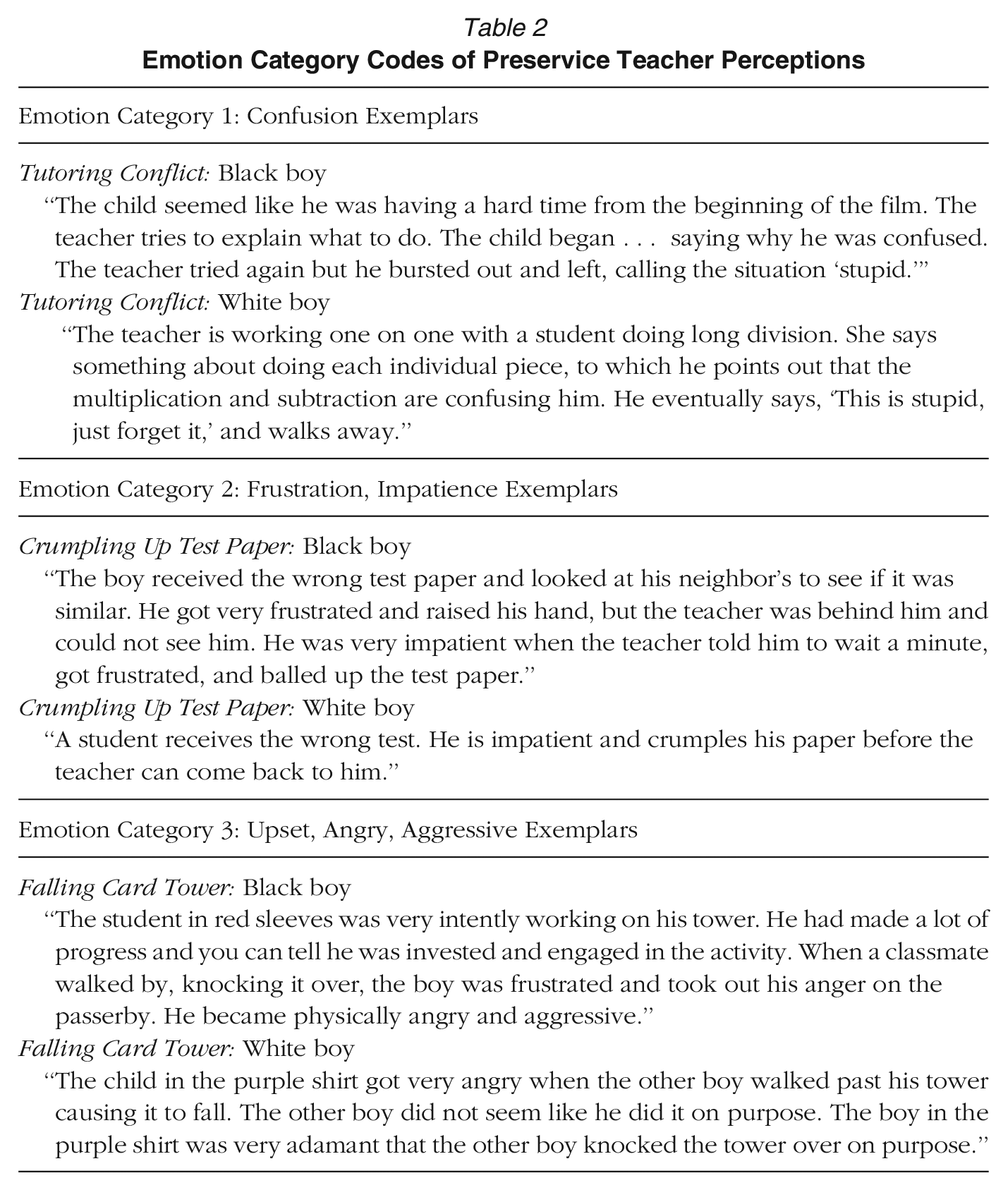
Although confusion was not identified often, it did emerge in the Tutoring Conflict and Crumpling Up Test Paper scenarios. For the Tutoring Conflict scenario, preservice teachers perceived the White boy (7%) as only slightly more confused than the Black boy (6%); but for the Crumpling Up Test Paper situation, the White boy (17%) was perceived as substantially more confused than the Black boy (4%). This was also surprising to us as the child in the Tutoring Conflict scenario states clearly that he does not understand math; whereas the child in the testing situation clearly states, “You gave me the wrong test!”
The greater number of attributions of the White boy as confused is especially interesting when viewed in light of the rates of frustration and impatience in these two contexts. For the Tutoring Conflict scenario, the White boy was perceived as frustrated or impatient (62%), but substantially less so than the Black boy (72%). A similar result emerged for the Crumpling Up Test Paper vignette, with the White boy (34%) perceived as less frustrated and impatient than the Black boy (41%). In the Knocking Over Board Game scenario, teachers did not identify confusion as an issue. However, frustration was noticeably more apparent for those teachers in the White boy (26%) than the Black boy (9%).
As we move into the cluster of emotion expressions that often involve serious consequences by teachers and, specifically, the visible expression of being upset, anger, and aggression, we can examine both the summed ratings and how descriptions of the behavior that might become increasingly racialized as preservice teachers judged the expressions more intensely. Only one scenario activated ratings of aggression, and for this one (Falling Card Tower), the ratio shifts to the Black child receiving charges of active distress, anger, and aggression. In this scenario, preservice teachers did not think the child was confused or frustrated—neither of these terms emerged at all. Rather, the teachers reported the composite more often for the Black boy (73%) than the White boy (66%), as demonstrated in Table 2. Moreover, this type of racialization became further apparent when examining the shifting usage of the three types of responses within the upset, angry, and aggressive cluster. The percentages of teachers describing the children as upset were 10% for the Black boy and 16% for the White boy, as being angry were 43% for the Black boy and 42% for the White boy, but as being aggressive as 33% for the Black boy and 27% for the White boy. As teachers are likely to respond to children they perceive as upset versus angry or aggressive with low levels of harshness, the shifting of teacher responses that grant the White boy the benefit of the doubt for dysregulated emotion and behavior and the attribution of blame and responsibility to a Black boy perceived as dysregulated is compelling.
In sum, for these scenarios, as the emotionality moves from something that is less negative/benign for the child to something more negative/inappropriate, the ratio of term usage shifts toward the Black child in each of these contexts. This was evident in the frequency of terminology suggesting confusion versus frustration versus anger/aggression for Black and White boys, and racialization was also evident even within the upset/angry/aggression cluster when we focused on the scenario that most activated these assessments (boy responding to another boy when his carefully constructed card tower fell).
Were the Behavioral Judgments of (Mis)behavior Racialized?
The pattern of racialization in behavioral judgments is complex. When developing the coding manual, we noted that negative judgments varied in their intensity and so coded them as mild or moderate. In the one scenario (Taking Cell Phone) in which the child’s behavior actually had the potential of criminal charges, but the behavior could also have been seen as “just fooling around,” the results reveal stark inequity. Preservice teachers clearly and specifically issued racialized negative judgments, with substantially more mild and moderate severity for the Black boy (44% and 44%, respectively) compared to the White boy (19% and 27%, respectively; see Table 3). In the two scenarios of Crumpling Up Test Paper and Knocking Over Board Game, the mild versus moderate distinction continued to be instructive, although racialization seemed limited. In all three cases, the percentage of mild negative judgments of the White boy was greater than for the Black boy, but the moderate level of judgment of the White boy was equivalent to or less than for the Black boy, suggesting that milder judgments are applied to White boys’ behavior, whereas harsher judgments may be rendered toward Black boys for the same behavior. It should be noted that, in the Falling Card Tower scenario, we found a very slight reversal of this pattern in preservice teachers’ comments concerning mild and moderate negative judgments (35% and 60%, respectively, for the Black boys; and 34% and 64%, respectively, for the White boys).
Behavioral Judgment Category Codes of Preservice Teacher Perceptions
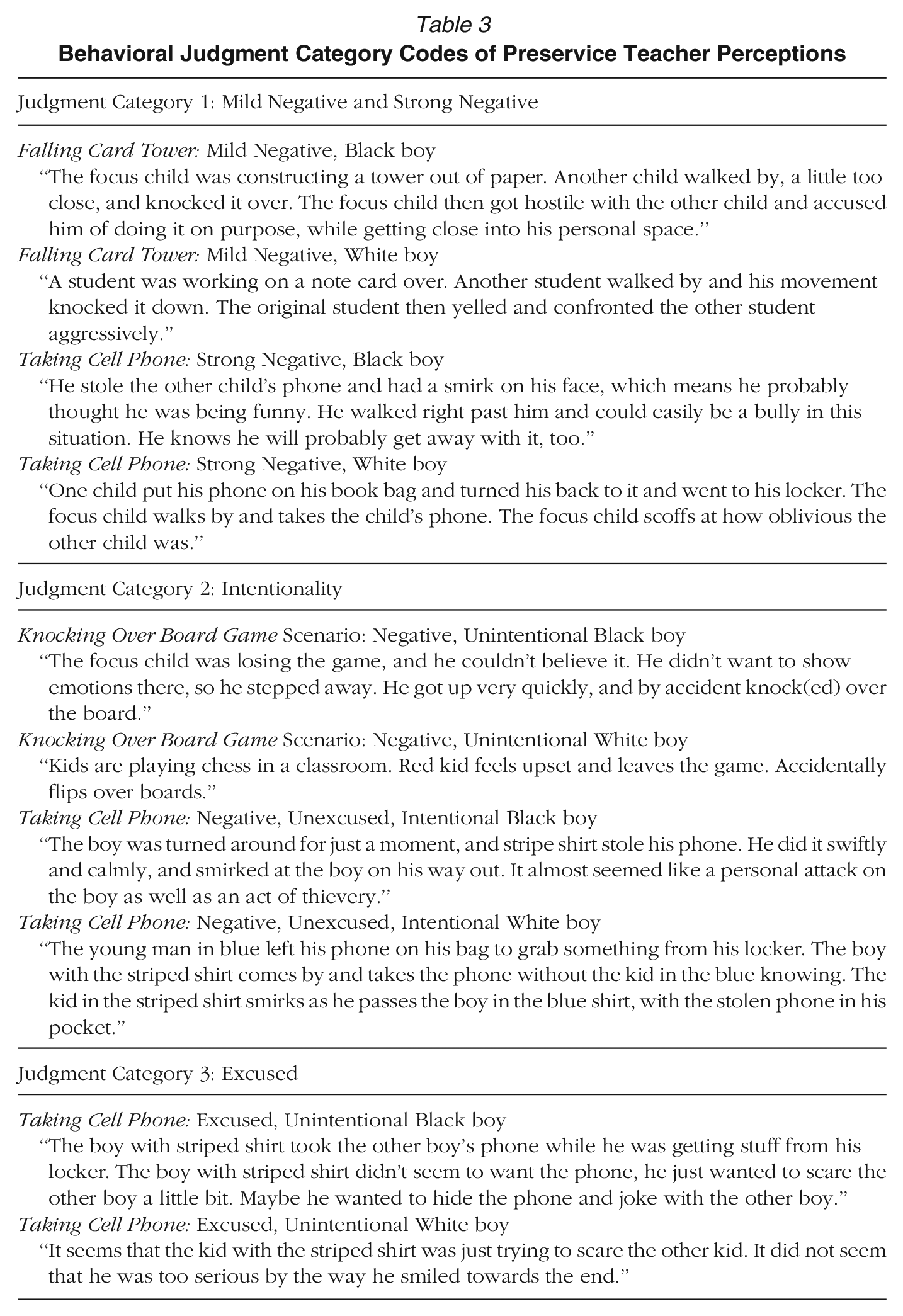
When we turn to intentionality and excuse-making, that very same context in the Falling Card Tower does clearly influence preservice teachers to respond with substantially more judgments of unintentional behavior for White boys (44%) than Black boys (27%), and twice as many excuses for the White boys (10%) than Black boys (5%), suggesting that this scenario activates different types of judgments for the Black and White boys. With regard to intentionality in other scenarios, the comments regarding what are considered to be noncostly scenarios are similar by racialized identity or implicate the White boy as intentional in behavior (Knocking Over Board Game, with 48% vs. 50%; and Tossing Artwork in Garbage, with 28% vs. 38% for the Black vs. White boys, respectively). These were the behaviors seen by teachers as least problematic, however. In contrast, in the Taking Cell Phone scenario, which is the type of event that could actually lead to a suspension, the behavior was judged as intentional for Black boys nearly twice as often as for White boys (9% vs. 5%).
Excuse-making also shows variability in that academic frustrations in teacher-related situations showed similar rates by racialized identity or slightly stronger rates for the Black boy’s versus the White boy’s behavior being excused in some way (15% vs. 14% in Tutoring Conflict and 16% vs. 11% in Crumpling Up Test Paper). When peers were involved, however, making excuses was especially frequent on behalf of the White boy as compared to the Black boy (Tossing Artwork in Garbage 6% vs. 3%; Card Tower 10% vs. 5%). Of interest in the Tossing Artwork in Garbage scenario is the increased frequency of attributing intentionality to the White boy, yet also making excuses much more readily for the White compared to the Black boy.
Discussion of Theme 2: Attributions Vary by Child’s Racialized Identity
For most scenarios, racialization was clear in preservice teachers’ descriptions. More specifically, preservice teachers described the actions of Black boys as demonstrating more negative emotions and behaviors than did the White boys. Given the randomization that we applied, such that for each vignette an equal number of preservice teachers saw the vignette with a White boy enacting the behavior and a Black boy enacting the behavior, it seems most likely that these negative emotions and behavioral attributions reflect the racial stereotypes and biases of the teachers.
With regard to emotion attributions, we found an important pattern in how preservice teachers interpreted Black and White students’ emotions as negative in the three clusters of key emotion-related descriptors: (a) confused; (b) frustrated and impatient; and (c) upset, anger, and aggressive. Emotions that reflect confusion, which can be an appropriate response to complex learning situations, appear to be applied relatively more to the experiences of White students; whereas increasingly negative and less “appropriate” emotions of impatience, anger, and aggression appear to be applied more readily to Black students relative to White students. To our knowledge, the ways in which preservice teachers apply a racialized understanding of the emotional states of their students are entirely new; and these results, with a substantive number of preservice teachers, suggest an important opportunity for reflection by adults working with students in the school context.
The findings of our thematic analysis also suggest that in all scenarios, teachers provided at least some negative judgments in their explanations of students’ behavior. In three of the scenarios, however, preservice teachers provided some racialized responses indicating a high level of negative judgments more often about Black boys, with a particular disparity in situations linked to confrontation and potential for criminality. These findings support previous literature that adults interpret Black and White individuals’ behaviors differently (e.g., Hill, 2004; Hutchings & Haddock, 2008; Tyson, 2003). Similar findings observed from the extant literature document that adults make more negative attributions even when shown similar faces or behaviors for Black as compared to their White counterparts (Aronson & Steele, 2005; Halberstadt, Castro, et al., 2018; Halberstadt et al., 2022; Rowley et al., 2014; Weir, 2016). Yet our findings do not simply replicate previous research because we include (a) six different scenarios which allow us to look across multiple school-related contexts, (b) qualitative data rich enough to support the assessment of multiple types of attribution involving emotions and judgments, and (c) White and Black actors enacting the same six scenarios with similar/same behavior in as many ways as possible. These methodological contributions allow us to note that racialized descriptions seem more likely to occur in certain contexts, particularly those associated with peers and with the potential for severe consequences. Additionally, preservice teachers were more likely to regard the (mis)behavior as intentional in certain scenarios, such as the peer conflict in the Falling Card Tower vignette, when Black children are involved. Teachers viewed Black boys as both more deliberately aggressive and/or unable to control their emotions in that vignette but also in the vignettes involving academic distress (Tutoring Conflict and Crumpling Up Test Paper). These findings fit with the preexisting racialized stereotypes of Black Americans, especially Black males, as angry and criminal (Weir, 2016). Thus, preservice teachers seem to perceive more animosity in the Black child’s actual behavior and intentions across a number of classroom contexts. This finding supports the notion that “teachers are people too” in terms of exhibiting “racial bias” like other U.S. adults (Starck et al., 2020, p. 273). In fact, the finding aligns with results from the past two decades that reveal disproportionately negative perceptions of a Black person’s facial expressions or behaviors (e.g., Halberstadt, Castro, et al., 2018; Hugenberg, 2005; Hugenberg & Bodenhausen, 2003). Our qualitative findings align with the results yielded from these quantitative studies, revealing that preservice teachers also tend to make more negative attributions and ascribe more intentionality to Black boys, particularly in scenarios with the highest threat and potential criminality assessment (i.e., the Taking Cell Phone scenario). For example, as alluded to in the introduction, (mis)attribution of Black children’s emotions and behaviors has been offered as an explanation for how they are treated by the juvenile justice system (Lowery & Burrow, 2019).
Relatedly, when preservice teachers dismiss student behaviors, they may offer more excuses for White children, particularly in peer-related situations (e.g., the Falling Card Tower and Tossing Artwork in Garbage scenarios). This is also interesting because the examples included in Tables 2 and 3 reflect greater text written about Black than White boys. This suggests that preservice teachers are working harder to understand Black students, yet they may continue to apply attributions that do not serve their students well.
Altogether, these findings align with culturally-framed attribution theory in that the Black boys seemed to be more likely to be perceived by teachers in terms of their status as racial minorities and, in this way, became open to receiving accompanying bias that teachers may not even be aware of. Given that such perceptions are grounded in beliefs rather than actual data, unsubstantiated explanations for and treatment of individuals in particular racialized groups may be especially likely.
Conclusions
Summarizing Thoughts
First, we note that attributions made by the preservice teachers were surprisingly frequent. The preservice teachers were asked to report what they saw in the scenarios. They were not asked to interpret behavior or fill in invented events preceding what was shown in the vignettes. Nevertheless, overinterpretation seemed to be almost irresistible, with over half of the preservice teachers making at least some type of attribution in the least evocative vignette and almost all making at least one attribution in the most evocative vignette. A few of the teachers asked why the children behaved as they had in their written texts, but those teachers also filled in answers to their own questions with inferences and assumptions that were not actually available to them. Although we were interested in learning about the types of attributions that the teachers would make, we were surprised by how very many teachers embellished the stories and added substantive information about what might or might not have happened. We had hoped for more curiosity from the preservice teachers regarding the motivations and thoughts of the students, yet interest in and openness to the minds of students were so infrequent that developing such thematic codes was not possible.
Second, the diversity of the scenarios turned out to be a strong asset of the study. We found that teachers perceived different amounts and types of emotions across the vignettes and seemed to have more sympathetic reactions to distress associated with formal and informal learning moments and their role in student frustration but greater judgment of students’ potential misbehavior with peers. Although we only had two teacher-related vignettes and two peer-related vignettes, our results suggest that the preservice teachers seemed to take potential anger on the part of the child toward them more in stride than potential anger at peers; further exploration of this pattern might be warranted with a greater number of vignettes per type of situation. Our results strongly suggest the importance of myriad scenarios in studies as the contexts activated different kinds of attributions by the adults in the classroom. Our results are supported by theoretical work that suggests that perceptions of behavioral and social functioning may influence teacher decision-making differently than perceptions of emotional functioning (see Scardamalia, 2017), especially when race is considered. In our study, the different contexts also seemed to evoke differing amounts of and, indeed, kinds of racialized interpretations.
Third, with regard to those racialized interpretations, attributions of Black boys as more challenging and disruptive than White boys were certainly present in our data. It is worth revisiting the evidence from this study that showed that preservice teachers tend to see White children as confused in the Tutoring Conflict and Crumpling Up Test Paper academic-related scenarios more so than Black children. Attributing higher frustration to the Black child but higher confusion to the White child presents an important contrast. Teachers may respond to confusion more productively because it may be anticipated and the source of the problem may be easier to pinpoint and address. The finding of racialized response bias related to confusion is crucial, as all teachers train to identify and respond to confused learners. It is commonplace to assume that teachers’ perceptions of confusion lead linearly to attempts to resolve the academic problem that instigated those feelings. Yet our findings suggest that teachers bring in their own biased conceptions of confusion without awareness of the racialization of those conceptions in their classroom practice. Any racialized responses that misinterpret confusion as hostility, impatience, frustration, or even anger seem more likely to feed into a negative consequence, rather than teachers trying to reflect upon and reduce the cause. Hence, perceiving a Black child as frustrated or impatient rather than confused might lead a teacher to provide negative consequences for letting emotion overwhelm the thinking process. The unchecked racialized response bias of teachers can render deleterious possibilities for Black children.
It is already well documented that Black students are frequent targets of generalized attribution biases, which can have adverse effects on academic identity, motivation, and learning outcomes (Graham, 2017, 2020; Heider, 1958; Pettigrew, 1979; Weiner, 2010). In the current study, we center preservice teachers’ conceptions of the emotion-related behaviors of Black versus White students and the negativity and intentionality judgments that they apply to students’ behaviors. In doing so, we identify some of the very specific domains in which these attribution errors occur. Indeed, our results may reflect the tendency of teachers to interpret Black children’s expressive behaviors as disrespectful rather than frustrated or otherwise distressed (Rowley et al., 2014; Tyson 2003). Quantitative studies also indicate that preservice teachers reflect bias in terms of attributions of Black children’s behavior as angry, even in situations in which the children are, in fact, displaying a different emotion (Halberstadt, Castro, et al., 2018; Halberstadt et al., 2022). Teachers’ implicit and explicit biases may further exacerbate racialized emotion recognition biases (Halberstadt, Castro, et al., 2018; Halberstadt et al., 2022). Moreover, racialized emotion biases may reinforce existing views of Black students as emotionally dysregulated.
Both preservice and in-class teachers are likely aware in a very broad way that they could be prey to attribution bias; but if they do not know the pathways by which these biases slip into their judgments and subsequent decisions about students, they are doomed to perpetuate such bias on their students. Our study contributes substantially to the opportunities for teachers to reflect on and reduce the very specific racialized attributions that seem so prevalent. To our knowledge, no previous study has specified the different contexts in which Black children may be especially at risk or specified these nuanced and sometimes co-occurring emotion-related and judgment-related attributions. Our study reveals some ways in which emotion terms are differentially applied, with more benign and academically appropriate emotions, such as “confused,” applied relatively more to White compared to Black boys; while negative emotions such as “angry,”“threatening,” and “aggressive” appear to be inequitably applied to Black boys. Combined with attributions of intentionality and excuse-making, which also seemed racialized and differently racialized across different contexts, these results invite preservice teachers and in-class educators to reflect in more nuanced ways on the kinds of emotion-related and behavioral attributions they apply differentially by racialized identity.
These attributions are nontrivial as they may lead to cascading consequences, with harsher and more frequent punishments for Black students as compared to their White peers. Such racialized attributions, which are subtle in the teachers’ experiences, but damning for the students, may also help to explain why Black children are overnominated and undernominated, respectively, for special and gifted education classes (e.g., Ford, 2013; Skiba et al., 2011) and are at increased risk for experiencing other academic inequalities and negative classroom climates (Chin et al., 2020; Pena-Shaff et al., 2019).
Finally, it is worth noting the methodological protections created in the study that strengthen confidence in our findings. Given the randomization that we applied, equal numbers of the preservice teachers saw the vignette with a White boy enacting a behavior versus a Black boy enacting the same behavior. Further, as every attempt was made to equalize the script, emotional and behavioral displays, and intensity of expressions, it cannot easily be claimed that there are any “true” differences between the behaviors of the Black and White boys portrayed in the vignettes. Additionally, readers may wonder whether some of our work is indicative of “isolated incidents,” a phrase commonly used when questions of racialization emerge. Our triangulated data analysis suggests that multiple “isolated incidents” that vary in severity according to the context, the racial identification of observed students, and the severity of the threat perceived by the teacher are indicative of a complex, but real, pattern of racialization. Moreover, given the large number of possible daily events in which teachers can make varied attributions and then act upon them, differential treatment for Black and White students can accumulate within days, weeks, and months of learning in a classroom. Because children also learn about themselves and others through observing others’ experiences with racism, these kinds of racialized attributions have the capacity to affect all students in the classroom (Seaton, 2020).
Limitations and Future Research
Like other qualitative studies, the purpose of this study is not to seek generalization, but to focus on particularity. Although our sample is reasonably large for a qualitative study, we studied preservice teachers learning at three large, public universities in one general region of the United States. Race-related consciousness is likely affected by region; educational centers likely vary as well in the curricular attention they focus on racial- and social-justice matters. The generalizability of these findings over time might also be questioned as the chronosystem is changing quickly and in multiple and dynamic ways. Data were collected at one point in our national history (in 2016–2017) as the Black Lives Matter movement gained traction among White young adults. However, the study also occurred well before many marches and civic involvement, well before COVID and the stark evidence of resulting educational inequities that emerged from the pandemic, and also well before the backlash activated by political movements supporting White supremacy in various guises. Whether the racial awareness of preservice and in-class teachers has improved in the resulting years or not, the specific mechanisms for bias are still being uncovered in this research and other studies. We contribute an awareness of the racialization of emotion-related bias in academic settings as well as ways in which behavioral judgments of negativity, intentionality, and allowances (excuse-making) are differentially invoked by educators and differentially applied by students’ racialized identity.
We also note that, with regard to positionality, the research team was racially diverse and spanned a wide range of ages, backgrounds, and educational disciplines. Of course, another set of five authors could provide a different set of insights or a richer analysis. However, various forms of saturation and triangulation of themes have hopefully provided some confidence in these results. Therefore, future research could examine educators’ racialization of students’ emotions and behaviors in other geographical and geopolitical regions. Researchers are also encouraged to examine current preservice teachers’ perceptions and implicit biases, especially as numerous civic movements and the COVID pandemic continue to influence us and intersect with race. Moreover, research teams with broad ranges of racialized identity, ethnicity, age, gender, schooling experience, and discipline will continue to contribute to a more complicated, multilayered, and less-essentialized interpretation of preservice teachers’ racialization.
In our study, we employed a qualitative research design that focuses on preservice teachers’ documentation of students’ emotions and behaviors. Studies using research designs from other theoretical and methodological traditions would strengthen the arguments that we make in the current study. Future research could investigate the robustness of our assertions by studying the intersection of preservice teacher perceptions of student behavior, emotion recognition, and race through the lens of critical race theory, including innovative scholarships on critical race using mixed-methods design (DeCuir-Gunby et al., 2018) and quantitative research methods (e.g., QuantCrit; Garcia et al., 2018). In situations of shared racial identity, “teachers may assume, incorrectly, that they know what is going on in students’ minds. They may over-rely on or misinterpret certain cues or signals” (Plaut, 2006, p. 413). The future application of the video scenarios, available from the authors, can support deeper explorations for detailed thick, rich description via in-depth interviews of selected teachers from diverse racial identity groups. Such explorations provide opportunities to learn more about how these attributions are intertwined with each other and with teacher practices that support racialized assumptions and, in this way, can potentially also learn how they can be interrupted.
Implications for Teacher Education
In terms of practical implications, our results imply that many beginning teachers may be entering the classroom inadequately prepared to work with children from racially minoritized groups, but also possibly with emotion-related biases towards Black children (Lin et al., 2008). Evidence supporting the point that many teachers begin their teaching careers with racialized views of students’ emotions and behaviors suggests that a focus on emotions should be included as part of any antiracist education for beginning teachers. This type of programming could begin with training to increase novice teachers’ awareness of their own biases (S. A. Hughes & Pennington, 2017) with regard to emotion- and race-related attributions and their readiness to address these issues effectively when they enter the classroom and work to create a classroom grounded in equity and justice. Teachers’ awareness of their racial biases and how they factor into the quality of their interactions and practices with students might also motivate teachers to engage in antiracist practices (Legette et al., 2023). Strategies could include implementing a prejudice habit-breaking protocol (Devine et al., 2012) and/or providing opportunities for learning through gaming tools (see Symborski et al., 2017).
Evidence for the need to implement such innovative research-based strategies to address the intersection of emotions, race, and bias is literally growing as we write. In fact, in the newest work we are aware of, a separate sample of teachers who watched these vignettes reported being 71% more likely to feel anger with Black students, compared to White students for the same misbehavior. Additionally, teachers’ anger mediated the association between students’ racialized identity and teachers’ discipline practices (Legette et al., 2023). These findings, when viewed along with those reported in the current study, imply a need to integrate current understandings of behavior- and emotion-related racial biases. This integrated approach may provide more tools for teacher education and professional development programming to address how context matters with regard to how racialization can evolve among preservice and novice teachers.
We also point to the population in this study, in that 50% of the participants reported that they were moderately to strongly liberal in their political orientation, whereas only 16% of the participants reported being moderately or strongly conservative. This suggests to us that we cannot assume that political orientation protects against racialized emotion biases. In addition, the vast majority of the students were in their 3rd or 4th year of college, suggesting that teacher education programs may need to expand their curriculum to include training of emotions in the context of a social justice orientation and, perhaps, include these opportunities much earlier in the teacher preparation process. There is also the issue that teacher training and professional development programs do not always provide opportunities for the enactment of the practices that are being taught, which may be required to establish long-term effects and sustainable change (Romijn et al., 2021). Accordingly, our results could encourage future research to consider how the effects of teacher training during the preservice years can be sustained through ongoing professional development aimed at promoting the development of race-conscious pedagogical skills and practices that contribute to an equitable learning experience for all students.
Conclusion
In sum, when interpreted all together, our findings speak to the potential for preservice teachers’ frequent misperceptions of Black children’s emotions, behavior, and intentionality. Such misperceptions increase the possibilities for racialized classroom experiences for these students with heightened potential to contribute to disproportionality in teachers’ disciplinary responses to Black students (Skiba et al., 2011). Because these vignettes were created for the study and every attempt was made to equalize behavior across the actors, it is unlikely that there is somehow a “kernel of truth” in the descriptions and decisions of the teacher participants; instead, the question can be directed next to why preservice teachers are prey to these types of attributions and how teachers can avoid these misapprehensions.
The two themes identified in our study coupled with the data exemplars provide evidence to confirm racial bias as influencing how preservice teachers respond to the actions of Black versus White boys in school settings. Moreover, our findings suggest that not only does context matter in the matrix of racialization (Parker et al., 2012), sometimes it can pivot how racialization influences teacher responses to observed student behaviors, particularly when those behaviors have clear triggers. By including a variety of contexts in our study, it can be seen that teacher attributions do vary across contexts, and in different ways, but almost always in favor of the White boy and to the detriment of the Black boy. Indeed, our findings suggest that a full understanding of racialization requires consideration of contexts and that racialization involving emotion-related behaviors and negative judgments seems to evolve within those contexts.
Footnotes
Note
Funding from the William T. Grant Foundation (Grant 184516 to Amy G. Halberstadt, Pamela W. Garner, and Sherick A. Hughes) is gratefully acknowledged, as well as the many undergraduate and graduate students who helped to collect data for this project.

S
W
P
K
A