




Abstract
Education research increasingly conceptualizes how social interactions and contexts of public schools replicate practices found in prisons. Yet prison-schooling is often left out of education research. Concurrently, prison-schooling is where we educate a disproportionate amount of multiply marginalized youth, specifically disabled Girls of Color. The lack of attention to prison-schools has limited how teaching in youth carceral facilities can be examined for its challenges and supports of disabled Girls of Color. Centering the girls’ words from class observations, field notes, and interviews, this study describes and intervenes in dehumanizing and (de)socializing mechanisms in prison-school education. We explore attempts and impacts of countering prison-school education through a sociocritical literacy course infused with an abolitionist praxis. We end with discussion on the limits of countering prison-school through courses alone, suggesting abolition across multiple scales instead.
There are … a number of young girls whose moral tendencies are bad. … Many of these could be rescued from the life they are leading … if there was only some institution which they could be placed and where they could be surrounded by good influences … [and] be guarded from temptation, and their highest interests cared for. —William G. Brock, Superintendent of the Police, Washington, D.C., 1882.
Calls for increased funding for the prison-school occurred as early as 1896, yet dismal conditions remained. In 1936, Senator Royal Copeland said he would “send a girl to hell before I send her to the National Training School for Girls” (Kelly, 2016, para. 10). Eleanor Roosevelt, then–first lady of the United States, also visited the prison-school in 1936 and said, Never have I seen an institution called a “school” which had so little claim to that name. Buildings are unfit for habitation—badly heated, rat infested, with inadequate sanitary facilities. … The girls are without an educational program or a teacher, children walled in like prisoners in spite of ample grounds and beautiful views, no … treatment of these unfortunate children who at such an early age have found the social conditions of the world too much to cope with—practically nothing but incarceration for a juvenile delinquent! (Kelly, 2016, para. 2)
Black 3 girls consistently made up between 85% to 95% of the population in the prison-school (Miller, 2019). For example, in 1903, there were 73 Black girls and 3 white girls (Brown, 1903). Still, integration was unusual since many of the Black girls were sent to adult or segregated youth prisons while white girls were often sent to foster care, industrial schools, or private institutions (Brown, 1903). Consequently, the few white girls there had committed severe crimes, while the only place for any Black girls to go in D.C. was the “barbaric National Training School” (Miller, 2021, para. 7). In 1941, the school became segregated and then was only for Black girls.
Black disabled girls were always part of prison-school, yet not specifically counted. However, their existence can be found in the archives. For instance, in the D.C.-based newspaper Evening Star from 1905, the superintendent told this story about an uprising: The cause of the riot which followed a day later was the harsh treatment of Hattie, an afflicted little colored girl, who was brought back to the institution in irons on a public street car, placed in the underground dungeon, with the irons yet upon her wrists and kept there all night in this condition, with a single blanket between her and the hard floor. (Russell, 1905, p. 8)
As conditions deteriorated at the National Training School for Girls, incarcerated Black girls continued to resist the appalling context by running away and rioting until it closed in 1953. The idea that the “school” would have the girls’“highest interests cared for” never materialized. The only part of Brock's goal that actualized was “guarding” girls: Black girls were locked in the “school,” kept out of public consciousness. This “prison repackaged as a school” (Buddington, 2021) offered locked doors, poor facilities, and nonexistent education for Black girls.
Since the closure of the National Training School for Girls, there has been a massive increase in youth prisons. We use the language of youth prisons, imprisonment, and incarceration in reference to places of detention and confinement where youth are mandated to be, regardless of length of stay, institution name, or goals (e.g., residential treatment centers, detention, shelter). This language of prison, imprisonment, and incarceration is used because (a) the local and national patchwork laws and systems that have sprung up around youth incarceration have created varied and sometimes conflicting language across counties and states, (b) some of the names for the places youth are placed are euphemistic (e.g., camps, rehabilitation, treatment), and (c) some of the places youth are sent look less like carceral facilities (e.g., open doors, no prison jumpsuits). These complexities may obfuscate the fact that youth are mandated by the courts and cannot leave without permission or without a warrant being issued for their rearrest.
Currently, there are over 1,700 facilities that house up to 60,000 incarcerated youth daily, the majority of which are prison-like with fences, locked doors, and additional security (American Civil Liberties Union, 2021; Hockenberry & Sladky, 2018). While overall youth incarceration has reduced since its peak in 2000 (Sawyer, 2019), girls’ incarceration increased between 1990 and 2010 and has not significantly decreased (Sickmund et al., 2019). Like in the National Training School for Girls, Black girls, along with other Girls of Color, 4 remain overrepresented (Rovner, 2021). The placement rate for white girls is 29 per 100,000, while for Hispanic girls it is 31, for African American girls 94, and for Native girls 123 (Sentencing Project, 2020). Asian girls experience higher rates of pretrial detention than white girls, but not in postsentencing confinement (Sawyer, 2019).
Federal data collection still does not include disability data in carceral facilities. Yet studies have shown that disabled youth are overincarcerated. For example, disabled youth make up about 14% of public schools (National Center for Education Statistics, 2022), while they comprise over 33% of incarcerated youth (Quinn et al., 2005). Most incarcerated children with disabilities have an emotional or learning disability (National Council of Disability, 2015), and Students of Color are overrepresented in both. Latina and Black girls labeled with emotional disturbance have an increased likelihood of becoming incarcerated (Mendoza et al., 2019). Black girls are twice as likely to receive services under the Individuals With Disabilities Education Act (IDEA) as incarcerated white girls, and Black girls make up 49% of all incarcerated girls receiving IDEA services (Patrick & Chaudhry, 2017). Ultimately, while disabled Girls of Color are overrepresented in youth incarceration, they are rarely the focus of education research.
In addition to the disproportionate number of disabled Girls of Color being educated in prison-schools, youth incarceration remains a questionable endeavor. The average state cost for secure confinement of one youth is over $200,000 per year (Justice Policy Institute, 2020), whereas the United States spends an average of about $15,000 per pupil per year on education (National Center for Education Statistics, 2022). Yet prison-school often does not provide high-quality general or special education or consistently produce positive education outcomes (U.S. Department of Education, 2013). Incarcerated youth “are 39 percentage points less likely to graduate” and “41 percentage points more likely to have entered adult prison by age 25” (Aizer & Doyle, 2015). They are also two to nine times more likely to die by suicide than nonimprisoned youth (Borschmann et al., 2020). Further, postincarceration services are largely punitive with little material support provided to achieve youth's goals (Flores, 2016).
Existing laws mandate educational services for incarcerated youth. However, what happens in youth prison education that yields problematic outcomes like those above is underexplored in education research. Thus, in this article, we consider what education looks like in prison-school and the possibilities that an abolitionist approach to education teaches us about the challenges and supports for incarcerated disabled Girls of Color. Our empirical questions guiding this article are (a) In what ways do disabled Girls of Color understand their education in a youth prison-school? and (b) How do incarcerated disabled Girls of Color identify and make meaning of an abolitionist praxis offered in a sociocritical literacy class? To answer, we review the literature on connections between education and carcerality. We then use disability critical race theory (DisCrit; Annamma et al., 2013) to frame our study. Next, we describe our study's context, research design, and data analysis. We then explore our findings via prison-school that include dehumanizing and (de)socializing mechanisms, and an abolitionist praxis. We conclude with implications and a discussion of abolition across multiple scales.
Ultimately, we argue that the proliferation of dehumanizing and (de)socializing mechanisms of prison-school, which we describe below, harms disabled Girls of Color. We illustrate how abolitionist praxis can improve the educational experiences for incarcerated youth but cannot erase the prison-school context imbued with punishment. We assert that the abolition of prisons is the only way to offer disabled Girls of Color an education they deserve.
Literature Review
The relevant literature we discuss below posits that school-prison research established connections between public schools and carceral logics, recognizing social conditions and practices that harm youth. In adult facilities, research has offered promise and critique on higher education in prisons. Youth prison education research reveals that it holds dangers of replicating narrow notions of literacy and problematic practices. Yet it also demonstrates the potential for creating powerful pedagogies with incarcerated youth. This literature informed how we explored what youth prison education classrooms traditionally offer and how we imagined and implemented a different kind of education through an abolitionist praxis.
School-Prison Literature
Scholarly discourse on the school-prison relationship has powerfully identified the social conditions in public schools that mirror and interact with carceral infrastructure, steering youth into prison spaces (Kim et al., 2010). As part of a broader social movement, scholars have worked towards highlighting, contesting, and eradicating the school-to-prison pipeline (Nocella et al., 2018; Wald & Losen, 2003; Warren, 2021) or school-prison nexus (Meiners, 2007; Meiners & Winn, 2010). Interdisciplinary scholars have extended theories of carcerality into schools and produced a robust educational literature on public school-prison relations (Cabral, 2022; Meiners, 2011; Rodríguez, 2010; Shange, 2019; Shedd, 2015; Sojoyner, 2016; Stovall, 2018). This research broadened the recognition of how schools and carcerality are related, and it is foundational to prison education. However, there has also been less focus on schools inside youth carceral facilities. There is, however, extensive literature on education in adult facilities.
Prison Education in Adult Facilities
Much adult prison education literature focuses on higher education (Baranger et al., 2018; Gould, 2018). One strand of this work highlights institutional hindrances (e.g., staff evaluations, funding) that limit quality education (Dewey et al., 2020). Another attends to constraints and affordances of pedagogy in prison education (Castro & Brawn, 2017; Thomas, 1995). Others highlight unique racialized and gendered experiences of incarcerated populations, such as Black women in prison higher education (S. Taylor et al., 2021; Willingham, 2019).
Literature focused on adult prison education connects to the interdisciplinary scholarship focused on the broader movements towards the abolition of adult carceral facilities (Ben-Moshe, 2020; Kaba, 2021; Richie, 2012; Ritchie, 2017; Spade, 2011). Educational scholarship that tends to prison dynamics for adults is necessary given the high prison population in the United States.
Prison-Schools in Youth Facilities
Though less prominent, there is foundational literature anchored in educational experiences inside youth carceral facilities (Annamma, 2018; Flores, 2016; Johnston, 2021; Laura, 2014; Vaught, 2017; Young et al., 2010). Because incarcerated youth often have low literacy attainment, much prison-schooling research targets improving discrete literacy skills (e.g., phonics, decoding, comprehension, fluency; Allen-DeBoer et al., 2006; Coulter, 2004; Drakeford, 2002; Houchins et al., 2008; Malmgreen & Leone, 2000). In-depth research in youth prison-schools reveals that these interventions highlight narrow conceptions of literacy and are compounded with numerous institutional security practices, such as constantly watching youth through windows, placing guards in prison-school classes, and removing youth arbitrarily from their classrooms (Young et al., 2010). This pathologization in prison-schools, one where differing from the norm is considered deviant and in need of fixing (Erevelles, 2014), produces criminal literacies, where students become fluent in institutional procedures and policies instead of learning what they need for life postincarceration (Annamma, 2017). Other youth prison-school studies have found similar results, where the policies, practices, and interactions inside “reflected the primary message that students are threats and require institutional control” (Vélez Young-Alfaro, 2017, p. 307), making education pathologizing, contradictory, and deprioritized within prison-school.
Conversely, critical literacy curriculum and practices in youth prison-schools can facilitate personal and social change (Musser, 2021). Flores (2012) refers to strategies deployed by instructors inside prison-school classrooms as “jail pedagogies,” those that aim to empower youth amidst a structure focused on punishing them. Yet Vaught (2017) argued that pedagogical relationships on their own cannot ameliorate reductive education practices in youth prison-schooling. Instead, robust relationships with prison-school instructors, along with critical pedagogy, are crucial factors for effective youth prison education (Young et al., 2010). However, most prison-schooling research has not intervened with an explicit abolitionist praxis. Further, this youth prison education research has focused on prison-schooling for Boys of Color explicitly or implicitly (Vaught, 2017; Young et al., 2010), with few exceptions focused on Girls of Color (Flores, 2016). For this article, we focus on building the growing literature of prison-school education through the experiences of disabled Girls of Color as knowledge generators, capable of sagaciously navigating systems of oppressions imbued in carceral spaces.
Conceptual Framing
DisCrit, a sibling of critical race theory that engages disability studies, provided unique affordances to studying the prison-school education of disabled Girls of Color. Tenet one addresses how ableism and racism in the United States positions People of Color: Without racialized notions of ability, racial difference would simply be racial difference. Because racial difference has been explicitly linked with an intellectual hierarchy, however, racial differences take on additional weight. Historically, scientific knowledge … did not simply reinforce racial hierarchies; it created their possibility. (Annamma et al., 2013, p. 15)
People of Color are harmed by the mutually constitutive nature of ableism and racism, while disabled People of Color are targeted for removal. In the legal system, disabilities are often simultaneously unacknowledged and punished for People of Color (Morgan, 2021). Given “the reality that this system has not produced anything remotely approximating justice for the vast majority of people” (Mogul et al., 2011, p. xx), we use legal in lieu of justice to recognize how multiple forms of institutional violence persist through the complex web of legal systems.
Tenet two of DisCrit considers how, in education, this mutually constitutive relationship between racism and ableism often means Students of Color are positioned as less than in thinking, behavior, and learning (Artiles, 2013), situating difference as deviant and/or disabled (Watts & Erevelles, 2004). Once socially constructed as less than, schools and educators often divest from meaningful education and invest in pathologizing Students of Color through labeling, surveillance, and punishment (Annamma, 2018). Consequently, DisCrit afforded an examination of prison-school as a context where, though the stated goals are often about rehabilitation, the underlying ideologies imbue education with pathologizing logics.
Once labeled as deviant and/or disabled, material realities accompany labeling (Baglieri & Knopf, 2004) is tenet three. The material reality is that disabled Girls of Color are more likely to be disappeared into youth prisons than most nondisabled and white disabled peers (National Council of Disability, 2015). Thus, disabled Girls of Color are our focus. Inside the site of prison-school, we used DisCrit to examine the material impacts for disabled Girls of Color being educated while imprisoned.
Tenet six also acknowledges how being situated as white and abled provides property rights, which includes access to a high-quality education (Harris, 1993; Leonardo & Broderick, 2011). Yet, as noted above, the U.S. Department of Education (2013) acknowledges that prison-schools often do not provide quality general or special education. When disabled Girls of Color are positioned outside the boundaries of normal (i.e., white and abled), they are more likely to be educated in carceral spaces where literacy is defined in constricted ways such as by phonetic awareness and decoding (Young et al., 2010), tools of learning are considered weapons such as pencils being counted before and after every class (Annamma, 2018), and a consequence of breaking rules is sexual and gendered violence including invasive strip searches (Winn, 2011).
Using the aforementioned DisCrit affordances, observations from the principal investigator (PI) across several prison-school contexts, and the literature describing literacy in prison-schools, we conceptualized a class that offered robust notions of literacy. That is, drawing from Gutiérrez (2008), we created a sociocritical literacy course “that focuses on how individuals and their communities influence and are influenced by social, political, and cultural discourses and practices” (p. 150). Thus, each class had a sociocritical literacy focus that aligned with state standards (the class design is further described in the Methods section). This course design aligns with DisCrit's tenet four that centers the voices of the marginalized, which redistributes ability and assumes competence.
Finally, DisCrit tenet seven centralizes resistance. Through our class, we refused the pathologizing logics commonly found in prison-schools. Instead, it recognized that incarcerated youth are taken from their families and communities in the name of rehabilitation and are deserving of an education that reconnects them to their lives outside of prison, while also recognizing their experiences inside. To more thoughtfully disrupt these carceral realities, we imbued our classroom with an abolitionist praxis, considering how relationships of un-freedom consolidate and stretch, but not for the purpose of documenting misery. Rather, the point is not only to identify contradictions—inherent vices—in regimes of dispossession, but also, urgently, to show how radical consciousness in action resolves into liberated life-ways, however provisional, present and past. (Gilmore, 2017, pp. 227–228)
Based on Gilmore’s (2017) words, we centered incarcerated youth in the design, pedagogy, and practices of our class. We refused simply to document the dispossession disabled Girls of Color experienced in prison-schools. From the girls’ perspective, we analyzed and narrated the way we sought, and failed, to engage liberating life-ways through a sociocritical literacy class. Consequently, we saturated the prison classroom with abolitionist tools to (a) facilitate robust literacy practices, (b) sustain connections with the world outside while recognizing what happens in youth prisons, and (c) develop and expand the radical consciousness for the girls, and for us.
Methods
Research Design
Our data for this article comes from a broader study in a youth prison. The PI approached the facility with a proposal to support incarcerated Girls of Color through a sociocritical literacy class. We were interested in this facility because the PI had extensive teaching and research with incarcerated youth. We drew from Merleau-Ponty and Smith (1962), who noted that the fundamental generator of meaning is the act of experiencing the world and others through our bodies and positioning. Concurrently, we were also committed to understanding how structural inequities impacted the meaning-making of incarcerated Girls of Color. Thus, we undertook a critical phenomenological methodological approach (Willen, 2007). We then used our conceptual framing of DisCrit to recognize the “enabling” and “debilitating” processes that disabled Girls of Color described while incarcerated; combined with our critical phenomenological approach, we analyzed what they shared and what we witnessed in SYRAD 5 (pseudonym) as interrelated with broader contexts of inequity that influence their carceral education.
Our full corpus of information included interviews with incarcerated disabled Girls of Color, classroom observations, focus groups, interviews with other educators and security staff, education journey maps, field notes, and classwork artifacts (see Table 1).
Full Corpus of Information for Research Study at SYRAD
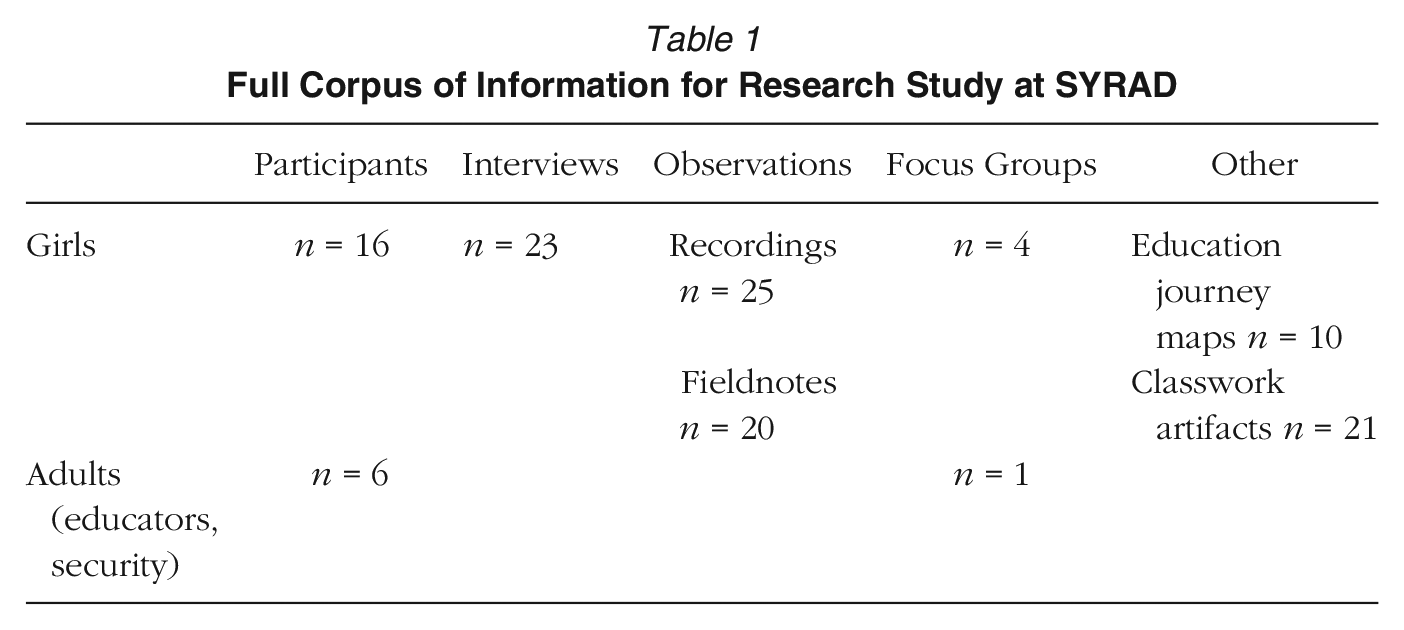
We focused on the 23 interviews, 20 fieldnotes, 25 class observations, 4 focus groups, and 5 researcher notebook entries for this article.
Research Site
SYRAD was a public, midwestern, coed, maximum-security youth prison. This site was selected because it is similar to maximum-security youth facilities across the country, with its own specific context. This similarity between SYRAD and other maximum-security facilities was determined from the body of literature discussed above and the PI's experience as a teacher and researcher in these facilities across two decades. We were able to gain prolonged access to the school and students, providing methodological rigor. To enter, we stored valuables in lockers, underwent multiple security checkpoints, and were subjected to various searches. The school was inside a wing of SYRAD, part of the sociospatial context of the facility. Inside the school, a security officer always sat at a central desk. Classrooms were always locked, and a sallyport—a secured entryway controlled by a guard—was located at the main office entrance.
The “‘Girls’ Classroom”
Our research mostly took place in the designated girls’ classroom at SYRAD. Walls were adorned with student artwork and printed posters with “motivational” quotes, two teacher desks, and a whiteboard—all features of a typical school classroom. Conversely, some features diverged from typical classrooms. The room's windows were covered with dark paper intended to prevent anyone from seeing out of or into the classroom. Two cameras were placed in the corners of the room so the girls could be monitored at all times. Every girl was stationed at a computer facing the wall; no one was seated to face the center of the room. There were also two heavy metal doors painted, what one girl described as, “jailhouse green,” one labeled “bathroom” and another with no label. We also did a class and focus group on the living unit when the facility was on lockdown. Beyond the physical classroom, our main site of inquiry was our class.
The Prison-School Curriculum and Pedagogy
In a discussion with the principal, he noted that all content classes were on the computer so girls could get “an individualized education.” The literacy teacher noted that for her class, which the PI observed, this meant reading paragraphs and answering comprehension questions on random topics ranging from hair to the weather to W. E. B. Du Bois. She described the research-based computer program as consisting mainly of short passages with quizzes at the end focused on comprehension. The girls’ only opportunities to read fiction were on their own.
Our Sociocritical Literacy Class Imbued With Abolitionist Praxis
Understanding the literature on how literacy is often taught in reductive ways in youth prisons along with discussions with educators at SYRAD specifically, we sought to create a space that was rooted in Winn and Behizadeh's (2011) conception of literacies as a civil right, “including children's right to their own creative and cultural literate practices, academic literacy, which is on the test, and critical literacy, which transcends what can be tested” (p. 151). Consequently, we reorganized prison-school education to center disabled Girls of Color “as valuable natural resources whose lived experiences and everyday knowledge must be built upon” (Annamma & Morrison, 2018, p. 71). Our attempts to provide the girls with expansive notions of literacy with abolitionist praxis in youth prison education was in direct contrast to the reductive literacy and pathologizing practices found in the literature and at SYRAD.
Our sociocritical literacy class was one where multiply marginalized disabled Girls of Color would “read the word and read the world” (Freire, 1970/2010). For the curriculum, we used fiction texts chosen by the girls as anchors and developed lesson plans that incorporated state literacy standards and sociocritical learning objectives. Examples of sociocritical literacy objectives included examining hip-hop artists as griots, understanding multiplicative identities and intersectional oppressions, exploring contributions of Black women to music, defining colorism, and discussing intimate partner violence—all related to the books we read. Pedagogically, all our efforts were to create access to these state standards and sociocritical objectives. Thus, some of our activities included creating black-out poems, designing masks, a class mural, and character mapping. We often listened to the audiobook as another pedagogical access point, while girls read along for the first quarter of each class, then did group discussions and collaborative work. Relationally, we used multiple types of group structures, and most of the time girls got to choose who they worked with or if they worked alone. Moreover, if a girl was off task, we individually checked in with her but did not use institutional punishments to coerce her to work. We held class once a week for 90 minutes from September 2018 to July 2019. We prearranged that girls who needed credits received them for the class, which counted towards graduation. If any girl already graduated and was employed with a “job,” which in SYRAD was folding laundry for $5 per hour, we negotiated they would be paid for class time. If girls chose not to participate, they could go to an alternative class, stay on the unit, or work.
Participants
We had a total of 16 participants between the ages of 15 and 21 throughout the year. Our class was intended to serve disabled Girls of Color, but, given that the girls population in SYRAD was smaller than boys, all girls, including those racialized as white, were in our class for most of the time. Nine identified as Black or multiracial Black, four as Latinx or multiracial Latinx, one as Indigenous, and two as white. We did not include white girls in our analysis because they were not our focal population. The themes were found specifically across the disabled Girls of Color. Due to normal youth prison attrition, some were released during the year; our lowest number of girls for class was six. All 16 girls in our study identified as cisgender and six identified as queer, or indicated they dated other girls. All girls had disability labels before incarceration or diagnosed during, though not all disability labels were served by individualized education programs (IEPs) (e.g., post-traumatic stress disorder [PTSD]). Given the doubly sensitive nature of our population under 18 years of age and incarcerated, we give no more specific details. At times we purposely limit or change details about the girls, institution, and discursive practices within to better protect their anonymity.
Research Team
The PI and three research assistants (RAs) planned lessons throughout the year. One of the RAs assisted in designing lesson plans and data collection in the fall of 2018. Another did the same in spring 2019. The third RA did the same, in addition to data organization, throughout the year. The PI moved institutions once the school year ended in SYRAD, which coincided with the planned end of the course. At the new institution, the PI began data analysis with a newly assembled research team, including the RA previously engaged in year-long data collection.
Data Collection
Data collection for this article included interviews, observations, field notes, focus groups, and researcher notebook entries. Given prevailing conditions of youth prison research, it took a substantial amount of time to gain access into SYRAD. For example, after a 6-month IRB process, the research team took a 3-day course for volunteers to get permission to regularly enter SYRAD. Thus, the fall semester was 11 weeks, and the spring semester was 15 weeks.
Interviews and Focus Groups
We conducted 23 interviews ranging between 6 to 98 minutes with the girls in two phases; the shortest was interrupted for a class. A subsequent interview was conducted with this participant to supplement the initial interview. No other interview was similarly short (for interview length distribution across participants, see Table 2). Additionally, we conducted four focus groups that lasted about 90 minutes each. The first phase occurred between October and December in 2018. The last took place between May and June in 2019. Given normal attrition in carceral facilities, a few of the girls only interviewed once, others twice. Due to this, parts of our findings may unevenly showcase some girls’ voices more than others (see Table 2).
Individual and Focus Group Interview Frequencies
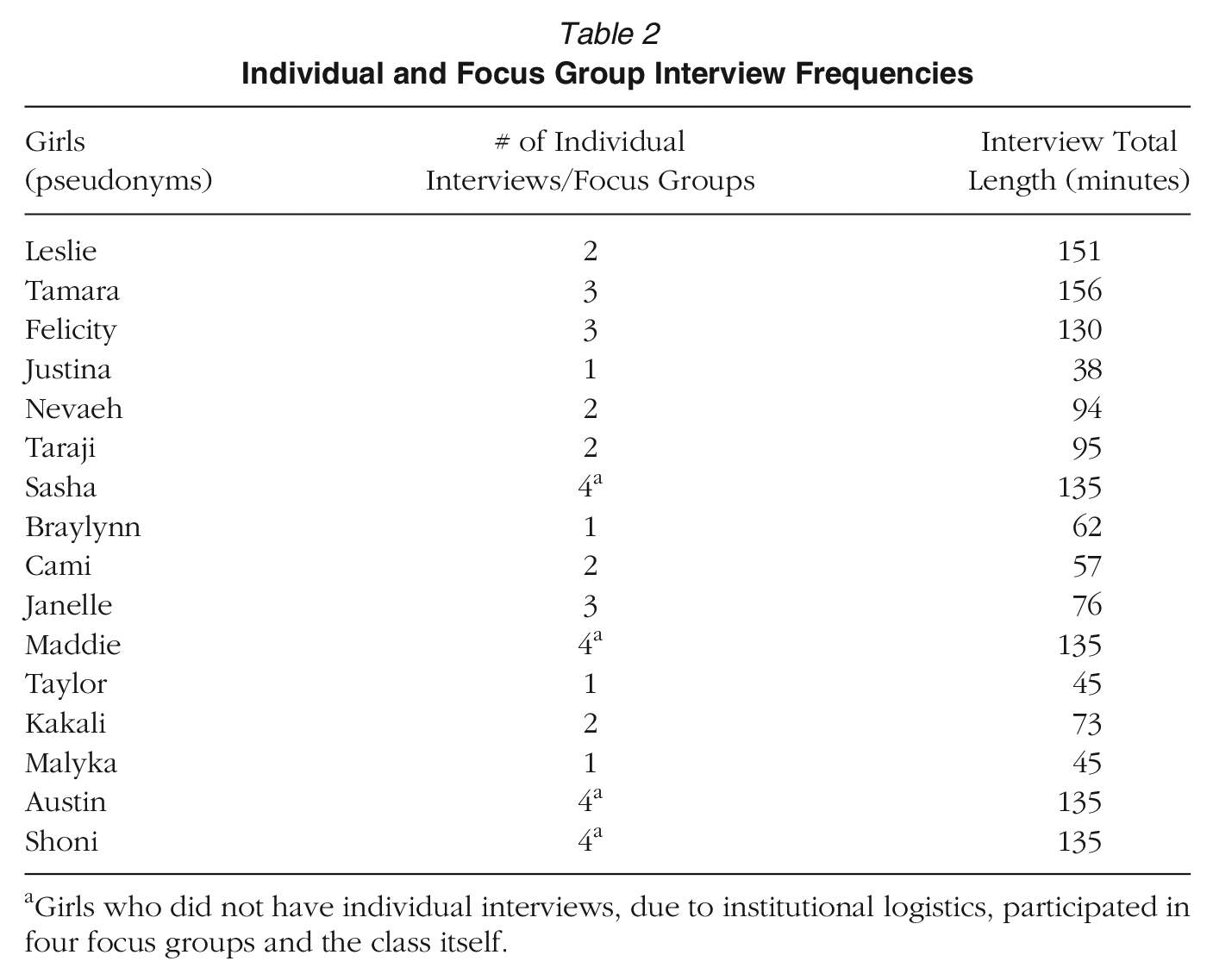
Girls who did not have individual interviews, due to institutional logistics, participated in four focus groups and the class itself.
In the first interviews, the girls drew out their Education Journey Map in response to a prompt (Annamma, 2017). They then verbally traced their education trajectories across space and time, inclusive of SYRAD. The second interview, which for some girls was done in a focus group given a facility-wide lockdown, was reflective of their experiences of and within our sociocritical literacy class.
Observations
Our 25 observations focused on our sociocritical literacy class, not other classes in the school. Each weekly observation was completed by a different research team member since the class was taught in rotation. If a team member was not teaching, they conducted field notes. Each audio file recorded the 90-minute length of the class. Field notes from observations were typed and ranged between one and five pages. When the PI was the only instructor in attendance, which occurred five times, there were no field notes, and she made researcher notebook entries after.
Data Analysis
To empirically address our research questions, we deployed multiple rounds of data analysis. Our rounds included conversations about data codes and meaning-making processes (Bhattacharya, 2017). We engaged in a rigorous data analytical process via a collective axiological commitment ensuring girls’ voices were the center of analysis (Maher et al., 2018).
Building Our Codebook
Once class ended, we reviewed and cleaned transcriptions thoroughly. At this preliminary stage, each researcher read transcriptions several times and noted emerging themes, which we wrote in our researcher notebooks and discussed in weekly meetings (Miles & Huberman, 1994). We then initiated our first round of coding. Our initial approach was “top-down” or deductive (Catanzaro, 1988) on Dedoose software. We used DisCrit “enabling processes” as those that students or adults found “useful and conducive to engagement and meaningful learning.” Conversely, we defined “debilitating processes” as “processes that disrupted engagement and meaningful learning for participants, resulting in Girls of Color feeling disconnected from school.” We refined our codes and added subcodes based on points of overlap and divergence. For example, for “enabling processes,” we incorporated subcodes from the DisCrit Classroom Ecology framework, such as “DisCrit Solidarity” and “DisCrit Pedagogy.” Our codebook also included two “Miscellaneous” subcodes: “Enabling-Miscellaneous” and “Debilitating-Miscellaneous” for concepts that did not fit within the above subcodes.
Inductive codes were directly influenced by participants’ words. For example, Felicity stated, “It’s kind of aggravating because the guys they get to move around like its high school. And we have to stay in our room.” Other girls corroborated Felicity's point. After having multiple research team member conversations and returning to the interview data we created the subcode “Gendered processes,” within “Debilitating processes” code, given that the girls repeatedly highlighted the role that gender played in the treatment of youth at SYRAD.
By considering the girls’ words, we enacted a “bottom-up” or inductive approach at the same time we conducted our initial top-down one (Charmaz, 2006; Corbin & Strauss, 1990). This second iteration allowed us to undergo an “abductive” coding analysis (Shank, 2008; Timmermans & Tavory, 2012) that generated a more coherent codebook. This refinement solidified our codes and increased trustworthiness in our findings. As we moved from coding to claim building, we specifically connected the girls’ experiences to institutional and societal structures as needed for our critical phenomenological approach and linked those connections with DisCrit tenets.
Trustworthiness
We deployed several strategies to ensure trustworthiness (Lincoln & Guba, 1985). First, as we mentioned, we remained close to the data by using the girls’ words to guide our analyses (Bhattacharya, 2017). Second, we ensured our data collection and analysis were conducted over a prolonged time, which granted robust engagement by all research team members (Erickson, 2004). Third, we used data triangulation to ensure themes were evident across sources (Brantlinger et al., 2005). Every research member read and coded multiple interview transcripts. This afforded us the opportunity to discuss, compare, collaborate, and refine our codes in a systematic way (Miles et al., 2014; Saldaña, 2013). Fourth, each member wrote individual reflections about codes, observations, and other data sources in their respective researcher notebooks. These reflections, alongside the other strategies, provided us with more robust agreement of our data, codes, and study findings (Rodwell, 1998).
Findings
Our findings are divided into two parts. The first set of findings describe the dehumanizing and (de)socializing mechanisms inside prison-school—including all SYRAD education except for our class—that disabled Girls of Color identified as significant. Our second set of findings explored the abolitionist praxis from only our sociocritical literacy class. We found it important to name what happened in prison-school outside of our class and then share what we did to (a) set the context of prison-school, (b) draw clear distinctions between our class and others in prison-school, and (c) illustrate the limits of our pedagogy. Each section provides opportunities to rethink how disabled Girls of Color are supported in their educational trajectories to and through youth prison education.
Inside Prison-School
To answer our first research question—“In what ways do disabled Girls of Color understand their education in a youth prison-school?”—we begin by discussing the positive aspects about prison-schools from the girls’ perspectives. Disabled Girls of Color shared how pedagogically and relationally they felt specific SYRAD educators were supportive, and they appreciated some of the aspects of the computer-based curriculum. Then, we discuss the dehumanizing and (de)socializing mechanisms disabled Girls of Color found prevalent in prison-school: the educational practices of remediation, hyperfocus on institutional practices that developed criminalized literacies, forced invisibility through inequitable treatment of the girls, and continuous attempts at softening carcerality through superficial changes to the facility all impacted how girls felt invisibilized and harmed by prison-school pedagogy, curriculum, and relationships. We found that the education ecologies of prison-school situated girls as threats and that a different kind of education was needed in our own course.
Supportive Prison-School Practices
Disabled Girls of Color reported some productive moments within SYRAD. Pedagogically, girls noted individual teachers who provided academic support. For example, Leslie noted that the assistant principal was her favorite school personnel “because she likes to listen to us.” In fact, all the Girls of Color were able to identify a SYRAD educator or staff they connected with. Many of the girls mentioned Ms. Juarez. When asked why she liked Ms. Juarez, Janelle stated, “She helps me understand. She expects greatness. So, I have nothing less to be.” She elaborated, “She’s not sitting there every step of the way. Of course she'll help me when I need it, but she'll be like, ‘You can do it on your own,’ helping me be independent.” Other Girls of Color also suggested that Ms. Juarez met their individual academic needs.
Some girls noted curricular strengths. Kakali stated, “I think they do well on making it … fun or they try to make it fun, doing different activities, movies, interacting with their kids.” Kakali appreciated the efforts some teachers put into supplementing the curriculum, keeping students educated and entertained. Further, Justina noted, “Ok I like it for the fact it's at my own pace and I can, if I (mess) up on an assignment they could just re-assign it like five times.” The opportunities to redo assignments via the computer-based curriculum meant that girls who were short on credits had ample chances to earn what they needed.
Finally, many of the Girls of Color mentioned the relational aspect of prison-school. Taraji said, “I see that they [instructors] pay close attention to me … I like that they notice if there's something wrong.” Taraji felt cared for when teachers paid attention to her. Ultimately, all the girls identified some positive aspects of prison-school.
Dehumanizing Mechanism in Prison-School: Remediation
Though many girls appreciated what teachers brought to the classroom, all expressed complex education experiences in prison-school. Angela Davis (2016) described adult prison practices such as “eternally repetitive routines, the imposed anonymity, and the rigid atomization of numbers and cages” as “dehumanizing, desocializing mechanisms.” When we talked to disabled Girls of Color about their educational trajectories in youth imprisonment, we found that what they described in prison-school was also dehumanizing, desocializing, or both.
The content of every class was a computer-based program that provided different modules based on what content students needed to graduate. This allowed them to catch up on credits quickly, but also had mixed feedback from the girls. Kakali noted, Ooh. I wish that there was a better instructor. I mean … it's all self-taught. You have to get on the computer … by yourself and you got to learn how to understand this. Sometimes, the teacher may not even know what's on there, so you got to understand it yourself.
Like Kakali, many of the girls noted that the computer-based programs, though “individualized,” made instruction for teachers difficult. Several girls described how teachers did not know the material and often could not help when a question arose. Naveah noted, “They don't really explain how to do it … I mean, they'll try and come over to help, but they don't really explain it to you. They just give you the answer.” Consistently, disabled Girls of Color reported that teachers often told them an answer, but the girls did not want that. Instead, they wanted to learn.
Simultaneously, computerized curricular programs, though individualized for credits, did not address the girls’ lives. The girls discussed that literacy program in a class discussion,
School is boring here, yo. It's so fucking boring here. … In regular school, they would have a teacher that would actually talk and do projects and … .
That's what I was talking to you about … it has nothing to do with anything.
Like, dude, [in] this school all you do is sit on your ass … .
You're not supposed to stare at a screen for so long.
That could actually mess up our eyes.
The girls wanted to learn, but, for different reasons, the teachers and the computerized curriculum did not teach. In prison-school, neither engaged the girls or their lives.
Relationally, Braylynn felt that some teachers tried to antagonize her. She talked about one educator: “I’ll be, ‘Can you please come help me?’ And (teacher says), ‘I just need a break from you’. … You probably helped me twice and need a fuckin’ break from me. Who says that?” Braylynn felt that this kind of treatment was not only common and unkind, but meant to get her to react, which would result in her losing privileges or even being restrained. Braylynn's experience is not unique. In a January class observation, the girls shared,
Whenever something bad is happening in the facility … they'll be like fill out a [Complaint Form]. And they say that with so much confidence because nothing happens from a [Complaint Form]. … They'll say sneaky comments and they'll be like …“make sure you spell my name right” and shit like that … .
Yeah … some of them will spell [their name] out for you, smiling the whole time.
All girls mentioned specific adults in SYRAD who would antagonize them. Girls learned they were often not welcomed in the prison space where they were forced to reside.
Finally, disabled Girls of Color felt their intelligence continually questioned in prison-school. In her researcher notebook, the PI noted that the literature teacher reported the girls had only read Seven Habits of the Highly Effective Teenager as a group and had not read fiction as a class. This theme of fixing the girls was prevalent in the data. When we discussed what they did not like about prison-school, Austin said, “How they kind of talk to us stupid, you know what I mean? Or like if we ask a question, they'll be explaining it, like we should've already known that.” Taraji also said, “They talk down to us … like because we're in jail … they talk to us like we're dumb.” Being approached as if they had limited intelligence evoked a variety of feelings from the girls, but all of them mentioned this mechanism specifically. What does it mean that the only shared text was one seeking to teach the girls how to be better? We question what it means to be in a school where a presumed lack of intelligence is consistently communicated directly to all students.
What these findings—the absence of teaching, antagonizing youth, and positioning the girls as unintelligent—illustrate was how prison-school highlighted remediation, focusing on fixing the students themselves, along with their literacy practices (Gutiérrez, Hunter, et al., 2009). Remediation can sound neutral or even necessary if it is understood as providing needed skills. However, the ideology that undergirds remediation is more insidious. To remediate is often an attempt to “cure the problematic difference. The less powerful will be understood to contain the problem within, and in turn, will need to be contained … the remedy to difference is to ideologically and/or spatially restrict and unlearn that difference” (Annamma & Booker, 2020, p. 303). Using DisCrit tenet one, we understand that assumptions of girls’ deficits and attempts to cure them are examples of the ways ableism and racism work together in the lives of disabled Girls of Color. Racism and ableism in prison-schools results in dehumanizing mechanisms—situating the girls as problems to be caged and repaired instead of young people facing challenging conditions. In public schools, these assumptions often create a binary, situating some students as normal and others as abnormal subjects of remediation (Gutiérrez, Hunter, et al., 2009). Our findings illustrate that prison-school practices were rooted in a dehumanizing mechanism of remediation, positioning all disabled Girls of Color as abnormal, as deficits needing to be fixed.
(De)Socializing Mechanism in Prison-School: Criminal Literacies
Along with what is explicitly taught in schools, youth learn “to and through”’ (Gutiérrez & Larson, 1994) the socializing practices institutions utilize; time and energy is spent enforcing the practices. As mentioned previously, the threat of a strip search always loomed if a pencil or other school supplies (e.g., paper clips) that could be deemed a weapon went missing and had to be meticulously counted before and after every class. This routine could take up to 10 minutes at the beginning and end of every class. Additionally, in our field notes, we noted that Girls of Color had to be hand searched with a wand before leaving every class. Even after assiduously counting pencils, girls had to line up and stand with arms and legs stretched while security traced their bodies with handheld metal detectors. Each of these routines could lead to more invasive searches and punishments. These socializing practices taught girls through and from threats by the state that they were deviant and dangerous.
Girls were also expected to sit in a specific way and form during class, referred to as “in position.” Our field notes contain several incidents in the first weeks of class being interrupted by an adult, sometimes security personnel or other educators, who opened the door, disrupted class, and told students to sit “in position,” which involved the girls sitting up with straight backs and feet on the floor. When commanded to sit “in position,” girls were immediately required to change their posture. Kakali reflected, Oh my gosh, why do I have to keep holding myself up to your standard all day? I'm tired of holding myself up to your standard. Why can't I just be me for a second? Why can't I just chill back and be chill? Why do I have to be [in position]? Why do I have to watch the way I sit for you? It's like [I] got to be diligent about everything.
Kakali’s frustration over having to be painstaking about her body postures was echoed by many of the other girls. Multiple participants mentioned that the effort from asserting that their bodies were not threats at prison-school was exhausting.
Academic instructional time is also being lost through the enforcement of these practices in prison-school. Flores (2012) noted that one result was that incarcerated students “may re-enter society with the ability to do certain types of labor but without the basic mathematics and reading skills” that impact their future (p. 8). While these types of routines in prison-schools socialize the girls to the institution, these mechanisms desocialize them for life after imprisonment (Cordilia, 1983). For example, sitting in position, counting pencils, and getting searched multiple times a day are not things required outside of prison-school. Disabled Girls of Color must monitor their bodies and will have standards to abide by in society, but not the rigid ones that are enacted in prison-school. During reentry, life outside of prison is not similarly routinized, surveilled, and controlled, making it less feasible to adapt to the challenging conditions of transitioning back to their communities, such as maintaining stable housing, acquiring a job, or finding adequate mental health resources. Consequently, the prison-school mechanisms (de)socialized disabled Girls of Color, making it more difficult to survive postincarceration.
DisCrit tenet three directs us to focus on the material impacts of being imprisoned for disabled Girls of Color. We found that the material impacts of criminal literacies “allowed girls to become fluent in institutionally sanctioned expectations … without supporting their critical analysis of their own education, incarceration, or larger systems of power” (Annamma, 2018, p. 81). These criminal literacies articulated racism and ableism, situating disabled Girls of Color as deficits, and emphasizing controlling their unruly bodies through (de)socializing mechanisms (Erevelles, 2000). DisCrit analysis illustrates how the work of attending to rigid institutional expectations in prison-school made disabled Girls of Color feel like threats to be contained.
Dehumanizing and (De)Socializing Mechanism in Prison-School: Forced Invisibility
Although we did not systematically study the boys’ experiences, the girls reported, and we observed in the daily operations of school, that the focus on body posture did not similarly occur for the boys. This does not mean they were not read as a threat. Instead, SYRAD (de)socialized bodies read as male in other ways. A focus on treating boys and girls differently, aside from physical separation, reified the gender binary that had varying impacts. Girls of Color noted several inequities in how they were treated compared to the boys. For example, Tamara noted, Boys got the nice shoes. They got the nice Nike Revolutions, the black ones. … And they got Adidas, the high tops, they got all them nice ones. But they want to give us some New Balances. What are we going to do with some New Balances?
Tamara was frustrated with how boys got better treatment than girls, in this case represented by sneakers. We found the institutional choice of purchasing different brands of shoes across gendered lines noteworthy, since the number of girls at SYRAD was smaller than the boys. We presumed it would be more cost-effective to get nicer shoes for the girls. We do not suggest girls should be treated better than boys, but only recognize that it was not a purely financial decision to have inequitable treatment in this case. During a March observation, girls also expressed frustration about other gendered inequities that spilled over into their experiences at school:
This place is sexist as hell … .
The boys get to spend more money than us. Boys have special activities that we don't have … the boys get guitar classes, photography classes.
And dance classes! They get to dance. That's what we found out in [SYRAD].
Repeatedly, disabled Girls of Color described gendered inequities in prison-school and the impacts of having less access to resources than the boys.
The inequitable (de)socializing practices were evident in other aspects of their education. Like inequitable opportunities to take classes, “halt operation,” where all movement had to stop so boys and girls would not see each other, only occurred inside prison-school since the imprisoned youth had segregated living units based on sex. Taraji noted, They act like we [girls] don't exist or like we'll ask for a [halt operation] from where we come [from unit to school]. And there's boys all over the hallways. Now I know y'all just heard them ask for that [halt operation]. … And they just act like we are not here.
As Taraji pointed out, when a halt operation was called so the girls could move from one school space to another, we observed a production of hustling boys into classrooms and other spaces. Yet boys were allowed to move around the prison-school freely, even looking into the girls’ classroom without reprimand. Further, Taraji explicitly noted the forced invisibility of girls with the statement, “And they just act like we are not here.” A DisCrit lens illustrates how even within the prison, a hierarchy positioned disabled Girls of Color as in more need of control than the boys. This practice was both dehumanizing and (de)socializing; the girls were situated as the problem to be contained and simultaneously forced out of sight.
Many of the girls, like Felicity, also mentioned the physical classroom: It’s kind of aggravating because the guys they get to move around like it's high school. And we have to stay in our room. I think that they should have something more available for the girls so we can at least go to a different classroom. At least go back and forth between two, but nah, that ain't gonna happen.
Felicity articulated a clear gender inequity. In the school, the boys traveled between about six classrooms for each subject while girls only had one. Kakali also noted, “I wish that our population wasn't just stuck in one classroom.” Though the girl's population was smaller, this did not entirely justify their educational classroom arrangement. This became clear when the girls lost their classroom, a situation the PI described in her researcher notebook: Today I went in and found girls in an uproar. They had been moved to a small room in the administrative space when their numbers dropped. Apparently, the boys had a fight and the regular “calm down room” did not have enough space to separate all the boys. So, the school administration decided the boys needed to use the girls’ classroom as the boys’ new “calm down room.” Girls noted that now, their classroom room was empty most of the day, and when it was used, usually only one or two boys were in it. Thus, the girls lost their only space in the school and had to have class in the old calm down room, a narrow room filled with barely working computers and plastic chairs with little room to move around. Tamara said, “And we had a whole classroom. We had our own little library, we had everything set up in that little classroom, man. Now if I want to go to the bathroom, I have to wait until the hallway is clear of the boys. I could have a feminine issue and I still have to wait … they took it away from us. … After they told us it was ours.”
These field notes reflected the anger girls felt when their only designated space in SYRAD became another for the boys. In a June focus group, the girls discussed the new classroom:
Sometimes in that classroom, it gets stuffy.
That's just because ours is tiny.
And it isn't made to hold all of us! That's why it made sense to be the calm-down room.
The rationale of the dropping population of girls, often touted as a good thing, was also used to justify treating the girls’ education space as inconsequential. DisCrit tenet two required that our data analysis consider multidimensional identities and accompanying oppressions. What we found is that once disabled Girls of Color are labeled as deficit, their education becomes divested from in different ways than the Boys of Color. Ultimately, a space to meet the emotional needs of the boys was deemed more important than a safe consistent space for the girls to learn. This forced invisibility was both dehumanizing and (de)socializing as it further disappeared the girls even within the context of youth prisons. This was especially noteworthy because the girls’ physical classroom was consistently held up as an example of the ways the institution softened carcerality.
Dehumanizing and (De)Socializing Mechanism in Prison-School: Softening Carcerality
Our findings demonstrated how the institution's attempts to soften carcerality were about changing the look and feel of the prison without changing policy or practice. For example, one thing that was often called to attention by adults was the fact that the girls’ doors on the living unit were painted bright colors. Tamara said, Jail cells are really any color in here, to be honest. The doors at first, they weren't green, they were gray and they turned green. They turned colorful because now they're trying to lift our spirits. I don't think it's working because I can't even see it when I'm in my room and I still hate this place.
Tamara’s point was important: The colorful paint could not be seen from inside the girls’ cell. What could be seen from the inside was a slot in the door where a tray of food could be provided, or girls could stick their hands out to be handcuffed. The doors, controlled by a button that is only accessed from a guard station in the living unit, were used to lock them in with few possessions, reinforcing the idea that the colorful paint was not for the girls.
Another institutional attempt at softening carcerality that occurred in prison-school was getting comfortable chairs in the girls’ classroom. The PI observed, The first time I visit the school to talk with the principal, he is excited to show me the girls’ classroom, he mentions this at least three times before we leave his office. … When we get to the classroom, he points at a set of eight chairs in the middle of the room that are cream colored and upholstered and says, “we wanted the girls to feel comfortable in their classroom since they had to be here all day.”
Initially, we were glad to witness this recognition that the girls had less space to call their own and the commitment to make that space more comfortable. Yet, in our observations, girls struggled to sit comfortably. This came up during an October class:
Are you comfortable?
The book is great.
Not these chairs.
… I [wonder] about those chairs, they look comfortable and uncomfortable.
They’re not comfortable.
Not comfortable.
This discussion cemented something we observed in our field notes early in the school year: Kakali has her legs over the chair, Shoni is sitting on a plastic chair, and Tamara is lying on the ground. These notes, and having sat in the chairs ourselves, showed that the chairs were not very comfortable; they just looked comfortable. Linking this finding with the rule to sit “in position” exhibits that when softening runs counter to routines, (de)socializing mechanisms are prioritized.
Ultimately, we found that softening carcerality was about increasing the visibility of gentleness of the prison for the girls specifically, while retaining most dehumanizing and (de)socializing mechanisms. That is, the same things were not done for boys, which produces an inequity regarding how girls were predominantly constructed as in need of nurturing while boys were imagined as in need of punishment. Concurrently, what we observed was how often the softening was ineffective or, even worse, how it could be taken away at the whims of the institution rationalized on youth compliance while still maintaining the visibility of the softening. The girls losing their classroom was an example of this. Claims about the ways the classroom was made more comfortable were a consistent part of the institutional narrative. Yet, simultaneously, when they lost access to it, Girls of Color were not able to enjoy the comforts of the classroom SYRAD representatives were often touting. Months later, the girl's population had increased to almost 20, but they were still not permitted back into their classroom. Instead, the girls had to sit on tables and the floor to fit everyone in this makeshift classroom.
Another more severe example of the ways softening carcerality retained dehumanizing and (de)socializing mechanisms occurred after a fight when three girls were taken from their regular living unit to a separate unit for segregation. Prison-school was canceled because of an unrelated lockdown, so we discussed this in a focus group in May on their living unit.
So, you all got put in Seg. Seg is like a separate unit? … And then you all just go into the same cell in the separate unit?
Separate cells, that are just empty rooms.
Empty rooms?
No pillow.
I had a sheet and a blanket.
I used a sheet as the fucking pillow.
So, you just have to sit there all day?
They give us one book.
We don't get to come out our rooms at all.
Nope. Never.
At all.
For how many hours?
We were there for three days. …
You can talk through the toilet, but [Tamara] wasn't in the next room like [Austin] and me could talk through the toilet. She got moved down because her toilet didn't work.
Talk through the toilet?
Yeah, we have vents for the toilet in between each room.
It was clear from the discussion that softening of carcerality through small modifications made to the living unit like painting the doors different colors could be taken away the instant disabled Girls of Color were deemed noncompliant. In this case, they were put in an isolated unit in empty cells with no pillows, thin sheets, and one book for 72 hours. None of them were able to receive any education during this period.
Two of the girls found ways to communicate, but the third was in a cell by herself for the entire time. Human Rights Watch (2012) notes of solitary confinement: “This bare social and physical existence makes many young people feel doomed and abandoned, or in some cases, suicidal, and can lead to serious physical and emotional consequences” (p. 1). Using dehumanizing and (de)socializing mechanisms like segregation harm the mental and physical health of the girls and reveal how softening of carceral settings was temporary and spatially limited since there were plenty of other spaces in the youth prisons where harsh punishment could be meted out to the girls. DisCrit tenet six addresses how when disabled Girls of Color are situated outside the boundaries of ability and whiteness in prison-school, they are situated as permanently undeserving of humanizing education and spaces. Softening carcerality was often a way to shift from one punitive response to disabled Girls of Color (e.g., “jailhouse green” cell doors) to a less punitive-looking response (e.g., colorful jail cell doors), while still maintaining dehumanizing and (de)socializing mechanisms (Schenwar & Law, 2020).
It is important to juxtapose the visibility of the softening carcerality with the forced invisibility we observed in the data. Specifically, when we first got to SYRAD, the softening through painted doors and comfortable-looking chairs was regularly described by institutional personnel. Yet the dehumanizing and (de)socializing mechanisms applied to incarcerated Girls of Color forced them into invisibility. Consequently, the girls were used as visible examples of softened carcerality while the institution forced them into invisibility.
Dylan Rodríguez (2006) stated that “the prison school stretches the epistemological and intellectual limits of the state's capacity to surveil and proctor its captives” (p. 89, italics in original). We found the prison-school used dehumanizing and (de)socializing mechanisms including remedial instruction, criminalized literacies, and softened carcerality to surveil and proctor the lives of disabled Girls of Color. Despite positive moments and supportive people, the overwhelming majority of prison-school mechanisms positioned the girls as threats to be contained, forcing them into invisibility. A DisCrit analysis highlights how prison-school reproduces macro-sociopolitical contexts through a collection of dehumanizing and (de)socializing mechanisms undergirded with racism, ableism, and sexism. Individually, these mechanisms were just routines and practices often done in the name of safety but, collectively, positioned disabled Girls of Color as problems to be caged undeserving of humanizing education. We sought to counter these prison-school mechanisms through an abolitionist praxis.
Abolitionist Praxis to Resist Prison-School
Though not always successful, we sought to uncouple education in youth prisons from the labeling, surveillance, and punishment through an abolitionist praxis (Cabral et al., 2023). Here, we explore our attempts to resist prison-school mechanisms in our second research question: “How do incarcerated disabled Girls of Color identify and make meaning of an abolitionist praxis offered in a sociocritical literacy class?” Rodríguez (2010) notes that abolitionist praxis, though not solely about prisons, “strategically prioritizes the prison as a central site for catalyzing broader, radical social transformations” (p. 15). Our first finding explores how our efforts to re-mediate prison-schools were taken up by the girls. Then, we discuss instructor failures in countering prison-school, attending to contradictions and harm. We end with radical possibilities afforded by an abolitionist praxis in a prison-school sociocritical literacy class.
Abolitionist Praxis: Re-mediation
To avoid the need for dehumanizing and (de)socializing mechanisms in prison-school, we used DisCrit to focus on “re-mediation—focus on the sociohistorical influences on students’ learning and the context of their development … a more robust notion of learning” (Gutiérrez, Hunter, et al., 2009, p. 227). Said differently, we refused deficit frames of girls’ thoughts and actions central to prison-school pedagogy. For example, a joke about a skinny man turned into a nuanced conversation about toxic masculinity in a November observation:
You’re so skinny I want to kick you.
Don’t do that … I have a lot of friends, male friends, who have body issues. …
Dudes go through it?
We don't talk about it … for a lot of reasons. Men have a lot of body issues.
Why do men think it's okay to hide their feelings and not show it?
… Have you heard of the term toxic masculinity? Toxic masculinity … teaches men that the only emotion that is healthy to express is anger. And so, what happens then is that when they're sad or upset or anything it comes off as anger. And that often gets taken out on the women in their community. …
Okay that makes a lot of sense because my fiancée, like, he'll act one way in front of the homies or the family but when it's just him and I, he would just cry. …
… I don't care for your looks, money or fame. It's about your personality.
So part of it is what you're saying is, “I’m refusing toxic masculinity. I want a man who can actually engage in his feelings.”
This conversation could have redirected an off-topic comment or punished Tamara for saying something “rude.” Yet this conversation had much to do with reading the world; the girls used observations about experiences with men in their communities and relationships with partners, and we supported robust literacy practices by providing language for what they observed. These moves resulted in all of us collectively growing our radical consciousness.
When the conversations grew from the content, re-mediation revealed and strengthened girls’ robust literacy practices. While reading Shadowshaper by Daniel José Older in December, girls connected prior conversations about colorism with what happened in the book:
Can you find one example of colorism?
When Rosa calls her negrita?
And she calls her morena?
… [Sierra] is talking about how she loves her skin.
Sierra’s arguing with Rosa about how she [Rosa] is not white either.
… Rosa is saying … negrita negatively, somebody calling Sierra negra or Morena … we also see Sierra refusing this position of antiblackness.
She’s coming back, she's passionate about her color … about her hair, she's passionate about what she looks like, how she presents herself, she loves herself.
That’s what we could call resistance. She loves her Blackness, her hair and skin. She's proud of being Afro-Latina.
Though this was more of a traditional turn-taking conversation about content, the girls witnessed a character refusing the colorism apparent in the book. Colorism came up repeatedly in class from the text and the girls’ own lives:
Any other themes that really stuck out to you?
Um, I don't know.
Colorism … like how they treated her different cause she was dark, that ain't right.
Colorism, absolutely, colorism. …
Right! Her aunt was using colorism against her and her boyfriend … my mom used to tell me not to date Hispanics cause they were too dark even though I'm Hispanic too.
Leslie displayed how she and other girls could increasingly make connections across the text and into their world. When asked about the book, The Poet X, by Elizabeth Acevedo, Janelle said, It’s not just like the normal book like, “Oh my God, I have power and I live in a nice house. I go to a nice school.” How would I say this? I don't know, rich people books where it's like, “Oh my God, I can't have this purse.” This is the worst thing.
Ultimately, Janelle felt that a novel-in-verse book about an Afro-Latina girl who dealt with complex issues like diasporic survival, body image, colorism, state violence, and art as resistance was more powerful than literature that did not reflect her experiences. This was in direct contrast to prison-school where the literacy teacher reported girls (a) had to read books based on fixing them, (b) did not have any chance to read fiction with their peers outside our class, and (c) could read independently. When we examined their library for independent reading, a renovated storage closet, we observed that it was made up of books predominantly written by white authors with mainly white characters (e.g., V. C. Andrews, Suzanne Collins, R. L. Stein).
Other girls felt our curriculum and pedagogy combination in reading a shared book and the activities that accompanied them increased accessibility reflecting a DisCrit commitment to re-mediate the learning ecology. Felicity said, “I like how we did like the character maps and stuff like that,” signaling that she found it useful when we created a map with all the characters and added to it every week to support reading and recalling of the text. Braylynn also mentioned the book, Shadowhouse Fall by Daniel José Older, and the way we saturated the learning ecology with mediating tools: I liked how we was reading the books because I felt like we don't read enough … it started to help or is helping a lot of our reading skills because we got opportunity to listen to the books. … Because you know an actual school you do like projects and stuff like that and that's pretty much like what we do in your class … I feel like we should do more of those because [everything] that we do are on the computer.
Overall, Braylnn felt impacted by re-mediation, including using an audiobook for class readings along with the physical text each girl got, and the breadth of activities. A specific activity came up in an interview when discussing her brother that passed away:
That’s right. Because when we did the circle and the remembrance circle, I remember that you brought him up then, didn't you?
Mm-hmm (affirmative).
That’s right … I really liked that activity.
Me too. I love that one. It meant a lot to include him. Actually, I forgot about how much I loved that.
Bringing Braylynn's family, life, and loss into the classroom was part of a sociocritical literacy commitment where we connected girls’ lives with the text and the world. In our remembrance circle, all the girls spoke about the loved ones they had lost and the joys of their memories. Many of the girls discussed how we linked their lives with activities like creating blackout poems (Taraji, Cami, Tamara); designing masks (Leslie, Justina); writing poetry (Taylor, Malyka, Sasha); painting the mural (Naveah); and virtually meeting one of the authors, Daniel José Older (Tamara, Felicity).
Prison-school often isolates knowledge from lived experiences. In our attempts to refuse dehumanizing and (de)socializing mechanisms, we focused on the lived experiences of disabled Girls of Color. Thus, concepts like colorism or state violence did not live in one lesson restricted to a reading. Instead, we were able to re-mediate prison-school through DisCrit's engagement with the voices of marginalized populations. Said differently, we centered disabled Girls of Color via (a) robust literacy practices, linking the students’ historical and current knowledge across lives and texts (Gutiérrez, 2008); and (b) abolitionist praxis committed to continually assessing “the density of (educators’) entanglement in this historically layered condition of violence, immobilization, and capture” (Rodríguez, 2010, pp. 15–16). Engaging the girls’ lives outside the prison-school classroom was a way to both engage sociocritical literacy and reduce our entanglement with carceral logics in the classroom via an abolitionist praxis. Yet, when we assessed our own practices, we found we still created harm in the prison-school classroom.
Recognizing Harm—Failing to Counter Prison-School
There were things we did poorly in class, jokes we made that did not land, and needs that went unmet. When discussing how we planned to bring in outside food for the girls, one of the instructors said, “It’s literally just chicken tenders, it's not that exciting.” Malyka responded, “It is exciting, we're in prison!” Though this could be a harmless joke, prison food has always been of little nutritive value, limited in taste and variety, rationed, or even withheld; prison food is used as a form of punishment (Smoyer & Lopes, 2017). The girls reminded us how it helped to have “outside” food access they rarely got while inside. The joke, however, was not funny—of course girls would be excited to have outside food in prison. In another moment, the instructor laughed and asked, “Who memorizes phone numbers anymore?” Tamara answered, “We do. That's because we're in prison.” The instructor paused and apologized, but the damage was done.
Finally, classroom logistics also reminded us forcefully that whatever we did to counter it, we were still in prison-school. During an observation while discussing a project, the conversation about making a class mural on individual canvases shifted:
So, it's really however you wanna express yourself, we're gonna hopefully take a picture and maybe hang it somewhere in the school so unless you want to take them back with you to the unit, I'm not sure what the rules are.
I don't think we can.
Cus it has wood and staples.
Sorry, I didn't think of that.
Even purportedly simple acts like allowing girls to take art they created to their living space in the unit were not possible. Attending to the tensions in our work is necessary from a sociocritical literacy framing (Gutiérrez, Morales, et al., 2009), as well as recognizing how those contradictions create harm via an abolitionist praxis (Kaba, 2021). Importantly, disabled Girls of Color felt safe to counter our harm instead of simply accepting it. Rodríguez (2010) notes in an abolitionist praxis, “Students and teachers speak radical truth to power under difficult and vulnerable circumstances” (p. 16). These moment-to-moment interactional failures reminded the girls they were still in the sociospatial context of prison-school. In these cases, we contributed to the containment the girls felt. DisCrit tenet four's commitment to recognizing resistance revealed how disabled Girls of Color refused to accept our missteps, by engaging and articulating their own radical consciousness. Though this may seem minor, in a prison-school classroom, where at any point they could be punished through physical removal or restraint for sharing what they were thinking, girls calling us out was courageous. Though we often failed, we supported their development of radical consciousness through the refusal of labeling and punishment.
Abolitionist Praxis: Refusing Labeling and Punishment
Girls repeatedly mentioned how their speech and discussions were deeply surveilled, labeled, and punished in prison-school. When asked if she had opportunities to discuss topics related to her life in prison-school, Felicity responded, “We really don't … it's just not allowed.” Girls consistently described how comments they made were labeled as “inappropriate” by educators. During a class observation in the spring, girls shared:
I like to be able to talk, like, freely in here without getting in trouble—like in real school they'll be like “change the subject.”
Yeah … we'll be talking about something, they'll be like “that’s an inappropriate subject, change the subject.”
We’ve talked about more real things here … than any other time in school.
As the girls note, much of their discourse was labeled as inappropriate and therefore heavily restricted in prison-school, so that their lives were also locked out of the classroom. To develop their radical consciousness, we centered Bettina Love's (2019) call for “an abolitionist praxis that, with urgency, embraces what seems impossible: education for collective dignity and human power for justice” (p. 13). Disabled Girls of Color noted how we countered dehumanizing and (de)socializing mechanisms of prison-school through centering dignity because their ideas and experiences were both welcomed and affirmed.
Moreover, girls mentioned that because we did not treat their bodies and minds as threats, they were more likely to engage with and in the class. In the end of the year focus group, the instructor explained this:
We tried to do things different that usually get done in schools in general but particularly in prison-schools. I tried really hard to not do a lot of redirecting of you. If you were off task … I'd give you a look … and you all responded. … But what I'm trying to get a sense of is, did that work for you, or how did that feel?
It felt good. It felt like you treat us like adults … you treat us with respect, and you know, in your head you knew we were gonna do the right thing.
Throughout observations, notes like “Neveah has her head down” or “Leslie is looking at the homework for another class” were common. When these things happened, one of the instructors simply went and stood by the girl, made eye contact, or checked in quietly; but we proactively and strategically chose not to force the girls back into expected behaviors. Instead, most of the time, the girls came back to work on their own. Though the instructors did not discuss their commitment to resistance to be institutional actors of prison-school fueled by DisCrit with the girls until the end of class, it was clear that they noticed and responded. Felicity went on, When we were with you guys it's cool, like it's chill. No one gets mad over something so little … but it's like if we take this stuff back to our unit or in another class, then our tempers start to rise. So, I kind of feel like y'all are kind of like the cool blanket.
Felicity shared how our refusal to engage in the institutionalized criminal literacies shifted the sociospatial context; it felt less like prison-school. Here we engaged in an abolitionist praxis where “intervention programs … must avoid even the most subtle or indirect reliance on the punishment industry” (Richie & Martensen, 2020, p. 14). Our refusal to engage the dehumanizing and (de)socializing mechanisms throughout our year-long course provided space for radical possibilities to be grown and nurtured.
Abolitionist Praxis: Radical Possibilities
Rodríguez (2018) suggested engaging moments of tension in history and into the present day as “revelations of radical possibility that obliterate the cultural tendency to reify … existing systems of state violence … and institutionalized dehumanization. Such … is a primary pedagogical purpose of abolitionist praxis” (p. 1612, italics in original). What we found in interviews, focus groups, and observations was that disabled Girls of Color described radical possibilities made possible through our course. In a May class, we reflected as follows:
Was there anything you really didn't like doing in our class?
I just loved every moment with you. … When we come to your class it's like we feel not like we're in prison like we're appreciated. That's how it is with me.
Good, that's how we hoped you would feel.
I don't feel like I'm a caged animal. We can be ourselves, we can talk about whatever we want.
The opportunity to name the social, political, and cultural discourses of their lives meant that girls felt, in those moments, that they were safe from the sociospatial context of prison-school. This served as a reminder that sociocritical literacy imbued with an abolitionist praxis had a material impact on the students.
A few other girls shared impacts in final interviews as well:
Okay. What do you think you learned about yourself through this course?
To love myself even though a lot of bad stuff has happened.
What helped you do that?
Being able to talk to you guys … being able to talk to you about everything.
Braylynn reminded us that disabled Girls of Color incarcerated across the country have lived through life circumstances brought on by intersecting oppressions, including sexual abuse, poverty, lack of health care, and other social conditions that produce harm (Harvey et al., forthcoming; Saar et al., 2015). DisCrit tenet five's commitment to considering the legal and historical aspects of how disability and race have been used to deny rights revealed how the trauma the girls experienced, their incredible resistance, and their robust literacies have been pathologized in public and prison-schools. Our attempts to counter prison-school through a sociocritical literacy and abolitionist praxis shifted that pathologization for multiple girls:
Back to the … course … anything you really liked that … was helpful?
Being able to speak out.
Okay. You mean, like not having to raise your hand and stuff, being able to speak out? Or what do you mean by that?
Being able to speak up, like hearing our voice instead of what everybody else has to say about us.
Tamara saw beyond the practices we engaged, to the ways we centralized her voice. She recognized that the master narratives written about disabled Girls of Color framed them as dangerous, lacking empathy, and uncaring (Chesney-Lind & Jones, 2010). By allowing the girls to author their own stories, Tamara was able to narrate and cement her counterstory.
Braylynn also shared a message about what people expected from her:
What recommendations do you have about education in youth prisons?
I think they should know we're not all bad people. We just make bad mistakes, and I don't look at it as if we're in prison. I look at it like somebody sent us to school to try to be successful or to get a new start to be successful, to learn how to do that.
Braylynn wanted to start over and believed prison-school could be a place to provide that opportunity. Her comment illustrates how she conceptualized prison-school as a place of punishment, but also a place of possibility. In each of the moments above, our attempts to counter prison-school were part of opening radical possibilities by supporting their powerful literacies infused with abolitionist principles.
All the girls wanted an education that set them up for success outside of prison. They all noted that the type of education they needed required powerful conversations deeply rooted in their lives and texts to make sense of their world. Disabled Girls of Color depicted how our attempts to resist prison-school through a DisCrit framing made this kind of impact on their lives. Yet no matter the radical possibilities we fostered, each time the disabled Girls of Color left our classroom, a halt operation was called as they lined up to get searched with a wand just to move through their school. We could not protect the girls from the dehumanizing and (de)socializing practices entrenched in youth prison education. Consequently, countering prison-school is an important element of abolitionist praxis, but it is not enough on its own.
Discussion
In Training Schools for Delinquent Girls (1929), Margaret Reeves described her team's visits to 57 girls’ prison-schools. She noted, In the best training schools for girls, the providing of “book knowledge” is, of course, not the chief task. We have already seen that their fundamental function is to help the girl to find herself through proper diagnosis, treatment, and readjustment. (p. 273)
Yet this focus on containment to provide proper diagnosis (remediation), treatment (criminal literacies, softening carcerality), and readjustment (forced invisibility) that Reeves describes has, by design, never allowed prison-schools to provide robust education. Instead, DisCrit revealed how prison-schools contribute to a vision of education that is raced, gendered, and abled—focused on segregating and curing disabled Girls of Color through dehumanizing and (de)socializing mechanisms. Our study thus adds to the in-depth explorations of prison-schools (Flores 2016; Vaught, 2017; Winn, 2011; Young et al., 2010) and the archives (Russell, 1905), illustrating how youth prison education is fraught, focused on dehumanizing and (de)socializing mechanisms in lieu of education that reveals and strengthens the radical consciousness of disabled Girls of Color. Our attempts to counter prison-school through sociocritical literacy imbued with abolitionist praxis re-mediated the classroom ecology and refused labeling and punishment. Though not always successful, our work allowed the girls to sharpen their existing literacies towards radical possibilities.
Through our findings about interventionist attempts in dehumanizing and (de)socializing mechanisms of prison-school, alongside the facts of the costs and problematic outcomes of prison-schools and existing youth prison-schooling literature (Flores, 2016; Vaught, 2017; Winn, 2011; Young et al., 2010), we draw from Gilmore (2017), who suggests the need for a multiscalar abolitionist politic. We briefly align our findings with multiscalar abolitionist dimensions.
The micro scale addressed in this article is shifting the material realities of incarcerated youth (Kaba, 2021). Our participants reported that prison-schools are replete with remediation and criminalized literacies. Girls described how curative education via an absence of teaching, antagonizing youth, and positioning the girls as unintelligent assumed that they were broken. Additionally, our results suggest that socializing imprisoned youth into routines and practices that do not translate outside the prison walls (e.g., sitting in position, counting pencils, getting searched multiple times a day) wasted precious educational time focusing on (de)socializing incarcerated disabled Girls of Color instead of preparing them for life after imprisonment. To shift their material realities, we countered dehumanizing and (de)socializing prison-school practices with our sociocritical literacy course rooted in abolitionist praxis where we refused labeling and punishment. We hope others will continue to counter prison-school. All teaching in and outside youth prison education can combine critical content with an abolitionist praxis.
This microdimension of abolition also means that any claims to abolition must be rooted in substantive solidarity relationships with incarcerated youth (Cabral et al., 2022). Imprisoned young people should not have to bear the dehumanization and (de)socialization we documented on their own. We attempted to counter these during our class through re-mediating the classroom ecology by saturating it with mediating tools and welcoming girls’ lived experiences into the classroom. This is essential as education takes up abolition, though often in ways far removed from prisons. This material abolitionist dimension does not mean everyone needs to teach classes in prison-schools. Given the dehumanization and (de)socialization participants experienced in prison-schools, future researchers and educators could find ways to connect their lives, their students’ lives, and the resistance of both to those of incarcerated youth (e.g., letter writing, donating to youth prison libraries, volunteering with current or formerly incarcerated youth, examining school and societal practices for pathologization). We must center the lives of multiply marginalized incarcerated youth in our scholarship, teaching, and organizing efforts.
The second implication of our periodic failures to counter prison-school points to a meso dimension of abolition. We must recognize how prison geographies are “connected—more than just … prisons or even aspects of public order—without collapsing or reducing various aspects in another” (Gilmore, 2017). Given that the girls described their forced invisibility through inequitable treatment, it is essential that DisCrit resistance examines how we perpetuate containment of prison-school in our discursive practices. Our findings suggest that imprisoned disabled Girls of Color feel erased by the (de)socializing practices that occurred in school such as halt operations. This makes it essential that educators and others who are in community with the girls must reflect on jokes, offhand comments, and logistics for how they perpetuate prison-school mechanisms of remediating for a cure, implementing criminal literacies, and invisibilizing disabled Girls of Color. Abolitionist praxis can humanize the education of incarcerated youth and must account for the harm it creates.
Additionally, Gilmore’s (2017) comments harken to the need for school-prison literature that recognizes the ways public schools reflect the pathologizing pedagogies of prison-schools. Concurrently, the second half of her point is that the two cannot be collapsed. Public schools are not prisons, though they may have several prison-like features. The recognition that public schools are not the same as youth prisons does not mean that their connections should not be examined. For example, public schools have specific spaces and practices that exacerbate a binary between abnormal and normal students, marginalizing the first group (Erevelles, 2011). Our results suggest prison-schools position all youth as a problem to be cured, marginalizing all incarcerated youth. Both are problematic. We can connect the carceral logics that animate both without suggesting these environments are the exact same. In fact, as Gilmore reminds us, we must hold the school and prison interconnected without collapsing prison geographies to root out the ways dehumanizing and (de)socializing mechanisms are present in both.
Finally, our findings indicated that the institution's attempt to soften carcerality in girls’ incarceration was illustrated through environmental shifts changing the color of the doors and the look of the chairs. However, our findings also suggested that (a) the softening was mostly about increasing the visibility of gentleness, without shifting policy or practices; (b) when softening runs counter to routines, (de)socializing mechanisms were prioritized; and (c) the softening could be removed whenever girls were deemed noncompliant. Yet softening carcerality was brought up to the research team multiple times by educators and staff as an example of gendered responsiveness. Our results suggest that educators and policymakers should question claims of carceral softening to determine if dehumanizing and (de)socializing practices continue behind those brightly painted doors.
The girls described radical possibilities that opened when they were able to trust their own voices, more fully love themselves, and believe in their possible futures because of our abolitionist praxis. Yet we could not protect them from those radical possibilities being foreclosed through many of the dehumanizing and (de)socializing practices that we documented in prison-schools. The implications that softening carcerality was ineffective and that abolitionist praxis could not protect the girls from the larger prison-school context in which it took place should be tied to the work at the macro scale of abolition seeking to eliminate youth prisons. Studying prison-schools reveals the lack of support for sufficient, let alone robust education (U.S. Department of Education, 2013), which leaves incarcerated youth without the literacies they need to be part of rewriting their future (Flores, 2016; Musser, 2021; Vaught, 2017; Winn, 2011). Though disabled Girls of Color show tremendous ingenuity to get their needs met in prison-schools (Annamma, 2018), they should not have to continuously exert the kind of energy prison-school demands to prove they are not threats and deserve to be treated more humanely. That is, our findings indicate that even while we organize to improve material conditions for imprisoned youth, we must simultaneously organize to end incarceration. Given the negative outcomes, costs, and the dehumanizing and (de)socializing mechanisms we and others have documented, we join the calls of the American Public Health Association (Uyeda, 2020), Youth Correctional Leaders for Justice (2020), and scholars (Akbar, 2020; Du Bois 1903/2008; Rocha Beardall, 2022; Sabati et al., 2022) for example, who have suggested we can and must divest from prisons and invest in youth futures.
This leads to some “limitations” of our study and directions for future research. First, SYRAD was not unique in its dehumanizing and (de)socializing mechanisms. These mechanisms are common across youth and adult carceral facilities, which results in the “institutionalization of educational deprivation” through “under-resourced and understaffed learning environments, and overtly militarized classrooms” (Alexander, 2017, p. 10–11). Though we are deeply committed to being in solidarity with incarcerated youth, we also recognize that research in spaces of confinement risks reproducing harm under the guise of knowledge production. As researchers, we must continue reckoning with what it means to make a living building knowledge about the prison-geographies we oppose. Second, our goal was to deploy an abolitionist praxis with disabled Girls of Color in prison-school, yet it was nearly impossible to do so without further replicating the existing carceral logics or creating new ones. For example, when a pen was lost, we had to do a deep reflection about what it meant if we did call security (institutionally mandated sexual violence) versus if we did not report it (we could lose our access to the site, a girl could be caught and punished for having “a weapon”). We discussed it with the girls, but it still felt like a dilemma with no correct answer. Third, doing research in carceral spaces inherently limits how incarcerated youth could express themselves. While we provided an alternative to some of the more punitive practices of prison-school, disabled Girls of Color still may not feel safe describing exactly what they experienced, given we were operating within “technologies of immobilization and punishment” (Rodríguez, 2006, p. 101). They knew they could be severely punished for minor infractions via strip search or segregation. Yet even holding these tensions of limitations with our commitment to be in solidarity with incarcerated youth, we do not turn away from improving the material education disabled Girls of Color receive in prison-schools. Finally, our study is unique in its situatedness. We are not attempting to create generalizability. Instead, we suggest abolitionist praxis must be committed to unique social contexts in which the work occurs. That is, we cannot simply suggest future researchers and educators add re-mediating the classroom ecology, recognizing harm, refusing labeling and punishment, and engaging radical possibilities just as we did. Those were the unique moments of abolitionist praxis that incarcerated disabled Girls of Color in our study felt were meaningful. Ultimately, if abolition is “(re)humanizing … by connecting with students’… lived experiences … political struggles for justice, their bodies, and their emotions, needs, and desires” (Yeh et al., 2021, p. 200), then that requires a specificity that does not seek to be generalizable.
We also contend that the “limitations” described above create possibilities. Future research should explore other classes offered in prison-schools that conceptualize abolitionist praxis across academic subjects. Future research and educators should also seek collaborative partnerships with prison-school educators who are already committed to working towards infusing education ecologies with an abolitionist praxis.
Looking at historical models, a school started by Nannie Helen Burroughs in 1909, called the National Training School for Women and Girls, had a wholly different commitment than the National Training School for Girls prison-school. Both focused on Black girls, but whereas the latter was centered on education as remediation, Burroughs’ re-mediated school blended with an “outward vision of industrial education … balanced with a strong belief in civil rights and a passion for Black history” (Murray & Woyshner, 2018, p. 34). Burroughs's own Black feminist ideology ran through the education she provided Black girls, even as she uplifted industrial labor and what some deemed “respectability politics” (Harley, 1996).
Ultimately, Burroughs refused dehumanizing and (de)socializing mechanisms of prison-schools. Instead, she argued that Black girls must “be cared for” and sought to create a school where “she could develop women as leaders” (T. L. Taylor, 2002, p. 395). Burroughs consistently recognized the race, gender, and class oppression and sought “to serve the group she considered the most dispossessed” (McCluskey, 1997, p. 418) in American education: Black girls. She believed Black girls deserved teachers who saw their potential and noted, “Teachers who have … no vision and are constantly saying to themselves ‘how little can I do today’… do not belong here” (McCluskey, 1997, p. 418). Burroughs thus argued, “We specialize in the wholly impossible.” We believe the macro-level third scale of abolition is one where we need to specialize in the wholly impossible, which, today, means we must consciously divest from prison-schools and prison geographies that reach public schools. Though complex, the history of prison-schools and the current iterations that exist in places like SYRAD illustrate how long and how much we have been investing in prison-schools and the pathologizing logics within that limit robust education for the most marginalized students. Consequently, to specialize in the wholly impossible would be a radical shift—a reinvestment centered wholly on the education of disabled Girls of Color.
Footnotes

Notes
S
B
B
J
A
J