



Abstract
Historically, Black educators have played a critical role in Black youth's well-being. Consequently, they are often assumed to “naturally” engage culturally relevant pedagogy (CRP), obscuring the diverse ways Black individuals identify, think, and behave regarding race and culture. This psychological survey study examines in-service Black educators’ (N = 238) multidimensional racial identity attitudes, background sociodemographics, and education contexts (postsecondary and current/teaching) in relation to their varied enactments of three CRP domains (African American Curriculum, Culturally Relevant Teaching, Sociopolitical Commitment). Results show CRP variation across individuals according to their racial identity attitudes, backgrounds, and contexts. The resulting conceptual framework advances research and discourse on teacher race by challenging homogenizing, detrimental narratives. Findings have important implications for teacher workforce diversification, training, and retention.
Black educators are integral to reducing K–12 racial disparities in the United States, especially through impacts on Black student outcomes (Egalite et al., 2015; Gershenson et al., 2018; Lindsay & Hart, 2017). Consequently, Black educators and other educators of color are often positioned as “superheroes” who will turn the tides of structurally disparate academic and discipline outcomes for children of historically marginalized racial groups (Baldridge, 2017; Brown & Brown, 2014; Pabon, 2016). Headlines such as “Wanted: More Teachers of Color” (Toppo & Nichols, 2017) and “2 Colleges Train Black Men to Work in Special Education” (Basinger, 1999) contribute (perhaps unintentionally) to public perpetuation of a problematic “magical negro” trope, one that “is designed to erase blacks’ [sic] complex humanity” (Ikard, 2017, p. 11) and assigns weighty expectations to racialized individuals. Stated differently, this magical negro trope implies that simply being Black endows Black educators with “natural” pedagogical abilities, detached from multitudes of other personal characteristics, strengths, and lived experiences that shape how Black people—as individuals embedded in complex social systems—come to see, understand, and behave in the world (Ikard, 2017).
Given that the majority of Black educators are female (76%) (National Center for Education Statistics [NCES], 2022), the magical negro trope in education frequently manifests as reification of the homogenizing “strong Black woman” schema (Abrams et al., 2014), whereby the full humanity and professional expertise of Black women educators is disregarded through imposed expectations that disproportionately tax their health (Donovan & West, 2014; Woods-Giscombé, 2010). Moreover, such expectations accelerate burnout, turnover, and attrition among educators who are ironically deemed essential within such environments (Carver-Thomas & Darling-Hammond, 2017). As such, there is a need for new discourses that move away from detrimental magical negro and strong Black woman norms, in favor of acknowledging, appreciating, and engaging with multiple facets of Black educators’ identities, backgrounds, professional expertise, and pedagogies.
The purpose of this study is to unpack and highlight the diverse humanity of Black educators, complicating discourse on teacher race as an analogue for pedagogy. I disentangle the tacit presumption that “Blackness” as a racial category yields culturally relevant pedagogy (CRP)—approaches to achieving equitable outcomes with African American/Black children while maintaining their cultural integrity and supporting critical consciousness development (Ladson-Billings, 1994, 1995). I argue that understanding Black educators’ meaning-making about “Blackness”—their racial identity attitudes—and understanding their diverse life and career trajectories provides important insights into which Black educators may be more or less inclined to engage specific domains of CRP.
To engage this inquiry, the article begins with existing research on Black racial identity attitudes and theorizes the relationship between racial identity attitudes and individual differences in Black educators’ pedagogy. The roles of Black educators’ diverse background sociodemographics are also considered, including childhood, postsecondary education, and current school contexts. I then summarize the survey methodology and measures, including application of Sellers and colleagues’ (1997) multidimensional racial identity measure, and several exploratory measures. Ultimately, I synthesize empirical results from tests of my emerging conceptual model, hypothesizing interrelations between educators’ racial identity attitudes, sociodemographics, and education contexts as essential for studying pedagogical diversity among educators of the same race.
The Contribution of Racial Identity Attitude Research to Understanding Within-Race Diversity Among Black Educators
The Multidimensional Model of Racial Identity (MMRI) (Sellers et al., 1998) was a significant theoretical intervention in the field of psychology. As indicated in the name, the MMRI suggests that Black racial identity—the meaning and significance individuals attach to their race, or what it means to be part of the racial group socially defined as “Black” (Sellers et al., 1998)—is expressed through multiple dimensions, rather than along a linear spectrum (e.g., “less pro-Black” to “more pro-Black”) as Black racial identity is sometimes understood and depicted in popular culture. The MMRI and its accompanying survey measure, the Multidimensional Inventory of Black Identity (MIBI) (Sellers et al., 1997) are grounded in phenomenology, whereby an individual's choices and own experiences guide definitions of what it means to “be Black” (Sellers et al., 1998). For decades, the MMRI and MIBI have been integral to the study of within-race diversity in racial identity attitudes among African Americans (Williams et al., 2023). In sum, the body of research shows that differences in Black individuals’ meaning-making about race help to elucidate various patterns of beliefs and behaviors related to race, culture, and social experiences (Marks et al., 2004; Sullivan et al., 2018). Consequently, in this study I use the MMRI to hypothesize the consequential ways in which Black educators’ thoughts about themselves and attitudes toward our racial group are embodied through differences in pedagogical beliefs and behaviors that center “Blackness” (i.e., race) and African American culture.
Dimensions of the MMRI and MIBI focus on the meaning (“What does it mean to be a member of this racial group?”) or significance (“How important is race in the individual's perception of self?”) of being Black (Sellers et al., 1998, p. 23). Two MMRI dimensions capture significance: salience and centrality. Salience is the extent to which race is important to a person's self-definition at a given timepoint/moment; it tends to influence how one perceives and responds to specific situations that may involve race (Sellers et al., 1997). In contrast, centrality is the degree to which an individual considers race as an important part of their overarching self-concept, or how “central” race is to how they identify on a daily basis (Sellers et al., 1997). In this study, I examine centrality because I am interested in how Black educators’ typical self-identifications with race and “Blackness” (rather than situational relations to race, as with salience) intersects with their culturally relevant pedagogical beliefs and behaviors.
In addition to significance, the MMRI operationalizes the meaning of race in the lives of African American/Black people through dimensions of “racial ideologies” (four dimensions: nationalist, oppressed minority, assimilation, humanist ideology) and “racial regard” (two dimensions: private regard and public regard). As a whole, the MMRI's racial ideologies represent how African American individuals believe Black people should act, feel, or think about various life arenas (e.g., political-economic issues, cultural-social activities, intergroup relations) (Sellers et al., 1998). Specifically, nationalist ideology includes attitudes about the uniqueness of being Black in America. Oppressed minority ideology emphasizes how African Americans should think and behave as members of a larger group of peoples historically oppressed in the United States. Assimilation ideology describes attitudes African Americans may hold about commonalities between Black people and the broader Eurocentric American society, including the extent to which African Americans should integrate into (Denis, 1997) society to promote perceived group interests. Humanist ideology centers on recognizing and valuing commonalities among all humans, regardless of race. Finally, private regard is the affective connection one feels toward African Americans as a group, whereas public regard describes an individual Black person's perception of how others view African Americans as a group. Figure 1 depicts the MMRI and example MIBI items that operationalize individuals’ multidimensional racial identity attitudes.
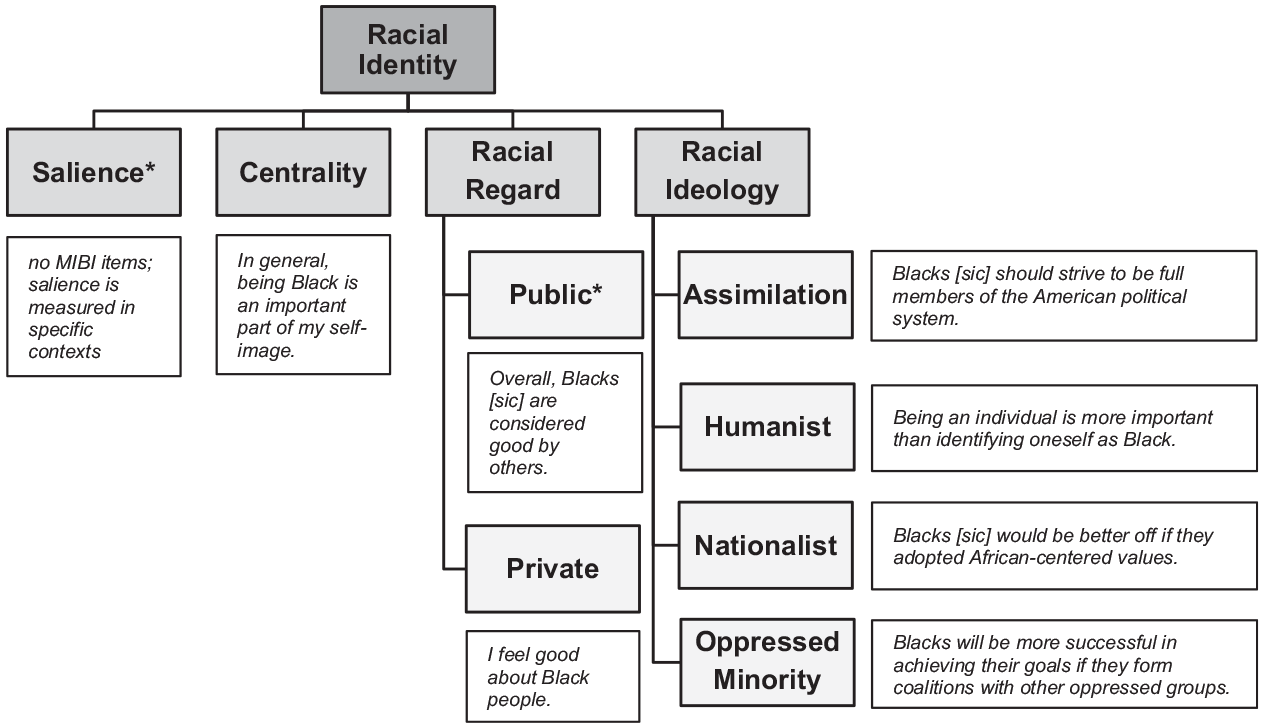
Representation of the Multidimensional Model of Racial Identity (MMRI) (Sellers et al., 1998) and corresponding items from the Multidimensional Inventory of Black Identity (MIBI) (Sellers et al., 1997).
Importantly, the MMRI suggests that racial identity attitudes are not only heterogeneous between Black individuals, but within a single individual; one's racial identity attitudes can vary across each MMRI dimension. In other words, an individual is neither ideologically “nationalist” nor “humanist,” but can have a comprehensive set of racial identity attitudes characterized, for example, as relatively low, medium, or high on any individual dimension of the MMRI. For instance, a Black educator may see race as a very important part of their self-definition (i.e., higher centrality) but have varying racial ideology views about “Blackness” in relation to their sociocultural engagements. To extrapolate, said educator might simultaneously center Blackness in their self-concept (high centrality) and place high value on commonalities among humans regardless of race (high humanist ideology), yet lack an ideological inclination toward coalition-building with other people of historically oppressed backgrounds (lower oppressed minority ideology). According to the MMRI, each of these dimensions of Black racial identity attitudes may independently relate to an individual's beliefs, dispositions, and behaviors. This individual variation on the MMRI dimensions can be captured in surveys using the MIBI.
A Conceptual Model of Associations Between Racial Identity Attitudes and Pedagogy
Drawing from decades of psychology scholarship on the heterogeneity of Black peoples’ self-perceptions, beliefs, and behaviors (e.g., Marks et al., 2004; Sellers et al., 1997; Zirkel & Johnson, 2016), I present and test a conceptual model (Figure 2) for examining within-racial group diversity in educators’ pedagogy. Using the MMRI (Sellers et al., 1998) as an example, this conceptual model centers racial identity attitudes as a necessary part of humanizing education discourse, policy, and practice—particularly regarding the work of Black educators and other often-homogenized, racialized educator groups (e.g., Asian Americans). Moreover, by using the MMRI's accompanying survey measure, the MIBI (Sellers et al., 1997), this study complements the rich history of qualitative research with Black educators (e.g., Foster, 1997; Irvine, 2002; C. D. Lee, 1992; Siddle Walker, 1996) as one of few studies using survey research and quantitative methods to learn from and uplift the pedagogical stories and life trajectories of a wider academic subject area and geographical range of Black educators.
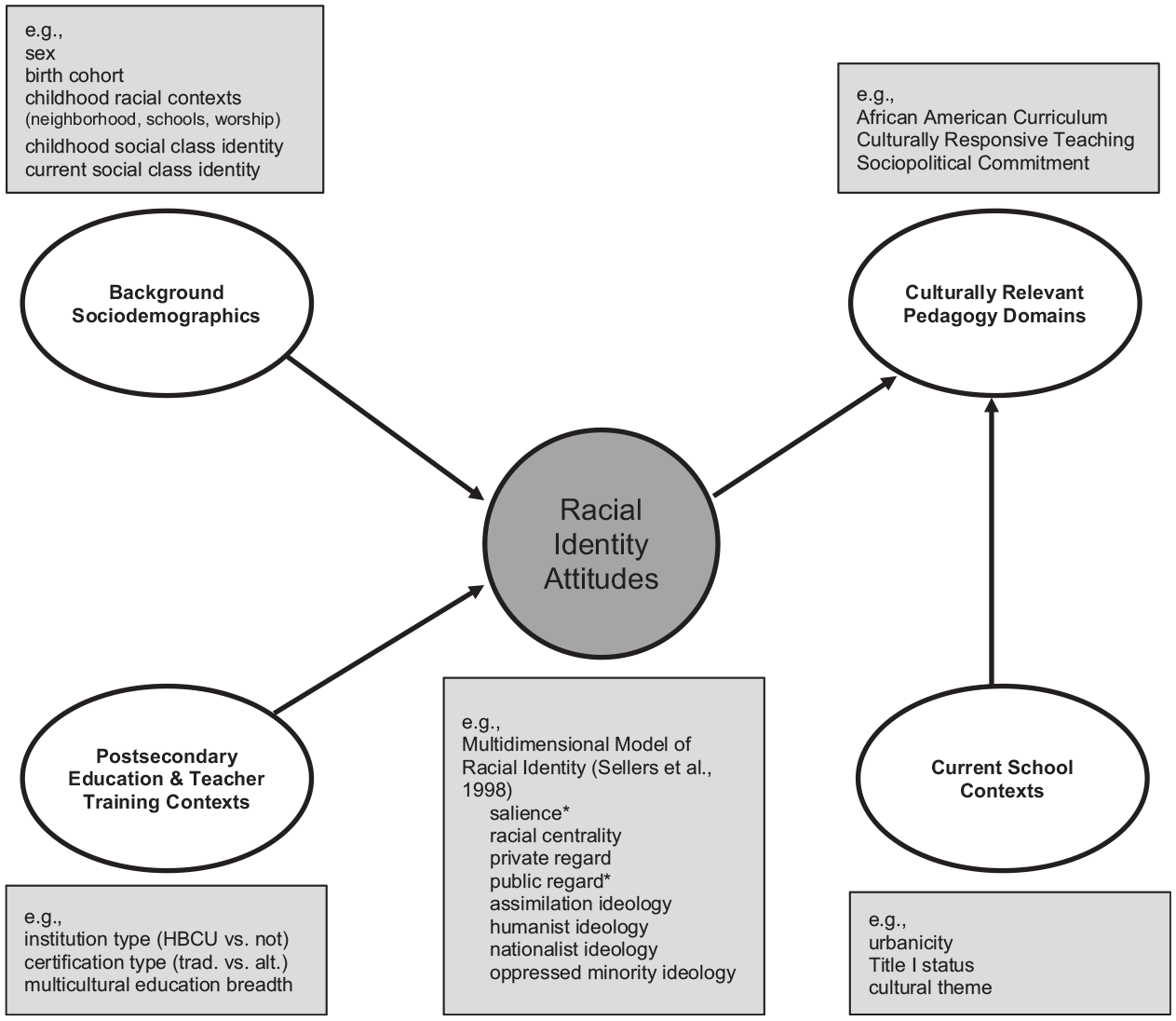
A conceptual model for examining within-race diversity in educators’ pedagogy.
Just one published study uses the MMRI as a theoretical framework to examine differences in Black educators’ racial identity attitudes and pedagogy (Durden et al., 2014). However, to date, no published studies have used the MIBI to directly query Black educators’ racial identity attitudes. In their qualitative study, Durden et al. (2014) use the MMRI to demonstrate how two Black preservice teachers with similar sociodemographic backgrounds (working-class, southern U.S. families), “Carla” (age 29) and “Ronald” (age 21), appear to have different racial identity attitudes along the MMRI's dimensions and concurrently exhibit divergent beliefs and pedagogy regarding race and culture. Carla is described as having a colorblind orientation toward race in the classroom, and as one who “did not address issues of oppression, prejudice, and stereotype [sic]” ( Durden et al., 2014, p. 1016). In contrast, Ronald, who is described as committed to integrating students’ cultures in the curriculum, “began to develop an ideology that was both nationalist (emphasizing the unique black [sic] experience) and oppressed minority (exploring culture of his [Hispanic] students). Arguably, the field and coursework experiences contribute to this racially transformative experience for Ronald” ( Durden et al., 2014, p. 1016). However, Durden and colleagues did not use the MIBI to directly study Ronald and Carla's racial identity attitudes—their own internalizations of what it means to “be Black,” vis-à-vis the MMRI's emphasis on phenomenological expressions of Blackness (Sellers et al., 1998). As such, the current study builds on Durden et al.’s work by using the MIBI to investigate associations between Black educators’self-defined racial identity attitudes and their pedagogy.
Diversity Within: Individual Differences and Black Educators’ CRP
While there is a dearth of education scholarship explicitly naming “racial identity” as part of understanding Black educator diversity, scholars have alluded to racial identity attitudes and other individual factors associated with within-race pedagogical differences. In her pioneering work with five Black and three White teachers, Ladson-Billings (1995) indirectly addresses an “elephant in the room” about teachers’ race and CRP, hinting at the possibility that other individual characteristics besides race may underlie their strengths-based pedagogies with Black students. She notes,
Another question that arises is whether or not this [culturally relevant] pedagogy is so idiosyncratic that only “certain” teachers can engage in it. I would argue that the diversity of these teachers and the variety of teaching strategies they employed challenge that notion. (Ladson-Billings, 1995, p. 484)
By highlighting the “diversity” of teachers and their “variety of teaching strategies,” it appears that Ladson-Billings is cautioning us against conceptions of CRP that narrowly assign the success of African American students to teachers of certain racial backgrounds, other personal characteristics, or specific manifestations of practice. Moreover, Ladson-Billings implicitly identified racial identity attitudes, “conceptions of self and others” (Ladson-Billings, 1995, p. 478), as a theoretical proposition of CRP. This nuanced proposition about identity conceptions underlying CRP has been insufficiently investigated— whether with Black or other educators.
However, scholars in psychology and family studies have long studied associations between Black parents’ racial identity attitudes and childrearing beliefs and practices that involve race and culture, or parental racial socialization (Branch & Newcombe, 1986; Demo & Hughes, 1990; White-Johnson et al., 2010). Parental racial socialization is a process by which caregivers transmit valued cultural strengths and also prepare their children to cope with, respond to, and be resilient in the face of negative race-related experiences (e.g., discrimination) (Bowman & Howard, 1985; Hughes & Chen, 1997; Hughes et al., 2006). Studies show that differences in Black parents’ racial identity attitudes help to explain which parents may provide their children with more or less African American cultural artifacts and experiences, such as books with Black protagonists, or outings to African American cultural institutions and events (Cooper et al., 2015; Scottham & Smalls, 2009; Thomas & Speight, 1999; White-Johnson et al., 2010). Moreover, a few parental racial socialization studies employing the MMRI and MIBI reveal that higher centrality and higher private regard among Black female (Scottham & Smalls, 2009; White-Johnson et al., 2010) and Black male (Cooper et al., 2015) caregivers are associated with more frequent cultural socialization messages and behaviors. White-Johnson et al. (2010) also found a positive association between higher nationalist ideology and frequency of parental racial socialization among Black mothers. I suggest that research on Black parents’ racial identity attitudes and parental racial socialization serves as an analogue for understanding potential associations between Black educators’ racial identity attitudes and CRP.
Operationalizing CRP and Within-Race Diversity Factors for Survey Research
Given the dearth of quantitative research on Black educators’ pedagogy, it was first necessary to operationalize CRP and other constructs in the proposed model (Figure 2) in a manner amenable to survey research. As discussed, CRP is not a prescriptive set of instructional practices; educators employ a “variety of teaching strategies” (Ladson-Billings, 1995, p. 484) to support Black children's well-being and academic success. Still, Ladson-Billings identified common characteristics underlying the pedagogy of the eight educators in her landmark dreamkeepers study (Ladson-Billings, 1994). I used these commonalities and other scholarship (e.g., Foster, 1997; Irvine, 2002; Siddle Walker, 1996) to inform my CRP operationalizations.
First, the dreamkeepers (Ladson-Billings, 1994) viewed African American culture and African American students’ cultural expertise as valuable knowledge that can be leveraged to support their learning and success. Consequently, they included curriculum content and mores of the African diaspora in their classrooms (Foster, 1997; C. D. Lee, 1992; Lomotey, 1992); I label and operationalize this CRP domain as “African American Curriculum”. Second, they tended to “the manner in which social relations are structured” (Ladson-Billings, 1995, p. 478) in their classrooms, schools, and communities; they approached relationships as communal rather than distant and hierarchical, using culturally congruent communication as a key lever of social connection. This second CRP domain is characterized as “Culturally Responsive Teaching” because it aligns with Gay’s (2000) definition of using students’“prior experiences, frames of reference, and performance styles … to make learning encounters more relevant and effective for them” (Gay, 2000, p. 31). Third, the dreamkeepers showed a commitment to teaching African American students in order to reach their highest potential, often going “beyond the call of duty” (Case, 1997; Irvine, 1989) while maintaining the students’ sense of cultural integrity and sociopolitical commitment to African American communities (Bakari, 2003; Foster, 1993; Robinson, 1978). Henceforth, I label and operationalize this last CRP domain as “Sociopolitical Commitment”.
While this study primarily focuses on associations between Black educators’ racial identity attitudes and within-race CRP diversity, when considering within-race differences it is important to consider the ways in which other identities and lived experiences contribute to and help to illuminate such diversity. As illustrated in Figure 2, background sociodemographics (e.g., childhood environment) and education contexts (i.e., where one is trained and where one teaches) play a role in one's accumulation of culturally relevant knowledge, attitudes, and skills. Consequently, I operationalize and explore multiple “background sociodemographics” and “education contexts” factors described in the literature as potential contributors to within-race differences in Black educators’ beliefs and behaviors. While the variables used are certainly not exhaustive of the universe of factors contributing to the complex individualities of Black educators—or educators of any group—they were thoughtfully selected from the literature and available measures to represent key elements of individuals’ lived experiences in the distant past (childhood), more recent past (college and teacher training), and present (teaching contexts).
Background Sociodemographics
Black educators’ childhood contexts determine the cultural and racial socialization they receive (Foster, 1993; Lesane-Brown, 2006), thereby influencing their racial identity attitudes (Demo & Hughes, 1990; Neblett et al., 2009; Thornton et al., 1990). Such early life experiences also directly relate to pedagogy by providing tangible, memorable examples of practices that facilitated one's own success. For example, scholars document the ways in which Black educators raised in predominantly Black environments (e.g., neighborhoods, schools, faith institutions) draw on lived experiences with family, teachers, and community members as models of how to emphasize race, culture, and support student success (Foster, 1993; Lesane-Brown, 2006; Nettles, 2013). Studies by Rist (1970) and Tyson (2003) suggest that Black educators identifying as middle class adults may be less disposed toward CRP; as such, it is important to investigate both childhood and adulthood social class. In addition, studies suggest that Black educators’ gender identities (Beauboeuf-Lafontant, 2002; Case, 1997; Dixson, 2003; Lewis & Toldson, 2013) and age/birth cohort (Case, 1997; Mabokela & Madsen, 2003) may systematically relate to differences in pedagogy.
Education Contexts
Postsecondary education and teacher training
Black educators’ postsecondary education and teacher training may be associated with their racial attitudes and pedagogy. Studies show differences in racial identity (Rowley, 2000; Sellers et al., 1997; Steinfeldt et al., 2010) and race-related beliefs (Chavous et al., 2004; Marbach-Ad & McGinnis, 2008) between Black college students attending historically black colleges and universities (HBCUs) and Predominantly White institutions (PWIs). For instance, Sellers and colleagues (1997) found that centrality was similar among undergraduates attending an HBCU or PWI, but mean differences emerged for private regard and the four racial ideologies. Nationalist ideology was higher, but private regard and the other three ideologies (assimilation, humanist, and oppressed minority) were lower among African American students at an HBCU versus a PWI. In one study, Bakari (2003) found that HBCU students expressed a greater commitment to teaching African American children than commitment to teaching in general. Although there is much variability within and across HBCUs and PWIs—on average, each type may foster racial attitudes with a lasting influence on educators’ pedagogy (Gasman et al., 2017; Liddell & Talpede, 2014).
While ideally, teacher training experiences help to increase educators’ preparedness to teach African American (and other) children, research shows mixed results (Burciaga & Kohli, 2018). For example, the impact of multicultural education coursework on pedagogy among educators of color is unclear (Montecinos, 2004). There is also debate about the extent to which traditional versus alternative teacher certification routes prepare educators to teach in culturally relevant ways. Some suggest that traditional university-based teacher preparation programs are better positioned than alternative preparation programs to prepare educators overall, especially in relation to issues of race, culture, and equity (e.g., Faison & McArthur, 2020). Others report no difference in outcomes among educators trained through traditional versus alternative routes (Lapayese et al., 2014). Nevertheless, few (if any) studies examine pedagogical differences between groups of Black educators based on their postsecondary education and training experiences.
Current school contexts
To the extent that Black educators want to teach in culturally relevant ways, they are challenged to exercise agency in their classrooms despite these approaches being considered by some as “against the grain” or too difficult to implement (Milner, 2006; Sleeter, 2012). Some school context factors that may play a role in Black educators’ pedagogy include whether or not the school has an explicit focus on race and culture (e.g., African-centered institutions) (C. D. Lee, 1992; Lomotey, 1992), the school's urbanicity (Irvine, 1988; Love & Kruger, 2005), and the average economic status of families in the community (e.g., Title I status). For instance, by definition, Black educators in African-centered schools are primed to include culture throughout the curriculum and exercise their sociopolitical commitments to people of African descent (C. D. Lee, 1992; Lomotey, 1992); however, in other school environments—regardless of their sociopolitical leanings—Black educators may be less inclined to similarly augment the curriculum (Mabokela & Madsen, 2003; Madsen & Hollins, 2000).
Research Questions and Hypotheses
I quantitatively examine the following questions regarding associations between Black educators’ racial identity attitudes and CRP: (a) To what extent do racial identity attitudes help to illuminate individual diversity in Black educators’ CRP? and (b) After accounting for racial identity attitudes, to what extent do background sociodemographics (e.g., childhood social class identity) and education context factors (e.g., postsecondary education and current school characteristics) relate to individual differences in Black educators’ CRP?
On the question of the role of racial identity attitudes in Black educators’ CRP, the study also includes subordinate exploratory questions: (a) Do dimensions of Black racial identity collectively predict individual variation in each culturally relevant pedagogy domain (African American Curriculum, Culturally Responsive Teaching, and Sociopolitical Commitment)? and (b) Do associations between each dimension of racial identity attitudes (centrality, private regard, four ideologies) vary across domains of culturally relevant pedagogy (African American Curriculum, Culturally Responsive Teaching, and Sociopolitical Commitment)?
Given relationships implied in aforementioned qualitative studies (e.g., Foster, 1997; Ladson-Billings, 1995), I anticipate that dimensions of Black racial identity will collectively predict individual variation on each CRP domain. Additionally, based on MMRI/MIBI findings with Black parents (Scottham & Smalls, 2009; White-Johnson et al., 2010), I hypothesize that centrality, private regard, and nationalist ideology are positively associated with the African American Curriculum domain of CRP. I also anticipate a positive association between oppressed minority ideology and Culturally Responsive Teaching; this racial identity dimension emphasizes commonalities among oppressed racial-ethnic groups (Sellers et al., 1997, 1998). Theoretically, a Black educator with higher oppressed minority ideology may be more responsive to students’ needs along multiple identities (e.g., cultural, linguistic, religious), as captured by the Culturally Responsive Teaching measure. In contrast, I anticipate a negative association for assimilation ideology, and no significant associations for oppressed minority or humanist ideology (commonalities among humans regardless of race) with the two CRP domains centered on African American culture/students (African American Curriculum, Sociopolitical Commitment).
On the question of the role of background sociodemographics and education contexts on CRP after considering racial identity attitudes, there is limited supporting literature disentangling specific factors. As such, through exploratory analyses I account for some of the factors noted earlier to uncover specific associations and motivate more in-depth future research.
Method
Participant Recruitment, Data Collection, and Data Preparation
The National Survey of Black Teachers (NSBT) (Mustafaa, 2014) was approved by the author's Institutional Review Board at the time of the study. Participants were recruited via an online interest form and in-person via handbills at a national educator conference. The online form was sent to educators with publicly available, verifiable district email addresses (i.e., often including “k12….us” and/or ending in “.edu”) and snowballing with individual contacts (Sadler et al., 2010) in K–12 education, resulting in 173 prospective online participants. Twenty-one did not meet the primary study criteria (i.e., identified as a Black educator in a K–12 school), leaving 152 potential online participants. The survey response rate among eligible online recruits was 43.4% (N = 66). Another 172 Black educators completed the survey at the conference, resulting in 238 participants. Computing a response rate for in-person participants was impossible; the number of individuals who received the conference recruitment message from others is unknown. Survey completion averaged about 30 minutes, and participants received a $20 gift card incentive in-person or via mail within 15 business days. Table 1 shows participant descriptives.
Individual Background Sociodemographics and Education Context Factors
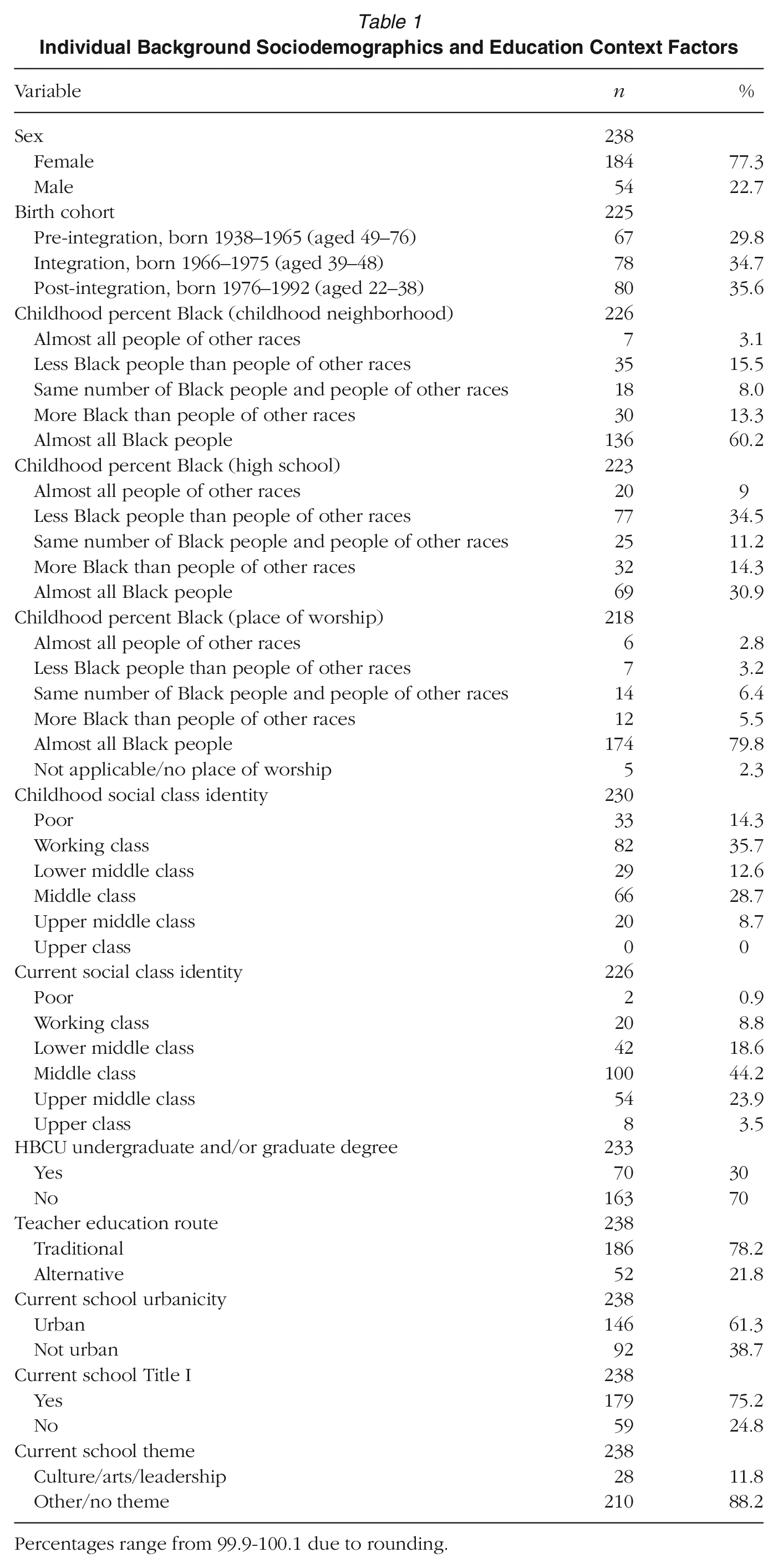
Percentages range from 99.9-100.1 due to rounding.
Measures
Culturally Relevant Pedagogy Outcome Measures
African American Curriculum
The African American Curriculum measure was adapted from the “Socialization Behaviors” subscale of the Racial Socialization Questionnaire-Parent (RSQ-P) (Lesane-Brown et al., 2008). The RSQ-P assesses how often Black parents initiate behaviors or communicate messages to prepare their child(ren) for engagement in a racialized society. Thus, African American Curriculum items were adapted from a parent/home context to a teacher/school context. Five items measured the frequency of Black educators’ use of resources and activities involving African American/Black people, culture, and artifacts over the past school year (1 = never, 2 = once or twice, 3 = more than twice). For example, “In the past school year, how often have you purchased/ordered, borrowed, or used books about Black people in your classroom?” Individuals’ responses to the five African American Curriculum items were averaged to create scale scores ranging from 1 to 3. With a Cronbach's alpha of .76, internal consistency was strong among the five items.
Culturally Responsive Teaching
I modified Siwatu’s (2007) 40-item Culturally Responsive Teaching Self-Efficacy (CRTSE) scale—which focuses on teachers’ Culturally Responsive Teaching self-efficacy—to measure Culturally Responsive Teaching practices. I first used principal components analysis (PCA) to assess whether the 40 items factored according to Gay’s (2000) five dimensions of Culturally Responsive Teaching. Since no interpretable factors were extracted with the current data (nor Siwatu’s [2007] study with 275 preservice teachers), I concluded that a single-factor solution best fit the data. However, though Siwatu proceeded with 40 items as one construct, they noted that the CRTSE instrument was theoretically founded on Culturally Responsive Teaching (Gay, 2000), and the items conceptually reflect each of the five dimensions (Knowledge, Curriculum, Community, Communi-caion, and Instruction). Thus, I further examined whether there was empirical support for using the 40 items as five distinct subscales. I conducted five separate confirmatory factor analyses (CFA) with each subset of items to test empirical fit under the hypothesized five latent constructs/dimensions.
Before running the CFAs, I used a process of expert validation to establish content validity of my modified version of Siwatu’s (2007) scale (Appendix A in the online version of the journal). First, I conceptually sorted each item under one of the five Culturally Responsive Teaching dimensions. Second, I used Grant and Davis's (1997) guidelines to recruit three content experts to evaluate the validity of my initial sorting. Each expert was provided with summaries of Gay's definitions for the five dimensions (Gay, 2000) alongside the 40 presorted items. Experts were asked to resort any items as they saw fit, and they were also given the option to place items in a sixth “does not fit anywhere” category. Third, my own sorting and those of the three experts were charted to examine the proportion of substantive agreement (Anderson & Gerbing, 1991)—a ratio of the number of experts who assigned an item to a particular category, over the total number of experts (n/N). In general, items with 75% agreement or better were kept under the respective dimension (including the “does not fit anywhere” category). I then used the experts’ rationales for resorting and made executive decisions about where to place items with 50% agreement or less. Comments were also used to decide which items should be deleted. Overall, 33 items were retained from the original 40 Culturally Responsive Teaching items, with 5 under Knowledge, 5 under Curriculum, 10 under Community, 5 under Communication, and 8 under Instruction.
Using structural equation modeling in Stata, I conducted a CFA for all five sets of Culturally Responsive Teaching items. I examined standardized factor loadings, comparative fit indexes (CFIs), Chi square, and root mean squared error of approximation (RMSEA) for each single-factor CFA. Standardized factor loadings above .4, and ideally closer to .7 (Kline, 2011) were considered evidence that the item shares meaningful variance with its respective factor. CFIs above .9 were desired to indicate that the items for each hypothesized subscale fit well together in comparison to a null model whereby the items are unrelated. Chi square test results were examined to determine whether or not the null hypothesis that the model fits should be rejected. A Chi square probability greater than .05 for each CFA was desirable (i.e., do not reject the null, model fits). Finally, RMSEAs below .05 were deemed ideal as this benchmark suggests efficient model specification.
While most of the item loadings for each latent factor were above .4, only the items capturing the Communication dimension of Culturally Responsive Teaching demonstrated adequate model fit. Thus, I considered the CFA results in conjunction with earlier exploratory factor analysis (EFA) results to suggest that the Culturally Responsive Teaching items measure a single construct (versus five latent constructs) in the current data. As a result, the 33 items were averaged to create a composite Culturally Responsive Teaching outcome variable. Items were rated strongly disagree (1) to strongly agree (5), and individuals’ responses were averaged to create a scale score (α = .95); higher scores indicate stronger inclinations toward Culturally Responsive Teaching (e.g., “I obtain information about my students’ cultural background”; “I revise instructional material to include a better representation of cultural groups”).
Sociopolitical Commitment
Sociopolitical Commitment was assessed using nine items scaled very strongly disagree (1) to very strongly agree (6) from the Willingness to Teach African American Students (WTAAS) subscale of the Teaching African American Students Scale (TAASS) (Bakari, 2003). A sample Sociopolitical Commitment item is, “I feel personally invested in helping African American/Black children achieve.” The nine WTAAS items were averaged to create a Sociopolitical Commitment score (α = .81). A higher Sociopolitical Commitment score suggests greater ideological support for teaching African American students and for supporting African American students’ sociopolitical commitment to their communities.
Racial Identity Attitude Predictors
Racial identity attitudes were measured using the Centrality, Private Regard, and four ideology (Assimilation, Humanist, Oppressed Minority, and Nationalist) subscales of the MIBI (Sellers et al., 1997). Participants indicated the extent to which they agreed with each item on a 7-point scale from strongly disagree (1) to strongly agree (7). Centrality (eight items) captures the extent to which an individual's self-concept is defined relative to race (e.g., “In general, being Black is an important part of my self-image”). Private Regard (six items) is how positively or negatively the individual feels toward African Americans, including affective attitudes about group membership (e.g., “I feel good about Black people”). Cronbach's alphas for Centrality and Private Regard were .68 and .71, respectively.
The four MIBI ideology subscales reflect an individual's beliefs, attitudes, and opinions about how they feel Black people should behave. Assimilation ideology (nine items) emphasizes commonalities between Black people and mainstream American society (e.g., “Blacks [sic] should try to work within the system to achieve their political and economic goals”). Humanist ideology (four items) highlights the importance of commonalities among different groups of people, regardless of race (e.g., “Being an individual is more important than identifying oneself as Black”). Nationalist ideology (nine items) focuses on the importance and uniqueness of being Black (e.g., “Blacks would be better off if they adopted Afrocentric values”). Finally, Oppressed Minority ideology (nine items) includes viewpoints emphasizing commonalities between Black people and members of other historically marginalized groups (e.g., “Black people should treat other oppressed people as allies”). Cronbach's alphas for the four MIBI ideology subscales were .62 (Assimilation), .59 (Humanist), .69 (Nationalist), and .72 (Oppressed Minority).
Background Sociodemographic Predictors
Participants provided demographic information including sex: female (1) and male (0); birth cohort: 1 Segregation, Born 1938-1965 (1), Integration, Born 1966-1975 (2), and Post-Integration, Born 1976-1992 (3); racial demographics of one's childhood neighborhood, high school, and place of worship: scaled almost all people of other races (1); less Black people than people of other races (2); same number of Black people and people of other races (3); more Black than people of other races (4); and almost all Black people (5); and childhood social class identity and current social class identity, both scaled poor (1), working class (2), lower middle class (3), middle class (4), upper middle class (5), upper class (6) (Ostrove & Long, 2007).
Education Context Predictors
Postsecondary education and teacher training
Participants were asked whether they obtained any degree from an HBCU (HBCU = 1, non-HBCU = 0); their teacher training type (traditional/university = 1, alternative = 0); and about their multicultural education professional development experiences. Multicultural Education breadth was measured using a 14-item modified version of the “Professional Preparation” subscale of Barry and Lechner's (1995) Attitudes and Awareness of Multicultural Teaching and Learning Measure. Items were scaled from strongly agree (1) to strongly disagree (5) and were reverse-coded and averaged for each individual (α = .95), with higher scale scores suggesting greater breadth of exposure to multicultural education ideals through coursework and other professional development experiences. An example item is, “My professional education courses have presented me with techniques for bringing a variety of cultures into the classroom.”
Current school
Participants provided demographic information about their school contexts at the time of the survey, coded urbanicity (urban = 1, nonurban = 0), Title I status (Title I = 1, non–Title I = 0), and school theme (cultural theme = 1, non-cultural = 0).
Results
Preliminary Analyses
Table 2 shows descriptives and correlations for continuous predictor and outcome measures. All variables are mean composites, and reliability estimates are reported for each scale or subscale. Of note are significant correlations between five of six racial identity attitude variables with Sociopolitical Commitment, and significant correlations between multicultural education breadth and two of the CRP outcome variables. Also, assimilation ideology is the only racial identity attitude dimension not significantly correlated with any of the CRP outcome variables. Supplementary Tables 5 through 7 in the online version of the journal show mean differences (t-tests and analyses of variance [ANOVAs]) on each CRP outcome by each categorical predictor variable in Table 1. There were no significant mean differences on any of the three CRP outcome variables (African American Curriculum, Culturally Responsive Teaching, Sociopolitical Commitment) by sex; birth cohort; childhood racial context-neighborhood; childhood racial context-place of worship; HBCU graduate status; and current social class identity. However, there were significant individual differences on CRP based on childhood social class identity; childhood racial context-high school; teacher training route; and the three current school context variables (urban, Title I status, cultural theme). Due to the significant covariance with the outcome variables, the latter exploratory variables were entered as predictors/controls in the forthcoming regression models.
Descriptive Statistics and Correlations for Continuous Study Variables
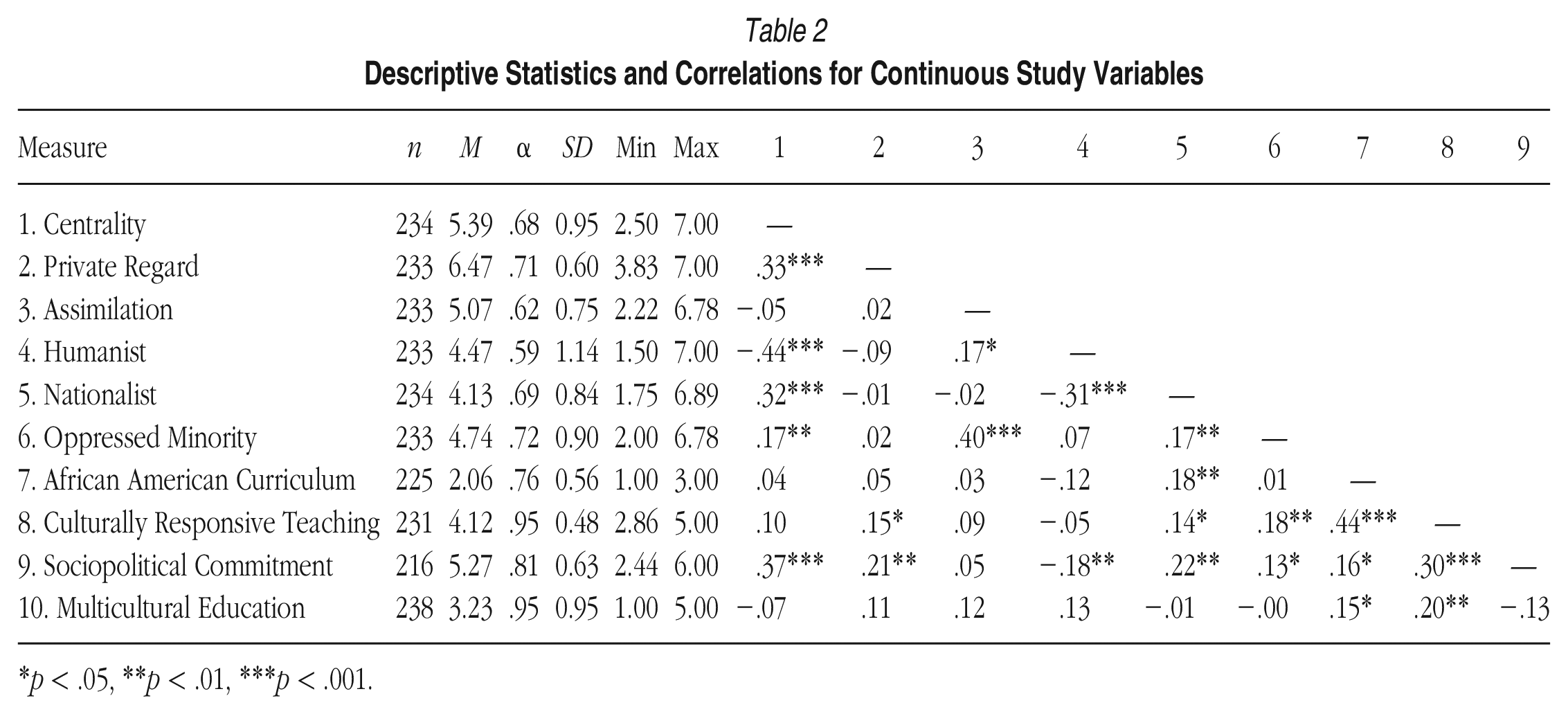
p < .05, **p < .01, ***p < .001.
Hierarchical Regression Models
To examine the hypothesized associations between racial identity attitudes, background sociodemographics, and education contexts (postsecondary and current) with three domains of CRP, three hierarchical regression models with four blocks/steps each were run. The first step included racial identity attitude variables; the second, background sociodemographics; the third, postsecondary context; and the fourth, current school context. Consistent with recommendations by Cohen et al. (2003), variables were entered according to causal priority, emphasizing relationships between the primary independent variables (IVs) of interest (Black racial identity attitudes, Step 1) and each CRP dependent variable. By entering the sociodemographic variables (Steps 2–4) after the primary IVs, “the statistical power of the test of the major hypothesis is likely to be maximal because the df are not deflated” (Cohen et al., 2003, p. 160). Moreover, the change statistics for each block (Table 3) help to demonstrate the empirical “value added” of each step toward understanding within-group CRP heterogeneity.
Hierarchical Regression Change Statistics
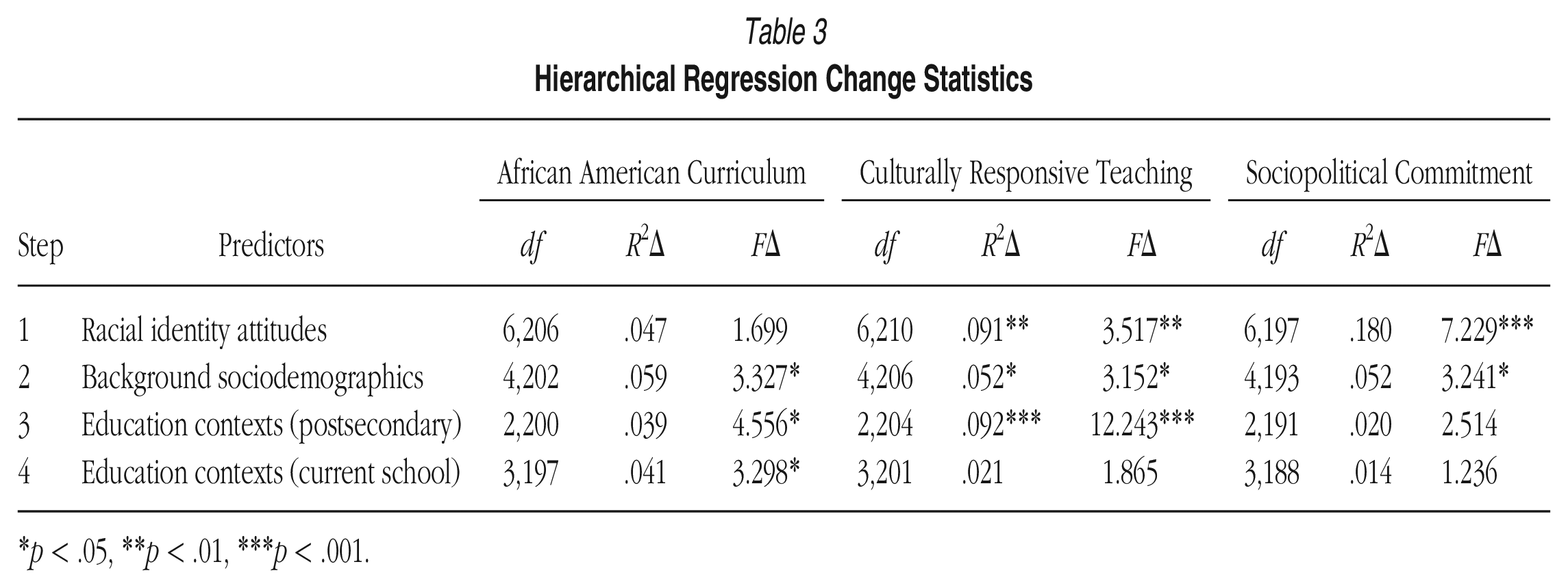
p < .05, **p < .01, ***p < .001.
African American Curriculum
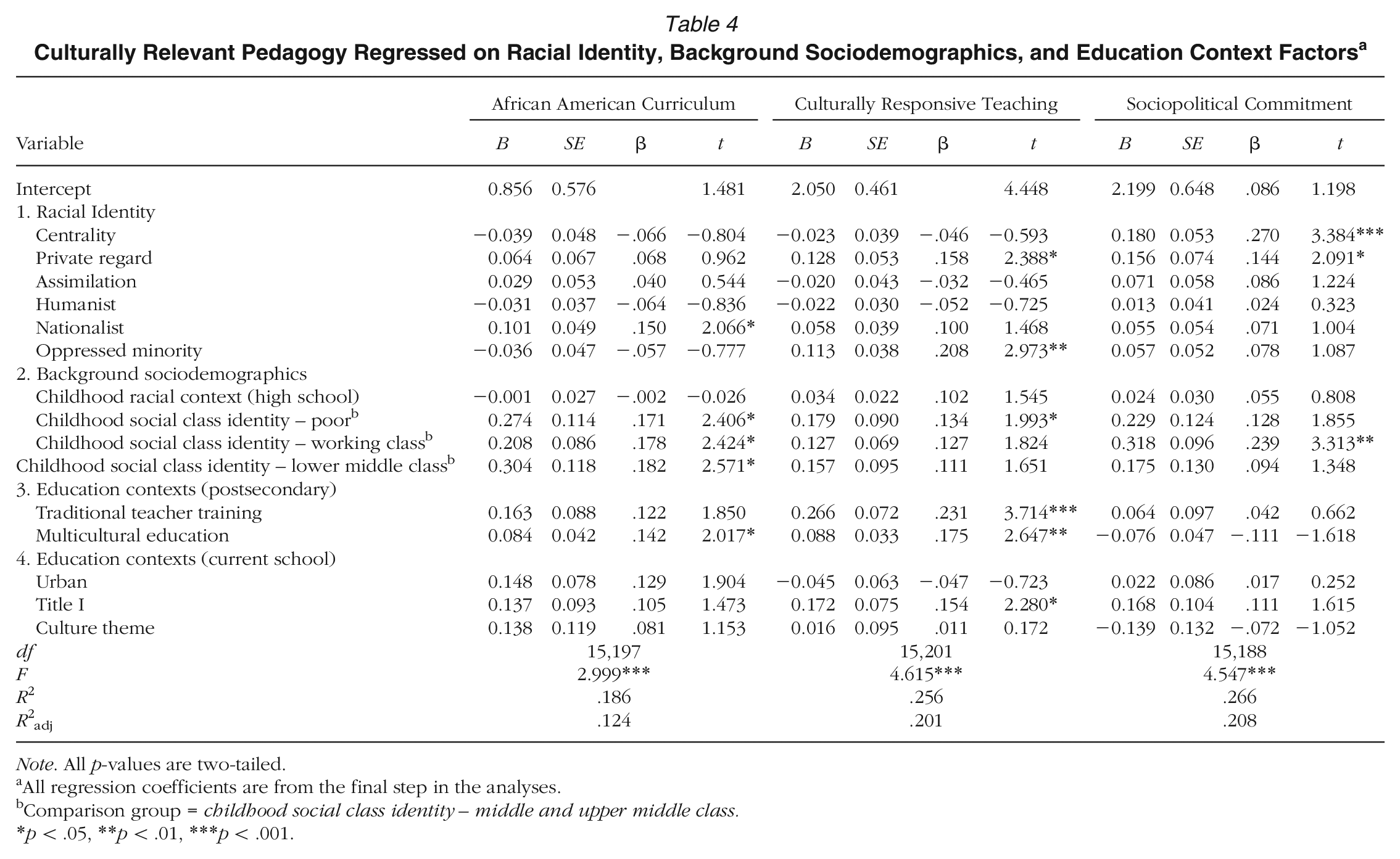
The racial identity attitudes block (Step 1) did not explain Black educators’African American Curriculum use F(6,206) = 1.699, p = .123, R2 = .047. Adding background sociodemographics (Step 2), ΔF(4,202) = 3.327, p = .012, ΔR2 = .059; postsecondary education context (Step 3), ΔF(2,200) = 4.556, p = .012, ΔR2 = .039; and current school context factors (Step 4), ΔF(3,197) = 3.298, p = .022, ΔR2 = .041, showed significant improvement over the model with racial identity attitudes only (Step 1). The final model (Table 4) explained 18.6% of the individual variance (R2adj = .124) in African American Curriculum use, F(15,197) = 2.999, p < .001, R2 = .186, among Black educators in the study.
Culturally Relevant Pedagogy Regressed on Racial Identity, Background Sociodemographics, and Education Context Factors a
Note. All p-values are two-tailed.
All regression coefficients are from the final step in the analyses.
Comparison group = childhood social class identity – middle and upper middle class.
p < .05, **p < .01, ***p < .001.
While the racial identity attitude block (Step 1) as a whole did not predict African American Curriculum use, at the univariate level nationalist ideology (B = .10, t = 2.066 p = .040) was positively associated. Among the nine sociodemographic and education context variables explored (Steps 2–4), childhood social class identity and multicultural education breadth were significantly associated with African American Curriculum. First, childhood social class identity – poor (B = .274, t = 2.406, p = .017), childhood social class identity – working class (B = .208, t = 2.424, p = .016), and childhood social class identity – lower middle class (B = .304, t = 2.571, p = .011), were positively associated with African American Curriculum use relative to the middle/upper middle class reference group. Second, multicultural education breadth (B = .084, t = 2.017, p = .045) was positively associated with African American Curriculum.
Culturally Responsive Teaching
The racial identity attitudes (Step 1) block was significant for Culturally Responsive Teaching, F(6,210) = 3.517, p = .002, R2 = .091. Both background sociodemographics (Step 2), ΔF(4,206) = 3.152, p = .015, ΔR2 = .052; and postsecondary education context variables (Step 3), ΔF(2,204) = 12.243, p < .001, ΔR2 = .092, were also significantly associated with Culturally Responsive Teaching. However, the current school context block (Step 4), ΔF(3,201) = 1.865, p = .137, ΔR2 = .021, did not add to the individual variance explained. The full model (Table 4) accounted for 25.6% of the individual variance (R2adj = .201) in Culturally Responsive Teaching as measured in the current study, F(15,201) = 4.615, p < .001, R2 = .256.
Among the racial identity attitude variables, private regard (B = .128, t = 2.388, p = .018) and oppressed minority ideology (B = .113, t = 2.973, p = .003) were positively associated with Black educators’Culturally Responsive Teaching. Relative to the reference group (childhood social class-middle/upper middle class), childhood social class identity – poor (B = .179, t = 1.993, p = .048) was more positively associated with Culturally Responsive Teaching. Additionally, both training context variables—traditional teacher training (B = .266, t = 3.714, p < .001) and multicultural education breadth (B = .088, t = 2.647, p = .009)—were positively associated with Culturally Responsive Teaching. While the three-variable current school context block (Step 4) as a whole did not add to variance explained, at the univariate level, teaching in a Title I school (B = .172, t = 2.280, p = .024) was positively associated with Culturally Responsive Teaching.
Sociopolitical Commitment
As with Culturally Responsive Teaching, the racial identity attitudes block (Step 1) was significant, F(6,197) = 7.229, p < .001, R2 = .180. Background sociodemographics (Step 2) improved variance explained in Black educators’Sociopolitical Commitment, ΔF(4,193) = 3.241, p = .013, ΔR2 = .052. In contrast, the postsecondary education context (Step 3), ΔF(2,191) = 2.514, p = .084, ΔR2 = .020; and current school context (Step 4), ΔF(3,188) = 1.236, p = .298, ΔR2 = .014, blocks did not show improvement in variance explained. The full model (Table 4) explained 26.6% of the variance (R2adj = .208) in Sociopolitical Commitment among Black educators, F(15,188) = 4.547, p < .001, R2 = .266.
Among the six racial identity attitude variables (Step 1), centrality (B = .180, t = 3.384, p < .001) and private regard (B = .156, t = 2.091, p = .038) were positively associated with Sociopolitical Commitment. Among the background sociodemographic and education context variables (Steps 2–4), childhood social class identity – working class (B = .318, t = 3.313, p = .001) was the only significant predictor of Sociopolitical Commitment.
Discussion
In sum, I found support for my overarching hypotheses—that racial identity attitudes, background sociodemographics, and education contexts (postsecondary education, teacher training, and current school) collectively illuminate individual differences in Black educators’ inclinations toward three domains of CRP. First, at least one of the six dimensions of racial identity attitudes as measured by the MIBI (Sellers et al., 1997) was significantly associated with each of the three CRP domains. Second, after accounting for racial identity attitudes, the exploratory analyses revealed individual differences across the CRP domains based on Black educators’ sociodemographic backgrounds and education contexts. However, childhood social class identity was the only background/context factor (out of nine exploratory variables) that predicted all three domains of CRP (see Table 4). These findings are expanded upon below.
Racial Identity Attitudes and Individual Differences Across Three CRP Domains
In hypothesizing the extent to which racial identity attitudes relate to each CRP domain, I expected positive associations between centrality and nationalist ideology with African American Curriculum use. While results showed that centrality was not related, higher nationalist ideology was associated with Black educators providing more frequent access to Black books, toys, field trips, and cultural experiences. Research on the work of Black educators and school leaders in African Centered Education (C. D. Lee, 1992; Shockley & Cleveland, 2011) support the notion that Black educators who center history and culture of the African diaspora in their teaching are those whose racial identities are rooted in the uniqueness of Black people's lived experiences (i.e., higher nationalist ideology). Similarly, more recent work on Black educators who explicitly seek professional learning and support communities around the broader interests of Black people also suggests that these educators may already arrive ideologically disposed to integrate African American culture in the curriculum (S. J. Lee & Thomas, 2022).
Future research should explore the extent to which higher nationalist ideology may show up through some Black educators’ practical beliefs and behaviors that support the well-being of Black people and, in turn, support Black educators themselves. Black educators with higher nationalist ideology may be more prone to seek support in communities of practice where like-minded peers help to fortify their pedagogy, socioemotional well-being, and thereby support their retention (e.g., Lisle-Johnson & Kohli, 2020). For example, building off of ross’s (2020)“Black educational fugitive space,”Stovall and Mosely (2022) describe the Black Teacher Project (BTP) as a Black teacher fugitive space, “an intergenerational space that brings together Black teachers who are focused on healing from internalized antiblackness and working towards Black liberation” (p. 4). More resources should be directed toward such initiatives, which play an integral role in nurturing and sustaining a critical, culturally grounded subset of Black educators.
Two racial identity dimensions, centrality and private regard, were positively associated with individual differences in Black educators’ Sociopolitical Commitment. In scholarship where community nomination is used as a means to identify Black educators who exemplify Sociopolitical Commitment (Foster, 1997; Howard, 2001; Ladson-Billings, 1994), it is possible that race was highly central to those educators’ sense of self, and these educators likely had positive affect (i.e., higher private regard) toward their racial group; these characterizations are congruent with common narratives about Black educators. But a contrasting possibility—that lower centrality and lower private regard predict lower Sociopolitical Commitment—can also be inferred by correlational results, further illuminating the value of using psychological measures and quantitative research to tap into educators’ racial identity attitudes and pedagogical beliefs.
While social desirability is an ever-present issue in research, with survey research we have an opportunity to examine latent beliefs and underlying mechanisms that might be impossible, difficult, and stigmatized within qualitative research. For example, in interviews, few Black educators would verbally express a low sense of identification with Black people (lower centrality) and concurrently express relatively low commitment to Black students and communities. However, through a battery of survey measures, we have unique opportunities to examine potential underpinnings of educators’ practice. That being said, while robust relative to many statistical models in social science research, with “acceptable”R2s as low as .1 (Ozili, 2023), the ordinary least squares (OLS) models in this study explain 20% or less of the variance in each CRP domain (see Table 4); this reiterates the importance of multiple lenses and methodologies—including community nomination (Foster, 1997) and qualitative research—in ongoing research on pedagogical diversity among Black educators and within other educator groups.
Lastly, I found that both private regard and oppressed minority ideology were positively associated with Culturally Responsive Teaching. As a reminder, private regard is the dimension of the MMRI/MIBI capturing an individual's affective connection to, and attitudes toward, Black people as a group (e.g., “I feel good about Black people”) (Sellers et al., 1997); and oppressed minority ideology is concerned with commonalities between Black people and other historically oppressed groups. Like oppressed minority ideology, the operationalization of Culturally Responsive Teaching measures educators’ responsiveness and attempts to counter structural biases impacting their students based on multiple identities including culture, language, and nationality. As the findings suggest, while having a relatively strong affinity toward one's own group (private regard) might support an educators’ likelihood of being culturally responsive to students of many different backgrounds, greater identification with oppressions across multiple groups (oppressed minority ideology) is also important. Future studies that aim to illuminate the “black box” of Black educator effects with students of their own and other racial groups might consider the possibility of measuring multiple dimensions of racial identity attitudes or using other indicators of within-race diversity to further unpack precisely which educators might be driving the results. For example, studies with Black educators like Cherng and Halpin's (2016)—which show positive outcomes among children of different races—could be further unpacked by understanding the extent to which the oppressed minority ideology dimension of Black racial identity may play a role. Likewise, future research with educators of other backgrounds (e.g., Latino/a/x) might benefit from including analogous measures of racial-ethnic identity attitudes that help to better account for relevant within-group pedagogical differences related to race, indigeneity, and bilingualism, for example.
In the next section, I discuss background sociodemographic and education context factors that—in addition to racial identity attitudes—further disentangle diversity among Black educators in relation to their employment of three domains of CRP.
Exploratory Associations of Background Sociodemographics and Educational Contexts With CRP, Accounting for Racial Identity Attitudes
Among nine sociodemographic and education context variables explored, childhood social class was the only factor significantly associated with all three CRP domains. As Black educators’ childhood social class identities increased from “poor” to “middle class/upper middle class”, on average, individuals integrated African American culture into the curriculum less frequently; were less inclined to engage Culturally Responsive Teaching; and espoused a relatively lower Sociopolitical Commitment to Black students and communities. These results challenge longstanding findings by sociologists Rist (1970) and Tyson (2003), who both suggested disconnects between middle-class Black educators and the needs of their Black students. While most of the educators in this study identified their current social class identity as middle class, upper middle class, or upper class (see Table 1), their social class identity as adults was not associated with CRP (Supplementary Tables 5–7 in the online version of the journal). Instead, it was Black educators’childhood social class identity that predicted the extent to which they engaged the CRP domains.
Given racial and class stratification of neighborhoods and schools in the United States, it is likely that on average, Black educators who identified as “poor” or “working class” during their childhoods were also in community with many other African American/Black people. As such, their childhood sociodemographic experiences may have nurtured various forms of community cultural wealth (CCW) (Yosso, 2005) that translate into relatively stronger ideological and behavioral alignment with CRP. Future studies should continue to interrogate these findings around educators’ childhood versus adulthood social class identity and, especially, consider potential implications for teacher recruitment and professional development. Whether explicit or implicit, “grow your own” educator pipeline programs often rely on the logic that educators accumulate context-specific CCW during their childhoods that better prepares them to teach in their home communities. Similarly, childhood social class identity may serve as an indirect indicator of Black educators’ accumulation of subsets of knowledge and skills that may better prepare them to teach in culturally relevant ways. For example, as other scholars (e.g., Foster, 1997; Nettles, 2013) indicate, Black educators’ pedagogies—including the content they teach, the ways they engage relationally, and their ideological commitments—have historically drawn from their own childhood experiences in predominantly Black schools and communities.
In addition to examining within-race diversity based on individual background sociodemographics, I explored pedagogical variation according to Black educators’ postsecondary training and current teaching contexts. After accounting for racial identity attitudes and other factors, individuals who completed teacher training through traditional routes (e.g., university-based teacher education) reported engaging Culturally Responsive Teaching to a greater extent than their alternatively trained counterparts. While there are studies on training/certification type and educator outcomes such as feelings of preparedness to teach (Kee, 2012), to my knowledge none interrogate within-race differences in CRP. In this study, I am unable to account for other factors associated with training type, and such complexities are beyond the current scope. However, I included “teacher training route” as an exploratory attempt to account for this factor's potential relationship with the extent to which educators may have received more extensive teacher training overall. Therefore, the result should be interpreted with particular caution, and future studies should further examine Black educators’ certification routes in relation to their CRP use and subsequent student outcomes.
Two additional education context factors are of note: multicultural education and Title I status. First, multicultural education was positively associated with African American Curriculum and Culturally Responsive Teaching, but it was unrelated to Sociopolitical Commitment after accounting for racial identity attitudes and other factors. Given the historical aims of multicultural education to redress racial and other inequities (Banks, 2013), it follows that more extensive multicultural education professional development might relate to some aspects of CRP, which likewise aims to eliminate racial inequities in education. In hindsight, the fact that the Sociopolitical Commitment domain of CRP was unrelated is unsurprising. Among the three CRP domains operationalized, Sociopolitical Commitment to Black students and communities is arguably least likely to be explicitly centered in multicultural education courses. Despite the historical origins from the work of Black scholar-educators (e.g., Banks, 2013), multicultural education courses often center on preparing the White, middle-class, female educator majority to teach in racial-ethnically, culturally, linguistically, and socioeconomically diverse schools (Sleeter, 2001, 2018). As such, it is unlikely that the bulk of Black educators’ multicultural education exposures specifically primed them to be more committed to Black students and Black communities. Instead, such commitment appears to be more grounded in Black educators’ racial centrality and childhood social class identities, as discussed earlier.
In contrast to Sociopolitical Commitment, results showed a positive association between multicultural education breadth and the other two CRP domains. Indeed, principles related to African American Curriculum enhancements (e.g., books with African American protagonists) and Culturally Responsive Teaching (e.g., relational and linguistic responsiveness) are likely broadly integrated into multicultural education courses in ways that are meaningful for Black educators and other educators alike. Additionally, Black educators already immersed in Culturally Responsive Teaching and African American Curriculum might be more prone to seek a greater breadth of multicultural education training to further enhance their pedagogy. Central to this study is the importance of using quantitative associations to entertain such multifaceted possibilities, rather than relying on “superhero” (Baldridge, 2017; Brown & Brown, 2014; Pabon, 2016) narratives of Black educators, missing the important fact that exemplary Black educators implementing CRP are often intentionally studying and honing their pedagogy.
Lastly, among three current school context factors, Title I status was the only significant predictor of any CRP domain, Culturally Responsive Teaching (see Table 4). Relative to counterparts in non–Title I schools, Black educators teaching greater proportions of students from low-income families engaged Culturally Responsive Teaching strategies to a greater extent. Title I schools often attract educators who want to work with students from low-income families and other historically marginalized backgrounds. Consequently, this subset of Black educators might be relatively more inclined to adapt their pedagogy in ways that meet the needs of their diverse student bodies. Additionally, it is possible that resources offered through Title I enable Black educators who desire to be more culturally responsive. Nevertheless, due to hostilities locally and nationally, Black and other educators of color are often constrained in their abilities to fully exercise their attitudes and beliefs in practice (e.g., Pagán, 2022). Such misalignment between one's belief systems and affordances of school environments is a heightened concern in education that threatens retention of exemplary Black educators, who disproportionately experience racial (Pizarro & Kohli, 2020) and gendered racial battle fatigue (Carter-Andrews, 2015). If we are to sustain and (optimistically) grow the Black teacher workforce, widespread effort and resources are needed to address the ongoing pedagogical constraints and well-being concerns of today's demographically and ideologically diverse Black educator pool.
Limitations
Here, I highlight a few salient limitations and suggest possibilities for future studies to address these gaps. First, participants were nonrandomly self-selected based on identifying as “Black/African American” during the recruitment and consent processes; it is unclear to what extent participants are representative of the larger population of K–12 Black educators in the United States. There is a need for better tracking of the U.S. teacher population to facilitate representative probability sampling for harder-to-reach populations in survey research. Second, some of the measures and ways of operationalizing constructs were less-than-ideal adaptations of existing measures, and other measures fail to capture additional layers of complexity. For example, the African American Curriculum measure was adapted from a Black parental racial socialization scale (Lesane-Brown et al., 2008), and the “HBCU versus non-HBCU graduate” variable does not account for variation within institution type. As noted in the Methods section, all adapted measures were examined psychometrically; however, measure development was not a primary focus of the original study. There is a great need for rigorous measure development and psychometric research around constructs that permit researchers to quantitatively examine nuanced race-related attitudes among Black educators and educators of all racial-ethnic backgrounds. Third, there are several interrelated limitations with the modeling approach: The associations are correlational and assumed as linear; on average, about 17% of the individual variance in three domains of CRP among Black educators’ is explained (Table 4); and the public regard subscale of the MIBI was omitted during data collection. Altogether, these modeling factors limited my ability to fully test the hypothesized interrelations among racial identity attitude dimensions, background sociodemographics, education contexts, and CRP domains as shown in Figure 2. Initially, I proposed a structural equation model to counterbalance some of these limitations, but the recruitment yield (N = 238) was smaller than the power needed to test the proposed model (approximately N = 400). Nevertheless, the bivariate and multivariate correlations provide new preliminary insights into the ways in which Black educators’ diverse racial identity attitudes and lived experiences interrelate with CRP. Lastly, the outcome measures are self-reported pedagogical beliefs and behaviors; this is a common limitation of psychological research and research on teacher practice. Future studies of within-race variation among educators might include other means of assessing CRP, such as observation (e.g., Howard, 2001). Additionally, the findings should be interrogated further to determine which combinations of racial identity dimensions (e.g., latent profiles) might collectively predict each CRP domain.
Conclusions
This study challenges homogenizing narratives about Black educators while revealing their complex humanity, identities, and pedagogies. While modest in scope (N = 238), to my knowledge the National Survey of Black Teachers (Mustafaa, 2014) from which this study extends is the largest survey of Black educators from around the United States (31 states and D.C.) whose upbringings, teacher training, current school contexts, and subjects taught vary. Moreover, this study is one of few designed to investigate race-related beliefs and practices among Black educators from a psychological frame using quantitative methods. It builds on the mostly qualitative 20th century studies with culturally relevant pedagogues (e.g., Foster, 1997; Ladson-Billings, 1994; C. D. Lee, 1992; Siddle Walker, 1996) and fills an important gap in scholarship on contemporary Black educators. Findings reiterate the importance of operationalizing CRP in ways that capture nuances of teacher practice (e.g., in multiple curricular, relational, and ideological domains; see Figure 2). A curriculum-only approach to “CRP” implementation is unlikely to yield the types of academic and psychosocial outcomes among students as proposed by Ladson-Billings (1994) and others. Moreover, studying CRP unidimensionally may mask variation in pedagogy across educators, especially those belonging to the same racial group.
Recently, more education scholars have begun to study the complex ways that Black educators think about themselves as racialized beings and how they engage in their profession and the world around race. For example, in their article “Skinfolk Ain't Always Kinfolk: The Dangers of Assuming and Assigning Inherent Cultural Responsiveness to Teachers of Color,”Cherry-McDaniel (2019) coins the term “settler teacher syndrome” to describe teachers of color whose workplace politics and practices serve to uphold whitsream (Denis, 1997), settler colonial norms counter to CRP. However, few have defined racial identity in a manner that accounts for the ways that educators generally make meaning of their race in the world and the pedagogical implications of such meaning-making, separate from their roles as educators. In alignment with Sellers and colleagues’ (1998) conception of Black racial identity, the findings show that this distinction of one's global meaning-making about race is important to teacher practice and should be further examined in future education research. The proposed conceptual model (Figure 2) can be adapted, revised, and applied to investigate within-race differences in identity attitudes, backgrounds, and pedagogy among educators of other identities and racial-ethnic backgrounds. Such research is greatly needed as we simultaneously acknowledge the need for a more diverse educator workforce of culturally relevant pedagogues while contending with the realities of a predominantly White female, middle- to upper-class majority—who likewise are diverse in their racial attitudes, lived experiences, and pedagogies.
Supplemental Material
sj-pdf-1-aer-10.3102_00028312231189238 – Supplemental material for Black Educators’ Racial Identity Attitudes and Culturally Relevant Pedagogy: A Psychological Framework and Survey of Within-Race Diversity
Supplemental material, sj-pdf-1-aer-10.3102_00028312231189238 for Black Educators’ Racial Identity Attitudes and Culturally Relevant Pedagogy: A Psychological Framework and Survey of Within-Race Diversity by Faheemah N. Mustafaa in American Educational Research Journal
Footnotes

I thank Drs. Cassandra Hart, Carmen McCallum, and V. Thandi Sulé; my sister (Dr. Rafiqah Mustafaa) and mother (Nairee Mustafaa); my writing support groups; and editor Leigha Smith for providing feedback and support with this manuscript. I also acknowledge Drs. Tabbye M. Chavous, Kendra L. Hearn, Robert J. Jagers, Stephanie J. Rowley, and Shari Saunders for their significant support with the larger study from which this manuscript is drawn.
Data collection was approved by the University of Michigan (UM) Institutional Review Board, and financially supported by Dr. Tabbye M. Chavous, School of Education and Department of Psychology; the Rackham Graduate School; and the Center for the Education of Women at UM. I have no conflicts of interest to disclose.
1
Participants provided their birth year as an open-ended response (range = 1938–1992). These open-ended responses were recoded as a historically-meaningful categorical “birth cohort” variable.
F
References
Supplementary Material
Please find the following supplemental material available below.
For Open Access articles published under a Creative Commons License, all supplemental material carries the same license as the article it is associated with.
For non-Open Access articles published, all supplemental material carries a non-exclusive license, and permission requests for re-use of supplemental material or any part of supplemental material shall be sent directly to the copyright owner as specified in the copyright notice associated with the article.
