




Abstract
This study examines implementation of college-and-career-ready (CCR) education standards across five school districts in Ohio, Texas, California, Pennsylvania, and Massachusetts. Drawing on the policy attributes theory, we found that the specificity of districts’ approaches to two long-recognized policy levers, curriculum and professional learning, was critical in shaping how stakeholders implemented and experienced CCR policies. We identified an approach we called “flexible specificity”—flexibility informed by ongoing data collection and evaluation that allowed districts to develop specific, useful guidance about curriculum and professional learning based on stakeholder needs. We present four shared practices characterizing this approach in two districts, analyzing why those districts seemed to find the right balance of specificity and flexibility while others struggled.
Keywords
Thirty years into the standards movement, the fundamental challenge remains the same—how to bring about meaningful implementation at scale. These challenges are heightened under the most recent version of standards-based reform, college- and career-readiness (CCR) standards. CCR standards, of which the Common Core standards (CCS) are an example, represent an effort to address the shortcomings of No Child Left Behind (NCLB)–era state standards. They are intended to raise the bar for rigor and prepare students for success in college and in their careers. Indications are that in the CCR era, as before, implementation of standards in the classroom is not what policy designers would have hoped (e.g., Kaufman et al., 2018). Evidence from case studies, surveys, and quasi-experiments suggests considerable unevenness in standards implementation, whether from inadequate or unaligned curricula (Blazar et al., 2020; Polikoff, 2015); unstable, and often competing, federal, state, and district policies (Loveless, 2021); challenges in meeting the needs of different students in the same classroom (Hodge, 2019; Pak et al., 2020); or gaps in teachers’ understandings about the standards (Kaufman et al., 2018).
Despite these challenges, there is every indication that standards-based reform in general, and CCR standards in particular, will remain a key component of state and federal education policies. At minimum, standards still play a prominent role in federal policy through the Every Student Succeeds Act (ESSA). Thus, there remains a need to offer evidence as to how standards can best be supported through policy—and, specifically, to understand how key policy levers might support high-quality CCR standards implementation. To understand the complexity of the challenges to standards implementation, we studied policy environments in different contexts and at different scales (e.g., federal, state, district, school). We drew on the policy attributes theory (Porter, 1994) to guide our cross-case analysis of five districts in five states (California, Massachusetts, Ohio, Pennsylvania, and Texas). This theory posits that implementation quality is a function of the policy’s specificity (level of detail and clarity), consistency (alignment with other elements of the policy system), authority (resources and buy-in), power (rewards and sanctions associated with the policy), and stability (of actors and the policy itself). In our efforts to study implementation practices on the ground, we focused on how education actors perceive the attributes rather than how the attributes are codified in legislation or policy, given that it is how actors interpret and understand policy that informs their behavior (Desimone, 2002).
The main research question guiding our study was, How are districts supporting stakeholders (i.e., teachers, coaches, principals, administrators) in standards-based instruction, in terms of the specificity, consistency, authority, power, and stability of districts’ CCR policies; and how are stakeholders experiencing these supports? In our analysis, we identified two primary policy levers as particularly sensitive to variation in local practice and acting as drivers of standards implementation: curriculum and professional learning (PL). Given that both curriculum and PL are central to original conceptions of standards-based reform (Smith & O’Day, 1991) and recognized as powerful mechanisms for standards implementation in particular and educational reform in general (e.g., Chingos & Whitehurst, 2012; Desimone, 2002; Desimone et al., 2019), we studied how these two levers intersected with one another and were implemented across diverse contexts. Despite variation in how these levers were capitalized on at the district level and experienced by educators on the ground, we found that the specificity of districts’ approaches to curriculum and PL was critical in shaping how stakeholders implemented and experienced CCR policies. In particular, how districts approached specificity—especially how specificity interacted with other policy attributes—appeared to be key in stakeholders’ understanding of how to translate standards into practice.
In drawing together insights across the five cases, we identified a key factor in how specificity was enacted across the districts—the districts’ flexibility in policies involving curriculum and PL. We describe how two suburban districts (California and Ohio) developed flexible specificity in curriculum and PL that drew on ongoing data collection and analysis to inform specific guidance. We outline four shared practices that characterized such an approach: (a) developing specificity through ongoing power negotiations, (b) using specificity to build authority for the standards, (c) supporting specificity through stable infrastructure, and (d) using specificity to create consistent policies around adaptations. Within our analysis of how these practices unfolded in the two suburban districts, we describe how three rural and urban districts (Massachusetts, Pennsylvania, and Texas) struggled with trading off detailed guidance with autonomy in regard to curriculum and professional development, resulting in uneven and inconsistent guidance to educators that was overly specific in some areas and underspecified in others. We discuss the ways these four practices of flexible specificity influenced teacher authority for, and implementation of, the standards, examining why these practices may have emerged in the two suburban districts in our study; and we conclude by discussing how flexibly specific approaches to policy implementation can be taken up more broadly in districts around the country.
This study contributes to the literature on curriculum and PL in standards implementation by using a multisited, cross-state study design and theoretically grounded analysis to identify how districts can successfully navigate complex implementation challenges through a flexibly specific approach. In addition, the study suggests which less-effective approaches they should avoid.
Conceptual Framework
The balance of power between states and localities has been an issue in education since the early 1900s (Tyack, 1974), with approaches toward standards implementation varying in the degrees to which states controlled the overarching goal and vision and localities determined the means (Spillane, 2009). While norms around local control have remained strong through the decades (Grissom & Herrington, 2012), during NCLB, both the federal and state governments exercised considerable control over standards (Wong et al., 2017). However, in this most recent wave of standards reform, we find the pendulum swinging back to local control, with local actors playing a major role in providing specific support and guidance on implementing standards (Desimone et al., 2019). This is consistent with research showing stronger local roles in other realms of education policy (Marsh & Wohlstetter, 2013).
Given this new (again) emphasis on local control, we sought to understand how policies were experienced by stakeholders on the ground, particularly how stakeholders worked within and across local educational systems to adapt and adjust to those policies in response to emerging needs. While a number of policy implementation frameworks have offered useful perspectives for considering how educators and district officials engage with (reemergent) policies of local control, such as sensemaking (Coburn, 2001), equity framing (Trujillo & Woulfin, 2014), cognition (Spillane et al., 2002), and social-organizational interactions (Bridwell-Mitchell, 2013), we draw on the policy attributes theory (Porter, 1994) both for its focus on implementation quality and its heuristic capacity for understanding people’s engagement with educational policies across five key dimensions.
Policy attributes theory (Porter, 1994; Porter et al., 1988) posits that a policy is more likely to be implemented with high quality if it is (a) specific in its details about how it should be implemented; (b) authoritative, or able to attain buy-in from its implementers; (c) powerful, or accompanied by rewards and sanctions; (d) consistent with other policies in play and with the beliefs of those who have to implement the policy; and (e) stable in its tenure. While this framework has been used for decades in education policy research to analyze systemic reform efforts (e.g., Clune, 1993), comprehensive school reforms (Berends et al., 2002), research practice partnerships (Desimone et al., 2016), school turnaround (Hill & Desimone, 2022), and standards reform (Desimone et al., 2019), we are not focused here on the attributes of standards-based policies themselves, as measured by rule, law, or written policy. Rather, we follow Desimone (2002) in understanding how education actors perceive the attributes, using these five dimensions as a lens for understanding stakeholder experiences in relation to the multifaceted contextual factors involved in implementation.
Our use of policy attributes theory (Porter, 1994) to understand the contextual dimensions of policy implementation complements other approaches for understanding the ways all policies are subject to interpretation and adaptation, influenced by complex factors shaping how stakeholders understand policies in and through practice (Coburn, 2001, 2005). We drew on the policy attributes theory (Porter, 1994) to highlight key components of reform that must work in concert to achieve change (Fixsen et al., 2005; Smith & O’Day, 1991). Examining these components simultaneously is crucial to capturing the reality of how teachers experience an intricate web of policies originating from federal, state, and local governing bodies (Coburn et al., 2016; Marsh & Wohlstetter, 2013; Spillane, 2009). Studies of standards efforts in the past decade have described state and district initiatives as well as how teachers perceive policy (Spillane, 1999; Stecher et al., 2008), but few have provided systematic data to compare experiences across states or linked policy perceptions and key inputs to teachers’ reported instructional changes. Notable exceptions are a study that found standards-based reform policies resulted in teachers focusing more on struggling learners and student understanding (Desimone, 2013), findings that higher principal and lower teacher authority for standards resulted in instruction less aligned to standards (Edgerton & Desimone, 2019), and analyses that showed the provision of more guidance specificity and resources increased standards-aligned instruction (Comstock et al., 2022). Given previous scholarship showing that behavior is influenced by teacher and leader perceptions of their policy environment (Hamilton et al., 2007; Loeb et al., 2008), we focus on how education actors in five districts perceive standards implementation policies in their local contexts, using the five dimensions of the framework to see nuances in stakeholders’ perceptions of the policies. Our work contributes to understanding the complexities and interactions of policy components, which has been called for in the literature (e.g., Coburn et al., 2016; Honig & Rainey, 2012). We do this by examining interactions among the policy attributes to understand what factors shape implementation practices on the ground.
In order to explore how policy components interact, we focused in this study on what might arguably be the two most well-studied and influential elements of standards-based reform: PL and instructional resources. By instructional resources, we mean formal curriculum materials (e.g., textbooks, district- or teacher-created materials), scope-and-sequence documents, and other resources for lesson planning (Ball & Cohen, 1996; Raudenbush et al., 1992), as well as the supplemental materials teachers use to augment their formal curriculum; we use “curriculum” or “curriculum materials” to refer to this set of resources. By professional learning (PL), we mean a wide range of teacher learning and development activities, including whole-school or district workshops, institutes, PL communities, and coaching or mentoring (e.g., Borko, 2004; Desimone & Pak, 2017; Garet et al., 2001). Decades of scholarship on school reform in general and standards-based reform in particular have established that the nature and content of, and teachers’ experiences with, curriculum (e.g., Blazer et al., 2020; Schmidt et al., 1997; Smith & O’Day, 1991) and PL (e.g., Desimone et al., 2002; Fishman et al., 2003; Kennedy, 2016; Wang & Odell, 2002) are two particularly powerful levers to fostering change.
Even in schools where teachers receive robust curriculum resources and PL well aligned with the standards and supportive of standards implementation, actual implementation can be far less than is called for by the policy and may not impact student achievement in the ways hoped (Blazar et al., 2020). With variations in uptake and effect in local practice, coupled with the movement toward less-consequential forms of accountability (Desimone et al., 2019), PL and curriculum have been deployed by districts as reform levers to support local education actors in implementing standards-based education policies. This study builds on prior scholarship about how these two policy components have been used as reform levers to shape standards implementation at the district and classroom levels, specifically how these levers were perceived and implemented as variably specific, authoritative, powerful, stable, and consistent in practice.
Curriculum as a Reform Lever
Curriculum materials represent one central lever meant to help teachers understand the content demands of the standards and bring them to life in the classroom. While the content standards at the heart of standards-based reforms lay out expectations for what students are to know and be able to do, standards writers—such as the authors of the CCS—often go to great lengths to emphasize that the standards “do not dictate curriculum or teaching methods” (see corestandards.org). And indeed, the standards themselves do not even specify things like the relative emphasis teachers are expected to place on one or another objective or the proper sequencing of the objectives over a year (Polikoff, 2021).
Based in part on dissatisfaction with the level of standards implementation, there has been growing attention to the role of curriculum materials as a reform lever over the last decade (Chingos & Whitehurst, 2012). Curriculum materials are often seen as a relatively inexpensive reform that is more politically neutral than teacher-oriented policies like evaluation reform, and there is clear and compelling evidence that curriculum materials affect—though far from perfectly—teachers’ actual enacted curriculum (see, for instance, Freeman & Porter, 1989; Remillard et al., 2011). Furthermore, there is some evidence that the choice of core curriculum materials can directly affect student achievement (e.g., Bhatt & Koedel, 2012; Bhatt et al., 2013; Koedel et al., 2017), though the most recent and largest study found no such effects (Blazar et al., 2020). Scholars have found that curriculum materials alone are insufficient to drive quality, aligned instruction (Pak et al., 2020; Yang et al., 2020). Recognizing evidence of the lack of consistency of many curriculum materials—that is, some are not well aligned to standards (Polikoff, 2015)—state departments of education and organizations like EdReports.org have begun rating core curriculum materials for quality and alignment to state standards. Some states have activated the policy attribute of power, by incentivizing school districts to adopt top-rated materials and providing PL to support those materials (Kaufman et al., 2016). Others have focused on stability—keeping the same curriculum in place to allow teachers time to develop familiarity and expertise (indeed, many states have not changed the standards since adopting the Common Core in 2010–2011; Education Week, 2022). Evidence suggests these efforts have paid off considerably in terms of teacher knowledge of the standards, use of the curriculum materials, and implementation of standards-aligned practices (Kaufman et al., 2016).
While this evidence on curriculum materials is promising, district and school leaders in the vast majority of states are on their own in making curriculum adoption and implementation decisions (e.g., Edgerton, 2019; Polikoff, 2021); and virtually all teachers supplement their core curriculum in ways that may undermine their alignment to standards (e.g., Blazar et al., 2020; Tosh et al., 2020). Research on school and district leadership indicates its central role in supporting teachers to understand and implement standards-aligned curriculum, with evidence suggesting that adaptive approaches—those that recognize the complexities of problems of practice with unknown solutions— are especially needed; and to help build teachers’authority, or their buy-in, understanding, and support for the standards (Pak et al., 2020). What we do not know, in contrast, is how school and district leaders can best design local policy to support teachers to use aligned materials and, through them, to produce better instruction and student outcomes. This study tackles the issue of how district design of supports and guidance in curriculum materials contributes to teachers’ experiences of—and implementation of—standards in the classroom.
Professional Learning as a Reform Lever
PL remains a core policy mechanism for fostering most any instructional change, including standards-aligned instruction. Ongoing, interactive, content-focused, collaborative forms of PL, which have robust consistency with other demands and policies teachers are beholden to (Desimone, 2009), mobilize teachers to learn and refine ways of using available resources that best meet the needs of their students. PL provides teachers with the sensemaking opportunity to engage with the standards and their available resources in their zones of enactment, which are the spaces in which “reform initiatives are encountered by the world of practitioners and ‘practice,’ delineating that zone in which teachers notice, construe, construct and operationalize the instructional ideas advocated by reforms” (Spillane, 1999, p. 144). This allows teachers to build authority, buy-in, and understanding of the reforms; and to bring specificity to the reform, guidelines for how to enact new content and pedagogies in the classroom. While research shows variation in when and how robust the associations are between PL and instruction (Desimone & Garet, 2015; Kennedy, 2016), there is sufficient evidence to suggest that high-quality PL focused on content standards would boost teachers’ standards-aligned instruction (Hill, 2021; Penuel et al., 2007). While links between PL and student achievement are inconsistent (Hill et al., 2018), some studies suggest that high-quality PL, including coaching, can lead to improvements in student achievement (Kraft et al., 2018; Penuel et al., 2007).
Successful standards implementation requires policymakers to think carefully about teacher learning and its consistency with the reform policy’s message (Spillane et al., 2002). There continues to be unevenness and lack of stability in PL opportunities across and within schools in standards implementation (Supovitz et al., 2016). Further, while research supports the idea of providing high-quality, coherent, sustained job-embedded PL (Borko, 2004; Kennedy, 2016), findings guiding districts on whether and how to utilize power in their PL systems—creating incentives and disincentives for participation—and how to shape and design such PL are less robust (Pak et al., 2021). This study addresses this gap by using a theory-based analysis to describe teacher and district leaders’ views of successful and unsuccessful approaches to shaping and providing PL to support teachers in transforming their instruction.
Methods
We took a multiple case study approach (Yin, 2018) to understand standards implementation on the ground, asking, How are districts supporting stakeholders in standards-based instruction, and how are stakeholders experiencing these supports? We identified five districts in five states with different approaches to standards implementation. These case studies were developed as part of a broader study conducted by (The Center for Standards, Alignment, Instruction, and Learning (C-SAIL)) that sought to examine how CCR standards are implemented, their effects on student learning, and what instructional tools support their implementation. The Center on Standards, Alignment, Instruction, and Learning (C-SAIL) was established in 2015 and partnered with California, Massachusetts, Ohio, Pennsylvania, and Texas to explore their experiences with CCR standards implementation for all students, including students with disabilities (SWDs) and English learners (ELs). Each of these states was selected as a partner based on its diverse geography and differing standards implementation approaches.
Our case study methodology involved first identifying five geographically and demographically different districts—one rural, two urban, and two suburban—in the five states. We identified an initial pool of potential districts in each state that had relatively high numbers of SWDs and ELs and relatively low to moderate levels of affluence. We chose to focus on one district in each state to maximize the difference in policy environments (in prior research in these states, we identified the ways local control shaped district policy implementation; Desimone et al., 2019). All five case study districts offered (a) geographic and demographic variety, (b) adequate numbers of SWDs and ELs to allow us to study how districts addressed the needs of these populations, and (c) access to additional contextual data about the state and/or district policy environments from complementary studies via C-SAIL.
We offer a snapshot of each district in Table 1. The two urban districts, in Texas and Pennsylvania, are different in size and demographics, though both have similar graduation rates (near 75%) and percentage of students considered economically disadvantaged (near 80%). In Texas, the centralized, midsize urban district (TX-U) serves many multilingual learners, with nearly two-thirds of the 10,000 to 20,000 students identifying as Hispanic. In Pennsylvania, the large, underresourced urban district (PA-U) includes many regional subdistricts that serve more than 50,000 students, the majority of whom identify as Black (~50%). The two suburban districts, in California and Ohio, share some similarities in demographics, proficiency rates, and resources (neither is particularly affluent relative to nearby districts). In CA-S, the majority of the 5,000 to 10,000 students in the midsize elementary-only district identify as White (~55%), with nearly a quarter identifying as ELs and more than a third as economically disadvantaged. In OH-S, the majority of the 10,000 to 20,000 students in the large district identify as White (~55%), with nearly a third considered economically disadvantaged and a rapidly growing number of ELs. The rural district in Massachusetts (MA-R) is small, with few schools that share staff between them (and with the district office) and a preponderance of its students identifying as White (~90%) and a quarter as economically disadvantaged. In terms of curriculum materials, all districts had adopted “Common Core–aligned” materials in mathematics and English language arts (ELA) in the prior 5 years, with most districts adopting mathematics materials first and ELA materials in a subsequent year. Formal adoptions in high school were less common; for instance, MA-R did not adopt any materials for high school grades.
Overview of Case Study Districts
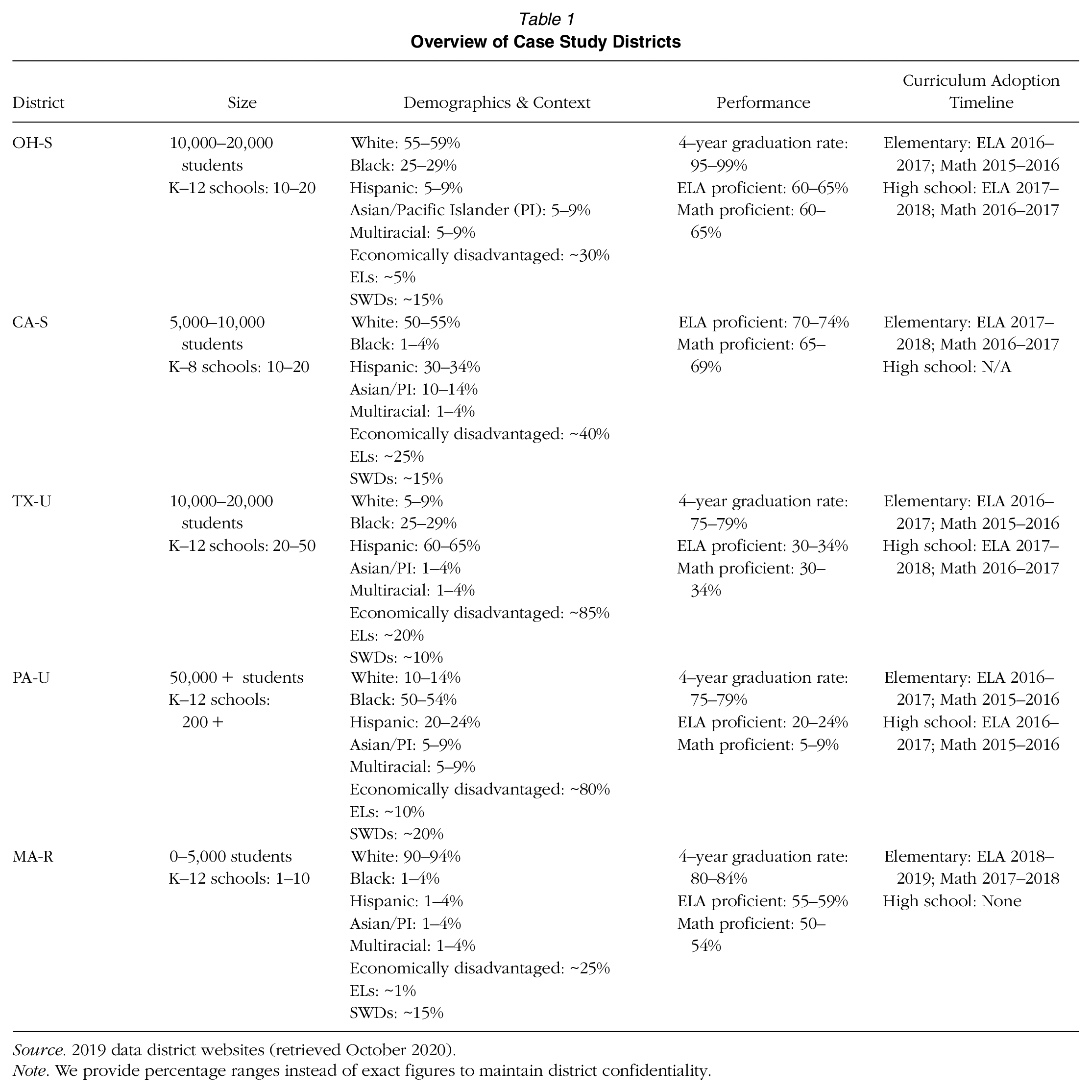
Source. 2019 data district websites (retrieved October 2020).
Note. We provide percentage ranges instead of exact figures to maintain district confidentiality.
Data Collection and Analysis
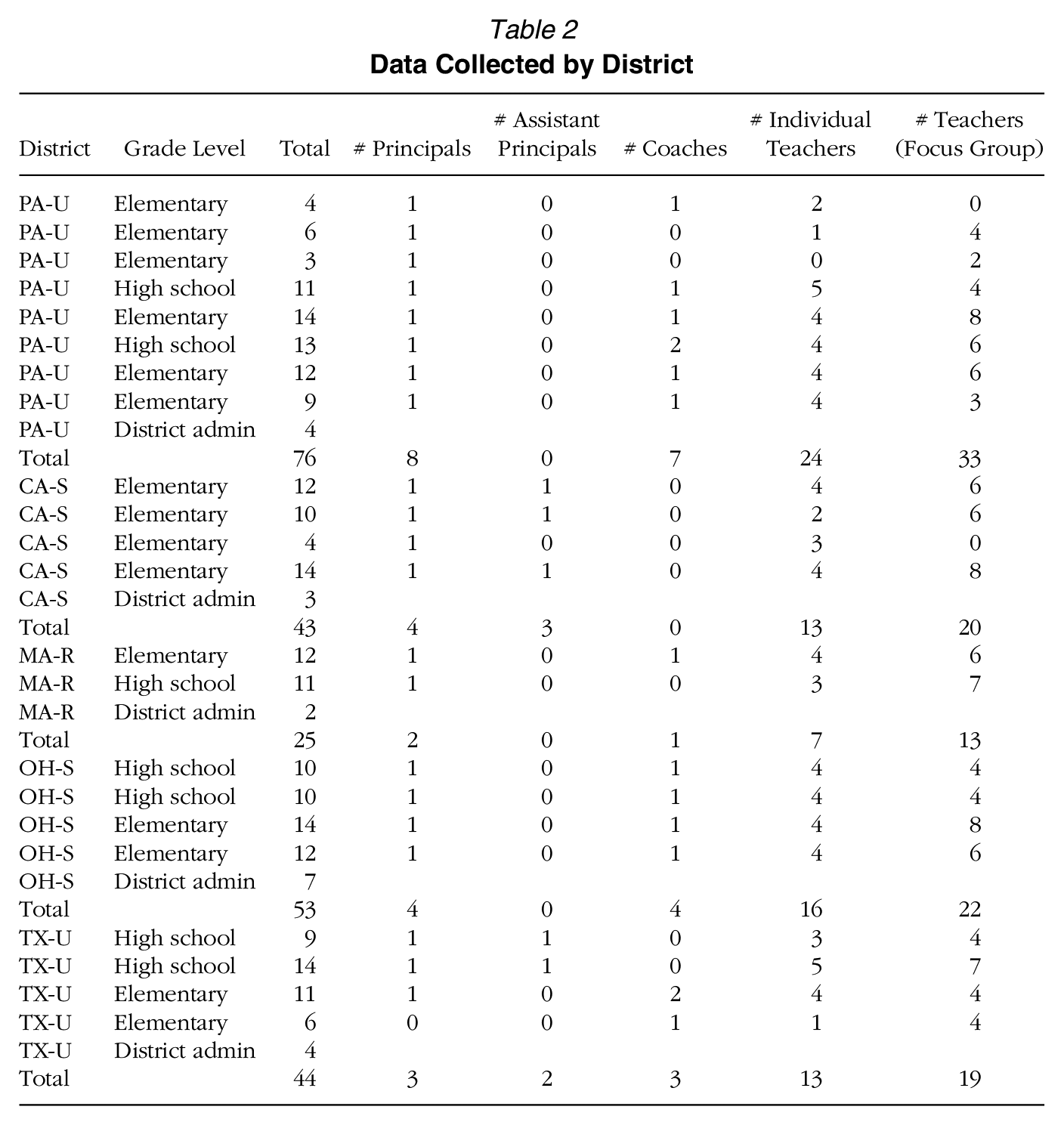
Guided by our overarching research question, we built cases for each of the five districts by collecting contextual information (e.g., policy documents, curricular materials, online resources) and spending time in each district in 2018 to 2019, interviewing district leaders, coaches, principals, and classroom teachers at 22 elementary and high schools. In each of the 15 elementary schools, we individually interviewed third- and fourth-grade teachers, EL and special education (SPED) teachers, any embedded school coaches, and the principal and assistant principals. In the seven high schools, we individually interviewed 10th-grade math and ELA teachers, EL and SPED teachers, ELA/math coaches, and the principal and assistant principals. We chose to focus on tested grade levels and subject areas, and we strived in each school to interview equal numbers of math and ELA teachers. We also conducted 21 confidential focus groups with 107 teachers in other subject areas and grade levels, which allowed us to capture how teachers across the schools were experiencing these policies. We interviewed 20 total district officials, including superintendents, assistant superintendents, and directors of curriculum and instruction, student services, special education, and ELs. We offer a breakdown of these 241 school and district personnel by school/district in Table 2, with each row representing one school community.
Data Collected by District
All interviews were transcribed and coded in two rounds (Miles et al., 2014) by a broader research team of faculty and graduate students. We first deductively coded for the five attributes of the policy attributes theory (specificity, authority, consistency, power, and stability). We then inductively coded the interview transcripts for emerging themes related to the policy environment (ESSA regulations, partnerships with external organizations, curriculum, differentiation, PD, supports for SWDs, supports for ELs, state governance mechanisms, geography, outreach and communication strategies, and technology). We negotiated interrater agreement by engaging in paired coding followed by group discussion (Ravitch & Carl, 2016). Drawing on these coded data, we created profiles of each case study district to examine how districts developed specific, powerful, authoritative, consistent, and stable materials, support, and guidance. We identified that standards implementation efforts in each district centered on developing curriculum materials and PL supports, with those two policy levers being the primary drivers of standards implementation in each of the five districts. As the team looked across the data set, we identified that “specificity” was the prevalent attribute, mediating interactions with the other policy attributes (consistency, stability, power, and authority).
Given the outsized role that specificity played in our first rounds of analysis, we oriented the cross-case analysis to the ways specificity contributed to how stakeholders experienced curriculum and PL on the ground in relation to the other attributes. Following Miles et al. (2014) and Bush-Mecenas and Marsh (2018), we used data matrices to dive into the case data across multiple stages of analysis, to surface patterns across cases in different visual forms. We first created a cross-case analytic matrix to examine the extent to which the districts’ approaches to curriculum and PL were perceived as specific in relation to the other attributes, with districts represented in rows and attributes in columns; we created one matrix for curriculum and one for PL. We then characterized each attribute as high, medium, or low depending on the number of stakeholders in each district who perceived the policies as specific, consistent, powerful, authoritative, and consistent in Table 3 (high = 70–100% of respondents agreed; medium = 40–69%; low = 0–39%). While there was considerable range in how respondents in each stakeholder group perceived the attributes (e.g., in MA-R, there were differences in how specific elementary teachers found the newly adopted curriculum vs. high school teachers with no specified curriculum), we did find this approach revealed broader trends (e.g., while elementary teachers rated the curriculum materials more highly specific than high school teachers, the average was still quite low (38%) compared to districts like TX-U (96%) that almost uniformly ranked the district’s approach to curriculum as highly specific).
Cross-Case Analytic Matrix Measuring Policy Attributes as Perceived by District Stakeholders
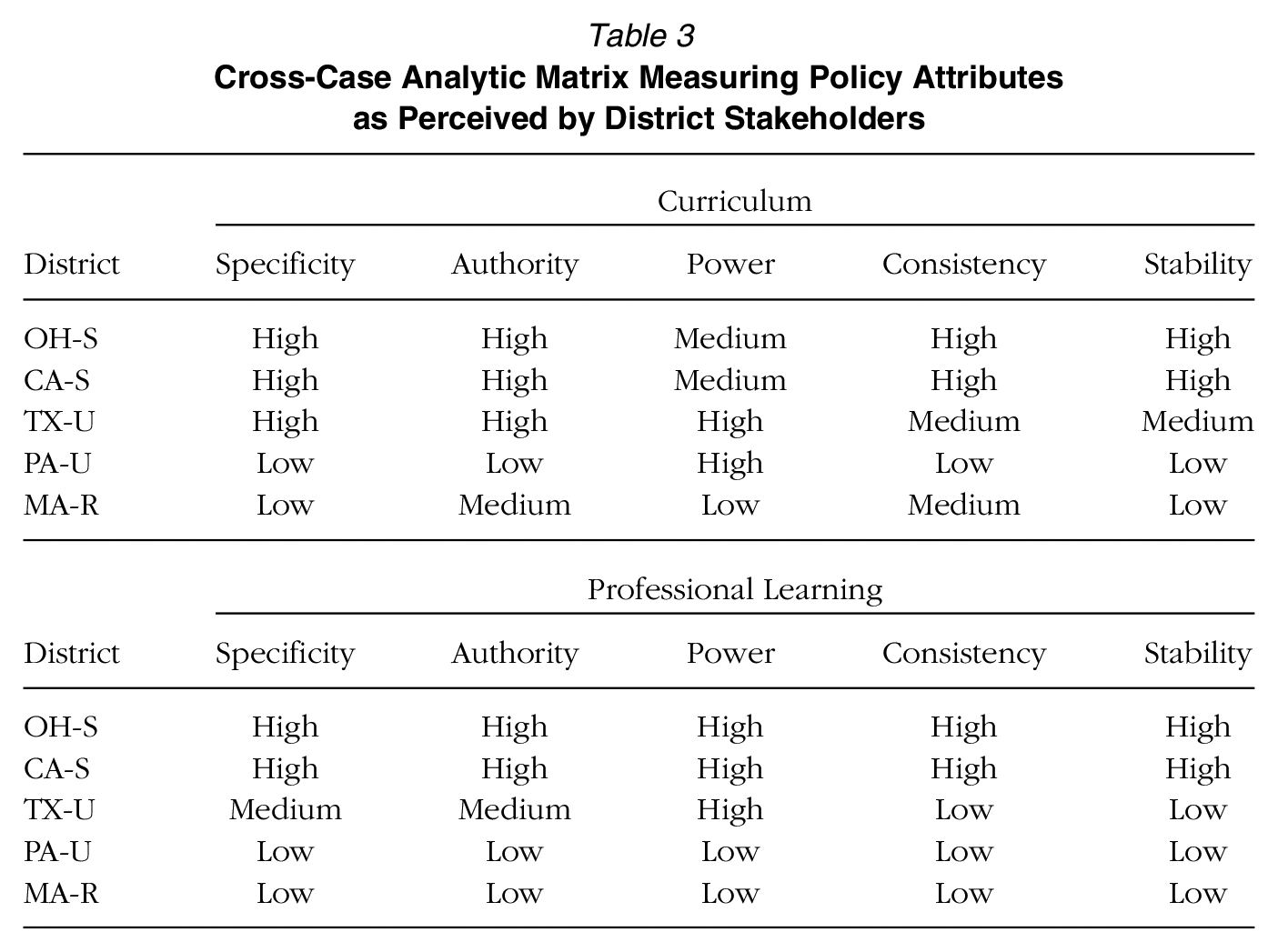
We began by averaging ratings of curriculum and PL together to get a broader picture of each district’s approach to CCR policies. We noted that TX-U remained high in specificity, similar to CA-S and OH-S, but with differences in how the other attributes were perceived by stakeholders. To examine this interaction visually, we created a data display in which we layered the other attributes in relation to specificity. Using the same high-low scale for each attribute, we placed each attribute on a continuum of specificity (see Figure 1). We ordered each attribute according to its averaged score (e.g., the low-power attribute in MA-R (11%) was on the left side of the continuum, while the high-power attribute in TX-U (91%) was on the right side). We found that for OH-S and CA-S, all the attributes clustered together on the higher side of the continuum; for MA-R and PA-U, the attributes clustered on the lower side; and for TX-U, the attributes were distributed across the continuum.
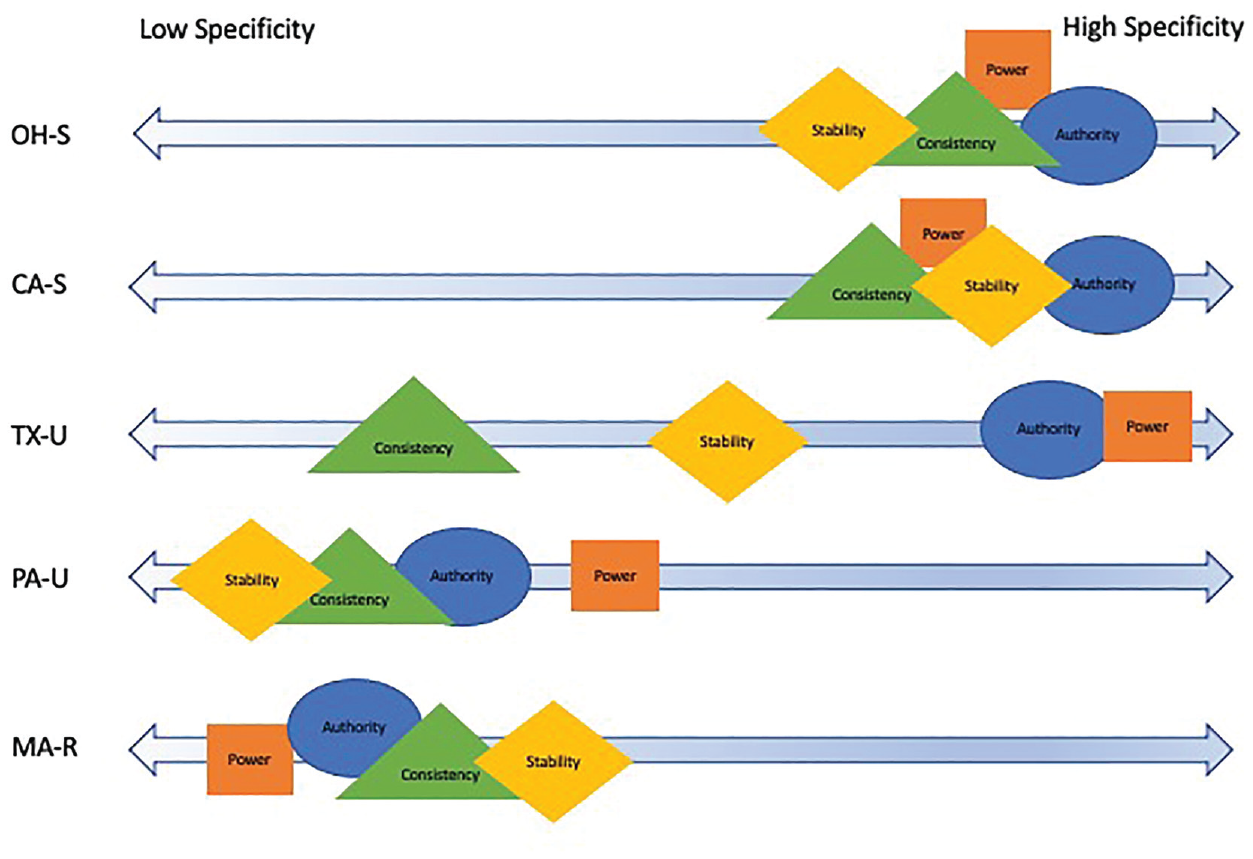
Continuum of specificity and flexibility.
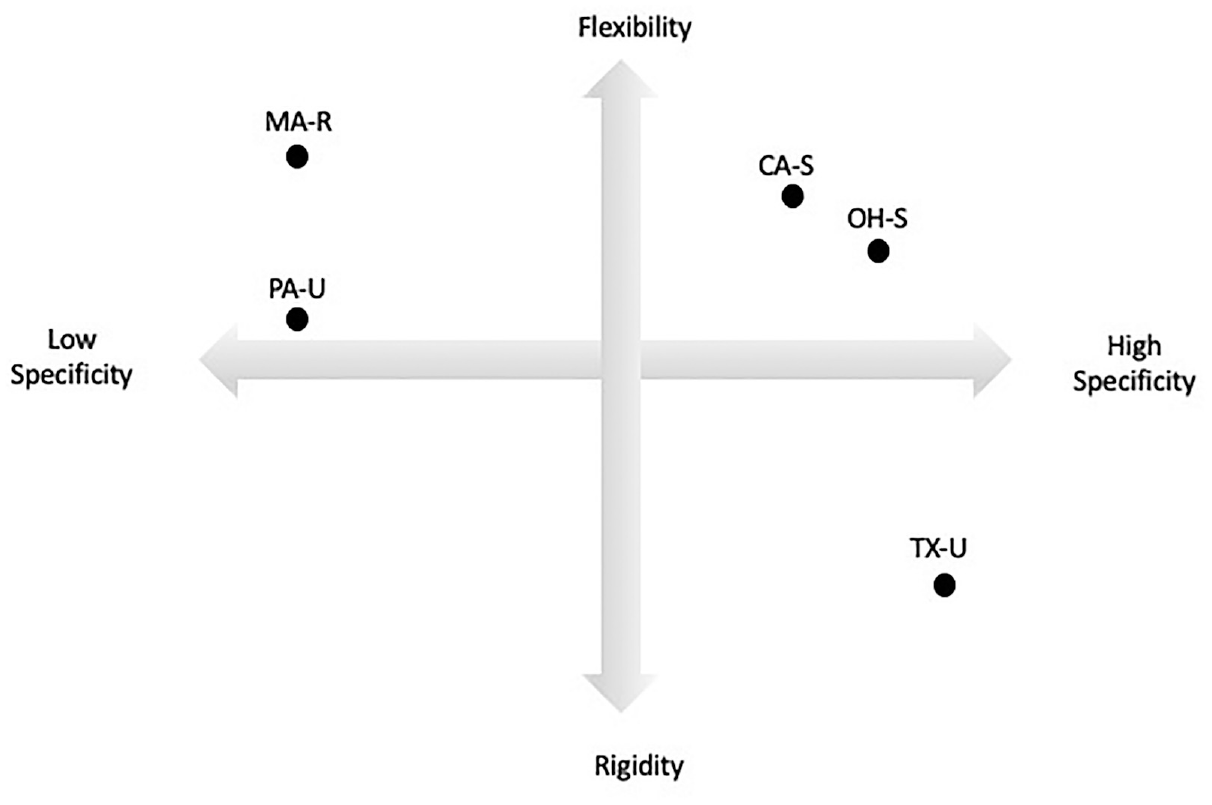
To explore why TX-U might have a different profile than the other two high-specificity districts (both suburban), we analyzed the matrix; reviewed previously coded data, especially all materials coded with specificity; and engaged in further analytic conversations and memo writing. We drew tentative conclusions about how the five districts developed guidance for stakeholders around curriculum and PL along a continuum of specificity, finding that flexibility operated as a key factor in how specificity was operationalized in each district. To explore what this interaction looked like visually to see patterns in how districts approached specificity in curriculum and PL, we mapped the districts along a continuum of specificity (high-low) and flexibility (flexible-rigid). In Figure 2, it is visible how CA-S and OH-S are both located in the upper right quadrant of the continuum, with more specificity and flexibility than TX-U; and MA-R and PA-U are on the opposite side of the continuum (low specificity but high flexibility). We explain these patterns in detail in the findings section.
Interaction of specificity with other attributes in five districts.
Limitations
Our study offers just one lens on the challenge of implementing CCR standards, and there are limitations to our work that motivate further research. Our design trades off breadth and depth; further work might test our hypotheses about the role of specificity in larger district samples or begin to develop validated measures of the nature and degree of specificity in local standards implementation policy. Further, future work might focus more centrally on questions of equity, particularly by diving more deeply into local contexts to understand the historical, cultural, and material conditions of educational reform efforts in each district and intersections with racial, socioeconomic, and political factors. Another limitation of our work was our focus on teacher views of alignment through interviews; triangulating sources with administrative data and observations would be useful. Future work might also investigate the associations of the attributes with instruction and student learning (see Comstock et al., 2022; Desimone, 2013; Edgerton & Desimone, 2018, 2019; Hill & Desimone, 2022). Finally, our work cannot support causal inferences about the relationships of the policy attributes with desired outcomes; future work could leverage experimental or quasi-experimental designs to test the relative and interactional influence of the attributes—to continue to move in the direction of understanding thresholds and how policies work collectively to support implementation.
Findings
We found that stakeholders in the five districts experienced CCR standards policies related to curriculum and PL on a continuum of specificity, ranging from highly specific materials and guidance on the one end to few or no materials or guidance on the other. We found that these different approaches to specificity interacted with the other policy attributes (see Figure 1) in ways that manifested as more rigid or flexible in practice (see Figure 2). Previous reforms have shown that more rigid forms of specificity can be viewed as interfering with teacher creativity and autonomy, while leaving reform development and implementation entirely up to teachers (i.e., too much flexibility) can result in little change due to the time-consuming nature of developing interventions from scratch (Rowan & Miller, 2007). The tension between ensuring leeway to respond to local conditions while adhering to design theory or principles means that flexibility is an enduring challenge to reform (Wylie, 2008). The two suburban districts that found the sweet spot—what we identified as flexible specificity—for both curriculum and PL had stakeholders that reported overwhelming buy-in to standards-aligned instruction and felt better prepared and supported to teach all students using the standards. Previous research has demonstrated that educators’ buy-in and views of their preparedness are related to changes in practice that support student learning (Desimone, 2002; Edgerton & Desimone 2018; Hamilton et al., 2008).
While we report on these trends in districts’ approaches to curriculum and PL, we do not imply that these districts’ approaches are monolithic, experienced the same by stakeholders positioned differently in each district; nor do we assume that similar practices (e.g., coaching, curriculum mapping) look the same in different contexts (or even across schools in the same district). Indeed, we hope to tease out these differences in and across the five districts even as we note the broad agreement that we found across stakeholder groups in each district about the ways curriculum and PL policies were experienced on the ground. This section begins by describing what we characterized as a flexibly specific approach to standards implementation—one consistently applied to both curriculum and PL that provided concrete and actionable materials and guidance for stakeholders while offering flexibility for them to exercise professional judgment (i.e., autonomy).
We first trace this approach in each of the two suburban districts in Ohio and California (OH-S and CA-S) that developed such an approach. District administrators in both districts talked about this approach as “the right balance” of specificity that they continually worked toward by collecting data from stakeholders and then responding to what they learned. We found that this “sweet spot” on the continuum of specificity was characterized by four practices, which we use to organize this section: (a) developing specificity through ongoing power negotiations, (b) using specificity to build authority for the standards, (c) supporting specificity through stable infrastructure, and (d) using specificity to create consistent policies around adaptations. In each of the sections discussing these practices, we then turn to how the other districts, TX-U, PA-U, and MA-R, varied in the ways specificity interacted with the other policy attributes in relation to the four practices, veering from rigid compliance in some areas to hands-off policies in others.
Practice 1: Developing Specificity Through Ongoing Power Negotiations
The first practice we identified involved the two suburban districts in our study, OH-S and CA-S, continually negotiating power in the course of developing specific materials and guidance for curriculum and PL. The two districts found that determining “the right balance” of specificity in PL and curriculum was not a settled issue, involving dynamic and continuous power struggles between different groups of stakeholders in shaping how the policies would be enacted and enforced. Both OH-S and CA-S began with more rigid forms of specificity in curriculum and PL and moved toward more flexible forms in response to these ongoing power dynamics. In OH-S, district officials initially required strict adherence to curriculum materials and a predetermined set of PL opportunities in the first year of curriculum adoption, which generated significant educator pushback. CA-S similarly began with more rigid adherence to specific curriculum materials in the 1st year of adoption, but the district had planned for more flexibility in the 2nd year and clearly communicated that plan to stakeholders. In both districts, these power negotiations became part of the cycle of responsive feedback: When districts asked teachers, principals, coaches, and support staff directly what they needed related to PL and curriculum and then responded in specific, targeted ways, stakeholders could anticipate a dynamic but largely transparent process of push and pull as different priorities and needs were negotiated.
In OH-S, stakeholders at every level we interviewed—district administrators, principals, coaches, and teachers—narrated the ongoing, collective challenge of finding the right balance of specificity. One elementary principal called the process “a good struggle”: “Teachers may not agree with [the fact that] it’s been a good struggle—it has been a struggle. Because it’s a balance of providing guidelines versus giving them some flexibility to grow as educators.” One district official described that the “good struggle” involved trial and error in negotiating power dynamics: It wasn’t smooth sailing, in the beginning the teachers were like “yeah we want this because it’ll tell us what to do.” But then when they got it and they were told what to do, they were like “we don’t want to be told what to do because we want to do our own gig.” And we’re like okay, the first year you’re going to do it just like it’s told. It’s kinda scripted. You’re gonna do the script, which they hated. And then we’re like, “once you get it, then you can start customizing it and doing your own gig.” Now, they’re okay. But in the beginning, no they were not okay.
This administrator recognized that the district’s more rigid approach using rewards and sanctions (i.e. measuring and then rewarding or punishing compliance school by school) was not well received by educators. As the administrator described, the district decided to shift in response to stakeholder pushback to the rigid approach to curriculum and PL. As one high school math teacher described, the district responded to concerns of the teachers by “adding a little more flexibility”: The first year we used it [the curriculum] pretty much with fidelity every activity we did, and we quickly realized that it was nearly impossible to follow that. … So we worked throughout that first year, tried to develop something, and we’ve tweaked it every year.
The district continually navigated this enduring challenge—between providing teachers enough specific guidance while recognizing teachers’ professional autonomy to adapt as needed.
Like OH-S, the CA-S district also worked to find the right balance of specificity over time, navigating ongoing power dynamics to find that balance. Stakeholders described that they were appreciative of the gradual, planned shift toward increased flexibility as a transparent process that lessened the impact of the district’s rewards and sanctions about curriculum fidelity. One elementary teacher described this process: This year the district is letting off a little with how much fidelity we need to stick to with that because when we first did it last year they were pretty adamant, “We really want you to try this. We’re open to hearing your feedback, we want to hear your feedback, but you need to stick with the curriculum so that we can assess its effectiveness, decide where changes need to be made and so on.” So, they do expect us to stick with it, but they are open to hearing our feedback.
Another teacher called this a move from fidelity to flexibility: “The first year of implementation they did ask us to stick to the program to see if we feel like it’s given us all we need from there, and … now there’s a little more flexibility.” In CA-S, just as in OH-S, the process of finding the “sweet spot” for specificity in curriculum and PL was not a one-time project but an ongoing approach to negotiating power dynamics across different stakeholder groups.
Like the two suburban districts, the three rural and urban districts continually were negotiating power in relation to specific guidance, searching for a sweet spot, but all three had different approaches to how power was negotiated that made the policies very uneven across stakeholder groups. While power in the TX-U tended to be more centralized in the district in ways that facilitated the development of highly specific curriculum and PL policies, the size of the district meant that the implementation of those policies was often left in the hands of intermediary actors (e.g., district coaches, building administrators). The district did not engage in systematic data-informed inquiry cycles or responsive adaptation based on stakeholder feedback, leaving decision making to local actors. As a result, there was uneven uptake of the policies across the district, leading to consistency challenges that were perceived by teachers to be unfair. For example, one high school English teacher reported, “We have a lot of freedom at [school], so as long as we’re aligned with the TEKS …. I think [principal] trusts us a lot more than some administrators might at other schools.” At a different high school, one math teacher noted the disparity in implementation: “[The curriculum] is the same for everybody for the entire district, which is good in a way. I just wish that we all did the same thing. … It seems like every campus has their own way of doing it.” This uneven enforcement of curricular policies left some educators feeling “lucky” that they were protected by their intermediaries and others feeling that the system was inequitable. Across all schools in the TX-U district, there was a shared sense by stakeholders that the district had a clear and specific vision that they wanted implemented with fidelity—even if the sanctions would follow any deviation were felt more keenly by particular stakeholders.
Like TX-U, the size of the PA-U district led to challenges with how power was distributed and negotiated across the district, which varied unevenly depending on who one spoke with. Some stakeholders described the district’s approach as strict and compliance oriented (high power), while others characterized it as unstructured and unconnected to rewards and sanctions (low power), depending on the school, administrators, or time period involved. One elementary teacher described feeling unmoored by shifts in the district’s approach to power and specificity over time: We went from being told exactly what we had to say, when we had to say it, how many minutes we had to say it, to like, all right, it’s a free for all. You do whatever you feel like is going to happen. We’re not sure if we’re going to get in trouble for not doing—it’s kind of just a free for all. It’s causing a lot of stress and teachers feel like we’re burnt out. Because we’re obviously here to teach and we’re all here for a reason. But it’s like we’re scared to do certain things.
While almost all teachers described the district as currently employing a “free for all” approach, most teachers did not experience such an approach as helpfully flexible; rather, they were uncertain how they could supplement curriculum materials and what the district expected of them, illustrating how power mediated specificity. For some teachers, their local building or network administrators dictated exactly what was and was not allowed to be supplemented. One elementary teacher reported teachers were not allowed to supplement at all in her school, which made it especially challenging to teach the standards: Especially in our network, where we’re only allowed to use certain materials now—in the past, we could’ve supplemented with what we had or what we found, but now we’re not allowed to. It makes it more difficult to hit certain standards.
The district’s lack of guidance for curriculum and PL created uncertainty about how to implement standards-aligned instruction in the district and created what many characterized as a scattershot approach that invested some intermediate actors with more power. District officials acknowledged that while they collected some data from stakeholders about these challenges, they did not have a systematic plan for evaluating the data or implementing changes in response.
In MA-R, the district took a hands-off approach, with little guidance for curriculum (particularly at the high school level) and virtually none about how teachers used PL time. At the high school, the principal added some informal collaboration time that one teacher described as “not officially PD,” but he left the content to the teachers to decide. As part of the turnaround efforts, the district built more collaborative planning time into the elementary teachers’ contracts (15 minutes 3 days a week to discuss data and 35 minutes twice a week for common planning), but teachers had autonomy over how they used the time (contractually, administrators could not impinge on that time). One third-grade teacher described that the sessions were teacher-driven: “We have the autonomy. They [administrators] can join us. We can invite them. But it’s definitely teacher driven.” Another fourth-grade teacher concurred about those team meetings: “There is no top-down structure.” While there were somewhat specific outlines about what elementary teachers should be spending their time on in PLC meetings (e.g., data, planning), the district had no standing to direct, participate in, or guide what happened.
Practice 2: Using Specificity to Build Authority for the Standards
The second practice we identified involved the two suburban districts using specificity to build authority for the standards. Both OH-S and CA-S developed specific guidance for curriculum and PL by first collecting data about stakeholders’ needs and then developing specific materials and guidance directly responsive to what they learned. This kind of flexibly specific approach involved stakeholders in the decision-making processes affecting them, a key mechanism for building authority (buy-in) to standards implementation. By creating a responsive feedback loop, districts could offer just-in-time opportunities for PL and targeted curriculum materials reflective of what teachers said they needed, allowing districts to provide enough specificity to be perceived as helpful while recognizing teachers’ expertise and autonomy to shape curriculum and PL decisions.
Using data to create a recursive feedback cycle was a central way that the two districts built authority for the standards. Both collected data through a combination of surveys, dialogue at district and school events, and teacher representation in governance structures. For example, the CA-S district regularly surveyed teachers about their needs related to curriculum and PL and included teacher representatives on all district committees. An important component of this approach is that the districts then responded to stakeholders based on that information—whether in changing policies, developing new materials, or explaining the rationale for not making a change. One district administrator in CA-S described how the district created feedback cycles: “Collect that need and feed it back, so that it becomes this collaborative kind of environment.” One CA-S 4th-grade teacher articulated how she felt included in decision making in regard to the recent curriculum adoption: I mean, I know it’s a long process from an administrator’s standpoint, but from a teacher’s standpoint, I can tell you that they included all stakeholders. For example, the board, and teachers, and they just made sure that parents, that the community, was involved in the process.
Such a collaborative environment allowed stakeholders to feel ownership in standards implementation. One third grade teacher in CA-S expressed how she felt included: “We all have the opportunity to give our opinion, ask for feedback, and solicit it, and have that constant conversation.” Both districts used these strategies for collecting feedback and acting on the data in ways that helped stakeholders feel heard.
More than simply being included, however, teachers we interviewed felt that they were recognized as professionals in partnership with the district in implementing standards effectively, rather than simply enacting curriculum. One high school math teacher in OH-S described how recognition of their expertise helped build authority for the standards: “So that clarity [in building priority standards and proficiency maps through PLCs] has given the teachers kind of ownership on ‘we’re teaching the standards, we’re not teaching [the curriculum].’” One high school principal in OH-S described how teachers’ involvement with the district curriculum mapping project “has really enabled teachers to have more ownership of the standards and even knowing what exactly they are and how they’re covering them.” We regularly heard echoes of this statement by a high school English teacher in OH-S: “I feel like I’ve been trusted as a professional to make decisions.” In both districts, it appeared that a central part of the districts’ approach to developing flexible specificity involved including people affected by policies in the decision-making process, recognizing the expertise of teachers, and supporting them in deepening their understanding of the standards. This practice of using specificity in curriculum and PL initiatives to build authority for the standards was a key factor driving broad stakeholder satisfaction with policy implementation in the two districts.
The other three rural and urban districts were varied in how they used specificity to build authority. The urban district in TX-U was similar in some ways to the two suburban districts of CA-S and OH-S in that TX-U had a clear and specific set of CCR policies related to curriculum and PL and high buy-in by teachers, who appreciated the specificity of the curriculum materials, which were aligned to the Texas Essential Knowledge and Skills (TEKS; Texas’s content standards) and created and distributed by district curriculum and instruction specialists via a shared annual calendar. The central difference was that TX-U’s approach to implementing those policies did not allow for planned flexibility coordinated by the district. In offering little room for adjustment or adaptation, the district was perceived by stakeholders to be fairly rigid in its approach, with highly specified new scope and sequence documents each 6 weeks and the expectation that teachers would follow that blueprint, directed by school-based instructional coaches who liaised both with district specialists and school administrators. One high school math teacher described the tight parameters on the scope and sequence: “They give us how many days to spend on [each topic]. Sometimes this is a little too restrictive, but we move around with it, mesh with it.” Another high school math teacher reported that there were benefits to this more rigid approach: Ultimately, at the end of the day, we have to stick to the plan because of accountability. It’s never been like, “You have to do this this way.” If we want our scores to grow, or we want to see some benefit to that, then we have to stick with it.
Like these two teachers, most stakeholders appreciated the specificity of the curriculum guidance provided by the district even given the district’s rigid approach, with the increased specificity helping to build authority for the standards in ways similar to CA-S and OH-S—even given that some stakeholders were held accountable to those policies more stringently than others.
On the opposite side of the spectrum was the urban district in Pennsylvania, PA-U, which was not only the largest we studied (at more than double the other urban district, TX-U) but had the most challenges in terms of few district resources, unstable governance structures, and high poverty levels (among myriad other challenges). As a result, many of the issues related to specificity in curriculum and PL policies were anchored in the simultaneous challenge of little stability or consistency in the district. This district was low in specificity and authority, with those two attributes seeming to interact with one another in more unproductive ways. For example, district officials felt that the curriculum materials adopted 2 years prior were adequately specific, but virtually all of the principals, coaches, and teachers we interviewed disagreed, describing how the materials themselves and district guidance about how to use or supplement them were unclear. A third-grade teacher claimed that teachers needed “to fill in the gaps even with the materials that we’re given.” Another fourth-grade teacher described how a lack of specificity in the curricular materials affected teacher practice: I would say, the trust in the district to give us instructional material that hits the standards and then saying to us, “Hey, by the way, take this and supplement it with all of this, because what we just purchased for you is insufficient”—I think that’s just making what teachers do extremely difficult.
District officials recognized that stakeholders may need to supplement materials, but as one acknowledged, there were not a lot of supports in place: “There’s not really a strict scope and sequence, or pacing guideline, or anything like that.” Across the board, we found that teachers agreed that the district’s approach to curriculum was not clear, coherent, or specific enough to guide them in implementing effective standards-based instruction, which affected the level of educator buy-in in the district.
The rural district in our study, MA-R, had very little in common with PA-U in its challenges but shared a similar profile in its lack of specificity and authority. In its 2nd year of turnaround status, MA-R had invested in new elementary reading, writing, and math programs the year prior to our visit only for the elementary school, leaving the high school to fend for itself. The adoption of more specific curriculum materials represented an effort by the district to assert more direct forms of power in a district characterized by one district official as “like the wild west before” (with another concurring that “everybody was doing their own thing”). One third-grade teacher reported that the resulting shift toward specificity in curriculum materials was helpful in making the standards more visible and thus building authority for the standards: “We are much better than where we were. Comparing to last year, when … people didn’t have standards. People didn’t have objectives. … As a school, we’ve gotten better, but we still definitely are developing.” All elementary teachers we spoke with agreed that the move toward greater specificity was a welcome shift but a slowly developing one, and the high school teachers and coaches found the lack of guidance by the district quite challenging. As a result of the district’s hands off approach and lack of specific guidance, we saw uneven buy-in from district stakeholders.
Practice 3: Supporting Specificity by Building Stable Infrastructure
The ongoing process of finding the right amount of specificity in both CA-S and OH-S was supported by the development of infrastructure that provided stability for both curriculum and PL policies. Both OH-S and CA-S invested their relatively modest resources into specific curriculum and PL materials and structures that were developed for and with teachers—both districts had common assessments (district and teacher created, available through a shared test bank), a clear scope and sequence provided by the district and coordinated by coaches, and myriad PL opportunities tightly coordinated with those materials. The infrastructure developed in each district around curriculum and PL helped create a stable framework for developing specific guidance in response to teachers’ needs.
The OH-S district voluntarily turned to the state’s Ohio Improvement Process (OIP) as a model for organizing the district’s approach to standards-aligned instruction around data-driven inquiry cycles. A systems framework usually required by the state for districts in turnaround status, the OIP offered OH-S an established and detailed organizational structure for collaboratively collecting and analyzing data in 90-day cycles. A high school principal described the benefits of the OIP for creating a shared structure in the district: The Ohio Improvement Process really forced us to look at what we’re teaching and how we’re teaching it. Rather than you teach one thing one way and I teach something different, having that framework for everybody, that consistency, has helped.
As part of their voluntary adaptation of the OIP, OH-S revamped their teacher contracts so that all teachers worked a 40-hour week to make space for PL opportunities. In addition to having access to disciplinary, technology, and EL and SWD coaches, teachers were supported by daily meetings with teacher-based teams (TBTs), weekly professional learning community (PLC) meetings in their schools, monthly district-wide professional development meetings with various “pathways” they could choose to attend (or present in), and an annual district-sponsored PL conference with well-known and local speakers. These PL opportunities were specific and coordinated, allowing teachers to deepen or broaden their expertise depending on their needs. One elementary principal summed up how the coordinated support in OH-S distinguished it from neighboring districts with similar resources: “We didn’t have the infrastructure [in neighbor district] that they have here. … I’ve had more professional development in the 4 years that I’ve been here than the 18 years I was [there].” The stability offered by the district using the data-informed OIP process supported stakeholders in developing high-quality, specific guidance for curriculum and PL tailored to teachers’ needs.
In CA-S, the district built a robust infrastructure first by adopting high-quality curricular materials that all stakeholders had a role in choosing and then offering aligned PL in multiple forms. In addition to monthly and yearly PD and the school-based coaches, the district had recently implemented Friday afternoon PLC meetings for 3 hours, with three sessions each month focused on student data and one on planning. These specific resources were introduced slowly, a benefit that one third-grade teacher characterized as a slow and steady approach: “This district has put a lot of money into PD and it’s been district-wide. There’s been a slow rollout, and they really grasp the concept of ‘go slowly to go fast.’” The pacing and teacher involvement in developing specific guidance for PL and curriculum materials was important to building stable infrastructure needed for teachers to understand and implement them well. A fourth-grade teacher reported that the coordinated approach to PL supported her: “I feel like I’ve received a plethora of professional development. I mean our district is so great at just making sure that they train us and that adult learning is constantly progressive.” One third-grade teacher described that the district’s deliberate focus on infrastructure helped them develop a broader view of what they were doing together: “We’re back to using the standards as our guide, but the curriculum as a resource.” As in OH-S, CA-S focused on providing extensive PL opportunities as a guide, coordinated with curriculum materials as a resource for teachers to translate standards into daily practice. The stability offered by a coordinated infrastructure for PL and curriculum across the entire district was a key mechanism for developing these helpfully specific materials that struck the “right balance” for stakeholders.
All three rural and urban districts had different challenges in developing stable infrastructure. In TX-U, the district offered highly specific curriculum guidance through their scope and sequence documents that was coupled with a specific vision for the district’s PL, with PLC meetings, building-level coaching, and district PD mandated at the beginning of the year. The district’s instructional coaches directed daily PLC meetings for teachers, which followed a clear structure described by one district official: “Our PLC framework, it follows the cycle of four things. It’s data analysis, lesson planning, common assessment building, and investigation or analysis of student work. They do those four things in PLCs every week.” However, what was envisioned was not always consistently enacted, a challenge that is explored in the next section.
The PA-U district had a completely different approach from TX-U—there was virtually no specific guidance for PL and no clear district vision about it as it was left to schools and intermediate actors to coordinate. In fact, there were few PL opportunities at the district level, with most of those opportunities voluntary (e.g., monthly drop-in sessions led by teachers demonstrating how to use new technology) or targeted toward new or struggling teachers (e.g., all 1st-year teachers and any teacher with an unsatisfactory rating were assigned a coach for the academic year, though most said these involved maybe one session at most and few could remember what that entailed). During the year that the new curriculum was adopted, coaches from the respective textbook companies were available for teachers to learn more about the curriculum, but that was only for a short time and only for some teachers. Since then, there were few, if any, district-wide opportunities to engage with issues around the curriculum and standards implementation. One high school math teacher described the lack of coaching in the district: “I don’t know that anybody really gets like consistent coaching. I’ve been informally observed and gotten like written feedback, but no, I’ve never had coaching. And I don’t know of anyone who really does get like formal, consistent coaching.” This lack of infrastructure was directly tied to budgetary constraints by many stakeholders, including the lack of physical infrastructure (e.g., appropriate heating and cooling, unsafe buildings), but even at the district level there was little description of a vision for PL or how the PL monies available should be spent by schools or administrators.
In MA-R, budgetary constraints and a lack of broader vision also hampered the development of specific infrastructure, particularly in relation to PL. There were few opportunities for PL at the district level, and what was offered did not focus primarily on the standards. One fourth-grade teacher described, We get very little professional development specifically on what it [standards-aligned practice] is. So how are we supposed to know what it’s really intended to look like? If there’s an expectation of what is perfect, what does that look like? What are the exemplars? We don’t get a lot of that.
Another second-grade teacher echoed these concerns about how to translate the more specific curriculum materials to standards-aligned practice in her classroom: They’ve got all these materials but how are we going to fit it into that time and again? The standards are listed for us there, but it’s so many standards and it’s just—how is this going to work in my classroom?
A high school math teacher similarly found that there was a distinct lack of focus on how specifically to help translate standards into practice: “I find that we don’t talk about standards a whole lot and that bothers me. … Here they are, but we didn’t talk about how to implement them the best way, to best take advantage of what they’re offering.” One district administrator acknowledged that teachers were often “confused and overwhelmed by the amount of materials” and needed more guidance, yet the district did not appear to collect or evaluate data about stakeholders’ experiences or shift district policy as a result.
Practice 4: Using Specificity to Create Consistent Policies around Adaptations
One of the most important elements of the flexibly specific approach in each district was how adaptations were addressed. Both OH-S and CA-S recognized that there would always be variance in how policies were adapted, so they developed a flexible approach to those adaptations that was not happenstance or idiosyncratic. District officials reported that they developed a clear, consistent process for helping stakeholders “make it [the curriculum] their own”—a phrase we heard repeatedly across both CA-S and OH-S. Indeed, both districts emphasized that teachers (as well as coaches and principals) were professionals with autonomy to customize, adapt, and supplement given curriculum materials—as long as those adaptations were aligned with the standards and the district’s vision. In both districts, this process of adapting the district’s specific guidance was collaborative, with teachers, coaches, and building administrators reporting that they worked closely together to analyze what their students needed, how to meet those needs in dynamic fashion, and how to decide whether those adaptations were appropriately aligned. The shared goal of consistency drove the development of policies around adaptation.
In OH-S, building leaders and coaches met with each other regularly— and received ongoing PL—to coordinate how they offered guidance for teachers in adapting materials and supported collaboration. One high school English teacher used a metaphor of a map to describe this navigational process: “So, at the high level, big picture, there’s, I would say, a map, but how you reach the destination varies per school, per teacher, per classroom and all that.” All of the teachers, coaches, and principals we spoke with agreed that having this kind of overarching map—a shared, specific guide at the district level—was helpful, especially in developing shared language across K–12 schools and using common assessments that gave a baseline understanding of where kids were located. However, all agreed that there were different routes to get to those shared goals. One high school math teacher described how the district offered the right balance of specificity: “It’s a pretty good balance so I feel like it’s enough management, but not too much management.” Another high school math teacher described the process of navigating district, building, and individual needs with colleagues: “The district gives us the curriculum, but when it comes to the lesson planning, I talk to the team, and then we pull what we think is necessary for the kids.”
The CA-S district had a similarly clear and consistent process by which stakeholders could adapt common materials and approaches. One district official described the process as rooted first in the district’s specific guidance: “The first shot should always be through the core materials and then you can supplement after that.” One teacher described how teachers first worked with the common materials, consulted with colleagues, administrators and coaches, and “then you can kind of make it your own as a teacher and use the strategies that we have.” A fourth-grade teacher summarized this delicate navigation between what was shared and adapted: I think we have a reasonable amount of flexibility. There are certain deadlines that specific assessments have to be given. They’re usually pulled from the curriculum so you have to have moved through that piece before so you can give that assessment by that due date. And all of that goes into a district database so that across the district we can compare data and see everyone’s results and stuff. But within that timeframe no one tells us what we have to do on which day. We determine that as a PLC, as a grade level team we determine how we’re going to pace things.
Like this teacher, all the CA-S stakeholders we interviewed were clear about how to navigate what was shared and what was adapted. As another third-grade teacher described, this navigational process was coordinated across teams, coaches, and consultants in the district’s PD: I like the inquiry cycle … because I mean that is how we’re going to grow as colleagues. I think anybody in any profession would benefit from an inquiry cycle where that’s been to me the best and most effective. When somebody comes in, they give me feedback, I go back, and I make changes.
Like OH-S, the CA-S district process was rooted in an inquiry cycle in which teachers looked closely at student data together, received feedback, and carefully adapted their practice.
In all three of our urban and rural districts, stakeholders found challenges in developing consistent policies around adaptation. In TX-U, the inconsistencies in PL revolved around who would offer those opportunities—oftentimes, district officials left it to individual schools, coaches, or other intermediaries to design and develop, which meant that more well-resourced schools could provide more PL opportunities for their teachers. For example, only some teachers had access to PLCs, with one official concluding: “PLCs are effective when they use them, but since we have so many courses that don’t have one, it gets difficult.” Similar unevenness was evident in the district-provided PL at the beginning of each academic year. One elementary teacher described that the PL at the beginning of each year left teachers unprepared: “They wanted us to implement it [the new reading curriculum] the next week without, you know, really fully understanding what you’re doing, just throw this in there, and that was hard.” The central challenge of such uneven implementation in TX-U was that teachers felt they received inadequate guidance in translating standards to practice, as one high school English teacher noted: “We would have emergency meetings where they would be like frustrated with us because we weren’t doing what we were supposed to be doing, but they never taught us what we were supposed to be doing.” In TX-U, policies for curriculum and PL were not responsive to educators’ ongoing needs, with any deviation from or adaptations of the district’s policies handled at the building level without central coordination of those shifts or collective development of the policies based on stakeholder data or inquiry cycles.
In PA-U, the biggest theme from all stakeholders, including district officials, was that the district was inconsistent in its policies around curriculum and PL, with no clear guidance about what and how teachers should adapt materials (and occasionally sanctions and repercussions if teachers used or adapted materials in ways determined to be inappropriate). Many stakeholders found that the size of the district coupled with time and budget constraints led to challenges even for developing PL opportunities even at the local level, as one principal noted: “We have such little time to collaborate. We’ve only had grade group meetings once a week to four times a month. And then with days off, snow days or half days, those are affected.” The district acknowledged that they did not follow up with most of the PD offered through the schools: Being the size district we are, PD, I think, is only as good as the follow-up. We collect surveys and that kind of thing, but we don’t have an effective way of actually seeing that teachers are taking what they get from the PD and putting it into place.
With the district focused on providing PD for particular teacher populations (e.g., new or struggling teachers) and leaving the rest up to schools, the district’s lack of specificity left stakeholders to figure out what constituted standards-aligned instruction and navigate the district’s policies on their own. This, coupled with a lack of curricular materials, meant that teachers often supplemented and adapted materials in idiosyncratic ways, often hoping for the best and using their other professional networks and judgment guide their practice.
In MA-R, the district left much of the local decision-making power to individual teachers and building administrators at the high school and elementary school to make any changes to existing materials or guidance as they saw fit. Such a hands-off approach to policy implementation led to a lot of inconsistency across the district. At the high school, for example, the completely separate approach for high school and elementary school (unlike the other four districts in our study) meant that there was no shift toward district-provided curriculum materials as part of the turnaround effort. The high school principal described a long history of teachers creating curriculum materials, noting that there did not seem to be a need for a shift from this approach because students “were doing well” (though district performance was very close to state averages, with about half the district’s students falling below state performance targets). The principal said he did not provide much guidance to teachers, particularly in math in which “I oftentimes would defer to their expertise.” One high school math teacher explained that the math department would plan common projects and tests together, iterating on materials that previous teachers had developed over many years: This is our basic syllabus guide that we give to the kids. … You can see that half of our curriculum isn’t even in the book. I do have a book that I use. However, literally half of the time we don’t touch it. That’s why it’s sitting there. They’re old and beat up.
Teachers at the high school all agreed that district officials and school administrators did not have much input into the curriculum, leading to uneven uptake of the standards at the high school level. Across both high school and elementary school, educators agreed that there were inconsistent opportunities for PL, with very little specific guidance about standards implementation even if there was time in the schedule.
Discussion
For as long as standards have been a focus for educational reform, there has been dissatisfaction with their implementation, rooted in the complexity and challenge of enacting change at multiple levels of the educational system as local actors interpret, experience, and interact with policies in relation to myriad factors on the ground (Coburn, 2001, 2005, 2016; Edgerton, 2020; Pak & Desimone, 2019; Spillane et al., 2002). While CCR standards offer a blueprint for the knowledge students are to learn, it is left to districts, schools, and teachers to operationalize those standards in everyday teaching and learning contexts. This local adaptation to individual contexts has been shown to be critical to successful implementation of school and classroom interventions (Desimone & Hill, 2017; Pak et al., 2021). We focused on two key policy levers that districts have regularly used in these efforts and that research has shown to be important for effective implementation: curriculum materials and PL. As Coburn (2016) has argued, if the field is to move forward, researchers need to do more than identify effective practices and levers—they need to understand the mechanisms at work in and across them. Our case studies about how stakeholders experienced, responded to, and implemented the standards in five districts highlighted that what mattered most was how districts designed and supported these levers. We found that what we term flexible specificity—a careful balance between providing clear guidance and supports, while ensuring ample opportunities for local feedback and adaptations—was a powerful mechanism for fostering strong educator buy-in and motivated enactment, which research has shown to be a key driver of implementation quality and student outcomes (Allensworth et al., 2021; Hamilton et al., 2008).
Our study identified several critical aspects that characterize the approach of flexible specificity: having specific processes for adaptation and coordination of guidance, including explicitly planning for flexibility (specificity); involving stakeholders in the implementation process through committees, surveys, and feedback cycles in ways that recognized their expertise and responded to their needs with just-in-time supports for teacher collaboration and learning (authority); negotiating regularly and responsively with stakeholders about district policies (power); and addressing the reform levers of curriculum and PL in tandem (consistency) and in ways that built over time through the development of stable infrastructure (stability). We traced these insights across the four practices, which show how specificity intersected with each of the policy attributes: (a) developing specificity through ongoing power negotiations (specificity-power), (b) using specificity to build authority for the standards (specificity-authority), (c) supporting specificity through stable infrastructure (specificity-stability), and (d) using specificity to create consistent policies around adaptations (specificity-consistency).
To help guide districts move toward a more flexibly specific approach, we discuss these factors in more depth in the following sections, particularly focusing on how and why the two suburban districts were more successful in navigating the delicate balance of offering enough specific guidance than the rural and urban districts in our study. Situating our findings about the four practices in relation to broader scholarship about policy implementation, we highlight three implications from our study that we hope address the myriad contextual factors facing districts and offer guidance to educational researchers and other stakeholders interested in policy implementation.
More Specificity Is Better, but Flexible Specificity Is Best: How Districts Plan for Policy Adaptations
One of our central findings is that stakeholders in all districts appreciated highly specific curriculum materials and PL opportunities. In districts with the most highly specific approaches, TX-U, CA-S, and OH-S (see Figures 1 and 2), teachers reported satisfaction with specific curriculum materials provided by the districts, commenting that they appreciated their regular and easy access to high-quality curriculum materials (including digital resources) that supported their standards-aligned instruction. In TX-U, virtually all educators liked the specific district guidance provided via scope and sequence documents and district coaching, but a number of teachers reported the need for more PL opportunities, especially more district-level sessions during the year and regular access to PLCs. The teachers in the OH-S district had a different issue—they had myriad opportunities (a few teachers thought too many) for deepening their understanding of the standards, including a popular PL pathways program that allowed teachers to choose a specific area of inquiry each quarter depending on interests and needs. In the two districts with the least specific approaches, PA-U and MA-R, virtually every teacher reported the need for more specific materials and guidance from the district. In MA-R, for example, the elementary teachers expressed appreciation for the newly adopted and more specific curriculum materials but wanted more of them as well as more guidance about how to use those materials; the high school teachers we spoke with all thought more specific materials and guidance would be useful. Across all districts, educators reported feeling more prepared to implement the standards when the district provided specific curriculum materials alongside detailed guidance.
While educators expressed the importance of districts providing specific curriculum and PL materials, we learned that how rigid or flexible districts were in their approaches was critical to stakeholder experiences. TX-U was the most rigid in its approach to specific curriculum and PL materials, providing district pacing guides that were enforced through district coaches and teacher accountability mechanisms (which were felt by some stakeholders more acutely than others). MA-R was the most flexible in the sense that the district exercised little power over curriculum and PL policy implementation at the classroom level, except in instances dictated by state mandates. While both districts might have been located at different ends of a continuum, they shared a hands-off approach to adaptations of district policies. Both left the rewards and sanctions for following district policy to actors at the school level, essentially distributing power to intermediaries to determine how adaptations to district policy would be addressed. Such a hands-off policy also characterized PA-U, though in this urban district it was both assistant superintendents and building administrators that enforced heavy-handed accountability mechanisms and threat of sanctions for some stakeholders and facilitated a high level of flexibility for others.
In all three districts, stakeholders reported feeling unsettled by the ways too rigid or too flexible approaches were executed on the ground, leaving teachers uncertain about who could adapt district policies around curriculum and PL and under what circumstances. The two suburban districts only found the “sweet spot” of flexible specificity after some challenges regarding teacher adaptations. Moving away from early mandates that teachers follow curriculum materials with fidelity and without variance, OH-S and CA-S built in more flexibility in response to stakeholder feedback, in OH-S as a result of teacher backlash and in CA-S through carefully planned stages that involved many stakeholders. The ongoing, dynamic negotiation of how adaptations would be handled became a central part of the districts’ approach to curriculum and PL policies. These findings suggest that districts might focus on developing consistent policies around how adaptations would be handled (Practice 4), knowing that adaptation is shaped by myriad social and structural conditions and a necessary and unavoidable part of all implementation efforts (Coburn 2001, 2005).
Involving Educators as Respected Professionals Builds Authority for the Standards: Developing a Responsive Approach to Using Stakeholder Data
A second takeaway that we highlight here is the role teachers played in district PL and curriculum policies—we found that a teacher inquiry model foregrounding teacher learning and collaboration was linked to teachers’ satisfaction with and preparation for standards instruction (i.e., authority for the standards). Allensworth et al. (2021) describe such a model in their study of standards implementation in Chicago as characterized by the district encouraging teacher experimentation and learning, “with teachers supporting each other around instructional change with access to expert knowledge and resources” (p. 16); they found that such a model was linked to a range of positive student outcomes, especially for low-achieving students. In both CA-S and OH-S, teachers reported feeling respected as professionals, involved in the decision making about district policies and supported as learners through collaboration and ongoing inquiry. Teachers in the two districts directly linked this approach to teacher learning as critical in their preparation for teaching the standards.
This approach to teacher learning in the suburban districts was supported by the collection of data about teacher needs. Both districts involved stakeholders directly in the decision-making processes around curriculum and PL, which enabled them to develop specific materials and guidance responsive to (and thus useful for) different stakeholders. They created opportunities for teachers, coaches, community members, families, and principals to share ideas and opinions and included teachers serving on committees involving district decision making. Most importantly, the districts publicly and visibly responded to stakeholder feedback, revising and shifting district policy in response to this input. These cycles of feedback and adaptation supported teacher investment in the standards. This is consistent with previous work that identified the importance of opportunities for teachers to adapt resources to their individual students’ needs (Comstock et al., 2022).
This approach to shifting policy in response to stakeholder feedback was absent in the other three districts we examined. In MA-U, stakeholders had considerable autonomy over classroom practice, but teachers felt uncertain about their preparation to teach the standards and disconnected from district curriculum and PL policies; as a result, there was little opportunity for collaborative inquiry and no clear feedback mechanisms. In TX-U, teachers seemed to perceive the district’s provision of specific curriculum materials as a top-down effort not particularly responsive to what teachers needed most; consequently, teachers did not always see themselves as partners or actors who were always prepared to implement the standards in high-quality ways. In PA-U, stakeholders felt very little involvement in district policy, perceiving it not just as top-down but at times as resistant to teacher autonomy or even actively hostile toward teachers. In these districts, teachers felt positioned as separate from district policies. This implication suggests that districts can use highly specific curriculum and PL guidance to build authority for the standards (Practice 2), tapping into teachers’ collective sensemaking and engagement across professional networks (Allensworth et al., 2021; Coburn, 2001) and the ongoing negotiation of power (Practice 1) as teachers seek to be recognized as professionals whose voices and perspectives shape policies as much as policies shape teachers’ practices (Coburn, 2005; Coburn et al., 2016; Edgerton, 2019). This is analogous to Nichols et al.’s (2021) identification of “smart power” as an approach leaders use to balance teacher buy-in (authority) with accountability (power) to support standards implementation.
Developing Stable Infrastructure Is a Resource Issue but Not Only a Resource Issue: The Importance of Consistent Professional Learning
Finally, we highlight the importance of stable infrastructure for developing consistent district policies around standards implementation, especially in relation to PL. We want to begin by noting that the two districts we found to develop flexible specificity were suburban, with all the attendant resources for developing infrastructure that are afforded suburban midsized districts. In OH-S and CA-S, teachers had time and opportunity to collaborate with each other and administrators, with multiple ways to exercise autonomy and participate in district decision making. The stability of these opportunities was an important component, as stakeholders could count on daily support by coaches, weekly teacher collaboration meetings, and monthly and annual district PL schedules. While shifts to curriculum and guidance occurred, these were messaged clearly and implemented in response to clearly articulated data collection, evaluation, and revision cycles. Over time, both districts developed consistent approaches to curriculum and PL, leveraging the two reform levers together in a coherent, sustained manner. While both districts were not well resourced relative to others in their areas—CA-S was an average-spending district in a below-average-spending state, and OH-S was a below-average-spending district in an average-spending state—they invested what resources they had in building aligned infrastructure around materials and guidance. However, they also did not face some of the serious challenges of the other districts.
In the other three districts, challenges related to size, resources, and histories of inequity appeared to hamper the development of stable infrastructure and consistent policies. The MA-R, PA-U, and TX-U districts had developed policies around curriculum and PL that intersected with historical considerations of state and city funding formulas, generational poverty, systemic racism, disparities in local neighborhood conditions, immigration and language policies, and labor and workforce issues. In the rural district, the small size of the district coupled with limited resources meant that stakeholders had to fulfill many roles, leaving little time or space for the development of stable infrastructure. In PA-U, the large district faced myriad challenges that had emerged over many decades of underfunding, dysfunctional leadership, and high student need, leading to a lack of consistency and stability that compromised teachers’ capacity to implement the standards on a day-to-day basis. In TX-U, histories of high teacher turnover and high student need were concentrated in some schools in the district, leading to some schools having more resources and stability than others. The size of both urban districts meant that intermediary actors often made decisions at the school level, contributing to a sense of instability and inconsistency.
While we did note important disparities across the five case study districts, we found that a vision for how resources would be allocated was equally as important as the presence of resources. In districts that invested in high-quality PL aligned with curriculum materials, stakeholders reported not only feeling more invested in the standards but more prepared to teach in standards-aligned ways. While all five districts had adopted new curricula in the previous 2 to 3 years, not all of them supported educators through specific, consistent PL opportunities. In PA-U, TX-U, and MA-R, there were few district-provided PL opportunities, leaving districts’ recent efforts to make curriculum materials more specific largely unhelpful.
Previous work has indicated how important consistency is for catalyzing high-quality teacher learning (Phillips et al., 2011) and how critical the role of leaders is in connecting teachers with instructional supports (Smith et al., 2018). We found that the lessons learned from the two suburban districts about how to build stable, consistent infrastructure across PL and curriculum (Practice 3) offer the education community a potential blueprint for how to establish structures that are responsive to teachers’ needs and inclusive of multiple voices. All districts had funds for PL (even PA-U, which had less than others) but used those resources in different ways. Investing district resources in PL aligned with the curriculum and standards and reflective of a teacher leader model was important not only in the two suburban districts in our study but also in the study Allensworth and colleagues (2021) conducted in Chicago’s urban district (similar to PA-U). Allensworth et al.’s study suggests that our finding about the importance of stable, aligned infrastructure in district implementation might transcend issues of resources, geography, or size alone, providing direction for how beleaguered school districts might spend their limited time and resources on aligned PL based on a teacher leader model.
Conclusion
We think our study points to the central need for arranging all aspects of district policy in service of a clear vision of teaching and learning aligned with standards and supported by quality curriculum materials and PL. The particulars of how to bring about that kind of specific, coherent structure will differ by the contextual issues at play in each district, but our work suggests the importance of a commitment to ongoing data collection and evaluation that involves all stakeholders and responds to their needs. Districts can create more nimble policies as a result, developing a flexibly specific approach to PL and curriculum informed by data and analysis that targets the specific guidance needed to translate standards into practice. Modifications and adaptations to standards-based policies can be negotiated on an ongoing basis, with clear and transparent mechanisms that can establish a universally high level of standards implementation sensitive to—and in collaboration with—key stakeholders.
Footnotes

Note
The research reported here was supported by the Institute of Education Sciences, U.S. Department of Education, through Grant R305C150007. We would like to acknowledge the efforts of the PI Andrew Porter and the research team involved in the data collection and analysis reported here: Meghan Comstock, Adam Edgerton, Nelson Flores, Erica Salvidar Garcia, Shira Haderlein, Jillian Harkins, Phil Nichols, and Katie Pak.
A
L
M