




Abstract
By law, language information of students in U.S. schools must be identified during enrollment. This information affects language screening, federal reporting, provision of services, and so on. In the Florida Heartland, analyses of observations, records, a language inventory (survey), and interviews show that some students and parents’ languages identified during registration are not recorded accurately. Raciolinguistic enregisterment played a role in registrars recording languages as others and in their differential questioning practices; employee training, policy, and the records system design also affected this linguistic re-formation. In the end, Indigenous Mexican languages were under measured by a factor of 19—for every 19 students whose parent spoke an Indigenous language, only one was recorded. Suggestions for improvement are provided.
Introduction
In the United States, students’ characteristics are quantified into statistics—the state’s products in the modern world (Koyama & Menken, 2013). Beginning with Lau v. Nichols in 1974, schools have been required to identify the language needs of students in an effort to deliver language services aimed at countering language-related obstacles to their education (Education Commission of the States, 2014). Typically, schools use a home language survey (HLS), often conducted during registration, to identify student, parent, and home languages. Outside of screening for language issues (Mendoza-Denton, 2008), data on student and parent languages collected during school registration have critical uses in schooling, many of which can relate to equity. For instance, this data can inform culturally sustaining pedagogies (Paris & Alim, 2017), including those in K–12 STEM (science, technology, engineering and mathematics) educational contexts (Mallinson & Hudley, 2018). Language data are also used in the mandated reporting of academic performance of subgroups required by the Every Student Succeeds Act as well as in informing accessibility in school-home communication (Campbell, 2016).
In this study, I interrogate how representations of student and parent languages are fashioned by analyzing the identification and recording of these languages during school registration. I specifically focus on the top-down influence of school registrars as authoritative representatives of educational institutions in the forming of language representations tied to perceived race and ethnicity of students and parents. Specifically, I pay attention to the sorting processes in which actors engage to classify language varieties in the real world. This approach is complementary to bottom-up approaches originating in analyses of student agency that highlight how language is mobilized to construct identities (e.g., Rosa, 2019). This emphasis will allow us to better understand school registration processes during which language is identified and make changes to improve this process where needed.
Previous research has explored the classification of students by school actors into various English learner categories and the ramifications of such categorizations, finding that Indigenous Mexican students are often Latinized as Latino 1 Spanish-speakers (Baquedano-López, 2019; Baquedano-López & Borge Janetti, 2017; Machado-Casas, 2012). However, previous studies have not offered a quantification of this Latinization nor a close look at the processes shaping it—a gap my research fills. There is also a corresponding need to be able to describe and theorize about the mechanism through which language representations come to misrepresent speakers’ linguistic repertoires 2 —addressed by my development of “linguistic re-formation.” This term refers to processes of transformation that language representations undergo from their reporting by speakers to digestion (codifying) by others (authorities; Campbell-Montalvo, 2019).
In this article, I analyze school ethnographic data to highlight linguistic essentialisms (Baquedano-López & Borge Janetti, 2017). Specifically, my findings show that
Languages were re-formed as registrars used differential questioning methods with various families and also changed Indigenous Latino languages to Spanish on forms.
Linguistic re-formation was widespread and had varying prevalence among racial/ethnic groups.
There were various influences and views on linguistic re-formation.
This study is part of my larger 2014–2015 ethnography that examined school resource access among linguistic, racial, and ethnic groups in public K–12 schools. The research site is in an agricultural, conservative central Florida county I anonymize as “Central county.” As a non-Latina White woman researcher, with a working knowledge of Spanish, I became interested in the research site because of its demographic context and location (see Campbell, 2016, for more on how I entered the site). Methods and data sources including school office observations; my language inventory (survey); interviews and casual conversations with parents, school employees (i.e., teachers, administrators, paraprofessionals, migrant advocates 3 ), and community members; and school records offer multiple perspectives informing on language identification by schools at the site. Due to migration, the 5,300 children in Central’s public K–12 schools reportedly are 61% Latino, 30% White, 6% African American, 1% Asian, and less than 1% American Indian.4,5 As the U.S. experiences more demographic change and in the current political climate, examining how language is recorded and codified becomes more pressing.
To put this work in discussion with previous research and to situate it within the historical trajectory of language identification, I review earlier work on language identification in the U.S. schools and Census. I then provide a springboard for the theorizing of linguistic re-formation 6 using “racial formation” (Omi & Winant, 1986) and “raciolinguistic enregisterment” (Rosa, 2019; Rosa & Flores, 2017). Next, I describe how my complementary qualitative and quantitative data collection methods allow the scoping of linguistic re-formation and provide examples from data. Then I offer a discussion on understanding the presence of linguistic re-formation, including a note on the study’s limitations. I close with a conclusion on implications and applications, addressing linguistic re-formation, steps for future research, and contributions.
Identifying Indigenous Latino Languages Through Measures
In many states, HLSs ask about a student’s first language, the language the child most often uses at home, the language in which parents converse with the child, and the language most often spoken in the home (Mendoza-Denton, 2008). Typically, only students whose records indicate an answer of English to all four items have their language records coded as “English,” while other answers result in further evaluation and a “non-English” coding. HLSs vary and have questionable reliability in detecting English learners (Bailey & Kelly, 2013).
The HLS can have major ramifications for students. For instance, Mendoza-Denton (2008) examined how schools assessed fluency for California students that had at least one non-English answer on their HLS. The students were subsequently categorized as LEP (limited English proficient) or FEP (fluent English proficient), and these categorizations shaped the educational opportunities available to them. Specifically, students “classified as LEP . . . could not follow the school’s regular course program for college preparation” (Mendoza-Denton, 2008, p. 34). Alarmingly, extralinguistic information, such as perceptions of student behavior (e.g., being considered “rowdy,” standardized test scores), was also used to determine students’ language proficiency classification (Mendoza-Denton, 2008; Koyama & Menken, 2013). Central had additional uses for language data: counts of how many speakers of various languages there were, decisions on how many notices or planners were to be sent home in English or Spanish, and classroom placement decisions (Campbell, 2016). More broadly, Flores and Rosa (2015) found English learner-type classifications perpetually stigmatized students as inferior, even when they engaged in speech that would have been legitimized were it produced by White students.
When conducting the HLS, Central registrars often Latinized students by excluding the Indigenous languages of Indigenous Latino students and recognizing only their (actual or perceived) use of Spanish (Campbell, 2016; Campbell-Montalvo, 2019). This was likewise found in Perez, Vasquez, and Buriel’s (2016) research on Mixteco students cast as Spanish-speakers and in Baquedano-López’s (2019) research on how incoming Maya students from Yucatan, Mexico, were understood by California schools. Here, Baquedano-López (2019) used a “language background questionnaire” and interviews to estimate that 25% of the children in the California school at focus were Indigenous Maya students. Yet these Indigenous students were typically “Latinized” as only Latino in school records even though Spanish was often the second language in their homes and Yucatec Maya the first. Thus, an accurate count of students who were Indigenous was not recorded by the school (Baquedano-López & Borge Janetti, 2017). Parents also experienced this Latinization (Baquedano-López, 2019). Additionally, when Machado-Casas (2012) studied parents who were Mexican and Central American at schools in North Carolina, she found that parents spoke Indigenous languages from Mexico (including Maya, Mixteco, Náhuatl, Otomi, Tzotzil, and Zapotec) and Indigenous languages from El Salvador (Pipil) and Guatemala (Quiché and Kaqchikel). However, no local school was aware of this linguistic diversity. At the same time, some Indigenous parents altered their behaviors to not stand out linguistically.
Difficulties identifying Indigenous Latino languages exist in other contexts, such as the Census. The American Community Survey (ACS), the replacement of the Census long form, is given to a sample of people in the United States on a rolling basis each year. It asks a three-part language question (Leeman, 2018). In the 2012 ACS, Item 14a asked, “Does this person speak a language other than English at home?” If the answer was affirmative, respondents were asked to write the name of the language in the box of the next question, Item 14b “What is the language?” Then, Item 14c asked, “How well does this person speak English?” Participants could mark one of four choices: “very well,”“well,”“not well,” or “not at all.” Thus, the ACS does not identify proficiency for languages other than English; asking only how “well” respondents speak English. Zentella et al. (2007) note that asking how “well” someone speaks English is problematically phrased, especially because it may instead measure notions of “correct” language use related to forms used by the dominant majority. Furthermore, lack of Census and ACS availability in Indigenous languages results in under counting of those groups (Correal, 2010). At play is the assumption that Spanish is “good enough” for Indigenous Latinos, an idea held by a Census outreach organization (Correal, 2010) and some in Central (Campbell, 2016).
Understanding the weight of HLSs, Latinization, and the issues identifying Indigenous languages in the Census may inform on the environment present during language identification during Central schools’ registration, especially when linguistic re-formation was found. Theories related to the formation of racial and linguistic categorizations provide further perspective.
Theoretical Basis of Linguistic Re-Formation
Racial Formation Theory
“Racial formation” refers to social, economic, and political processes through which racial categories are constructed, primarily via state institutions or laws (Omi & Winant, 1986). According to racial formation theory, an unequal organization of human bodies (social structure) exists. Then, the organizing of society based on representations of people benefitting the ruling group (hegemonic ideology) causes reproduction of racial definitions that replicate inequality (Omi & Winant, 1986). “Racial formation” highlights the lens through which the world is seen—for instance, when Whites assume that non-Whites they meet are tradespeople, it exposes the internalization of a racialized social structure. Such expectations influence definitions of groups in institutions given that those in power often internalize these representations (Baker, 1998).
The basis of linguistic re-formation is similar to racial formation in that an unequal social structure exists. However, in linguistic re-formation, it is definitions of language that are reproduced, rather than definitions of race or ethnicity. For example, whether a variety is defined as a “language” or “dialect” is political and social instead of solely linguistic 7 (Linguistic Society of America, 1997; Wardhaugh, 2011). In the case of the varieties at hand in this research, Indigenous Latino languages are entirely unrelated to Spanish, but are often referred to as dialects of Spanish (Meek & Messing, 2007). This incorrectly implies that these so-called dialects “developed as derivatives of the real language, Spanish” (Holmes, 2013, p. 189). The linguistic re-formation of Indigenous languages in Mexico (and the United States) as Spanish coincides with oppression and dehumanization of Indigenous Mexicans (Castañeda, 2004; Greenblatt, 1990; Rosa & Flores, 2017; Stavenhagen, 2002).
In considering the utilities of “racial formation,” it must be noted that in emphasizing the social construction of race, racial formation theory has been key in research dissociating race from capitalism, democracy, colonialism, and liberalism (Hesse, 2016). This has led to work which might ignore the impacts of race and how anti-Blackness is a main underpinning in the structuring of relationships between groups. Saucier and Woods (2016) refer to the resulting ineffectiveness of critiques of race that exclude considerations of historical and current inequality born in the U.S. slavery as “conceptual aphasia.” My utilization of “racial formation” as a basis for “linguistic re-formation” is done while recognizing these concerns (Golash-Boza, 2013).
Specifically, I advance the argument that there are multiple influences on how language information comes to be represented in school records, or how language groups are formed through institutional representations. Thus, because I am interested in the formation of these language representations, my riff on racial formation theory of “linguistic re-formation” is appropriate. Analyses focusing more on how linguistic re-formation reproduces inequality should more fittingly draw on theories of how racism works (Golash-Boza, 2013). Such an analysis using theories on racism might trace a connection between language screening (possibly related to linguistic re-formation as demonstrated here) and school resource inequity.
Raciolinguistic Enregisterment
Underscoring the sorting processes and hegemonic practices of language grouping in linguistic re-formation are ideas about relationships between people and language, or language ideologies (Errington, 1999; Silverstein, 1979; Woolard, 1998). When linguistic re-formation processes due to language ideologies are expressed through the rendering invisible of information and descriptions of languages or sociolinguistic phenomena or persons, “erasure” has occurred (Gal & Irvine, 2019). To be clear, linguistic re-formation is a specific “semiotic process of differentiation” through which differences among perceptions of groups of people are enacted and made by others whether or not they truly exist (Gal & Irvine, 2019), as shown in this study.
In raciolinguistic ideologies, ethnoracially-minoritized groups’ social positionings affect how their language is perceived (Flores & Rosa, 2015) by the “White listening subject” (Inoue, 2006). The abstract position of the White listening subject operates on language ideologies that favor speaking one language, English (Flores & Rosa, 2015). Within raciolinguistic theory, “raciolinguistic enregisterment” refers to how “linguistic and racial forms [are] jointly constructed as sets” that become “mutually recognizable as named languages/varieties and racial categories” (Rosa & Flores, 2017, p. 631). To put it differently, raciolinguistic enregisterment is when “particular linguistic forms are construed as emblems of particular racial categories and vice versa” (Rosa & Flores, 2017, p. 634). I argue that Latinization via linguistic re-formation observed in the present study occurred due to race and language being co-naturalized and signifying each other (Rosa, 2019). Specifically, Latino and Spanish are a set—a set constructed to be exclusive of Indigenous race and languages, which results in the erasure of Indigeneity.
By tying the concept of raciolinguistic enregisterment to the documented qualitative and quantitative representations of groups’ languages in this article, the concept of linguistic re-formation extends existing theories of power and Latinization. Specifically, the concept of linguistic re-formation enables the zooming in to highlight the change, simplification, or erasure that language categorizations undergo as they are morphed by the listening subject to fit into the set corresponding to the perceived race/ethnicity of the speaker. The “re” in the term linguistic re-formation designates the forming again or “re-forming” of language representations. To put it plainly, parents and their children’s linguistic identifications are changed by those in power (registrars) during registration and throughout the recording process as school records are constructed. The concept of linguistic re-formation expands the model of Latinization by offering an analytical frame to understand the changing of language to match the race/ethnicity of any speaker, not only Latino speakers. That is to say, while Latinization focuses on how characteristics “inconsistent” with a perceived Latino identity are erased, linguistic re-formation underscores differentiation and linguistic erasure and applies both inside and outside of Latino contexts. Thus, the concept of linguistic re-formation is a useful tool to articulate and theorize about the processes involving power that shape how (mis)representations of languages are fashioned and codified. These processes affect microinteractional to large-scale data—in this case, from reporting by students and parents to recording and codifying by registrars.
Research Setting
Located in the Florida Heartland, an area culturally similar to the Deep South (Matschat, 1938), Central’s population was ~27,500 in 2015, according to the U.S. Census Bureau. The setting is extensively described in existing scholarship (see especially Campbell, 2016; Campbell-Montalvo & Pfister, in press; Campbell-Montalvo, in press; Campbell-Montalvo & Castañeda, 2019; Campbell-Montalvo, 2020). Central is a heavily religious and conservative county that has a history of migration (Association of Religion Data Archives, 2015; Campbell, 2016).
In Central, agriculture draws migrant farmworkers, many whom are of Mexican origin, speak Indigenous languages, are Tejano (Mexican Americans from Texas) or their descendants, and/or were born in Central. Many migrants trek to Michigan, Georgia, the Carolinas, and so on, for harvests annually (Campbell, 2016), though families are reconsidering their movements in light of the recent political climate and increased surveillance. Tejanos have lived in Central since at least the 1950s when many came to harvest watermelons (Campbell, 2016; Mize & Swords, 2010; Weise, 2015). Now, more people are coming from Mexico (as well as Guatemala), some on H-2A visas, and about 5% of students’ parents are Indigenous Mexicans (Campbell, 2016).
To dissect how registrars make sense of the languages reported by students and parents requires understanding the local history of the movement and integration of groups. African Americans have lived in Central since at least 1874, and a segregated worker settlement was created in the 1920s, according to local historians (Campbell, 2016). Central resisted integration, not complying with Brown vs. Board of Education until 10 years after the ruling. In 1839, American Indians were promised land, but Whites moved in and conflict followed, with surviving American Indians forcibly relocated. Today, many White Centralians celebrate “cracker” roots and do not use the term pejoratively; the term is thought to come from the bullwhip sound of cow herders and symbolizes White Southerners (Griffith, 2005).
In some ways, Central’s population changes reflect or are more prominent than the changes in the overall United States population (Table 1). This suggests that findings in this study could be especially relevant as more areas experience changes in the future that Central has undergone more recently. For instance, there was a large difference between the proportion of Whites (71%) and the proportion of Latinos (23%) in 1990 in Central, according to the U.S. Census Bureau. Yet, by 2015, Whites (47%) and Latinos (43%) had similar shares in Central. Similar historical narrowing between proportions of Whites and Latinos exists nationally, as shares of Latinos doubled at the county and national levels since 1990. Though identities are not exclusive, for the sake of comparison in this article I use Florida Department of Education (FDOE) race/ethnicity grouping definitions. According to the FDOE (2009), Latino, White, African American/Black, Asian, Native Hawaiian/Pacific Islander, and American Indian are distinct categorizations.
Selected Racial/Ethnic Makeup at National, State, and County Levels During 1990, 2000, and 2015
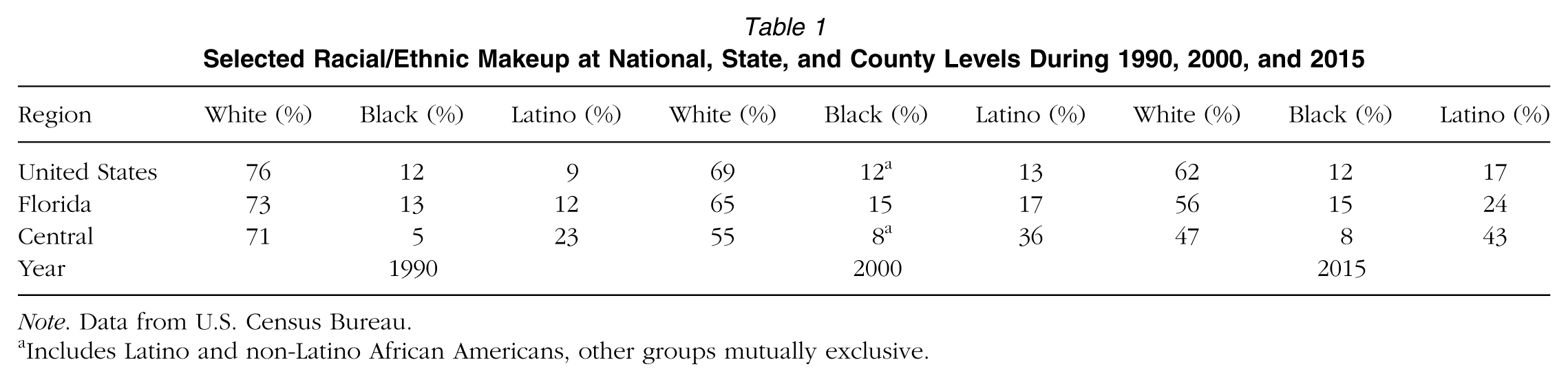
Note. Data from U.S. Census Bureau.
Includes Latino and non-Latino African Americans, other groups mutually exclusive.
Five elementary schools, one middle school, and one high school mainly comprise the Central county public school district; children are also served by private and other schools (e.g., two Redlands Christian Migrant Association schools, one East Coast Migrant Head Start Project school). Until the 1950s, Strawberry Schools closed from December to March to allow children to pick strawberries with their families. Their ending marked a beginning of the majority publicly questioning educational accommodations for farmworkers. According to my larger study, White and Indigenous Mexican community members typically held favorable views of the schools (Campbell-Montalvo & Pfister, in press). These favorable views were in contrast to those expressed by many African American and Latino participants who had been in the county for generations. Indeed, this latter group of interviewees noted displeasure regarding inequality in school resources as well as curriculum and instruction (Campbell, 2016).
In Central county, most students were economically disadvantaged and there was a substantial migrant 8 population. Sixty-three percent of Centralians had a high school diploma, and 38% of children lived in a home where a language other than English was used in 2011–2015, according to the U.S. Census Bureau. From 2011–2015, Central’s income was $16,298 per capita and a quarter of residents were under the poverty line.
At the time of data collection, students at Apple, Central Junior High (CJH), and the district as a whole were about 61% Latino, 30% White, 6% Black, less than 1% Asian, and less than 1% American Indian. Emerald’s student body was 80% Latino, 17% White, less than 1% Black, less than 1% Asian, and 0% American Indian. Central’s teachers were 89% White, 8% Latino, and 2% Black (FDOE, 2015). These differences between students and teachers comprise a marked and consequential mismatch (La Salle et al., 2020). As noted earlier, these race/ethnicity figures all utilize an exclusive racial typology where individuals can be in only one category, resulting in Indigenous Latinos and Latinos of other races being Latinized as Latino only (see Campbell-Montalvo, 2020, for an in-depth analysis of this racial re-formation in Central). Table 2 contains additional information for the three schools at focus (Emerald Elementary, Apple Elementary, and CJH) as well as the district overall.
School and District Demographic Characteristics for 2014–2015 School Year
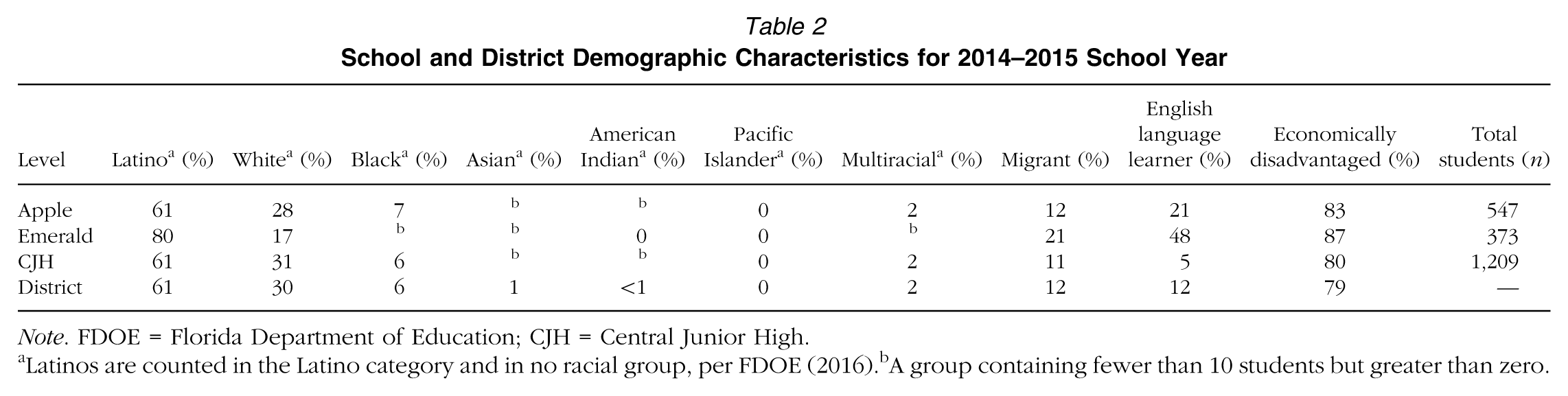
Note. FDOE = Florida Department of Education; CJH = Central Junior High.
Latinos are counted in the Latino category and in no racial group, per FDOE (2016).bA group containing fewer than 10 students but greater than zero.
Most Central teachers were monolingual English-speakers. They appeared to be outside of the social network of families of color and regularly conveyed feelings of being surprised or shocked when confronted with cultural and linguistic realities of their students (Campbell, 2016). According to the FDOE, 63% of Central’s 325 active teachers were English for Speakers of Other Languages (ESOL) endorsed, higher than figures for Florida teachers as a whole where 40% were ESOL endorsed. Only 1% of Central’s teachers were ESOL certified, which has more requirements than endorsement, whereas 6% of Florida’s teaching were ESOL certified. Notably, these figures on ESOL endorsement and certification were only available for the 2018–2019 school year, 3 years after the data for this study was collected.
Method
Triangulated (Schensul et al., 1999) qualitative and quantitative data come from three primary sources and one secondary source:
School office observations of around 40 registrations at Apple.
A language inventory (survey) completed by parents or students themselves for 1,287 students at Apple, Emerald, and CJH.
Forty-six interviews with diverse individuals, including many parents or school employees (including teachers) from each of the three schools.
A total of 1,956 records from the three schools.
Initial observations showing that Indigenous Mexican languages were re-formed into Spanish guided my creation of the language inventory (including informing on which languages I should include as choices on the inventory), construction of follow-up questions during interviews, and procurement and analysis of school records containing language information. The inventory allowed me to evaluate the extent to which the linguistic re-formation first found during observations might have been systemic (Bernard, 2011). A more robust understanding of linguistic re-formation processes (the “how”) and the raciolinguistic ideologies, staff training, and policies underlying them (the “why”) was made possible by drawing on interview and observation data from various emic perspectives (i.e., school personnel, parents).
Observations
School office observations described here were conducted at Apple, due to the timing of my observations. I witnessed around 40 student enrollments there. Some days there were multiple enrollments, on other days none. The registrations mostly occurred during the days/weeks, leading up to the start of the 2014–2015 school year, in November 2014 when migrant families were returning, and at 2015 events such as Meet Your Teacher and Kindergarten Round-Up. I took thick, descriptive notes during office observations, focusing on actions Central to the original project’s goals of school resource equity.
Apple’s office was run by a monolingual English-speaking White office worker and data clerk, both women. A bilingual (Spanish and English) Latino worked part-time as a nurse for the first half of the year and often interpreted in the main school office that was next door to the clinic. Another monolingual English-speaking White woman provided part-time office assistance. Two bilingual (Spanish and English) Latina paraprofessionals occasionally assisted but their full-time positions were located outside of the office. I sat at the open desk opposite the main office worker during observations, moving toward the counter when parents came in. During registration, I stood next to the office workers to listen closely while they talked to parents.
Language Inventory
The language inventory I conducted to identify student and parent languages was in English on one side and Spanish on the other. In order to ensure the collection of data comparative to parent language data in school records, the inventory asked about the language of parents/guardians and not extended family members or others who might shape a child’s upbringing. It could have also asked about the language spoken in the home, but that would have added additional length, potentially affecting response rates. The inventory’s instructions read, “Circle all of the languages that apply to each question. Talk with your parents to make sure that the language(s) they speak is shown correctly. If a language is not listed, write it in.”
Below these instructions, there were three items:
Which language(s) do you speak? (This is for the student.)
Which language(s) can mom/guardian #1 speak?
Which language(s) can dad/guardian #2 speak?
In columns, the following choices were listed for each question: “English, Spanish, Nahuatl, Yucatec Maya, Mixteca, Zapoteca, Trique, Haitian Creole, Romanian, American Sign Language, Mexican Sign Language, Chinese, Hmong, Arabic, Mazateca, Chinanteco, Mixe, Amuzgo, Chatino, Zoque, Popotaca, Contal, Huave, Other (write in): _________.”
Nearly 2,000 copies were distributed based on the number of students officially enrolled in classes at Apple, Emerald, and CJH at the time the survey was administered. Administrators allowed me to provide teachers with inventory copies for students to take home to fill out. Teachers collected returned inventories and sent them to the school office. Returned inventories were then entered into Microsoft Excel. In sum, there were 1,287 student inventories returned, for a response rate of 68%. For what counted as a valid inventory, see Campbell (2016).
Interviews
The 46 structured interviews I conducted with parents, school employees, and community members from various language, racial, and ethnic groups focused on resource access, school satisfaction, and participants’ lives. More information on participants’ characteristics and the interview questions used can be found in the appendix of Campbell (2016). Campbell-Montalvo and Castañeda (2019), Campbell-Montalvo and Pfister (in press), and Campbell-Montalvo (in press) offer more insight into Indigenous Mexican participants’ lives specifically.
Interview participants were recruited through various avenues. For example, I approached employees at school after my observations had been underway for some time. Parents were asked if they wanted to participate in interviews during home visits with migrant advocates or when they visited the school for various reasons. Interviews lasted between 30 and 60 minutes and were audio-recoded and transcribed verbatim. For most Spanish interviews, I was accompanied by a bilingual middle schooler Mexicana who received community service hours at school. Transcription and translation of Spanish interviews were done by a bilingual Spanish and English speaker and checked by me. Casual conversations were jotted down in my journal and occurred throughout the study as well as when details were needed toward the end of the analysis phase. These follow-ups illuminated rationales behind and perceptions on linguistic re-formation.
Secondary Data
Data obtained from school records included race, ethnicity, “parent’s native language,”“home language,” and “language” as recorded by registrars during registration. Records were obtained from data clerks with administrator permission and deidentified for confidentiality. Registrars noted that the first language column (“parent’s native language”) was to “contain the language spoken natively” by the parent. The second column (“home language”) was to reflect the language spoken at home based on the registration form item, “Is a language other than English used in the home?” The third column (“language”) was to show the student’s language.
According to records, at the three schools altogether there were 2,344 students. However, there were in actuality fewer than 2,344 students enrolled at the school when the survey was distributed since withdrawals and other changes to the records had not yet been processed to reflect the removal of inactive students. The sample of school records for 1,956 cases (of the 2,344) were available for analysis; this included all records at Apple and Emerald and records for the first 1,000 of 1,388 cases at CJH due to a copying error. No evidence suggested that the 1,000 records in the CJH data were not representative of the broader sample (1,388).
Analysis
Qualitative data from observations and interviews were coded using thematic analysis (Braun & Clarke, 2006). A codebook was developed containing themes relevant to the project’s research questions and as coding progressed, was refined and subcodes, and additional codes were added. The coded excerpts were organized in Microsoft Excel in thematically labeled columns and rows labeled with participant data (such as demographics and their position in relation to the school, e.g., a teacher, parent, school employee, etc.). Examples of thematic codes included the following: opinion on schools; opinion on school equity; discussion of home language; reports of language problems in school; perspectives on school population demographics; feelings of judgement by others due to language, race, or ethnicity; perceptions of racism in school; and thoughts on the ability of schools to communicate with families.
For the quantitative data, averages, percentage analysis, and totals were calculated to compare and contrast languages reported in school records and the language inventory, based on emergent themes from the qualitative data analysis. To determine the language varieties used by students according to school records, I analyzed the first two of the three system columns (“parent’s native language” and “home language”), omitting “language” as it was blank in more than 90% of cases. To determine the differences in language recording for various racial groups, I looked at the recorded race and ethnicity in the records and matched that to whether each case had linguistic information in any of the three columns.
Positionality
My language repertoire as well as my racial, ethnic, and gender identities influenced the ways Centralians perceived my work, the ways they perceived me, and the ways I moved through groups. For instance, my use of Spanish, efforts to establish rapport and trust, and daily presence at the schools might have encouraged Spanish speakers to be open with me, as many shared documentation status and concerns with me during interviews. Some participants of color likely were initially careful with comments, perhaps believing I held various hegemonic ideas similar to those held by many in the majority, though interviewees appeared to be more open as time went on. At the same time, I was privy to certain comments because my race may have led some to assume I shared their views, such as those justifying or explaining racial inequalities by drawing on White supremacist views (see Campbell, 2016, for examples). I was also at either of the two elementary schools almost every day of the 2014–2015 school year, so I got to know many people that way. Most school personnel were White women, most of the parents I talked to were women, and almost all migrant advocates were women. My gender likely helped these women trust me. At the same time, men may have been less likely to engage with me.
Additionally, my own views on language and my understandings of the views of others in power are reflected in my analysis. For example, I excluded Spanglish from language inventory analyses given that it is unlikely that Spanglish would be considered a valid language choice in the eyes of the school, whose policies I hope to influence. Spanglish is defined differently by various scholars (e.g., Rosa, 2019), and I do not know exactly what participants may have meant by listing it in the inventory. It often refers to the use of language that mainly has features of English and Spanish or a language made through the combining of English and Spanish. For readers interested in Spanglish, Table 4 includes data on the variety. Additionally, in analyses, I grouped specific Mixtec dialects (i.e., “Meztico,”“Misteco,”“Mixtica,” and “Mixteca”) together, though participants may not have considered them the same. See Josserand (1983) for more on the Mixtec language, its dialects, and the geographic regions from which its varieties are named.
Findings: Language Is Re-Formed During Registration and Codified Into Records
Analysis of observations showed that linguistic re-formation occurred during registration, from differences in how registrars asked language questions to various families and when registrars changed the names of languages that families reported during the recording process. Analyses of school records and the language inventory suggested that this linguistic re-formation might have been systemic. For instance, school language records (in contrast to the language inventory) showed much fewer numbers of languages spoken by parents overall, with Indigenous Mexican languages markedly erased. Likewise, students from various racial/ethnic groups had different levels of language records completion. This suggested that the HLSs might not have been implemented across groups similarly. Additionally, personnel and parent perspectives related to these findings differed. Comments from personnel especially informed on the raciolinguistic ideologies, training and policy, and records system design influences on the linguistic re-formation found. Parent interviews particularly shed light on broader concerns about language use in school and how linguistic re-formation might be perceived by those it affected. Before getting into these findings, additional context on registration observations is needed.
Language Identification During Registration
Observations showed that the HLS was combined into the school registration form (see Figure 1), and parents were typically asked five or fewer language questions. A general consensus of Central registrars was that the three questions on the registration form attempted to determine (1) whether a language outside of English was used at home, (2) if the student’s first language was something other than English, and (3) if the student frequently spoke a language beside English. A language could be specified in the blank line next to each question. According to a Central registrar, if the answer to the second or third question was anything other than English, students were placed in an ESOL program until they took an assessment. Answering “yes” to the first question would also result in further evaluation. There were two more language questions not listed on the HLS/school registration form that were often asked during registration in Central schools. These attempted to identify parents’ first language and the primary language 9 used in the student’s home. Answers to these latter two questions were entered into the schools’ records system, while answers to the three questions on the registration form were placed in the student’s hard copy cumulative file, according to a Central data clerk.
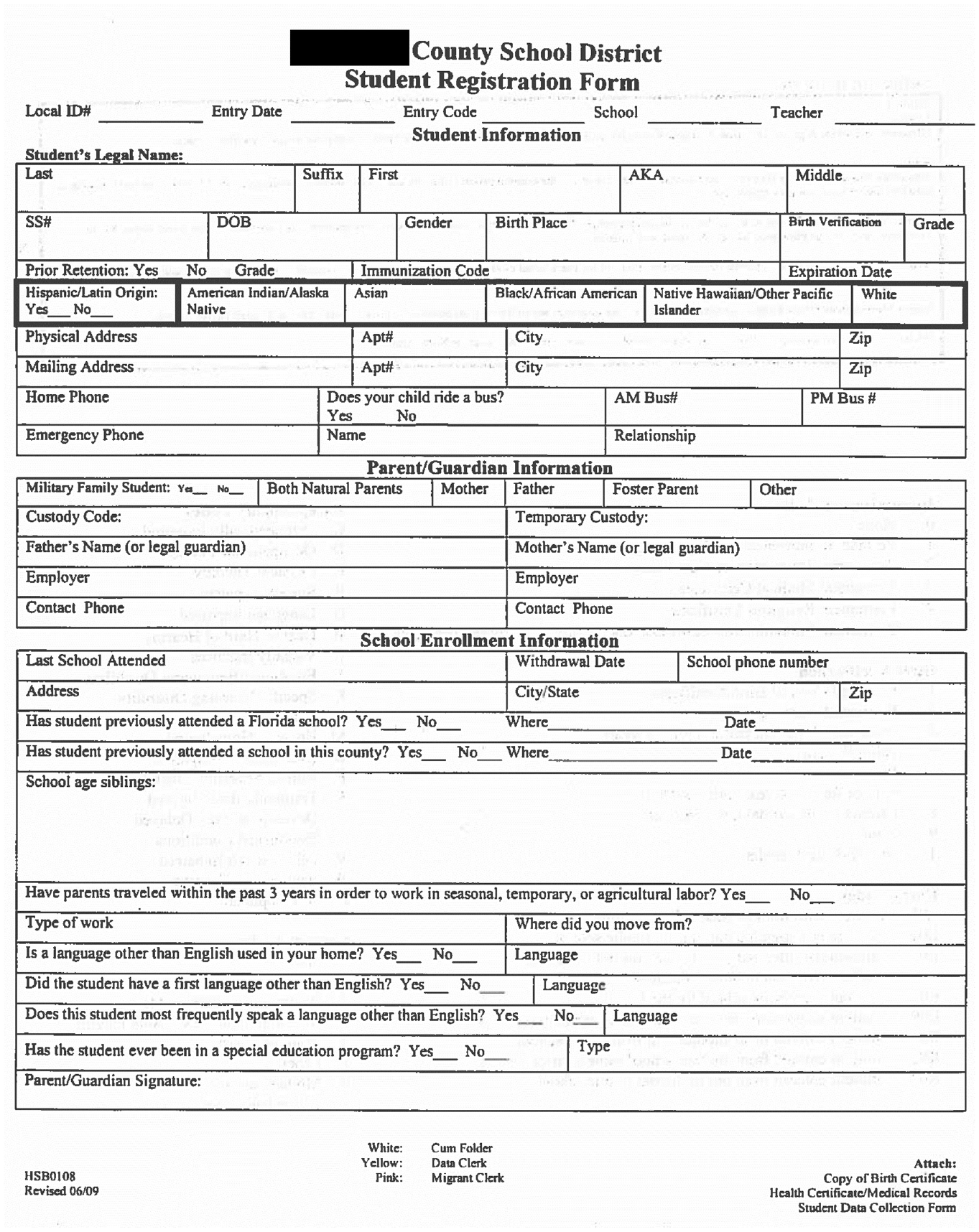
Redacted Central county school registration form.
Linguistic Re-Formation During School Registration
Observations and interviews showed that when families came in to register their children they were usually either given a form to fill out or the form was completed by registrars. When registrars completed the form, it was based on their perceptions of parent conversational abilities or of parent responses to items when registrars read the form aloud to them. At Apple, sometimes children or a family member interpreted or parents requested an interpreter, and a paraprofessional, nurse, or teacher would assist in Spanish. If there was no interpreter available, the family and employees struggled through the interaction or parents were asked to leave and return later when there would be an interpreter available (Campbell, 2016). At Emerald, because the data clerk was bilingual, more bilingual employees were available, and there was a school culture that better supported translation, such struggles occurred far less often than they did at Apple. As shown in the next two paragraphs, the same line of registrar questioning of families was not always used during registration.
The following example from my fieldnotes illustrates how a registration might look. On August 22, 2014, in Apple’s school office, a Palestinian multilingual family came in to register a student. The oldest woman wore a hijab. A young woman, likely the older sister of the child, spoke on behalf of the family while an office worker went through the registration protocol.
For race?
We put White. It’s the closest thing.
The closest thing . . . are there records from the prior school? Where was it?
No records, they would be in Palestine, West Bank.
Does he speak English?
“Hi,”“bye,” ABCs, numbers . . .
What language?
Arabic.
The questions asked by the office worker did not exactly mirror the registration form (Figure 1). After final registration tasks the family left, speaking Arabic on their way out. In reference to people who are Middle Eastern, I had previously heard comments from Central school employees, such as “You never know what they are up to.” Though I was expecting similar remarks of suspicion during this interaction, there were no further comments about the family from staff. I asked if the child would be tested for language services and the office worker replied, “Yes.”
As noted, there were differences in how registration language questions were asked to families at Apple. For example, “Spanish, right?” was used for a Latino family on one occasion versus “What language?” used with the Middle Eastern family in the previous example. Other times Apple registrars omitted asking some of the language questions for some parents, often those who appeared White or African American and not Latino.
On another occasion when I was at the frontline of registration, I observed registrars changing Indigenous Mexican languages reported by parents into other languages (i.e., Spanish) when they recorded them. An instance of this occurred during Kindergarten Round-Up at Apple (May 15, 2015), an annual event during which families come to enroll incoming kindergarteners, visit classrooms, and participate in activities to get to know the teachers, curriculum, and school. At Kindergarten Round-Up, employees and I answered questions and registered 14 students; there were no school-provided interpreters available. According to the students’ forms, five spoke Spanish, one Arabic, and eight only English. During registration, some parents reported speaking Náhuatl when asked about their language. In response, an office worker wrote “Spanish” on the registration form. Afterward, I asked the registrar what I should do in a similar situation so that I could follow office protocol. I was told to write “Spanish” if parents said they spoke—to use the words of the office worker—any “language down there.” Based on the context of our discussion and tasks at hand, I understood her to be referring to languages spoken in Mexico. I observed this language re-forming during my time in the office on several different occasions.
Linguistic Re-Formation Is Widespread yet Affects Groups Differently
Analyses of school records and the language inventory at Apple, Emerald, and CJH suggested that the linguistic re-formation first noticed during observations might be a widespread and systemic issue. First, parental multilingual abilities could not be included in school records due to a limiting system design that allowed only one total parent language to be entered into the computer. In contrast to school records (Table 3), language inventory results (Table 4) showed that student and parent linguistic repertoires were more dynamic. Specifically, according to the language inventory, 56% of parents were monolingual, 42% bilingual, and 2% trilingual. Twenty-five percent of parents did not speak English though 104 of non-English speakers were multilingual. The inventory also showed that half of students were monolingual, 46% bilingual, and 3% trilingual. The noted records system’s design meant that every parent’s language abilities had to be re-formed into a single parental language value for each student. Additionally, registrar comments suggested that registrars have been differently trained in terms of what language information goes into the three language columns.
“Native” Parent and “Home” Language Based on School Records
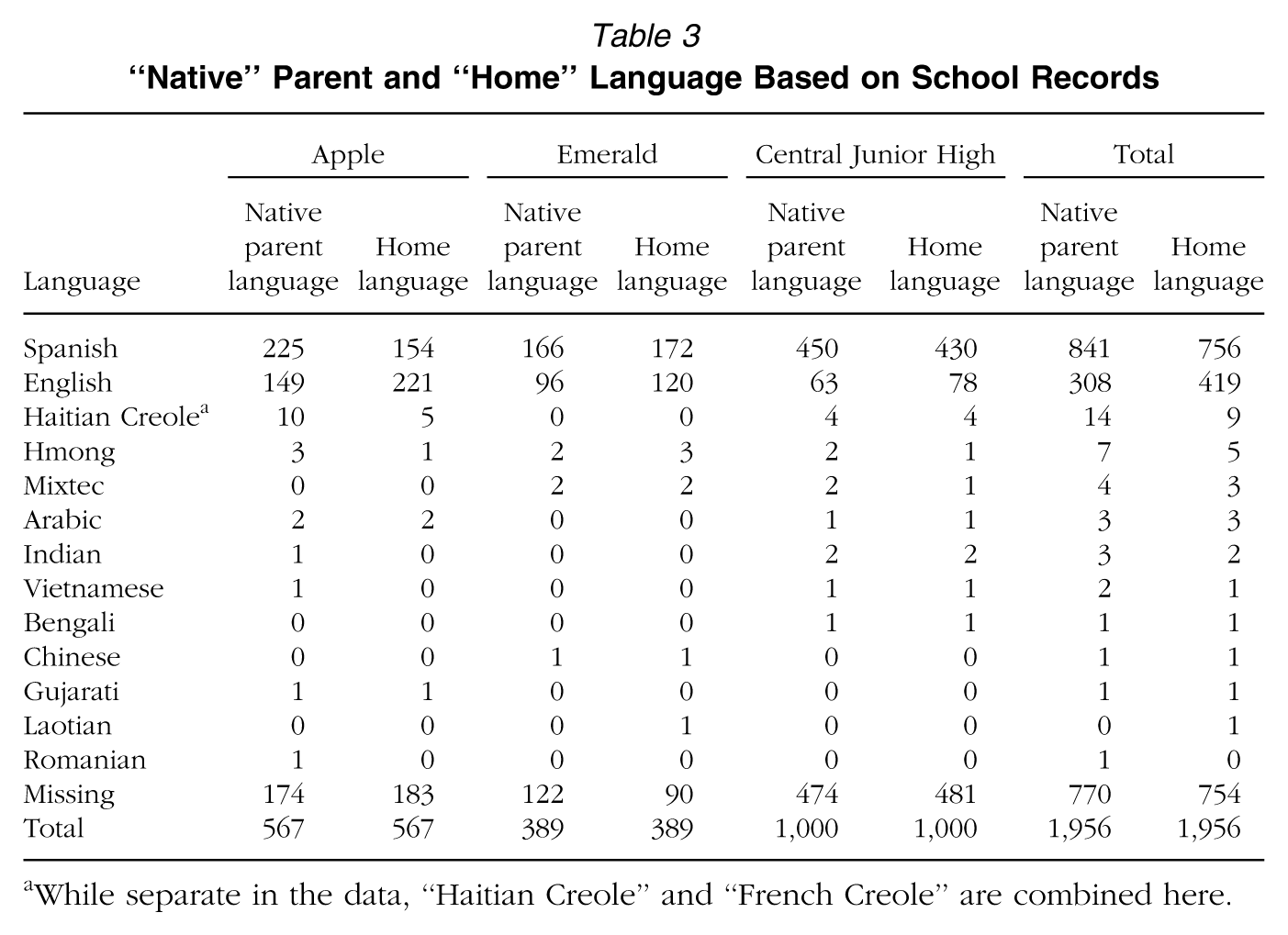
While separate in the data, “Haitian Creole” and “French Creole” are combined here.
Student, Mother/Guardian, and Father/Guardian Languages Based on Language Inventory (Including Spanglish)
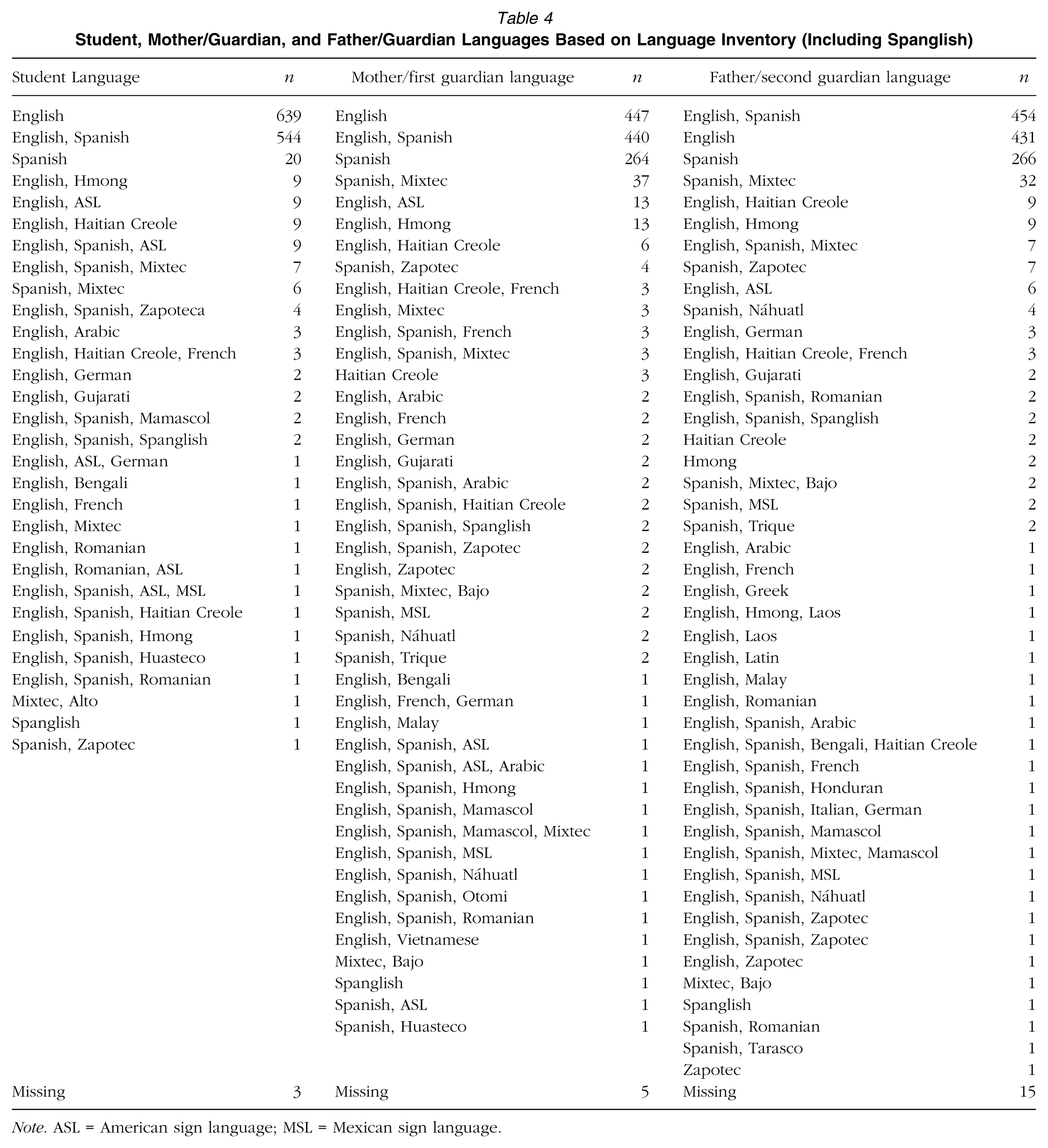
Note. ASL = American sign language; MSL = Mexican sign language.
Second, contrast of records and the inventory showed that school records under identified language variation, especially under counting Indigenous Mexican languages. School records showed that parents collectively spoke 13 languages, while the language inventory revealed they spoke 29 (excluding Spanglish—though that variety is included on Table 4). Zapotec, Bajo, Náhuatl, Trique, Huasteco, Tarasco 10 [Purépecha], and Otomi did not appear in school records but did on the inventory. Furthermore, the inventory showed that 5.7% of students’ parents spoke an Indigenous Mexican language, while this was only 0.3% in school records. Thus, parents were Indigenous language speakers 19 times more often than reflected in records. 11
Third, school language records were more often complete for some racial and ethnic groups than they were for other groups. White students lacked any language information in the three language columns 64% of the time, followed by students who were Black (55% missing), multiracial (52%), Latino (19%), Asian (11%), and American Indian (0%).
The Various Influences and Views on Linguistic Re-Formation
Paying close attention to what people said and did during, after, or about registration offers clues as to the influences on and perceptions of the linguistic re-formation found in the data. I draw on interviews and casual conversations with participants from Apple, Emerald, and CJH to focus on how employee training and policy as well as the records system design influenced linguistic re-formation; and how parents viewed language treatment by schools.
Training, Policy, and System Design
Employee perspectives informed by their training and their understanding of the local and state policies prompting language data collection grounded their practices. For example, in contrast to Emerald, Apple placed much less emphasis on identifying the specific languages spoken by families. When I asked an Apple registrar about how decisions are made as to what language to record when parents reported Mixtec or Náhuatl, the White monolingual English-speaking woman replied, It really isn’t relevant as to which dialect they use on our end of registration or to the state, which we report to. We are simply establishing if the child needs to be tested for our ESOL program. Any registration that includes a foreign language spoken at all in the home will prompt for an ESOL evaluation. If the child tests high enough they will not be pulled out for extra assistance in school, if they don’t pass they will receive extra help.
Talking with an Emerald registrar who was a bilingual (English and Spanish) Latina (Carmen
12
) showed that she put a lot of thought into which language she recorded for a student. For instance, her judgement of student and parent language ability factored in to how she recorded a student’s language. She also shared for what purpose language information was used (which played a role in her decision), though she was unaware it was sent to the state. She said, [Language information helps so that] we would know when we have to make contact if we need a translator. If their parents only speak dialect, or a different language other than Spanish, we don’t have anybody to speak it. [Knowing the answer to] “Is there another language the student knows?” would benefit us when we place them. We try to place them with bilingual teachers . . . [or] we would make sure that there’s a paraprofessional to go in there with them . . . For instance, I have a bilingual family coming in, mom and dad speak perfect English and Spanish and majority of their home language is English. There would be no reason to mark “Yes” [to the HLS questions] because they would be tested.
Carmen said that she always recorded the language exactly as the parents reported it, and if that specific language was not a listed choice available in the records system, she left it blank. The FDOE (2017) has a list of 381 languages that schools can select, and while some Indigenous languages are available in the system to choose from (i.e., Mixtec, Zapotec) others are not (i.e., Náhuatl, Otomi). Carmen noted that it would be better if she could type in the unlisted languages so “we would know who would be able to help” those students and parents. Notably, Emerald’s practice of recording the language as-is or leaving the item blank was much different than Apple’s practice, where Indigenous Mexican languages were re-formed into “Spanish.”
In addition to training and policy, the records system design influenced how language data were recorded, as noted earlier. The recording of multilingual repertoires for a parent, the monolinguistic repertoires for both parents, or the multilingual repertoires of both parents was not possible in Central because the records system could only hold one parent language. Carmen detailed how she made decisions on which language to record for parents within these confines, “I ask [the parent], ‘What do you primarily speak?’ If it’s dialect, that’s what the primary language is. Though they may know other languages, I go with what they use at home.”
Parent Perspectives on Language Information
While registrars differed in their registration practices, in observations Indigenous parents appeared unaware that there might have been issues in how language information was recorded by the schools. In interviews about language issues in school, these parents were more concerned with the availability of translated documents and interpreters in the office and meetings (Campbell, 2016; Campbell-Montalvo, in press; Campbell-Montalvo & Castañeda, 2019; Campbell-Montalvo & Pfister, in press).
For instance, Indigenous Mexicana mothers shared concerns about the lack of interpreters.
13
Eleuia, a Náhuatl and Spanish speaker, had children in Apple, CJH, and Central High School. Note that Eleuia’s daughter is removed from instruction to interpret: Sometimes when I go to CJH, they don’t have a Spanish speaker and I have to stand until somebody arrives and helps me . . . there is a Spanish speaker but sometimes she’s busy, because she’s the only one . . . I think that if there’s someone to translate, people would go to the meetings more often. Not many parents are told to go [by the school] . . . My kids also tell me: “I go to the office, Mom,” and it’s because their teacher asks them to. [My kids say,] “There are people who are there because they need help.” And she helps them.
Alejandra, a Mixtec and Spanish speaker, had two children at Apple and one at Central High School. When asked if there was always someone at the school who could speak Spanish, she replied, No, there is not always someone who speaks Spanish. Before there was
14
but now, no. Sometimes I go to the office to ask something and there is not someone who can speak Spanish, so I can’t ask the question. And I would like it if there was someone there who speaks Spanish so they could help . . . When there is no one there to help me, I come back home and I ask my daughter to speak [with the school], because she speaks English.
Many personnel from Apple agreed that the lack of interpreters was an issue, and many teachers and parents from Apple believed it affected parent attendance at meetings (Campbell, 2016; Campbell-Montalvo, in press). With the critical lack of interpreters at Apple, I served as an unplanned interpreter when necessary in reciprocity with the schools, though my Spanish language ability was limited. Parents and teachers from Emerald did not report having had a lack of interpreters or translated materials at school—a trend triangulated by my observations.
During follow-up conversations with parents, I explained that some language information may not be recorded by schools. Indigenous Mexican parents from each of the three schools did not see this as a major problem. However, most noted that they would like all languages to be recorded. For example, Yatzil, a Zapotec, and Spanish-speaking mother at Emerald said, My girls speak Spanish but they don’t speak Zapotec. We just want them to continue speaking English at school. [We want them] to learn as much English as they can. We speak to them in Spanish but I think that they’re having a hard time with Spanish.
When asked if she preferred that the school recorded all the languages that she spoke she agreed, “Yes, I do prefer that they record all of the languages that we speak at home.” Similarly, Eleuia and her husband Lucio, who also spoke Spanish and Náhuatl, said of the linguistic re-formation, “To us, it’s not really a problem. But we do see how others may view it as a bit offensive. Because they’re proud of their culture and the language they speak may be a big part of them.” When asked if they would want the school to mark down that they also speak Náhuatl, they agreed, “Yes, that would be nice.” Likewise, Alejandra was “not really concerned about it because the schools don’t speak Mixtec.”
Discussion: Understanding the Presence of Linguistic Re-Formation
In Central, globalization and sociopolitical and economic forces spurred the environment that existed when linguistic re-formation was found. Likewise, the history of linguistic, racial, and ethnic group relations as well as extant raciolinguistic ideologies couch the finding that linguistic re-formation was a widespread issue. The linguistic re-formation in Central I highlight indeed comprised processes through which languages (and people) were differentiated (Gal & Irvine, 2019), exemplifying hegemonic practices reproducing state definitions of language (and people). These definitions are consequential, as they are often used to determine for which varieties accommodations, such as interpreters and translations, are made available.
The triangulation of language data from the inventory and school records along with the context from interviews and observations suggested that the inventory provided a more complete and nuanced representation of student and parent linguistic repertoires than school records did. Additionally, the much smaller number of languages found in school records (13) contrasted with those found in the inventory (29) suggested that linguistic re-formation issues identified during observations might be systemic. I argue that the main influences on the linguistic re-formation observed include the manifestation of
Raciolinguistic enregisterment, where the listening subject believes that people they perceive to be Latino must speak Spanish.
Language ideologies, which see Indigenous Latino languages as a subset of Spanish.
School district priorities, practices, and policies in identifying language, which deemphasize the recording of language repertoires in their totality.
In a discussion of these influences, I also speak to the additional point raised in the findings regarding Indigenous Mexican parents’ nonovert displeasure with linguistic re-formation.
First, the existence of raciolinguistic enregisterment at Central was evidenced when registrars changed Indigenous Mexican languages to Spanish on forms, phrased questions indicating they may have presupposed the linguistic repertoires of parents (e.g., “Spanish, right?” for Latinos vs. “What language?” for Middle Eastern families 15 ), or decided not to ask language questions to parents at all (often for White or African American parents). These decisions about whether and how to ask language questions likely correspond to the differences in school language data completion rates among racial/ethnic groups. Here, registrars might have considered the language of White and African American students to be less important to document than the language of Asian, Latino, and American Indian students. This might have occurred because registrars assumed Asian, Latino, and American Indian students had “linguistic barriers” to record. This coincides with the racial ideologies of Central’s actors (Campbell, 2016), where Whites and African Americans are constructed to have a longer standing presence in Central. This also aligns with raciolinguistic ideologies assuming that students perceived to be White or African American will be more likely to speak English than Latino, Asian, or American Indian will be. Ultimately, in at least some of these instances, how people looked seemed to matter more than the language they actually used or reported (Rosa, 2019).
Second, many school employees considered Indigenous Latino languages to be a dialect or subset of Spanish. This language ideology likely also played a role in how Indigenous Mexican languages were recorded, which is especially unfortunate for Indigenous Latino-language speaking families who did not speak Spanish. This assumption is illustrated when Carmen, like many others, referred to Indigenous Latino languages as “dialect,” a term often referring to a language variety that is a subset of another variety. Furthermore, the lack of including the indefinite article “a” in front of “dialect” by Carmen and other Central Latino school employees suggests that they might view Indigenous Latino languages to actually be one language type altogether rather than numerous varieties that are not often mutually intelligible. I posit that because Spanish-speaking school employees could recognize that these varieties were not Spanish, many grouped Indigenous Latino language together into an other, almost mysterious category (see Campbell & Castañeda, 2019; Campbell-Montalvo, in press, for evidence that triangulates this). Their recognition that “dialect” was not Spanish resulted in them being less likely to record Indigenous Latino languages as Spanish. At the same time, monolingual English-speaking registrars might have had a more difficult time discerning between Spanish and Indigenous Latino languages, so they were more likely to mark the languages as Spanish. Notably, Indigenous Latino languages being mistaken as a subset of Spanish might have played a role in Apple’s registrar instructing me to record Spanish for any “language down there.” Gal and Irvine’s (2019) noting that “ideologies can convince even without any linguistic manifestation” applies to the points presented both in this and the prior paragraphs (p. 2).
However, in addition to being affected by the assumption that Indigenous Latino languages were a subset of Spanish, I argue that the any “language down there” example is also a case of raciolinguistic enregisterment. Given that raciolinguistic enregisterment indexes how one comes to “look like a language and sound like a race” (Rosa, 2019), one might argue that the mistaking of language forms that are absent of a body by which to append a race may be unable to be described as raciolinguistic enregisterment. Yet, raciolinguistic ideologies seem to work outside of contexts where physical bodies exist. That is to say that proxies for race appear to do the job of race in raciolinguistic enregisterment (where race and language are coupled). An important point in this argument on the role of a proxy for race in raciolinguistic enregisterment depends on a concept I specified in a recent article (Campbell-Montalvo, 2020), called “racial re-formation.” The concept of racial re-formation is similar to the concept of linguistic re-formation except it is race that is re-formed rather than language. In the case of “racial re-formation,” my data showed that people’s race was re-formed into the racial typology understood by the categorizer, causing identities not perceived to be associated with Mexico (e.g., American Indian; i.e., Mixtec) to be re-formed or Latinized into Latino, thereby erasing Indigeneity (Campbell-Montalvo, 2020). Thus “down there” (Mexico) as a place, becomes a proxy for de facto race (where Mexico is coupled with Latino), and in raciolinguistic enregisterment Latino and Spanish are coupled. This understanding coincides with previous work linking ideas of language and nationality (Urciuoli, 1995) and acknowledging that linguistic forms can index dimensions of shifting salience, including place, person/type, and so on (Gal & Irvine, 2019).
Third, linguistic re-formation also spurred from employee understandings about the use of the language data generally, the school district leaders’ priorities, and differences across registrars in the implementation of FDOE’s policy to record language exactly as identified by respondents. This is seen in Apple’s registrar who placed a lack of emphasis in recording home languages accurately because her understanding of the role of identifying language was that it was done to simply determine whether English was the main language of a speaker or not. This is mirrored in the design of the records system, which prohibits the capturing of parental multilingualism. The records system design was something few employees problematized as limiting, and no known changes in system design were being planned to allow for the more accurate capture of linguistic repertoires. In accordance with FDOE policy, registrars should select the category of “other” in cases where any language reported by parents but not listed in the system, rather than leaving it blank or writing “Spanish.” Evinced by Apple’s registrar recording “Spanish” for all Indigenous languages and Emerald’s registrar leaving them blank if unlisted, there were training and policy execution inconsistencies in how registrars recorded language. In addition, while the electronic system may be limiting, the paper registration form is not. Thus, multilingual repertoires could be recorded there, which might be better than total erasure. In the end, this work provides support for Central, FDOE, and other districts to revisit how their systems are built to record multilingualism.
Importantly, several Indigenous Mexican parents indicated that they did not perceive that linguistic re-formation was a major problem. A reader might contend that this suggests that miscategorizations of language might be unimportant. However, I do not believe that their statements diminish the significance of linguistic re-formation as a theoretical contribution nor negate possible negative consequences of it. Rather, it is important to note that these parents often contrasted Central schools to schools in Mexico when they discussed their views on Central schools (see Campbell-Montalvo & Pfister, in press, for a detailed analysis of this). Indigenous Mexican parents often shared that they were just glad to have schools that were close by at which their children could receive free education, obtain free meals, or even have their health care access facilitated (Campbell-Montalvo & Castañeda, 2019). Prior research shows that many Indigenous Latino parents believe that learning English is valuable and that their children’s Indigenous language loss may be inevitable (Bishop & Kelley, 2013; Velasco, 2010).
While this study yielded robust findings, it has limitations. For instance, it was not discovered until several enrollments had occurred that linguistic re-formation was happening or that enrollment would be such an important event. Thus thick, descriptive notes for all observed registrations noting exactly how language, race, and ethnicity questions were asked to all families are unavailable. An additional limitation is that office observations were only available at Apple. Other data provided here, such as comments from Carmen, suggest that families might encounter a different and more nuanced context during Emerald registration. The inventory design was also limiting, given that it did not ask about languages spoken in the home, which could differ from parent languages. Careful weighing of design options, research questions, and feasibility will likely yield a revised inventory offering additional insight.
Conclusion: Addressing Linguistic Re-Formation
The identification of linguistic re-formation in this study mandates changes in Central structures and programs so that more students’ needs are met. I discuss the implications and applications of this research on three especially relevant areas that are and will continue to be affected if change is not made: culturally sustaining pedagogies (CSPs; Paris & Alim, 2017) and teacher representation, language screening, and language accessibility.
First, regarding CSP and teacher representation, in part due to the type of language information available in the records, school and district employees appeared uninformed of the linguistic repertoires of many students and families (Campbell, 2016). Therefore, faculty, staff, and district administrators missed opportunities to better serve students through CSP and initiate aggressive hiring initiatives to diversify the teaching force. With better linguistic data on students, Central could act on the need for CSP and for teachers who share similar cultural and linguistic repertoires as students to secure greater linguistic diversity among teachers. Central administrators share such information on student demographics with teachers during School Advisory Council meetings, faculty professional development meetings, and so on. More purposeful discussion about how that information can be used to craft student-centered approaches is needed. This more purposeful discussion must include professional development aimed at addressing racialized and xenophobic worldviews, which were found at the research site. The discussion should also build upon some of the CSP already observed in Central schools (Campbell, 2016). These conversations may bring raciolinguistic ideologies to light for school employees, which is a step toward ameliorating these biases. Language data would also be useful in beginning to recognize identities of Indigenous Latino students, as Indigeneity is a critical “dimension of intersectionality for U.S. Latinx youth” (Casanova, 2019, p. 61). My previous work provides additional rationale for schools to recognize the Indigeneity of Latino students (i.e., Campbell-Montalvo, 2020; Campbell-Montalvo & Castañeda, 2019).
Second, having language information recorded for students from various racial and ethnic groups at different rates in school records raises questions on the language screening process. When the first step in the screening process is not executed in a manner that appropriately screens all students, the remaining steps are taken with a sample of students that is racially and ethnically skewed. In terms of language screening, employee training on how to ask registration questions of families in nuanced ways respectfully appropriate to understanding their linguistic repertoires is needed. Every family should be asked language questions, and all responses, no matter what they are, should be accurately recorded verbatim on the form. Additionally, having a map and a list of the common languages used in areas from where families frequently come depicted in the languages themselves can help. This would also allow families who do not speak English to point to a language, further improving the accuracy of the recording of languages.
Third, that parents’ linguistic repertoires were likely to be at least as broad as those reflected in the inventory highlights the importance of language accessibility at school. Parents and school employees agreed that language accessibility affected parent involvement and attendance at meetings (Campbell-Montalvo, in press). Parents often had to depend on neighbors or children to interpret at school (Campbell & Castañeda, 2019; Campbell-Montalvo, in press). Likewise, Indigenous Latino migrants who did not speak Spanish were excluded from bilingual assistance, given that migrant advocates in Central spoke Spanish/English and no Indigenous languages (see Campbell-Montalvo, in press; Campbell & Castañeda, 2019). Suggestions provided in the two previous paragraphs could provide a scaffolding of information and resources (i.e., more diverse employee workforce) to be used to promote resource availability and access (i.e., interpreters and translations) for language minority speakers. Furthermore, an improved translation system should be implemented district-wide, which could increase the availability of translated documents and cut down on duplicated effort. See Campbell-Montalvo (in press) for more suggestions.
In the end, without reeducation, those in power might continue to believe that Indigenous Latino languages are merely “dialects of Spanish” that are potentially mutually intelligible with it, continuing to reproduce linguistic re-formation and its effects. Generally, linguistic re-formation could be addressed by educating employees on the principles of linguistic, racial, and ethnic diversity within their community and by training staff on the registration process and on entering information into the records system (e.g., when the language category of “other” should be used). It is likely that having more Spanish- and Indigenous language-speaking employees and more Latino and Indigenous personnel may result in more accurate registrations. Improvements to the system design to allow it to hold information for multiple languages would also allow for more language information to be recorded.
Further research on linguistic re-formation is needed to replicate this study in different contexts. This could inform theories on how local and broader language and raciolinguistic ideologies, policies, and training intersect to affect representations of people. More work will likely raise added questions on data integrity. Further studies could inform improved methods for language identification. Efforts should also investigate the impacts of more appropriate language identification and recording procedures. Additional research should more fully explore parent, student, and employee views on linguistic re-formation. It should also uncover the relationship between linguistic re-formation and equitable school opportunities. Such opportunities might relate to the school resources and services to which students have access, including the extent to which students receive appropriate language screening and the effects of that screening.
The contributions of this study can help improve measurement, theory, and pedagogy. This study (and Campbell-Montalvo, 2020) reminds us to be cautious in gathering, interpreting, and engaging with demographic information in school contexts. It also highlights the importance of information system design and of employee training on documenting student and parent identities. By illuminating the extent and influences of linguistic re-formation, this research can inform policies on system design and training on school data collection both locally and possibly in other contexts. The principal offerings of the present study lie in its quantification of Latinization and its theorization of “linguistic re-formation.” By presenting a quantification of the extent of Latinization in specific terms (i.e., Indigenous Mexican languages under measured by a factor of 19), this work complements previous qualitative work and articulates how pervasive this problem can be. As established, the concept of linguistic re-formation offers an important tool to theorize and describe the microinteractional and macro processes that distort language representations. In the end, this work supports the addressing of linguistic re-formation to yield better language data that could support accessibility and more culturally sustaining pedagogy.
Footnotes

Notes
R