




Abstract
This study investigates designs for developing knowledge building (KB) and higher order competencies among academically low-achieving students. Thirty-seven low-achieving students from a ninth-grade visual arts course in Hong Kong participated. The design involved principle-based KB pedagogy, with students writing on Knowledge Forum® (KF), enriched by analytics-supported reflective assessment. Analysis of the discourse on KF showed that the low achievers were able to engage in productive discourse, with evidence of metacognitive, collaborative, and epistemic inquiry. Analysis illustrates how the design supported student engagement, including (1) reflective inquiry and social metacognition; (2) reflective meta- and epistemic talk; (3) evidence-based reflection for collective growth; and (4) reflection embedded in community ethos. Implications of reflective assessment for supporting low achievers for inquiry learning and KB are discussed.
Keywords
Twenty first-century education calls for the development in students of high-order competencies such as metacognition, collaboration, agency, and creativity (Bereiter, 2002; National Research Council, 2000; Trilling & Fadel, 2009). All students, regardless of socioeconomic status and academic background, need equitable access to opportunities to develop these competencies. In particular, successful learning experiences that focus on high-order competencies are critically important for low-achieving students. These can not only help students improve their academic performance and thus narrow the achievement gap, they can also create a cycle of continuous improvement (Becker & Luthar, 2002; Snell & Lefstein, 2018). Lower expectations of students and associated instructional approaches that are geared toward lower order skills do not provide low-achieving students the necessary opportunities to improve their academic performance (Becker & Luthar, 2002). Addressing the needs of all learners was identified in the recently published How People Learn II report (National Academy of Science, Engineering and Medicine, 2018) as an area needing substantial research.
Collaborative and inquiry-based instructional approaches that emphasize higher order competencies have many benefits for learners, such as deep understanding, higher order competencies, and self-efficacy (Chan, 2013). Positive collaborative inquiry engagement requires metacognitive skills, that is, goal setting, monitoring, and reflection (Brown, 1997; Järvelä et al., 2015; National Research Council, 2000); quality social interaction (Barron, 2003; Kaendler, Wiedmann, Rummel, & Spada, 2015; Stahl, 2006); and epistemic dispositions (Barzilai & Chinn, 2018). Low achievers have various difficulties and fewer opportunity to develop competencies in these areas. This creates a vicious cycle. Engaging them in successful collaborative inquiry and providing access to educational opportunity is not only an important educational endeavor but also a great challenge for educators, where engagement refers to “a goal-directed state of active and focused involvement in a learning activity” (D’Mello, Dieterle, & Duckworth, 2017, p. 106).
Although the literature includes many intervention studies on low achievers’ task engagement (Baxter, Woodward, & Olson, 2001; Dietrichson, Bøg, Filges, & Jørgensen, 2017; Han, Capraro, & Capraro, 2014), many focus on educational achievement and not high-order thinking and collaborative inquiry. Research on collaborative inquiry and scaffolding in the learning sciences has flourished in the past two decades, but there is limited research concerning students from different academic tracks (Raes, Schellens, & De Wever, 2014). Our informal analysis of research published in the two flagship journals of the International Society of the Learning Sciences in the past 5 years suggests few studies have specifically investigated underprivileged populations, although most classrooms have included students with low academic achievement. This also applies to research on knowledge building, the educational model we consider in this article. Furthermore, when research has compared differential effects on high and low achievers, there are few explanatory frameworks (Han et al., 2014; So, Seah, & Toh-Heng, 2010). How academic low achievers and at-risk learners can be scaffolded to engage in high-level collaborative inquiry and knowledge building, supported by technology, are important questions that remain to be investigated.
The term knowledge building (KB), as used in this article, refers to the educational model developed by Scardamalia and Bereiter since the 1990s (Scardamalia & Bereiter, 2006, 2014). The primary aim of KB is to introduce students to the practices by which the state of knowledge in a community is advanced. As an educational model, it goes beyond understanding the core concepts of a domain to understanding the nature of knowledge in that domain and how knowledge is created. Collective effort toward this community-level goal, student agency, metacognition, the improvability and social nature of knowledge and knowing, all are essential features. KB discourse takes place in Knowledge Forum® (KF), a computer-supported collaborative environment (Scardamalia & Bereiter, 2014). In KB classrooms, students generate questions and co-construct explanations, using both online and offline discourse to pursue progressively deeper understanding collectively.
In this study, we designed a KB environment enriched by reflective assessment supported by analytic tools to engage low achievers in KB inquiry. Reflective assessment refers to how students take on collective agency to set learning goals, monitor personal and community progress, use feedback to identify knowledge gaps, and examine how to improve their ongoing learning addressing broader problems (Lei & Chan, 2018; Yang, van Aalst, Chan, & Tian, 2016). Earlier research on reflective assessment has examined self and peer assessments focusing on individual progress (White & Frederiksen, 1998). In KB, reflective assessment is a collaborative process in a community; not everyone needs to be metacognitive at the same pace but collectively students can pursue shared metacognition and agency for community and personal advances.
The online discourse in KB occurs in KF, which can be augmented by assessment tools in KF that students use to reflect on their KB progress. We have developed one tool, the Knowledge Connections Analyzer (KCA) and an accompanying framework, which collects information from KF relevant to a few basic questions about the KB process (van Aalst, Chan, Tian, Teplovs, Chan, & Wan, 2012). Research using the KCA tools with cohorts of low achievers show that they were able to use the tool, make sense of the data it provided, and use these data to improve their KB (Yang, 2019; Yang et al., 2016). However, these preliminary studies did not investigate the classroom dynamics and knowledge practices, including how students engaged in reflective assessment, the changes that occurred in the classroom, design implications for developing agency and metacognition, or the principles needed to support low achievers in interventions. The present study aims to provide a framework addressing student difficulties by examining the principles, design, and dynamics of KB for engaging low-achieving students in KB and inquiry-learning. To our knowledge, it is one of the first studies on KB to specifically examine work by a cohort of low-achieving students, and in which tools for reflecting on discourse are used by the students. KB provides only a context here; the bigger challenge is to promote low-achieving students’ collaboration, reflection, and epistemology for productive inquiry more generally.
Literature Review and Framework
Higher Order Competencies and Difficulties for Low-Achieving Students
Low-achieving students, who often are from low socioeconomic and diverse ethnic backgrounds (Dietrichson et al., 2017; Slavin, Lake, Davis, & Madden, 2011), enter schools with fewer cognitive, metacognitive, and social skills; and with limited epistemic dispositions needed for educational achievement (Dietrichson et al., 2017) and productive inquiry-based learning (White & Frederickson, 1998; Tsai & Shen, 2009). Many have low motivation and efficacy (Becker & Luthar, 2002) and have more difficulty developing higher order competencies than higher achieving students. Helping low achievers gain successful learning experience in collaborative inquiry can benefit them greatly (Raes et al., 2014; White & Frederiksen, 1998).
Metacognitive skills—such as planning, monitoring, and reflection—are crucial for developing various capabilities for collaborative inquiry (White & Frederiksen, 1998; Zohar & Dori, 2003), particularly for academic low achievers (Yang et al., 2016). Skilled readers are more aware of the purpose of reading than poor readers—setting goals, allocating time, using strategies, and monitoring their comprehension (Wong, 1987); similarly, low achievers in math learning seldom appropriately select, monitor, or adapt strategies (Montague, Enders, & Dietz, 2011). Learners benefit most from collaborative inquiry when adept at metacognitive monitoring, reflection, and regulating (Azevedo, 2005). However low achievers often have cognitive, metacognitive, and collaborative inquiry skill difficulties (Yang et al., 2016). They often focus on low-level strategies (e.g., searching without a goal) and are less able to deploy/develop key metacognitive skills (Brown & Campione, 1994).
Collaborative and discursive skills are essential for productive collaborative inquiry. Students who collaborate well often show sound question-explanation exchanges, argumentation and uptake of ideas, and rise-above by synthesizing diverse ideas (van Aalst & Chan, 2007; Zhang, Scardamalia, Lamon, Messina, & Reeve, 2007). Low achievers are generally unfamiliar with group skills such as articulating viewpoints, listening to others, building on others’ ideas, and thinking together, which are important collaborative inquiry competencies. Primarily, low achievers and at-risk students lack a developed cultural sense of what collaboration is about, and opportunity to engage in productive and collaborative talk (Duschl & Osborne, 2002). Due to a lack of social support and opportunities in school and nonschool settings, they have limited experience communicating and expressing ideas, examining the validity of ideas, and developing discursive practices.
Epistemic disposition is important in collaborative inquiry that involves students’ epistemic understanding about what knowledge is and how it develops as well as engagement in epistemic goals and processes (Greene, Sandoval, & Bråten, 2016). Research has shown students’ epistemic understanding and dispositions influence student achievement, thinking and problem solving (Greene et al., 2016). Primarily, immature learners have less developed views of what knowledge involves, seeing it as linear and static, rather than evolving and extendable, and they lack epistemic goals and purposes (Barzilai & Chinn, 2018). With less developed epistemic goals and dispositions, low-achieving students often believe there are “certain” and definitive answers and thus less likely to exert efforts inquiring thus hampering their higher order and collaborative inquiry.
With lower teacher expectations (Zohar, Degani, & Vaaknin, 2001), subsequent inequitable exposure to learning opportunities, and negative appraisal messages, many low achievers feel powerless over their own learning potential, which impedes the development of self-efficacy (Becker & Luthar, 2002; Zohar & Dori, 2003). While the literature has revealed these difficulties, we do not use a deficit model viewing inadequate skills as something inherent to low-achieving students. Rather, in their educational histories, these students have lacked opportunities to engage productively. Research has shown that when low achievers are provided appropriate instruction, they can engage in higher order thinking (Zohar & Dori, 2003). Accordingly, efforts to improve students’ academic achievement and develop their higher order competencies require corresponding higher teacher expectations and support.
Educational Interventions for Diverse Learners and Low Achievers
Research has examined low achievers’educational achievement and the instruction they receive, emphasizing task engagement and peer-assisted learning (Baker, Gersten, & Lee, 2002; Baxter et al., 2001; Hawkins, Doueck, & Lishner, 1988). Research on diverse learners and low–socioeconomic status students similarly highlights cooperative learning (Dietrichson et al., 2017; Slavin et al., 2011), student agency, and the importance of being heard (Wallace & Chhuon, 2014). Research in STEM (science, technology, engineering, and mathematics) education using problem-based learning shows student engagement yields positive results, comparing high and low achievers (Han et al., 2014). Barton and Tan (2010) suggested low-income urban youth could actively appropriate project activities and tools to challenge their traditional classroom roles. Direct instruction involving explicit teaching of principles (Baker et al., 2002; Kroesbergen, van Luit, & Mass, 2004), formative assessment that provides students data (Baker et al., 2002), and progress monitoring (Dietrichson et al., 2017) all are important strategies. Effective intervention strategies for low achievers include task engagement (Barton & Tan, 2010; Han et al., 2014), peer-assisted and cooperative learning (Dietrichson et al., 2017; Slavin et al., 2011), direct instruction (Baker et al., 2002), and formative assessment for progress monitoring (Baker et al., 2002; Dietrichson et al., 2017). These studies also show low achievement is less a psychological trait than an artifact of the learning context and history. While some progress has been made, interventions are needed to help low achievers develop the high-order competencies fundamental to continuous development (Becker & Luthar, 2002; Snell & Lefstein, 2018).
From a learning-sciences perspective, historically, cognitive and learning scientists have examined the importance of designing for low achievers’ higher order competencies, focusing on metacognition, and social support. Seminal research on reciprocal teaching involved students with learning difficulties taking increased cognitive responsibility for teaching their peers key strategies for understanding, supported by social context (Palincsar & Brown, 1984). Reciprocal teaching, later extended to include fostering communities of learners in low–socioeconomic status contexts (Brown, 1997; Brown & Campione, 1994), has focused on students scaffolding each other with multiple zones of proximal development with a learn-to-learn community ethos. White and Frederiksen (1998) developed reflective assessment to promote metacognition in scientific inquiry. Zohar and Dori (2003) found low-achieving students significantly progressed using authentic problems and hands-on activities. In one of the few studies using technology-supported environment, Raes et al. (2014) found low achievers benefited more than their inquiry science counterparts from using a web-based environment when phenomena are made concrete and visible using visualization. Research suggests low achievers can achieve higher order learning goals, given appropriate supports and scaffoldings. Thus far, few studies have examined collaborative and epistemic inquiry among low achievers. Epistemic inquiry refers to endeavors to build knowledge together.
Knowledge Building as a Principle-Based Approach
KB is an educational model focusing on students’ collective responsibility for idea improvement and community growth (Bereiter, 2002; Scardamalia & Bereiter 2006, 2014) supported by technology. KB aims to bring to schools the creative processes in knowledge communities— school-aged students can be cultivated to work like a community of scientists, contributing and extending frontiers of knowledge. In KB classrooms, students inquire and pursue problems using classroom and KF discussion. They post questions, build on ideas, construct explanations, and direct further inquiry to deepen and synthesize knowledge.
Students’ KB inquiry is supported by KF, a computer-supported collaborative discourse environment designed to support communal idea improvement (see Figure 1). KF includes collaborative workspaces (views) with a graphical interface, where students can post questions and ideas for collective idea improvement. Students write notes using metacognitive scaffolds (e.g., “I need to understand,”“My theory”) and can synthesize the development of ideas by linking their notes to a synthesis note or using the rise-above function. KF includes assessment and analytics tools to track student progress (Scardamalia & Bereiter, 2016). Three decades of design-based research in KB indicates that students can engage in advanced KB practice with positive effects on learning outcomes (Chan, 2013; Chen & Hong, 2016). However, most studies involve regular students with mixed backgrounds; few focus on cohorts of primarily low achievers.
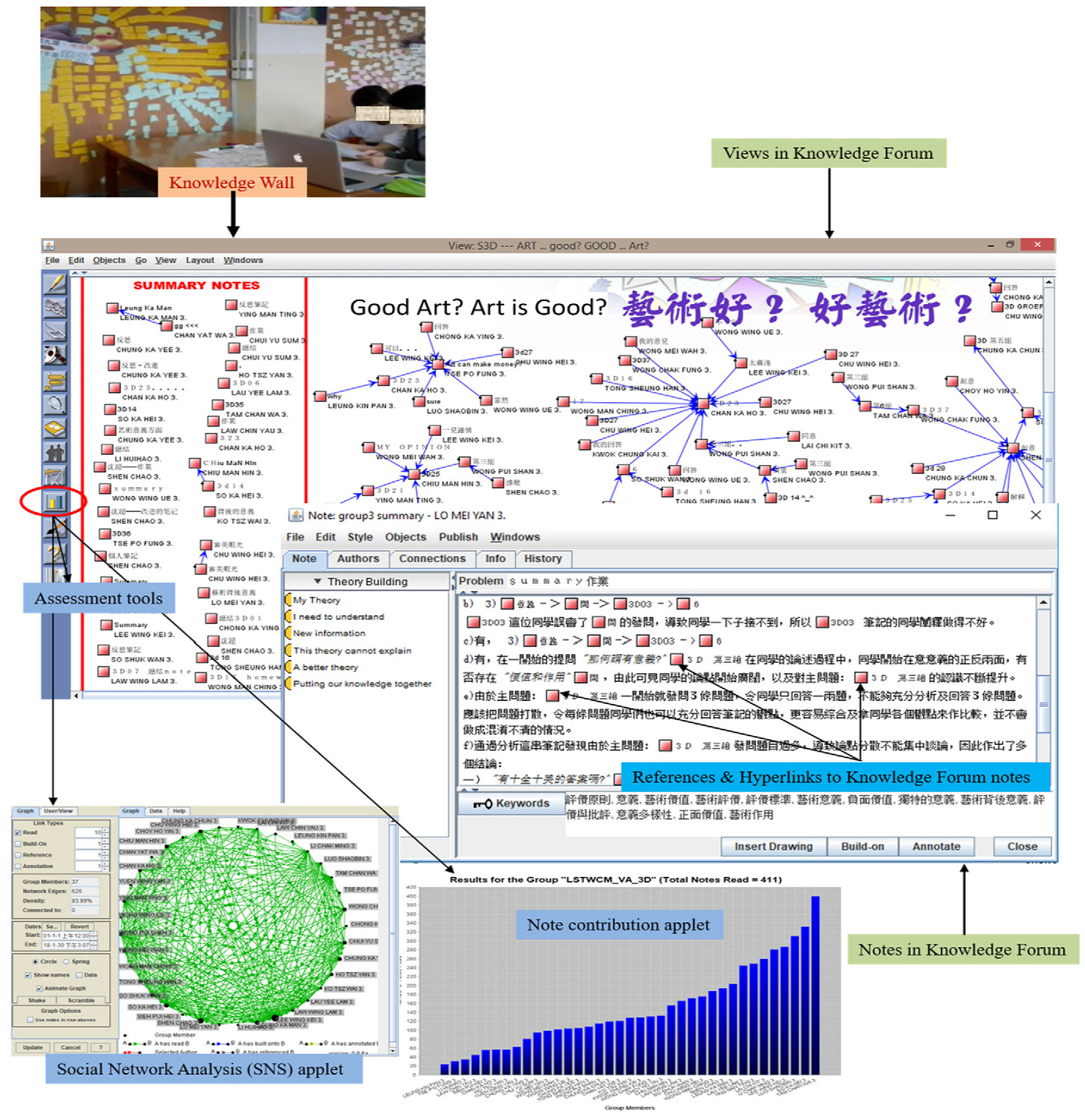
Knowledge forum and features and knowledge building wall.
KB is a principle-based, open-ended model that highlights students’ collective efforts for idea improvement. A principle-based approach “defines core values and principles, leaving to teachers . . . discretionary judgment . . . making adaptive classroom decisions to accommodate their different contexts and possibilities” (Zhang, Hong, Scardamalia, Teo, & Morley, 2011, p. 263).
A system of 12 KB principles, formulated by Scardamalia (2002) guide KB pedagogical design and research. Several principles summarized below illuminate metacognitive, social, and epistemic competencies, which are important for working with low-achieving students:
Epistemic Agency
High-level agency with students taking initiative, negotiating the fit between own and others’ ideas, and taking charge of high-level inquiry (e. g., goal setting, monitoring, and evaluation) is emphasized in KB. Low achievers manifest limited agency and metacognition, await teacher direction, and lack task motivation. In KB settings, students perform high-level knowledge work with related goals, motivations, evaluations, and long-range planning normally left to teachers. Students are encouraged to have agency and think about what they know and need to know. While this is often difficult for low achievers, they are supported in a social and community context, where they can see their ideas through others and compare them; they can see their own thinking through others’ lens, thus encouraging metacognition.
Collective Responsibility for Community Knowledge
Contributing ideas to the community is as or more prized than individual performance. Communities working together contribute valuable and diverse ideas; knowledge advances cannot be done by individuals, and KB provides low achievers opportunities to advance together. Low achievers face competition problems, as schools often compare individual performance. Diversity and individual differences are often considered obstacles, and educational approaches like differentiation have been used to address low achievers’ problems. Community knowledge emphasizes that everyone, regardless of accomplishment and background, can add value in a KB community; diverse ideas and learners are community assets that contribute to the progress of ideas.
Improvable Ideas
All ideas are improvable and continuous and collective efforts can improve ideas’ quality, coherence, and utility. Low achievers generally lack epistemic understanding of knowledge and inquiry, believing knowledge to be static, based on fixed, external standards. In KB communities, learning focuses on progress, not a fixed end-product. Inquiry can be increasingly deepened and diverse learners can improve ideas together, thus supporting new ways of viewing knowledge, and helping low achievers develop more mature epistemic dispositions.
Concurrent, Embedded, and Transformative Assessment
Assessment is an integral component of KB and adds an inquiry component to the community’s work and progress, leading to new actions that enhance both. Embedded and transformative assessment helps students actualize and develop their metacognitive skills, which is key to low achievers’ inquiry and KB process (more details in the next section).
Although KB, as an open-ended community approach, is intended for all learners, students with academic difficulties may still face problems due to a lack of strategic moves, communication, and epistemic dispositions in technology-enhanced inquiry environments. When working on KB, students need to post ideas, build on and work with multiple KF posts, which can be challenging for low achievers lacking in agency and collaborative skills. With ideas distributed across individual postings over time, students easily get into short or fragmented discussions lacking in conceptual progress and knowledge integration (Yang et al., 2016; Zhang et al., 2018). Students, particularly low achievers lacking in collaborative and metacognitive skills, need additional designs and tools to scaffold their engagement in collective monitoring of and reflection on their online discourse.
KB Enhanced by Reflective Assessment
Fundamentally, we highlight the importance of reflection, first emphasized in How People Learn report (National Research Council, 2000) as a key strategy for promoting students learning, understanding, and KB. It is widely accepted that inquiry alone is inadequate; students also need to reflect on their inquiry (Sandoval, 2005). In the seminal study on reflective assessment, White and Frederiksen (1998) provided students scientific inquiry criteria for peer assessment to help them improve their metacognition and found below-average students gained more in physics knowledge than above-average students. Encouraging students to think back scaffolds them to become metacognitive and realize what they are doing and what to do next, which is particularly important for low achievers.
In KB, we define reflective assessment as students taking active roles in identifying personal and community knowledge gaps and examining how to move forward, personally and as a community (Lei & Chan, 2018; Scardamalia, 2002; Yang et al., 2016). Compared with formative assessment, which focuses on closing the gap between current and desired performance (Taras, 2009), reflective assessment focuses more on cultivating student agency for continuing inquiry.
While earlier studies on reflective assessment have involved peer assessment (Toth, Suthers, & Lesgold, 2002; White & Frederiksen, 1998), we use reflective assessment as a collaborative KB community process. Not every community member develops at the same pace, but students can scaffold each other’s metacognitive development through modeling and collective work. Students who have difficulty engaging in metacognition, monitoring their personal progress, or enacting individual metacognition can be sustained in a community, as reflective assessment in KB takes on richer dimensions. In a community, students can engage in metacognitive activities through monitoring and reflecting on group progress (Hmelo-Silver & Barrows, 2008; van Aalst & Chan, 2007; Yang et al., 2016), asking questions and explaining, and scaffolding one another’s metacognition through shared agency; such pooled intelligence is crucial for low achievers.
There is increased research on the use of learning analytics in supporting student inquiry in the learning sciences (Wise & Schwarz, 2017). KB research also encompasses learning analytics on KF, particularly students using analytic tools for collective agency (Zhang et al., 2018). Reflective assessment, premised on the KB principle of concurrent and embedded assessment supports student inquiry when it is embedded in their KB work; concurrent with the use of evidence-supported tools to help them visualize and understand where they are heading; and transformative as they reflect on their inquiry and change their KB processes (Scardamalia, 2002). Reflective assessment helps students to reflect on what individuals and their community know and what need to be improved—it involves goal setting, monitoring, rise-above, and meta-discourse (meta-talk), which is critical for productive KB discourse (Scardamalia & Bereiter, 2006).
Rationale, Framework, and Design of the Study
This study examines reflective assessment supported by technology in a KB classroom to help academic low achievers develop higher order competencies and productive KB.
This reflective-assessment design uses a variety of tasks, scaffolds, and tools to support students to reflect and assess their classroom and KF discussion and to support their complex inquiry and productive discourse creation.
Reflective assessment can benefit all students, but is particularly important for low achievers, due to their assumed difficulties. First, it promotes low achievers’ engagement in metacognitive processes—planning, monitoring, reflecting on their online discourse, deploying and developing metacognition and agency—through principle-guided reflection, aided by analytics tools and evidence. Second, it can help low achievers develop collaboration through awareness of principle-based norms emphasizing collective effort and community examples. Third, by asking students to reflect on and improve ideas for continuing pursuit (not just fixed answers), it can help low achievers to develop productive epistemic dispositions through cultivating reflective and collaborative culture for idea improvement.
We propose a framework using KB with reflective assessment, supported by analytics for transformative learning (Figure 2). Primarily, we first identify academically low-achieving students’ common difficulties regarding metacognition and agency, collaboration, and epistemic dispositions. This framework emphasizes key KB principles (epistemic agency, community knowledge, and improvable ideas) that target metacognition, collaboration, and epistemic dispositions. These key principles are further enhanced by the reflective assessment principle that is concurrent (with analytics-tool feedback), embedded (intertwined with the main inquiry), and transformative (student agency for changing their learning). We designed key phases and different tasks/scaffolds to enact the principles (seeTable 2), but these tasks can vary depending on contextual situations. Principle-based design, rather than highly scripted instruction (Zhang et al., 2018) is important in KB pedagogy (Scardamalia, 2002) and most useful for adaptation to the emergent needs of academic low achievers.
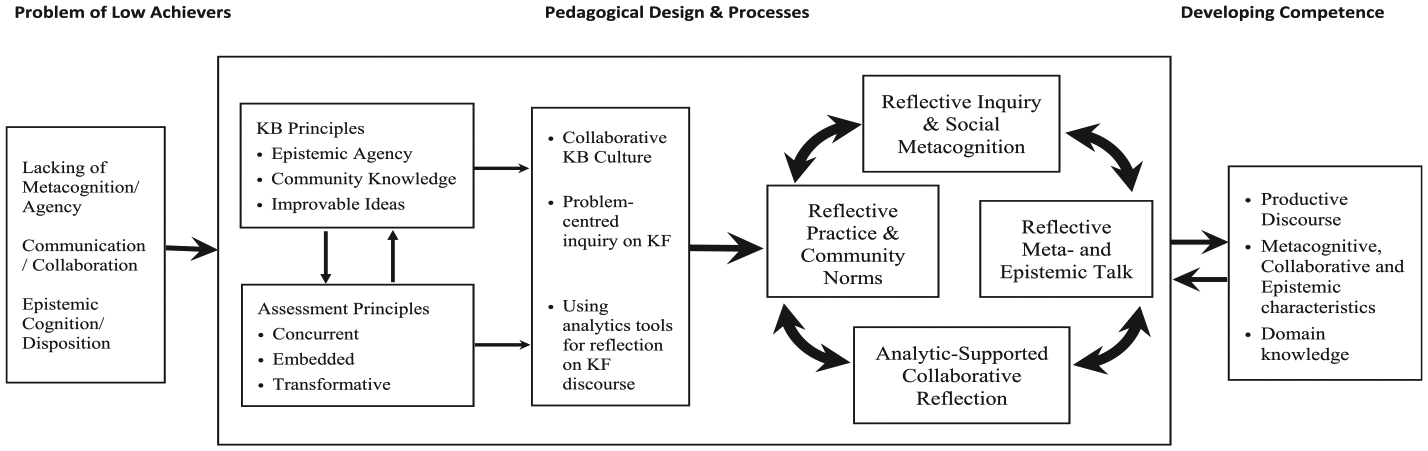
A design framework of reflective assessment for academic low achievers in knowledge building (KB).
We also conjecture how the design as a system will support student reflection including (1) Reflective inquiry and social metacognition help scaffold students to reflect on different inquiry tasks; ideas are made public that help them see theirs and others’ points of views in collective work. (2) Reflection through meta- and epistemic talk encourage students to reflect on KF work by discussing examples of good discourse to help them develop an explicit and metacognitive understanding of higher order inquiry. (3) Analytics-supported collaborative reflection for collective growth help to visualize KF inquiry that support students to engage in collaborative reflection. (4) Reflective practice and community norms, in which students see reflection as a community norm that becomes their part of thinking and habit of mind. The framework also examines the learning outcomes and competencies reflected in KF discourse and domain knowledge.
The design framework features KB principles, tasks, and processes aligned with three assertions. First, reflective assessment has been shown to promote metacognition (White & Frederiksen, 1998); we now enhance that in a social context. Collective inquiry and reflection are intertwined, supported by different scaffolds, including KB wall, portfolio, meta-talk, and visualization from analytics tools (Raes et al., 2014; discussed later). Students will reflect on questions they have (goal setting), what they have/have not learnt (monitoring), and new inquiry (planning); individual low achievers may not be metacognitive but can develop social metacognition supported by tool-based visualization (Raes et al., 2014). Second, reflection is done in small groups and community, as students interact, they have opportunities to develop social and collaborative competencies; KB talk takes place throughout and the KCA data necessitates students’ discussing how they make meaning and synthesize ideas; the use of tool can help widen the dialogic and reflective space (Wegerif, 2007). Third, reflective assessment emphasizes not just reaching correct answers but also deepening understanding and idea improvement (Scardamalia, 2002). As students engage in collaborative reflection supported by tools, they can see multiple perspectives and can begin to realize that knowledge is not fixed and certain. Concurrent feedback (no need to wait for teacher appraisal) can help students develop epistemic dispositions needed for higher level inquiry.
The current study and proposed framework are a systematic program premised on the KB model and reflective assessment. In previous research, regular high-school students taking geography and chemistry courses created electronic KF portfolios in which they reflected on and assessed their online KF discourse and accomplishments, and areas and questions yet to be considered. Reflective assessment helped students to develop explanatory and productive KB discourse (Lee, Chan, & van Aalst, 2006; van Aalst & Chan, 2007). More recently, we designed reflective assessment enhanced with analytic tools (the KCA) to help a wider range of students to reflect on their inquiry and discourse (Yang, 2019; Yang et al., 2016). While these studies have shown positive results, the integrated system of classroom processes and dynamics of reflective assessment has not been investigated to unveil how reflective-assessment design in a KB environment can support academic low achievers’ higher order inquiry, an area much needed for equity in current education.
Research Goal and Questions
The goal of this study was to examine how academic low achievers can be supported to engage in higher order inquiry and KB in technology-supported environments. We developed a pedagogical design using KB with reflective assessment supported by analytic tools and examined the processes and dynamics of reflective assessment. KB pedagogy involves students pursuing inquiry into self-generated problems using offline and KF discussion, developing theory, and building knowledge. To support academic low achievers, we enriched KB using reflective assessment, with students engaging in reflective tasks and dialogic talks supported by analytics while collectively reflecting on their classroom inquiry and KF discourse to chart their knowledge advance.
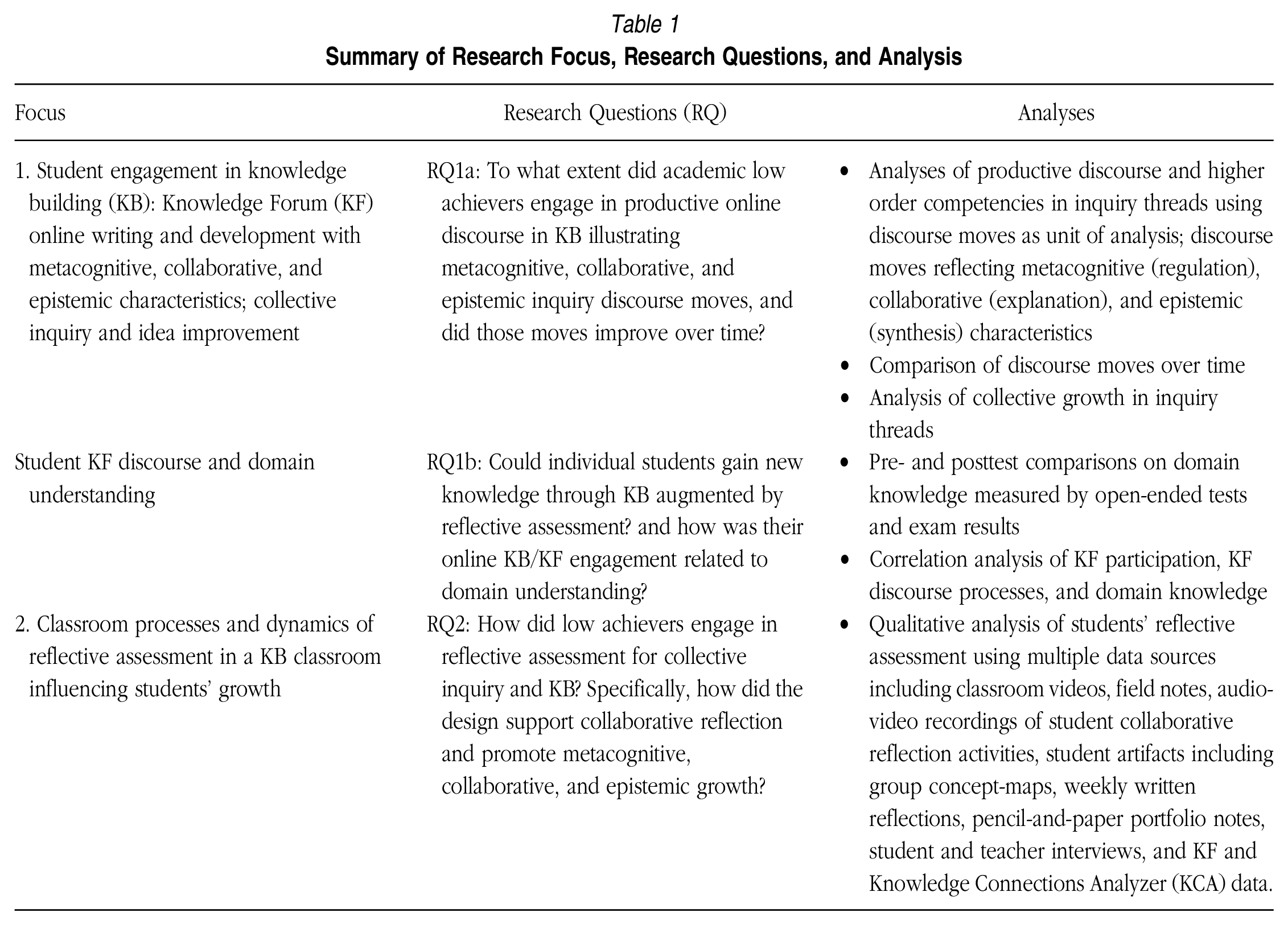
We first investigated if and how low achievers could engage in KB demonstrating productive discourse with metacognitive, social, and epistemic characteristics. We argue that, if students gradually take on higher level agency supported by reflective assessment, they may show productive KF discourse moves with collaborative interaction, metacognitive competence in identifying gaps, regulating group inquiry, and epistemic orientation reflected in synthesis, conceptualization, and sustained pursuit of inquiry. We expected to see low achievers could engage in productive online discourse illustrating these productive discourse moves with changes over time. Second, we analyzed how academic low achievers engaged in reflective assessment and how reflective-assessment designs supported their metacognitive, social, and epistemic growth. We employed qualitative analysis using multiple rich data sources to examine how students enact reflective assessment in KB contexts, identifying key themes to illuminate processes. Table 1 shows our research focus, research questions, and proposed analyses.
Summary of Research Focus, Research Questions, and Analysis
Method
Research Context and Participants
Hong Kong secondary schools are classified into three bands, based on students’ public examination results. This study was conducted at a Band-3 school, with students performing at or below the 10th percentile of the student population at admission. The sample was a class of 37 Grade 9 students taking a Visual Arts course. Participants were typical of low-achieving students. They were taught in Chinese and had no previous KB experience. The teacher was an experienced visual-arts teacher who had employed KB-based teaching for approximately 8 years.
Pedagogical Design: Knowledge Building and Reflective Assessment
Students carried out a 5-month inquiry into the topics of art and art evaluation, with weekly lessons including key questions such as “What is art?” and “How is art appreciated?” Course content was flexibly arranged in response to students’ emergent inquiries. Student work comprised whole-class discussions, small-group collaboration, individual and collaborative note writing, and reflection (online and offline). Building on previous KB studies (Chan, 2011; Yang et al., 2016), the development of collaborative KB culture, problem-centered collective inquiry, deepening inquiry, and assessment were emphasized. This study includes new designs of reflective assessment integrated throughout supported by analytic tools. Aligned with the design framework (Figure 1), Table 2 details the pedagogical design of analytics-supported reflective assessment for academic low achievers in KB.
Pedagogical Design of Reflective Assessment in Knowledge Building (KB)
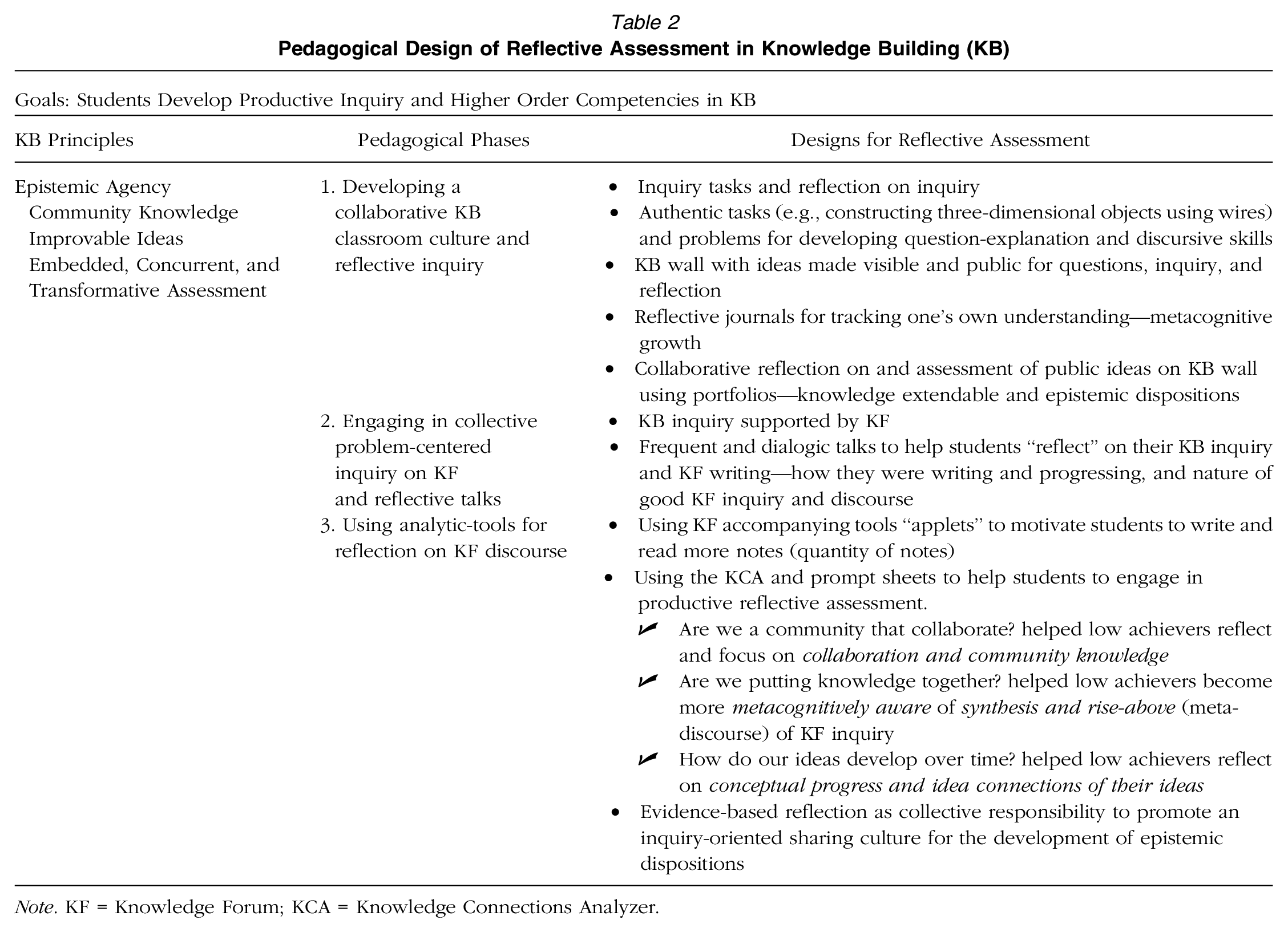
Note. KF = Knowledge Forum; KCA = Knowledge Connections Analyzer.
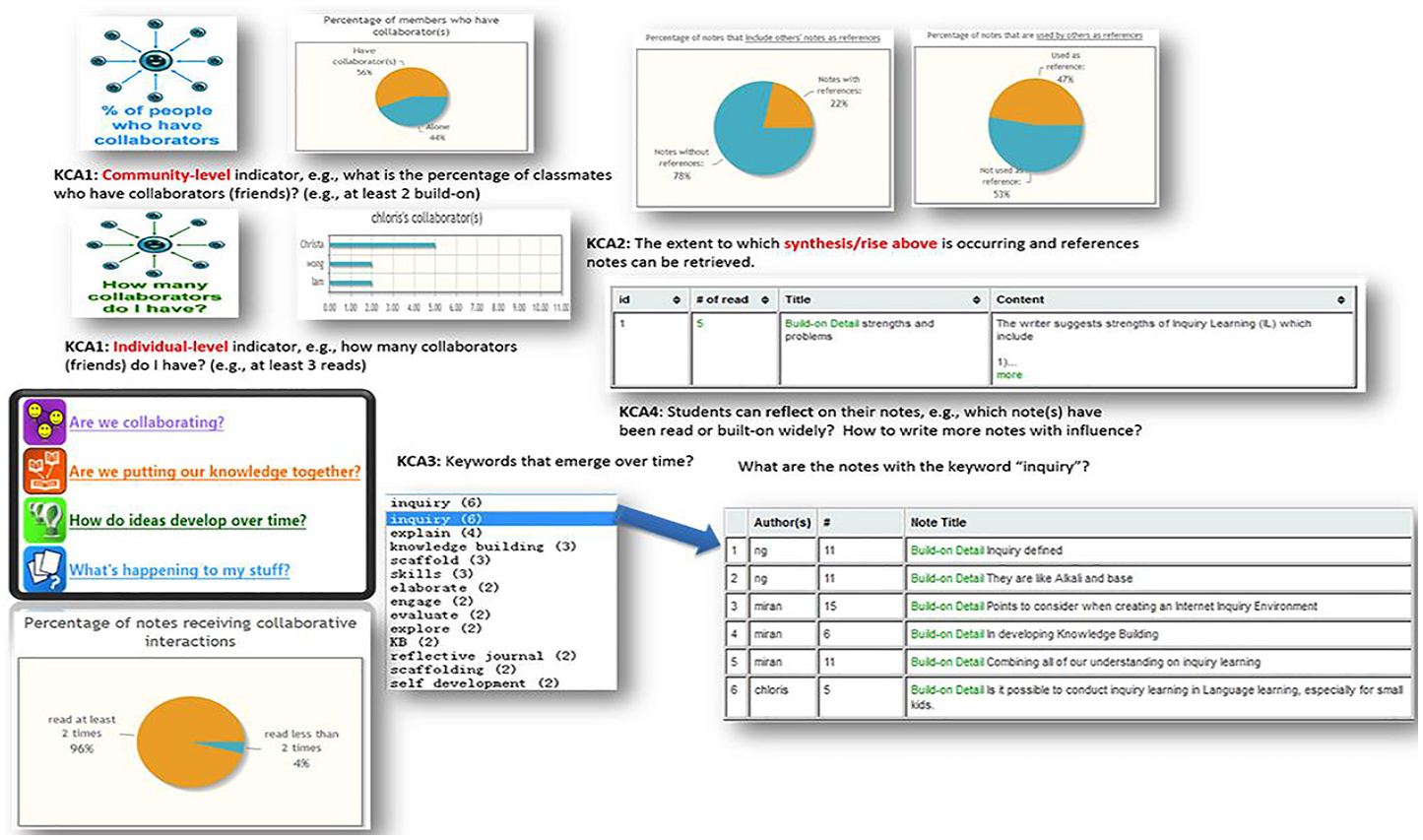
Knowledge Connections Analyzer (KCA): Interface, questions, and output.
Aligned with the KB emphasis on student agency (Scardamalia, 2002), students were provided opportunities to use the KCA, followed by reflective discussion on the visualized data, to help them review what they have done on KF, analyze problems, and set goals for future work.
The KCA tools includes a framework with four intuitive questions that allow young students, including low achievers, to reflect on their KB work from different angles (van Aalst et al., 2012). The KCA set of questions include (1) “Are we a community that collaborates?” that taps into the notion of community knowledge (collaboration)—the extent to which all members contribute and collaborate when writing on KF; (2) “Are we putting knowledge together?” that addresses the notion of synthesis and rise-above and synthesis—the extent to which the class community synthesized individual ideas and makes “rise-above” contributions, which provide a higher level of conceptualization of them; (3) “How do our ideas develop over time?” that touches on improvable ideas, conceptual progress, and idea connections—the extent to which class members take agency collectively to improve their ideas and discourse; and finally (4) “What is happening to my own contributions?” that helps show the impact of students’ work in the community, and how different notes influence others’ ideas and development over time. After selecting one of these questions, students could choose and vary its parameters and the KCA output would show data on what students had done (e.g., how many friends we have?).
In the classroom, students worked together using the KCA in whole-class situations enriched with after-class small-group discussion. Initially, the teacher demonstrated KCA and explained the need to review and reflect on their KF inquiry. Typically, the teacher introduced one KCA question each lesson and discussed why the visualization and data from each question were important for KB inquiry. The teacher also demonstrated and discussed productive ways of interpreting the KCA data; students tried the KCA in dyads and groups, using metacognitive questions (e.g., What have we found? Why run this analysis? How would we plan to improve our inquiry?; see Appendix) supported by reflective talks on KCA findings. Classwork was enriched with small-groups learning after class, six groups included, one at a time, so students could learn more about KCA and interact with closer guidance using the KCA. With the collaborative reflection opportunities using the KCA, students progressively became more aware of what they were doing on KF and made plans to improve their KF writing; they also put together their ideas in collaborative concept-maps, wrote rise-above notes, and posted them on KF. In sum, online and offline discourse are intertwined, sustained with reflection, as students wrote on KF using analytic tools to help them assess and reflect collectively on their KF writing and KB inquiry.
Data Sources
Classroom Observations, Videotaping, and Student Artifacts
We observed and kept a record of classroom events, capturing both student and teacher activities through field notes and photographs of all lessons, and video recordings of most lessons; seventeen 50-minute videos were collected in total (850 minutes). We collected all artifacts, including students’ weekly written reflections that recorded what they had learned about art and design and questions they had—specifically they wrote about what they had and had not known and what they would like to inquire in the future. Students wrote their ideas mounted on post-it cards on the KB wall, and for individual pencil-and-paper portfolios, they identified and selected the important ideas from themselves, their peers, and the class community from the KB wall. We also collected collaborative concept maps that recorded the key points of group and KF discussions and indicated the changing understanding of domain knowledge. In total, 80 concept maps produced by 8 student groups were collected.
Video Recordings of Reflective-Assessment Sessions
We video-recorded students’ reflective-assessment activities while on KF, in-class and after-class group sessions, including their interpretations of and reflections on the data, and plans for their KF discourse. Detailed field notes were included, and interpretations discussed with the teacher. Six in-class reflective-assessment sessions (whole-class) of 30 to 50 minutes and six after-class reflective-assessment sessions of 60 to 90 minutes were video-recorded. In each after-class session, student groups (2 to 6 volunteer students in each) ran the KCA and reflected on their collaboration, knowledge synthesis, and idea improvement using the KCA data.
Student and Teacher Interviews
Semistructured interviews were used to examine students’ reflective-assessment experiences. We interviewed groups of two to five students, either before or immediately after class, and also after they used the KCA. Most interviews were informal and lasted 20 to 30 minutes. The interview questions tapped into their reflective experience, for example, “What did you write on KF after the last KCA analysis?” The teacher’s reflection was collected regularly with systematic interviews over different periods, each lasting for 30 minutes, to capture teacher’s design and understanding of how KB and reflective assessment was enacted.
Domain Understanding
To examine students’ knowledge gains on their inquiry topics, pre-and posttests designed by the teacher were administered at the beginning and the end of the course. The pretest questions were What do you know about the topics of “What is art?” and “How is art appreciated?” The posttest questions were What have you learnt about the topics of “What is art?” and “How is art appreciated?” Students were given about 15 minutes to complete the test on both occasions.
KF Participation and the KCA Data
The Analytic Toolkit (Burtis, 1998) was used to collect information about the number of notes written and read, and the percentage of notes linked to each other from log data. Data from 400 KF notes were collected and analyzed. The Analytic Toolkit data have been used widely in published studies (e.g., Lai & Law, 2006; Lee et al., 2006; So et al., 2010). Using the KCA, the researcher further retrieved quantitative data on student collaboration in terms of reading notes, building on notes, and synthesizing notes. We used the KCA data to indicate the extent to which students were collaborating with others, synthesizing ideas, and writing rise-above notes.
Data Analysis
Analyzing KF Writing
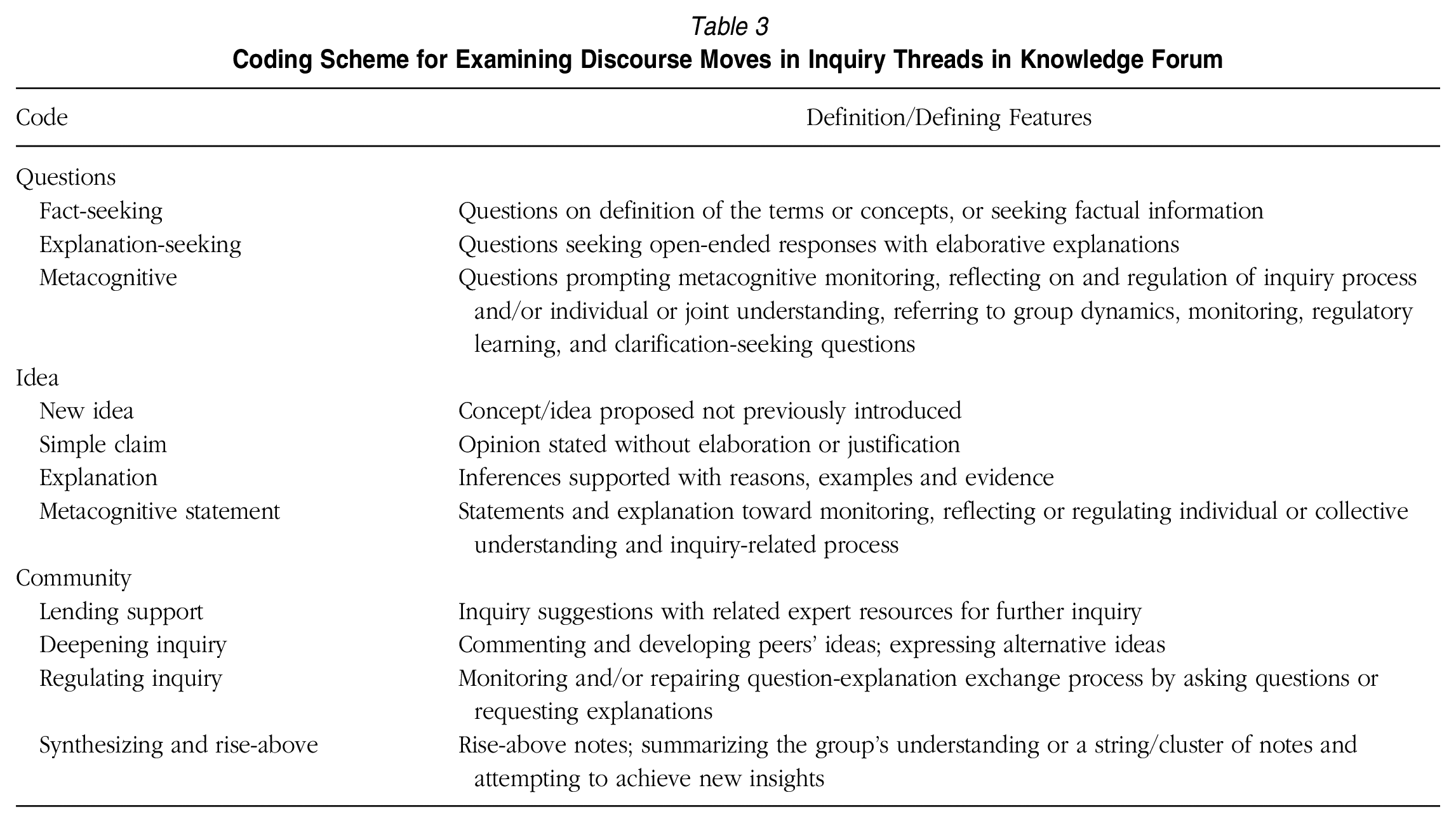
Analysis was conducted to examine students’ engagement in productive discourse for KB (i.e., How students made knowledge advance together) and cognitive, metacognitive, collaborative, and epistemic characteristics of discourse. The unit of analysis was an “inquiry thread,” a sequence of KF notes contributed by different community members to address a problem (e.g., “How to appreciate art pieces”) illuminating students’ collective pursuit of knowledge (Zhang et al., 2007). We analyzed all 400 computer notes; 17 inquiry threads were identified for analysis. A second researcher independently placed 40% of the notes into inquiry threads, leading to an intercoder reliability of .80 (Cohen’s kappa). Within each inquiry thread, we coded students’ KF notes using different categories illuminating cognitive, metacognitive, collaborative, and epistemic characteristics adapted from our coding framework (Table 3; Yang et al., 2016). Different categories reflect students’ developing competences including ideation (cognitive), regulation (metacognition), synthesis (collaborative-epistemic) reflecting rise-above and higher level conceptualization. Two raters independently coded notes from three inquiry threads (n = 120, 30%), with an interrater reliabilities of .78 for questions, .78 for ideas, and .77 for community (Cohen’s kappas).
Coding Scheme for Examining Discourse Moves in Inquiry Threads in Knowledge Forum
Synthesis/Rise-Above KF Notes
Students also wrote group synthesis notes before and after KCA use. Students’ synthesis/rise-above KF notes (a meta-level note that consisted of hyperlink to other notes) were analyzed with a 5-point coding scheme, modified from an earlier study (Lei & Chan, 2018). These synthesis/rise-above notes were examined to provide evidence of students’ ability to engage in higher level collaborative and epistemic inquiry. These notes varied from listing notes and copying information from others’ notes with no explanations to meta-conversation using a “we” perspective to reflect on discourse goals, identification of gaps, and investigation of what the discourse was about. Two raters independently scored all the synthesis notes, leading to an interrater reliability of .72 (Cohen’s kappa).
Assessment of Domain Understanding
Students’ responses were rated based on degrees of understanding and whether a clear and coherent explanation were provided using a 4-point scale from 1 to 4 (see Supplementary Materials available in the online version of the journal). Two raters independently scored all of the data; the interrater reliability was .78 (Cohen’s kappa).
Thematic/Narrative Analysis
We employed qualitative analyses using thick data to understand how low achievers engaged in KB and reflective assessment. We first browsed the videos and transcripts to develop an overall sense of the reflective-assessment process, followed by identifying “digestible” chunks of the videos: with major episodes of reflective assessment. These video segments were contextualized and linked to develop a story line. We analyzed classroom data as well as analytic-based reflective assessment and other sources of data (e.g., interviews, artifacts, classroom observations). We identified and selected important classroom events guided by principles of KB and assessment outlined in framework. For example, during each phase of the pedagogical design, we first identified the classroom events that best illustrated the practices of KB and reflective assessment and examined how they support the development of capabilities necessary for engaging in collective KB. Constant comparison of these different episodes, narratives, and critical events mapping to different instructional phases bring about the key emerging themes.
Results
Research Question 1: Students’ Productive Discourse and Change and Relations With Domain Knowledge
Productive and Sustained Inquiry in KF Discourse
Inquiry thread analysis
This analysis examined the entire inquiry threads to show how students engaged in distributed work and sustained inquiry. Figure 4 illustrates how low achievers could engage in distributed work and sustained inquiry. No student dominated the process, and many threads (e.g., #1, #3, #4, #7, #8, and #13) involved most students as authors, demonstrating their ability to collaborate and sustain inquiry. Most inquiry threads lasted more than 7 weeks, indicating different students showed sustained interest pursuing inquiry into these topics, suggesting students’ developing epistemic-oriented dispositions.
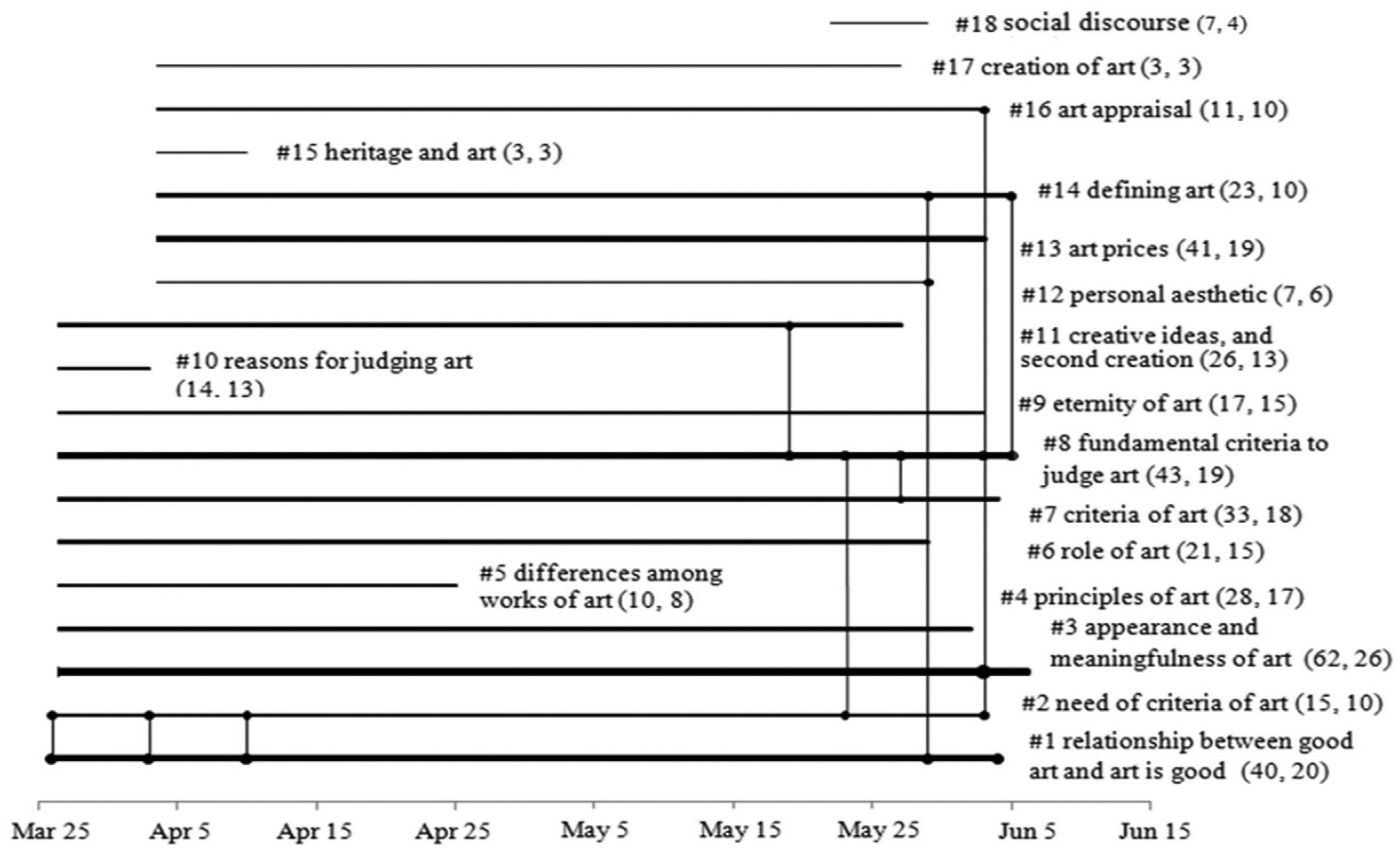
KF inquiry threads with distributed work for collective inquiry.
Qualitative analysis of threads illustrates how low achievers collectively pursued KB and engaged in progressive problem solving (e.g., #1, #3, #4, #7, #8, and #9). In these threads, students proposed interesting problems and explanations, monitored and regulated their inquiry by asking relevant questions and seeking clarification, addressed problems at increasing depth, and produced higher levels of conceptualization. For example, in the art evaluation thread (Thread #8), students initially asked how to judge whether a piece of art were successful, leading them to the understanding that the judging practice was influenced rather than determined by a personal aesthetic vision. This spawned further inquiry problems and statements of what students knew, and students generated summaries of what they discussed to identify problems for further inquiry; for example, “What do you mean by . . .? Are they contradictory?” (Student [S2]) “Why not talk about the meanings behind the art instead of personal aesthetic vision, seemingly an endless conversation?” (S21) “Let me summarize the above selected notes . . . successful art should be meaningful, which means thought-provoking,” (S7) and “Idea improvement [scaffold]. . . . Both the appearance of and meanings behind art determine the critical and defining qualities of successful art” (S15).
Analysis of discourse types
We further examined the extent of productive KB discourse by coding the 17 inquiry threads (van Aalst, 2009) to distinguish among increasingly advanced KB discourse patterns: (1) knowledge sharing, mere accumulation of information; (2) knowledge construction (questions, explanations, and co-construction of ideas); and (3) KB/creation discourse (progressive problem solving, rise-above meta-discourse and community advances). Of the 17 inquiry threads, 4 were classified as knowledge sharing, 7 as knowledge construction, and 6 as KB. This is a relatively positive result, compared to previous studies on knowledge quality of KB threads among regular students (Fu, van Aalst, & Chan, 2016; van Aalst, 2009).
Discourse Characteristics: Discourse Moves and Change Over Time
Analysis of discourse moves
KF writing was coded to examine student engagement in productive discourse moves (questions, ideation, community) illuminating metacognitive, collaborative, and epistemic characteristics (see Table 3 and Supplementary Materials available in the online version of the journal). Table 4 shows students wrote more notes with new ideas and collaborative explanations (124) than simple claims (111), suggesting collaboration; KF progress was reviewed and shown in metacognitive questions (53 notes), and metacognitive/discursive statements (48 notes). Analysis of community perspective showed 66 notes as regulating inquiry and 40 as synthesizing notes. These results suggest students were involved in regulating their group/community inquiry, aligned with social metacognition and agency; they also generated synthesis and rise-above notes (with high-level conceptualization) that reflect progress in collaborative-epistemic work; putting sustained efforts to help the community synthesize, rise above and advance knowledge (see examples, Figure 5).
Characteristics of Discourse: Frequency in Questioning, Ideas and Community in Inquiry Threads
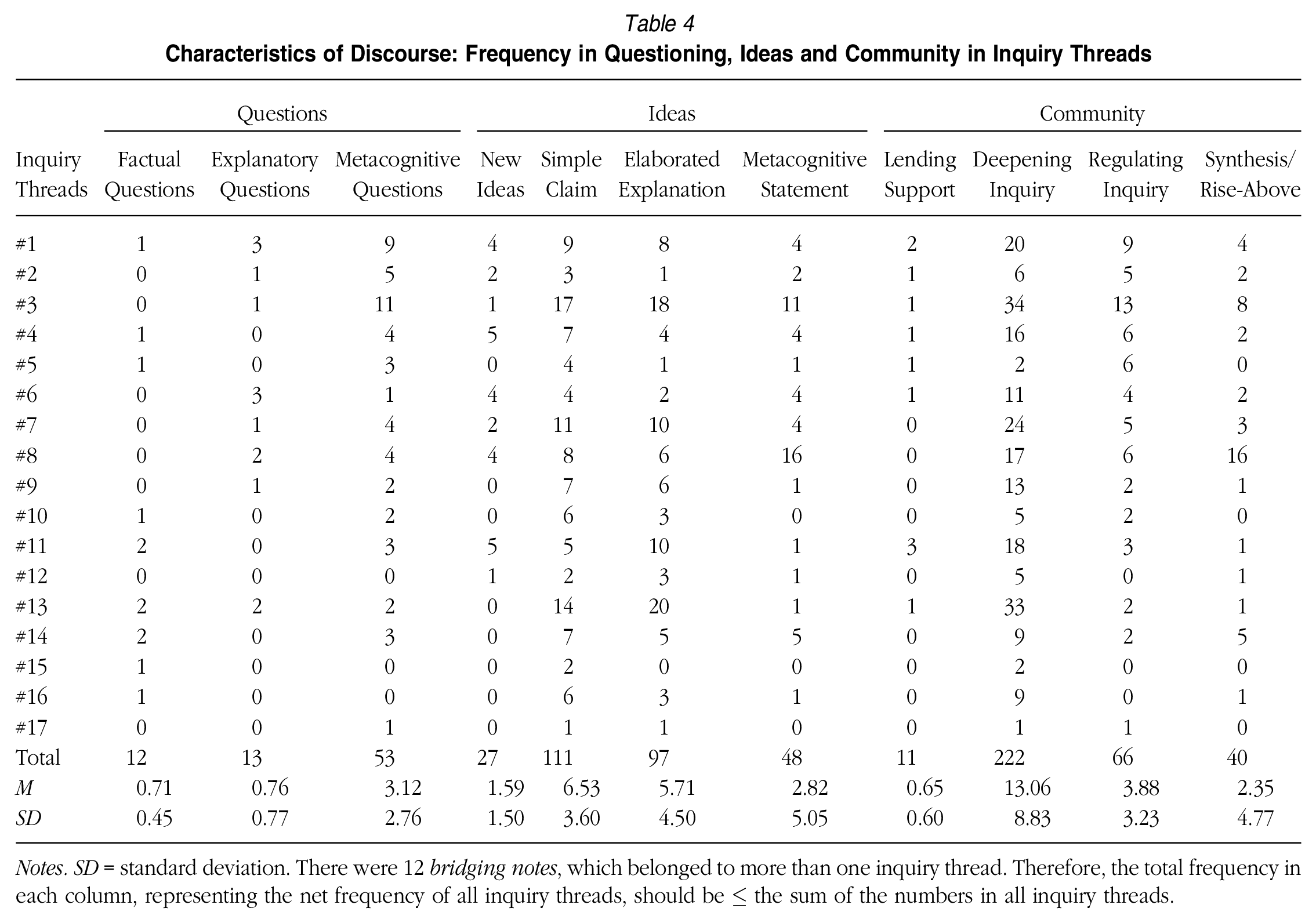
Notes. SD = standard deviation. There were 12 bridging notes, which belonged to more than one inquiry thread. Therefore, the total frequency in each column, representing the net frequency of all inquiry threads, should be ≤ the sum of the numbers in all inquiry threads.
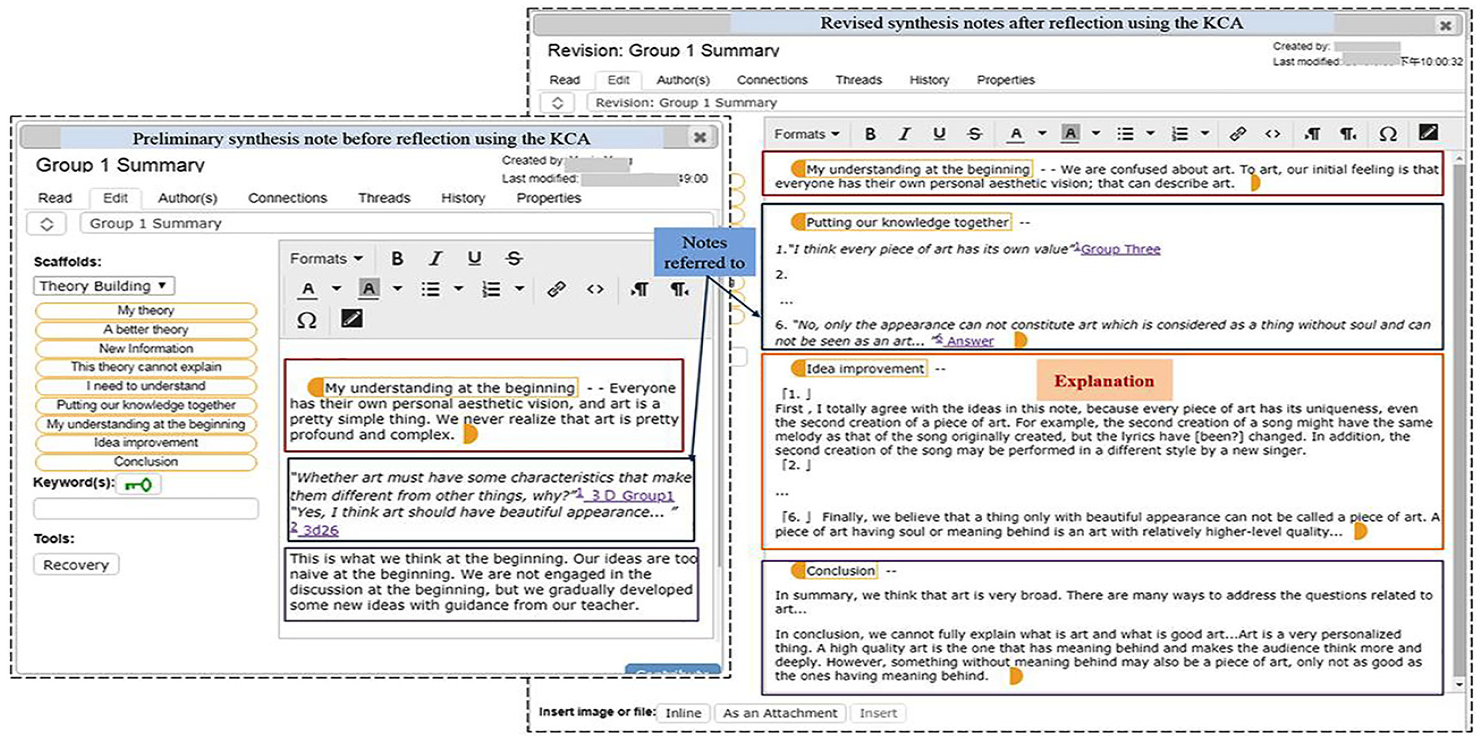
Comparison of group synthesis notes written before and after KCA reflection.
Changes in discourse characteristics over time
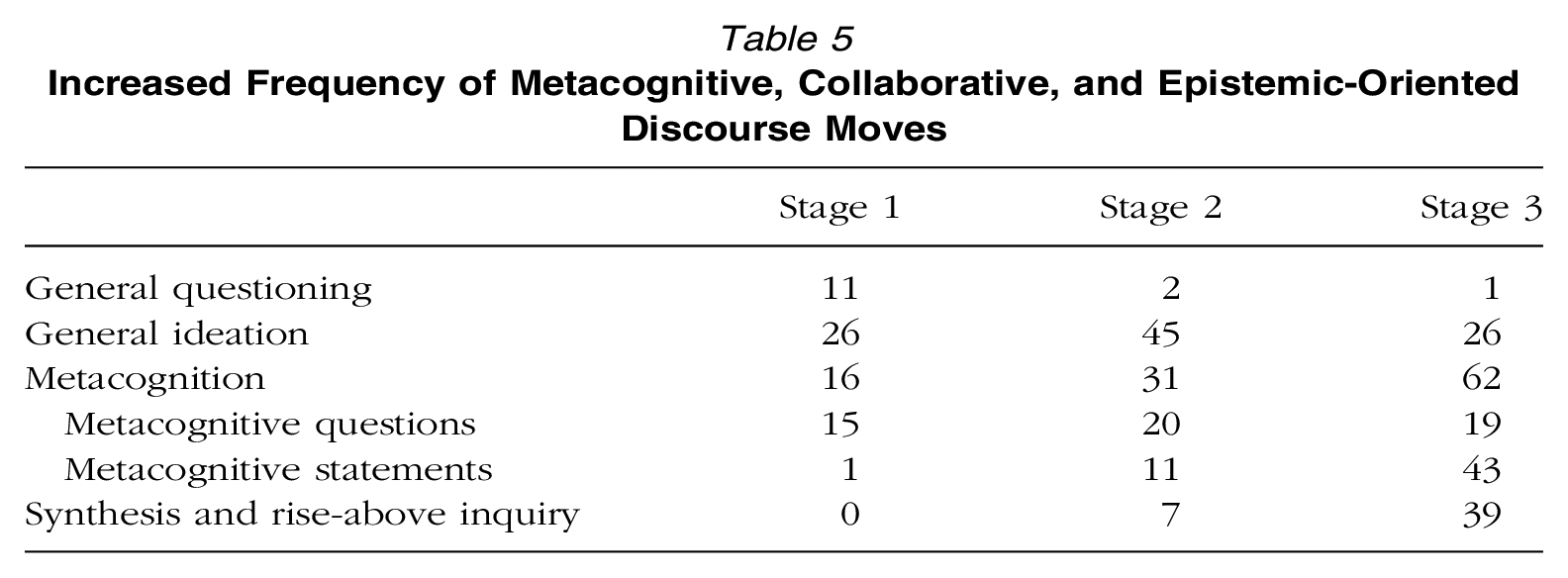
To examine change over time, the KF notes in each inquiry thread were sequenced based on when they were last modified, then equally distributed into three stages (Stages 1, 2, 3; Zhang et al., 2007), and each stage analyzed. Fourteen large inquiry threads (10 or more notes) were analyzed, and several smaller threads excluded. Analysis of higher level discourse moves—metacognitive questions and statements and synthesis notes—was conducted. Table 5 indicates students mostly contributed questions and ideas during Stage 1; during Stages 2 and 3 they deepened their Stage 1 inquiry questions, generated metacognitive questions and statements to regulate their inquiries, and wrote synthesis and rise-above notes that reflected the class’ collective pursuit of knowledge advancement. Overall, the results suggest low achievers were increasingly able to use sophisticated metacognitive, collaborative, and epistemic discourse moves over time as they engaged in productive KB.
Increased Frequency of Metacognitive, Collaborative, and Epistemic-Oriented Discourse Moves
Knowledge Gains and Relations Between KB and Domain Knowledge
Change in domain knowledge
Students’ individual knowledge gains were examined, and significant differences obtained between pretest (M = 1.81, SD = 0.60) and posttest scores (M = 3.08, SD = 0.80), t (36) = −12.71, p < .01. We also examined students’ knowledge gains based on examination results. Paired sample t test indicated significant differences in examination scores before (M = 56.17, SD = 13.50) and after (M = 67.92, SD = 11.18) the program, t (36) = −8.48, p < .01. While no control class was available and the results must be interpreted with caution, preliminary evidence was obtained indicating benefits to learning outcomes.
Relationships between online discourse and individual knowledge gains
Table 6 shows Pearson correlation coefficients between KF participation (e.g., notes written from log files), discourse moves, domain understanding, and examination scores. Notes written, reflecting cognitive contributions, was significantly correlated with domain understanding (r = .43) and examination scores (r = .68). KF metacognitive statements and revision were significantly correlated with domain understanding (rs = .52 and .45), and examination scores (rs = .65 and .45). The “references” in syntheses notes and explanations were significantly correlated with domain understanding (rs = .52 and .33) and examination scores (rs = .51 and .53). These results suggest students were more likely to understand domain knowledge better when involved in active contribution, collaboration, and metacognitive and epistemic-oriented processes during their online discourse.
Correlation Analysis of KF Activities (Written, Revision, References) and KF Discourse (Explanation, Metacognition, Synthesis) With Domain Understanding and Examination Scores
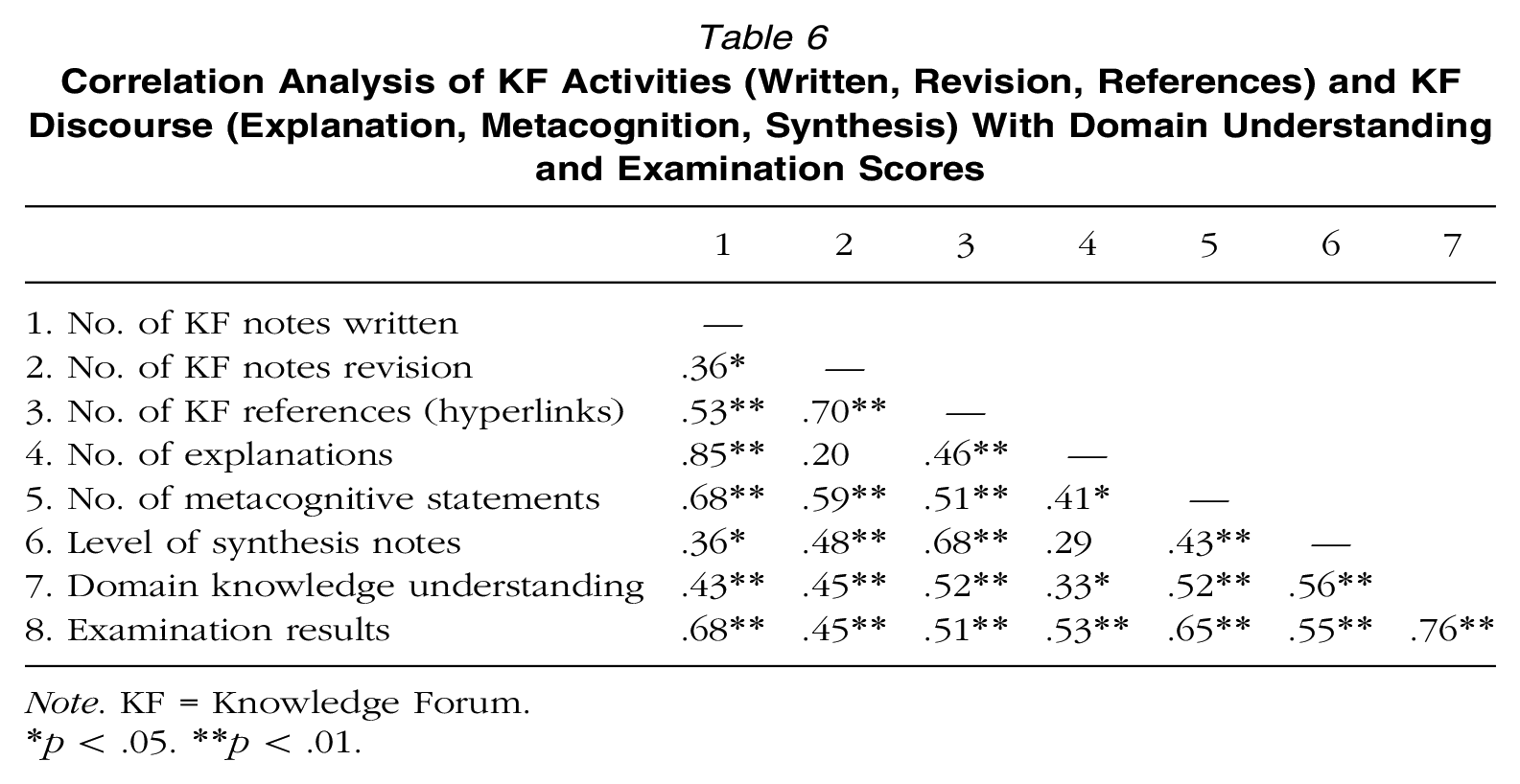
Note. KF = Knowledge Forum.
p < .05. **p < .01.
Taken together, the analyses show that these academic low achievers were involved in productive KB discourse illustrating distributed and sustained inquiry and engaged in metacognitive, collaborative, and epistemic discourse moves with changes over time. As in other KB studies (Lee et al., 2006), low achievers’ discourse engagement was related to domain understanding. As well, both KF discourse quality (KB threads; Fu et al., 2016) and KF participation quantity (e.g., number of notes read/written, use of scaffolds) were comparable to results from published studies using regular cohorts (e.g., Lai & Law, 2006; Lee et al., 2006). Low achievers not only could improve with the interventions, they could, given appropriate scaffolds, engage in KB inquiry at levels similar to regular students’.
Research Question 2: Student Engagement in Reflective Assessment, Processes, and Dynamics
We examined classroom processes and dynamics to investigate how students engaged in reflective assessment and how the pedagogical design supported their development, in terms of metacognition, collaboration, and epistemic dispositions. Four interrelated themes on reflective assessment mapping to instructional phases were examined: (1) reflection on inquiry tasks and social metacognition, (2) reflection on KF inquiry and meta- and epistemic talk, (3) analytics-supported reflection for collective growth, and (4) reflection as social practice and community norms.
Reflection on Inquiry Tasks and Social Metacognition
From the start, principle-based inquiry and reflective tasks were designed to support students’ engagement, agency, and metacognition situated in a social/community context. Students began by experiencing a community culture of inquiry, metacognition, and collaboration. They visited a village; created (in groups) objects to illustrate what art is; collaboratively constructed concept maps; and asked questions of each other. One goal of these activities was to help low achievers engage in communication—that is, “to talk with others . . . to listen to others” (Teacher interview, May 20). Another was to help low achievers develop inquiry dispositions and metacognition in setting goals through formulating questions. As noted in the teacher interview, “For students with low achievement, it is helpful to start with something authentic, such as wired objects and field visits; they can be motivated and self-directed to some extent to ask more questions and work together to create.” The teacher helped students develop inquiry and reflective skills using scaffolds for ideas to place on the KB wall (Figure 1): “In your writing of your ideas, you can play with these coloured cards and . . . openers: “My idea,”“I need to understand,”“My explanation,” and “A better theory” (Teacher instruction on KB wall). Students were scaffold to become metacognitively more aware of inquiry processes, as these ideas and scaffolds were visually displayed for inquiry and reflection. Students put forth ideas on what they knew and wondered about, such as “How can the rubber duck at Kowloon West be art?” They reflected on what they needed to know, generated questions on note-cards placed on KB wall, connected cards with strings, and collaboratively responded to each other (Figure 1). A primary goal was to help students develop metacognitive skills for asking deepening questions and collaborative inquiry, and the epistemic disposition that inquiry is open-ended. The KB wall note cards made it possible for students to track their development and reflect on what they thought in the context of other classmates’ ideas. Ideas on KB walls are improvable and can be extended through collective efforts. In the interview, the teacher elaborated, My students have poor communication and thinking skills, but can benefit from scaffolds, such as making objects, using the KB wall where they physically work on arranging the notes . . . with that . . . even low achievers can understand the public nature of nature of discussion . . . the visual display is the class’s shared ideas—it is physically present and visually displayed in our room. (Teacher interview)
The teacher was alluding to the epistemic aspects linking the public nature of discussion to KB. Students also engaged in continuous reflective assessment through writing learning journals after each lesson. Writing learning journals based on their experience was a regular feature that helped students not only engage in continuous monitoring and gradually internalize metacognitive skills but also to take increasing responsibility for their own learning and develop personal efficacy. As S9 commented, “Writing these diaries seems helpful though I was kind of unwilling to at the beginning. . . . Keep thinking and questioning . . . I have a sense of achievement when I [go back] and read all my writing at the end . . . I really make it” (Informal interview, February 13).
Students found it difficult to be metacognitive about their own work, but could do so together (socially) via viewing own and others’ ideas on KB wall and carrying out collective reflection tasks such as paper portfolios, wherein students would select several notes (their own and their classmates’ ideas) from the KB wall, and then reflect on how these ideas (theirs and their classmates’) were useful or relevant. The portfolios helped them set learning goals (identify the original question), track what was discussed (monitor), consider what was missing (identify gaps), and reflect on new learning and questions (set plans and goals).
In summary, reflective-assessment tasks were embedded with inquiry activities to transform students’ learning. These different reflective tasks enabled students to develop metacognitive and collaborative competence, and the epistemic view that knowledge is extendable. Metacognition is socially developed, undergirded by principles of agency (e.g., question asking), community knowledge (working together), and improvable ideas (new directions) that set the stage to transform students’ knowledge and competencies.
Reflection on KF Inquiry Using Meta- and Epistemic Talk
When first introduced to KF, students seemed to lack motivation and did not know how to write quality notes, ask good questions, and build on others’ notes. Frequent and opportunistic reflective talks were conducted to help students reflect on their KF work and understand the criteria for and nature and standards of good inquiry and discussion. For example,
Ok . . . “What is good inquiry question” . . . What are the elements of good inquiry questions?
Have points! [content]
Yes. Have points! . . . (microphone passed to another group)
They can help other classmates to think more.
Yes, question that makes others to think deeply. What do you mean about this kind of question? . . . (one student raised hand, and the teacher passed microphone to the student)
Meaningful and constructive
Have room to discuss . . . flexible . . .
New questions can come from the question
Could you elaborate a little bit more?
For example, I put forth a question [on KF], then another question follows from that . . .
Yes, that mean the questions can give birth to other questions, and make you keep thinking, right?
New . . . Newsy . . . does not repeat what other classmates have already said . . .
It is an unusual idea.
Um . . . How to be unusual?
Um . . . Unexpected
Use questions to address questions
Good, use questions to address questions. Any more ideas? . . . Just now, you contributed several good [ideas]. Good questions and discussion is open, newsy . . . and provoking, and make others think more questions, OK? Wow, you are really great. So, let us go and create such a question or issue on KF around “Good art . . . Art is good.” OK? (from classroom videos, March 27).
This example illustrates how the teacher helped students reflect on the quality of their KF writing by focusing on generating questions. Through this reflective talk, students were the ones to develop the criteria for good inquiry questions in their KF writing. Low achievers were also not good at responding and building on others’ notes. Here is another example of how KB talk helped them reflect and develop an epistemic understanding of discourse.
. . . another thing . . . to consider is whether students are responding to others? Um we call that build on . . . But why respond to others . . .
I think responding to others can support the arguments . . . or [help to] ask deeper questions.
Yes . . . you mean supporting others’ arguments, or ask deeper questions to help him/her clarify their arguments . . . Any other ideas?
Um, share our own opinions.
Sharing your own ideas . . . Why is responding to others about sharing your own ideas. What is the connection? . . . same or different? . . . How does it work?
First, sharing our own ideas; then deepening . . . and making our own ideas clear.
Why is [responding] about making our own ideas clear?
Um, first, we present our own ideas; then . . . we need to deepen the inquiry . . . and clarify our own ideas when we think these ideas are not so good [Remark: S17 was setting goal of deepening and reflecting on gaps]
Yes, well done. She speaks out one of the dance steps . . . that is voicing our own opinions, then deepening and clarifying. This is the dance steps from this group. This may be Cha-Cha. Is there a second Cha-Cha? (S8 raised hand and the teacher passed the microphone to her.)
I think we can see the problems of others’ ideas when responding to others. But some of their points can also help us change our own ideas. Then we add other ideas to enrich our own explanation and even rise above our own ideas.
Good, thanks. Can you hear What S8 said? Cannot? (Microphone passed to S8 again) Can you speak aloud again? Make it clearer?
What I mean . . . responding to others’ notes can help us deepen our own ideas, because we may never think about [what we think] ourselves . . . um . . . we can even make a summary and refer to what others have written. [metacognition in social context]
This example illustrates how students engaged in reflective talks to become more aware of the nature of productive discourse—they noted that they can see their own views better through the lens of others. Reflective and epistemic talks about KF discourse helped scaffold students toward more productive discourse for ongoing work—they used their understanding to inform their KF work. One student commented that one of the teacher’s “most important” tasks was to “structure discussion [by asking us to evaluate and reflect on] [what] notes are good and why . . . [and] how to produce good notes” (S12, informal interview immediately after the KB talk).
Reflective KB talks were used opportunistically, undergirded by principles of community and improvable ideas as the need arose—for example, students built on others and made deeper inquiries. KB classroom talk often focused on content and idea development; however, emphasis here was placed on the epistemic nature of inquiry and discourse. These reflective meta-talks helped low achievers become metacognitively aware of the discourse process, develop epistemic criteria for good discourse, and were encouraged to use these understanding from collective reflection in their continued KF inquiry.
Reflection Supported by Analytics for Collective Growth
KB inquiry on KF involving multiple posts, and the need to create community discourse with synthesis and conceptualization can be complex for low achievers. Initially, the teacher employed KF’s integrated assessment applets to show students graphs on how much they had written on KF both collectively and individually (Figure 1). These visualization of their KF participation provided concurrent feedback that could help them reflect on their progress and is generally motivating (Student comment: “When I see how much we have written, I felt I can do better and I will write more”)
While these initial works using applet tools seemed to motivate students to write more notes, nevertheless, students were not doing collaborative KB—that is, synthesizing, creating, and advancing knowledge. They presented ideas with limited explanations or articulating an isolated understanding of concepts (e.g., the appearance of art). The KCA was then introduced to help low achievers engage in deeper discourse, reflect, and become more metacognitively aware of their online work, as discussed in the Method section. Students could run the KCA questions on their KF writing—KCA, supported by reflective prompts (e.g., What do you want to find out?), helped students engage in reflection collaboratively with peers, while developing metacognitive competence. Here we include an example of KCA reflective assessment elicited by the second question (Are we putting our knowledge together?). A classroom discussion ensued, with the teacher working with students to interpret and reflect on the data, and scaffolding students toward the KB goal of synthesis/rising above as a collective responsibility.
. . . 19 notes have references. [Notes with hyperlinks to other students’ KF notes for collective work] Only 8% of the notes have references; 92% do not. . . . Now, have a look at the notes in the table (reading the KCA output). What does this mean? Do you know how we could make it better? [Using analytics and evidence to support inquiry]
We didn’t use each other’s notes to write our own notes. . . We are not used to summarizing (synthesizing) what we have discussed. [students reflect on their problems . . . focus on “we” as community]
I think we need to write more notes with references
We can use each other’s notes (as references) to support our own notes.
Write more synthesis notes and incorporate as many references as we can [planning ahead] . . .
. . . OK, let’s have a look at the synthesis notes and see whether they really synthesize the ideas they refer to . . . Let’s look at this note (written by Group One) . . . Are you happy with the quality of the note? . . . What would you do to improve it?
I think we just listed the notes to which we referred, without explaining why we incorporated them . . . [noting problems]
Our conclusion is kind of problematic: it’s so general. It seems unrelated to the reference notes . . . [identifying issues]
. . . When preparing synthesis notes, you could propose and explain your arguments . . . with a short introduction . . . you could explain how the reference notes illustrate your arguments, and what topics need further inquiry . . . (Video-recording of reflective-assessment session, May 15)
These excerpts suggest how students engaged in KB reflection with a focus on the collective, raising issues and suggestion plans. Students appreciated these analytic-supported reflections and became more aware of the process. For example, S15 commented, “the use of [KCA] and discussion was quite helpful . . . we learned how to collaboratively reflect on and analyze the assessment data and . . . how to analyze. . . improve our notes” (informal interview after a KB talk, May 23).
Figure 6 shows two examples of student group inquiry using the KCA—setting learning goals, reviewing what they had done, analyzing gaps, and setting new plans—primarily framed by the notion of collective responsibility helping the group and community to improve on KF inquiry. With the support of KCA-aided reflection, these low achievers continued to engage in inquiry reaching 400 KF notes, and some produced synthesis notes that depicted change after KCA reflection (see Figure 5). Students not only made sense of the assessment data in thoughtful ways and created a shared understanding of the purpose of data use but were also equipped with critical cognitive and metacognitive skills such as questioning, explaining, and summarizing. Evidence-based reflection supported by tools could help low achievers to analyze gaps in their collective knowledge, take actions to address gaps, advance collective knowledge and take increased ownership. The reflective instances, framed by collective responsibility, promoted an inquiry-oriented sharing culture for the development of epistemic dispositions that led students to converse about the data productively and thoughtfully.
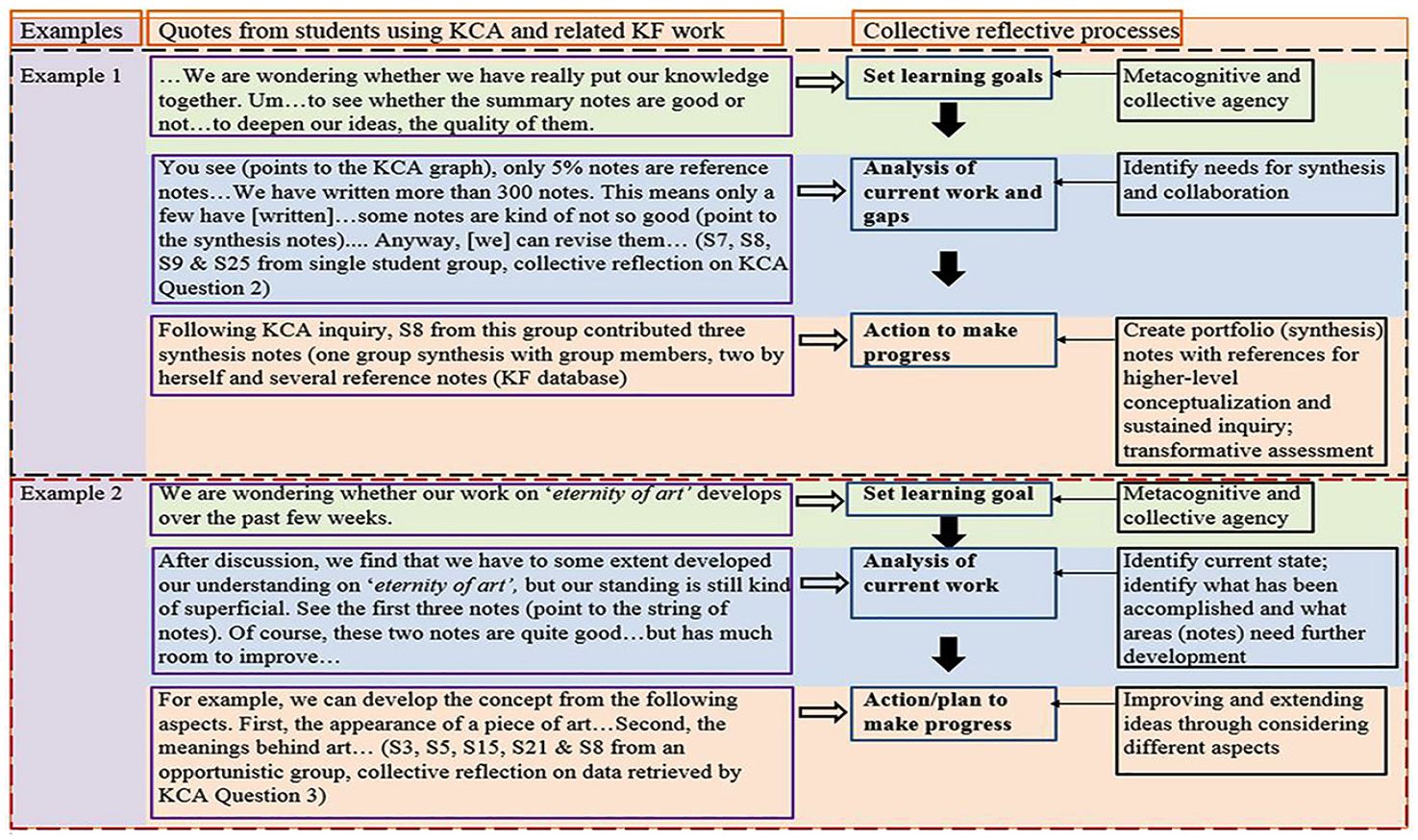
Reflective assessment using Knowledge Connections Analyzer (KCA) (excerpts from group inquiry).
Reflection Developed as Social Practice and Community Norms
Reflective assessment is a developing social practice with a community ethos of supporting students to gradually take up practices and is important for tackling problems of epistemic dispositions. In this KB classroom, emphasis was not placed on specific activities, but on the general development of an ethos of wondering, working together to find out, stepping back, and looking forward. As an example, the teacher said, There are a lot of dialogues in the classroom. I emphasize question-answer-question [ever deepening]. I teach my students to use questions to clarify the problems. When they face a problem, they will use questions . . . they will engage . . . they will create a habit. When there is a question, they know something new is happening . . . they dare to think, to argue with you . . . and when they argue, there will be another question, and they will just keep going on . . . (Teacher interview)
What the teacher seems to have been alluding to is the development of epistemic dispositions toward an inquiry orientation. Students were developing community norms and practices of reflecting on their own and others’ work to make collective progress. In a KB talk on Q2 of the KCA, S11 commented on a revised KF synthesis note of another group, calling it “quite messy and fragmented, especially toward the end . . . so many ideas, but incoherent and not well integrated.” The student also said, “I can learn from some other notes . . . how to synthesize ideas; some peer notes . . . provide useful perspectives . . . I think [the above-mentioned note] could be improved incorporating more notes . . .”
The above example suggests that students were developing the practice and that they were able to articulate, assess, evaluate, and contribute to others’ ideas for collective progress. There were no comparisons or criticisms of others’ work, because collaborative reflection for idea improvement support class progress and transformative learning. Reflection and pursuit for improvement were gradually becoming classroom norms and practice in this community, sustaining its continuing growth.
Another aspect of the community developing reflective and inquiry practices was its cumulative and progressive nature. New skills, competences, and epistemic dispositions were gradually and progressively developed, supported by reflection that mediated students’ new activities and competence. Reflective inquiry, opportunistic KB talk, and analytics-supported reflection were integral to the process. When students engaged in inquiry such as question posing on KB wall, they were engaged in reflection and idea development, which helped them progressively develop reflective and collaborative skills in their KF writing; KB meta-talk and analytics-supported reflection helped them further to develop the KB process of productive discourse.
With reflection as developing skills and social practices, students also seemed capable of reflecting on and interweaving different parts of their learning experience. Working on a KCA-supported assessment, S8 commented, We realized the problems with our note through this discussion . . . we were also motivated to improve the note. I think, for example, that we should have followed the format we used to prepare the KF wall summary portfolio note to improve it. . . . We should have explained why we use particular notes as references and commented on their strengths and weaknesses. (Interview after KB talks, May 15).
In this example, S8 was referring back to how their start-of-the-year KF wall and portfolio experience helped them tackle the new task of producing quality synthesis notes. The student also demonstrated metacognitive competences and seemed able to identify problems, set improvement goals, and identify strategies by drawing from his peers’ collective learning: “We realized the problem,”“We should have followed the format.” The emphasis on reflective assessment may have helped students realize the need to integrate and consolidate their developing competences. Primarily, students used their newly gained skills and interests to engage in new activities that allowed them to progressively advance ideas in the communal space.
Collaborative reflection is a community norm. Their increased metacognitive and epistemic understanding helped them engage in the KB process by collectively advancing ideas and helping improve each other’s notes. Combined with skills such as inquiry, collaboration and metacognition, students gradually exhibited increased engagement in KB, supported by reflective assessment using the KCA, resulting in their production of rich KB discourse.
Taken together, these four themes could also be mapped onto the pedagogy design phases, as they were interrelated and progressive. Students first engaged in reflective inquiry with guided reflection to develop metacognition in a social context, including setting learning goals. These inquiry and reflective tasks were developed further through opportunistic KB talks, and students used analytic-supported assessment to develop metacognitive goal setting, planning, and reflection skills. In the KB community, competencies and skills were cumulative and integrative, developing into social practices supported by community ethos and norms.
Discussion
This study examined how reflective-assessment design in a KB environment supported academic low achievers’ collaborative inquiry and development of higher order competencies and investigated sociocognitive dynamics associated with that development. Figure 2 provides a summary, including problems of low achievers, pedagogical designs, sociocognitive processes, and learning outcomes. In the following, we first discuss the evidence regarding the research questions, and then provide an explanatory account of sociocognitive dynamics, and finally outline the educational implications for developing higher order inquiry and productive KB for low achievers.
Effects of KB Reflective Assessment on Productive Discourse and Higher Order Competencies
Analysis of the KF inquiry threads (Figure 4) indicated that many students contributed to them; KF work is distributed, and most threads developed over many weeks. These results are important for equity, because they suggest not only some students can benefit—many students were involved and collectively pursued sustained inquiry. The analysis suggested these low achievers gradually shifted from viewing online KF writing as question-answer short exchanges toward developing epistemic dispositions for open-ended inquiry. Analysis of KF discourse showed that, despite their difficulties and low prior achievement, students engaged in productive KB discourse, including collaborative explanations, metacognitive and regulatory processes, and epistemic-oriented inquiry using synthesis and emerging questions. The coding of online discourse moves illustrated students’ developing metacognitive, collaborative, and epistemic competence (Table 4). Students were increasingly engaged and motivated to take responsibility for the advancement of collective knowledge (Table 5).
Although it was not possible to include a control group, previous KB research provides a solid precedent for using changes over time to measure student development; for example, Zhang et al. (2007) assessed changes in students’ personal ideas across three stages to investigate discourse development and KB. Comparisons with published KB studies indicate these students participated actively and produced KB discourse similar to that of regular cohorts (Lee et al., 2006; van Aalst, 2009; Lai & Law, 2006). With reflective-assessment design, KB activities not only affected low achievers’ higher order inquiry, including their metacognition, inquiry, and epistemic dispositions but also their domain knowledge.
KF analysis findings from this study are consistent with our earlier research using analytics-supported reflective assessment with different classes (Yang, 2019; Yang et al., 2016). In the present article, we provide a clearer analysis of productive KB examining online discourse illustrating students’ collective responsibility, using discourse coding, thread content, and summary notes. KF analysis generally focuses on knowledge advance (e.g., Zhang et al. 2007); our analyses also suggest the discourse moves reflect students’ higher order competencies in metacognition, collaboration, and epistemic dispositions in community context, for example, students wrote synthesis note as they became more epistemic in their approach to knowledge. As well, such high-quality discourse is generally absent from other online discussion environments or even KB classrooms lacking strong design. Without a clear focus on the collective supported by reflective assessment, students may focus on individual work, resulting in fragmented writing commonly found in online contexts (Hew & Cheung, 2008).
The findings are consistent with KB research on the role of reflection (van Aalst & Chan, 2007) and designed intervention on productive KB discourse (Zhang et al., 2018). While it was expected KB interventions would bring about improvement, this is one of the few studies to focus on a whole cohort of low achievers. Using detailed analysis of online discourse and other qualitative data, these low achievers were shown to engage in productive KB discourse and complex inquiry comparable to other KB cohorts. Different excerpts and data provide corroborating evidence illustrating their increased metacognitive competence (e.g., Figure 6 KCA examples setting goals, analyzing gaps), collaborative discourse (e.g., constructive comments for classmates’ progress in KF writing), and epistemic dispositions (e.g., discussion of what inquiry involves). As shown in research on academic interventions (e.g., Dietrichson et al., 2017) and higher order thinking (Zohar & Dori, 2003), the problems of low achievers is not a deficit model but lack of engagement opportunities. Our findings add to the literature that, given appropriate designs and scaffolds in the learning environment, academic low achievers can engage in complex collaborative inquiry and KB.
Dynamics of KB Reflective Assessment Scaffolding Academic Low Achievers
Qualitative analyses illustrated how academic low achievers engaged in reflective assessment for KB in alignment with the framework (Figure 2). The analyses show how low achievers initially had difficulties writing/discussing questions, and how the designs and dynamics of reflective assessment—including (1) reflective inquiry and social metacognition, (2) reflective meta- and epistemic talk, (3) evidence-based reflection for collective growth, and (4) reflective practice embedded in classroom system and community ethos helped them to gradually take up collective agency and engage in productive inquiry. Teacher interviews suggested that authenticity of design and pedagogical intentions align with assumptions of KB and reflective assessment. In the following, we discuss how the design features and processes work coherently as a system of KB practice, supporting low achievers in inquiry-based learning and KB. While this study on reflective assessment was in a KB classroom, its themes are applicable to other classrooms.
Developing Reflective Inquiry and Social Metacognition
Metacognitive reflection and agency are pivotal to learning and inquiry, but often lacking among low achievers. Reflective assessment builds on seminal research with low achievers and at-risk students developing metacognitive reading in social contexts (Palincsar & Brown, 1984) and reflective inquiry in science (White & Frederiksen, 1998). Similar to reciprocal teaching asking children with learning difficulties to take up increased responsibility, KB enhanced with reflective assessment emphasizes collective responsibility for low achievers—reflection is social, and students support each other in a KB community.
This study shows how low achievers had many opportunities to work on authentic and reflective tasks in a community to develop a sense of agency and collective responsibility. KB inquiry activities were enriched using learning journals and paper-and-pencil portfolio. Students wrote notes asking questions and setting learning goals; they monitored their progress through comparing their own ideas with those of others (e.g., KB wall), and evaluated their own and the class’ progress. Thinking about thinking is not easy for low achievers; however, when working as a community wherein ideas are improvable (Scardamalia, 2002), they can ask questions of an audience, see what others think, learn from others’ examples and strategies, and become more aware of what they know and what they need to know through interacting with others.
Using metacognition to teach low achievers has been a key theme (Brown, 1997; White & Frederiksen, 1998; Zohar & Peled, 2008), and we emphasize developing shared cognition and metacognition in a KB community. Primarily, through reflective assessment in a community, students can use others’ lenses to sharpen their understanding of their own thinking and develop goal setting, monitoring, and planning collectively in a social context. Not everyone becomes metacognitive at the same pace; however, they can scaffold each other, follow up on others’ examples, use others’ ideas to sharpen their own, and become metacognitive collectively, as reflected in their KF discourse and classroom inquiry.
Reflective Meta- and Epistemic Talk
Students with low achievement commonly have difficulties in communicating, collaborating, and engaging in discursive talk; as such, educational approaches for low achievers typically involve peer interaction (Han et al., 2014; Hawkins et al., 1988; Slavin et al., 2011). Analysis shows the classroom teacher regularly used talks to help students articulate and reflect on their understanding. Low-achieving students were continually involved in dialogue in dyads, groups, and classroom communities, with different students building on others’ ideas, reflecting on experience, and the teacher being just another discussion member—dialogue was ongoing.
This study also extends the notion of classroom and KB talk, adding metacognitive and epistemic dimensions for low achievers. Most inquiry-based classroom and KB talks are about content and improving ideas (Zhang et al., 2007). This proposed framework added another layer and helped low achievers develop an understanding of the epistemic nature of discussion. Similar to the idea of thinking about thinking, reflective talk involves talking about their talk to enhance collaborative competence. Low achievers lacking collaborative skills may have difficulties in inquiry-based environments. In reflective talks, students engaged in discussing their dialogue/discourse on KF; initially, low achievers might not know what to write and, through such reflective talk, could use examples from peers to construct criteria and standards. Assessing others’ responses required them to comprehend and to process, while productive talk helped them to articulate. Primarily, reflective and opportunistic talks can help low achievers become metacognitively aware of their own actions and gradually develop the epistemic disposition viewing knowledge as extendable. The notion of explicitly teaching principles has been examined in academic interventions for low achievers (Baker et al., 2002); our study shows students can work together to construct these principles through reflective and epistemic talk in a community context.
Evidence-Based Reflection for Collective Growth
Reflective assessment, as a design for academic low achievers, is also important from the perspective of formative assessment—providing data to students on how they are performing (Baker et al., 2002) and progress monitoring (Dietrichson et al., 2017) in academic interventions. Analytics-supported reflective assessment emphasizes giving students agency and having them reflect on their own data and progress. Raes et al. (2014) discussed the role of visualization of data and phenomenon in facilitating low achievers’ inquiry in computer-supported environments.
We developed these ideas of progress monitoring, linked to the principle of concurrent, embedded, and transformative assessment (Scardamalia, 2002). We designed learning analytics tools and used KCA’s intuitive questions to engage academic low achievers. Visualization of KF data provided through technology and analytics—applets, scaffolds on prompt sheets, and the KCA output—facilitated collective reflection for inquiry and provided specific areas for them to discuss. Running the KCA and different tools, students could see their and their classmates’ contributions on KF for timely feedback (concurrent assessment), then use that evidence to improve their KF writing (transformative assessment). Premised on the community principle, students were not just working for their own progress but for the progress of the class community (“We found out the problems. We can try out . . .”). As students assessed their own work—supported by evidence and discussed goals, problems, and plans—they gradually took on metacognitive/regulatory competencies and transformed their understanding. Reflective assessment using analytics is consistent with the notion of formative assessment and feedback (Dietrichson et al., 2017), but goes beyond fixed goals, with students continually pursuing deepening inquiry using data and evidence to guide their collaborative reflection and collective growth—the ideas that there are no specific answers and things are extendable through collective efforts can motivate academic low achievers.
Reflection Embedded in Classroom System and Community Ethos
Reflective assessment builds on the idea of fostering communities of learners (Brown, 1997), emphasizing reflective practice as a community norm. The analysis suggests reflection and epistemic dispositions for diverse learners and low achievers need to be developed progressively, supported by a community ethos. The strength of the classroom community emerged from the multiple and intertwined ways in which students’ discourse and knowledge development was supported by the sociocultural contexts, online environment, and reflective assessment.
Learning in this KB classroom involved both individual and collective goals, supported in different ways, including the following: principles governing classroom behavior, such as KB’s collaborative culture and norms; the allocation of roles for collective responsibility in advancing discourse and reflection; the design of tools, including KF/KCA; and opportunistic meta-talks and prompt sheets. The goals and intentions of this classroom were unlike those in more traditional ones—emphasis was on developing a collaborative KB culture for collective advancement, using KF and the KCA to make the processes tangible and achievable by providing a record of community inquiry. KB’s community ethos was important for reflective assessment, as students were not judging their personal attainment, but how the whole class progressed.
Our study demonstrates that low achievers—albeit with initial difficulties and tensions—could gradually move toward high-level inquiry and discourse, in part because KB’s collaborative ethos encouraged their agency and belief in improvable ideas to sustain their continual engagement. The teacher noted KB is an “error-free” safe environment for his students. Research has shown the important role of cooperative learning in academic interventions for low achievers (Slavin et al., 2011); reflective assessment in KB also draws on students as resources but focuses on the collective. For developing higher order inquiry, KB culture goes beyond fixed goals to afford students the openness to pursue and create new goals. Low-achieving students can work together toward collective accomplishments and community responsibility, a new kind of identity emphasizing collective rather than individual achievement.
These explanatory themes are progressive and cyclical and address low achievers’ metacognitive, social, and epistemic difficulties. The importance of reflection and self-peer assessments has always been emphasized in designing learning environments. This study emphasizes collaborative reflection—students reflecting on and assessing their own inquiry and discourse collaboratively. The progressive and interrelated themes of reflective inquiry, reflective talks, evidence-based reflection, and reflective practice are premised on KB community principles, and can be applicable in different learning environments.
This study was conducted in a Hong Kong classroom, where learning sciences research is still a recent phenomenon. Chinese students, particularly those with low academic abilities, are usually regarded as passive learners (Chan, 2011); this study reveals the possibility of nurturing a community of knowledge builders among such low-achieving Chinese students. The study suggests the general applicability of KB theories and designs and documents the adaptive expertise of the teacher who implemented the KB approach in a specific classroom context. While students tend to be more compliant in Asian settings, the results cannot be explained by compliance behavior. KB is different from behavioral approaches in which students merely follow teacher instructions and perform practice. The change involves metacognitive work, sustained collaborative inquiry, and epistemic work and discourse—all normally difficult for low achievers. This intervention was grounded in KB theory, and its technology-supported assessment design enriched the teacher’s adaptive expertise. While its findings are specific to this Asian classroom, its analysis, processes, and implications are applicable for designing KB and higher order inquiry in other classrooms in different cultural contexts.
Limitation and Implications for Future Research
While this study is limited—paradoxically—by the teacher’s competence and high-level adaptive expertise, this is also its strength. With the paucity of research on designing collaborative and epistemic work for low achievers, in-depth case study is important. This study has provided rich data and key themes that may be translated into other reflective-assessment designs to be further tested. It is important to examine the extent to which the designs implemented depended on this specific teacher, and whether they can be used effectively by other teachers working in different KB classroom contexts. There may also be questions regarding the study’s focus on local circumstances, and on whether the KB activities and analytic-supported reflective assessment designs should be separated to test KCA’s causal mechanisms. Nevertheless, this study builds on a research tradition in KB studies; the notion of a case study is to illuminate designs, processes, and dynamics, even in a best-scenario case, examining what is possible and what it says about theories and design of KB and assessment. We have offered explanatory processes and design principles; in the tradition of design-based research, these designs and processes need to be continually tested in other classroom and educational settings.
In examining higher order inquiry and 21st-century education competencies, it would be useful to examine whether the observed changes are transferable. What changes in students’ understandings about art might emerge months after the conclusion of the KB intervention? To what extent do KB and reflective assessment prepare students for future learning or KB in other domains? Transfer is an important issue in the learning sciences (Lobato, 2008), and responses to these questions will advance this research.
This study included data on domain knowledge and pretest-posttest change. As there was no comparison group, it is difficult to ascertain causal change to the pedagogical design. It would be useful to test the reflective assessment design in future studies incorporating different classes in different contexts and to investigate more closely how the design and dynamics influence students’ higher order competencies, KB, and domain knowledge. As well, this study examined and identified ideas such as social metacognition, meta-talk, and collaborative reflection that are important for theory and design in learning sciences. Our findings provide some characterization, but they need to be unpacked further through iterative studies and analyses.
Conclusions
This study has addressed the important problem of providing equity and access to diverse learners to develop higher order collaborative and epistemic inquiry for 21st-century education. While there have been many discussions on meeting the needs of all students (e.g., National Academy of Science, Engineering and Medicine, 2018, How People Learn II), this is one of the few studies to document how a cohort of low-achieving students can engage in productive KB and develop high-order competencies, including metacognition, collaboration, and epistemic disposition. Contemporary educational interventions generally focus on educational achievement for low achievers (Baker et al., 2002; Dietrichson et al., 2017); this study directly examined how low achievers can succeed in collaborative inquiry and KB, addressing the need to provide access for all learners through innovative learning designs.
This study contributes to research on scaffolding inquiry-based learning among low achievers by proposing an explanatory framework. We started with the difficulties facing low achievers and proposed a design premised on KB principles enriched with reflective assessment for promoting their metacognitive, collaborative, and epistemic growth. The integrated design and themes—including reflective inquiry and social metacognition, reflective meta- and epistemic talk for understanding, evidence-based reflection for collective growth, and reflection embedded in classroom system and community ethos—provide explanatory themes with implications for designing learning environments to support collaborative inquiry among academic low achievers in different classroom contexts.
This study builds on current research by enriching conceptualization for scaffolding diverse learners using the KB reflective-assessment perspective. Educational research has examined support for low achievers using principles of task engagement, authentic problems, and peer interaction/cooperative learning. This study builds on the literature emphasizing metacognition/agency, community, and improvable ideas for low achievers. While low achievers are passive learners, these principles paradoxically would encourage them to take collective responsibility for productive inquiry. The community perspective is important—cognitive and learning-sciences research has examined metacognition in reflective assessment (White & Frederiksen, 1998), and we extend that to collaborative reflective assessment and social metacognition supported in a community context. Metacognition and reflection are difficult, and the novelty of this study is to use learning analytics tools to provide visualization of students’ ideas to support their metacognition and reflection and to widen the dialogic and reflective space for low achievers’ KB. Progress monitoring and feedback are discussed in the academic intervention literature (Dietrichson et al., 2017); we extend this with the use of analytics tools placed in the hands of students to promote their agency in directing their own inquiry. We have developed the design and demonstrated one of the first studies helping low achievers to use analytics-supported tools to reflect on their inquiry in complex technology environment. A key contribution of this study is that it is not only a proof-of-concept study but also provides an explanatory framework supporting low achievers in complex inquiry using KB reflective assessment that can be examined and tested in other inquiry-based technology environments.
This study also has implications for KB research. This is one of the few KB studies to include deep analyses of both online and offline discourse; such analysis may enrich theory and analysis of KB with design implications for scaffolding inquiry for low achievers. This study also contributes to KB assessment through unpacking the principles of embedded, concurrent, and transformative assessment, and points to continuing work in this direction. This implementation of KB in a different cultural context is also beneficial for examining the application and robustness of the theory and opens up new design possibilities.
This study also has classroom-level implications for facilitating academic low achievers in engaging in higher order competencies, collaborative inquiry, and KB. Several key principles are discussed based on the findings. First, teachers can enhance metacognition in a social context by supporting students to reflect, inquire, and use others’ examples and different lenses to reflect on their own models (e.g., One student noted she understood what she thought when responding to others). They can scaffold students to enhance both their personal and social metacognition by asking them what they earlier thought, what they discussed, and how that changed their understanding. Second, a dialogic approach is needed to engage low achievers in productive dialogues and reflective meta-talk (e.g., teacher said my classroom is full of student talks). Classroom talks are often about content, but they can be extended to help low achievers develop explicit understandings of what makes good inquiry and discourse and reflect on their dialogue activity. Third, reflective assessment gives cognitive responsibility to the students and enables assessment for transformative purposes; even low achievers can assess their own and others’ learning and collaboration, increasing their agency. Teachers can provide meaningful concurrent feedback using different tools, prompting students to reflect and explain; technology can be placed in students’ hands to afford them more agency in assessing their work. Finally, developing a collaborative KB classroom ethos is important for supporting reflective culture and practices. KB involves students working as a community of learners and adding value to the community, regardless of their level of competence. It focuses not on individual achievements, but on collective efforts and progress; the classroom norm is students working together, reflecting together, and developing epistemic dispositions to inquire and improve collectively.
This study of KB and reflective assessment has theoretical and educational implications for examining and designing classroom-level learning environments intended to develop higher order thinking, inquiry, and collaboration among academic low achievers. While it has examined KB, this study has theoretical value and design implications that offer insights into the relationships among assessment, collaborative inquiry, and instructional practice; the potential affordances of KB for students with low achievement; and the nature and dynamics of reflective assessment.
Supplemental Material
6._AERJ_Final_Supplementary – Supplemental material for Dynamics of Reflective Assessment and Knowledge Building for Academically Low-Achieving Students
Supplemental material, 6._AERJ_Final_Supplementary for Dynamics of Reflective Assessment and Knowledge Building for Academically Low-Achieving Students by Yuqin Yang, Jan van Aalst and Carol K. K. Chan in American Educational Research Journal
Footnotes
Appendix
Notes
Y
J
C
References
Supplementary Material
Please find the following supplemental material available below.
For Open Access articles published under a Creative Commons License, all supplemental material carries the same license as the article it is associated with.
For non-Open Access articles published, all supplemental material carries a non-exclusive license, and permission requests for re-use of supplemental material or any part of supplemental material shall be sent directly to the copyright owner as specified in the copyright notice associated with the article.
