




Abstract
A forensic investigation of radioactive contamination at Iraq's central nuclear research center confirms Saddam's nuclear program never made it off the ground, but it did endanger Iraqis.
Located 18 kilometers southeast of Baghdad, the Al Tuwaitha Nuclear Research Center served as the foundation of Iraq's nuclear research and development from 1967 until its final closure by U.S.-led coalition forces in 2003. Originally a facility for radioisotope production with a Russian-supplied 2-megawatt IRT-2000 research reactor, the site began to focus on uranium enrichment and plutonium production for a nuclear weapon in 1982 under Saddam Hussein. 1 Iraq would eventually construct three nuclear reactors at the Al Tuwaitha site. The IRT-2000 was upgraded by Russian contractors to a 5-megawatt IRT-5000 in 1978, and two French-designed light water reactors, the 40-megawatt Tammuz-1 and the 500-kilowatt Tammuz-2, were constructed in the early 1980s. The Tammuz-1 was destroyed prior to fueling by an Israeli bombing raid in 1981. Thereafter, Iraq abandoned its plans for plutonium production and focused on enriched uranium as its source for a nuclear weapon.
By 1991, the Al Tuwaitha complex comprised 90 buildings dedicated to nuclear fuel fabrication, radiochemistry, uranium enrichment, radioactive waste treatment, and biological research (see map on page 21). 2 At that time, the Iraq Atomic Energy Commission (IAEC) reportedly was between 18 and 30 months from having enough enriched uranium for a nuclear weapon. 3 Despite the long history of nuclear programs at Al Tuwaitha, no significant radioactive contamination as a result of normal operations has been officially reported for the site or surrounding communities. 4
Iraq's capacity to enrich uranium was essentially eliminated during Operation Desert Storm in March 1991. At that time the IRT-5000, Tammuz-2, radiochemistry and nuclear physics laboratories, fuel fabrication laboratories, the radioactive waste treatment station, and nuclear material stores were seriously damaged or destroyed. Unsubstantiated reports of radiation releases as a result of coalition bombing have been made by Iraqi personnel at the Al Tuwaitha site.
In late-April 2003 during Operation Iraqi Freedom, a documented radioactive dispersal occurred. At that time, Iraqi civilians looted perimeter storage areas at Al Tuwaitha and dumped more than 200 barrels of uranium compounds in the form of yellowcake at a breached compound near the village of Ishtar. The barrels, still containing more than 10 kilograms of yellowcake residue, were transported to nearby villages and used for household storage. 5 Uranium residue from the looted barrels was likely dumped in residential areas prior to recovery of the containers. Coalition forces, IAEC hazmat teams, and others recovered most of the barrels and dumped yellowcake by June 2003. Also recovered were numerous cesium and cobalt sources that posed acute danger to surrounding communities. Subsequently, all high-level radioactive materials at the site were secured and transported out of Iraq. Remaining sources and unsecured radioactive materials were consolidated into on-site bunkers and storage buildings. Since July 2004, security at the site has been maintained by a combination of security forces from Iraq's Ministry of Science and Technology and the U.S.-led multinational force.
Secret operations at Al Tuwaitha, combined with the bombing of nuclear facilities and the subsequent looting by local residents, have contributed to the perception that the site and nearby villages suffer widespread radioactive contamination. 6 In June 2005, we, a U.S. research team from Texas Tech University, commenced a program to evaluate the types, activity levels, and geospatial distribution of radiation contamination at Al Tuwaitha and in the neighboring villages of Ishtar, Al Riyadh, and Al Wardia. The objectives of this work were to conduct a scientifically valid assessment of the dispersion of radioactive materials, identify the likely sources of contamination, and provide a basis for gauging potential hazards to workers at the site and inhabitants of the nearby villages. Such data provides a template for planning future dismantlement and research activities at Al Tuwaitha as well as at other former nuclear facilities throughout Iraq. It also provides an accounting of activities at Al Tuwait-ha since its inception, filling in the historical record on Saddam's nuclear program during the period that western observers did not have access.
Structures at 10 different nuclear locations in Iraq have been targeted for similar dismantlement. 7 Dismantlement of facilities and disposal of waste products at former nuclear sites cannot commence, however, without comprehensive characterization of the radionuclides present in the environment and within the remaining structures. Knowledge of the inventory of dispersed radioactive materials is an important prerequisite for planning work areas, waste disposal sites and routes, and for anticipated future uses of remediated sites. Among these, Al Tuwaitha–the most contaminated and important piece of the former regime's nuclear weapons program–ranks as the highest priority for immediate attention, and has been the focus of our team's work. 8
RADIOACTIVE CONTAMINATION AT THE AL TUWAITHA NUCLEAR RESEARCH CENTER
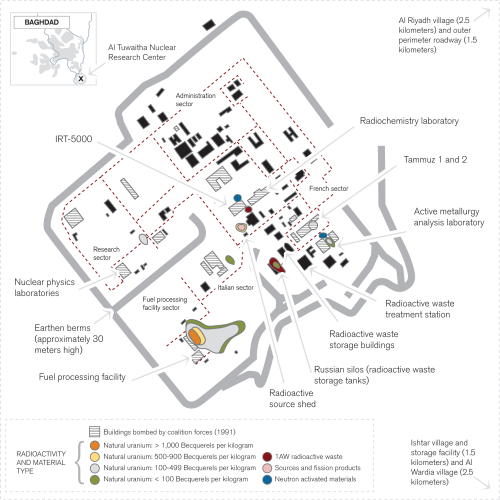
This report is only one part of a comprehensive effort to assist the Iraqi government with dismantlement of its legacy nuclear infrastructure and disposal of uncontained nuclear waste. Numerous training programs on waste disposal methods, site prioritization, radiation worker safety programs, project management planning, health assessments, and building characterization exercises have been conducted from 2006 to 2007. 9 Additionally, the International Atomic Energy Agency (IAEA), which received a request from the Iraqi government in mid-2005 to help with cleanup of former nuclear sites, has regularly organized consultations with Iraqi representatives on proposed dismantlement procedures and instituting international standards for dealing with radioactive materials. Regardless of progress on other fronts, on-site environmental characterization is the critical requisite before dismantlement activities can commence.
The Iraqi government did not have the capacity to undertake laboratory analyses of samples domestically, so with assistance from the U.S. State Department, the Royal Scientific Society of Jordan, and the U. S. Civilian Research and Development Foundation we transported samples to the International Radioecology Laboratory (IRL) in Slavutych, Ukraine. The IRL provided training for Iraqi specialists from the Ministry of Science and Technology. Because the IRL has the necessary certification and credentials to ensure quality control and international credibility of the results, it helped us achieve both the scientific goals of the project and capacity building by providing training in radiation detection methods for Iraqi personnel.
All soil samples were analyzed for gamma, beta, and alpha spectra with participation of Ukrainian and Iraqi scientists. After preliminary screening, all reference samples (from Al Tuwaitha or surrounding areas) that registered radiation levels above background alpha and beta emissions were treated according to standard ra-diochemical procedures for specific radionuclide identifications. 10
The methods used provided a conservative approach to determining elevated radionuclide activity levels. 11 A significantly elevated value, in this context, does not infer significant risk, nor does it convey information regarding recommended cleanup criteria; it simply indicates elevated values from background levels. With the assistance of the IAEA, Iraq is presently preparing new regulations governing cleanup criteria and radioactive waste categorizations.
Sixty-three samples (17.6 percent) were found to have one or more radionuclides with activities significantly greater than background. 12 The types and locations of radionuclides were consistent with contamination by historical releases of radiation into the environment by the operation of a nuclear facility, dispersal during bombing, looting and dumping of yellow-cake, and transfer of sources and radioactive waste by the IAEC following Operation Desert Storm and Operation Iraqi Freedom. 13
Iraq's capacity to enrich uranium was essentially eliminated during Operation Desert Storm in march 1991. at that time the IRt-5000, tammuz-2, radiochemistry and nuclear physics laboratories, fuel fabrication laboratories, the radioactive waste treatment station, and nuclear materials stores were seriously damaged or destroyed.
Natural uranium was the most common contaminant encountered across Al Tuwaitha and nearby areas. Forty-four of the 358 soil samples (12.3 percent) from the vicinity were determined to have natural uranium activities significantly higher than background. Significant uranium activities were seen in all areas except for reference samples and the administration and research sectors. The characteristics of all samples containing uranium contamination were consistent with natural uranium, and no environmental samples at Al Tuwaitha showed evidence of enriched uranium. Sixteen locations were determined to be contaminated with yellow-cake looted from the storage facility outside of Ishtar. This material was carried into the villages of Ishtar and Al Riyadh and was scattered along the roadside between Al Tuwaitha and Al Riyadh and in soils adjacent to the storage facility near Ishtar. The remaining 21 locations that were contaminated with uranium were likely from dispersal of fragments of natural uranium fuel pellets.
Elevated activity levels of cesium 137 were detected in 29 of the 358 sampling localities (8.1 percent). The highest cesium 137 levels were found in areas adjacent to the IRT-5000 and in the vicinity of the Russian silos that were used to store radioactive waste. 14 Moderate, yet significant, quantities of cesium 137 were also found in the administration sector, fuel processing facility, Italian sector, research sector, and Ishtar village. Cesium 137 was found together with other radionuclides in 16 of the 29 significant samples; cesium 137 was found in nine samples that also had elevated natural uranium, and it was found in seven localities in combination with high activities of cobalt 60, strontium 90, americium 241, and barium 133. These latter seven samples are interpreted to be the remnants of 1AW radioactive waste products, generated by the first uranium solvent extraction of fuel reprocessing by the PUREX method. 15 This waste is characterized by the presence of fission products and induced-activity isotopes (cesium 137, cobalt 60, strontium 90, and plutonium 238, 239, and 240) but without significant uranium activities. The combination of cesium 137 and uranium probably originates from other radioactive waste products not involved in the uranium extraction process. Samples containing solely cesium 137 were found outside of the waste processing and storage facilities. Such contamination may have resulted from improper disposal and dispersal of radioactive sources used in medical applications or research endeavors.
One example of contamination by site operations is at the Russian silos used to store solid and liquid radioactive wastes. Contamination at that site was initially attributed to cracking of the concrete containment structure by the concussion of a nearby bomb impact. The vicinity of the waste storage silos, however, was found to be contaminated with a variety of radioactive products ranging from 1AW waste to probable medical isotopes. All but one of 12 samples collected along the northeastern side of this facility had significantly elevated activities for one or more radionuclides. The northeastern border of the Russian silos was the obvious avenue for vehicular delivery and unloading of wastes to be deposited at the site. Only two of the remaining 20 samples bordering other parts of the structure showed significant contamination, and they were lower in radionu-clide activities. Furthermore, our inspection of the area provided no evidence of nearby explosive impacts or cracking of the containment assembly. Our analyses could not discern the times at which the waste was spilled. It is possible that contamination at the site resulted from hasty cleanup of damaged facilities prior to the first IAEA inspections following Operation Desert Storm. The variety of radiation sources, lack of evidence of structural damage, and the remaining clutter at the Russian silos suggest a long history of incautious handling and transfer of radioactive wastes.
Elevated levels of natural uranium due to the destruction of the fuel processing facility (FPF) in the Italian sector were found at 11 sample sites. The FPF was known to fabricate natural uranium fuel rods for use in the IRT-5000. The ratio of uranium 238 to uranium 235 in samples indicates that the material dispersed by the bombing was indeed natural uranium, and we found no contamination by enriched or depleted uranium. Most contamination from the destruction of the FPF was confined within a 5,000-square-meter area, although two contaminated sites in the Italian sector and one in the research sector could be the result of a broader dispersion of natural uranium fuel.
Natural uranium was the most common contaminant encountered and no environmental samples showed evidence of enriched uranium across al tuwaitha and nearby areas.
Evidence of uranium contamination due to yellowcake looting was found at 16 sample sites. Two-hundred-kilogram barrels containing yellowcake were first dumped by looters inside a storage facility near Ishtar. Further contamination from remaining yellow-cake in the barrels occurred when looters washed the barrels and dumped the residue outside the storage facility or after their transport from the site. Not surprisingly, five locations adjacent to the storage site near Ishtar showed significant uranium contamination. Two sites in Ishtar, located within the nuclear complex's outer perimeter roadway, and two locations in a ditch just outside the village were found to be contaminated as well. Yellowcake was also dumped along the roadside south of Al Riyadh and at four sites within Al Riyadh. Sites contaminated with yellowcake were usually only a few square meters in size so it is likely that other contaminated spots were missed by our sampling.
We also found evidence that transfer of radioactive materials subsequent to the 1991 bombing of the IRT-5000 resulted in isolated environmental contamination. A storage tank was buried near the reactor after Operation Desert Storm to house spent fuel rods from the destroyed reactor. Soil samples adjacent to the storage tank were contaminated with 1AW radioactive waste similar in profile to contamination found near the Russian silos. A metal shed near the tank was used to consolidate and store low-level radioactive sources moved from other on-site facilities. Two sites adjacent to this storage shed showed elevated cesium 137 levels probably due to spillage via transfer of sources from other facilities.
Other sites with significantly elevated activities of radionuclides that were likely the result of transport of contaminated materials were found near the active metallurgy analysis laboratory (LAMA), which was destroyed by coalition bombing in 1991. Soil samples adjacent to this building showed evidence of natural uranium and unusually high ratios of plutonium 239 and 240 to plutonium 238 greater or equal to 15 to 1. Although one of the three hot cells in this facility was reportedly used to conduct a single experimental uranium separations test, it is unlikely that the plutonium source originated there. The hot cells were thoroughly cleaned subsequent to the test and no radioactive contamination was present on the floors, walls, ceilings, drains, server arms, or leaded glass within the structures.
Great volumes of scrap metal, structural debris, and damaged equipment were moved by Iraqi workers from the IRT-5000 and the radiochemistry laboratory to areas surrounding the LAMA building subsequent to coalition bombing in 1991. Some neutron-activated materials from the IRT-5000 were found among the scrap piles (e.g., a tritium generator assembly). The high ratio of plutonium 239 and 240 to plutonium 238 is probably the result of insertion of natural uranium targets into the neutron channels of the IRT-5000. The high volume of uranium 238 relative to uranium 235 present in the natural uranium used led to a disproportionately high amount of plutonium 239 produced subsequent to neutron activation. Similar plutonium isotope ratios were evident in several samples obtained near the Russian silos. Final products would have been transferred to the radiochemistry laboratory. Therefore, we speculate that the material located near the LAMA facility was transferred via cross-contamination from materials or equipment moved from the radiochemistry laboratory to scrap piles near LAMA.
Three locations near the IRT-5000 and two along the northeastern border of the Russian silos were the only environmental sites that registered above background radiation levels on handheld gamma/beta detectors held at 1-meter height. Earlier scoping surveys conducted by Iraqi personnel using hand-held gamma detectors had not shown evidence of environmental contamination at the site. Clearly the magnitude and distribution of contamination at Al Tuwaitha would have been grossly underestimated without the detailed field and laboratory analyses that we have done.
Natural uranium, in the form of yellow-cake and processed fuel pellets, is the most widely dispersed radioactive contaminant found at Al Tuwaitha and the surrounding region. The April 2003 looting at the storage facility near Ishtar is the only activity that led to measurable radioactive contamination beyond the outer perimeter of the center. Isotopic ratios of uranium 234 to uranium 238 show that the yellowcake dumped at one site in the village of Ishtar was from a different geographic source than yellowcake detected at other locations. 19 Our interpretation of these findings is consistent with earlier IAEA inspection teams at the storage facility. 20 Several radioactive sources (cesium 137 and cobalt 60) also were looted but were recovered by U.S. and Iraqi personnel prior to June 2003.
Two-hundred-kilogram barrels containing yellowcake were dumped by looters inside a storage facility near Ishtar. Further contamination from remaining yellowcake in the barrels occurred when looters washed the barrels and dumped the remaining residue.
The dispersal of natural uranium pellet fragments near the FPF was likely the result of coalition bombing during Operation Desert Storm. The FPF structures were completely destroyed by the bombing sorties and much of the remaining scrap and debris was removed and transported by Iraqi workers to areas surrounding the LAMA facility. Significant uranium contamination found adjacent to LAMA, which was also destroyed by coalition bombing, is probably a result of materials being transported from the FPF rather than nuclear activities conducted at LAMA.
Cesium 137 was found in significantly elevated activities primarily in the vicinity of the IRT-5000, the radioactive source shed, and the radioactive waste storage tanks located at the Russian silos. We presume that environmental contamination near the IRT-5000 and the source shed was the result of spillage of sources and 1AW waste during the consolidation of radioactive sources following Operation Desert Storm. The highest concentrations of 1AW waste were found adjacent to the access doors of the metal tank used to house spent fuel and wastes from the IRT-5000. This structure was embedded into the soil in late 1991 by Al Tuwaitha personnel. Small areas of cesium 137 contamination were found alongside the access doors to the radioactive source storage shed, presumably due to spillage during unloading and transfer of spent fuel and wastes.
Variation in the activity levels and radionuclide content in the soil samples surrounding the Russian silos imply that contamination at that site was not the result of a single source. Although the radionuclide profiles for six of the samples were consistent with 1AW radioactive waste, others contained single radionuclides of cesium 137, barium 133, and natural uranium. Our survey of the site found no evidence of nearby bomb impacts or cracks in the containment structure of the silos. The top of the liquid storage tanks and the surrounding ground areas were littered with empty, unlabeled bottles, canisters, and barrels. Inside many of the containers we found radioactive residues (predominantly cesium 137). One liquid storage silo access port was open to the air allowing inspection of its contents. No liquid remained in the tank, but the bottom was littered with discarded containers. The combination of factors including variation of radionuclide types and activities, lack of evidence of local bomb impacts, absence of cracks in the silo containment structures, and the considerable clutter of discarded containers lead us to conclude that contamination at the Russian silo site was probably due to a long history of substandard procedures for handling radioactive wastes and tainted containers during the “normal” operations of the site prior to military operations. Fortunately, these activities did not result in measurable contamination in populated areas beyond the site perimeter.
Considerable time will be required for Iraq to enact new laws governing the regulation and storage of radioactive wastes and to implement programs to oversee public health concerns. Even if legal mandates are in place, Iraq also is faced with building an infrastructure to enable legitimate assessment of compliance. Progress on these technical issues represent a considerable cultural change from the legacy of Saddam's IAEC, which was absolved of such legal liabilities. Currently, the Ministry of Science and Technology and Ministry of Environment are moving forward with dismantlement based on anticipated statutes for regulatory criteria, waste definitions, and disposal methods. Scrap metal and building debris are now being stockpiled in temporary waste areas awaiting future definitions of waste streams. Despite these obstacles, it is essential that Iraqi agencies such as the Ministry of Science and Technology continue and expand their efforts. Decontamination of the country's nuclear sites is a vital component of the elected government's effort to develop the trust of its citizens. As such, this important work cannot be deferred to an unknown future date when regulations and procedures for nuclear dismantlement have a firm legal foundation.
Characterization efforts have progressed to the difficult task of evaluating rubble, scrap, discarded equipment, and the interior spaces of buildings at the site. many technical challenges remain for the Iraqi teams before they can completely dismantle the most contaminated structures.
While Iraq has been eager to show the world that it is serious about dismantling its former nuclear facilities, it is not yet ready to tackle a facility as complex as one of the reactor buildings. Instead, Iraq chose to begin its dismantlement efforts at Al Tuwaitha on the LAMA facility. The LAMA building was destroyed by coalition bombing prior to its use in radiological activities and therefore it is not expected to house significant amounts of radiation. Environmental surveys and extensive analyses of swipes and samples from the three hot cells at LAMA have shown only small traces of natural uranium, probably the result of cross contamination from transported scrap. Yet clearing the work area of scrap metal, structural concrete, and discarded equipment will require many months of work. A scrap-sorting area has been established atop the foundation of the adjacent storage building, which was also destroyed by bombing. The intact basement (approximately 10,000 square meters in size) will be used as a temporary holding facility for radioactive waste encountered during site excavations.
Dismantlement of the LAMA building will represent a significant change in the skyline at the Al Tuwaitha site and convey Iraq's unwavering progress toward nuclear dismantlement. This “skyline project” will enable Iraq to proceed in its dismantlement activities without requiring extensive laboratory analyses, clearance criteria, or accepted regulatory statutes. It is anticipated that LAMA dismantlement will be completed sometime in 2010.
Currently, data collection and development of laboratory analytical capacity and regulatory oversight are progressing along parallel paths. Radioactive characterizations have shifted from soil samples to buildings and the Iraqis, with help from international partners advising through the IAEA, are finalizing laws that will govern radioactive waste characterizations, standards for radioactive waste disposal sites, and radiation protection guidelines. With support from the U.S. government, Iraqi technicians and scientists previously employed in Saddam's nuclear weapons program are being retrained in the intricacies of biological evaluations, waste characterizations, and engineering solutions for dismantlement of these complex structures. The progressive capacity-building for Iraq's technical industry is directed toward its ultimate independence and implementation of international standards. Moreover, the environmental and technical problems associated with the former nuclear facilities offer a focused opportunity to develop Iraq's civilian scientific capacity.
From the U.S. perspective, it is important that Iraqi nuclear scientists, technicians, and engineers participate in civilian activities needed by their fledgling democracy. 21 To further that goal, the State Department has promoted activities ranging from scientific research to development of private companies in Iraq to replace the former Military Industrial Commission. 22 The reconstruction of a peaceful Iraqi science and technology sector is vital and requires the involvement and collaboration of the international scientific community in active research and training of the next generation of Iraqi scientists. Cooperative scientific programs such as the effort to characterize the contamination at Al Tuwaitha have sought to address the collective concerns of both countries.
The environmental characterization at Al Tuwaitha has cleared the path for nuclear dismantlement in Iraq to formally commence. Two of the authors of this report were honored to speak on July 7, 2008 at a ceremony at the Iraqi Parliament commemorating the start of nuclear dismantlement. In February, we witnessed significant progress toward dismantlement of the LAMA building. Much more work remains to be done before nuclear dismantlement in Iraq is a reality. It is estimated that removing all structures of concern and disposal of wastes will require at least 15 years. Changes in the skyline at Al Tuwaitha are only superficial steps toward cleaning up the remnants of Saddam's nuclear program. Real progress is represented by Iraq's commitment to the processes that have led to nuclear dismantlement with international oversight. Iraq has set into motion a program that demonstrates its break from recent history and its embrace of transparent and responsible management of its nuclear legacy.
Footnotes
1.
Iraq Atomic Energy Commission (IAEC) 1988 Annual Report; U.N. Security Council
Report S/1997/779 (October 8, 1997); David Albright,
“Iraq's Programs to Make Highly Enriched Uranium and
Plutonium for Nuclear Weapons Prior to the Gulf War,” (Institute for
Science and International Security, 2002), available at  ;
U.N. Security Council, 4th Semi-Annual Report on Implementation of UNSCR
687 (June 21, 1993); International Atomic Energy Agency (IAEA),
Director-General Report, Implementation of Safeguards Agreement
Between the Republic of Iraq and the IAEA Pursuant to the Treaty on the
Non-Proliferation of Nuclear Weapons (July 14, 2003); Garry B.
Dillon, “The IAEA Iraq Action Team Record: Activities and
Findings,” IAEA Bulletin, vol. 44, no. 2, pp. 13-16
(2002).
;
U.N. Security Council, 4th Semi-Annual Report on Implementation of UNSCR
687 (June 21, 1993); International Atomic Energy Agency (IAEA),
Director-General Report, Implementation of Safeguards Agreement
Between the Republic of Iraq and the IAEA Pursuant to the Treaty on the
Non-Proliferation of Nuclear Weapons (July 14, 2003); Garry B.
Dillon, “The IAEA Iraq Action Team Record: Activities and
Findings,” IAEA Bulletin, vol. 44, no. 2, pp. 13-16
(2002).
2.
U.N. Security Council Report S/1997/779.
3.
Jay C. Davis and David A. Kay, “Iraq's Secret Nuclear Weapons Program,” Physics Today, vol. 45, no. ? pp. 21-27 (1992).
4.
IAEC 1988 Annual Report; Y. K. Abdul Ahad, H. H. Ali, and M. M. Abdalla, “Environmental Gamma Radiation Monitoring Using TLD at the Tuwaitha Site and Other Regions of Iraq,” Radiation Protection Dosimetry, vol. 34, no. 1, pp. 215-218 (1990); B. A. Marouf, A. S. Mohamad, and J. S. Taha. “Assessment of Exposure Rate and Collective Effective Dose Equivalent in the City of Baghdad Due to Natural Gamma Radiation,” The Science of the Total Environment, vol. 133, no. 1-2, pp. 133-137 (1993).
5.
IAEA, Director General Report (July 14, 2003).
6.
U.N. Security Council, 4th Semi-Annual Report on Implementation of UNSCR 687.
7.
8.
Ibid.
9.
Ibid.; J. R. Cochran, J. J. Danneels, C. J. Phillips, and R. K. Chesser,
“Iraq Nuclear Dismantlement and Disposal Project.” Paper
presented at Waste Management Symposium 2007. Available at www-ns.iaea.org/downloads/rw/projects/iraq/doc-umentation/wm07paper.pdf;
J. J. Danneels, R. Coates, J. R. Cochran, R. K. Chesser, C. J. Phillips, and B.
Rodgers, “Support of the Iraq Nuclear Facility Dismantlement and
Disposal Program.” Paper presented at the Proceedings of the 11th
International Conference on Environmental Remediation and Radioactive Waste
Management. Available at
10.
Michael G. Bronikowski and John H. Gray, Decanting of Neutralized H-Canyon Unirradiated Nuclear Material High Activity Waste Streams, report prepared for Energy Department, July 2004.
11.
Alpha spectrometric measurements of uranium isotopes were evaluated using electrodeposited precipitates prepared from sample solutions by radiochemical methods in the presence of uranium 232 as a yield monitor. Each estimate of radio-nuclide activity had some fraction of uncertainty determined by the activity of the sample, the period of time that the sample was read, and the efficiency of the detector.
12.
Background estimates for total uranium and radiocesium were as follows: total uranium=0.031 ± 0.0038 Becquerels per gram; cesium 137=0.0081 ± 0.003 Becquerels per gram. Some radionuclides found in environmental samples at Al Tu-waitha were not detected in control samples. These radionuclides and their detection limits were: plutonium 239, 240=0.005 Becquerels per kilogram, plutonium 238 ∼0 Becquerels per kilogram; cobalt 60=0.021 Becquerels per gram; strontium 90=0.11 Becquerels per gram.
13.
IAEC 1988 Annual Report; Y. K. Abdul Ahad, H. H. Ali, and M. M. Abdalla, “Environmental Gamma Radiation Monitoring Using TLD at the Tuwaitha Site and other Regions of Iraq”; B. A. Marouf, A. S. Mohamad, and J. S. Taha, “Assessment of Exposure Rate and Collective Effective Dose Equivalent in the City of Baghdad Due to Natural Gamma Radiation.”
14.
U.N. Security Council, 4th Semi-Annual Report on Implementation of UNSCR 687; L. U. Joshi and U. C. Mishra, “Studies on the Geochemical Behaviour of Uranium Isotopes in Coastal Environment of the East Coast of India,” Journal of Radio-analytical Chemistry, vol. 67, no. 1, pp. 47–54.
15.
M. G. Bronikowski and J. H. Gray, “Decanting of Neutralized H-Canyon Unir-radiated Nuclear Material High Activity Waste Streams.”
16.
IAEC 1988 Annual Report; Y. K. Abdul Ahad, H. H. Ali, and M. M. Abdalla, “Environmental Gamma Radiation Monitoring Using TLD at the Tuwaitha Site and Other Regions of Iraq”; B. A. Marouf, A. S. Mohamad, and J. S. Taha, “Assessment of Exposure Rate and Collective Effective Dose Equivalent in the City of Baghdad Due to Natural Gamma Radiation.”
17.
Nuclear Regulatory Commission, “Disposal or Onsite Storage of Thorium or Uranium Wastes from Past Operations,” Federal Register, vol. 46, no. 205, pp. 52,061-52,063 (October 1981).
18.
19.
L. U. Joshi, M. D. Zingde, and S. A. H. Abidi, “Anomalous Behaviour of Uranium Isotopes in Backwater Sediments of Zuari River,” Journal of Radioanalytical Chemistry, vol. 79, no. 2, pp. 317–323.
20.
U.N. Security Council, 4th Semi-Annual Report on Implementation of UNSCR 687.
21.
Richard Stone, “New Initiatives Reach Out to Iraq's Scientific Elite,” Science, vol. 303, no. 5,664, p. 1,594 (2004); Richard Stone, “Coalition Throws 11th-Hour Lifeline to Iraqi Weaponeers,” Science, vol. 304, no. 5,679, p. 1,884 (2004); Richard Stone “In the Line of Fire,” Science, vol. 309, no. 5,744, pp. 2,156-2,159 (2005).
22.
Richard Boucher, U.S. State Department, “Redirection of Iraqi Weapons of Mass Destruction (WMD) Experts” (press statement, December 18, 2003).