




Abstract

Of the five original nuclear weapon states, China alone is believed to be increasing its nuclear arsenal, boosting its numbers by roughly 25 percent since 2005, according to Pentagon estimates. 1 Other significant nuclear-related events in China include the deployment of the long-predicted Dong Feng (DF)-3i and DF-31A nuclear-capable ballistic missiles and the Dong Hai (DH)-io nuclear-capable cruise missile.
Since 1997, the Pentagon has published an annual unclassified assessment of Chinese military power. Its 2008 report concluded, “China has the most active ballistic missile program in the world.” 2 Although the claim is not quantified, the report elaborates that China is “developing and testing offensive missiles, forming additional missile units, qualitatively upgrading certain missile systems, and developing methods to counter ballistic missile defenses.”
Taking these assessments into account, we estimate that China now has approximately 176 deployed warheads, plus an unknown number of stored warheads, for a total stockpile of approximately 240 warheads. Over the coming decade, China is expected to deploy more warheads on new systems but also retire others as it phases out older systems; however, there continues to be substantial uncertainty about the composition of China's future forces.
Snapshot
The DF-31A is a solid-fueled, three-stage intercontinental ballistic missile (ICBM) launched from a road-mobile transporter-erector-launcher (TEL). Although it can fly beyond 11,200 kilometers (7,000 miles), the DF-31A has a shorter range–and a smaller payload–than China's only other full-range ICBM, the DF-5A. China has deployed fewer than 10 DF-31AS, according to the Defense Department. We are not aware that the DF-31A has ever been flight-tested, which may suggest that its development and certification were based on flight-tests of its shorter-range parent missile, the DF-31. Nor have we seen any authoritative photos of the DF-31A TEL. The number of DF-31AS that China will eventually deploy is unknown, but the U.S. intelligence community projects that China will have 75-100 warheads targeted primarily against the United States by 2015–an estimate that hinges largely on several dozen DF-31AS being deployed over the next seven years. The missile's payload will most likely be a single warhead, along with decoys and penetration aids to confuse missile defense systems.
The first DF-31S have also become operational, according to Defense, with fewer than 10 missiles deployed. The solid-fueled, two-stage, road-mobile missile is carried on a six-axle TEL within a 15-meter canister. The DF-31 carries a single warhead and penetration aids; it is a long-range missile, but it cannot reach the continental United States. It is expected to replace the DF-3A and DF-4 as China's main weapon for regional targeting.
China has deployed solid-fueled, road-mobile missiles for nearly two decades, starting with the first DF-21S in the late-1980s as it began to replace the DF-3A. Deployment of the medium-range DF-21 did not get under way in earnest until 1991, and significant increases in the number of DF-21S have occurred only very recently. In 2005, the Pentagon estimated that China had 19-23 DF-21S for approximately 36 launchers. 4 The 2008 report lists “upwards of 50” nuclear-capable DF-21S deployed for 60 launchers, a 148 percent increase in missiles over four years. The Pentagon estimates China's total DF-21 inventory at 60-80 missiles, with the balance being conventionally armed anti-ship ballistic missiles “based on the CSS-5 (DF-21) airframe.” 5 Some DF-21S may also have an antisatellite mission, a capability demonstrated in 2007 when China destroyed one of its satellites with a DF-21-launched interceptor.
Photos of a new missile launcher similar to the one used for the DF-21 circulated on the internet in 2007, triggering rumors that China may have revived its abandoned DF-25 program. Some even speculated that each missile might have as many as three nuclear warheads. The U.S. National Air and Space Intelligence Center (NASIC) declined to comment when we asked about the image, and the 2008 Pentagon report does not mention the DF-25 or any other new missile.
THE CHINESE ARSENAL
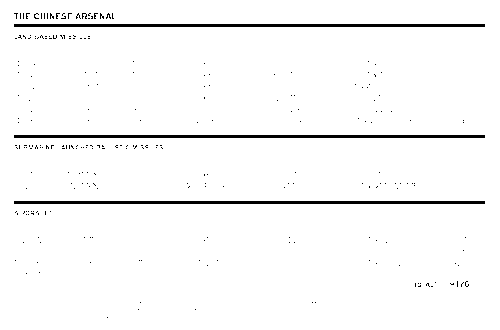
The JL-1 was never fully operational.
Figures are for nuclear-configured aircraft only. Hundreds of aircraft are deployed in non-nuclear versions. Aircraft range is equivalent to combat radius; assumes a small stockpile of nuclear bombs with yields between 10 kilotons and 3 megatons.
About 65 additional warheads may be in storage.
The DF-5 is China's largest missile, capable of delivering a multimegaton warhead further than 13,000 kilometers (8,100 miles). China has used the liquid-fueled, silo-based DF-5 to target the United States and Russia since 1981. A program to upgrade the DF-5 to the DF-5A by increasing its range and payload has been ongoing since the 1980s. The ICBMs are thought to be deployed in silos at two locations, with their nuclear warheads stored separately nearby. If China decides to deploy multiple warheads on a portion of its ICBM force as a counter-measure to U.S. ballistic missile defenses, the DF-5A is a likely candidate that might use up to three lighter-weight warheads with penetration aids. It is unclear whether China plans to keep the DF-5A in operation along with the DF-31A or will maintain only the newer DF-31A.
China also deploys about 17 two-stage, liquid-fueled DF-4 long-range missiles and roughly the same number of launchers. Probably intended for regional targets, the DF-4S are expected to be replaced by DF-31S.
The oldest missile in China's inventory, the liquid-fueled, medium-range DF-3A, is slowly being retired after nearly four decades of service; about 17 missiles (and perhaps 10 launchers) remain operational. The Pentagon expects the DF-3A to be retired by 2010. 6
A third satellite image, taken on February 27,2008, revealed the first deployment of a Jin sub to the expanding Yulin Naval Base on Hainan Island in the South China Sea. This might have been the submarine we spotted at Xiaopingdao, in which case three Jins have been launched. The image also showed that a submarine demagnetization facility has been added to Yulin since 2005, the first such Chinese facility. Demagnetization improves stealth by removing residual magnetic fields in the metal of the hull. A submarine cave similar to the one we disclosed at Jiangge-zhuang Naval Base in 2006 has also been constructed at the Yulin base, as well as extensive underground facilities. 9 We first reported the Yulin cave in 2006. 10
How many Jin-class submarines China plans to build is unknown, but the U.S. Office of Naval Intelligence (ONI) estimated in December 2006 that “a fleet of probably five SSBNs will be built in order to provide more redundancy and capacity for a near-continuous at-sea SSBN presence.” 11 Some media reports assumed that ONI meant China is building five Jin-class SSBNs; we interpreted the statement as more of a projection. The 2007 Pentagon report ignored the ONI estimate, but the 2008 report estimates that by 2010 China likely will have “up to five” Jin-class SSBNs. 12 A fleet of four SSBNs would be similar to those of Britain and France; four to five Jin-class SSBNs would carry 48-60 missiles, a significant increase from the 12 on the Xia.
The ONI's projection of “a near-continuous at-sea SSBN presence” assumes that China plans to operate its SSBNs in a fashion similar to the United States, Britain, and France. This would be a dramatic change. China has no experience with operating SSBNs; its single operational SSBN has never gone on patrol. The new SSBNs' Julang (JL)-2 missiles cannot reach the continental United States from Chinese waters and in a crisis would face considerable threats from hostile attack submarines if trying to venture into the Pacific Ocean, especially in such choke-points as the narrow strait between South Korea and Japan or the Malacca Strait.
The Jin-class SSBN is approximately 135 meters long (443 feet) and has 12 launch tubes for the JL-2 submarine-launched ballistic missile (SLBM). The JL-2 was previously credited with a range of 8,000 kilometers (5,000 miles), but the 2008 Pentagon report has lowered that estimate to 7,200 kilometers (4,500 miles), the same as the parent missile, the DF-31.
As with the DF-31 and DF-31A, there is speculation that the JL-2 may be equipped with multiple warheads, but the U.S. intelligence community credits the missile with only a single warhead. The Pentagon predicts initial operational capability for the JL-2 in 2009 or 2010, but given China's previous difficulties with ballistic missile submarine technology, this remains unlikely.
China's sole first-generation SSBN, the Xia, is no longer considered fully operational. In 2003, the Pentagon predicted that China would deploy the JL-i SLBM that year and that the sub's service life would be extended past 2010, but the Xia has never sailed on a deterrent patrol. 13 The 2008 Pentagon report does not include the JL-i on its list of Chinese missile forces.
In July 1990, the CIA reported that China's second nuclear test of the year “may be related to development of a warhead for a Chinese short-range ballistic missile.” 15 In February 1993, an intelligence report concluded that part of the purpose of China's testing series at the time was “possibly to test for tactical systems to be developed in the future.” 16 Later that year, another CIA assessment said the Chinese testing probably would enable China “to develop new warheads for its … tactical missile systems by 1996.” 17 In 1995, the agency thought a Chinese test scheduled for that June “may include warhead testing for … a cruise missile.” 18 Although unknown, it is possible that this cruise missile might be today's DH-10. The same year, another CIA assessment said a Chinese nuclear test scheduled for September 1995 possibly involved “a uranium artillery shell,” and speculated, “China could be seeking to confirm the reliability of a nuclear artillery shell design in advance of a nuclear test ban. Such a weapon would be primarily defensive, for use along China's perimeter against massed formations such as an amphibious landing or a Russian ground attack.” 19
These assessments add to evidence that China pursued or possessed several types of nonstrategic weapons: ballistic missiles, cruise missiles, and artillery. The overwhelming majority of China's short-range ballistic missiles, perhaps all of them, are thought to be conventional.
Estimating the size and composition of the Chinese nuclear stockpile is exceedingly difficult; China does not publicize details about its nuclear forces. U.S. and other intelligence sources release very little information–often contradictory or even exaggerated–about what they know, and unofficial publications and the internet are awash in inaccurate and unsubstantiated claims.
Production of new warheads for the DF-31, DF-31A, and JL-2–assuming they will carry new warheads–has probably already taken place, increasing China's stockpile. This warhead increase probably will be offset by the retirement of old warheads for the shorter-range DF-3, DF-4, and JL-i as those systems are withdrawn during the next several years.
The Pentagon projects that by 2010, the Chinese nuclear force will have DF-4S; “enhanced” DF-5S (DF-5AS); DF-2is; “solid-fueled, road-mobile DF-31 and DF-31A ICBMs”; and “up to five Jin-class SSBNs, each carrying between 10 and 12 JL-2 SLBMs.” 22 Faced with U.S., Russian, and Indian nuclear force modernizations, China apparently believes this posture will reduce the vulnerability of its nuclear deterrent.
Supplementary Material
Annual Report to Congress: Military Power of the People's Republic of China 2008
Supplementary Material
Reaction to Chinese Nuclear Test
Supplementary Material
Ballistic and Cruise Missile Threat
Footnotes
1.
Defense Department, Office of the Secretary of Defense, The Military Power of the People's Republic of China 2005, July 20, 2005, p. 45; Defense Department, Military Power of the People's Republic of China 2008, March 3,2008, p. 56.
2.
Defense Department, Military Power of the People's Republic of China 2008, p. 2.
3.
Defense Department, The Military Power of the People's Republic of China 2005, p. 45.
4.
Ibid.
5.
Defense Department, Military Power of the People's Republic of China 2008, pp. 23-24.
6.
Ibid., p. 25.
7.

8.
9.
10.
Hans M. Kristensen, Robert S. Norris, and Matthew G. McKinzie, Chinese Nuclear Forces and U.S. Nuclear War Planning (Washington, D.C.: Federation of American Scientists/Natural Resources Defense Council, 2006), p. 121.
11.
12.
Defense Department, Military Power of the People's Republic of China 2007, May 23, 2007; Defense Department, Military Power of the People's Republic of China 2008, p. 25.
13.
14.
Defense Department, Military Power of the People's Republic of China 2008, p. 25.
15.
CIA, Directorate of Intelligence, Office of Scientific and Weapons Research, “China: New Nuclear Test [Deleted],” Science and Weapons Review, SW SWR 90-048C, July 31,1990, p. 1. Partially declassified and released under FOIA to the National Security Archive.
16.
CIA, “China: Accelerated Nuclear Testing Schedule,” CPAS NID 93-040JX, February 19,1993, p. 8. Partially declassified and released under FOIA to the National Security Archive.
17.
CIA, National Intelligence Council, “Reaction to Chinese Nuclear Test,” National Intelligence Digest, CPAS NID 93-234JX, October 7,1993, p. 4. Partially declassified and released under FOIA to National Security Archive.
18.
CIA, National Intelligence Council, “China: Nuclear Test [Deleted],” National Intelligence Digest, CPAS NID 95-053CX, March 7,1995, p. 11. Partially declassified and released under FOIA to National Security Archive. This possible cruise missile warhead might have been for the DH-10 land-attack cruise missile, which the U.S. intelligence community in 2006 said had nuclear capability and the Defense Department in 2008 reported had been deployed.
19.
CIA, National Intelligence Council, “China: Possible Nuclear Artillery Test,” National Intelligence Digest, CPAS NID 95-0214CX, September 14, 1995, p. 10. Partially declassified and released under FOIA to National Security Archive.
20.
National Air and Space Intelligence Center, Ballistic and Cruise Missile Threat, NASIC-1031-0985-06, March 2006, p. 20; Defense Department, Military Power of the People's Republic of China 2008, p. 25.
21.
Jane's Information Group, Strategic Weapon Systems, Issue 47,2007, pp. 12,20,33.
22.
Defense Department, Military Power of the People's Republic of China 2008, p. 25.