



Abstract

Closer to midnight
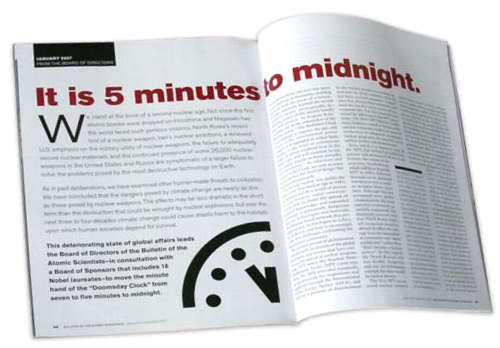
The Bulletin of the Atomic Scientists's decision to move the “Doomsday Clock” forward to five minutes before midnight highlights the continuing and immediate need to secure loose nuclear material.
Last year, we advocated establishing an international nuclear fuel bank controlled by the International Atomic Energy Agency (IAEA). The proposal would ensure access to nuclear energy for peaceful purposes and prevent weapons proliferation. Countries would be able to draw fuel for their power plants, provided they agree to strict verification and inspections, and then return the spent fuel for safe oversight by the IAEA. The nuclear fuel bank cuts short the debate over nuclear technology rights. Countries that refuse nuclear fuel bank services would come under immediate suspicion about their weapons intentions.
The nuclear fuel bank would be an important complement to the Nunn-Lugar Cooperative Threat Reduction program and other international nonproliferation programs. We still face an existential threat from weapons of mass destruction falling into the wrong hands. We must continue to work vigorously to make certain that all weapons and materials of mass destruction are identified, continuously guarded, and systematically destroyed.
Republican, Indiana
Democrat, Indiana
The decision by the Bulletin of the Atomic Scientists to move its iconic “Doomsday Clock” forward by two minutes unfortunately confirms what we already know: President George W Bush has presided over a dramatic degradation of the global nonproliferation regime, bringing the world closer to nuclear midnight. For 60 years, the “Doomsday Clock” has been a lasting image of the nuclear age. It has served as a visceral warning symbol that we must take all necessary measures to not only halt the spread of new nuclear weapons powers through successful nonproliferation policies, but also that we must roll back our own nuclear arsenals through arms control agreements.
The Bulletin of the Atomic Scientists is an organization that the world cannot afford to ignore. Combining scientific expertise with moral authority, the Bulletin must continue to remind us of our ultimate goal: ending the threat of nuclear weapons through global nuclear disarmament. That is a goal that I believed in during the early 1980s as I led the drive for a nuclear freeze, and it is a goal whose accomplishment has only become more essential as nuclear know-how has since spread further, to Pakistan, to India, to North Korea, and perhaps soon to Iran.
The Clock
For 60 years, the “Doomsday Clock” has been the world's most recognizable symbol of global catastrophe. Since 1947, the Clock has moved forward and back 18 times, reflecting changes in the state of international security. The Bulletin's Board of Directors–in consultation with a prestigious group of sponsors that includes 18 Nobel laureates–is the “keeper” of the Clock, deciding when to move the Clock's hand, and by how much. At present, it is five minutes to midnight.
We have suffered setbacks as we fight to protect future generations from the horrors of nuclear weapons, as the movement of the “Doomsday Clock” confirms. But our determination to succeed is not dampened. In fact, I feel a new wind at our backs after the November election, in which the American people roundly rejected Bush's conduct of U.S. foreign policy. We cannot and must not allow the Clock to ever strike midnight.
Democrat, Massachusetts
The recent movement of the “Doomsday Clock” helps put the strategic military consequences of climate change in perspective: The geopolitical instabilities being caused by climate change have finally been recognized as a significant threat to world peace.
As recently as two years ago, climate change was seen largely as an environmental issue, around which the scientific community was reaching consensus. Last year, climate change came to be seen as an economic issue, especially after Kofi Annan (then secretary general of the United Nations) endorsed a report by Sir Nicholas Stern, the former chief economist of the World Bank. Quoting Stern in part, Annan wrote in the Washington Post that climate change is “the greatest and widest-ranging market failure ever seen, with the potential to shrink the global economy by 20 percent and to cause economic and social disruption on par with the two world wars and the Great Depression.”
This year, and thanks to the Bulletin of the Atomic Scientists and the “Doomsday Clock,” climate change is being properly seen as a strategic military issue. Shifts in water, food, and energy resources related to climate change will add significantly to the demographic and social stresses causing political instability, principally in developing nations.
Professor of geology, University of Connecticut
The January/February 2007 Bulletin makes a germinal break, explained in the statement by its Board of Directors, from a six-decade past uniquely concerned with nuclear risks. It now includes climate change among its concerns about human-made threats to civilization.
The board's act is momentous. The incorporation of a concern for climate change is not merely the add-on of another global risk, but a first step into a larger frame of reference: the comparative assessments of grave dangers across risk domains. A growing number of risks (e.g., the products of biotechnology, nanotechnology and other emergent technologies, and the threat of pandemics and terrorism) are global in scope due to international trade, transportation, and communication. Despite this commonality, however, we have no comparative risk framework for assessing and managing risks across these disparate domains. In that context, the Bulletin's first step–perhaps unwittingly–is potentially a prescient leap toward building such a framework.
Department of Sociology
Washington State University
A few years back, in discussing nuclear politics with the students in my history of modern science course, I took them through the “Doomsday Clock” time line and asked them each to sketch their own clock, along with an explanation of their placement of the minute hand. I was surprised to learn that many students resented what they saw as the manipulative nature of physicists choosing the last 15 minutes before midnight as the Clock's rationale. Many of them argued for placing the hands at 9,10, or 11 o'clock–not because they were insisting that nuclear weapons were of little importance, but because they believed that their own starting points placed more faith in the power of human beings to maneuver within difficult straits. It might still be night, their thinking went, but we had been pushing back against the darkness and we were not at the last gasps before a total loss of control, of options, of hope. They were looking to be empowered, not diminished, as a motivation toward action.
To many, my students might seem naive in rejecting the “minutes to midnight” framework. As the Bulletin's press release notes, the decision to reset the clock was made in consultation with 18 Nobel laureates. It is true that there were no Nobel laureates on my class roll that year. But I believe that these students were articulating an important reality, one that places the thinking of their generation at odds with the Cold War mechanics out of which the Clock is constructed. There is a black-and-white, analog feel to the idea that experts can only reach an “ignorant” public through apocalyptic declarations and a symbolic shorthand that can forestall meaningful discussions of risk assessment and democratic decision-making.
It is easier to periodically reanimate old patterns of discourse than to construct new forms of engagement. But if the public is truly to be a partner in a scientific conversation about pressing political issues, then perhaps new strategies of discursive detente need to be deployed. In fact, it may be time–it may be past time–to do so.
Department of the History of Science
University of Oklahoma
The recent change in the Clock is timely, if not overdue. The Clock, because it is a respected indicator of the world situation with regards to nuclear hostilities, serves to heighten awareness when awareness is most crucially needed. An awakened citizenry is the most viable force of restraint against further danger. May the leaders of governments worldwide be alerted by this change and deeply reconsider policies that have, directly or indirectly, moved us in the wrong direction.
Eugene, Oregon
Star wars revisited
We read with interest Theresa Hitchens's review of our Independent Working Group (IWG) report, Missile Defense, the Space Relationship, and the Twenty-First Century. To her obvious dismay, we are pleased to be associated with President Ronald Reagan's Strategic Defense Initiative. While she claims to have read the report, her review offers little evidence that she understands its contents.
Aside from intended insults and misrepresentations, Hitchens makes two basic charges: first, that the report lacks documentation of technical feasibility, and second, that the Independent Working Group inappropriately uses the word “independent.” As for the documentation of technical feasibility, Hitchens seems to have missed entire sections. Appendix I, for example, lists in tabular form the Brilliant Pebbles components that two contractor teams were exploiting in 1990-1992 under a fully approved major defense acquisition program. As discussed in Appendix D, they pursued a design that was fully scrubbed by the technical community in a 1989 “season of studies,” in which no less than the Jasons, a senior panel of outside academics who regularly advise the Pentagon on technical matters and are not known for missile defense advocacy, found no technological “show-stoppers.” Appendix D also provides the Missile Defense Agency historian's view of the rise and fall of Brilliant Pebbles–more authoritatively than Hitchens.
In any case, the 1989 “season of studies” was much more substantive than the American Physical Society and Congressional Budget Office reports that Hitchens apparently reveres. Hitchens seems to be impressed by mounds of paper and equations and not fully aware of the old adage, “garbage in, garbage out.”
Prior to its cancellation by the Clinton administration, when then-Defense Secretary Les Aspin “took the stars out of Star Wars,” two contractor teams were pursuing a fully approved program, which if continued, could have produced an operational constellation of 1,000 space-based interceptors by the mid- to late-1990s. The Pentagon's Cost Independent Analysis Group estimated the full cost for building the constellation and operating it for 20 years at $11 billion in 1989 dollars. Inflated to 2005 dollars, this amounts to $16.4 billion, the figure we cite in the rWG report. This system was to provide high-confidence protection against attacks up to and including 200 reentry vehicles/warheads, or the equivalent of a hypothetical Soviet submarine ballistic missile load with Russian-quality countermeasures–as set forth in the 1989 “season of studies.”
Appendix I also provides technological data for the award-winning Clementine mission and an Astrid flight that, together, space qualified the third-generation Brilliant Pebbles technology in 1994. The success of these efforts, and the technological feasibility of Brilliant Pebbles it underscores, is reflected in the Clementine spacecraft replica showcased in the Smithsonian Institution's National Air and Space Museum in Washington, D.C. As for the operational concept for constellation station-keeping, the appendix also points to the Iridium satellite global communication system, which was built for about $5 billion in the mid-1990s and still uses methods and technology derived from the Brilliant Pebbles concept to support military and commercial customers. There is no doubt that the technology was sufficiently mature 15 years ago to build the Brilliant Pebbles global defense, but for the political problems and biases that persist to this day as evidenced by Hitchens's review.
Furthermore, Brilliant Pebbles drew from commercial off-the-shelf technology, which has since advanced by several cycles of Moore's Law. And it is available to others who may take advantage of it before the United States–a potential basis for the “space Pearl Harbor” scenario which Hitchens also ridicules.
UPDATE: Legal-ease

The recent surge of African migrants seeking entrance to the European Union (see Michael Flynn's “On its Borders, New Problems,” November/December 2006 Bulletin) has precipitated plans to preempt illegal migrants from ending up in controversial detention centers by establishing job centers closer to their homes. The BBC reported that “the idea is to match potential migrants with job offers in sectors like agriculture, building, or cleaning,” while offering services like microcredit, help with obtaining proper visas and permits, and facilitation of circular, or temporary, migration.
France and Spain, which shoulder a significant portion of the migrant wave, have reportedly pledged to advertise seasonal vacancies at the proposed job center in Bamako, the capital of Mali. “Opening the center represents a long-overdue recognition by the EU that interdiction alone will not solve the problem of migration,” says Flynn, echoing the reserved optimism of migrant advocates. But, he adds, “the heavy lifting has not begun.” Flynn's recommendation for encouraging folks to stay home? “Cut national subsidies, thereby allowing African products to compete on the European market.”
As for the name of the Independent Working Group, it signifies independence from partisan advocacy. An important theme of the report is that while the Bush administration has taken some important steps, such as withdrawing from the Anti-Ballistic Missile Treaty, enormous obstacles remain in the way of abandoning the doctrinal shackles of Mutual Assured Destruction, which continues to dominate strategic discourse despite the end of the Cold War. We prefer that America lead rather than follow in such space development. The driving element should be to “provide for the common defense” of the American people against a missile attack. Even today, protection against such an attack remains clearly inadequate, indeed nearly nonexistent. Drawing on proven space-based technologies developed over 15 years ago–as well as technological advances made since then–will help rectify this dangerous situation.
Independent Working Group members
The review of Missile Defense, the Space Relationship, and the Twenty-First Century by Theresa Hitchens includes errors in fact and judgment. She devotes considerable attention to a listing of members of the Independent Working Group (IWG) whom she ridicules as “hardline Star Warriors.” In doing so, Hitch-ens mistakenly includes William Graham and me as members of the IWG. In fact, both of us are listed explicitly and in bold print in the report as project advisors, not members, with the disclaimer stating, “The views expressed by members of the Independent Working Group, as set forth in this Report, are not necessarily those of the sponsoring organizations or of the project advisors.” I am honored to be included in such a distinguished group, but if this error by Hitchens reflects the care and detail with which she examined the rest of the report, she should not be offering reviews of it in the first place.
In addition, Hitchens describes me as “an architect of the current Bush administration's doctrine advocating the preemptive use of nuclear weapons.” This complete mischaracterization of both U.S. policy development and my role in it is more suited to a partisan polemic than serious commentary. Ironically, Hitchens complains that the IWG report is written with “incendiary language,” and then offers a review of the report in precisely such language.
Finally, Hitchens claims that the IWG sponsorship, which consists entirely of nonprofit, educational organizations, is not “independent,” with the strong implication that the IWG report should be considered suspect a priori. She contrasts this with the “truly independent” American Physical Society and Congressional Budget Office reports. The latter reports may offer conclusions more to her liking, but to suggest that they are somehow free of biases and preexisting points of view while the IWG report cannot be, is truly naive. If the Bulletin of the Atomic Scientists is to review reports that depart from its usual policy positions, it should do better.
President
National Institute for Public Policy
As for Payne's objection that I “mis-characterized” his role with regard to the Bush administration's development of nuclear doctrine and its 2001 Nuclear Posture Review (NPR), it is widely known that as president of the National Institute for Public Policy in January 2001, Payne was the study director of a report, “Rationale and Requirements for U.S. Nuclear Forces and Arms Control,” which served as a blueprint for the NPR. Following the recommendations of the Payne study, the NPR called for the development of new, low-yield weapons, a widening of the nuclear target list, and the contemplation of preemptive nuclear attack against hardened targets. Subsequently, in October 2001, Payne was appointed to the president's Deterrence Concepts Advisory Panel, charged to provide advice on implementing the NPR; in 2002, he was appointed as deputy assistant secretary of defense for forces policy, the top civilian official responsible for nuclear weapons development, procurement, and planning.
Neither did I simply miss, or ignore, any alleged technical analysis provided by the rWG report. The documents referred to in the letter from Berman et al. are nothing more than 1990s equivalents of PowerPoint slides–three charts that fall far short of serving as the technical underpinning for the report's claim that an architecture of 1,000 pebbles could knock down “well over half” of a 200 missile salvo launched from anywhere in the world. There is no data provided on exactly how that could be accomplished, such as calculations of required interceptor speeds, incoming target trajectories and speeds, orbital parameters, or absentee ratios. While the IWG authors criticize the CBO and APS studies as being based on “garbage in,” at least those studies provided a detailed account of technical assumptions used, and detailed calculations showing how results were attained, so that other scientists could replicate or find flaws in the work. The IWG study provides no such data. Thus, there is no way to judge whether it is based on “garbage” or not.
Finally, as for their characterization of the 1989 Jasons study, at best, the IWG authors can be found guilty of the sin of omission; at worst, of outright manipulation of the facts. John M. Cornwall, the UCLA physicist who chaired the Jasons study, was widely quoted by the media following its release with regard to the myriad obstacles to Brilliant Pebbles. The Jasons indeed found that there were no “show-stoppers” to the concept of small orbiting spacecraft being able to hit targets, but–and this is a very large but–only if new technologies were developed, and, in the absence of countermeasures. Other problems pointed out by the study included absentee ratios and costs.
In an article typical of the press coverage, the Los Angeles Times on October 18,1989 reported: “At a recent Washington symposium … the director of the Jasons' Brilliant Pebbles study was highly critical of the project.” And lest one think that the mainstream media simply got it wrong, the SDI Monitor, the in-house newsletter of the Strategic Defense Initiative Organization, stated in an October 2, 1989 report: “In addition to the problems of not having all the components available today, the [Jasons] study found other problems fac[ing] Brilliant Pebbles.” These problems included “hardening the commercially available components to meet the threats that would face the interceptors” and “suitable performance from the off-the-shelf components to do the job.” The SDI Monitor reported, “It might be possible for the Soviets to develop brilliant reentry vehicles that could use Brilliant Pebbles technology to develop reentry vehicles that could maneuver in space and do their own targeting.”
Contrast these reports to the claim in IWG Appendix D, footnote 28, that the study was “a categorical endorsement of Brilliant Pebbles.” This claim is categorically false, raising serious doubts about the IWG report's accuracy in portraying the outcome of the so-called “season of studies.”
Legitimate proliferation?
I was perplexed to read in “Batteries Included” (November/December 2006 Bulletin), by Gerald Marsh and George Stanford, that one of the Nuclear Non-Proliferation Treaty's (NPT) “serious, congenital flaws” is that the treaty “lacks a mechanism for adding new weapon states.” My understanding is that the purpose of the NPT is to precisely prevent the proliferation of nuclear weapons. It is not and should not become a mechanism for legitimate proliferation. Marsh and Stanford's proposal would also eliminate Article VI, which calls upon weapon states to “undertake effective measures in the direction of nuclear disarmament.” Moreover, how would we actually discriminate between nuclear aspirant states? The history of the state system demonstrates that there is no logical correlation between the internal structure of a state and its external behavior. The world's most free and open society just so happens to be the one that has actually used nuclear weapons in war. Whatever criteria Marsh and Stanford come up with for legitimate proliferation, I bet the United States could not meet it.
Melbourne, Australia
Ultimately, of course, preventing nuclear as well as conventional war depends on removing the causes of international friction. The main bones of contention can be expected to center around the increasing scarcity of clean energy and fresh water–really only a single problem, of course, since the solution to the water problem depends on having acceptable, affordable energy for desalination and for construction of distribution infrastructures. Paradoxically, widespread nuclear power–properly managed–will be a major part of a successful counter-proliferation strategy.
In the meantime, as India demonstrates, new weapons states will appear whether we like it or not. If the NPT is to continue playing a positive role it must accommodate this. Realistically, the treaty's function is to minimize proliferation to the extent possible, as part of the effort to reach the overarching goal: prevention of nuclear conflict.
Since we can expect more additions to the nuclear club, the productive approach is to emerge from our state of denial and deal directly with the problem. The new members must be integrated peaceably into the international community. Treating them as outcasts might be morally satisfying but is hardly conducive to international stability.
PUT IT IN WRITING
Send your letter to Bulletin of the Atomic Scientists, 6042 South Kimbark Avenue, Chicago, IL 60637, by fax to 773/702-0725, or via e-mail to