



Abstract
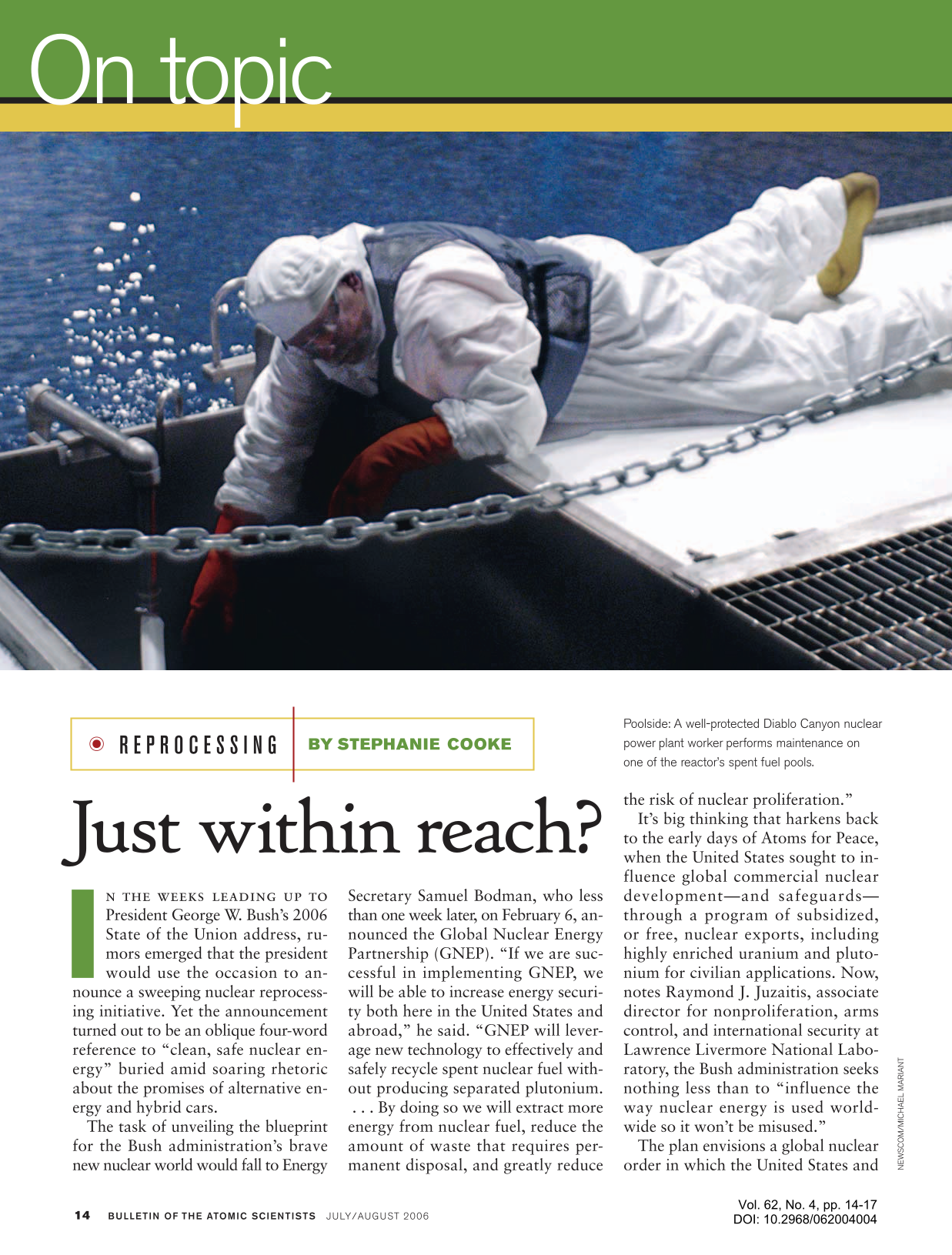
In the weeks leading up to President George W. Bush's 2006 State of the Union address, rumors emerged that the president would use the occasion to announce a sweeping nuclear reprocessing initiative. Yet the announcement turned out to be an oblique four-word reference to “clean, safe nuclear energy” buried amid soaring rhetoric about the promises of alternative energy and hybrid cars.

The task of unveiling the blueprint for the Bush administration's brave new nuclear world would fall to Energy Secretary Samuel Bodman, who less than one week later, on February 6, announced the Global Nuclear Energy Partnership (GNEP). “If we are successful in implementing GNEP, we will be able to increase energy security both here in the United States and abroad,” he said. “GNEP will leverage new technology to effectively and safely recycle spent nuclear fuel without producing separated plutonium. … By doing so we will extract more energy from nuclear fuel, reduce the amount of waste that requires permanent disposal, and greatly reduce the risk of nuclear proliferation.”
It's big thinking that harkens back to the early days of Atoms for Peace, when the United States sought to influence global commercial nuclear development–and safeguards–through a program of subsidized, or free, nuclear exports, including highly enriched uranium and plutonium for civilian applications. Now, notes Raymond J. Juzaitis, associate director for nonproliferation, arms control, and international security at Lawrence Livermore National Laboratory, the Bush administration seeks nothing less than to “influence the way nuclear energy is used worldwide so it won't be misused.”
The plan envisions a global nuclear order in which the United States and other fuel supplier nations, such as Russia, Britain, France, and Japan, operate a cradle-to-grave nuclear fuel-leasing program, similar to what the United States started in the 1950s. Supplier nations would provide fresh fuel to conventional nuclear plants in return for user nations agreeing to forego enrichment and reprocessing activities, both of which present proliferation concerns. Spent fuel from conventional reactors would be returned to the host countries for reprocessing and recovery of plutonium and other heavy radioactive metals. This reprocessed mix would ultimately be used in fuel for a fast “burner” reactor designed to generate electricity while destroying the plutonium and other long-lived radioactive elements through transmutation. Part of the program would include working with other countries to develop smaller reactors that run on the initial fuel load for a lifetime of operation.
GNEP, in short, would have something for everybody–if only the project could be brought to fruition. The program's administrators would create a vast complex of recycling facilities, fast reactors, and waste facilities to accomplish their task. That could take decades, and, critics charge, cost billions of dollars and create vast quantities of new waste.
Most nuclear power plants (including the 103 operating in the United States) utilize the “once-through” fuel cycle: uranium fuel rods undergo a controlled fission reaction to produce steam that drives turbine generators. The spent fuel rods are replaced every 18 to 24 months and put in cooling ponds, followed by temporary dry storage, where they then await shipment to an as-yet-unfinished permanent disposal facility. The United States alone produces some 2,000 tons of spent fuel annually; already, more than 55,000 tons of spent fuel from U.S. reactors sit in storage, earmarked for disposal at the proposed Yucca Mountain waste facility in Nevada.
The Energy Department requested $250 million for fiscal 2007 to advance the GNEP initiative. The bulk of the money is slated for research and development toward an engineering-scale demonstration of the Uranium Extraction Plus (UREX+) reprocessing method, and continued work on another technology known as pyroprocessing.
UREX+, which has been successfully tested on a laboratory scale at the Argonne, Oak Ridge, and Idaho national laboratories, is a variant of the more familiar reprocessing method, PUREX, developed by the United States in the 1950s and now mainly used in Europe. PUREX entails dissolving spent fuel rods in nitric acid. A chemical process separates the dissolved rods into three product streams: plutonium, uranium, and high-level waste. The waste is comprised of light radioactive elements (such as strontium 90 and cesium 135) known as fission products and heavy radioactive metals (americium, curium, and neptunium) known as transuranics. The plutonium (which is also a transuranic), in the form of plutonium oxide, is combined with uranium oxides and pressed into ceramic pellets to create mixed oxide fuel that has been used in some 30 reactors in Europe.
UREX+ has become one of the technological cornerstones of GNEP, based on claims by its advocates that it reduces rather than exacerbates waste and minimizes proliferation problems by creating a different, and theoretically more manageable, mix of waste streams. By contrast, the PUREX process was originally devised as a way to harvest plutonium for nuclear weapons. It didn't address the issue of what to do with the leftover transuranics that can remain radioactive for hundreds of thousands of years. And since PUREX separates out reactor-grade plutonium, it raises concerns about nuclear proliferation. It was for this reason that the Ford and Carter administrations terminated commercial reprocessing in the United States in 1976 and 1977 in the hopes that other nations would follow suit. (President Ronald Reagan briefly overturned the ban in 1981, although by then it was proving too expensive for any U.S.-based company in the private sector to pursue the technology.)
Using the UREX+ method, the waste aspect would be tackled by separating out the light radioactive elements (mainly cesium and strontium) and storing them above ground, or on a separate geologic shelf in an existing repository, for the several hundred years it takes them to lose their radioactivity. This would reduce the heat load in a repository, effectively expanding its storage capacity. For this reason, GNEP's sponsors say the proposed Yucca Mountain site would last well beyond the end of the century and eliminate the need for additional repositories.
Meanwhile, the transuranics (containing mainly plutonium, americium, neptunium, and curium) would be mixed with lanthanides (the so-called rare-earth metals) for their journey from the reprocessing plant to the fabrication site in a manner that proponents claim would make it resistant to would-be proliferators. After arriving at the fabrication site, the transuranics would be stripped of the lanthanides and fabricated into fuel (either in oxide or metallic form) for use in advanced burner reactors.
GNEP's critics include some individuals in the nuclear industry who worry that the administration is relying too much on unproven technology while the opening date for the Yucca Mountain waste facility slips further into the future.
The burner reactors for which this fuel is intended are a variation on breeder reactors–a type of design that utilizes fast neutrons to produce more fuel than the reactor consumes. (The reactor core is surrounded by a “blanket” of tubes containing non-fissile uranium 238, which the fast neutrons transmute into fissile plutonium 239.) Burner reactors would forego the uranium blanket, and the fast neutrons would split apart the transuranics into shorter-lived isotopes–and in doing so release energy for the production of electricity. The fuel would have to undergo several cycles of reprocessing for the transmutation process to be effective.
Besides UREX+, Energy is investigating pyroprocessing, a “dry” form of reprocessing, wherein the metal fuel is mechanically chopped, submerged into molten salt, and subjected to an electric current. This method is seen as the likely route to producing metallic fuel that would be used in burner reactors in the event that oxide fuel proves too difficult to fabricate or performs in a less than optimal manner.
Phillip Finck, associate laboratory director for applied science and technology at Argonne and deputy director of GNEP, admits there is still more work to do on both processes. But he is confident in the outcome, particularly of UREX+. “This is not breakthrough technology,” he says. “These are relatively standard, well-known technologies. That's why we think scale-up [of UREX+] should be successful.” Pyroprocessing faces more difficult problems. “Probably the biggest challenge in pyro is separating the transuranics and fission products with sufficient purity,” Finck says.
Deputy Energy Secretary Clay Sell, who was staff director for New Mexico Republican Sen. Pete Domenici's Energy and Water Development Appropriations Subcommittee and then special assistant to the president on energy, says the GNEP proposal stemmed from President Bush's conviction that nuclear power should play a “major role” in the U.S. economy and from concerns that the United States made the wrong choice when it opted for the once-through fuel cycle 30 years ago, while countries such as France, Britain, and Japan continued with reprocessing. “My view is the president had the sense that the policy course the U.S. had chosen in the 1970s was perhaps not the best,” he notes, referring to the decision to forego reprocessing. “When I was still working at the “White House, he asked, ‘Why are we not reprocessing and all these other countries are?’”
“Intellectually, [GNEP] has a certain superficial appeal,” says former Nuclear Regulatory Commissioner Victor Gilinsky. “They're saying, ‘Let's turn the million-year problem into the thousand-year problem by burning it all up, and you leave the thousand-year problem on the ground.’”
However, he points out that fuel would have to undergo multiple recyclings, perhaps seven to eight times, in order to achieve the goal of transmuting the long-lived transuranic elements. Each cycle would produce more by-products like cesium and strontium, Gilinsky says, and “at the end you still have a spent fuel rod.” Also, the anticipated growth in the number of nuclear reactors worldwide would create a need for more and more plants to process the fuel, thereby increasing waste streams.
Gilinsky, currently a consultant to Nevada in its battle over the Yucca Mountain repository, argues that the proposal flies in the face of common sense and experience–breeders in Europe and Japan have been costly and plagued with problems. “You can fission these things [transuranics], but that doesn't mean you can have a working practical system, and even if you do, it will be very costly.” For the plan to work, Gilinsky says, “You're going to have to site 20-30 reprocessing plants and 500 or more reactors. Compared to that, siting another repository is nothing.”
GNEP officials are well aware of the challenges. “Those four [transuranics] together are hot as a pistol,” acknowledges Steven J. Piet, senior nuclear systems analyst for GNEP at the Idaho National Laboratory. “The chemistry gets a little tricky.”
Indeed, the administration has said that GNEP's first two phases, involving program definition and preliminary design through fiscal 2008, will cost $1.06 billion. No definite figures have been given for the demonstration phase (scheduled for fiscal 2008-2020), but critics such as Thomas Cochran and Christopher Paine at the Natural Resources Defense Council's Nuclear Program, expect considerable long-term costs. “Implementing just the initial demonstration phase of GNEP will cost taxpayers $30 billion to $40 billion over the next 15 years without generating a single kilowatt of commercially available electric power,” they wrote in a paper, “Peddling Plutonium.” Making the program viable, if it proves possible, could take decades and cost well more than $100 billion, they contend.
That might be precisely the point of the Global Nuclear Energy Partnership-putting nuclear waste in perpetual transport, like the old folk song about Charlie riding the MTA.
Rather surprisingly, GNEP's critics also include some individuals in the nuclear industry who are worried that the administration is relying too much on unproven technology while the opening date for Yucca Mountain slips further into the future. They point to the fact that utilities have been rushing to apply for reactor extensions, fearful the Nuclear Regulatory Commission will soon be unable to meet its Waste Confidence Rule, which bars it from granting operating licenses if it decides that there is no solution to the problem of long-term waste disposal. “You know [the Energy Department] can't develop a hole in the ground in Nevada,” says one industry executive, who prefers to remain anonymous owing to business ties to Energy. “I don't know how they're going to do this.”
Filling up: Each black dot on the Diablo Canyon fuel storage board represents a vacant storage assembly in a spent fuel pool.

But that may be precisely the point–putting nuclear waste in perpetual transport, like the old folk song about Charlie riding the MTA. “Their attitude is basically that if you can't ship it someplace [for permanent burial], then just keep it in circulation,” says Princeton physicist Frank von Hippel. Gilinsky agrees: “Yucca is basically for 100 reactors. If you're going to have 1,000 reactors, you need 10 more repositories. You're never going to get them. So [GNEP proponents] see that as a bar to nuclear power.”
Critics also charge that by promoting plutonium recycling, the administration risks undermining its efforts to persuade countries such as Iran and North Korea to forego enrichment and reprocessing. They also worry the plan might create a proliferation hazard. “All reprocessing technologies are far more proliferation-prone than direct disposal and require much greater resources to be safeguarded against diversion and theft of plutonium,” argues Ed Lyman, a senior scientist at the Union of Concerned Scientists' (UCS) Global Security Program. Likewise, physicist Richard Garwin recently testified before Congress that, in his view, GNEP does not meet its goal of proliferation resistance. To obtain 10 kilograms of plutonium from ordinary spent fuel from pressurized water reactors, he explained, a terrorist would need to acquire and reprocess 1,000 kilograms of highly radioactive material. But, “Once the uranium and the fission products have been removed in any of the UREX processes, the plutonium will be contaminated only with a modest amount of transuranics, so that the terrorist would need to reprocess a mere 11 kilograms of material…. “ And using lanthanides as a contaminant, he believes, offers “relatively little protection.” While admiring GNEP's general goal, Garwin also warned that the “reprocessing and transmutation aspect of GNEP must be seen as a gamble, and an optional–not a necessary–gamble.”
If it is a gamble, then GNEP's sponsors may only have a narrow window in which to place their bets. Their chief congressional supporter, Senator Domenici, retires in 2008, and by then the United States will have a new president. “This is their moment,” says Damon Moglen, UCS outreach coordinator. “They have two years to establish a beachhead and overturn 30 years of nuclear power policy in the United States.”
Supplementary Material
R and D Priorities for GNEP
Supplementary Material
Global Nuclear Energy Partnership Strategic Plan