



Abstract

On February 10, North Korea announced for the first time that it possesses nuclear weapons. The claim grabbed headlines, but it is difficult to substantiate. In the early 1990s, the CIA concluded that North Korea had effectively joined the nuclear club by building one or possibly two weapons from plutonium it produced before 1992. Yet North Korea has never conducted a nuclear test, and although it has extracted weapon-grade plutonium, it has never conclusively demonstrated that it possesses operational nuclear warheads. (Nor has the United States been able to verify it.) It is known, however, that Pyongyang has a nuclear program. By cataloging the program's capabilities and quantity of separated plutonium, it is possible to estimate how many nuclear weapons Kim Jong Il's country might have.
North Korea's probable possession of nuclear weapons presents a serious and extremely complicated problem, with implications that could drastically affect Asian security and, by extension, U.S. interests as well. By violating the Nuclear Non-Proliferation Treaty (NPT), North Korea has weakened the treaty and sent signals that obtaining nuclear weapons has geopolitical benefits, at least when confronting the United States.
Mine's eye view: The Pyongsan uranium mill facility, pictured in this March 2003 image, produces uranium concentrate, presumably in the form of “yellowcake,” which is the feed material for fuel rods and for the uranium hexafluoride gas used in enrichment.

The threat of a U.S. nuclear attack both during and after the Korean War may have helped spur former North Korean leader Kim Il Sung to launch his own nuclear weapons program. Pyongyang started the program in the 1960s with Soviet help, and over the next two decades China provided various kinds of support. In 1986, the North began operating a newly constructed 20-megawatt thermal (MWt) reactor near the city of Yongbyon–a major milestone.
More recently, Pakistan has played a substantial role in the progress of North Korea's nuclear program. In the second half of the 1990s, Abdul Qadeer Khan, scientist and “father” of Pakistan's nuclear program, supplied uranium enrichment equipment and perhaps even warhead designs to North Korea, according to some news reports. Khan originally came to world attention for stealing centrifuge designs and equipment while working in the Netherlands in the 1970s. After returning to Pakistan, Khan used suppliers from around the world to build centrifuges capable of enriching uranium for Pakistan's bomb program. Those vendors and manufacturers became the foundation of an extensive and profitable black market run by Khan and others, which amassed hundreds of millions of dollars. U.S. intelligence agencies monitored Khan's network for years but did little to halt the traffic, so as not to compromise sources and methods or, later, jeopardize relations with Pakistan. Achieving short-term foreign policy goals took precedence over preventing widespread nuclear proliferation.
Finally, in early 2004, Pakistan's President Gen. Pervez Musharraf placed Khan under house arrest but pardoned him soon after. Neither the United States nor the International Atomic Energy Agency (IAEA) was permitted to interrogate him. On February 4, 2004, Khan admitted on national television that he was responsible for widespread nuclear proliferation. Later news reports described how Pakistani centrifuges were transferred to North Korea in exchange for ballistic missile technology. In 2003, New Yorker reporter Seymour Hersh wrote that U.S. intelligence agencies believed that Khan had made at least 13 trips to Pyongyang, the last in June 2002.
Intelligence analysts and nuclear experts widely believe that North Korea has produced and separated enough plutonium for a small number of nuclear warheads. Most or all of the plutonium came from reprocessed spent fuel from the 20 MWt reactor at Yongbyon, which went critical on August 14, 1985, and became operational the following January. The U.S. intelligence community believes that during a 70-day shutdown period in 1989, North Korea secretly removed fuel from the reactor and separated the plutonium. Estimates vary as to how much plutonium was obtained. The State Department believes about 6-8 kilograms; the CIA and Defense Intelligence Agency say 8-9 kilograms; the Institute for Science and International Security estimates as much as 14 kilograms. South Korean, Japanese, and Russian analysts estimate a much larger quantity, ranging up to 24 kilograms.
In October 2002, the United States publicly accused North Korea of operating a secret uranium enrichment program; North Korea denied it. In response to the U.S. claim, Pyongyang in December 2002 removed the IAEA safeguard seals at Yongbyon, shut down the monitoring cameras, and ordered the IAEA inspectors out of the country. On January 10, 2003, Pyongyang announced that it would withdraw from the NPT; it is the only country ever to do so. North Korea restarted its 20 MWt reactor and reprocessing plant at Yongbyon, and by June 2003 scientists had extracted plutonium from the 8,000 spent fuel rods kept at the site, according to North Korean officials. Western analysts estimate that this reprocessing would have resulted in 25-30 kilograms of plutonium.
Little is known about North Korea's alleged uranium enrichment program–where it might be located, its state of development, or how many centrifuges might be operational. The United States has not provided any public information that substantiates its existence. Following the U.S. manipulation and distortion of intelligence about Iraq's weapons of mass destruction, some countries and analysts are now skeptical of any U.S. allegations regarding other nations' nuclear programs. A March 20 Washington Post report that the White House misrepresented intelligence on the supposed transfer of nuclear material from North Korea to Libya may have further undermined the Bush administration's credibility, even though the White House denied the report.
Approximate fissile material requirements for pure fission nuclear weapons

No one knows the skill level of North Korean bomb designers. In the 60 years since the Manhattan Project, a large amount of information on nuclear weapons design has become available, and a medium capability certainly seems possible. This would mean that building a bomb with a 1-5 kiloton yield would require about 2 kilograms of plutonium. Weapons with a 10-20 kiloton yield would require approximately 3 kilograms. For several weapons, 8-9 kilograms of plutonium could be enough. During the 1994 North Korean crisis, then-Defense Secretary William Perry said, “If they had a very advanced technology, they could make five bombs out of the amount of plutonium we estimate they have.” With 25-30 kilograms of additional plutonium from the 8,000 fuel rods, North Korea could build approximately 6-8 more warheads. A reasonable estimate of the number of assembled North Korean nuclear weapons is up to 10.
The potential capacity of North Korea's nuclear program is unsettling. The CIA estimates that the 200 MWt reactor at Yongbyon and the 700-800 MWt reactor at Taechon would generate about 275 kilograms of plutonium per year if completed and operated at full capacity. Even if North Korea resumed work at these unfinished reactors it would take several years to complete construction and more time to operate them and reprocess the fuel.
North Korea could make more bombs if it produced highly enriched uranium and manufactured it into weapon cores. If it used a composite-core design, which features a smaller plutonium sphere encased in a shell of highly enriched uranium, the North could make even more bombs than if it used plutonium or uranium in separate weapons. (The United States successfully tested the composite-core design in Operation Sandstone during the spring of 1948.)
North Korean ballistic missiles
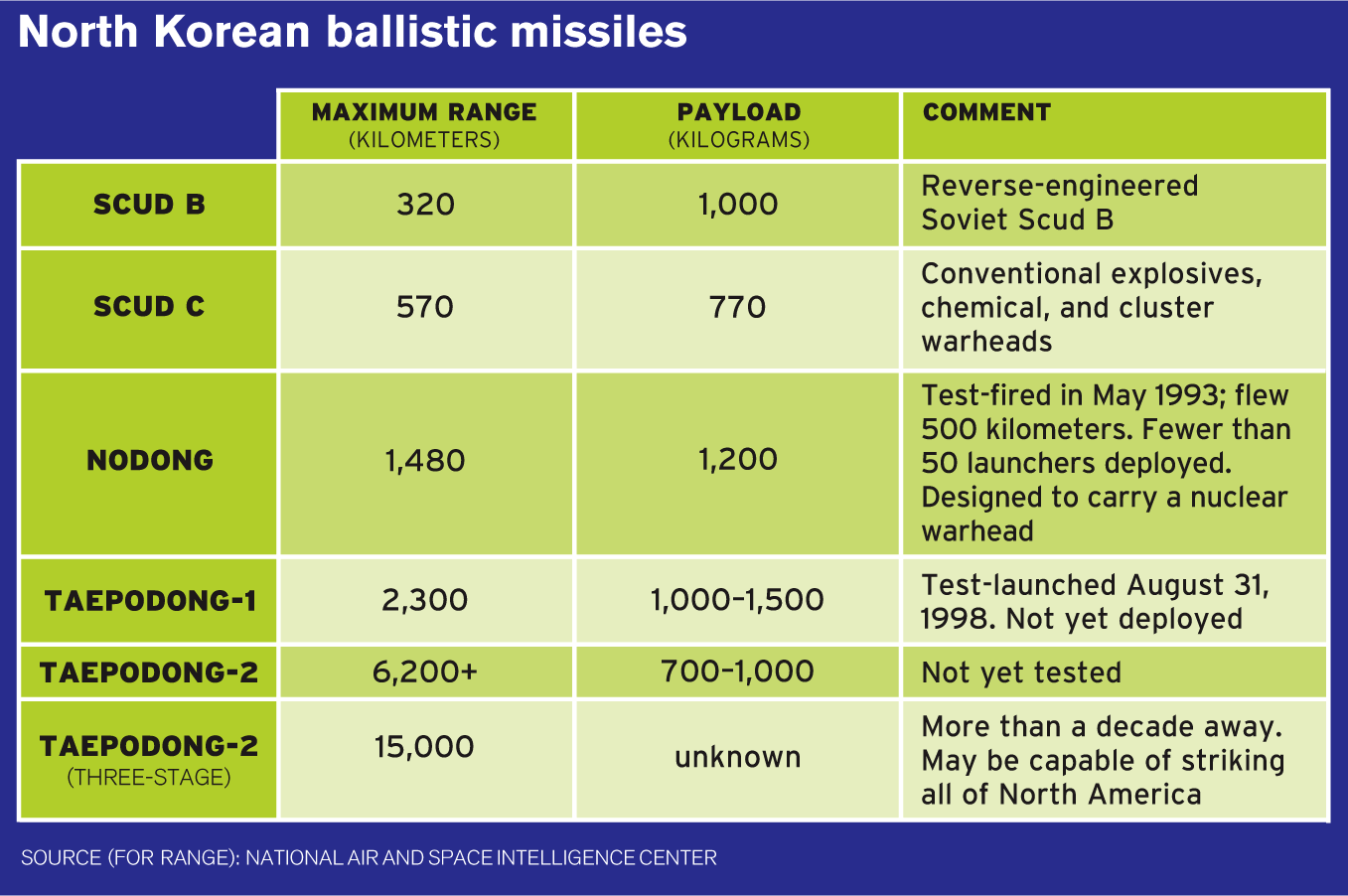
SOURCE (FOR RANGE): NATIONAL AIR AND SPACE INTELLIGENCECENTER
In 1979 and 1980, Egypt supplied Pyongyang with a small number of Soviet Scud B missiles, launchers, and support equipment. North Korea reverse-engineered the Scuds and built the industrial infrastructure to produce its own missiles. In 1987 and 1988 it was producing Scuds at a rate of eight to ten per month. It sold approximately 100 to Iran, many of which were fired at Iraqi cities during the Iran-Iraq War. North Korea first test-launched an extended-range version of the missile, known as the Scud C, in June 1990 and achieved a 500-kilometer range by reducing the payload from 1,000 to 770 kilograms. The North had produced a total of 600-1,000 Scud B and Scud Cs by the end of 1999, according to some estimates. It sold half of them to foreign countries.
Driven by a desire for longer missile ranges, North Korea developed what is known in the West as the Nodong (also Rodong), which has a maximum range of 1,480 kilometers (depending upon payload) and is capable of hitting Japan and U.S. bases in Okinawa. Pyongyang deployed 100 Nodongs in the mid-1990s and sold another 50 or so to foreign countries. The missile is known as the Ghauri-I in Pakistan and the Shahab-3 in Iran.
The North is working to build a missile with an intercontinental range. The two-stage Taepodong-1 is intended to carry a 1,000-1,500 kilogram warhead up to 2,300 kilometers. Pyongyang launched a three-stage space-launch version of the missile, intended to place a North Korean satellite in orbit, on August 31, 1998, from the facility at Musudanri. The missile flew over Japan, causing much consternation. Its first and second stages separated and landed in the water, but the third stage broke up after traveling more than 5,500 kilometers, and the satellite did not reach orbit.
Depending on the payload, the as-yet-untested Taepodong-2 may have a range greater than 6,200 kilometers, sufficient to strike parts of Hawaii and Alaska in its two-stage variant, and all of North America in a three-stage variant.
It is reasonable to assume that North Korea wants to put nuclear warheads on its ballistic missiles, but whether it has achieved this capability is unknown. Most other countries that have developed nuclear weapons chose airplanes as their initial delivery method, followed in most instances by the development of ballistic missiles of various ranges.
Although there is no evidence that North Korea has modified aircraft for nuclear delivery, such a capability would be easier to develop and more difficult to detect than ballistic missiles. North Korea maintains underground aircraft hangars within a 10-20 minute striking distance of Seoul and has bombers and fighter aircraft that had nuclear strike roles in the Soviet Air Force.
President George W. Bush's first-term policies failed to move North Korea toward the goal of disarmament and instead proved to be counterproductive. Admonitions that North Korea is an “outpost of tyranny” and part of the “axis of evil” have tended to increase the North's already substantial fear and paranoia of the United States. The hardliners around Bush believe that isolation, pressure, and sanctions will cause North Korea to collapse and that it should not be rewarded for any positive steps it might take. The six-party talks, held in August 2003, February 2004, and June 2004, have yielded little, though the U.S. proposed a step-by-step process for further talks. Convening a fourth round remains difficult because of North Korean demands. The United States and the other parties involved in the negotiations disagree on how to deal with the North. Perhaps the sharpest differences are with South Korea. In a speech that must have shocked the Bush administration, President Roh Moo-hyun said that, “North Korea professes that nuclear capabilities are a deterrent for defending itself from external aggression.” While in many cases its claims and allegations are hard to believe, Roh said that, “In this particular case it is true and undeniable that there is a considerable element of rationality in North Korea's claim.”
A nuclear-armed North Korea could trigger an arms race in East Asia and beyond. This prospect has already prompted the United States to expand its nuclear targeting doctrine, enlarge missile defense programs, and plan the development of new nuclear weapons, such as the Robust Nuclear Earth Penetrator. A nuclear North could further harden the U.S. posture toward the country and reinvigorate extended nuclear deterrence strategies in the region. Worse, Japan might decide to build its own nuclear weapons program, which would surely provoke a Chinese response and in turn cause reverberations in India and Pakistan. There could also be repercussions in Taiwan and South Korea, both of which built fledgling nuclear weapons programs before U.S. pressure shut them down. Recent public disclosures of secret South Korean nuclear research do little to increase trust and allay fears.
Perhaps the greatest danger of all would be North Korea selling its plutonium, highly enriched uranium, or finished weapons to other countries or terrorists. Its track record with ballistic missiles is not encouraging. It has sold missiles to Iran, Yemen, Syria, and Pakistan–lucrative sources of income to the impoverished country. Fissile material and nuclear weapons would be even more lucrative and would have a far larger impact on regional and international security.