



Abstract

North Korea has apparently become the worlds ninth nuclear power. Last November, the CIA estimated that Pyongyang has one, perhaps two, nuclear weapons. The North Korean crisis, as it has emerged over the past several months, is an extremely complex affair with implications that could drastically affect Asian security and, by extension, U.S. interests. The confrontation has weakened the Nuclear Non-Proliferation Treaty (NPT) and may send signals to others that obtaining nuclear weapons has geopolitical benefits, especially when facing the United States.
The safeguard seals that were removed from the Yongbyon nuclear facilities in North Korea and returned to the International Atomic Energy Agency in Vienna.

By the mid-1980s, only the 8-inch and 155-millimeter artillery shells, ADMs, and gravity bombs remained, and the number of warheads had dropped to about 150. With little fanfare and no formal public announcement, in the fall of 1991 President George H. W. Bush ordered the removal of all the remaining weapons, which was accomplished in 1992.
The fact that North Korea (the Democratic Peoples Republic of Korea, or DPRK) was threatened with nuclear weapons during the Korean War, and that for decades afterwards U.S. weapons were deployed in the South, may have helped motivate former president Kim Il Sung to launch a nuclear weapons program of his own. With Soviet help, the program began in the 1960s. China also provided various kinds of support over the next two decades, and by the late 1980s success was near. A milestone was reached with the construction of a 5-megawatt electric (MWe) reactor that began operating in 1986. More recently, Pakistan has played a substantial role in the progress of North Koreas nuclear program.
For North Korea, another important aspect of the accord was the U.S. pledge to provide formal assurances to the DPRK against the threat or use of nuclear weapons by the United States, a commitment that it says the United States has not lived up to. While North Korea has failed to fulfill all its obligations, Washington has continued to hold a nuclear sword over it. In March 1997, the chief of U.S. Strategic Command told Congress that just as the United States threatened Iraq with nuclear weapons in 1991, that same message was passed on to the North Koreans back in 1995. And documents obtained under the Freedom of Information Act show that the air force carried out simulated nuclear strikes against North Korea in 1998 (see Preemptive Posturing, September/October 2002 Bulletin, pp. 5459).
The latest crisis erupted in early October 2002, when North Korean officials did not deny charges made by James A. Kelly, the U.S. Assistant Secretary of State for East Asian and Pacific Affairs, that Pyongyang had a secret uranium enrichment program. According to a June 2002 CIA report, described by Seymour Hersh in the January 27 New Yorker, in 1997 Pakistan gave North Korea highspeed centrifuges and how-to data on building and testing a uranium-triggered nuclear weapon. (Pakistans nuclear weapons are based on a Chinese implosion design that uses a core of highly enriched uranium.) In return, North Korea gave Pakistan missile technology and parts.
After the United States went public with the North Korean program on October 16, Pyongyang announced its intention to further break its commitment to the Agreed Framework and restart its 5-MWe reactor and reprocessing plant and resume construction of two larger reactors. In December, it removed the IAEA safeguard seals at the nuclear research center in Yongbyon, shut down the monitoring cameras, and ordered the IAEA inspectors out of the country.
On January 10, this fast-moving train of events culminated in Pyongyangs announcement that North Korea would withdraw from the NPT–the only country ever to do so. According to the New York Times (January 31), U.S. satellites detected activity in North Korea throughout January that appeared to indicate it was removing its spent nuclear fuel rods from storage.
North Korea is widely believed to have produced and separated enough plutonium for a small number of nuclear warheads. Most or all of the plutonium came from the 5-MWe reactor at Yongbyon, which went critical on August 14, 1985, and became operational the following January. The U.S. intelligence community believes that during a 70-day shutdown in 1989, North Korea secretly removed fuel from the reactor and separated the plutonium. Estimates vary as to how much plutonium was obtained. The State Department believes about 68 kilograms; the CIA and Defense Intelligence Agency say 89 kilograms, an estimate consistent with the careful analysis of the Institute for Science and International Security. South Korean, Japanese, and Russian analysts have made much higher estimates, ranging up to 24 kilograms.
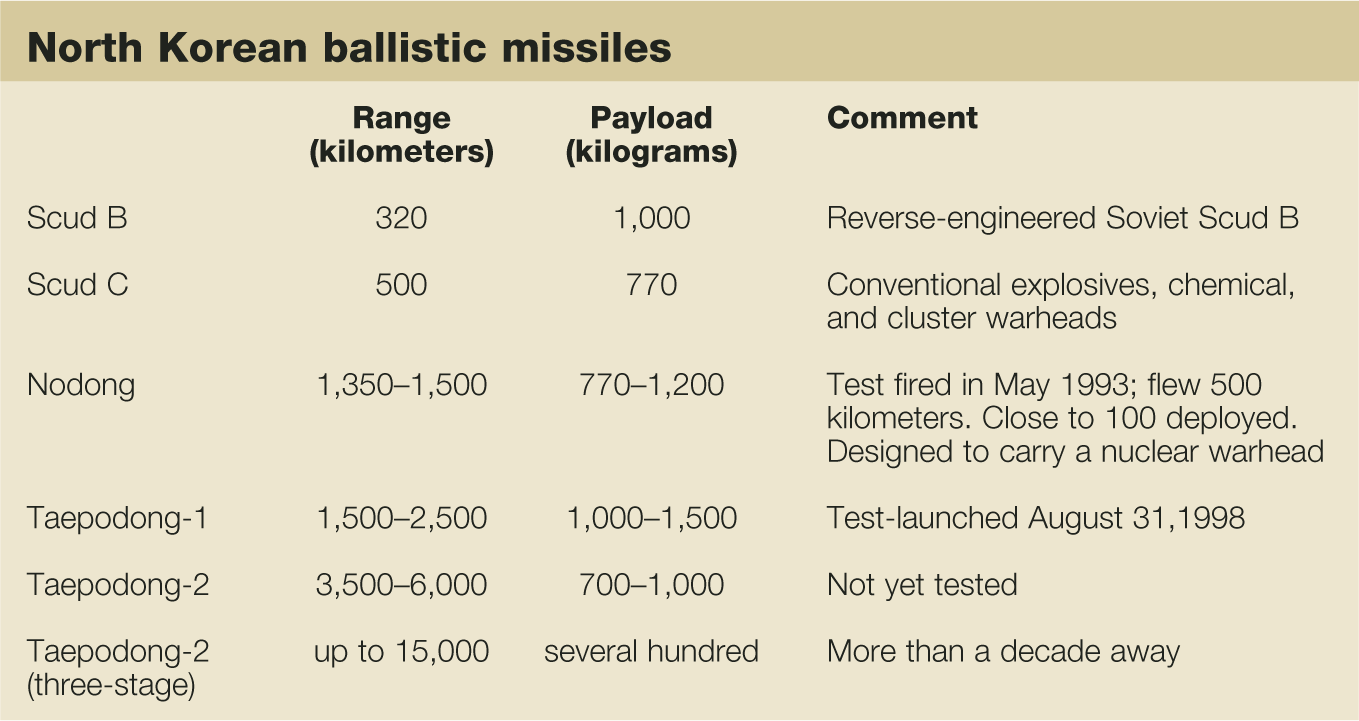
North Korean ballistic missiles
North Korea has never admitted it possesses nuclear weapons, but it appears likely that it does. Nucleonics and NBC Nightly News reported in 1993 that reprocessed plutonium had already been converted from a liquid form to metal, and several U.S. officials concluded that Pyongyang had made it into a bomb. In November 2002, the CIA went further than its previous estimates, stating, The United States has been concerned about North Koreas desire for nuclear weapons and has assessed since the early 1990s that the North has one or possibly two weapons using plutonium it produced prior to 1992.
Very little is known about North Koreas uranium enrichment program. Questions about it include: How many centrifuges (used to enrich uranium) does North Korea have, and where are they located? Has it begun enriching uranium? If so, what level is the uranium enriched to, how much has been enriched, and how much will be? Hersh reported that the CIA concluded that the North began to enrich uranium in significant quantities in 2001. Analysts at the Nonproliferation Policy Education Center estimate its future production rate could be anywhere from 40100 kilograms a year.
No one knows for sure what the skill level of North Korean bomb designers is, but a medium capability seems possible. For weapons production, this might mean that for a lower-yield weapon (15 kilotons) they would need around 2 kilograms of plutonium, and for a higher-yield weapon (1020 kilotons) approximately 3 kilograms. Assuming that North Korea has a medium capability, 89 kilograms of plutonium might be enough for four or five weapons. During the crisis in 1994, thenDefense Secretary William Perry said, If they had a very advanced technology, they could make five bombs out of the amount of plutonium we estimate they have.
The potential size of North Koreas future arsenal is unsettling. The CIA estimates that the 50-MWe reactor at Yongbyon and the 200-MWe reactor at Taechon would generate about 275 kilograms of plutonium per year (operating at full capacity), but it would take several years to complete the reactors. Forty kilograms of highly enriched uranium would be enough to produce six to 10 low-yield nuclear weapons or four or five higher-yield weapons per year.
North Korea could make more bombs if it uses a composite-core design (a smaller plutonium sphere encased in a shell of highly enriched uranium) than if it builds designs that use only plutonium or only uranium. A few days after the Trinity test of July 16, 1945, the United States considered using some or all of the highly enriched uranium intended for Little Boy in order to increase the number of available bombs, but rejected the idea. The U.S. successfully tested the design in Operation Sandstone during the spring of 1948.
Approximate fissile material requirements for pure fission nuclear weapons

In 1979 or 1980, Egypt supplied Pyongyang with a small number of Soviet Scud B missiles, along with launchers and support equipment. North Korea reverse-engineered the Scud and built an industrial infrastructure to produce its own missiles, eventually at a rate of eight to 10 per month in 1987 and 1988. It sold approximately 100 to Iran, many of which were fired at Iraqi cities during the IranIraq War. An extended-range version of the missile, known as the Scud C, was first test-launched in June 1990. Its 500-kilometer range was achieved mainly by reducing the payload from 1,000 to 770 kilograms. It is estimated that a total of 6001,000 Scud B and Cs were produced by the end of 1999. Half of them were sold to foreign countries.
Driven by a desire for longer missile ranges, North Korea developed what is known in the West as the Nodong (or Rodong), which has a range of 1,3501,500 kilometers (depending upon payload) and is capable of hitting Japan and U.S. bases in Okinawa. Nodongs were deployed in the mid-1990s, with nearly 100 fielded and another 50 or so sold to foreign countries. The missile is known as the Ghauri I in Pakistan and the Shahab 3 in Iran. North Korea wants a missile with an intercontinental range, and work is under way to achieve it. The two-stage Taepodong-1 is intended to carry a 1,0001,500 kilogram warhead to a range of 1,5002,500 kilometers. A three-stage space-launch version, intended to place a DPRK satellite in orbit, was launched on August 31, 1998, from the facility at Musudan-ri. The missile flew over Japan, causing much consternation. Its first and second stages separated and landed in the water, but the third stage, after traveling more than 5,500 kilometers (3,450 miles), broke up and the satellite did not reach orbit.
The longer-range Taepodong-2 may be ready for flight-testing. Depending on the payload, it may have a range greater than 6,000 kilometers, sufficient to strike parts of Hawaii and Alaska.
It is reasonable to assume that North Korea wants to put nuclear warheads on its ballistic missiles, but whether it has achieved this capability is unknown. Other countries that have developed nuclear weapons usually chose airplanes as their initial delivery method, followed in most instances by the development of ballistic missiles of various ranges. North Korea is an exception to this pattern–ballistic missiles are its preferred delivery method, and aircraft do not appear to have a role.
The Bush administrations hope that North Korea will give up its nuclear program seems fanciful at this point. What incentives could possibly be offered that would cause it to give up its weapons program, dismantle its nuclear complex, and agree to an intrusive verification regime? It is highly unlikely that North Korea will agree to abandon the very thing that gives it leverage with its neighbors and the United States.
A nuclear-armed North Korea could trigger an arms race in East Asia and beyond. It could harden the U.S. posture toward North Korea and reinvigorate the extended nuclear deterrence strategies in the region. Worse, Japan might decide to undertake a nuclear weapons program of its own, which would surely provoke a Chinese response, which in turn could cause reverberations in India and Pakistan. There could also be repercussions in Taiwan and South Korea, both of which had fledgling nuclear weapons programs of their own before U.S. pressure forced their termination.
Perhaps the larger danger: North Korea could sell its plutonium, highly enriched uranium, or finished weapons to other countries or terrorists. Its track record with ballistic missiles is not encouraging. It has made missile deals with Iran, Yemen, Syria, and Pakistan–lucrative sources of income to the impoverished country. Fissile material and nuclear weapons would be even more lucrative.