



Abstract
An alternate plan could eliminate Russian weapons material sooner rather than later.
The events of September 11 destroyed any notion of U.S. invulnerability to terrorists bent on mass destruction. Yet as terrible as the attacks were, detonating even the smallest nuclear weapon in a populated area would be many times more destructive.
The easiest way for terrorists to acquire nuclear material is to buy or steal it, and perhaps the easiest targets are sites in Russia and other former Soviet republics, where economic and political turmoil has created a formidable challenge to control of nuclear materials.
Over the past decade, thieves have tried dozens of times to steal uranium or plutonium from sites in the former Soviet Union. In several cases, a kilogram or more of weapons-usable material has been stolen.
In January 2001, a bipartisan task force chaired by former Senate majority leader Howard Baker and former White House counsel Lloyd Cutler concluded: “The most urgent unmet national security threat to the United States today is the danger that weapons of mass destruction or weapons usable material in Russia could be stolen, sold to terrorists or hostile nation states, and used against American troops abroad or citizens at home.” 1

There have been no confirmed reports of successful thefts of a complete nuclear weapon or of sufficient nuclear material to make one. But given the inadequate Soviet-era recordkeeping of fissile material stocks, there is no way to know for sure that significant diversions have not taken place. If they haven't, it may only be a matter of time before they do.
U.S. efforts to reduce and eliminate stockpiles of highly enriched uranium (HEU) in Russia and the former Soviet republics must be expanded with some urgency.
Terrorists are more likely to target fissile material than complete nuclear weapons because it is less carefully guarded. (All Soviet nuclear weapons are now stored in Russia, guarded by highly trained professional security forces.) Highly enriched uranium is of particular concern because it can be used in rudimentary nuclear weapon designs, like gun-barrel-type weapons, for which plutonium cannot be used.
It is also less radioactive and less hazardous than plutonium, which would make it easier for terrorists to transport, store, and fabricate into a weapon. There is also six times more HEU than plutonium in Russia, and it can be found at many more sites.
Reducing Russian HEU stockpiles
In 1993, the United States agreed to purchase uranium enriched to 4-5 percent uranium 235 derived from 500 metric tons of HEU from dismantled Russian nuclear weapons. This agreement, commonly referred to as “the HEU deal,” has been one of the most successful of all U.S. Russian nonproliferation programs.
June 1995: The first shipment of Russian weapons-origin uranium converted to reactor fuel arrives in the United States.

So far, more than 140 metric tons of Russian weapons-origin HEU has been blended down. But the agreement limits the rate at which reactor fuel can be sold without disrupting the international nuclear fuel market.
Under the current schedule, the full 500 metric tons of HEU will not be eliminated until 2013. Furthermore, when all Russian nuclear weapons scheduled for retirement are eliminated, hundreds of tons of additional excess weapons-origin HEU will still be in storage. In addition, there is substantial non-weapons HEU not covered under the deal that is kept at research institutes, nuclear fuel-processing facilities, and other locations that typically have less security than storage sites for nuclear weapons or weapons-origin material.
The Bush administration should take three steps to expand the HEU deal and to enhance other programs that address civilian HEU in Russia and the other former Soviet republics. It should facilitate the accelerated downblending of all excess Russian weapons-origin HEU; encourage the removal of HEU stockpiles from smaller, less secure facilities; and offer incentives for the replacement of all HEU fuel used in Soviet-built research reactors with low-enriched fuel. (This last proposal is discussed in detail by Oleg Bukharin in “Making Fuel Less Tempting,” page 44.)
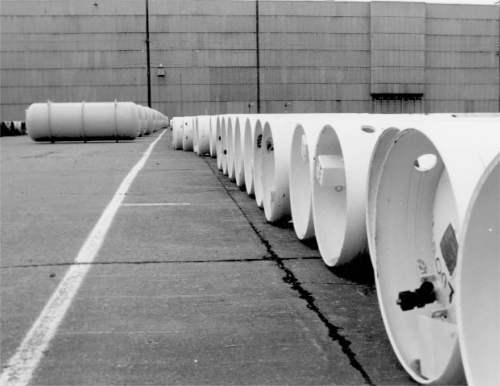
The research reactor at the Institute of Nuclear Physics in Kiev, Ukraine, would be a less likely target if it were converted to lower enriched uranium fuel.
Downblending weapons
The stockpile of Russian uranium not covered by the HEU deal is sufficient for more than 20,000 nuclear weapons, well beyond the 1,500 to 2,000 nuclear weapons that Russia plans to retain. 2
One way to speed elimination of this material would be to increase the pace of the existing HEU deal, but any significant increase under the current arrangements would overwhelm the commercial nuclear fuel markets upon which the deal depends. Attempting to expand the existing deal could, therefore, lead to its collapse rather than its expansion.
The solution is to modify the agreement to increase the pace of down-blending, but at the same time maintain the existing level of sales. For this to work, commercial interests must
be assured that Russia will not prematurely bring the additional down-blended material into the market. In addition, the cost of the accelerated blending operation would need to be kept low because it would not be recovered through sales for an extended period. Both of these problems could be solved if the extra HEU were blended to only 19.9 percent uranium 235 and kept in Russia, under Russian ownership.
Blending down to 19.9 percent uranium 235 provides nearly the same level of security as lower levels of enrichment because enriching it back to HEU is well beyond the capabilities of terrorists—and most governments. Even expert designers would need several hundred kilograms of 19.9 percent material to make a nuclear weapon, and considerably more material would be needed for the simple gun-barrel design that terrorists might more readily build.
The Bush administration should seek to expand the existing HEU deal with Russia and to accelerate the pace by offering the following incentives:
• The United States would pay costs, plus a modest incentive payment, to downblend an additional 30 metric tons per year to 19.9 percent uranium 235, blending it with natural uranium;
• The resulting material would remain in Russia, without further blending, until at least 500 metric tons were downblended under the terms of the existing agreement; and
• The United States would agree to buy, and Russia would agree to sell, fuel-grade material from an additional quantity beyond the 500 metric tons of HEU covered under the existing agreement.
This last element is needed both to lock in blending beyond the existing deal and to assure Russia that it will be able to get the full commercial value for the additional material after all the material from the original deal has been sold.
These steps would double the current rate at which weapon HEU was eliminated at a cost of about $40 million to $60 million per year. This includes the costs of collecting and processing the HEU, transporting it, acquiring natural uranium, down-blending, storage, and incentive payments.
The U.S. government should pay to speed up the process only if Russia agrees to downblend more than the 500 metric tons of the existing deal. The financial incentives and other benefits of the proposal could entice Russia to expand the down-blending of HEU by 200-300 metric tons. This would be a significant achievement, and even greater reductions might be possible. However, larger reductions in Russia's HEU holdings would eventually impinge on the size of its nuclear weapons stockpile or on the reserves of uranium Russia may want to hold for potential use in nuclear weapons. As the reductions approached the limit of excess Russian HEU, the Russian government would be unlikely to continue to down-blend its holdings without a reciprocal arrangement from the United States. The United States would eventually need to address the issue of reciprocity if it wanted to obtain the security and arms control benefits of deeper reductions in HEU stockpiles in Russia.
Secure civilian HEU
Under the existing agreement, Russia must derive the material it sells to the United States from nuclear weapons.
There is no question that blending and selling this material improves its security and provides a long-term benefit for arms control. Nevertheless, it is the HEU held at small research facilities, with fewer resources for security, that poses a greater immediate risk of diversion and should
have even higher priority for elimination than the weapons-origin uranium. According to the Energy Department's 2003 congressional budget request, “civilian sites contain approximately 35 metric tons of the most vulnerable proliferation-concern material. These facilities are located in densely populated areas throughout the Russian Federation and the Newly Independent States and are considered to be the most likely target for proliferants seeking weapon-usable material through either abrupt theft or protracted diversion.”
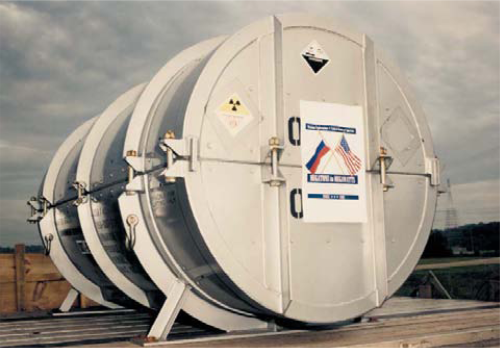
A single container from the first shipment. More than 140 metric tons of Russian weapons uranium has now been downblended under the current U.S.-Russian uranium deal.

Most of that 35 metric tons is in a handful of large research institutes or processing facilities, but many other sites have relatively small quantities that are still significant from a security standpoint. A recent report on nuclear facilities in the former Soviet
Union listed 20 civilian facilities as having more than a few kilograms of HEU, but less than a metric ton. 3 Ten of the facilities are in Russia; the other 10 are in Belarus, Kazakhstan, Latvia, Ukraine, and Uzbekistan. These 20 facilities have less than 3 metric tons of HEU combined—but that amount would be sufficient for many dozens of nuclear weapons. Removing all the HEU from these facilities would significantly improve security at a relatively modest cost.
In 1999, the Energy Department and the Russian Ministry for Atomic Energy (Minatom) established the Materials Consolidation and Conversion (MCC) Project to reduce the complexity and the costs of securing Russian HEU. The project's approach is to move HEU from civilian facilities to two large Minatom facilities with downblending capabilities, blend the HEU down to 19.9 percent uranium 235, and store it at those facilities. Energy pays the blending facilities a fee for each kilogram of 19.9 percent material they produce.
The problem with this approach is that it does not target the most vulnerable facilities first. Removing HEU from the smallest facilities would provide the largest improvement in security per ton of down-blended HEU. But the Energy Department has little say in determining where the HEU to be downblended comes from—that has been left to the discretion of the Russian blending facilities. In some cases, Energy has not even known the origin of the HEU—the project could be paying to draw down stockpiles of HEU from large storage facilities, where the reductions give only a marginal improvement in security.
Many of the facilities of greatest concern are reluctant to give up their HEU. These facilities will need specifically tailored incentives, including non-monetary incentives such as assistance with converting to low-enriched uranium.
The Energy Department should be more active in prioritizing the sites for HEU removal. Energy should put together specific incentive and assistance packages for individual institutes in Russia and other former Soviet republics to secure their HEU stockpiles, and should offer larger payments and additional bonuses to sites that completely eliminate their HEU stockpiles.
With this in mind, the Energy Department should:
• Prepare a comprehensive list of facilities in the former Soviet republics that may be candidates for HEU reductions or removal;
• Assign a project manager for each facility;
• Target facilities that are the highest priority to the United States for HEU reduction and elimination;
• Designate a senior official to negotiate tailored packages of incentives, on a site-by-site basis; and
• Provide an appropriate incentive for Russia to take back spent fuel from research reactors outside of Russia.
Most of the recommendations are policy changes that would cost little to implement. Annual funding for Energy's MCC Project should be increased to at least $54 million—
twice the administration's 2003 request but still a relatively low cost. The additional funds would be sufficient to remove all HEU from high-priority facilities within three years.
Replace HEU reactor fuel
Russia has approximately 60 operational civilian research and test reactors and critical assemblies that use HEU fuel.
Three operational research reactors are located in former Soviet republics, and several others are in operation throughout Eastern Europe. Unused or slightly irradiated fuel at these facilities is an attractive target to terrorists or nations seeking to obtain HEU for nuclear weapons.
Spent HEU fuel, though more difficult to handle and therefore less attractive, can still be used to make a nuclear weapon. If these facilities were to convert their reactors from HEU to lower-enriched fuel, they would no longer be targets for proliferants. An increase over current funding levels of less than $20 million per year could be sufficient to fund the conversion of virtually all Soviet-built, HEU-fueled reactors and the return of all HEU fuels to Russia by 2010.
U.S. should act
The danger that HEU in Russia or other former Soviet republics could be stolen, sold to terrorists or hostile nations, and used against Americans or our allies remains a grave threat to U.S. national security.
The Bush administration should implement the proposed measures to reduce and secure HEU stockpiles in the former Soviet Union as soon as possible. Doing so would be a quick and inexpensive way to significantly lower the risk of nuclear terrorism. •
Footnotes
1.
2.
This assumes Russia has 500 metric tons of weapons-grade-equivalent HEU beyond the material covered in the existing HEU deal and assumes a nominal requirement of 25 kilograms of weapons-grade HEU per nuclear weapon. Naval and other reactor fuels in Russia and other former Soviet republics contain another 100-200 tons of weapons-usable HEU. See The Challenges of Fissile Material Control, David Albright and Kevin O'Neill, eds. (Washington, D.C.: Institute for Science and International Security, 1999).
3.
Jon Wolfsthal, Christina-Astrid Chuen, and Emily Daughtry, eds., Nuclear
Status Report: Nuclear Weapons, Fissile Material, and Export Controls in the
Former Soviet Union, Monterey Institute of International Studies,
Monterey, California, and Carnegie Endowment for International Peace,
Washington, D.C., June 2001 ( ).
).