




Abstract
Millions try each year to slip into the United States through its “soft underbelly”—the U.S. Mexico border. The solution: Move the border south.
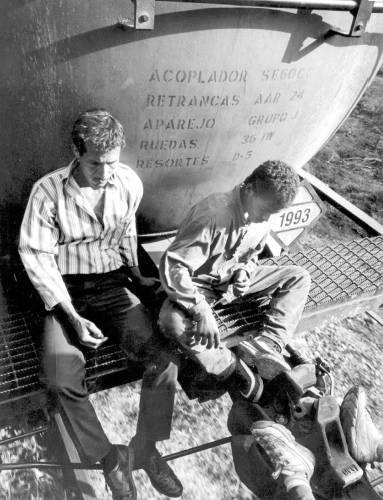
To avoid roadblocks, many migrants hitch rides on trains that connect southern Mexico with northern border towns. They must stay awake for days to keep from falling off and being crushed.
In the early morning of December 3, 2001, Kanu Okany Patel, a 35-year-old undocumented migrant from Gujarat, India, furtively made his way to the bathroom of a government-run detention center in Guatemala City, tied one end of a sturdy cord he'd secretly stripped from a window curtain around his neck, the other around a shower head, and hanged himself.
Patel died without ever knowing why he was in Guatemala. Several months earlier, he and dozens of other undocumented migrants from India were arrested in Mexico, accused of trying to enter the United States illegally. The migrants claimed that the Mexican police destroyed their personal documents and stole their money before turning them over to Mexico's migration service, the Instituto Nacional de Migración (INM), which placed them in a detention facility in Mexico City.
There they sat for nearly five months as Mexican, Indian, U.S., and Guatemalan authorities decided their fate. The Americans didn't want them, the Mexicans didn't know what to do with them, and the Indians refused to accept that they were from India (the languages they speak—Gujarati, Hindi, and Punjabi—are all native to India). At some point, all sides agreed—or at least quietly acquiesced—to allow them to be turned over to the Guatemalans who, for reasons unknown, were willing to accept them. Late last August, Mexico bused the Indians just across its southern border and handed them over to the Guatemalan national police. The migrants were then shipped to a detention facility in Guatemala City.
“We are not understanding this,” one of the migrants told journalists a few days after Patel's death. “The U.S. tells Mexico, ‘Deport these people,’ and Guatemala accepts us? Our fortune is not too good.”
During the weeks leading up to his suicide, Patel's fellow detainees had tried to keep close watch over him as he spiraled deeper and deeper into depression. He had lost the thousands of dollars he paid smugglers to spirit him to America, he was denied medical care for increasingly intense cardiac pains, and he was locked up for months in a squalid detention center 1,500 miles from his hoped-for destination in Arizona—and thousands of miles more from his wife and three children in India. He decided to end the nightmare.
Patel's companions remained in detention in Guatemala until late December, when a judge ordered them released, ruling that they had been illegally detained. Although many of the migrants were later rearrested in Guatemala or Mexico, nearly all of them eventually succeeded in making it to the United States.
Chain reaction
Patel's suicide, and the plight of the other Indian migrants, received little attention in the United States. The only major newspaper to take notice was the Miami Herald, which ran a piece three weeks after his death under the headline, “Illegal Migrants Languish in Guatemala.” (Guatemalan newspapers, on the other hand, ran dozens of stories about the saga of “los hindúes”—an inaccurate name, as many of the migrants were Sikhs.)
The Herald described how several dozen migrants were “crammed into a dark, two-bedroom shelter outfitted with bunk beds, locks, metal bars, and armed guards.” Although the cost of feeding and housing the Indians was high, reported the news paper, Guatemala didn't mind because the United States was picking up all the expenses. For the United States it was a bargain: Officials told the Herald that the U.S. embassy was paying $8.50 per day per migrant, a far cry from the $60 to $250 the Immigration and Naturalization Service (INS) pays U.S. jails that hold detainees. “One killed himself the other day,” the Herald noted in passing.
Despite scant press attention—and despite the fact that Patel never stepped foot on U.S. soil—his story highlights a growing American problem: What can and should be done about the millions of impoverished and desperate people who each year try to slip into the United States through its “soft underbelly”—the U.S. Mexico border?
It's no longer just Mexicans and Central Americans who attempt to cross from Mexico. Increasingly, undocumented migrants from places like China, Iraq, Yemen, India, Pakistan, Ecuador, and Colombia see a Mexican crossing as their best route to the American dream. Sometimes, as in the case of Patel and his compatriots, when these “extraregional” migrants are apprehended, they are rejected by every country involved; they become, in effect, stateless.
For years, the U.S. press has focused attention on the successes, failures, and excesses of various border policing strategies devised by the INS and the Border Patrol. But the case of “los hindúes” illustrates a little known aspect of migration-blocking efforts—the growing U.S. role in stopping migrants long before they set eyes on the border.
Since the mid-1990s, the United States has been putting increasing pressure on its southern neighbors to stem migration flows by securing their borders, developing regional migration strategies, tightening visa restrictions, and participating in multilateral operations ostensibly aimed at breaking up the lucrative trade in people smuggling. According to migrant-rights advocates, however, this southward advance of U.S. policies has resulted in an increase in human rights violations, the criminalization of migrants, and the growing militarization of borders especially Mexico's southern border. Advocates add that, far from breaking up smuggling rings, the latest strategies have spurred a boom in the people-trafficking business. Stricter visa regulations and tighter border crossings, they say, simply drive migrants into the hands of traffickers.
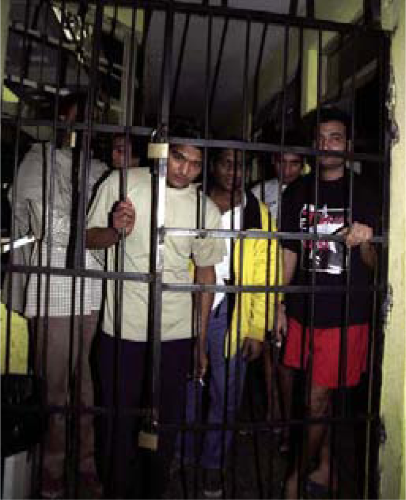
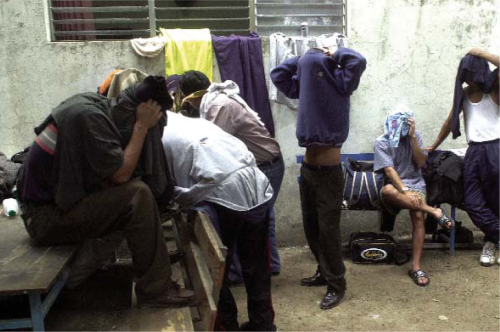
December 15, 2001: Indian migrants at “Hotel Brasilia,” a U.S.-funded detention center in Guatemala City.
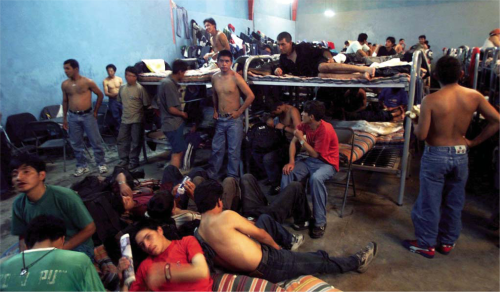
March 28, 2001: Undocumented Ecuadorean migrants await deportation at a detention center in Guatemala City. Their boat had been intercepted in international waters by the U.S. Coast Guard.
“Because they deny legal migration, people are forced to travel illegally,” says Father Ademar Barilli, a Scalibrinian priest who runs a casa de migrantes in Tecún Umán, a dusty, crime-ridden Guatemalan border town that serves as a central crossing point for undocumented migrants.
“Every country has its own policies,” Father Barilli told me in March, “but when it comes to immigration it is the United States that imposes its policies on everyone else. Just as U.S. policies are forcing migrants along its border to take more dangerous routes to get into the country, now Mexico is doing the same down here.” He adds: “Ever since the free trade agreement [the
North American Free Trade Agreement, or NAFTA], the impact of these policies has been growing…. Now there are more polleros [people smugglers], more corrupt border agents, and more deaths out at sea and along routes in the mountains that nobody knows about.”
In a press release two days after Patel's death, the Heartland Alliance, a Chicago-based migrant-rights organization that works closely with advocates in Mexico and Central America, said that his case “illuminates a pattern that is emerging in North and Central America” as a result of U.S. attempts to deter migration throughout the region. Responding to U.S. pressure, said the release, Mexico and Guatemala have begun to crack down on migrants and implement deportation agreements like the one that resulted in Patel's expulsion from Mexico:
“Unfortunately, this ‘chain reaction’ crackdown …relies heavily on law enforcement and military strategies [and] is accompanied by increased violations of the human rights of migrants and refugees.” The release continued: “The funding of migrant detention centers in countries south of the border seems to be part of a new [U.S.] strategy intended to keep potential U.S.-bound migrants from ever reaching [its] territory.”
Building walls
“In the wake of the Cold War, as Soviet missiles lay rusting in their cages, the fretful turned their gaze toward international migration, one of a host of new ‘transnational’ challenges,” wrote Demetrios Papademetriou, a migration policy expert at the Carnegie Endowment for International Peace, in a 1998 Foreign Policy article. “For veteran students of immigration, this burst of attention brought some gratification. But attention is one thing; alarm is another: The dispiriting legacy of this sudden obsession with immigration has been the elevation of myths and half-truths to the status of conventional wisdom.”
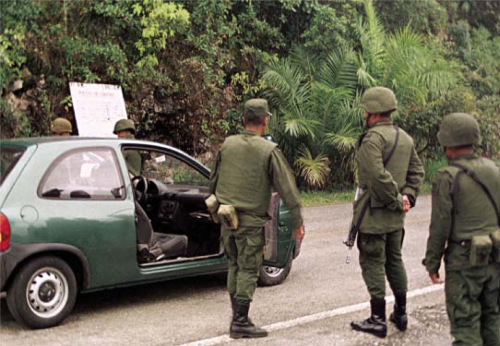
Mexican soldiers inspect cars at a roadblock near the Mexico-Guatemala border.
These “myths and half truths”— that illegal migration is an out-of-control phenomenon sapping the economic strength of industrialized nations, and that it can only be contained by implementing draconian immigration policies—particularly bedeviled the United States with the advent of NAFTA. During negotiations leading up to the agreement, which went into effect in 1994, the United States adopted what many observers consider a “siege mentality” regarding its borders. NAFTA presented a seemingly intractable dilemma: How could the United States open its borders to the free transit of goods and services yet keep unwanted drugs and migrants out?
One way was to build walls. In 1993, the INS, under the leadership of then-Commissioner Doris Meissner, implemented “Operation Hold the Line” in El Paso, Texas, the first of a series of initiatives that involved building massive walls along selected sections of the border, multiplying the number of border guards, and deploying a fleet of jeeps, boats, and helicopters armed with high-tech sensors.
Then, in 1996, Congress passed two harsh immigration and asylum laws—the “Anti-Terrorism Effective Death Penalty Act” and the “Illegal Immigration and Immigrant Responsibility Act”—which beefed up border enforcement even more, built new barriers to achieving legal status, expanded the grounds for deportation, and gave the INS the authority to use new law enforcement techniques (like wiretaps) to aid its investigations. 1
Officials and observers soon realized that neither stricter legal remedies nor reinforced borders were adequate to the task. Partly in response to stiffer immigration laws in the United States (and other countries in Western Europe), migrants increasingly turned to international smugglers who, for a hefty price, would supply them with false documents and promises of smooth passage to their destinations.
According to the International Labor Organization, by the late 1990s alien smuggling had boomed into a multi-billion-dollar-a-year enterprise, accounting for more than half of all illegal migration. (One tragic aspect of this phenomenon is the trafficking of women and children for sexual purposes. The U.S. intelligence community estimates that in 1997 alone some 700,000 woman and children were trafficked globally, about 50,000 of whom were brought to the United States.) 2
At the same time, Central America and Mexico, which generally have looser visa regulations than the United States, rapidly became the initial ports of entry for many migrants and smugglers, who saw the region as a convenient and relatively accessible bridge to the United States.
As for the stiffer blockade strategies that INS implemented, it is a matter of debate whether they have actually impeded the progress of the millions of Mexicans, tens of thousands of Central Americans, and thousands of extraregionals who each year try to cross the border.
One thing is clear—along with tighter security has come higher death counts. The walls, guards, and helicopters, it turns out, simply force migrants to take more perilous paths north, even if it means walking for days through the desert. (Early this year, the INS erected 30-foot-tall signal beacons in various spots of the Arizona desert, which presumably are meant to alert border guards of emergencies. The beacons have buttons that when pushed set off strobe lights every 10 seconds.) 3
The Center for Immigration Research at the University of Houston estimates that between 1995 and 1998 the number of deaths due to hypothermia, heat stroke, and other causes was nearly three times the levels of the mid-1980s. By 2000, according to the INS, deaths had reached more than one a day. 4 (Doris Meissner, now at the Carnegie Endowment for International Peace, told me in February, “We honestly didn't believe that would happen.”)
The INS goes global
In the meantime, U.S. authorities started looking abroad for other ways to deter undocumented migrants, with Mexicans being the most immediate concern. For Mexico, which receives billions of dollars in remittances from its migrants in the United States, migration and border control have always been touchy subjects. But along with NAFTA came new signs of cooperation. Hoping to convince a skeptical U.S. Congress that it would be a responsible partner, Mexico began devoting more energy to combating narco-trafficking and collaborating in cross-border interdiction efforts with U.S. agencies. 5
In 1996, Mexico also helped launch an annual series of meetings called the Regional Conference on Migration (known as the “Puebla process,” after the Mexican city where the first meeting took place), which brings together migration and foreign policy officials from Mexico, Canada, the United States, and Central America. According to Susan Gzesh, head of the University of Chicago's Human Rights Program, the administration of then-President Ernesto Zedillo hoped to use Puebla as a way of advancing its own interests and enlisting the support of other countries in the region, many of which also rely on remittances from immigrants living in the United States as a principal source of hard currency. The United States, on the other hand, saw the process as a way to push its policy objectives.
A Guatemalan police officer frisks bus passengers at a checkpoint near the Mexico-Guatemalan border in the Petén.
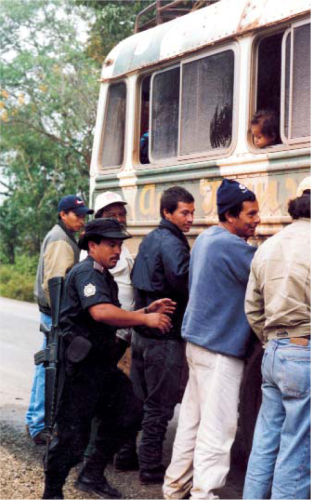
According to Melanie Nezer, an immigration attorney with the Washington-based Immigration and Refugee Services of America, migrants have benefited little from the Puebla process. Because many of the meetings take place behind closed doors, says Nezer, it is difficult to know precisely what agreements are made. But one thing is clear, she says: the process has institutionalized regional cooperation over migration issues.
“Instead of leading to increased protections of the human rights of migrants,” Nezer wrote in a 1999 report for the U.S. Committee for Refugees, “cooperation among North and Central American governments has led to a ‘southward migration’ of the Mexico-U.S. border.” She pointed to the aftermath of Hurricane Mitch (which devastated areas of Honduras, Nicaragua, and El Salvador) in 1998 as an example:
“In the wake of Hurricane Mitch, Mexico and Guatemala turned back tens of thousands of migrants headed toward the United States. Intergovernmental cooperation was evident, as press reports revealed that the U.S. government paid to rent buses that transported migrants apprehended near the Guatemala-Mexico border back to El Salvador and Honduras.” Following Hurricane
Mitch, she wrote, Guatemala began requiring for the first time passports from the other countries that with it make up the “CA-4 group.” Before Mitch, “nationals of the CA-4 countries [Guatemala, El Salvador, Honduras, and Nicaragua] could freely travel in the region with no more than an identity document.” (A few months after Mitch struck, Carnegie's Demetrios Papademetri-ou told Newsweek: “They're buckling under pressure from the United States. There is no other compelling reason for Guatemala to stop people from crossing its territory.”)
In 1997, the INS implemented an international anti-smuggling operation called “Global Reach,” which greatly expanded the agency's presence throughout the world. According to a Justice Department fact sheet, Global Reach is a “strategy of combating illegal immigration through emphasis on overseas deterrence…. The United States is a primary destination [for alien smuggling], which has grown dramatically in the post-Cold War years.” The INS has established “40 overseas offices with 150 U.S. positions to provide a permanent presence of immigration officers overseas,” “trained more than 45,000 host-country officials and airline personnel in fraudulent document detection,” and “undertaken special operations to test various illegal migrant deterrence methods in source and transit countries.”
Global Reach's initiatives in the Western Hemisphere are part of what is called “Operation Disrupt,” a series of INS-led multilateral operations involving law enforcement officers from throughout the region. According to activists in these countries, during the operations, INS agents accompany local authorities to restaurants, hotels, border crossings, checkpoints, and airports to help identify suspicious travelers. They also say that despite INS claims that Disrupt has been enormously successful in breaking up smuggling rings, a cursory glance at the numbers shows that it is migrants, not smugglers, who are disproportionately targeted. In 2000, for example, the INS declared that year's operation “Forerunner” to be the “largest anti-smuggling operation ever conducted in the Western Hemisphere.” Involving agents from six Latin America countries, the operation nabbed 3,500 migrants, but only 38 smugglers.
This was the “first Disrupt operation,” said the INS in a press release, “where several countries worked in a coordinated effort to protect migrants who are victims of criminal smuggling operations.”
A group of U.S. Catholic bishops who visited a prison in Tegucigalpa, Honduras, where migrants detained during the operation were confined, told a different story. They denounced the terrible conditions of the prison, the lack of legal representation, and the fact that the operation prevented the migrants from applying for asylum.
On the other hand, Joe Banda, the INS special representative in Tegucigalpa, told a journalist at the time, “The cost savings [from detaining and deporting migrants in Honduras as opposed to in the United States] are enormous.” 6
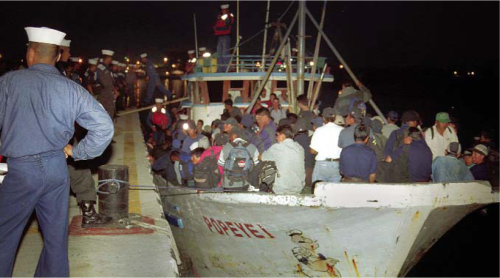
Also playing a role in these interdiction efforts is the U.S. Coast Guard. Long a key player in U.S. efforts to stem narco-trafficking and contain migration crises in the Caribbean, the Coast Guard's “national security” mandate was expanded in the early 1990s by a succession of presidential decrees. In 1992 then-President George H. W. Bush issued an executive order authorizing the Coast Guard to interdict vessels at sea carrying undocumented migrants and to return the migrants to their home countries. In 1993 then-President Bill Clinton directed the service to cooperate with other law enforcement agencies in combating alien smuggling. 7
February 11, 2002: Undocumented migrants arrive at Puerto Madero in Chiapas, Mexico, aboard an Ecuadorean smuggling vessel that had been intercepted by the U.S. Coast Guard.
In 2000, Joe Banda, the INS special representative in Tegucigalpa, told a journalist, “The cost savings [of detaining migrants in Honduras] are enormous.”
In recent years, much of the Coast Guard's efforts have been focused on the Pacific rim of the Americas, which has seen a massive spike in the number of Chinese and Ecuadorean smuggling vessels. In Ecuador, where “dollarization” has failed to resolve a three-year economic crisis, some 500,000 people have fled to Europe or gone north on smuggling boats. 8 The boats, which also carry migrants from as far away as Asia and the Middle East, tend to be rickety, overloaded death traps that struggle up the coast to clandestine landings in Guatemala and southern Mexico.
One Ecuadorean I met at a church-run migrant shelter in Guatemala City told me that the boat he had arrived on was loaded with 200 migrants from several countries. “There [at the Ecuadorean port of Guayaquil] they arrive from everywhere,” he told me, “They come from China and Saudi Arabia. And then they come here. In my boat, there were also Peruvians and Colombians.” Most of the migrants, he said, had “coyotes” (smugglers) waiting for them when the boat landed on Guatemala's southern coast. “I found a coyote when I got here, but he took $5,000 from me and then hid me for several days. I finally escaped and went to a relative's home in Huehuete-nango [a city in the Guatemalan highlands].”
A Salvadoran migrant at the shelter said that he too was trying to make it to the United States because “the change to the dollar in El Salvador has made it difficult for people to buy things. They tell me that in the United States I can earn $7 or $8 an hour. You can't even earn that in a day in my country.” The Ecuadorean then said: “I wanted to go for more or less the same reasons. The dollar has made things difficult for us.”
Undocumented migrants cross the Río Suchiate between Guatemala and Mexico.
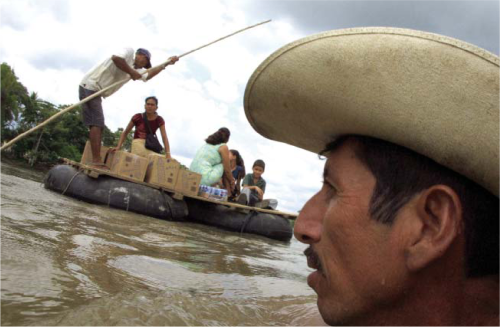
According to a Coast Guard fact sheet, since 1999 it has “encountered increasing numbers of migrants being smuggled from Ecuador to points in Central America and Mexico.”
Although its principal mission is to patrol the coast for illegal narcotics trafficking, the Coast Guard regularly intercepts migrant smuggling boats. Many of these interventions are for legitimate humanitarian purposes—most of the vessels do not have the proper conditions to transport migrants and lack emergency equipment. But despite its humanitarian goals, the Coast Guard's expanding mission has raised concerns among advocates in the region, who argue that it is ultimately just another U.S. attempt to prevent migrants and legitimate asylum seekers from reaching its shores. Says Yovani Sán-doval Martínez, an analyst with the Guatemalan government's human rights defenders office (the Procu-raduría de Derechos Humanos, or PDH): “When the [Coast Guard] intercepts these boats, it often asks Guatemala to accept the migrants on humanitarian grounds. But it really isn't for that. The fact is, other countries either don't accept U.S. policies or don't want the migrants, so the United States turns to Guatemala.”
Martínez also questions the legality of some of the detentions. He points to a case last March when the Coast Guard, working with the U.S. Navy, intercepted an Ecuadorean fishing vessel in international waters off the coast of Costa Rica that was carrying some 220 undocumented migrants from Ecuador. According to a PDH report about the case, after the boat was escorted to Guatemala's Puerto Quetzal, the U.S. embassy asked the vice president to have the five crew members detained. Guatemala's migration authority (the Di-rección General de Migración, or DGM) then brought up charges against the crew members, accusing them of illegally bringing people into the country—although the boat had been detained in international waters. A judge finally threw the case out, but the DGM refused to release the crew. They remained in detention for several months before finally escaping.
From virtual frontier to security perimeter
It is difficult to call the 620-mile virtual line between Mexico and Central America a “border” in any normal sense of the word. Sure, there are a few major customs stations in places where paved highways cross. But the rest is dense forest or mountain terrain crisscrossed by turquoise-colored rivers, broad canyons, isolated dirt roads and foot paths, and centuries-old ethnic ties that pre-date the arrival of the Spanish conquistadors. Until fairly recently, many of the Mayans who inhabit the region might not have been able to say on which side of the border they lived, or even what a border was. They knew themselves not as Mexicans, Guatemalans, or Belizeans, but as Chols, Kanjolobals, Tzotzils, Tzel-tals, Ixils, Quichés, Kekchis, Mams, Chujs, or Tojolobals.
In the early 1980s, however, the border rapidly became a concrete reality as hundreds of thousands of indigenous Guatemalans fled into Mexico seeking refuge from the brutal counterinsurgency campaigns unleashed by a succession of military dictatorships. Joining this wave of Guatemalans were thousands of Sal-vadoran and Nicaraguan refugees, who also fled into neighboring countries as civil wars broke out in their own countries.
When the wars came to an end in the late 1980s and early 1990s, the flow of refugees halted, only to be replaced by a new wave of people fleeing poverty, hunger, unemployment, and a succession of natural disasters. (In 2000, Mexico deported some 150,000 Central Americans, and another 100,000 during the first six months of last year.) 9 As Jaime Ruiz, an official with the U.N. High Commissioner for Refugees, said in an interview with the Inter Press Service last February, “The flow of refugees is no longer a result of political reasons as much as economic motives.”
But economic migrants don't receive the same treatment as refugees— the latter are granted asylum by host countries, the former tend to be considered “illegal.” According to Father Flor María Rigoni, a Scalibrinian priest who runs a casa de migrantes in Tapachula, the main border city in southern Mexico, the distinction in name and treatment is unfortunate. “As you know, the concept of conflict is very relative. There is ideological conflict, there is religious conflict, and there is the conflict of hunger. Each causes pain.”
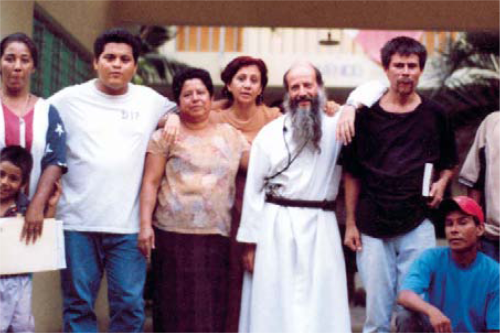
Sporting a long, wavy beard, flowing white robes, and a crucifix tucked into a cord that is tied around his waist, the Italian-born Rigoni has the appearance of a medieval monk who has been hidden away in a monastery for years. It is a misleading impression. For nearly two decades, he has worked in the trenches along both Mexico's southern and northern borders, managing migrant shelters, working with refugees, and preaching the sort of messages that must give migration policy-makers nightmares.
“A Honduran told me recently,” said Rigoni, “‘If I have to die of hunger, I would rather do it beyond the borders of my country so I won't have to die of shame as well.’”
“Clearly, the problem of immigration will not be resolved by the Río Bravo or the Río Suchiate [between Guatemala and Mexico]. Rather, it is a problem of globalization, and it is on that level that we have to begin to take steps to deal with this phenomenon. When I arrived in Tijuana 18 years ago, journalists and sociologists used the phrase: ‘We have to stop the brown tide.’ If instead they had said, ‘We have to stop the human tide,’ then maybe our politics would have changed by now, because you don't stop humanity. When immigration starts moving, all borders move. So it is a big problem, but the hunger doesn't end.”
For years, the “human tide” crossing Mexico's southern border en route to the United States was a sore spot in relations between the two countries. By not enforcing its southern border, U.S. officials argued, Mexico was opening up the entire North American continent to narco-traffickers, undocumented migrants, and increased insecurity. For the most part, Mexico responded by arguing that the United States should focus its attention on treating Mexican migrants more humanely.
Father Flor María Rigoni poses with migrants staying at his casa de migrantes in Tapachula, Mexico.
But last July, in a dramatic about-face, Mexico began a massive new interdiction effort in its southern states that seems aimed not only at migrants and smugglers, but at Washington. As part of “Plan Sur” (“Southern Plan”), Mexico deployed hundreds of new agents, fired border officials accused of corruption or abuse of power, established dozens of new road blocks in an area stretching from its southern border to the isthmus of Tehuantepec (the narrowest section of Mexico), and increased military participation in interdiction efforts. To make it more difficult for Central American migrants to return to Mexico after being deported, the government— with the support of Guatemala and the United States—started busing them directly back to their countries, instead of just dropping them off at the Guatemalan border.
At about the same time, the Mexican government implemented a plan to deport extraregional migrants back to Guatemala if it could be determined that they had entered from that country. According to the U.S. Committee for Refugees, some 1,000 migrants from India, Pakistan, Sudan, China, Colombia, Ecuador, and other countries were deported to Guatemala last year, with the United States covering most of the transportation costs. 10
It was this deportation scheme, which many observers claim contra venes binational accords between the countries and international law, that caught Kanu Patel and his compatriots. Making their case particularly strange was their claim to have never stepped foot on Guatemalan soil until they were “sent back” there.
While Mexican officials have made a lot of noise about the purported success of Plan Sur, they—and just about everyone else involved—are tight-lipped when asked about the case of “los hindúes.” Why did Mexico decide to deport these migrants, who lacked consular representation in Guatemala? Why did Guatemala agree to take them? Why didn't the Indian embassy aid the repatriation of Patel and his compatriots? And what, if any, role did the United States play in the decision?
When I called Hipolito Acosta, the head of the INS regional office in Mexico City, he told me that he had asked Indian officials why they weren't doing more to help their countrymen, and he suggested that I should ask them the same question. A spokeswoman at the Indian embassy's consular section in Mexico City told me only that they had not been able to confirm the migrants' identities, adding that if I had any other questions I should fax them to the consul general (from whom I received no reply to my fax). Her-menegildo Castro, head of public communications for Mexico's INM, said that he was not familiar with the case (a disingenuous claim, Mexican advocates say, because of its notoriety), but that if I sent him an email outlining precisely what I wanted to know he would gladly look into it for me (I received no reply to my e-mail).
The most forthcoming official I spoke to was Antonio Jeréz, an adviser to Oscar Contreras, Guatemala's migration chief. This was not altogether surprising as Contreras assumed office in late December, after the deportations had ended. “We should not have received those migrants,” Jeréz told me, “because the only official treaty [we have with Mexico] covers Central Americans.” He said the case of the Indians was extremely difficult “because the Indian embassy in Mexico didn't have an electronic database of names…. Nor did the migrants cooperate with us because their objective was not to return to their country but to stay in Guatemala or go to the United States.”
According to Father Rigoni, part of the problem is that Mexico doesn't know what to do with all the extra-regionals arriving in the country, adding that there are numerous cases in which it has sent them to one part of the country or another in an attempt to keep them detained. (The Mexico City-based organization Sin Fronteras says that the INM detention center there is routinely overcrowded with migrants from Iraq, Palestine, Yemen, China, and other countries. Detainees are often released after extended stays simply to make room for new batches of migrants.) “Mexico has to learn very quickly [how to be a receiving country], to be the place where all roads converge as they head north,” says Rigoni. “At this moment, Mexico's southern border and coast represent the only open door into the northern hemisphere.”
With Plan Sur, say Mexican officials, that door is being shut. According to Felipe de Jesús Preciado, Mexico's immigration commissioner, the plan has resulted in about a 35 percent decrease in the number of migrants crossing the border. “The problem of the undocumented is very serious in Mexico,” Preciado told journalists in March, while announcing the plan's results. “Imagine the migratory populations in Mexico headed for the United States, increasing the levels of criminality, un-healthiness, drug trafficking, prostitution. The fact that [smugglers] operate in Mexico is a problem that the government has to solve, which will benefit the United States.” 11
Although the government insists that the plan is only about ensuring its own “national security,” most observers see it as part of the Vicente Fox administration's efforts to persuade the U.S. government to “normalize” the legal status of the 6-8 million undocumented Mexicans who live in the United States.
“Mexico's motivation here is clear,” says George Kourous, director of the Americas Program at the New Mexico-based Interhemispheric Resource Center. “In exchange for sealing off its southern border and cutting off northern flows of non-Mexican migrants, Vicente Fox hopes to get something in return, perhaps more visas for Mexicans, a new guest worker program, or even an amnesty for its undocumented migrants already living in the United States.”
In Mexico and Guatemala, the plan has been the source of considerable controversy among advocates and many government officials, who charge that Mexico is committing the same kinds of abuses along its southern border that for years it has criticized the United States for.
In an interview with the Spanish news service EFE last July, Pablo Salazar, governor of the southern Mexican state of Chiapas, said that the plan contradicts “our principles, those we have historically invoked in dealing with our neighbors to the north…. If the United States were to announce, as it has several times, that it intended to militarize our northern border, we would be the first to jump.”
May 30, 2001: Undocumented migrants from Ecuador, Peru, the Dominican Republic, and Colombia at a detention center in San Salvador, El Salvador.
“Mexico has to learn very quickly to be the place where all roads converge. At this moment, its southern border and coast represent the only open door into the northern hemisphere.”
Not surprisingly, the U.S. government likes Plan Sur. “There have been a lot of problems down here,” an unnamed U.S. official told Reuters last July. “You can't end it overnight, but finally a Mexican government is recognizing the problem and trying to do something about it.”
According to Father Barilli in Tecún Umán, Guatemala, the reduction in border crossings is not principally a result of Plan Sur, but rather a temporary response to the September 11 terrorist attacks and the fear that it has inspired among migrants, many of whom have heard from friends or family members in the United States that it is not a good time to hazard the passage north.
The region's governments and security forces have responded to the terrorists attacks by establishing a series of migration-related security agreements. Last September, the Central
American police chiefs agreed to improve information sharing between police, intelligence, and migration offices; and in February, President Fox and Guatemala's President Alfonso Portillo signed a series of bilateral accords aimed at reinforcing security along their mutual border, coordinating customs activities, and creating a “High Level Group on Border Securi-ty.” 12 Also last September, the United States announced that it would begin assisting Central American countries in anti-terrorism operations. Explained one U.S. official, “Before, they were thinking about Ecuadore-ans and coyotes. Now, after these attacks, there is a recognition it may be a different kind of person.” 13
Father Barilli says there has been a region-wide crackdown on migrants since the terrorists attacks. According to statistics he has compiled from migrants passing through his shelter, human rights violations—including abuse of authority and thefts committed by corrupt officials—have increased measurably. However, he says that since Plan Sur went into effect, he has noticed that Mexico is in some ways trying to “humanize” immigration by replacing abusive agents and providing detained migrants with decent transportation directly back to their home countries.
Also since the terrorist attacks, which effectively quashed negotiations between the Fox and Bush administrations over the status of undocumented Mexicans in the United States, Mexico has adopted a second diplomatic track in its efforts to woo Washington. Building on Plan Sur's alleged success, Mexican officials now emphasize in their conversations with U.S. officials the idea of a “North American security perimeter,” an idea first proposed by President Fox early in his administration. The next logical step is to create a shared security structure for all the NAFTA partners—Canada, the United States, and Mexico. “Security is not strictly a national question,” said Adolfo Aguilar Zinser, Mexico's national security adviser, during a visit to Washington last October. “If we do not do things with the United States and Canada, none of us will be secure.” 14
As part of this idea, Mexico has proposed increasing intelligence sharing among the countries, coordinating customs efforts, and harmonizing visa regulations for third-country visitors. In exchange, Mexicans—as well as Canadians and Americans— would be able to travel more freely within the perimeter.
Says George Kourous: “Although the terrorists attacks made the United States increasingly leery about its border, they provided the Mexicans with an opportunity to prove to U.S. officials that it could play a role in ensuring security. Mexico is convinced that the only way to arrive at a ‘NAFTA-plus’ in the post-9-11 era is to implement dramatic security reforms, including getting ever more aggressive about closing down its southern border.”
Carnegie's Papademetriou compares the idea to the European Union system: “You begin by giving up some of your inspection functions, and once you feel good about that you begin to loosen up the environment within…. Basically, you are extending the border to the south of Mexico, you are incorporating Mexico into this new state, but only because they are much more careful about who they allow in.”
I asked Papademetriou if he thought a security perimeter of this sort would be implemented within the next 15 years: “I'd say yes,” he told me, “but only because I will be retired by then and you won't be able to come back to me and say, ‘You were damn wrong.’”
Detained
As migrants moving north meet U.S.-driven migration controls moving south, a dilemma is emerging on the Central American isthmus: Where do you put detainees while they await deportation?
In a study published early this year about the state of detention centers in the region, the Comisión para la Defensa de los Derechos Humanos en Centroamérica (Codehuca), a Costa Rica-based human rights group, reported: “The trafficking of migrants from Latin America and the Caribbean to the United States and Canada is growing rapidly…. The magnitude of this phenomenon has overwhelmed the capacities of [Central American] governments, whose response has been ineffective and often repressive.”
In Belize, where undocumented migration is considered a crime, the government simply imprisons migrants indefinitely; in El Salvador, which doesn't have a dedicated detention facility, migrants are kept at a police station lock-up where they are mixed with regular prisoners before being deported; and in Costa Rica, which is a central destination country for both Nicaraguans and Colombians, the government partially refurbished a dilapidated prison to house undocumented migrants. Only one country, Nicaragua, was found to have a doctor available 24 hours a day for detainees.
Guatemala, which Codehuca described as the “final frontier” between North and South America, has had a particularly difficult time housing migrants. Last year, while Mexico was busy deporting extraregional migrants across its southern border, Guatemala was knee-deep in its own detention campaigns: “Venceremos 2001” (“We Shall Overcome”), which coincided with the INS's Disrupt operation, “Crossroads International”; and “Coyote 2001,” which involved putting up police road blocks in various parts of the country and randomly checking vehicles. (According to PDH's Martínez, although only the national police are legally authorized to detain migrants, several other law enforcement bodies, including the anti-narcotics police and the forest protection service, are playing an increasing role in detention efforts.)
Overrun with detainees, Guatemala turned to the U.S. embassy for support. In a July 2001 letter to Amb. Prudence Bushnell, Carlos Velásquez Domínguez, then the country's migration chief (he was fired a few days after Patel committed suicide), wrote in tortured but revealing prose: “Taking into consideration that migration is an international problem, I appeal to you for humanitarian aid to help avoid this immigration and thereby contribute to the American dream that they desire and to contribute as well to national security. The aid that we ask for consists in helping us rent albergues [shelters] and to pay for flight tickets to transport undocumented people back to their countries of origin.”
The United States responded favorably. Kaye Mayfield, the embassy press attaché, told me, “The decision to support this request was made on the basis of the needs of the migrants. They need to be housed and cared for, and the question was what can we do to make sure there is a place for them to stay as their nationality is being established. That was the concern, that was what we tried to accomplish.”
Margarita Hurtado, a member of the Guatemalan migrants rights group Menamig, described the two U.S.-funded detention centers, which were closed down early this year: “After they initiated Coyote 2001, the centers were filled with people from everywhere—from Ecuador, India, Peru, Syria, Cuba. In one space there were 40 people. Everything was being destroyed, there was no light, no air. They were worse than our jails.”
When I asked Mayfield if the U.S. embassy had bothered to check on the facilities it was funding, she referred me to Hipolito Acosta, who told me that INS officials did eventually visit the centers. “We determined that the facilities Guatemala was using were not acceptable. Guatemala is now looking at another location to build a new detention center, which will be almost like a model for Central America…. I sent my deputy director to check it out because we are greatly concerned.” •
Footnotes
1.
Information about the legislation cited in Melanie Nezer, “The Puebla Process: U.S.
Migration Controls Move South of the Border,” U.S. Committee for Refugees, 1999
(www.refugees.org/world/articles/wrs99_migration
controls.htm); and statement of Doris Meiss-ner, Commissioner of the Immigration and
Naturalization Service, November 20, 1998 ( ).
).
2.
Statistics cited in Growing Global Migration and Its Implications for the United States, U.S. National Intelligence Estimate, National Foreign Intelligence Board, March 2001.
3.
New York Times, May 25, 2002.
4.
Washington Post, May 23, 2002.
5.
Peter Andreas, “U.S.-Mexico Drug Control in the Age of Free Trade,” borderlines, April 2000.
6.
Paul Jeffrey, “Central America: The Long Arm of U.S. Immigration Policy,” Central America/Mexico Report, April 2001.
7.
8.
Figure cited in “Making the Most of an Exodus,” The Economist, February 23, 2002.
9.
The Guardian, July 25, 2001.
10.
World Refugee Survey, 2002, U.S. Committee for Refugees.
11.
Reforma, March 11, 2002.
12.
borderlines Updater, October 22, 2001; EFE, February 25, 2002.
13.
Financial Times, September 27, 2001.
14.
Financial Times, October 7, 2001.