



Abstract

On October 23, 2001, the Irish Republican Army (IRA) completed what some are calling a turning point in Northern Ireland's troubled history. The IRA poured concrete into bunkers north and south of the border, putting “a quantity of arms completely beyond use,” said Gen. John de Chastelain, the Canadian officer in charge of decommissioning paramilitary weapons in the British-controlled province. International officials inspected the arms and explosives before the pouring of the concrete, and tampering with the bunkers now will trigger satellite surveillance.
The action marked the first voluntary decommissioning ever in Northern Ireland. No gun, bullet, or bomb component had ever been surrendered by the IRA or revealed willingly to any inspector or intermediary. The event raises new hope that the Irish conflict may be resolved. However, it came only under heavy pressure from the U.S. government and careful maneuvering by Irish politicians and political factions to maintain the balance of power. And all parties admit the peace process has far to go before delivering a united Ireland.
The decommissioning led to the reconstitution of the Northern Ireland Executive (the power-sharing government coalition of unionists, nationalists, and republicans) and pledges from the British government to scale down troop levels and army installations, particularly in the border area of South Armagh (“bandit country”). But it also caused what Sinn Féin President Gerry Adams called “little earthquakes” among the IRA membership.
The mainstream Provisional IRA is by far the largest of the three republican-armed resistance groups, with the most powerful political arm, Sinn Féin. Sinn Féin policies under the leadership of Gerry Adams led to a split in 1997 with the Real IRA, which continues armed resistance to British partition, and the Continuity IRA, which has been less active. Fear of wholesale defections to the dissident ranks influenced the IRA army council to resist decommissioning efforts.
But those resistance efforts have been consistently weakened by internal tensions and increasing pressure from the United States to settle the Northern Ireland conflict–especially after September 11.
More than 40 million Americans are of Irish extraction, so it is not surprising that the United States has played an important role in the peace process. Americans were instrumental in formulating the Good Friday Agreement in 1998. And pro-republican fundraisers in America (Nor-aid and others) have put some $11 million a year into IRA coffers.
Those donations are looking endangered. Many Irish-Americans who opposed the Good Friday Agreement switched their allegiance from the mainstream IRA. Then in May 2001, the U.S. State Department officially designated the Real IRA a foreign terrorist organization. In August 2001, three alleged IRA operatives in Colombia were arrested and accused of training Revolutionary Armed Forces of Colombia (FARC) guerrillas in bomb technology. The U.S.-backed Colombian government is fighting a war against FARC, which has been linked to the Colombian drug trade.
The Colombia fiasco, together with a visit to Cuba by Gerry Adams, incurred the wrath of the Bush administration–which is far less pro-Irish than its predecessor. This anger helped propel the IRA toward decommissioning. Bill Flynn, a pivotal figure in Irish-American politics and chairman of the Mutual Bank of America, made it clear to Adams after Colombia that the only way to rescue the party's reputation in Washington was for the IRA to disarm.
April 25, 2001: A British army engineer dismantles an observation post in South Armagh, Northern Ireland.

Then after September 11, U.S. policy and public opinion on Irish republican groups hardened even more. The Wall Street Journal argued that the IRA had “figured out that nowadays Americans are assuming that one man's terrorist is another man's … terrorist.” On September 24, the Treasury Department's Office of Foreign Assets Control (OFAC) blocked terrorist assets and added to the existing list of terrorist organizations: the Real IRA and its political wing, the 32 County Sovereignty Movement; the Continuity IRA and its political wing, Republican Sinn Féin; and the Irish Republican Prisoners Welfare Association. The listings ban Americans from giving the organizations money or support.
Careful State Department diplomacy together with the widespread revulsion to terrorism put considerable pressure on the IRA. Sinn Fein's future support in the United States was at stake. In October, the IRA acted. In a carefully planned publicity coup, Sinn Fein's Martin McGuinness, former IRA commander and now education minister for the Northern Ireland Assembly, announced the historic decommissioning in Washington, D.C., as it took place in Ireland, saying the IRA leadership had taken the action “to save the peace process.”
But U.S. pressure has not let up. In January, OFAC froze the assets of the Protestant Loyalist Volunteer Force, Orange Volunteers, Red Hand Defenders, Ulster Defence Association, and its sister organization, the Ulster Freedom Fighters. Richard Haass, director of policy planning at the State Department, involved in coordinating the U.S. government's Northern Ireland policy, made it clear in January that the United States wants all terrorist weapons given up. In February, the original deadline for total IRA decommissioning, the United States refused entry to leading Sinn Féin member Conor Murphy.
Illinois Republican Henry Hyde, chairman of the House International Relations Committee, which is investigating the IRA-FARC link, said that the Sinn Féin leadership and the IRA must state where exactly they stand on global terrorism. Adams has been invited to speak to the committee, which was expected to hold hearings in April. Some prominent Irish-Americans feel the hearings will embarrass Sinn Féin. A letter from the president of the Irish National Congress, Sean McManus, sent to members of the committee, appealed “not to schedule the above mentioned hearings” because it would “harm the Irish peace process.” The committee argued that halting the investigation would cause even greater embarrassment if the three Irishmen were later convicted of aiding terrorists.
The net has been tightening around hardline republicanism, despite claims by Gerry Adams, on visiting New York last November, that Irish-American support is as steadfast as ever. Rumors circulated that a new decommissioning would take place around Easter–with its historic resonance–but the holiday passed without an announcement. Observers, however, still expect a second decommissioning to occur. If it comes, it will signify that the IRA means business and that it is a sequel to what is now an ongoing process. But disarmament is far from finished and includes more than Irish republicans.
Protestant loyalist groups (extreme unionists) insisted they would hand over none of their weapons for decommissioning. Their lack of cooperation means the focus of future disarmament initiatives will inevitably fall on loyalist terrorists and their weaponry even though it is inferior to the IRA's armory.
The IRA possesses enough improvised and imported weaponry to equip at least two battalions, including 50 heavy- and general-purpose machine guns, 40 rocket launchers, grenades, mortars, ground-to-air missiles, at least two tons of Semtex, and bombs large enough to destroy several multi-story buildings. It also has the world's leading designers of improvised explosive devices.
Police in Donegal, Ireland, which has long been a proving ground for IRA members, uncovered an arms cache in February. It included a PRIG (projected recoilless improvised grenade) armed with a 1-pound Semtex warhead in a dangerous condition, which was removed and detonated by an army ordnance team. The inclusion of the fully primed rocket proved that the cache was part of the IRA arsenal rather than any of the dissident republican organizations.
The Real IRA's 1998 bombing of Omagh–which killed 29 and injured more than 200–marked the biggest single loss of life during “The Troubles,” the 30 years of violence between Catholics and Protestants in Northern Ireland. The Real IRA also carried out attacks on the BBC's Television Centre, London's Hammersmith Bridge, and the headquarters of the British Foreign Intelligence Service, MI6. Most of the Real IRA's weaponry and Semtex came with the members when they split from the Provisional IRA. Apart from one conviction, the Omagh perpetrators had still not been caught as of March. The investigation by the Police Service of Northern Ireland (formerly the Royal Ulster Constabulary) has been heavily criticized. Only slightly more than 100 people have been picked up over the past three years, north and south of the border. In December 2001, two Real IRA bomb-makers arrested in Dublin had a state-of-the-art bomb-making factory with the latest timing power units. British mainland authorities remain on high alert in readiness for further Real IRA attacks.
The British government has been criticized for applying insufficient pressure on the paramilitaries to decommission more weapons. And a possible amnesty for IRA on-the-runs (OTRs) still at large, which was among the proposals that led to the decommissioning move, is seen by army commanders and unionists as a concession too far. If it gets through Parliament, an amnesty will be granted to all paramilitary OTRs on ceasefire in Northern Ireland for crimes committed before the 1998 Good Friday Agreement. British Prime Minister Tony Blair admitted to the House of Commons that it was necessary to take “distasteful” decisions as part of the peace process.
Even if IRA factions can get together, unionists stand in the way of any reunification. The State Department's Haass has warned that the “crisis within Unionism” could result in the collapse of the Good Friday Agreement if Protestant concerns are not addressed. Haass expressed Washington's concern at the level of loyalist violence in the province and signaled a break with the past by urging Americans and others to understand the fears of Protestants in Northern Ireland. He also called on Sinn Féin to cooperate with the new Police Service of Northern Ireland and appoint representatives to the province's policing board.
Are the unionists under threat? To many, nationalist gains seem much more tangible; there are ministerial feet under tables, police reform, and cross-border institutions. While the political landscape has changed since the “Ulster says No” campaign in the 1980s, unionists still fear that republicans might return to war.
Many unionists feel beleaguered, expressed in extremis by the sustained, appalling campaign of pipe-bombing and sectarian assassination by loyalist elements. (These are the same people responsible for rioting and threatening Catholic children and their parents walking to school through a mainly Protestant area of north Belfast.) Unionists resent losing former privileges in a society where Catholics were until only recently second-class citizens.
The 2001 census returns are likely to indicate that Catholics make up roughly half of the population of the north. Projections that the Catholic minority will probably become the majority in this small part of a small, long-troubled–but rapidly changing–island assume that a united Ireland is the inevitable, if long-term, result. The census result could be the political equivalent of a bar-rackbuster, blasting the old unionist order.
Ulster unionist leader David Trimble has called for a Northern Ireland referendum, with outright rejection of a united Ireland intended to close the issue for years to come. The Good Friday Agreement requires a poll if it looks like a majority would favor a united Ireland. This is not yet the case.
“You're still my main man, Igor. The monster is just science!”
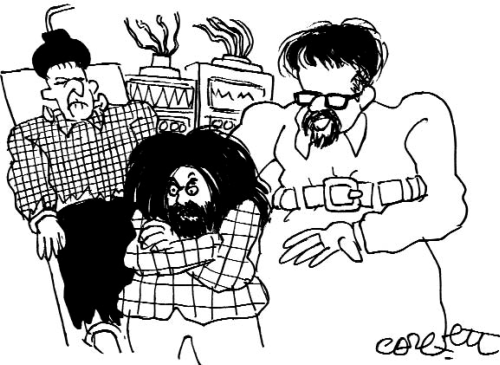
There will eventually be a united Ireland, whether unionists like it or not. Although the unionists don't believe him, Gerry Adams said in New York in February: “We cannot build a united Ireland upon a society that does not have the assent of the northern unionist community.”
Unionists already have their British citizenship guaranteed–even in a united Ireland context–by the Good Friday Agreement, and there is a raft of equality and rights measures to protect them. Under the agreement, Ireland had to relinquish its claim on the north through a referendum to amend Articles 2 and 3 of the Irish constitution. It received 94 percent support. Many Irish people would like to see a united Ireland, but by peaceful means and with no fear of loyalist reprisals.