



Abstract


On October 16, 1994, the Federal Bureau of Investigation (FBI) received word that one of its informants was being held hostage by a domestic terrorist group, the Patriots for National Unity, in a New Orleans safe house. The next morning, after overhearing plans to kill the hostage, a raid by the FBI's hostage rescue team freed the informant. During a debriefing, the rescued informant revealed that members of the terrorist group were looking to obtain nuclear material and assemble several nuclear devices. The bureau also determined that one of the group's members may have leased a boat. In response to a possible nuclear threat, the FBI alerted a number of other federal agencies, including the Nuclear Emergency Search Team (NEST)–a special unit under the control of the Energy Department's Nevada Operations Office. Fortunately, this entire scenario is fictional, just like the many incidents of nuclear terror portrayed in films and novels over the last 40 years: from Spectre's threat in the 1961 James Bond thriller Thunderball to employ stolen nuclear bombs against U.S. or British cities; to the Libyan-backed threat of atomic devastation in Larry Collins's The Fifth Horseman (1980); to the destruction caused by a terrorist nuclear device in Tom Clancy's The Sum of All Fears (1991); to the attempt by an aggrieved Serbian to incinerate the United Nations in the 1997 film The Peacemaker starring George Clooney and Nicole Kidman.
In the scenario described above, NEST was participating, along with the FBI, Federal Emergency Management Agency (FEMA), and several other organizations, in a “full-field exercise” designated “Mirage Gold.” The purpose of the exercise was to test how successfully the agencies would respond to a nuclear terrorist threat–and if they could work together effectively.
Without fictional heroes to avert nuclear terrorism, the United States relies on the CIA, the FBI, and NEST.

The possible need to track down lost, stolen, smuggled, or “improvised” nuclear devices has concerned national security agencies for at least as long as novelists have been spinning fictional scenarios. A 1963 national intelligence estimate, The Clandestine Introduction of Weapons of Mass Destruction into the U.S., addressed the question of whether the Soviet Union was likely to attempt to smuggle biological, chemical, or nuclear weapons into the United States. The intelligence community concluded that “the Soviets almost certainly would not contemplate the use of clandestinely delivered nuclear weapons except as a supplement to other weapons in the context of general war,” and that “the Soviets probably recognize that it would be impracticable for them to mount a clandestine nuclear attack on a sufficient number of [U.S. delivery vehicles] to reduce substantially the weight of a U.S. strike.”
There was also, in the 1960s, concern about the possible consequences of a crash of nuclear-armed aircraft. According to Duane C. Sewell, commonly referred to as the “father of NEST,” this led to the creation of a team based at Lawrence Livermore National Laboratory that could send qualified people to pick up the remains of the aircraft, detect the presence of a nuclear device, determine the area at risk, remove the bomb, and minimize the physical and political damage. When a B-52 carrying four thermonuclear bombs crashed near Thule, Greenland, in 1968, the value of such a capability was demonstrated. “Project Crested Ice” involved transporting two technicians and an instrument for detecting plutonium, suitably winterized to operate at temperatures of minus 60 degrees Fahrenheit, to the accident scene. Within 24 hours of arrival, they were able to locate the area contaminated with plutonium.
“If they were counting on us to save the good folk of Boston … well, it was bye-bye Boston.”
Then, in the summer of 1972, the terrorist group Black September seized, and ultimately murdered, nine members of the Israeli Olympic team. Among those who became seriously concerned over the prospect of nuclear terrorism was James Schlesinger, then chairman of the Atomic Energy Commission (AEC). He held a series of meetings exploring whether terrorists could steal plutonium and make a bomb with it, whether they could steal a bomb, and whether the United States would be able to locate it. In 1974, while those issues were being considered and investigated, the FBI received a note demanding that $200,000 be left at a particular location in Boston or a nuclear device would be detonated somewhere in the city. This note was not part of an exercise, but the real thing (New York Times Magazine, December 14, 1980).
William Chambers, a Los Alamos nuclear physicist who was studying the detection issue, was instructed by the AEC and FBI to assemble the best team he could and head for Boston to search the city. The operation reflected its ad hoc origins. The group rented a fleet of mail vans to carry concealed equipment that could detect the emissions of a plutonium or uranium weapon. But the team found that they did not have the necessary drills to install the detectors in the vans. NEST field director Jerry Doyle recalled, “If they were counting on us to save the good folk of Boston … well, it was bye-bye Boston.” Fortunately, it was all a hoax–FBI agents waited, but no one showed up to claim the bag of phony bills they left at the designated location.
The threat to Boston resulted in a secret November 18, 1974 memo from Gen. Ernest Graves, the AEC's assistant general manager for military applications, to Mahlon E. Gates, manager of the commission's Nevada Operations Office. Titled “Responsibility for Search and Detection Operations,” it authorized Gates to assume responsibility for the planning and execution of AEC operations to search for and identify “lost or stolen nuclear weapons and special nuclear materials, nuclear bomb threats, and radiation dispersal threats.” Before the end of 1975, the NEST team was established to prepare for and manage such activities.
If necessary, NEST can deploy approximately 600 individuals to the scene of a terrorist threat, although actual deployments have rarely involved more than 45 people. According to a Nevada Operations Office briefing, deployed personnel come from a pool of about 750 individuals, most of whom work for Energy or its private contractors in other primary capacities. In addition to NEST members based at the team's Las Vegas headquarters, personnel are pulled from three Energy Department labs (Lawrence Livermore, Los Alamos, and Sandia), and from three contractors (Reynolds Electrical & Engineering, Raytheon Services of Nevada, and EG&G).
NEST personnel also have a wide variety of specialties. NEST briefing slides list 17 different categories of personnel, including four types of physicists (nuclear, infrared, atmospheric, and health), engineers, chemists, and mathematicians, as well as specialists in communications, logistics, management, and public information. As a result, the organization chart for a full NEST field deployment contains a multitude of divisions and subdivisions–what one might expect at a large government agency.
If a nuclear terrorist threat is received, the NEST team first assesses the threat's technical and psychological validity. To determine if the technical details are accurate and indicate some knowledge of building nuclear devices (or were simply lifted from a Tom Clancy novel), NEST maintains a comprehensive computer database of nuclear weapon design information–from reports in scientific journals to passages from spy novels. Meanwhile, psychologists and psychiatrists examine the letter writer's choice of words and sentence structure to try to assess the writer's state of mind and the region from which he or she originates.
If NEST were to move into the field, it would not travel lightly. Along with the ability to deploy about 600 people, it also has about 150 tons of equipment at its disposal. NEST's air force consists of four helicopters equipped with radiological search systems, and three airplanes (a King Air B-200, a Citation-II, and a Convair 580T) modified for remote sensing missions. It can deploy vans with equipment capable of detecting the emissions from nuclear material. And by applying appropriate artwork to the sides of vehicles, its graphics department can help undercover vans blend into the flood of commercial vans on the road. When asked if the artwork would be the same as a legitimate company's or be imaginary–possibly allowing a terrorist armed with the Yellow Pages to determine that the van was a phony–a NEST spokesperson remarked that the search team seeks to insure that it does not “raise the suspicions of the terrorists.”
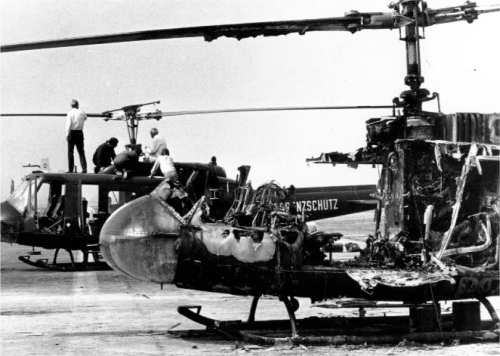
Two West German police helicopters used in the Black September hostage crisis at the 1972 Munich Olympics—the one in the foreground was destroyed by a terrorist grenade during a rescue attempt. The event raised concerns about nuclear terrorism.
NEST also has an arsenal of handheld nuclear detectors that can be concealed in any one of many at-taché cases, briefcases, lunch packs, and suitcases. The detectors can silently let a NEST member know that a radiation source has been detected by transmitting a signal to the member's concealed earphone.
In addition to equipment for detecting nuclear material, NEST also has diagnostic, disablement, and damage-limitation devices. Its diagnostic capability includes portable X-ray machines to peer under a bomb's outer shell as well as a hand-held device that looks like a Dustbuster and can pick up emissions to better estimate a threat. To disable a bomb, NEST might detonate explosives around it, or it could use a 30-millimeter cannon to blast the bomb into small pieces. The team can construct a nylon tent, 35 feet high and 50 feet in diameter, into which 30,000 cubic feet of thick foam can be pumped, which can mitigate the spread of radiation from a radiation dispersal device. According to a NEST team member, however, the foam is primarily intended to limit the damage from a non-nuclear detonation used to disable a nuclear weapon.
Since NEST's creation, about 100 threats involving alleged nuclear devices or radioactivity have come to its attention. At least a dozen, and possibly more than twice that number, have resulted in deployment of NEST personnel. NEST, in general, will not confirm or deny when or whether it has deployed to a particular city or region. However, it has been reported that between 1975 and 1981 NEST personnel were sent to investigate threats in Boston, Los Angeles, Spokane, Pittsburgh, New York, Sacramento, Tennessee, and Reno (Time, January 8, 1996; Washington Post, June 21, 1983).
The threat to New York came in July 1975 when terrorists claimed, “We have successfully designed and built an atomic bomb. It is somewhere on Manhattan Island. We refer you to the accompanying drawing in one-eighth scale. We have enough plutonium and explosives for the bomb to function. The device will be used at 6:00 p.m. July 10 unless our demands are met.” As reported in the New York Times Magazine, the key demand involved $30 million in small bills.
NEST was impressed by the drawing. According to one account, it was sophisticated, precise, and “made by someone with more than a passing acquaintance with nuclear physics.” But that did not lead the United States to part with real money. A dummy ransom package was left at the drop site in Northampton, Massachusetts, and FBI agents waited for someone to claim it. Nobody showed up and there was no further communication from the extortionists.
NEST's deployment to Washington, D.C. during the bicentennial may be the type of precaution that becomes more common after the September 11 attacks.
That same year, Fred L. Hartley, chairman of the Los Angeles-based Union Oil Company of California, received a note claiming that there was a nuclear device on one of the company's properties. The extortionist wanted $1 million; otherwise, the bomb would be detonated. Such a threat, away from the natural radiation of an urban area–where radiation can be emitted by freshly paved streets or Vermont granite in an office building–made it easier to use NEST vans in the search for a nuclear device.
“The guys were out there in their trucks listening to their earpieces,” former NEST official Jerry Doyle told Larry Collins, the author of the first major article on the search team. “Suddenly one got an intensive reading, looked up and there, about 50 yards away, was a big bulky, unidentified wooden crate resting by a refinery fence. There was a moment of real panic,” Doyle recalled. Fortunately, it was just a box left by some repairmen, and the signal came from natural radioactivity in the soil. The FBI managed to capture a suspect, who was tried and convicted, but was released after six months in prison.
NEST's deployment to Washington, D.C. during the bicentennial summer of 1976 may be the type of precautionary deployment that becomes more common after the September 11 attacks. Vans circled the streets and drove around federal buildings near the Mall, checking radiation levels. The FBI worried that a terrorist group might be tempted by the bicentennial's significance to threaten to explode or release nuclear material, but the summer passed without a threat.
Not all of NEST's deployments have involved nuclear terrorism. For three months in 1978, about 120 NEST personnel helped the Canadian government locate the remains of the Soviet Cosmos 954 ocean surveillance satellite that crashed into northern Canada. The following year, NEST equipment was used to monitor radiation in the vicinity of the Three Mile Island nuclear accident.
Returning to the Mirage Gold exercise, an intensive evaluation of NEST and the nature of the exercise revealed several problems.
By early morning on October 18, 1994, the first NEST search and support personnel had arrived in Louisiana and, along with FEMA and Defense Department personnel, established command posts in an unused industrial complex across the Intercoastal Waterway from the New Orleans Naval Air Station. Communications equipment–including secure voice, data, and video display systems for the exercise–had been installed in September. That afternoon, “a maritime target was located (anchored at Lake Michoud) and put under surveillance,” according to the Nevada Operations Office after-action report.
“Additional information,” according to the report, directed NEST personnel to a small flying service at an airstrip near Magazine Road in Belle Chase (the Naval Air Station). During a drive-by, the team's radiation detectors registered a “hit” which led them to a mock nuclear device hidden in an airport shed. Following orders from the FBI, NEST waited until noon the next day when the three Patriots for National Unity members drove away from the airport. While NEST kept the terrorists under surveillance, the FBI proceeded to secure the airport. When the shed was searched, an improvised nuclear device was found, along with information indicating that it was armed and set to explode on Thursday at noon.
NEST personnel constructed a 35-foot cone around the shed and pumped in thick foam to limit blast effects and absorb radioactive particles. One part of the Nevada Operations Office after-action report asserts that the plan to disable the device “was successfully carried out before the deadline without the release of any radioactivity,” although other parts are consistent with an account given by Andrew and Leslie Cockburn in their book One Point Safe (1997). According to the Cock-burns, someone had failed to obtain permission to detonate explosive charges to disable the simulated bomb. As a result, the search team was left with a mound of foam that made it impossible to determine if the bomb had been properly disabled, and forensic experts were unable to search the crime scene.
But according to a scathing memo sent to the manager of the Nevada Operations Office by Adm. Charles J. Beers, then the Energy Department's deputy assistant secretary for military applications and stockpile support, problems with Mirage Gold went far beyond such mistakes and involved the very integrity of the exercise. The Beers memo “requested” a general assessment of NEST that would address a number of concerns regarding the exercise. These included the failure to employ a realistic estimate of the time the operation would require, the negative impact of the large NEST structure on rapid decision-making, the leaking to NEST personnel of key information, including the location of the device, and the deployment of communications systems before the FBI had requested assistance from NEST. The consequences of such actions were “optimistic and unrealistic results.”
The Beers memo was also less than complimentary to the leadership of NEST. He wrote, “It is quite possible that we have allowed a management regime to be established that does not serve the NEST program as well as it should…. Perceptions of poor integration of assets, improper flow of information to players during exercises, and implications that an unrealistic time line has been advertised are not issues that can be solved by budget reallocations, but reflect on leadership and management of the program.”
NEST management reacted swiftly, commissioning an outside review group, headed by Duane Sewell, to examine the entire program. The group conducted more than 120 hours of interviews and produced an 80-page report, which noted that a deteriorating relationship with Energy had lowered both the morale and effectiveness of NEST. In addition, the review group found a number of well-known but unspecified “technical constraints which limit the ability of NEST to respond effectively to the full range of nuclear devices which might be developed by a terrorist organization.” Energy Department managers had not yet made a decision, according to the Sewell panel, as to whether they would continue to accept those limitations or seek the funding necessary for the research required to eliminate or reduce them.
A 1996 assessment of NEST, conducted by minority counsel to the Senate Governmental Affairs Committee, was relatively optimistic. NEST “is clearly a national asset which could not be duplicated by other organizations because of the unique scientific capabilities and field operational experience of the nuclear weapons laboratories that directly support it with volunteers and R&D.” The assessment noted that since the Sewell report, NEST had “successfully conducted its first truly no-notice full-field exercises overseas.” In addition, “in exercises since Mirage Gold, the NEST team had also deployed all of its resources within established time lines.” The search team had conducted 16 major command post and full-field exercises. But the report also cited continuing technical constraints, again unspecified, that senior management at the Energy Department needed to address.
The catalyst for NEST's creation in the mid-1970s was the attempt to enlist nuclear terror in the service of extortion. And some NEST exercises still employ a nuclear extortion scenario, according to a current team member. But the premise for Mirage Gold was different, and consistent with today's greatest fear–that terrorists may not be interested in money or changing government policy. They may simply want to detonate a nuclear weapon.
It is also a premise that puts a much greater premium on intelligence. Nuclear extortionists have to threaten a particular city or area and give the threatened party time to react, giving NEST time to deploy and attempt to locate any bomb that might be in place. But terrorists could strike anywhere, and would give no warning. A NEST spokesperson acknowledged that without advance intelligence, the team would have nowhere to go. Exceptions may include deployments at high-profile events, such as the Salt Lake City Olympics, which would be obvious potential targets for terrorists. But to prevent detonation of a terrorist nuclear device in other circumstances would require warning from the FBI, Central Intelligence Agency, National Security Agency, or an allied intelligence service.
Of course, even advance warning is no guarantee of success, given the difficulty of locating a hidden nuclear device and the limited time that may be available. A comment in the Nevada Operations Office's after-action report on Mirage Gold is chilling, not as a criticism of NEST members, with their diverse talents and dedication, but as an acknowledgment of a harsh reality. The report notes that it would be “a drastic mistake to assume that NEST technology and procedures will always succeed, resulting in zero nuclear yield.”
Today's terrorists may not be interested in money or changing government policy. They may simply want to detonate a nuclear weapon.