




Abstract
A Do-lt-Yourself: SIOP
Information about nuclear weapons is closely guarded, and information about the current U.S. nuclear war plan—the “siop” or Single Integrated Operational Plan that dictates how those nuclear weapons would actually be used—has been all but impossible to come by.
And it's not just the public who can't get their hands on the siop— even members of Congress with security clearances are not permitted a look at the plans developed by Strategic Command targeters in Omaha.
The problem, says Janne Nolan, director of international programs at the Century Foundation, is that “you have two worlds. You have the world of the political management of nuclear weapons—the stated policies. And you have the operational world, which is where the rubber really hits the road in terms of how forces are organized and postured to be launched in a crisis. Over time, these worlds became ever more separate.”
But now researchers at the Natural Resources Defense Council (nrdc) have developed a computer program, part of their “Nuclear War Simulation Project,” that can mimic the secret plan. The nrdc team hopes that by using their software, anyone can visualize the outcome of a nuclear attack scenario. Their goal is a deeper public understanding of what it really means to target countries like Russia and China with thousands of nuclear weapons on a day-to-day basis.
The SIOP problem
You might think that a senior U.S. senator—let's say the ranking member of the Senate Intelligence Committee—would be able to get straight answers about the siop. But that wasn't the case when Sen. Bob Kerrey of Nebraska asked for details about the targeting plan. Congress and the president are tasked by the Constitution with a vital role in determining national security policy, “but how can we provide the policy guidance that is needed,” the former senator asked last October in a letter to then-Defense Secretary William Cohen, “if we are not given the information we need to decide if our current course of action is the correct one?”
Specifically, Kerrey wanted a peek at the Slop, which directs how U.S. nuclear forces will be used in any number of crises. One might assume it includes targets, population figures, force numbers, weapon specs, and so forth. But that would be a guess, since nobody outside a small military circle has seen it.
What started Kerrey and other members of the Senate Democratic Caucus on their quest for information was the Joint Chiefs' claim that the United States could not realistically reduce its number of nuclear warheads below 2,500. They asked: Why that magical number and not some other number? But their questions went unanswered.
So the senators approached Bruce Blair, president of the Center for Defense Information and a former Min-uteman missile launch control officer, for his help.
“They wanted to know why the Joint Chiefs said they couldn't go below 2,500 warheads,” said Blair. “I explained it in terms of the war plan. We have 2,260 vital Russian targets in the siop today. You obviously need a lot of weapons if you have that many targets.”
Next, the Democratic Caucus asked for a briefing from Strategic Command, inviting the Republicans to join them. On June 15, 2000, in the “vault” of the Capitol building, Undersecretary of Defense Walter Slocombe and Commander in Chief of Strategic Command Adm. Richard Mies presided over the first siop briefing ever given to the full Congress. It did not go as expected.
“It was a very unhappy affair because they wouldn't answer the questions that were being posed,” said Blair.
Kerrey was also baffled by the constantly changing explanations—no less that seven—given him as to why Congress is not entitled to know the specific targeting decisions made by Strategic Command (Stratcom) in Omaha. Even for those legislators who might have access to the Presidential Directive that governs targeting, the actual targeting plan is classified beyond reach. Kerrey notes: “As an elected representative of the people, every member of Congress has an absolute need to know these details”; it is the only way to know that the instructions of the Presidential Directive are being followed.
Approximating the SIOP
In the absence of the real, classified siop, arms controllers have long made their own calculations. But the viewgraphs, charts, and reports that arms control experts generate are often too technical and convoluted for nonspecialists.
Researchers at nrdc have been studying the issue of nuclear weapons targeting, nuclear force numbers, and the mountains of other data surrounding the support of the nuclear arsenal for more than two decades. A confluence of advances in computer technology, availability of commercial satellite data, and old-fashioned ingenuity, allowed the nrdc team to create an interactive computer model of what they believe the siop might look like.
Nrdc claims that for the first time in unclassified literature people can view—with maps, charts, images, and other visual representations— and better understand the cumulative effects of the large-scale nuclear “counterforce” attacks that are part of U.S. and Russian nuclear war planning. They hope their program will illustrate alternatives to the current arms control process and eventually lead to more modest contingency war planning with far fewer weapons.
An idea germinates
The idea of developing a usable computer model for the siop came to nrdc Nuclear Project Director Tom Cochran and his colleagues in 1998, after President Clinton changed the presidential guidance allowing the number of targets to be lowered. “We thought if we could identify 90 percent of those targets,” said Cochran, “we could replicate the plan.”
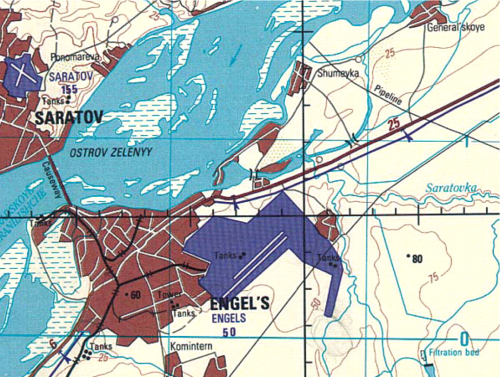
A Joint Operations Graphic (JOG) map depicting Engel's air base, located approximately 750 kilometers southeast from Moscow on the Volga River.
Before joining NRDC, Staff Scientist Matt McKinzie had been exposed to the Geographic Information System (gis) in the context of seismic monitoring of a nuclear test ban. A grant from Environmental Systems Research Institute, Inc. (esri)—makers of a popular gis software package called Arc View—got the nrdc nuclear war plans project team started on their efforts to replicate on a personal computer the effects of various nuclear options. Nrdc hired professional GIS programmers from the University of Florida to assist in initial programming and file structure. McKinzie took it from there.
As a physicist, nuclear weapons expert, and computer programmer, McKinzie had an ideal background to bring it all together. For example, the unclassified fallout data program that he had acquired from a contact working at Lawrence Livermore had to be modified to run on a personal computer. According to Cochran, McKinzie spent months tirelessly converting code and entering data. “I remember him on the bus going to an nrdc retreat converting code on his laptop.”
A composite image depicting central Moscow. The upper left and lower right quarters are JOG maps, primarily used for aviation. The lower left corner is a 16-meter resolution Ikonos satellite image taken on February 17, 2001. The map in the upper right corner is from a Moscow street atlas (note the Metro stations). The yellow aim points are military targets from the NRDC Russian target database.
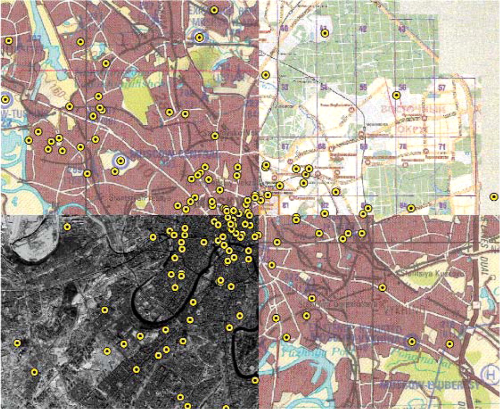
When they got back from the retreat, nrdc ordered Joint Operations Graphics (jog) aviation maps, which often have the telltale signs of military targets. For example, tank farms, antennae, or closely spaced piers in remote areas—useful landmarks for aviators—can be used to identify military depots, communication facilities, or submarine bases. Once such clues are correlated with other sources, a clearer picture emerges of where targets in the siop might be placed.
“I spent a lot of time trying to find targets,” Cochran said. After researchers at nrdc identified potential targets, that data had to be matched with the global coordinates (longitude and latitude) required by the gis program. “In the normal literature people don't give you coordinates,” he added.
Nrdc gathered and integrated data from open sources, including declassified documents, census and meteorological data, U.S. and Russian charts and maps, government and commercial satellite data, and nuclear weapons-effects data. Often they found data sources by asking: “Now who would want to keep track of this information?” They purchased a Russian commercial database that listed tens of thousands of industrial addresses. They located street atlases of Russian cities. They found command and control information from the International Telecommunications Union, which publishes a database of radio transmission sources around the world. They looked up local addresses in phone books, from which they could extrapolate geographic coordinates. Everything they needed was available to the public, they found, but it had never been brought together in one place.
“Once we got the start mou [memorandum of understanding] data it started looking possible,” Cochran said. The start data, which disclose many of the locations of U.S. and Russian strategic forces, are unclassified, but not widely circulated or published. They also knew that the SIOP targeted four types of military targets—nuclear forces, conventional forces, leadership and communication facilities, and war-supporting industry. They felt that if they could identify and classify those targets, they would be working from the same set of premises as the nuclear planners in Omaha. The information could then be fed into the computer and processed into a graphic model.
“Two years and 6,795 targets later,” Cochran said, “we had an adequate list.”
Nuts and bolts
ArcView allowed nrdc to integrate maps, treaty data, business information, satellite imagery, weather patterns, population data, fallout predictions—basically everything you'd want to know if you wanted to drop nuclear warheads on other people. As long as a target can be pinned down to a geographic coordinate, ArcView can tie it together and show how time or different variables can alter the results.
To start his information gathering, McKinzie had only to walk down the hall. For more than 25 years nrdc has collected information for its series of nuclear weapons databooks, so a lot of information was already in the nrdc offices. “So right away we had a set of data to enter into the database.” The amount of publicly available satellite imagery as well as commercial information designed to encourage investment in Russia also played a role in getting the project off the ground.
Next, McKinzie added code, called K-Division Fallout Code, version 3 (kdfoc3), that he acquired through a Lawrence Livermore beta-testing program. “With KDFOC3, we've reached another level for getting open source information for calculating fallout,” he said. “It's an unclassified code, but by comparing its predictions to actual fallout data, it can tell how dirty a nuclear weapon can get.”
The whole game, McKinzie explained, was to put together the program on an unclassified basis to shed light on classified secrets.
Finally, because ArcView is an off-the-shelf desktop computer software package—currently used by, according to the ESRi web site, more than 500,000 users worldwide—it is potentially portable across several computer platforms.
How low can it go?
“Anyone who has been doing research in this area has to look at the war plan, the siop,” said nrdc Senior Staff Analyst Robert S. Norris. At an early point in the project, it dawned on him that the difficulty experts have with discussing lower numbers of nuclear weapons was directly related to the war plan itself. If you have a certain number of targets, the plan has to have a corresponding number of warheads to deal with them. “The idea isn't novel, but it is one of those moments of clarity,” he said. As the project progressed, Norris said they began to hope that they could use the model to show how a smaller number of nuclear weapons—a much smaller number—could be as effective a deterrent as the more than 10,000 we have today.
These graphics generated by NRDC's program show how fallout would spread following an attack on the SSBN mooring area on Russia's Kola Peninsula. With typical January winds (right), fallout would be blown toward Murmansk, killing 250,000. A typical August wind pattern (above), however, would scatter fallout over the largely uninhabited arctic coastline, killing about 5,000.
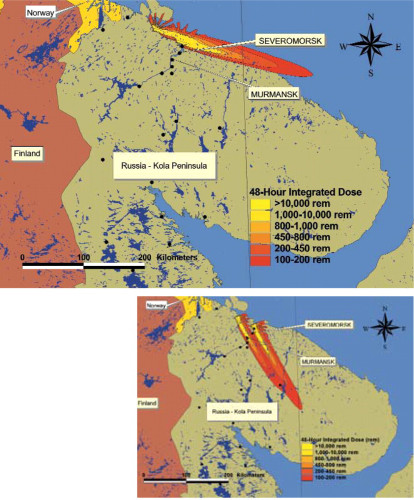
But rather than pulling some magic number out of a hat, nrdc ran a series of specific scenarios with their program—three of which are published in their report, “The U.S. Nuclear War Plan: A Time for Change”—which allowed them to generate the pictures and maps that illustrate the outcomes visually.
“We couldn't have done this 10 years ago,” Norris said. “Advances in satellite imagery and computers, greater information about Russia in general, and increased access to information have made it possible. “We hope people can use this program to reflect more deeply about the siop problem, and we want to show how the siop prevented progress [in arms reductions] during the Clinton administration. Our goal is to change the circumstances that will allow us to live in a safer world.”
Counterforce versus countervalue
At the core of their questions were the two reigning theories of how to target nuclear weapons: “counter-force” versus “countervalue.”
Experts love to debate the intricacies of these theories, but basically a counterforce strategy targets an enemy's forces. Countervalue strategy targets populated areas, mainly cities. When you're talking about thousands of nuclear weapons—and the mass fires, fallout, and destruction that they can cause—the differences between counterforce and counter-value quickly begin to blur. Millions are going to die—instantly or over time—either way.
Another distinction is that a countervalue strategy requires fewer weapons. When the primary purpose is to hold the lives of millions of people hostage, it takes relatively less nuclear fire power—much less.
On the other hand, if the strategy depends on knocking out an enemy's nuclear forces, or conventional forces, or command and control centers (and on down the line), it takes many more weapons, because any logical military defensive strategy is going to include spreading weapons and key facilities around and fortifying them so they're not all at risk from a single attack.
In the earliest days of the Cold War, the United States mainly targeted large cities. But as the number of missiles grew, it eventually had enough warheads to target individual Soviet weapons and bases, and military targeteers took the position that a strategy targeting weapons and not people—counterforce—was more “moral.”
Just one problem. If you lob enough nukes to take out the Kozelsk missile fields more than 200 kilometers west of Moscow (to use one of the examples detailed in the NRDC report), you're incidentally going to kill millions of people. So while counterforce doesn't target people, per se, millions of civilians are still at risk.
“After we did our analysis,” Cochran said, “it raised some interesting issues about countervalue versus counterforce. For example, if you can hold at risk one-third of Russia's population with a single submarine, you can go to very deep reductions without feeling naked in the absence of your deterrent capability.”
So when talking about the morality of any nuclear targeting strategy one thing quickly becomes clear: It's all horrific. Nrdc takes the extra step of presenting these scenarios graphically so the public, and not just experts, can understand the results.
This, they said, should insert the human element back into the discussion. “We wanted to put some zip codes on these warheads,” Cochran said.
Firing the virtual missiles
The first scenario that nrdc ran involved a counterforce attack against Russian nuclear forces. They believed this scenario to be close to the one fabricated by Stratcom. Using the most comprehensive levels of targeting for Russian aviation and naval sites, the total number of warheads required by the first NRDC plan was 1,289, including 500 W87 warheads, 220 W88 warheads, and 569 W76 warheads (with a total yield of more than 300 megatons). This represents the entire arsenal of U.S. single-warhead Minuteman III intercontinental ballistic missiles (iCBMs) and slightly more than four fully loaded ballistic missile submarines (ssbns). This equals nearly half the number of U.S. nuclear weapons on high alert today and still less than the number of weapons on high alert in a future start II force.
The result of the “attack” as detailed in the report: “More than 90 percent of Russian icbm silos would be severely damaged; all 50 SS-25 garrisons and bases would be destroyed; all three SS-24 bases would be devastated by air bursts; all Russian Northern and Pacific Fleet naval sites would be radioactive ruins, and any SSBNs that had been in port would become blasted pieces of metal on the bottom of the bays; more than 60 important air fields would have their runways cratered and any strategic bombers caught at the air bases would be severely damaged; 17 nuclear warhead storage sites would have their bunkers turned into radiating holes; the entire Russian weapons production and design complex would be blasted apart, killing a large fraction of the nuclear workers; and communications across the country would have been severely degraded. The attack would take about 30 minutes.”
This simulated countervalue attack on Russian cities west of the Urals uses 192 W88 warheads—the load aboard a single Trident II submarine. NRDC used the most probable wind pattern for June and calculated the radiation dose to unsheltered persons over the first 48 hours after the attack. With a fission fraction of 80 percent, computed casualties totaled 52 million people, including 49 million deaths.
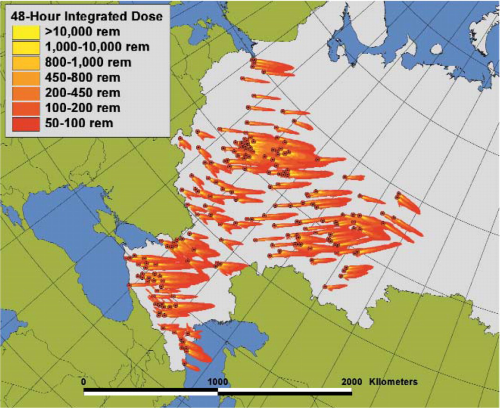
Then the fallout would descend, creating lethal conditions over an area larger than 775,000 square kilometers. (By comparison, the area of Texas is 678,358 square kilometers.) With fission fraction values between 50 and 80 percent (a measure of how “dirty” a nuclear weapon is) casualties would be between 11 and 17 million, of which eight to 12 million would be fatalities.
This illustrates that even with a counterforce strategy targeting only nuclear forces, millions of civilians still die. The nrdc report notes that existing U.S. policy, which requires levels of alert of strategic nuclear forces in excess of 1,300 weapons, can be readily understood as maintaining such a counterforce capability against Russia.
But what would happen if the United States drastically reduced the number of weapons in its arsenal and abandoned the pretense that one kind of nuclear targeting is more morally acceptable than another? How many nuclear weapons is enough to deter a nuclear attack on the United States, which, according to the nrdc report, is arguably the only reason for continuing to possess nuclear weapons at all?
To illustrate this, nrdc ran nuclear attack scenarios on Russian cities using either 150 single-warhead, silo-based icbms or 192 single-warhead, submarine-launched ballistic missiles (slbms), essentially the load aboard a single fully loaded Trident submarine. The results from either scenario, each using less than 3 percent of current U.S. nuclear forces, resulted in more than 50 million casualties.
But what does this mean? In 1962, then-Defense Secretary Robert McNamara defined “mutual assured destruction” (mad) as the intolerable level of destruction—killing 25 percent of a country's population and destroying 50 percent of its industry—that would most likely deter a nuclear attack. Using these arbitrary criteria, nrdc found that a remarkably small number of nuclear weapons, used in a countervalue attack against Russian cities, would be needed.
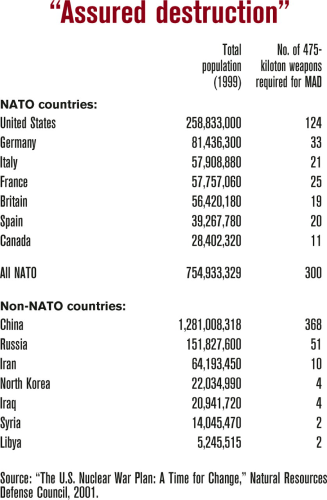
To illustrate how few weapons are needed for mad, McKinzie looked at each “cell” in a population distribution database. For its population data, Stratcom divides the world into cells measuring somewhat less than a square kilometer. For each cell, McKinzie asked the computer to count the population within a 9-kilometer circle—the radius inside which MIT physicist Ted Postol concluded that mass fires from W88 air-bursts would be anticipated in urban areas—and then chose the cells with maximum nearby populations as the nuclear warhead “ground zeros.”
He found that detonating only 51 high-yield (475-kiloton) W88 warheads would achieve McNamara's “assured destruction” criteria for Russia. To be fair, nrdc also ran this calculation for several countries, including some U.S. allies and key “rogue” states. (See “Assured Destruction,” above.)
“Assured destruction”
Source: “The U.S. Nuclear War Plan: A Time for Change,” Natural Resources Defense Council, 2001.
What it means for arms controllers
According to Bruce Blair, while there are many models of strategic nuclear exchanges, they don't take the step that the nrdc model has taken to provide graphic representations of targets and the consequences of an attack that you can appreciate visually. By putting a human face onto an abstraction, nrdc's model helps people “understand the war plan and its consequences. Then they can decide for themselves if it represents proof of certain views,” he said. “It is an important advance in both our ability to grasp the war plan and its consequences, because it converts abstraction into graphic consequences. And that's very important, just to be able to see all those red dots on the map.”
Most strategic exchange models produce only numbers, not maps and graphic representations, Blair explained. The nrdc model “is the first one that's in circulation in the arms control community that does this. It's a flexible model that allows us to jigger the assumptions and test our hunches about alternative war plans.”
The impact on policy-makers could be profound, he noted. To see the plan unfold and the casualty numbers mount using a reliable model could give people a fuller grasp of the issue.
And armed with this kind of knowledge, Blair says, policy-makers could start demanding to learn more about the actual war plan, “to expose it to the light of day, at least within the vaults of Congress,” and to push for reform and reduction.
“It illustrates the truly apocalyptic character of the war plan,” Blair continued. “In the past we'd say ‘what if and then sit down and spend days trying to calculate the casualties or the destruction of silos by a certain war plan variant. It was a daunting exercise that a lot of people aren't equipped to do.”
He said that the nrdc package is a “soup-to-nuts” program that can quickly answer a lot of questions. What used to take weeks or months to calculate can now be produced in minutes or seconds.
For example, one of the striking calculations that Senator Kerrey noticed when he saw a demonstration of the NRDC program was the number of casualties that can be caused by a single Trident submarine firing its load at a Russian civilian population. Even though this is no longer how the United States targets its missiles, he could see that if the object was to kill people, one Trident submarine could kill more than 40 million. “That's a striking result,” Blair said. “And then you can pursue other variations that are interesting questions. It's just a very practical, convenient, expedient tool—one that is as refined as it needs to be—to expose the many facets of nuclear targeting. It just reveals information, and there's no real counter to it. There's no antidote to the truth.”
Janne Nolan hopes that the nrdc model will also be used by journalists, who often find the intricacies of nuclear targeting beyond their scope. She points out that if you look at the period of time spanning start I and START II, military planners have gone from an “absolute” requirement for 6,700 weapons down to 4,500, then to 3,500, and now 2,500. “And very few reporters ask where these numbers come from and what they mean,” she said. “The assumptions that guide the calculations of how many weapons you need on target haven't been subject to any systematic policy oversight for decades.”
One exception occurred in 1991, when Vice President Dick Cheney— at the time secretary of defense— ordered a targeting review. “He was shocked by the idiotic redundancy that had been built into these plans,” Nolan said.
An example of this kind of redundancy was discovered by Gen. George Lee Butler shortly after he took command of Strategic Air Command in 1991. He already had doubts about the operational feasibility of the war plan, but when he saw for the first time how general presidential guidance is translated into actual targeting, he was appalled at what he found.
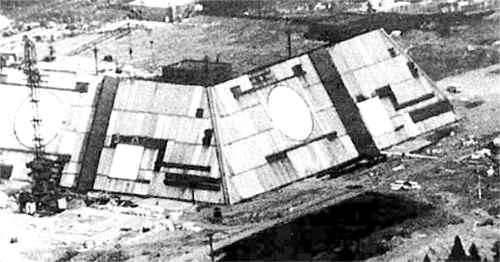
For example, of the 12,500 targets then in the Slop, reported the March 15, 1998, New York Times Magazine, one particular target was slated to be hit by 69 consecutive nuclear weapons. At the time, Blair speculated that the target might have been a deeply buried command post at Chekhov. It turned out, Blair later told the magazine, the target was the Pushkino radar facility on the outskirts of Moscow. Defying common sense, a defense contractor had somehow managed to conclude that the above-ground radar facility was resilient enough to require a 69-missile attack.
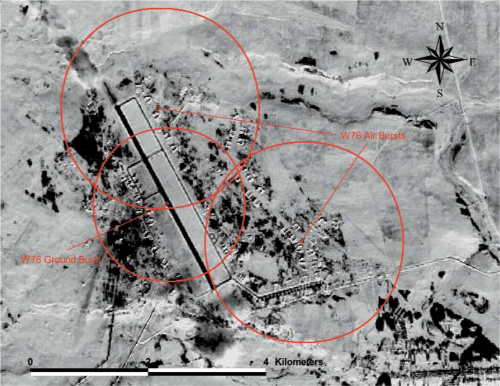
NRDC Superimposed three aimpoints for W76 warheads over this commercial satellite image of the Ukrainka air base taken on January 17, 2000. The Bear bombers within the circles would have a 90 percent chance of being destroyed. In order to crater the runway and make it unusable, a ground burst was selected for the center aimpoint.
Hardened target or miscalculation? At one point during the Reagan years, this aboveground radar at Pushkino, located just outside of Moscow, was targeted with 69 nuclear missiles. Although counterforce strategy targets only military targets, the facility's proximity to Moscow means that millions of people wereand areheld at risk.
In the end, Nolan sees the nrdc project as helping to show that the numbers aren't magic, that they are derived from particular assumptions and methodologies. “I think it would be useful for reporters when they write about this topic that they'll understand some of the assumptions behind a number like 2,500.1 think anything that helps you understand how operational practices affect nuclear policy—what we say and do about arms control—is a good thing.
“It's a very arcane world,” she concluded, “and this chisels at its ‘sacred’ nature.”
Defining an enemy
A final issue addressed by this nrdc project is posed by the question, “What defines an enemy?” During the Cold War, it was obvious that the Soviet Union was a threat to the United States. “But now Bush tells us that Russia is no longer our enemy,” said Norris, “and if he means it, he'll need to do some things differently.”
The very act of targeting someone defines them as an enemy, Norris continued, and that's what the war plan is about: “It assumes they're an enemy and then goes about doing something about it.” That “something” is targeting thousands of nuclear weapons at Russia. “You have to build defenses on your opponents' capabilities, not their intentions,” he noted. In other words, actions speak louder than words.
“Our mission has always been to widen the debate and make our leaders reflect differently about these issues,” said Norris. Ultimately, Norris and his colleagues advocate the adoption of a set of contingency nuclear war plans that do not target any country on a day-to-day basis. Instead, nuclear weapons would be handled more like conventional forces. In the event of hostilities with another nuclear state, forces would go on alert, the pre-launch status of missiles would be upgraded, and a plan would be drawn from preexisting guidance. That would alleviate the need for large numbers of weapons and defuse the implications that go with the ongoing targeting of specific counties.
Not just another face in the crowd
Cochran believes the interactivity of their model will distinguish their project from the many other policy projects out there. He also believes that if they can replicate closely what Stratcom is doing, people will pay attention. “There's a zillion people putting out policy papers that just stack up on your bookshelf,” he says. Early on, nrdc established credibility in the arms control community by publishing its series of Nuclear Weapons Data-books, which detailed force numbers in way that had never before been revealed. “Until you pry open the secrecy it can be very hard to prevail in these arms control debates. This is the last big secret. We want to expose Stratcom's calculations and numbers so the public and Congress can understand the war plan and its implications.”
They also hope their work will force the government and arms controllers to defend their numbers, so that if someone says the United States needs 1,000 warheads, they're forced to back it up, especially when talking about a modern-day Russia that has seen a sharp decline in its military infrastructure. For example, Cochran asked, “Why do we still have to take out a war industry when it's collapsed of its own accord? Why do we have to take out the Russian Army when it can't win a war in Chechnya?”
In the end, Cochran wants the United States to treat Russia just like any other country and eliminate the day-to-day siop operations that keep U.S. missiles poised for a nuclear first strike. “We're saying take a grand leap to get out of this counterforce mode—even in the interim—and see if the other side matches.”