



Abstract

Now that the long and bitter national presidential election is finally over, and conservative Republicans have once again seized the executive branch, we can expect advocates of resumed nuclear testing–undoubtedly led by James Schlesinger, former secretary of both defense and energy–to come swarming out of the woodwork. The effort to resume testing may eventually be as vigorous and–if successful–as costly as efforts to resurrect Reagan-era “Star Wars” missile defense technology.
If this occurs, both the public and Congress would be wise to examine previous arguments by the nuclear weapons establishment–which were invariably characterized by outright falsehoods, half truths, and wild exaggerations.
Advocates of testing will be quick to point out that it has been more than eight years since the United States conducted a full nuclear test–more than twice as long a period as the 1958-61 test moratorium. The weapons labs, they add, are deep into terra incognita when it comes to predicting the future behavior of U.S. nuclear weapons, most of which are long past their expected stockpile lifetimes. And only the Energy Department's science-based Stockpile Stewardship Program, with its numerous problems and cost overruns, guarantees the reliability of the nuclear weapons arsenal.
The Comprehensive Test Ban Treaty (ctbt), which the Senate refused to ratify in October 1999, provides a loophole that allows signatories to resume testing if they believe their national security is jeopardized by unreliable weapons. Opponents of the ctbt will repeat their belief that ongoing nuclear testing is required to ensure confidence in aging weapons.
From the beginning, the Energy Department and its predecessor organizations, especially the Atomic Energy Commission (aec), have been less than candid with the American public about important aspects of the nuclear arms race between the Soviet Union and the United States during the Cold War.
This was especially true when it came to the arguments made for the necessity of continued nuclear testing between 1954 and 1992. The weapons labs, the Defense Department, and other constituents of the nuclear weapons establishment always presented worst-case scenarios when discussing possible results of a nuclear test ban.
An early example of this deception was the “great clean weapons fraud” of the late 1950s, when aec officials and President Dwight Eisenhower repeatedly assured the world that great progress was being made in the development of “clean” nuclear weapons–that is, weapons that produced less radioactive fallout than comparable weapons of the same yield. Recently declassified internal aec documents show, however, that little progress was actually being made.
In some respects, the political aspects of “clean” weapons were more important than their military applications. In 1958, there was worldwide political pressure on both the United States and the Soviet Union to curb nuclear testing. Tests of clean weapons could be justified on the basis of diminished global fallout. In addition, continuing the U.S. nuclear testing program could more easily be defended from negative public opinion by the need to perfect clean weapons.
It was also politically advantageous to the United States to portray itself as being more interested and more advanced in the development of clean weapons than the Soviet Union. Continued testing to develop these weapons, and even their use in combat, could be justified on the basis that they were more “humanitarian” than “dirty” Soviet bombs.
In an August 1957 draft staff paper, Morse Salisbury, director of AEC's information services division, stated that one of the major public relations objectives of his office was to convey that “clean strategic and tactical weapons and non-military uses of atomic explosive devices will result only from further tests,” and that the United States was “making substantial progress in the development of such devices.”
However, just 10 months later, within the safeguarded and cloistered halls of the AEC, Salisbury was saying something quite different.
One shot considered for phase I of the Hardtack series of tests was named Piñón. The test was designed to allow foreign scientists–at the invitation of President Eisenhower–to collect radiological samples and verify publicly and dispassionately that the United States indeed had a small, tactical, high-yield, and clean thermonuclear warhead.
Although Piñón was canceled without being fired–the presence of uncleared foreign observers near one of the most sophisticated and advanced nuclear devices turned out to be a logistical and security nightmare–remarks made by Salisbury in June 1958 reveal alternate reasons for the cancellation.
May 25, 1953: The first and only test of a tactical nuclear artillery shell.

“The Piñón device,” he said, “in either case, would be so large that it clearly would not illustrate the cleanliness of the small tactical defensive weapons that have been stressed in public references to Hardtack and in other statements of policy on testing. To the contrary, such detonations in Piñón would disclose that we have made essentially no progress in our attempts to reduce substantially the size of feasible clean weapons…. If we had a small ‘clean’ weapon we would certainly be expected, in light of our public statements on the subject, to use it for the [U.N.] Demonstration Program.”
This statement–highly classified at the time and circulated only within the aec–was at great odds with what Salisbury said 10 months earlier: Within the aec, “essentially no progress” was being made in the development of small clean weapons; nonetheless, the public was told that “substantial progress” was being made.
In July 1957, nearly a year before Hardtack, Gen. Alfred Starbird had addressed the status of the clean weapons program and certain aspects of Operation Hardtack, including the “open” shot.
“Is there danger,” the general asked, that the public “will get a mistaken idea as to how soon we shall have clean weapons and in what types? I believe that there is a great danger that this can occur, and could hurt our interim programs which are necessary until clean versions are available.”
The general concluded that the earliest a clean tactical weapon might enter the arsenal was 1961 or 1962, if they had some “very lucky breaks in [Operations] Plumbob and Hardtack,” and that it would be several more years before weapons of lower fission yield and greatly reduced size would be available.
As early as September 1957, the Los Alamos Scientific Laboratory admitted that only high-yield weapons (heavy bombs and warheads) could be expected to be largely clean and that “cleanliness” was most important for high-yield rather than low-yield warheads.
By the end of Hardtack Phase I, the only clean weapons in the stockpile were six megaton MK 36Y2 gravity bombs, which were strategic, not tactical.
Little progress had been made toward miniaturizing clean weapons. On August 25, 1958, Commander Harry J. Waters of the navy's research and development branch wrote: “We do not know how to make small nuclear weapons which derive a very small fraction of their yield from the fission process, i.e., the so-called clean tactical weapon,” he admitted. “Our weapon laboratories are investigating various interesting ideas which may eventually permit the design of a clean tactical weapon … but there is no contender which will be available in the near future.”
More recently, the Energy Department has been less than honest in its public statements about stockpile reliability, that is, how the long-term viability of the U.S. nuclear weapons arsenal can best be guaranteed. For many years, stockpiled weapons were occasionally selected at random and fired at the Nevada Test Site to determine if the weapon produced its certified yield.
An example of this was the April 22, 1986 partial-yield test of an aging W56 Minuteman warhead during Operation Charioteer. This was the first firing of a W56 since 1962.
The W56, first deployed in 1963, was more than 20 years old at the time of the test. In addition, the weapon had been modified (without nuclear tests) to improve its performance. All arming and firing systems performed successfully; the measured yield was as expected, showing that the W56, although past maturity, was still a potent and reliable weapon.
“Effects tests” provide ad hoc stockpile reliability testing. Most of these tests were conducted to determine the effects of radiation on delivery system or warhead components, blast shelters, missile silos, and other systems. While most effects tests used custom, special purpose nuclear explosive “sources,” some used stockpiled warheads, or replicas of stockpiled weapons.
The use of a stockpiled warhead for an effects test implied a fairly high level of confidence in the device's predicted behavior, but these effects tests were nonetheless also tests of the warhead's reliability.
On several occasions, both during congressional hearings and in classified reports supporting continued U.S. tests, laboratory personnel claimed that as many as one-third of all U.S. nuclear warheads stockpiled since 1956 required nuclear tests to identify and solve problems.
This myth originated in a hearing before the Senate Foreign Affairs Committee in April 1986, when Roger Batzel, then director of the Lawrence Livermore National Laboratory, stated that “in the 25 years since testing resumed after the 1958-1961 nuclear test moratorium, one-third of all modern weapon designs that were thoroughly tested before entering the stockpile have required post-deployment nuclear tests.”
This “one-third” included an entire generation of so-called “sealed pit” weapons in which nuclear components are an integral and nearly unremovable part of the warhead. A few months later, Richard Perle, assistant secretary of defense during the Reagan administration, testified to the Senate Armed Services Committee that since 1970 alone, eight nuclear tests had been conducted to “correct” defects in stockpiled weapons.
Unfortunately, persons who reiterated the “one-third of the stockpile had problems” mantra failed to add that many of these problems could be traced to a handful of common components, mainly primaries (also called fission stages) shared among several single-stage and multi-stage weapons.
Effects tests
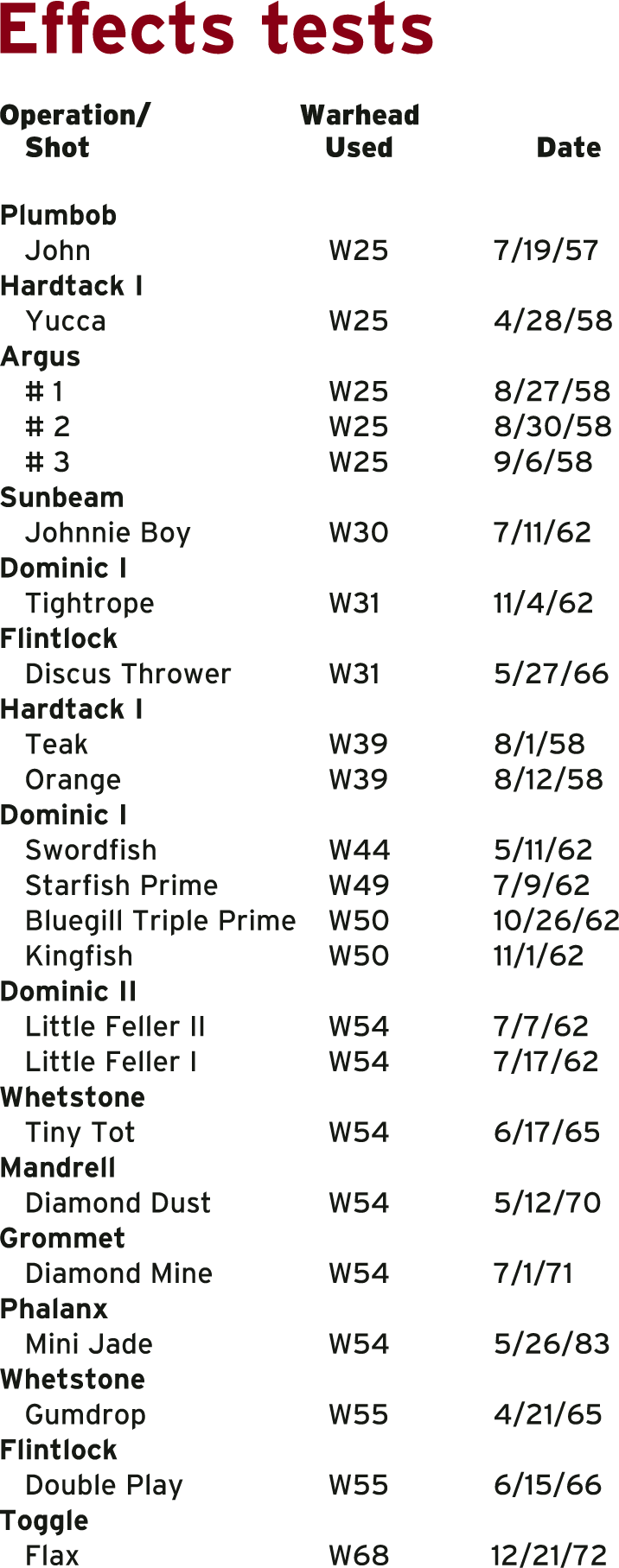
In fact, nearly 43 percent of the alleged problems could be blamed on five primaries. The MK 43, W44, W50, MK 57, and W59 shared a common primary, the “Tsetse”; the W/MK 28, W40, and W49 also used a common primary, the “Python.” Both of these primaries were plagued by a tritium cross-section miscalculation discovered during the early 1960s after the nuclear testing moratorium had ended.
Similarly, the Livermore-designed W38, W45, and W47 shared a common primary, the “Robin.” The Los Alamos-designed W30 and W52 also shared a common primary, the “Boa.” The Livermore-designed W55 and W58 shared the “Kinglet.”
Later warheads that suffered problems also shared common components, or components derived from the design of an earlier weapon. The primary of the W80 was derived from the primary of the MK/B61 gravity bomb. The Livermore-designed W62 and W70 shared at least one major common component, as did the Los Alamos-designed W66 and W69. Many of the post-deployment stockpiled warhead problems can be traced to these common components, and the alleged stockpile reliability problems were of considerably lesser magnitude than claimed by government scientists.
Deceptive arguments regarding stockpile reliability may well arise again in the future, should Energy's ambitious Stockpile Stewardship Program falter, or require that nuclear testing be resumed to guarantee the future viability of the U.S. nuclear deterrent. Proponents from both inside and outside the U.S. nuclear weapons establishment continue to advocate the resumption of testing to demonstrate the reliability of the U.S. stockpile. In this environment, politically driven “worst case” arguments are bound to surface again, regardless of their accuracy.