Abstract
Stranded in Gibraltar, a nuclear sub becomes a political hot potato
The Rock is a hard
In Spain, they simply call it el Peñon, or the Rock—that large wall of limestone jutting out from Spain's southern coast which, to the dismay of Spaniards, has flown a British flag since 1713. Despite Spain's long-standing claim over el Peñon— Gibraltar—the residents of the tiny peninsula have repeatedly sworn their allegiance to the British crown.
May 19, 2000: The Tireless arrives in Gibraltar

That allegiance was severely tested this summer by a drawn-out dispute over a damaged nuclear submarine stranded in Gibraltar's port.
In mid-May, the Tireless, a British nuclear-powered attack sub, was forced to make an emergency stop in Gibraltar—its reactor was shut down after a leak was detected in the reactor's cooling system. The Royal Navy initially announced that the naval base at Gibraltar was not equipped to repair the reactor, and that the sub would be transported to Britain when weather permitted.
By late July, however, the British government had changed its plan. In response to questions from Spanish authorities, the navy stated that it had ruled out transporting the boat to Britain because of “bad climactic conditions.” Instead, it would bring the necessary repair equipment to Gibraltar.
The residents of Gibraltar were not pleased. Responding to growing public opposition to the navy's decision, Gibraltar's chief minister, Peter Caruana, told the BBC on August 18 that although the colony was “a willing host” to the British Navy, “the [Ministry of Defence] needs to think long and hard about whether to proceed with the repairs.”
Making matters worse, information was leaked to the press that the Ministry of Defence had completed a classified “safety case” about the sub. Chief Minister Caruana demanded that repairs on the boat be halted until information from the classified report was turned over to an independent panel of experts, who would assess the potential risks to Gibraltar residents.
Concerned that—as one reporter put it—the sub “was becoming caught up in the wider question of the future of Gibraltar,” the British government acquiesced to Caruana's demands and suspended work on the sub. The navy also began a public relations campaign, inviting locals to take tours of the boat with crew members and downplaying the danger posed by the sub's reactor. In an interview with the Daily Telegraph (August 21), Mike Hawthorne, the skipper of the Tireless, described the damage as a two-millimeter crack in one of the cooling pipes. “It is absolutely safe,” he said. “What we have is a leaking pipe. You could put your finger over it to stop the leak.”
In mid-September, the panel of experts concluded that there was no risk to public health or the environment, and local authorities agreed to allow the repairs. Not all residents of the Rock were convinced. In a September 18 press release, a coalition of citizen groups stated: “We want to transmit the message that Gibraltar will not tolerate being used as the dumping yard for the repairs of nuclear submarines. We must show not only to Great Britain but to the world at large that we cannot be treated as a colonial people.”
“Was it something I did, or something the government did?”

The sub was a political hot potato in Spain, too. The government of President Jose Maria Aznar stated early on that it “was totally removed from the situation, whose responsibility falls exclusively on the United Kingdom.” But political commentators and members of the leftist opposition party criticized the government for accepting the safety assessments of the British Navy, which they argued was not being completely above board about the situation. They also criticized the British for jeopardizing the security of nearby Spanish cities.
Wrote one columnist: “Great Britain is not acting appropriately to be a Spanish ally. Despite the fact that the submarine is located in Gibraltar, which unfortunately is English territory, the damage that could result from an accident would have terrible consequences in a large area of Spain” (El Mundo, September 7).
—Michael Flynn
Faster than a speeding computer
Moore's Law—named after Gordon Moore, the co-founder of Intel who began observing the phenomenon in 1965—states that the density of data a state-of-the-art computer can handle doubles every 18 months. But if you have the bucks, you can make things go even faster.
At least that's the case with the $215 million supercomputer that will be built at Los Alamos National Laboratory by early 2002, reported the August 23 Albuquerque Journal.
The lab has hired Compaq Computer to wire together almost 12,000 DEC Alpha processors that will calculate simulated nuclear explosions at a speed of 26 teraflops (a teraflop is one trillion calculations per second). The computer will be called “Q.”
(For comparison, the fastest personal computer on the market, made by Apple Computer, has dual 500-Mhz processors that can theoretically process 3.6 billion calculations per second.)
“No one comes close.”
The new U.S. Air Force slogan, which has prompted complaints from Pentagon insiders who claim it is too easily used to mock the service's bombing accuracy.
It seems like just yesterday that the Bulletin reported the December 1996 supercomputer breakthrough, again at Los Alamos, where a 9,000-processor “ultracomputer” reached a blistering speed of just one ter-aflop. So much for Moore's Law.
What is the theoretical upper speed limit, then? According to the September 2 New Scientist, MIT physicist Seth Lloyd might have the answer—and it looks more like a piece of the big bang than an air-conditioned box at a nuclear laboratory.
Don't be fooled, Lloyd has no idea how to build such a computer. But based on the physical limits of energy, volume, and temperature, he estimates that a 1-liter laptop (an arbitrary size picked because you have to start somewhere), could perform 1051 calculations per second.
This computer would process information by converting its own mass-energy into radiation. Input would be via a controlled gamma-ray generator, and output would be done by counting the “processed” photons as they exit the box. Binary data that current computers store as magnetic “ones” and “zeros” would be a function of entropic states of matter.
Cooling could be a problem, though. With all those shifting states of matter, the ultimate laptop would operate at about a billion degrees.
—Bret Lortie
Don't say we never gave you anything

In brief
▀ Secrets on your sleeve
When the National Reconnaissance Office (nro) distributed an embroidered patch to its employees in commemoration of the launching of a new NRO satellite on August 17, the gift was more of a giveaway than intended. The hush-hush agency's fancy needlework shows an owl wearing mesh glasses—reminiscent of the wire mesh that covers the antennas on the agency's secret “Lacrosse” radar imaging satellites. But the patch also indicates the satellite's approximate inclination—the angle at which its orbit crosses the equator. Canadian satellite tracker Ted Molczan determined from viewing a copy of the patch on a Florida newspaper website that the path would be at a 68 degree inclination—and that's where he found it (Washington Post, August 30).

▀ When paranoid worlds collide
Two years ago, in an effort to deflect the many requests it got for info on flying saucers and space aliens, the National Security Agency began posting declassified documents on the subject on its web site (Baltimore Sun, August 8). But rather than relieving the pressure, the web page has encouraged UFO enthusiasts to demand more. What fascinates UFOlogists who visit the site—some 30,000 of them a month—are the agency's thousands of pages of unofficial reports, many with little or no information in between sections of heavily censored text. “Maybe it has nothing to do with aliens, that's a possibility,” says John Greenwald, a California UFO document collector. “But I've never found so many documents this blacked out before, and that adds to the fascination.”
▀ Red rover, red rover
A recent press release from NASA revealed that it had decided to send up two Mars rovers rather than just one, as previously planned. The release went on to explain: “The rovers will be exact duplicates, but that's where the similarities end” (New Scientist, August 26).
▀ After a couple, the taste doesn't matter
The Commerce Department may be responsible for checking the export of sensitive technologies to Russia, but the Bureau of Alcohol, Tobacco, and Firearms has fingered a much less high-tech item that is being shipped there from the United States. According to the August 6 Chicago Tribune, as many as six U.S. distillers have been smuggling tens of millions of gallons of American-made grain alcohol—by disguising it with dye and describing it as windshield wiper fluid, cologne, mouthwash, or cleaning solvent. Once the product arrives in Russia, the dye is chemically removed, a little “vodka flavoring” added, and it's off to the black market.
From the one-actor play The Idiot—based on Dostoevsky's novel—winner of a Wellcome Trust grant for dramatic works about science.

▀ It's win-win for Cheney
If Republican candidates George W. Bush and Dick Cheney win the presidential contest—and Bush reduces the nuclear arsenal as he has threatened—then Brown & Root, a subsidiary of Cheney's Halliburton Co., could stand to make a bundle from contracts for removing and dismantling even more Russian intercontinental missiles than it is now doing. On the other hand, if Bush-Cheney opponents Al Gore and Joe Lieberman win—and U.S. soldiers continue to serve as peacekeepers despite Cheney's objections—then Hallibur-ton subsidiary Brown & Root will continue to profit from its contracts for support services to U.S. peacekeepers abroad.
▀ Not sensational enough?
Several environmental groups as well as Physicians for Social Responsibility have been impressed by increased federal funds devoted to preparation against terrorist attack. Their own proposal (which seems almost too sensible to be accepted in the current climate) is that the first line of defense against chemical terrorism should be prevention—reducing the quantity of hazardous material when possible, and improving safety and security standards for chemical hazards when elimination is not feasible (Chemical & Engineering News, August 21).
▀ For and against
In 1995, after Nevada used part of a federal grant (provided for state oversight of the Yucca Mountain waste site) to lobby against the facility, the federal government promptly yanked the funds. This year, Nevada Sen. Harry Reid, a Democrat, introduced a bill to prevent the U.S. government from advertising free tours of Yucca Mountain, because, he says, those tours—offered to the public and described by the Energy Department as “community outreach”—are used by Energy to lobby in favor of the waste project. And “turnabout is fair play,” says Reid (Las Vegas Sun, September 8).
▀ Congress at work, part 1
When Congress wrote the fiscal 2000 defense appropriations act, it included language directing that in future years the air force must include a request for funding a fleet of 94 B-52s instead of the 76 bombers the air force wants to maintain. But Congress cannot “tell the air force how much to ask for,” says constitutional law expert Scott Silliman of Duke University (Inside the Air Force, August 11). The air force apparently has decided to interpret the separation of powers the same way Silliman does—and ignore the legislation.
▀ Congress at work, part 2
Congress added more than $3.3 billion to the 2001 defense budget for weapons that were not requested. Then the House-Senate Conference Committee added $350 million more for weapons that were not requested by the Pentagon and not included in either the House or Senate bill (Center for Defense Information).
Lifting the curtain on science
What do you get when you cross gene therapy, a dramatist and his geneticist daughter, and a bundle of money from a medical research charity looking for novel ways to educate the public? A play. According to Nature (August 17, 2000), Safe Delivery, by the father-daughter team of Tom McGrath and Julie Webb, is a drama that blends the science of gene therapy with a story of betrayal and deceit at a leukemia research lab.
The production was one of three plays to receive the Britain-based Wellcome Trust's Science on Stage and Screen awards. All three premiered at this year's Edinburgh Fringe Festival.
According to Wellcome's web page (www.wellcome.ac.uk), the prizes, which range in value from £25,000 to £36,000, promote projects that “engage the public's interest in biomedical science and human health through the use of drama, film, video, television, and multimedia.”
Combined with the recent success of Michael Frayn's Copenhagen, which is currently on Broadway after a two-year run in London, and other awards promoting dramatic works involving science (“The Real Mystery Science Theater,” November/December 1998 Bulletin), the Wellcome-sponsored productions provide further proof that—on stage at least—the science-art gap is being bridged like never before.
(Not all the recent science-based plays have been successful. Robin Hawdon's God and Stephen Hawking, which opened at Bath's Theatre Royal in August, was described by Hawking as “stupid and worthless.”)
The British stage is not the only place where the curtain is being lifted on science and the lives of scientists. In Chicago, writer Penny Penniston's now then again, a play about Fermilab scientists that incorporates theories of time from quantum mechanics, is receiving rave reviews. The play, which is at the Fermilab's Ramsey Auditorium, has won several awards, including the Jeff Award for outstanding new work in Chicago theater.
—M. F.
'n(y) ü-kiē-ər
It's not by accident that Bart Simpson (of TV's The Simpsons) chastises his sister Lisa for how she pronounces the type of plant where their father Homer works. It's “NU-CUE-LAR,” Bart insists, not “NU-CLEE-AR.” He goes on to drill her in his mispronunciation.
According to the just-released American Heritage Dictionary of the English Language, Fourth Edition, Bart's insistent mispronunciation is an example of how “familiar phonological patterns can influence an unfamiliar one.”
Editor Steve Kleinedler said the new edition of the dictionary is designed to “show how language is used.” As a result, the editors decided that the word “nuclear” deserved special mention.
If Bart Simpson—like several recent American presidents—gets it wrong, it is because the order of sounds in the word “NU-CLEE-AR” is uncommon in English. Instead of using a combination that feels uncomfortable, people model their pronunciation of the word after other words that use a more common order—words “such as molecular, or vascular,” says Kleinedler.
On the other hand, there was President Jimmy Carter, in a class by himself, who was fond of reminding the public that he was once a “NU-KEE-AR engineer.”
—Linda Rothstein
WEB Watch
In the 1960s a small number of scientists and protocomputer geeks prophesied a global network of electronic documents containing embedded links to primary sources, related documents, just about any data in the “docuverse” they were sure was about to be created. They coined the idea “hypertext,” which eventually led to HTML and the World Wide Web. It was supposed to be a gold mine for researchers.
Images from the Cuban missile crisis, now declassified, part of the National Security Archive's online collection.

A few decades later we got Web search engines, which are great for finding tons and tons of general information and endless commentary, but are often terrible at turning up primary sources.
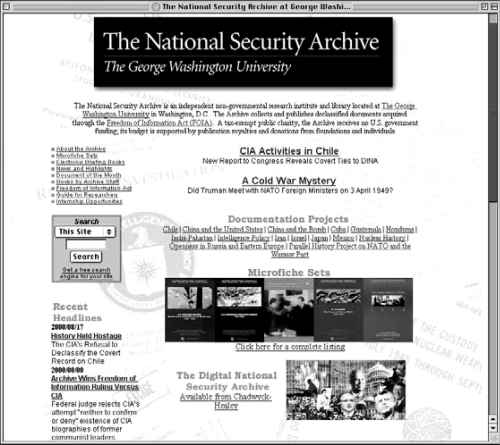
Enter the National Security Archive, based at George Washington University in Washington D.C., which has mated the reporter's “best friend”— the Freedom of Information Act (FOIA) request— with a variety of on- and off-line media resources. The result is an ever-expanding collection of declassified government documents available in their entirety. And it's a good example of how “hypertext” can be used to organize primary and secondary sources in a way that's actually helpful.
Not all of the archive's offerings are online. Some have been published in book format, some are on microfiche, but a growing collection is available on the National Security Archive web site, www.nsarchive.org.
The archive's approach: Assemble a staff of experts in international affairs, news analysis, law, and library science. Make a list of the declassified documents likely to be of value to the public. Send out thousands of FOIA requests. Mix in a lot of patience, and the result is one bulging archive.
The archive, which receives no government funding, charges a nominal fee for some of its material, but a good deal is free. Every month the archive posts a “document of the month,” for example. Recent postings include: The “Bush-National Archives Agreement,” the “Weinberger File,” the “Woerner Report on El Salvador,” and Possible Intention of Mexican Drug Organizations. There are also special online exhibits covering juicier moments in history like the Nixon-Elvis exchanges.
When visiting the site, a look through the Electronic Briefing Books is a must. This is where to find critical declassified records on specific issues, including U.S. national security, foreign policy, military history, intelligence policy, and more. Of particular interest to Bulletin readers is a section on nuclear history.
While the archive's staff provides easy-to-read analysis and explanations to ease visitors through the complexities of government documentation, the biggest thrill is being able to see and print out scans of the documents themselves, all decorated with the thick black markouts left behind by zealous government declassifiers.
The not-for-profit National Security Archive was founded in 1985 by journalists and scholars who wanted a centralized location to store government documents they had obtained through FOIA requests. Today it is the largest nongovernmental library of declassified documents, with 90,000 records of released documents, more than 15,000 authority files for individuals and organizations in international affairs, and more than 20,000 FOIA requests filed by archive staff and contributors.
—Bret Lortie