



Abstract
Although the evidence for human-induced global warming is still the subject of intense debate, the majority of the world's climate researchers believe that the process is well under way.
The earth is a natural greenhouse. It would not be habitable if natural greenhouse gases—chiefly water vapor—did not trap heat in the atmosphere. But industrialization and rapid population growth have significantly increased the concentration of greenhouse gases—especially carbon dioxide, which is released by fossil fuel burning and deforestation.
In response to the belief that increasing concentrations of greenhouse gases might lead to harmful changes in climate, the Framework Convention on Climate Change was negotiated in Rio de Janeiro in 1992. Its objective: to achieve “stabilization of greenhouse gas concentrations in the atmosphere at a level that would prevent dangerous anthropogenic interference with the climate system.”
Most studies of climate change focus on the global impact of a doubling of carbon dioxide in the atmosphere from the preindustrial level of 275 parts per million to 550 parts per million. According to the Intergovernmental Panel on Climate Change, the scientific body established to advise parties to the convention, a doubling would, over the long term, increase the average global surface air temperature by 1.5-4.5 degrees Celsius (2.5-8 degrees Fahrenheit), with a best estimate of 2.5 degrees Celsius (4.5 degrees Fahrenheit).
Uncertainties about how cloud cover, ocean currents, and vegetation would change as the atmosphere warms are at the root of the wide range in estimates. But even “small” changes could have big consequences. An increase of 1.5 degrees Celsius, for example, would be greater than any change in the last 10,000 years; one of 4.5 degrees would rival the increase that occurred at the end of the last ice age.
The European Union argues that the increase in average global temperature should not be allowed to exceed 2 degrees Celsius (3.5 degrees Fahrenheit) and that greenhouse gas concentrations should be stabilized at less than an “equivalent doubling” of carbon dioxide. (Equivalent doubling reflects the fact that other greenhouse gases—methane, nitrous oxide, and hydrocarbons—must be factored in.) This would require reductions in greenhouse emissions far beyond existing commitments or proposals.
In particular, it would require a fundamental transformation of the global energy system during the next half century. Traditional fossil fuels—main-ly coal, oil, and natural gas—would have to be largely replaced by energy sources that emit little or no carbon dioxide.
The great transformation
Energy experts predict that total global consumption of primary energy—energy used for space heating, transportation, and generating electricity— will double or triple over the next 50 years, from about 400 exajoules (EJ) per year in 1998 to 800-1,200 EJ per year in 2050.
Without a fundamental transformation of the world's energy system, global warming will spiral out of control.
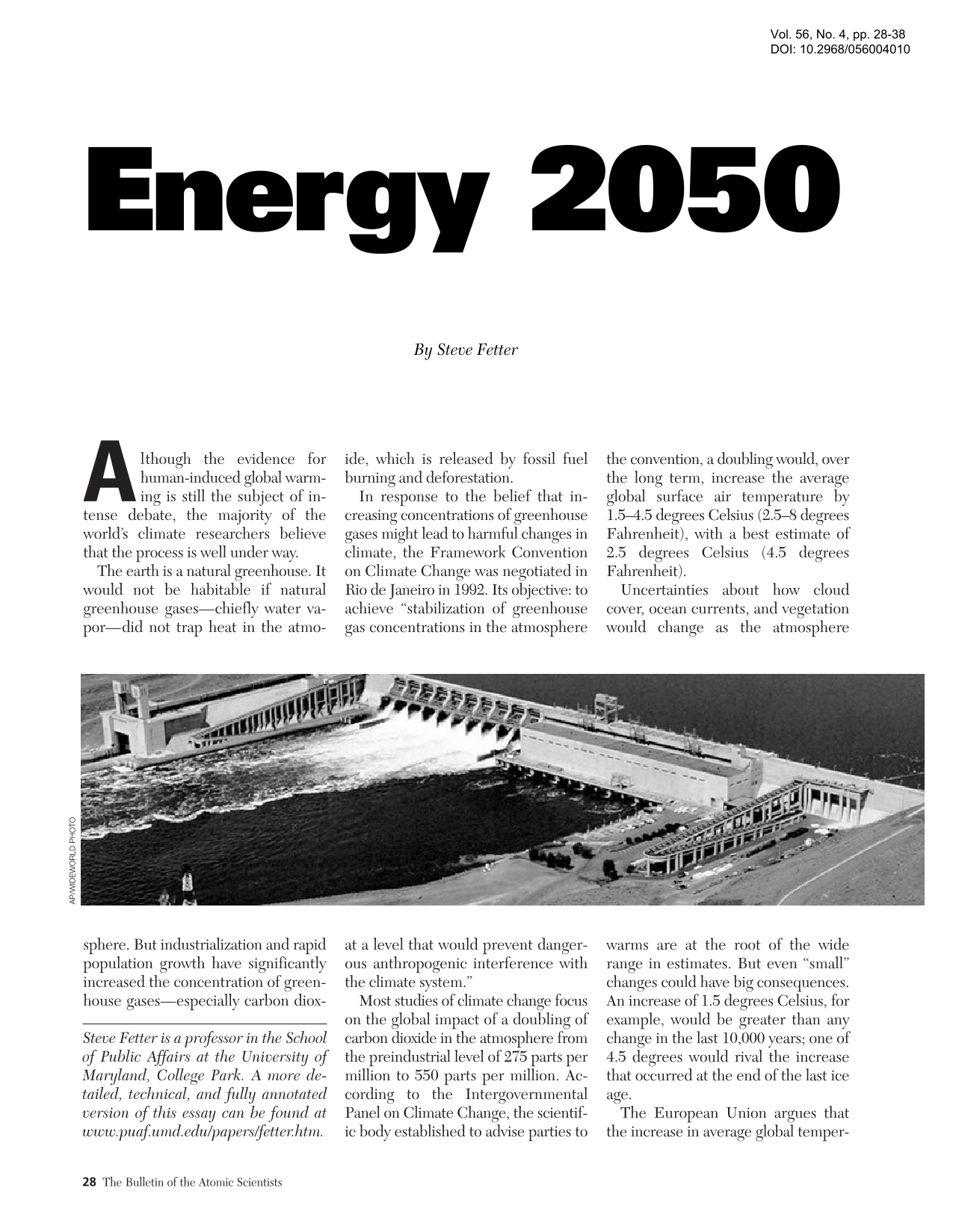
Opposite page: The Ice Harbor Dam on the Snake River in Levey, Washington. Above, the Solar One power plant in the Mojave Desert—a 300-foot “power tower” surrounded by 1,800 heliostats.

(An exajoule is a billion billion joules. One exajoule is about equal to the energy content of 30 million tons of coal, or the gasoline consumed by a million automobiles during their lifetimes, or the annual energy consumption of West Virginia or Portugal.)
Fossil fuel consumption would have to be limited to about 300 EJ per year in 2050 to permit stabilization of anthropogenic greenhouse gases at an equivalent doubling. Carbon-free energy sources would then have to supply the difference: 500-900 EJ per year.
That's daunting. In 1998, carbon-free sources supplied less than 60 EJ. Carbon-free energy would need to grow tenfold over the next 50 years— from 15 percent of the total commercial supply to 60-75 percent in 2050.
Possibilities and improbabilities
Only two sources of carbon-free ener-gy—hydropower and nuclear fission— currently produce a significant fraction of the world's energy supply, with each accounting for about 27 EJ per year (7 percent of the current energy supply), virtually all of it used to generate electricity. All other carbon-free sources— geothermal, wind, solar, and commercial biomass combined—supplied only about 4 EJ (1 percent) in 1998.
Carbon-free energy production has been growing recently at about 2 percent per year—much less than the 5 percent rate needed to stabilize carbon dioxide levels at an equivalent doubling. Moreover, most of the recent growth has been caused by an expansion of nuclear and hydro capacity, both of which are expected to taper off in the coming decades.
Further expansion of hydropower is limited by geography and people's tolerance for dams. Hydropower's contribution might increase to about 60 EJ per year by 2050, but even that is doubtful.
Among the other carbon-free sources of energy often mentioned with enthusiasm are fusion and tapping various forms of geothermal and ocean energy. But each of these has significant technical and economic drawbacks; they almost certainly will not supply a significant fraction of the world's energy before 2050.
This leaves five carbon-free energy sources that could potentially make a substantial contribution to the energy supply in 2050: fission, biomass, solar, wind, and “decarbonized” fossil fuels.
Fission
Of the carbon-free sources that could make a major contribution to the future supply of electrical energy, only nuclear fission is deployed on a significant scale today. In 1998, 434 nuclear reactors with a capacity of 350 gi-gawatts supplied over 2,300 terawatt-hours of electricity—17 percent of the world's electricity and more than 6 percent of commercial primary energy.
In some nuclear-intensive scenarios, the number of reactors would increase to 1,000-2,000 by 2050, with an installed capacity of 1,100-1,700 gi-gawatts. At that level, nuclear energy could supply 70-110 EJ per year— about 30-40 percent of the world's electricity.
If this energy were supplied entirely by light-water reactors (the type now in widest use) operating on a once-through cycle (in which the spent fuel is treated as waste), 5-7 million tons of natural uranium would be consumed by 2050. For comparison, it is estimated that at least 20 million tons of uranium can be mined at reasonable prices. Conventional uranium resources could easily support a high-growth scenario for at least 50 years using a once-through cycle.
Over the longer term, heavy reliance on nuclear energy would require a transition to fuel cycles that use uranium more efficiently—or that exploit unconventional uranium resources.
For decades, recycling unburned plutonium and uranium in breeder reactors has been thought to be the “solution” to possible eventual uranium shortages. Recycling is potentially perilous, though, because it increases the risk that plutonium could be diverted to the manufacture of weapons.
Less often discussed is tapping the oceans, which contain about 4.5 billion metric tons of dissolved uranium. Recent studies suggest that uranium could be extracted from seawater for as little as $100 per kilogram. If anything like that proves true, plutonium recycling and breeder reactors might forever remain economically unattractive.
Although fission's technical potential is substantial, its near-term prospects are bleak. Forecasts range from a substantial decrease in nuclear power to a modest increase over the next 20 years, with fission's share of world electricity production falling to less than 10 percent by 2020. The only region expected to experience significant growth in the near future is East Asia.
High capital costs and unpredictable construction times are the main limiting factors. In the United States, the average cost of nuclear-generated electricity in the early 1990s was nearly twice that of gas- or coal-fired electricity, mainly because of high construction outlays and non-fuel-related operating costs.
The best U.S. nuclear plants, however, produce electricity at a lower cost than the best coal-fired plants. In countries with expensive fossil fuels and well-run nuclear plants, such as Japan, nuclear electricity is somewhat less expensive on average than fossil-fuel-generated electricity.
New plants should have lower construction and operating expenses. A host of studies suggest that in many countries new nuclear plants will be economically competitive with new coal- and gas-fired plants.
But economic considerations aside, the future of fission energy is clouded by worries about accidents, waste disposal, and the spread of nuclear weapons.
Carbon-free energy production has been growing at about 2 percent per year—much less than needed to stabilize carbon dioxide levels.
France's Paluel Nuclear Power Plant.

The accident triggered many safety improvements. According to some calculations, the probability of core damage is now less than one in 10,000 reactor-years for current U.S. light-water reactors. The probability of a large release of radioactivity is about ten times smaller.
Although these are low probabilities, they are not low enough. At that rate, accidents resulting in core damage could be expected about once a decade in a world with just 1,000 light-water reactors. That is unacceptable insofar as public opinion is concerned.
However, new “evolutionary” light-water reactors are designed to be safer than today's nuclear plants. Calculations suggest that General Electric's Advanced Boiling Water Reactor—two of which operate in Japan—and Combustion Engineering's System 80+ pressurized water reactor would have core-damage probabilities lower than one in 1 million reactor-years.
It would be difficult, however, to persuade critics of nuclear power that such a high level of safety is possible in the real world. Even advanced light-water reactors depend on the proper operation and maintenance of equipment, such as pumps and valves, to prevent accidents. It is difficult to estimate the likelihood of operator errors that could trigger or exacerbate an accident.
For these reasons, a substantial expansion of nuclear power may require the development of “inherently safe” or “passively safe” reactors, which place less reliance on the proper functioning of equipment and human operators and more on the immutable laws of physics.
For example, a cooling system that relies on natural circulation is safer— and its safety is easier to demonstrate—than a system that relies on pumps. Design concepts have been put forward for passively safe light-water reactors, gas-cooled graphite-moderated reactors, and liquid-metal-cooled fast reactors that would shut down automatically and prevent core damage for several days or longer without operator intervention.
Although passively safe reactors would be more expensive than conventional light-water reactors, shorter licensing and construction times, higher investor confidence, and reduced public opposition could provide offsetting advantages.
Although spent fuel can be stored safely in interim facilities for several hundred years, the continued accumulation of wastes in the absence of a proven, permanent repository is a barrier to the expansion of nuclear power.
Cost is not a major issue; geological disposal is expected to add only about 2 percent to the price of nuclear-generated electricity in the United States.
Neither is the availability of land an issue. All nuclear wastes that would be generated worldwide in this century— and beyond—could be stored in an area one-tenth the size of the Nevada Test Site, the scene of more than 800 underground nuclear explosions.
The problem is time. Although much of the radioactivity of spent fuel is dissipated within a few hundred years, the spent fuel would be potentially dangerous for a much longer time. Selecting a site and certifying that people would not be exposed to unacceptable risks over many thousands of years and under almost any conceivable scenario has proven (to engage in understatement) difficult. Even though there is a high level of scientific confidence that this can be done, overcoming public opposition may prove virtually impossible.
Analogs, such as natural reactors and uranium ore bodies, indicate that—at least in some geologies—the most hazardous radionuclides would be contained extremely well in the surrounding rock, and they would decay to harmless levels long before they could come into contact with living things.
The most commonly cited analog is the “natural reactor” in Africa, which went critical some two billion years ago. Uranium's readily fissionable isotope is uranium 235. Because 235 decays at a faster rate than uranium 238, natural uranium contained more 235 two billion years ago. Water infiltrated an exceptionally rich deposit of uranium in what is today's Gabon, causing a chain reaction. After hundreds of thousands of years, this natural reactor burned out. Since then, there has been little migration of either plutonium or fission products.
The U.S. National Academy of Sciences and regulatory bodies in several countries have recommended that the radiation standards currently used to protect the public should apply thousands of years into the future. These standards are very stringent. In the United States, the dose to an individual must be less than 0.15 millisieverts per year. That is about one-twentieth of the average dose rate from natural background radiation.
Calculations for proposed repositories in Belgium, Canada, Finland, France, Japan, and Sweden indicate that the maximum dose would at all times be far below such limits. Although similar calculations show that the maximum doses from the U.S. repository at Yucca Mountain would be very low during the first 10,000 years (the time horizon proposed by the EPA for evaluating the performance of the repository), doses in excess of the proposed limits would be possible after 100,000 years. Whether this will prove a barrier to the licensing of Yucca Mountain remains to be seen.
Another problem is that every country is expected to dispose of its own nuclear wastes—even small countries such as Belgium, the Netherlands, Switzerland, and Taiwan, whose combined areas are less than the state of Wisconsin. This practice is shortsighted, inefficient, uneconomical, and potentially risky. Countries should be encouraged to accept nuclear wastes from other countries, provided their repositories meet an international standard comparable to the most restrictive national standards.
Scientists are confident that they can build very safe nuclear waste sites, but overcoming public opposition may prove virtually impossible.
This “reactor-grade” plutonium contains a higher percentage of undesirable isotopes than “weapon-grade” plutonium. The undesirable isotopes emit heat and radiation, complicating weapon design and leading some observers to argue that reactor-grade plutonium is unsuited for weapons. In fact, any group that could make a nuclear explosive with weapon-grade plutonium would be able to make an effective device with reactor-grade plutonium.
Because access to weapons-usable material is the principal barrier to the acquisition of nuclear weapons, the plutonium discharged from civilian reactors should receive the same degree of protection from theft or misuse as assembled nuclear weapons.
The once-through fuel cycle is highly resistant to proliferation risks. As long as the fuel remains intact, international inspectors can simply tag and count the number of fuel assemblies. Spent fuel is also difficult to steal because of its unwieldy size and because it is highly radioactive. A spent fuel assembly from a typical light-water reactor is four meters long and weighs 650 kilograms. It would deliver a lethal dose of radiation to an unprotected person in a few minutes.
Reprocessing—the separation and recycling of the plutonium and uranium in spent fuel—is the main alternative to the once-through cycle. In contrast to spent fuel rods, which are easy to count and track, precise measurements of plutonium inventories in a reprocessing plant are difficult. The amount of plutonium in the spent fuel is variable, leading to inevitable differences between the estimated amounts entering and exiting the plant. In a large plant, this “inventory difference” can amount to many bombs' worth of plutonium per year.
Although material accounting can be improved, it is doubtful that the theft or diversion of a significant amount of plutonium could be detected with high confidence and in a timely manner.
Reprocessing may become economically attractive if nuclear power grows and uranium prices increase substantially. In this case, additional measures could be introduced to deter and detect theft or diversion. This could include new reprocessing techniques that do not involve the separation of pure plutonium, the use of fuel cycles that minimize the production of high-quality plutonium, such as the thorium fuel cycle, or the internationalization of certain parts of the nuclear fuel cycle, such as facilities that produce and use plutonium fuels.
Rocket scientists not required
It won't solve the greenhouse-gases problem. Nor will it help stem the massive growth in energy consumption projected to occur over the next few decades. But its use in several developing countries demonstrates that small energy-efficiency initiatives can make a difference.

It's the “rocket stove”—an easy-to-build device that consumes only half the wood used by traditional stoves in the developing world. The central element of the stove is the so-called “rocket elbow,” a hollow, L-shaped shaft made of tin, ceramic, or clay. The shaft runs through a metal or brick container (a 5-gallon drum will do) and the space between the shaft and container is filled in with a lightweight insulation like wood ash.
Sticks of wood are slowly fed into the stove through the bottom section of the elbow, allowing only the tips to burn. The elbow's chimney creates a draft that pulls smoke and air through the flame. Because the fire is well insulated and the air is preheated as it passes through a channel under the wood and then into the stove, the elbow's combustion chamber reaches extremely high temperatures (above 1,100 degrees Fahrenheit). The stove gets so hot that most of the smoke and combustible gases generated by the fire burn up. The rising hot flue gases are then forced against the sides of the cooking pot by a metal skirt wrapped around the top of the stove. By causing the entire surface of the pot to be heat-ed—instead of just the bottom—the skirt increases the stove's “average amateur efficiency” from 12 to 23 percent. (Some advanced versions of the stove have reached efficiencies of 40 percent.) By comparison, the efficiency of a typical open fire is 5-10 percent.
Originally designed by engineers at the Aprovecho Research Center near Eugene, Oregon, the stove has been introduced into some 20 developing countries during the last few years by an alliance of non-governmental organizations (NGOs). In 1998, Trees, Water, and People (TWP), a Colorado-based conservation group, teamed up with Aprovecho to teach women in Suyapa, Honduras, how to build a modified version of the stove called the estufa Justa. According to Patrick Flynn, a TWP coordinator, the stove was a hit: “Not only does the stove save money by burning half as much wood as open fires, it also eliminates smoke from kitchens, which is a major cause of respiratory illnesses.”
Since the stove's introduction in Suyapa, the women from the community have assisted TWP and a local NGO, the Honduran Association for Development, in bringing it to neighboring communities. The women have also been inspired to take on a variety of conservation initiatives. Justa Nuñez, the first rocket stove trainee in Suyapa, told the Christian Science Monitor, “We haven't stopped at putting in the stoves. Now we talk about the importance of trees and how we can take care of them. Next we're going to begin reforesting.”
Flynn points out that in Central America, where 90 percent of cut wood is used for fuel, the stove could play a significant role in conservation efforts. “The rocket stove is what we call an appropriate technology,” he says. “It's cheap and easy to build, fulfills the needs of the community, improves living conditions—all this while at the same time helping to preserve forests and local watersheds.”
—Michael Flynn
Biomass
Wood, crop residues, dung, and other combustible wastes are the main source of energy for a majority of the world's population. Because most biomass fuels are not traded on world markets, estimates of consumption are highly uncertain. They range from 15 to 65 EJ per year or 4-15 percent of world energy consumption.
The source of all biomass is photosynthesis, in which plants use solar energy to produce carbohydrates from carbon dioxide and water. The burning of biomass does not lead to a net emission of carbon dioxide if biomass is grown at the same rate as it is consumed. Unfortunately, this is not the case today.
About 60 percent of biomass energy is supplied by wood, most of which is cut and burned faster than it is replaced. The results: deforestation, loss of natural wildlife habitat, and a large net release of carbon dioxide into the atmosphere.
Roughly 200 million hectares (500 million acres) of land would be required to produce this much fuel wood in a sustainable manner. That is twice as much land as now exists in all forest plantations. Moreover, biomass typically is burned inefficiently, resulting in indoor and outdoor air pollution.
And yet, biomass energy can be a modern and environmentally benign energy source. In the United States, biomass supplied about 3 EJ in 1998. Most of this energy was generated by wood waste and, to a lesser extent, by agricultural waste, solid waste, landfill gas, and more than 1 billion gallons of ethanol produced from corn. Biomass is promising for several reasons:
The energy potential of biomass is enormous—the value of wastes alone is about 130 exajoules a year.
Windmill and nuclear power plant in Nottinghamshire, England.

• It can be used to produce solid, liquid, and gaseous fuels as well as electricity. (Its ability to provide transportation fuels is particularly important.)
• The technology for producing biofuels is mature and available even in the poorest countries.
• Relatively modest advances in production or increases in fossil fuel prices could make biofuels economically competitive.
• The energy potential of biomass is large. Globally, plants store energy at a rate of about 3,000 EJ per year. Two-thirds of this is on land, half of which is in the tropics.
Humans already manage more than half of the world's usable land for the production of food and fiber. Croplands, pastures, and managed forests store about 600 EJ per year. Some of this potential is locked in wastes that could be diverted for energy production. And some of the potential is in the form of fallow or degraded cropland and pastures that could be converted to the growing of energy crops.
It is difficult to estimate the amount of land that realistically could be devoted to energy crops. In 1997 about 1.5 billion hectares (3.7 billion acres) were classified as “arable”—that is, cultivated in the last five years—of which about 1 billion hectares (2.5 billion acres) were actually harvested. Further, there is marginal land in which rain-fed crops could achieve reasonable yields. Estimates of such land range from 500 million to 2.5 billion hectares (1.2 to 6 billion acres), mostly in sub-Saharan Africa and Latin America.
The wide range of estimates reflects an incomplete knowledge of soils and climate conditions, differing evaluations of the potential of poor soils or steep terrain to support crops, and differing views about the desirability and feasibility of converting natural forests and swamps into cropland.
If the conversion of natural lands is ruled out, 500 million to 1 billion hectares (1.2 to 2.5 billion acres) of potentially arable land might be available. But this land also could be used to grow additional food. The availability of land for energy crops will depend on the balance between future growth in crop yields and grain consumption.
If crop yields increase at a rate greater than consumption, the area harvested will shrink, and larger areas will be available for biomass plantations. But if increases in yields do not keep pace with increases in consumption, cropland will increase, and less land may be available for energy crops.
Past trends are encouraging. Between 1961 and 1996, world production of cereals increased by 140 percent, while the area harvested increased by only 9 percent. But it is difficult to predict whether growth in crop yields will continue to keep pace with consumption. Demand for cereal crops is expected to increase at an average rate of 1-2 percent per year over the next half century, driven by increases in population and per capita consumption.
If increases in yield do keep pace, then 500 million to 1 billion hectares would be available for energy crops and the energy potential would be 100-200 EJ per year. But if grain consumption increases 2 percent per year while yields increase 1 percent per year, the amount of land available for energy plantations would decrease by 700 million hectares (1.7 billion acres), and the energy production potential would be 0-50 EJ per year.
In contrast, if yields increase 1 percent per year faster than consumption, an additional 500 million hectares would be available and the energy production potential would be 200-300 EJ per year.
Cereal yields in France and Britain are more than twice the world average, and China has attained yields 60 percent higher than the world average. Biotechnology holds the promise of further increases.
But most of the increase in yields was achieved before 1984; since then, yields have increased at an average of only 1.3 percent per year. Much of the past growth in yields was due to the increased use of fertilizers, pesticides, and irrigation. Further increases are unlikely because of diminishing returns, adverse environmental impacts, and water shortages.
Another factor: The world loses productive cropland at the rate of about 10 million hectares (25 million acres) per year because of erosion, salinization, desertification, and urbanization.
Another major uncertainty: Is it possible to grow and harvest very large quantities of biomass in a sustainable and environmentally acceptable manner? The history of agriculture, which has been characterized by widespread land abuse, is not encouraging.
Solar
In 1998 solar energy produced about 3 terawatt-hours of electricity and perhaps 0.5 EJ of heat in solar thermal collectors.
The solar resource is huge. About 500,000 EJ falls on the continents each year. The challenge is to capture and deliver solar energy economically. In temperate climates, properly designed and oriented buildings can be partially heated and lighted with solar energy at costs that are competitive with current U.S. energy prices. However, less than one percent of new homes built in the United States incorporate significant passive solar features.

Meanwhile, the turnover of the building stock is very slow. Even if passive solar designs become far more popular, it would not contribute more than 1 percent to total U.S. energy needs by 2050.
Collectors can be mounted on the roofs of existing buildings to heat air or water, but at current prices solar heat is several times more expensive than natural gas. The economics of solar heat are even less favorable for industrial users, who require higher-temperature heat and who pay lower prices for conventional fuels.
Unfortunately, the potential for lowering the cost of solar heat is limited. The technology is mature and it uses common materials. But if energy prices double or quadruple, solar could provide a substantial fraction of the energy used for heat—up to 10 percent of total energy demand.
The sun—like coal, oil, natural gas, or fission—can also supply the heat necessary to produce the steam that drives generators. The technical feasibility of generating electricity with solar heat has been demonstrated in multi-megawatt facilities, both with distributed parabolic-trough collectors and with central “power-tower” receivers illuminated by hundreds of sun-tracking mirrors called heliostats.
The cost of electricity from advanced facilities located in very sunny areas is about $0.08-0.16 per kilowatt hour. With additional improvements in efficiency and cost, solar thermal electric plants might compete favorably with new nuclear plants—at least in sunny locations.
Photovoltaic cells represent the solar technology with the greatest potential. They convert sunlight directly into electricity and they require no focusing or tracking mechanisms (although these may be used). They need no boilers, turbines, or cooling water, and they generate no waste products, heat, or noise. They are highly reliable, they have long lifetimes, and they require very little maintenance.
Further, photovoltaic cells can be wired together to form units of any size, from a fraction of a watt to hundreds of megawatts. They can even be integrated into the design of exterior building surfaces.
Although the cost of photovoltaic modules has decreased tremendously in the last 25 years, the cost of photovoltaic electricity is still very high— more than $0.25 per kilowatt hour in sunny areas. Even if prices fall to levels that would be economically competitive with other sources, solar would be limited to 10-20 percent of total electricity production unless large-scale, inexpensive storage or the intercontinental transmission of electrical energy could be achieved.
A commonly suggested scheme for capturing solar power: Large arrays of solar cells could be placed in geosynchronous orbit, with the power transmitted in microwaves to fixed antennae on earth.
Because the array would receive sunlight at a constant rate, a photovoltaic module in orbit would on average produce electricity at about five times the rate that it would at the sunniest locations on the earth's surface. This constant and predictable supply would eliminate the need for energy storage.
Although conceptually appealing, launch costs would have to drop by twentyfold or more for space-based systems to be economically competitive with ground-based generation.
Wind energy
Wind power has been harnessed for thousands of years, but only in the last decade has it generated significant amounts of commercial energy. In 1998 wind generated 13 terawatt-hours (0.14 EJ) of electricity, mostly in the United States, Germany, and Denmark. From 1985 to 1999, wind energy had an average growth rate of nearly 20 percent per year.
Wind farm in Lake Benton, Minnesota.

Today, electricity is produced at a cost of $0.05-0.08 per kilowatt hour at sites with high average wind speeds. But only about 5 percent of the earth's land area is windy enough to produce cheap electricity. Many of the world's windiest areas are located far from population centers—northern Canada and Russia, for instance—where transmission and maintenance costs would be high. The intermittent and unpredictable nature of wind power would limit its contribution to perhaps 20 percent of regional electricity supply, unless large-scale energy storage or intercontinental transmission is available.
Environmental constraints, such as the presence of forests and protected areas, further limit the siting of wind turbines, as would simple public acceptance. Wind farms are not necessarily attractive, and they have generated complaints about noise, interference with radio and TV signals, and the killing of, or interfering with, migratory birds.
All things considered, only about one-tenth of high-wind areas—mostly cropland and pasture—may be suitable for electricity production. A realistic upper limit for wind production in 2050 might be 40 EJ per year— roughly 10-20 percent of the projected world electricity needs.
Although wind is unlikely to become a dominant energy source, it may ultimately contribute a substantial fraction to total energy needs. In the short term, at least, it is the most economically attractive renewable energy source.
Decarbonized fossil fuels
Recoverable, low-cost resources of conventional oil, gas, and coal are sufficient to meet world energy needs for at least another hundred years. Moreover, enormous quantities of unconventional fossil fuels—methane hydrates, oil shales, and tar sands—could be extracted at somewhat higher prices or with improved technology.
If the carbon contained in fossil fuels could be safely and inexpensively “decarbonized,” or captured and sequestered, those fuels could continue to serve as a basis for the world energy supply even while greenhouse gas concentrations are stabilized.
The technology for capturing carbon dioxide from flue gases using chemical solvents is mature but expensive. It might increase the price of electricity from a traditional coal-fired power plant by 40-120 percent. The costs would be greater for a gas-fired power plant because of the lower carbon content of the fuel.
The second approach is to chemically convert fossil fuels into hydrogen and carbon dioxide. Hydrogen is produced from both natural gas and gasified coal on a commercial scale today for the manufacture of ammonia and other chemicals. The cost per unit of hydrogen energy is about 70 percent greater than that of natural gas and five times greater than that of coal.
But even at these high prices, hydrogen could be an attractive fuel over the long term because it could be efficiently converted in fuel cells into electricity with virtually no pollution.
Coal also can be converted into hydrogen-rich fuels, such as methane or methanol, which are easier to transport and store than hydrogen. The cost of such chemical conversions is very high, however—equivalent to $150-500 per ton of carbon emissions avoided.
Perhaps the most attractive decar-bonization concept is based on the integrated coal-gasification combined-cycle (IGCC) power plant. Combustion of gas derived from coal, as well as waste heat, would drive turbines. The carbon dioxide would be separated from the fuel gas before combustion, generating a stream of almost pure carbon dioxide.
The price of electricity from an IGCC plant would be somewhat greater than that of a traditional coal-fired power plant, but the incremental cost of capturing the carbon dioxide would be smaller because of the high concentration of carbon dioxide in the fuel gas. Even so, the carbon dioxide recovery would add perhaps 25-50 percent to the price of electricity.
Other options, such as the manufacture of solids or industrial chemicals or storage in engineered facilities or mined cavities, are too limited or too expensive to make a major contribution.
For the birds
Wind farms have been harshly criticized by environmentalists who complain that giant wind turbines cause the unnecessary deaths of thousands of birds. However, in the May/June issue of World Watch, Christopher Flavin explains that although early wind power projects did not consider the safety of birds, that is no longer the case.
“No major bird fatalities have been identified with the wind farms built over the last decade,” he writes. “This is due in part to the cooperative efforts of environmental groups, wind power developers, and other stakeholders to develop systematic ways of assessing the potential avian impacts of proposed sites.”
—Linda Rothstein
Oil and gas wells, depleted or active, probably would be the least expensive and the most reliable option for storage. Exploration and drilling costs would be low and the prior existence of oil and gas deposits would ensure that carbon dioxide could be stored for millions of years if the original pressure of the reservoir was not exceeded.
A small fraction of the carbon diox-ide—perhaps 10-15 percent—could even be used to enhance the recovery of the oil and gas remaining in active wells, thereby lowering the costs of sequestration. Carbon dioxide was injected into oil wells in the United States on a small scale in the late 1970s to enhance oil recovery, when inflation-adjusted oil prices were much higher than at present.
Storage in oil and gas wells alone would not be sufficient, however. A large fraction of fossil-fuel use occurs in areas such as Japan, Western Europe, and the northeastern United States, where the cost to transport carbon dioxide to oil and gas wells would be high.
One option is to store carbon dioxide in deep saline aquifers. In the United States, for example, 65 percent of power-plant carbon emissions occur close to such deep aquifers. Storage sites would have to be located at depths greater than 800 meters (2,600 feet)—to maintain the carbon dioxide in a dense supercritical phase—and under an impermeable layer to prevent its escape or mixing with shallow aquifers used for drinking water or irrigation.
The potential storage capacity of underground aquifers is highly uncertain, however, partly because of a lack of basic geological data, such as their volume, porosity, permeability, and structure.
Natural gas often contains carbon dioxide, which currently is separated and vented into the atmosphere. Injecting this carbon dioxide would be an obvious application of sequestration. In 1996, Statoil of Norway began injecting carbon dioxide from a gas field into an aquifer beneath the North Sea.
Another option is to inject carbon dioxide into the deep ocean. Since most of the carbon dioxide emitted into the atmosphere would dissolve in the ocean eventually, one could think of this as simply accelerating the natural processes that would result from the burning of fossil fuels.
The carbon sequestration potential of the oceans is huge. But in contrast to underground aquifers, which can sequester carbon for millions of years, a significant fraction of the carbon dioxide injected into the oceans would return to the atmosphere over a period of several hundred years.
The rate of return would be determined primarily by the depth of injection. At depths greater than 3,700 meters (12,000 feet), the density of the carbon dioxide is greater than that of seawater. The carbon dioxide would sink to the bottom of the ocean, creating a carbon dioxide “lake” on the ocean floor. But even at that depth, about 15 percent of it would return to the atmosphere over a period of roughly a thousand years.
Pipelines have not been laid at depths greater than 1,000 meters (3,300 feet), but there may be ways of achieving greater depths. For example, long vertical pipes might be suspended from a tanker or offshore platform, or a dense plume might be created that would fall naturally to the ocean floor or become caught in downwelling ocean currents.
The rate of return to the atmosphere would be significantly greater for carbon dioxide dispersed at depths of less than 2,000 meters (6,600 feet), depending on ocean currents and topography near the point of injection. Given that, the net gain might not be great.
The environmental impact and legal status of ocean disposal are uncertain. Sequestration would increase the acidity of seawater. Depending on the dispersal mechanism, the decrease in pH could be biologically significant over large volumes of water. To put it another way, it might kill sea animals over large areas near the carbon dioxide injection points.
In any case, dumping of wastes in the oceans is regulated by international law and issuance of the required permits would have to take into account the possible effects on deep-sea marine life and the availability of land-based disposal alternatives.
The capture, transport, and disposal of hundreds of billions of tons of carbon is unlikely to be accomplished at an average cost of much less than $100 per ton of carbon, which would represent a substantial increase in the price of coal or coal-fired electricity. Even so, decarbonized coal might be economically competitive with other carbon-free energy sources.
Needed: more research
Only five energy sources are capable of providing a substantial fraction of the carbon-free energy required to stabilize greenhouse gas concentrations at an equivalent doubling: biomass, fission, solar, wind, and “decarbonized” fossil fuels.
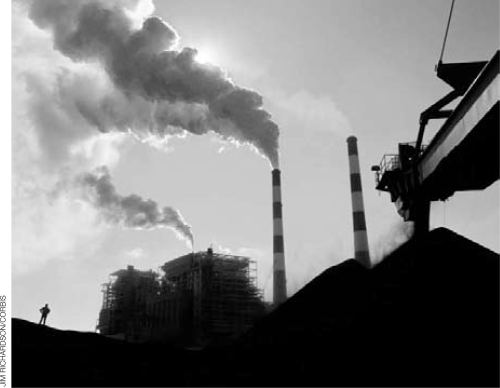
Coal-fired plant in Colliery, England.
Unfortunately, each of the five major alternatives has significant technical, economic, political, and/or environmental handicaps.
• Nuclear fission, which is the only technology widely deployed on a large scale today, suffers from public-acceptance problems related to the perceived risk of accidents, the still-unsolved matter of waste disposal, and the link between civilian nuclear power and the proliferation of nuclear weapons.
• Biomass has the potential to supply low-cost portable fuels, but large-scale use of energy crops could compete with food production and the preservation of natural ecosystems.
• Solar is benign but currently very expensive, and it would require massive energy storage or intercontinental transmission to supply a large fraction of the world's energy.
• Wind is economically competitive in certain areas today, but most highwind areas are far from cities and would, like solar, require expensive storage or long-distance transmission to achieve a large fraction of the energy market.
• Fossil fuels are cheap and abundant, but the cost of capturing, transporting, and disposing of the carbon dioxide contained within them could be high, and the environmental impacts are largely unknown.
A global, broad-based program of energy research and development is needed to address these issues and to ensure that abundant, affordable, and acceptable substitutes for traditional fossil fuels will be available worldwide in the coming decades.
Whether or not there will be the will to conduct such intensive global research and development in an increasingly fractious world is another question. But it may become the question of the century.