



Abstract

It's late April and I've just landed in Sarajevo after a three-year absence. I didn't travel in a nato C-130 this time, but on a regularly scheduled commercial flight from Budapest. Instead of being ushered off a ramp and into a temporary shelter by French soldiers, I'm directed into a renovated passenger terminal by Air Bosnia flight attendants, reunited with my baggage, and whisked away to town in a taxi. Along “Sniper's Alley” the gutted high-rises have been reoccupied and there are enough imported automobiles to make for a bit of traffic congestion. There are more storefronts, restaurants, hotels, and people. The city, once eerily empty, has started to come back to life.
UNESCO is spending millions of dollars to rebuild Stari Most, the famous medieval bridge destroyed by Bosnian Croat forces and for which Mostar is named.

Bosnia has not.
The unified, democratic, multiethnic nation the international community delivered at the Dayton peace talks was stillborn. The great powers quickly rushed the corpse into the operating room, surrounded it with highly trained specialists and expensive equipment, then stood around watching it decompose. After four years as an international protectorate, Bosnia is more divided than ever.
With my first social invitation I was hoping otherwise. I'd only been in the city a few hours when friends invited me to join them on their first sledding trip since the war.
The family—a teacher and her two teenage sons—had fond memories of weekends and vacations spent skiing and sledding on the slopes of Mount Jahorina, high in the forested mountains that surround Sarajevo. But the war put an end to that.
Bosnian Serb forces occupied the hills and mountains, which afford a breathtaking view of the city. From there Serb snipers, gunners, and mortar teams spent the next four years doing their best to kill the city's inhabitants, most of whom were Croats or Muslims. Today the Serbs still hold most of the high ground, which is incorporated into the Republika Srpska, their ethnically cleansed state-within-a-state.
These days a city bus to Jahorina leaves downtown Sarajevo every Saturday morning—if eight people show up. The following morning there were nine of us, so the bus left the station and climbed up the mountain, passing devastated buildings along the former front. Within a few minutes we crossed an invisible border and all the signs changed from Latin to Cyrillic script. My friends had entered the Republika Srpska for the first time. The mood on the bus was subdued.
The winding mountain road crept up into the forested slopes, the husks of automobiles decorating the shoulder between switchbacks. There were staggering vistas of the city, so close and vulnerable at the foot of the mountain. The teenagers picked out the family's top-floor apartment, the one the Serbs dropped several mortar rounds on in 1992. We sped by tiny, dilapidated farmhouses with sheep in their yards. People walked the shoulder miles from the nearest farmstead. In the mountains the war damage is economic rather than physical.
Jahorina is a world class ski resort built for the 1984 Winter Olympics. During the games its sculpted slopes hosted the women's downhill and slalom competitions and provided a picturesque backdrop for television announcers from the world over. Afterward its modern hotels and swank restaurants were packed with weekend visitors from Sarajevo and beyond.
When the war started, Radovan Karadzic and his cronies set up shop in the nearby village of Pale. They'd pop up to Jahorina—untouched by the fighting—for meetings of the Bosnian Serb parliament or to relax on the slopes as the shells echoed far below.
It was at Jahorina's Heavenly Valley Hotel—the one with the indoor swimming pool—that the Bosnian Serbs brazenly rejected the 1993 Vance-Owen peace plan, defying both the international community and Slobodan Milosevic. But the West didn't make good on its threat to bomb. The war dragged on for two more years.
Jahorina is a shadow of its former self. Despite ample April snows, most of the ski lifts and hotels were shut down. Refugees occupied two decaying hotels. Four-foot snowdrifts blocked the restaurant entrance of one; in front of the other all the outdoor lights were shattered. The only things that looked new are the Olympic road signs, recently replaced with ones printed in the Cyrillic alphabet only. (Muslims and Croats use Latin letters.)
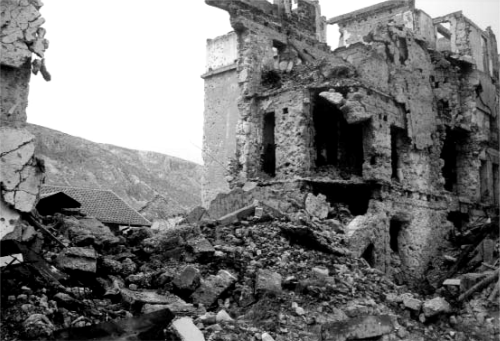
Much of Mostar remains in ruins.
A couple of hundred people were skiing and snowboarding on the open trails. Half were soldiers, aid workers, and other officials from the shrinking international force sent here to make Bosnia a united, multi-ethnic nation. Virtually everyone else was Serbian, a good many from Belgrade and Novi Sad, both a hundred times farther away than Sarajevo.
But the sledding was good. The kids had a great time. We got a few intimidating glances from some beefy men with short-cropped hair, but no one tried to kill anyone. Smoke drifted up from the chimney of a chalet technically owned by a family member in Sarajevo, but now occupied by a Serbian.
When the temperature dropped we retreated into the restaurant of one of the few hotels that remain open. One of the picture windows was cracked and the tablecloth was faded. A gaunt, nervous-looking waitress showed us to a table next to a portable electric heater, the only source of heat in the place. We ordered tea.
When the steaming cups came the waitress meekly asked where the family was from. Her face lit up at the answer. “Sarajevo? The real Sarajevo! How wonderful,” she said, surprised and genuinely pleased. “How is life there? I'm so happy you came.”
The bus left an hour later. It wouldn't be returning for another week, maybe longer if there are less than eight passengers.
A few days and several hundred kilometers later I was in the southern Bosnian city of Mostar, standing at one end of a missing bridge.
All of the bridges in the center of the city were destroyed. But this one was special. The stone guard tower next to me once guarded the approach to the Stari Most (Old Bridge), an elegant arched structure that gave Mostar its name and is still featured on tourism posters worldwide.
Today most of what remains of the bridge is somewhere beneath the racing blue-green surface of the Neretva River. Croat shelling reduced the delicate span to limestone blocks and fragments. There are probably hundreds of them: big blocks of hand-hewn limestone hauled to riverbank cliffs at the center of Mostar in the sixteenth century after the sultan ordered the bridge's construction.
On the opposite bank of the river next to another stone guard tower is a stack of 158 stones that Hungarian engineers have plucked from the river as part of a $14 million U.N. project to rebuild the bridge, which was a UNESCO-designated world heritage site. But during the years the rubble sat in the water it forced the river currents against the shore, which may have undermined the cliffs to which the bridge was affixed. If so, rebuilding will be extremely difficult.
The international community has rebuilt most of Mostar's other, less historic bridges, but few people use them.
From the riverbank, Safet Krkic, a Muslim university professor, can almost see the apartment he was driven from eight years ago. “If they offered it back to me today, I'm not sure I would be able to take it,” he told me in his office at the new University of Mostar (East). “I don't feel I would be safe in the building I lived in for so many years.”
Like many Mostarites, Krkic was deeply affected by his wartime experiences. When Bosnian Croat police started rounding up non-Croats and taking them to an uncertain future at the university stadium, Krkic narrowly escaped with the help of a British friend. He says that some friends and colleagues who didn't escape were tortured or killed.
He works only a two-minute walk from the main bridge, but Krkic crosses the river only two or three times a year. “I just don't feel comfortable there,” he says. “It's strange over there—a different atmosphere and way of behaving. There are some people I've encountered who clearly regard me as their enemy.”
He told me he had met several former colleagues who teach at what is now the Croatian University of Mostar (West), but only at conferences in Austria and Spain. “Never here in Mostar.”
Students at the two universities have only a slightly better relationship. The student unions get together for formal projects like a joint youth radio program and an occasional foreign-financed publication. But when they go out at night, young people stay on their own side of the river. “I've never been to a disco in the West,” says Abdulah Alagic, president of the University of Mostar (East) student union.
Before the war Mostar was a mixed community of 150,000, with the highest rate of ethnic intermarriage in all of Yugoslavia. Now it is bitterly divided, the river separating the Muslim-controlled East from the Bosnian Croat West.
Central Mostar—site of the heaviest fighting—remains a warren of burned out buildings and mortar-scarred pavements. In some burned-out apartment buildings one or two families have returned and renovated their apartments. From the street, the new windows and curtains looked surreal surrounded on all floors by gutted window casements or artillery breaches. The streets bustle with traffic and pedestrians on both sides of the former front, but as with Jahorina, there's little communication between the two.
Mostar was the site of not one, but two Bosnian wars. In 1992 Croats and Muslims fought side by side to repulse a Bosnian Serb offensive, with neighboring Croatia providing weapons and supplies. The battle won, Bosnian Croats launched a sudden surprise 1993 offensive against their weaker Muslim allies and tried to create their own ethnically purified statelet in Herzegovina.
In the process, tens of thousands were killed or driven from their homes, central Mostar was reduced to rubble, and all the city's bridges were destroyed. By the time the war ended, the west side of the river had become the capital of a self-proclaimed Bosnian Croat state, Herzeg-Bosna, a haven for gangsters supported by Croatian President Franjo Tudjman. The eastern bank remained in Muslim hands.
Many foreign officials believe the nationalists will simply outwait the international community, ensuring another Bosnian war later this decade.
Mostar's division was so serious that Western leaders placed it under direct European Union administration even before the Dayton agreement ended fighting in 1995. Successive international administrations have rebuilt buildings, bridges, hydroelectric dams, power plants, and telephone exchanges, but they are no closer to uniting the city than when they started.
“We've achieved absolutely nothing,” a well-placed international official told me in Mostar that day. “The international community is not willing to wait long enough and spend enough to see this thing through.”
Many foreign officials in Bosnia believe that the nationalists may simply outwait the international community, ensuring another Bosnian war later this decade. With attention focused on Kosovo, most agencies and programs are cutting back. The only exception is the NATO-led military force, which appears to be digging in for the long term. But informal talk among civilian international officials in Sarajevo is of some sort of “withdrawal with honor,” the phrase President Richard Nixon used for the U.S. exit from South Vietnam.
“Bosnia is a country without a central government, divided into three de facto entities based on ethnicity,” says James Lyons, director of the Sarajevo office of the International Crisis Group. “If the nationalists wait long enough, the international community will leave and they'll end up settling this their way.” Since the beginning of the peace implementation here the United States and other leading NATO governments have been criticized for their unwillingness to use NATO troops to vigorously apprehend war criminals or to enforce treaty provisions. As a result, civilian peace implementers have had to negotiate with Bosnian nationalists every step of the way. When nationalists refuse to give way—on the return of refugees across ethnic lines or the strengthening of a centralized, multiethnic national government—there is no progress at all.
“We're at the same place the world was in in 1949,” says Jakob Finci, the head of the Open Society Fund's Sarajevo office. “At that time it was impossible to imagine that Germany and Japan would be the best allies of the United States. The problem is that we Bosnians aren't being given 60 years to work things out.”
And as the international community continues to scale back its financial and personnel commitments in Bosnia, the prospect of a lasting peace grows dimmer by the month.