



Abstract

Laguna Verde, Mexico's sole nuclear power plant, has been controversial since it came on line in 1990. Environmental activists accuse plant management of covering up accidents, former employees allege that management is corrupt, geologists argue that the plant is located on an unstable fault, people living near the plant worry they would not be evacuated during an emergency, and academics criticize the plant as an unnecessary money pit in a country rich in other sources of energy.
Mexico's Laguna Verde nuclear power plant.

Though critics disagree whether the state-owned plant, whose two boilingwater reactors produce about 5 percent of the country's electricity, should be shut down, all agree that it should be subjected to an independent audit.
The government and plant operators apparently think otherwise. Aside from sporadic announcements about the “satisfactory” conditions at the plant, officials have generally ignored criticism of the plant and calls for an audit.
“This is the way Mexican politics works,” says Alejandro Nadal, an economist and the co-author of a critical 1989 book about the plant's offsite emergency plan. “If you want to overcome your opponent, don't pay any attention to him.”
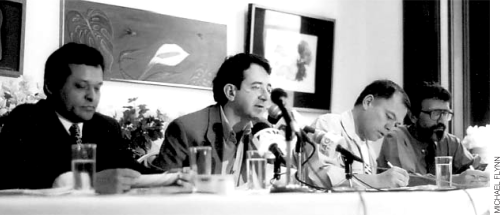
In early March, however, a new controversy forced the government to briefly abandon its stonewalling tactics. At a March 13 press conference in Mexico City, Nadal and three other plant critics—Alejandro Calvillo, head of Greenpeace Mexico; Bernardo Salas, a former radiation technician at the plant who was fired in 1996 after speaking out about irregularities; and Marco Martínez, a physicist at the Autonomous University of Mexico—announced that an anonymous group of engineers at Laguna Verde had sent Greenpeace a document detailing serious problems at the plant.
Although the document was not the independent audit called for by critics, it was the next best thing. It was a 170-page preliminary report about operations at Laguna Verde prepared by the World Association of Nuclear Operators (WANO), an organization created in the wake of the Chernobyl disaster to foster safety and reliability in the world's nuclear power industry. Titled “Peer Review Field Notes,” the report is a collection of systematic observations made by 18 nuclear operators from several different countries during a three-month period last year.
The report states that of the 72 “activities” observed by the WANO team, only nine were “performed in a generally satisfactory manner.”
Among its conclusions: “Some radiological controls are insufficient to prevent unplanned personnel exposures”; “monitoring techniques used by workers, supervisors, and radiation technicians is [sic] insufficient to prevent the spread of contamination”; “the operating experience program is not an effective barrier in preventing station events”; and “safety culture is not a station recognized issue.” The report also describes several recent accidents and details a variety of deficiencies in the plant's equipment performance, material condition, maintenance procedures, and engineering practices.
David Lochbaum, a nuclear safety engineer at the Union of Concerned Scientists (UCS), says the WANO report is devastating. “If Laguna Verde were a U.S. plant, we would petition the Nuclear Regulatory Commission to force the plant to shut down until all necessary repairs were completed.” He says that the problems identified by WANO are remarkably similar to those discovered during a 1997 audit of several nuclear power plants in Canada, which resulted in the closure of seven of Canada's 19 reactors.
Another U.S. expert familiar with WANO's peer review process told me the report was “the worst set of field notes [about a plant] I have ever seen.” The expert, a former U.S. nuclear power plant director who asked to remain anonymous, cautioned that because it is a preliminary report it is difficult to judge whether the plant's reactors are safe to operate. “But having said that,” he continued, “it looks like the plant is in lousy shape.”
The four participants at the March 13 press conference reached a similar conclusion. They repeated their calls for an independent audit of the plant and all but one (Salas, the former technician) demanded that the plant be temporarily shut down.
In response to the growing controversy, Mexico's Federal Electricity Commission (CFE), which oversees the plant, released a three-paragraph statement declaring that Laguna Verde “operates satisfactorily and according to internationally established norms.” The statement also claimed that WANO considered the plant's performance to be “acceptable.”
Plant critics rejected CFE's curt assurances as absurd. How, they asked, could the plant's operations be judged “satisfactory” given WANO ‘ s apparently scathing critique?
A January 7 letter from Bill Kindley, director of WANO's Atlanta office, to Alfredo Elías, head of CFE, aroused further suspicions. In the letter, which was annexed to the WANO report, Kindley wrote, “Issues such as those identified at Laguna Verde have existed at other nuclear power stations in the past and still exist at other operating stations in North America today…. These plants are currently operating with the full agreement of their governments, utilities, and wano.”
At the March 13 Greenpeace press conference: (left to right) Bernardo Salas, Alejandro Calvillo, Marco Martínez, and Alejandro Nadal.
After reading the letter, UCS's Lochbaum quipped, “Sure, U.S. plants operate with problems comparable to those at Laguna Verde—but only until they are caught.”
Plant opponents believe the letter is proof that wano is colluding with cfe to keep an unsafe plant open. At the March 13 press conference, Greenpeace's Calvillo denounced the declarations of wano and cfe as an example of the nuclear industry's “deceitful practices.”
When I contacted Kindley, he refused to comment on the report. All peer review reports, he said, are confidential. Asked if wano has ever advised a utility that a plant is unsafe to operate, he responded, “We do not address those kinds of issues.”
Kindley also said he had been unaware that the peer review had been leaked. Wano members, he said, “have certain obligations to us to maintain the confidentiality of our reports. And since the reports are our property and they were unable to maintain its privacy, then we would be concerned.”
Who's the boss?
The “confidentiality” of the wano report has been another focus of controversy. News of the report first came to light in early January when Greenpeace released a statement demanding that CFE divulge the document. According to Greenpeace, plant employees who were concerned about the report's conclusions told the organization about the report.
Mexico's congressional Committee on Ecology and the Environment followed Greenpeace's lead and asked CFE's Elías for a copy. In a written response addressed to committee head Alejandro Jiménez, Elías cited WANO's position that the report was confidential and denied the committee's request. In support of the confidentiality claim, Elías cited the Berne Convention and the Universal Copyright Convention, which protect the privacy of unpublished works.
In a March 1 op-ed in the Mexico daily La Jornada, economist and author Nadal lambasted CFE's decision. He wrote, “Who should CFE obey regarding the security of Laguna Verde? A non-governmental association of nuclear operators or Congress?”
To invoke the copyright conventions, he wrote, was to “talk nonsense.” The conventions, he said, “establish incentives to enable authors to release their works, not to help keep them secret.” The confidentiality of the document is an internal policy of WANO, he added, “but this policy is secondary to the question of public interest.”
Asked if WANO would release a peer review report at the behest of a nation's congress, Kindley said, “I think we would have to look at the individual circumstances under which [the congress] agreed to maintain the report's confidentiality.” Regarding the Mexico case, Kindley claims that he was never informed by CFE that a congressional committee had solicited the report.
Asked if he agreed with Nadal's assertion that the public interest would trump WANO's right to privacy, Kindley demurred, saying he wasn't an expert on such matters.
The political dimension
Kindley regards the controversy surrounding the WANO document as unfortunate and counterproductive.
“In reality,” he told me, “what you've got going on down there is that there are people who want to improve what they are doing in the plant, and they've joined WANO to do that. But the fact that we went there to help has created quite a stir. I think from the positive side of this equation, when operators from different parts of the world share their experiences it can help a plant improve its safety. The alternative is that the plant didn't do anything.”
Nadal, who is also a member of the Bulletin's Board of Directors, calls CFE's decision not to release the document to the congressional committee a “cover-up.” “The true dimension of Laguna Verde is the political dimension here in Mexico. You can't have a cover-up like the one at the plant and still call yourself a democracy.”