



Abstract
Betrayal, by Washington Times national security reporter Bill Gertz, is as subtle as an H-bomb but, fortunately not nearly as lethal. Gertz clearly holds President Bill Clinton in great contempt, and the book, largely a compilation and expansion of previously published articles in his newspaper, is an effort to document how the president sold out the security of the United States. He writes, “[Clinton's] wrong-headed policies affecting our nation's security, and his cavalier cover-up of this misconduct, amount to a betrayal—a betrayal that has left the United States weaker militarily as its enemies grow stronger and the world becomes more dangerous.”
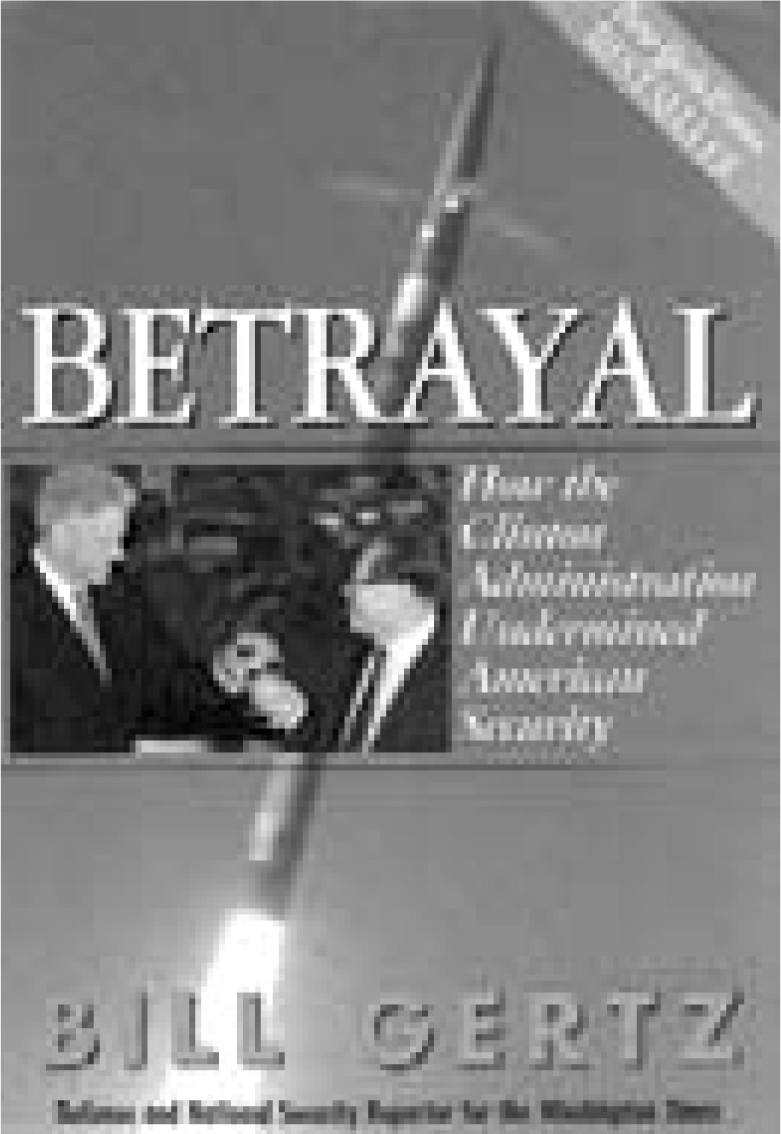
Gertz builds his case by examining U.S. policies towards Russia, China, North Korea, and Iraq—all of which, not surprisingly, he finds wanting. But in many instances, his ideological tunnel vision keeps Gertz from exploring plausible alternative explanations. He also undermines his arguments with sloppy writing, an over-reliance on unnamed sources, mistaken assertions and, not least, a lack of footnotes to substantiate his specific and very serious charges. He does, however, occasionally cite the 20 or so classified government documents that are reproduced in the book's extraordinary appendix, including a CIA report titled “Prospects for Unsanctioned Use of Russian Nuclear Weapons,” and Presidential Decision Directive 17, concerning ballistic missile defense technologies and the Anti-Ballistic Missile Treaty. Gertz and his publisher did accede to government requests not to reproduce National Security Agency documents about the sale of Russian missile technology to Iran.
Perhaps more than any other reporter on the national security beat, Gertz relies on leaks. But his leakers provide him not only with information, but with partial or complete copies of still classified documents. He writes that Clinton's betrayals “so angered some intelligence, defense, and foreign policy officials that they responded in the only way they knew how: by disclosing to the press some of the nation's most secret intelligence.” He praises these officials as “unsung heroes” who “have jeopardized their careers to expose wrongdoing.” Yet if Gertz worked for a publication on the opposite side of the political spectrum, he and his paper would be branded as security risks by some of the very people who strongly endorsed Betrayal, including former defense secretary Caspar Weinberger.
Gertz's reliance on leaks and his assumption of the infallibility of leaked information is problematic. People who leak information rarely do so for completely altruistic reasons. They leak to curry favor, to promote or denigrate a particular policy or program, or to cast political opponents in an unfavorable light. Because only Gertz knows the identities of these leakers, it is impossible to ascertain their motives. And Gertz never once questions the motivations of his sources. Nor does he raise the possibility that other documents by other analysts at other agencies may have reached very different conclusions.
A perfect illustration of this problem is Gertz's assertion that the large underground facility at Kumchangri is an unequivocal violation of North Korea's agreement with the United States to halt its nuclear weapons activities. He cites classified documents based on satellite photo reconnaissance to support the charge. But an on-the-ground inspection by U.S. officials in late May 1999, after Betrayal was published, revealed the facility to be—for the moment anyway—nothing more than a large, empty underground tunnel.
Gertz criticizes U.S. efforts to help Russia dismantle its outdated nuclear weapons. He takes at face value the 1998 statements by Andrei Kokoshin, secretary of the Russian Security Council, that Russia will maintain a large and robust nuclear arsenal until 2010 and beyond, and that sizable funds will be devoted to modernizing existing forces. He then argues that Russia is doing this even as the United States sends Russia “over $1 billion to help the Russians ‘dismantle’ nuclear weapons.”
But anyone who has followed the Russian nuclear weapons program knows that Russian weapons were not designed to last as long as their U.S. counterparts. The current modernization program is necessary to replace existing, obsolescent weapons, not to supplement them. Further, Russia's precarious financial state means that the modernization effort is not keeping pace with retirements, so the overall size of Russia's forces is shrinking.
Gertz dismisses efforts initiated by the United States to share early warning data with Russia to avoid misunderstandings and accidents as a “windfall of extremely valuable intelligence on American missile detection and warning systems, which could be used to make Russia's strategic missiles harder to detect.” That there could be some benefit to the United States from this arrangement is not mentioned.
He also criticizes President Clinton for not supporting ballistic missile defenses. Yet his charge that Clinton administration policies “led to the death” of the Strategic Defense Initiative (SDI) is a gross exaggeration, unless one interprets Gertz's words to mean that under Clinton the Strategic Defense Initiative Organization was renamed the Ballistic Missile Defense Organization. The program was also reoriented because President Ronald Reagan's grandiose plans for space-based lasers and other exotic weaponry failed, despite expenditures of more than $60 billion (in constant 2000 dollars) since 1983. In reality, the SDI program was constantly evolving and changing from the moment Reagan announced it. That farfetched schemes for unworkable weapons failed can hardly be blamed on someone who took office 10 years after the fact.
According to Gertz, Clinton doesn't believe missile defenses are necessary. He cites Clinton's frequent statements during the 1996 campaign that no nuclear weapons were pointed at America's children. That the assertion was misleading is a fair enough charge, but Clinton only began using it after he and his aides found it to be a big applause line. However, the president clearly supports missile defense research, and he has signed legislation making deployment of missile defenses a national priority. What he does not support, much to Gertz's consternation, is abandoning the Anti-Ballistic Missile Treaty to deploy systems of dubious effectiveness.
Gertz alleges that Pakistan's 1998 nuclear tests “could have happened only because the Clinton administration chose to ignore China's sales of nuclear weapons technology to Islamabad.” He fails to point out that both the Reagan and Bush administrations deliberately downplayed Pakistan's nuclear weapons program between 1986 and 1990. Clinton shares the blame, but he was hardly the first president to look the other way on nuclear weapons proliferation when the facts proved politically inconvenient.
Several times in the book, Gertz juxtaposes sentences that are so obviously contradictory that you wonder if he or his editors ever read what he wrote. For example, he writes, “China knows its weaknesses and vulnerabilities and is moving quickly—often with U.S. as-sistance—to improve its capabilities.” The following paragraph begins, “China's military modernization is deceptive and measured in order to avoid arousing international attention.” So is China moving quickly or in a measured fashion? Take your pick.
In another example, Gertz writes, “China claims it will use its nuclear arsenal only in retaliation against a nuclear attack. But the hollowness of China's promise was exposed in October 1995, when a Chinese general threatened to fire a nuclear missile at Los Angeles if the United States did not better accommodate an increasingly aggressive China.” But on the following page, Gertz gives what appears to be the exact quote by Gen. Xiong Guangkai, the deputy chief of staff for intelligence, commenting on U.S. threats to use nuclear weapons against China and North Korea during the Korean War. “You could do that then because you knew we couldn't retaliate…. Now we can. In the end, you care a lot more about Los Angeles than you do about Taipei.” Xiong's comment may be construed as a vague threat against Los Angeles, but it is in no way a threat to use nuclear weapons first.
The book also contains numerous errors. Gertz claims that “the United States never tested its neutron bomb due to political pressure.” In fact, the United States did test the enhanced radiation warhead, or neutron bomb, several times. It even built 930 of the weapons in two different types. What it did not do was deploy the weapons overseas. Gertz also wrongly asserts at one point that uranium 235, or highly enriched uranium, “is not suitable for making fuel to run civilian power reactors.”
Despite the book's serious flaws, Gertz does raise one or two issues that merit further exploration—though perhaps by another author with less of an ideological ax to grind. For example, the handling of a 1997 incident over Puget Sound, when a Canadian helicopter on a joint U.S.-Canadian intelligence mission was apparently illuminated by a laser, damaging the eyes of two passengers, needs to be fully explained. The helicopter was attempting to photograph a Russian merchant vessel suspected of shadowing U.S. Trident submarines when the incident occurred. Before searching the vessel for the suspected laser, the State Department notified the Russian embassy of the impending inspection. U.S. officials also limited the search to only public areas of the ship, and to only two hours.
Despite the wealth of classified information at his disposal, Gertz fails to make his case. In his zeal to blame Bill Clinton for security failings both real and imagined, Bill Gertz betrays only himself.
we want to hear from you
Send them to: Letters, The Bulletin, 6042 South Kimbark, Chicago, IL 60637, fax: 773 702-0725 e-mail:
Be sure to include your mailing address and phone number.