






Abstract
Total body length and head capsule width (mm) were used as biometric characteristics in discriminating between size-frequency estimates of three Anacroneuria morphospecies, from 28 sampling sites along a tropical river subject to bimodal variations in water level in Central Colombia. A total of 344 specimens grouped into four size classes were collected. The highest abundance of Anacroneuria larvae was observed during the dry season and there was a higher abundance of small-sized individuals (body length <12mm). Overall, the highest abundance of stonefly larvae was recorded between 1000 to 1600m.a.s.l. Conductivity and pH showed a significant correlation with the total abundance of preimaginal stoneflies. Plecoptera size distribution patterns could be useful in assessing which stonefly size-spectra are susceptible to disturbance in tropical rivers and in evaluating their population dynamics.
Introduction
The order Plecoptera, is a group of hemimetabolous insects with more than 3497 species described worldwide, of which 474 species are Neotropical (Fochetti and Tierno de Figueroa 2008), but recently 32 out of 508 valid names were considered questionable by Froehlich (2010). This order is an important component in lotic systems, both in terms of abundance and in terms of ecological significance (Zwick 2004; McLellan and Zwick 2007; Stark et al. 2009). In comparison to their temperate counterparts, tropical stoneflies are poorly understood (Sheldon and Theischinger 2009), and regional and local species lists are extremely incomplete. One reason for the paucity of systematics and ecological studies of tropical river Plecoptera is that identification of tropical species is difficult for non-specialists (Suhaila and Che Salmah 2011).
In Colombia, the order Plecoptera is represented by two families: Perlidae with three genera (Anacroneuria, Macrogynoplax and Klapalekia; Tamaris-Turizo et al. 2007; Zúñiga et al. 2007) and, Gripopterygidae with one genus (Claudioperla, Barreto et al. 2005; Zúñiga et al. 2009). Anacroneuria Klapálek, 1909 (Plecoptera: Perlidae) is the largest Neotropical genus with more than 300 species (Froehlich 2003; Bispo et al. 2005; Tomanova and Tedesco 2007). Its distribution extends from the southern United States to northern Argentina (Stark 2001; Froehlich 2004). Sixty-one species are reported from Colombia alone (Zúñiga et al. 2007). Nevertheless, there is no published information on stoneflies from the Tolima province, Central Colombia, except for the first record of the Gripopterygidae family in the Páramo ecosystem (Barreto et al. 2005), a special biogeographic zone at the highest altitudes of the Andean region in northern South America (Hofstede 1995). Despite their importance as water quality indicators, stoneflies have received little attention in Colombia and the peer-reviewed literature is scarce (Stark et al. 2009). The life histories and trophic interactions of stonefly larvae are not well-known even though they play an important ecological role in the freshwater ecosystems (Bohórquez et al. 2006; Tamaris-Turizo et al. 2007; Gamboa et al. 2009).
Biometric studies are important because several biological, physiological and ecological properties can be extracted from specific body dimensions (body length or head width; Beer-Stiller and Zwick 1995; Krasnov et al. 1996; Klingenberg and Spence 1997; Zwick 2003). The morphological characteristics of aquatic insect larvae can be influenced by biotic and abiotic factors (Crosa and Buffagni 2002; Tomanova and Tedesco 2007). Altitude, temperature, seasonality, competition and predation are key factors regulating insect abundances in aquatic environments (Brittain 1983; Saltveit et al. 1994; Céréghino and Lavandier 1998; Céréghino et al. 2002). Worldwide, biometric research on plecopterans has mainly involved obtaining linear measurements to determine growth in immature stages (larvae) for life-cycle and secondary production analyses (e.g., Sheldon 1969, 1980; Schmidt and Tarter 1985; Lillehamnur et al. 1989; Townsend and Pritchard 1998; Fenoglio et al. 2007; Principe 2008). Similarly, studies of morphometric differences (except taxonomic descriptions) in larvae and adults of the Anacroneuria genus and their relationships to environmental factors have been highlighted for some tropical rivers (Tomanova and Tedesco 2007; Fenoglio et al. 2007; Cressa et al. 2008; Gamboa and Arrivillaga 2010).
In tropical rivers, precipitation and discharge play an important role in structuring the benthic community (Silveira et al. 2006; Wantzen et al. 2006). These rivers and their aquatic communities are conditioned by rainfall during the rainy season (Turcotte and Harper 1982; Flecker and Feifarek 1994; Jacobsen and Encalada 1998; Buss et al. 2004; Jacobsen 2004; Bispo et al. 2006). Rivers in the Andean region of Colombia are also highly influenced by seasonal rainfall, normally occurring during two wet seasons, with sporadic spates even during the "dry" season (Restrepo and Kjerfve 2000; Arias et al. 2007).
The present study was carried out in the Prado River Basin, which is a valuable tributary of the Magdalena River, the most important river system in Colombia (Galvis and Mojica 2007). The objectives of this study were to measure the variation in body size of Anacroneuria larvae across sampling sites of varying in altitude during two contrasting seasons (dry and wet); to identify morphological differences caused by these temporal and spatial parameters; and to determine whether this life-history characteristic varies with elevation and season.
Materials and Methods
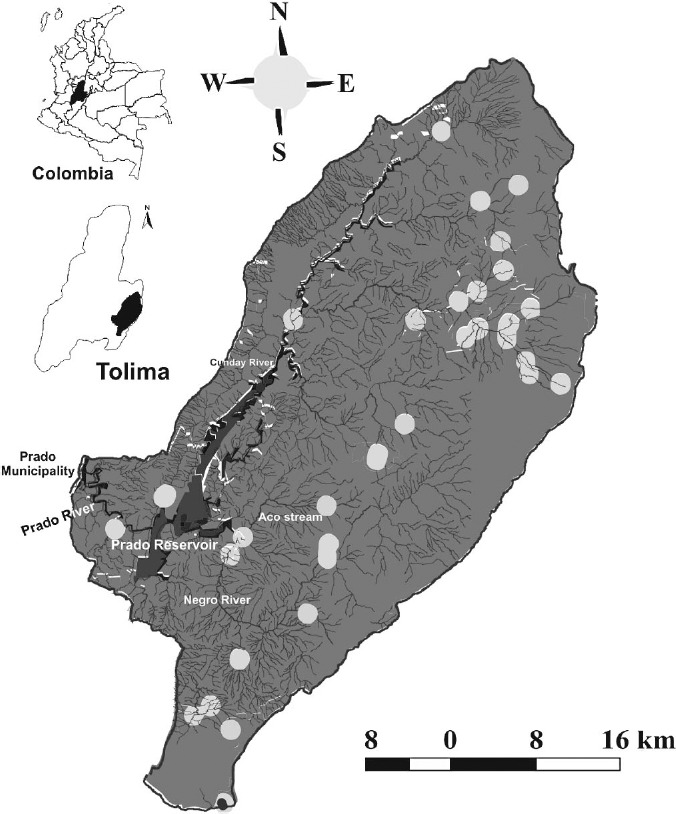
Location of the Prado River Basin in Tolima Province (Colombia). The distribution of Anacroneuria larvae in watershed networks is shown by yellow circles.
In the laboratory, body length (BL; from the front of the head to the tip of the abdomen), head capsule width (HCW; across the compound eyes), and mesothoracic wing pad length (WL; from the tip of the wing pad to the paramedial contact point with the mesonotum) of each specimen (sensu Nesterovitch and Zwick 2003) were measured to the nearest 0.01mm using a stereomicroscope (Olympus, 10X). We sorted the collected larvae into three different Anacroneuria morphospecies (M1, M2, M3; see Bohórquez et al. 2006) related to variations in body size and pigmentation, among other morphological traits. Intrastadial sizes characterized by differences in the shape of the margins, the orientation and the pigmented pattern of hind wingpads, i.e., rounded, pronounced and darkish, were traced by assigning larvae to one of four arbitrary size classes (obtained from frequency histograms), given that estimation of larval instars is difficult for stoneflies because of their molting times (Otsuki and Iwakuma 2008). Therefore, body length measurements for each morphospecies were used to construct size-frequency distributions pooled into four size classes (mm). Selected physical, chemical and microbiological parameters were recorded at each sampling site and later analyzed following methodologies proposed by APHA-AWWA-WEF (Clesceri et al. 1999).
The relationships between total larval abundance and elevation or physicochemical variables were analyzed by means of Spearman Rank Correlation test, due to lack of normality. We used linear regressions to test the relationships between the body length and head capsule width measurements. Since morphospecies 3 (M3) abundance was low during each sampling period (4 during the dry season, 2 during the wet season), we combined the data from both seasons when fitting linear regressions. All analyses were performed using STATISTICA version 7 (StatSoft 2004) considering a significance of 5% (α=0.05).
Results
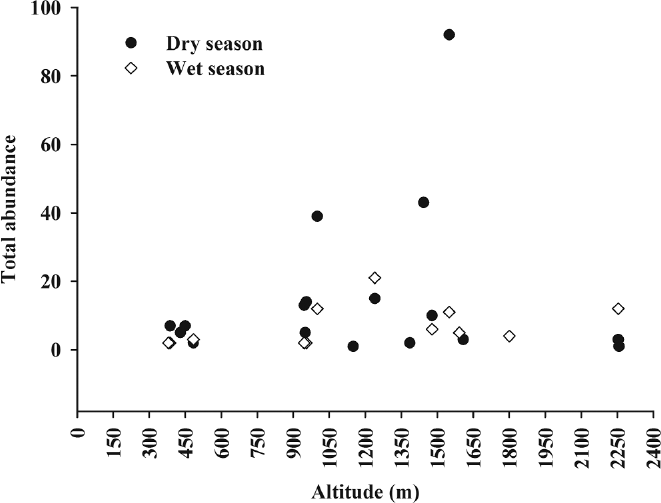
Scatter plot of the total abundance of Anacroneuria larvae against elevation in the Prado River Basin (Tolima, Colombia) during 2005. Note the contrasting total numbers of individuals between dry and wet seasons.
The physicochemical variables, water temperature, air temperature, pH, conductivity, total hardness, and total and fecal coliforms, were highest during the dry season. On the contrary, conductivity, dissolved oxygen and O 2 saturation percentage displayed higher values during high water level conditions (Table 1). The pH and conductivity variables showed a significant correlation with total abundance during the dry season (n=17; r=-0.58, P=0.014; r=-0.57, P=0.015, respectively), while only conductivity was marginally significant during the wet season (n=12; r=-0.57, P=0.047).
Physical, chemical and microbiological parameters at 28 sampling sites along the Prado River Basin recorded during two contrasting seasons in 2005.
WT = water temperature (°C); AT = air temperature (°C); T = turbidity (NTU); C = conductivity (µScm−1); TH = Total Hardness (mgl−1 CaCO3); DO = dissolved oxygen (mgl−1); %DO = percentage dissolved oxygen; TC = total coliforms (CFU 100ml−1); FC = fecal coliforms (CFU 100ml−1).
Different sampling points.
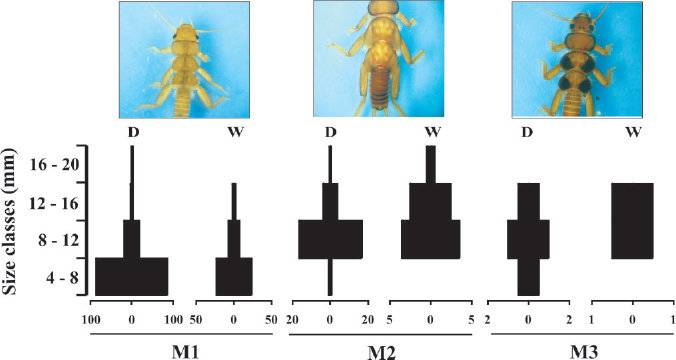
Size-frequency distribution (mm) of the body length of Plecoptera larvae in the Prado River Basin in central Colombia. Values of the X-axis are proportional to the total abundance during each season. D=Dry season, W=Wet season. M=morphospecies: specimens that have been sorted and classified as distinct according to their shape and morphological characteristics, although unidentified and unsexed; M1: morphospecies 1, M2: morphospecies 2, M3: morphospecies 3. Main intrastadial changes are shown in the upper part.
The smallest head capsule width was 1.08mm, and the maximum was 3.95mm. We found a relationship between total body length and head capsule width in every morphospecies and according to season. This relationship was strongly isometric (Fig. 4) and linear, with the following equations being highly significant for all morphospecies: M1 (dry and wet season; rβ=0.98, P<0.001 and rβ=0.91, P<0.001); M2 (rβ=0.81, P<0.001 and rβ=0.69, P<0.001); M3 (rβ=0.80, P<0.016). Larvae of all morphospecies exhibited continuous variation of both HCW and WL and could not be grouped precisely into instars based on either one of these variables.
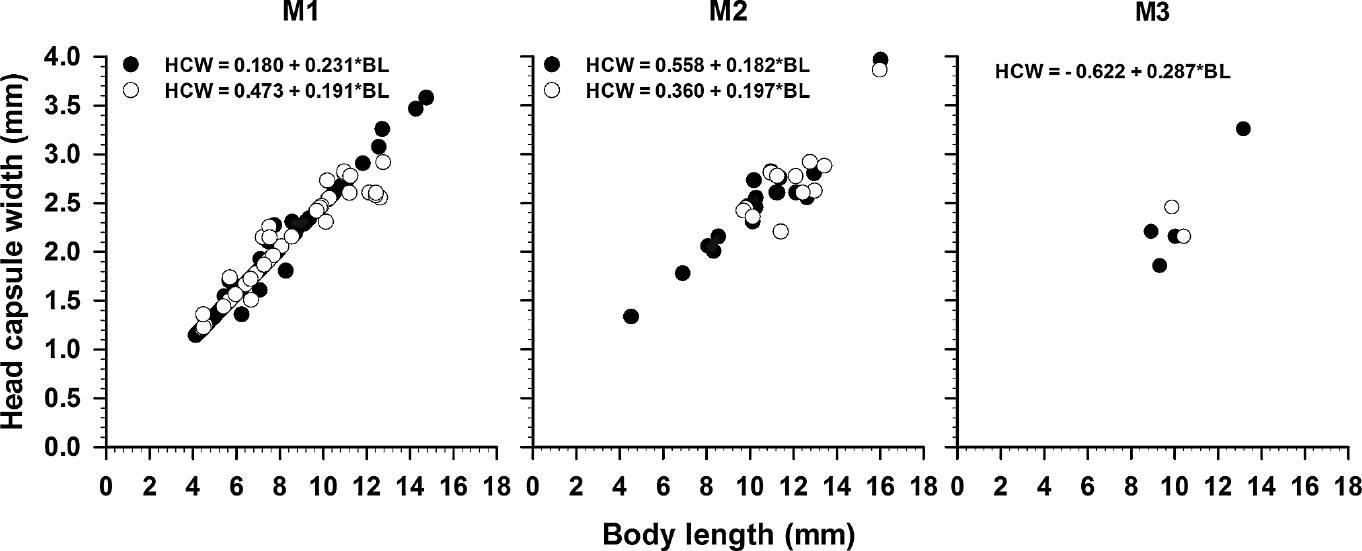
Relationship between body length (BL) and head capsule width (HCW) of three Anacroneuria morphospecies registered during contrasting seasons in the Prado River Basin (Tolima, Colombia). Regression equations are also shown. ●=dry season, ○=wet season.
Discussion
Zwick (2003) argued that in Plecoptera, the first small rudiments of wingpads appear in the antepenultimate instar, and the definite shape is reached during subsequent molts. We sorted morphs according to biometric characters (mainly wingpads) and color similarities, and identified and grouped them according to stonefly congeneric specie, which unquestionably under-represents the actual species richness for the river and the region. For instance, we report the presence of at least three species which are probably correlated to the three morphs, but a minimum of 58 species have been described in Colombia based on adult collections (Zúñiga et al. 2007). Since most ecological and biological studies ideally involve aquatic insects in the adult stage (mainly males), it is necessary to rear larvae in order to associate them with the adults (Hamada and Couceiro 2003). Therefore, more detailed studies are required in the region, beginning with adult collections, species identification and adult-larvae associations (rearing). These aspects are important for future life-cycle studies, nutrient fluxes, biodiversity and secondary production analyses in tropical rivers where the limnology remain understudied (Allan et al. 2006).
In general, tropical freshwater bodies are characterized by drastic variations in benthic community abundance during high water level conditions (Winemiller and Jepsen 1998; Jacobsen and Encalada 1998; Rincon and Cressa 2000; Wantzen 2003). Turcotte and Harper (1982) suggested that rainfall spates are the major factor regulating benthic densities in non-seasonal environments (Amazon drainage basin, Ecuador). The stonefly larvae abundance found during the wet season (November) was markedly different from that found during the dry season (August-September). The high precipitation registered during the second sampling period, November (wet season), increased discharge and consequently stream and river instability, altering the community structure by dislodging substrate and forcing drifting (Céréghino and Lavandier 1998; Céréghino et al. 2002). In a tropical river of Venezuela, Anacroneuria larvae were most abundant during the period of least precipitation (Pérez and Segnini 2005). These results are concomitant with a study of caddisfly larvae in the Coello River watershed, Central Colombia, where lowest abundances were recorded during the rainy season (Guevara et al. 2005, 2007b).
In general terms, a decline in species richness with increasing altitude was observed (Von Ellenrieder 2007), as well as a decline in frequency of occurrence in certain species towards higher altitudes, without disappearing altogether (Jacobsen et al. 2003; Jacobsen and Brodersen 2008). Other species can disappear completely at different points along the altitude gradient, which affects their local and regional abundance (Romero-Alcaraz and Avila 2000).
Although the size of stoneflies in temperate regions seems to be correlated with environmental factors such as photoperiod, water temperature and season (Nesterovitch and Zwick 2003), our results suggest that environmental factors in the study area do not influence size or that these physicochemical parameters are not sufficiently different to affect larval size. Also, we did not find a significant relationship between body length and elevation, but it is possible that a further evaluation of pre-emergent Anacroneuria larvae may reveal significant correlations with altitude and/or any other physicochemical variable (e.g., Tomanova and Tedesco 2007; Cressa et al. 2008).
Footnotes
Acknowledgements
The authors would like thank to the anonymous reviewers for the very helpful suggestions and criticisms that improved the manuscript draft. All remaining errors and omissions are our responsibility. Thanks also to CORTOLIMA (regional environmental authority) and the University of Tolima for supporting this research. G. Guevara thanks the Austral University of Chile for the doctoral fellowships (MECESUP UCO0214 - AUS0703) and the Subcommittee of the Permanent Committee for Mayflies and Stoneflies Conferences for travel scholarships to attend the International Joint Meeting on Ephemeroptera and Plecoptera held in Stuttgart in June 2008.