Specimens of Mechanitis menapis menapis (Lepidoptera: Nymphalidae: Ithomiinae) were collected from three localities in the Colombian Andes. Eggs and larvae found on the host plant were collected and studied under laboratory conditions. The plant on which the immatures were found was identified as Solanum hirtum, which represents a new host plant record for Mechanitis menapis in Colombia. The observations presented contribute to an understanding of the host plants of Neotropical diurnal butterflies, and specifically the Ithomiinae, for Colombia.
Mechanitis menapis menapis (Hewitson, 1856) belongs to the family Nymphalidae, subfamily Ithomiinae. This subfamily includes Neotropical butterflies distributed in humid forests from sea level up to 3.000 m and from Mexico to southern Brazil, Paraguay, and across three Caribbean islands (Willmott and Freitas 2006). Ithomiinae species are of special interest as entomological and ecological models because they belong to at least eight distinct mimicry rings (Joron and Mallet 1998) and because they establish particular relationships with host plants, most of which produce alkaloids that are detoxified during the caterpillar life cycle and later used as defenses against natural enemies (Drummond and Brown 1987). Important advances improving the knowledge of Ithomiinae in South America have been recently published (e.g. Drummond and Brown 1987, 1999; Willmott and Mallet 2004; Willmott and Freitas 2006). In Colombia, some publications including host plants records have been made by Constantino (1997a, 1997b) and García et al. (2002), but detailed studies related to host plants and life cycle are scarce.
The genus Mechanitis has been recorded in the Colombian Andes particularly in coffee growing areas of Antioquia and Caldas departments (Constantino 1997a). The genus is taxonomically difficult and identification to the species level is mainly achieved using morphological characters such as wing color pattern and venation. Variation in color pattern among some species and subspecies, however, makes identification difficult (Brown 1977). Brown (1977) reviewed the taxonomy of Mechanitis and Melinaea, but studies are still lacking on relevant characters as derived from immature instars, and aspects such as host plant range and life cycle detail. Regarding his work, Brown (1977) stated: “it is not claimed that this represents a final taxonomic revision, as much field, insectary, genetic, cytological, physiological and biochemical work must still be undertaken before a complete and definitive comprehension of these groups can be achieved.”
Interactions between Ithomiinae butterflies and Solanaceae plants have been well documented (Drummond and Brown 1987, 1999; Willmott and Mallet 2004). Records of Mechanitis larvae feeding on Solanum plants have been reported in Brazil, Costa Rica and Colombia (Vasconcellos-Neto 1986; Acevedo 1992; Constantino 1997a; Haber 2001). According to Willmott and Mallet (2004), and based on an extensive compilation from different authors, there are more than 35 Solanum host plants registered for Mechanitis species. As an example, M. lysimnia (Fabricius, 1793) females have been observed laying eggs on the leaves of at least five prickly Solanum species in southeast of Brazil (Vasconcellos-Neto and Monteiro 1993). In Colombia, Constantino (1997a), recorded M. polymnia (Linnaeus, 1758) feeding on S. torvum (Sw., 1788) and S. quitoense (Lam., 1794) and M. menapis on S. torvum, S. hispidum (S. asperolanatum Ruiz & Pav., 1799), S. nigrum (L., 1753) and S. mammosum (S. circinatum Bohs, 1995).
The high diversity of the genus Solanum, estimated at approximately 1400 species (Bosh 2005) with 163 restricted to Colombia (NHM 2008), and the morphological similarity between species, have contributed to a poor understanding of Solanum host plants for Ithomiinae in Colombia, including for Mechanitis. In this work we report Solanum hirtum Vahl. as a host plant for M. menapis menapis in Colombia.
Materials and Methods
Biological material was obtained during fieldwork from three localities in the Andean region of Colombia. Santa Fé de Antioquia (500 m elevation, 6°32’08,19” N, 75°49’41,32” W) Valparaiso Antioquia (1000 m elevation 5°41’32,86”N, 75°38’24,14”W), and Anserma Caldas (840 m elevation 5°10’35,01”N, 75°40’51,84”W). Eggs and larvae were collected from plant leaves and plant samples were taken for the later taxonomic identification. Plants were identified using Whalen et al. (1981) and Bohs (2005) and by comparison with specimens deposited at the Herbarium MEDEL, Universidad Nacional de Colombia, Medellín. Species identities were confirmed by an expert of the Solanum genus, Dr. Lynn Bosh. Voucher specimens were deposited in the Herbarium MEDEL.
Immature stages were reared under laboratory conditions in the insectarium at the Universidad Nacional de Colombia, Medellín (1538 m elevation, 27°C and 45% humidity). Selected branches with eggs or larvae were taken from the plants and transported to the insectarium. There, each stem was hydrated with water and put into a cage made of wood and mesh (20 X 30 X 29 cm). Branches were replaced after larvae consumed them. Length and width measurements of the larvae were taken after each molt. Insects remained in the cages until eclosion of the imago. Adult butterflies obtained were mounted and deposited at the Entomological Museum Francisco Luis Gallego (MEFLG) of the Universidad Nacional de Colombia, Medellin. Adults were sexed and identified using morphological characters and field guides (Brown 1977; García et al. 2002). Species identities were also confirmed by Gerardo Lamas (Museum of Natural History, Universidad Nacional Mayor de San Marcos).
Results and Discussion
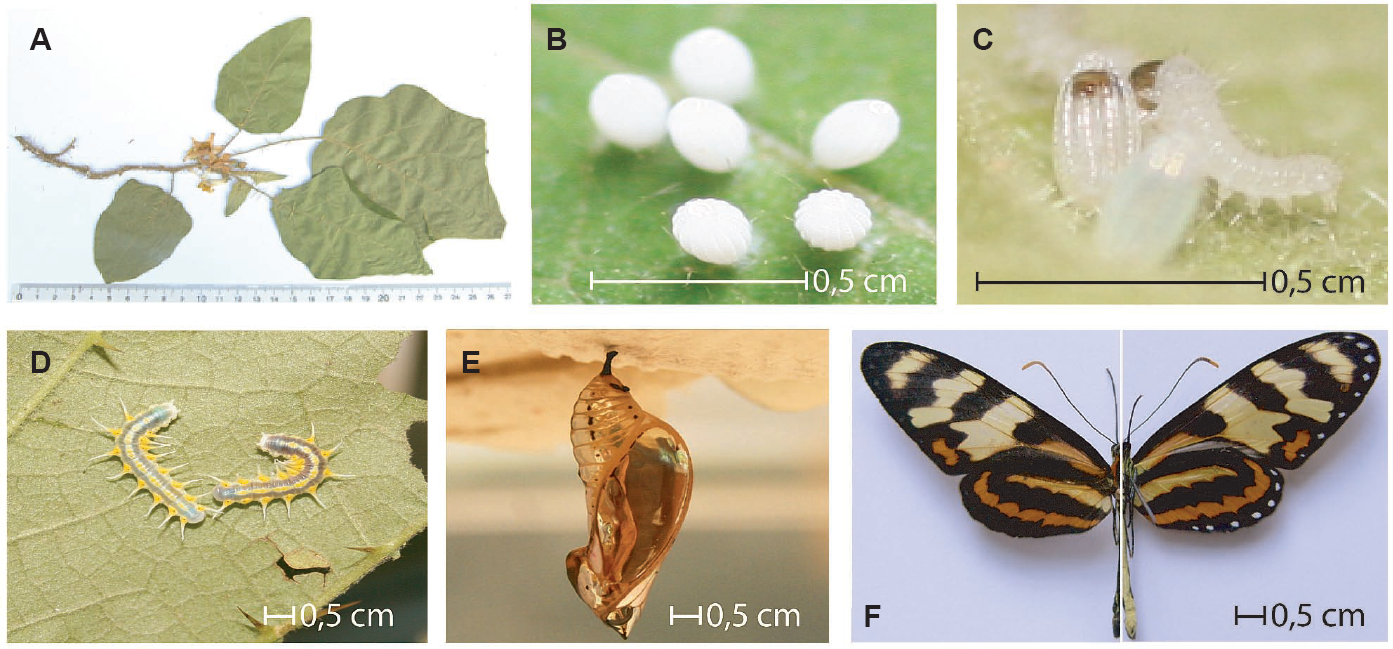
Plant samples where immature stages of Mechanitis were found and reared corresponded to S. hirtum (Fig. 1A). S. hirtum is distributed from Peru to Central America (Bohs 2005) and was previously reported as a host plant for M. isthmia (M. polymnia isthmia H. W. Bates, 1863) by Rathcke and Poole (1975) and Drummond and Brown (1987) in Venezuela. In Colombia, it has not previously been reported as a host plant for Mechanitis.
A.Solanum hirtumB. Eggs C. first instar larvae eclosion. D. Fifth instar larvae. E. Pupae, F. Male adult dorsal view (Left) and ventral view (Right).
The life cycle from egg to adult lasted 30 days with five instars exhibited. In the field, the eggs were found distributed individually or in small clusters (Fig. 1B), usually on the upper leaf surface of young plants <1 m tall. A total of 109 eggs were collected and reared of which 63 reached adult stage (57.8%). Of these, 33 were males (52.38%) and 30 were females (47.62%).
After hatching, first instars ate a part of the egg shell and a small part of the leaf, making a hole through which they passed to the inner leaf surface. They then weaved a web on the leaf's stellate trichomes on which they were able to move. According to Rathcke and Poole (1975), such behavior in M. isthmia (M. polymnia isthmia) is an adaptation for feeding on Solanum plants. Larvae begin to eat at the edge of the same hole they passed through before to fed on the upper leaf surface. First instars have a black cephalic capsule. The body is clear before eating and then turns dark green due to food. They have eight pairs of almost imperceptible, undeveloped, lateral tubercles above the prolegs. Their thoracic legs and prolegs are white. The body is 3 mm long and 0.7 mm wide after eclosion (Fig. 1C). One day later, the legs are black and prolegs are white; the body is 5 mm long and 0.7 mm wide.
Second instars are 7 mm long and 2.0 mm wide; their lateral tubercles are white and larger (0,5 mm). The cephalic capsule is black and the body is grey from the head until the sixth abdominal segment. The other segments are white. Prolegs are grey. Third instars are 18 mm long and 2.5 mm wide. The cephalic capsule and body are grey, but the central part and bases of the tubercles are yellow. For this instar, abdominal tubercles are well developed (1 mm). Posterior instars (fourth) have similar coloration but are different in size (21 x 3.0 mm; tubercles 2 mm). The last instar (fifth) is 25 mm long and 4 mm wide; the tubercles are 5 mm long, the color turns purple along the body (Fig. 1D). Before pupation, the larvae turn yellow and stop feeding. Pupae are yellow on the first day and then become golden (Fig. 1E). The finding of five larval instars is in accordance with previous results from Constantino (1997a) for this species and for many other species of Ithomiinae (Willmott 2009). For morphological comparisons there are no published details of immature stages for M. menapis.
The finding of S. hirtum as host plant of M. menapis in Colombia highlights the importance of this kind of study that reveals details of the butterfly-host plant interaction. It is clear that in Colombia information related to this aspect, and based on ecological data and field studies, is quite scarce. There is only one previously published work in Colombia reporting host plants for M. menapis (Constantino 1997a). This work reported other Solanum species but not S. hirtum. Our study on M. menapis and others in Costa Rica and Ecuador (Drummond and Brown 1987; Haber 2001) indicate that the genus Solanum is perhaps the only one used by M. menapis.
Other Mechanitis species such as M. polymnia and M. lysimnia also lay eggs in S. hirtum as indicated by the observations of Drummond and Brown (1987) in Venezuela. Both species are morphologically similar and their taxonomic status and host plants records in Colombia are also being revised by the authors.
Although Solanum appears to be the most important host plant genus for Mechanitis, other genera such as Brugmansia, Brunfelsia, Cyphomandra, Datura, Jaltomata and Nicandra have been previously reported in Brazil, Costa Rica, Ecuador, Uruguay and Venezuela (Beccaloni et al. 2008), and their importance as host plants in Colombia has not been determined. Intensive studies are needed on local populations with different life histories, ecology and biochemical properties. This type of investigation is necessary to answer important questions such as why butterflies evolve to use a particular host plant or set of host plants, and what phenotypic and micro-evolutionary alternatives are open to a population in exploiting the food plant resource.
Footnotes
Acknowledgements
We thank Andre Freitas who encouraged us to study Ithomiinae in Colombia and helped us at every step, as well as Keith Willmott for his support and training. We also thank Gerardo Lamas (Museum of Natural History, Universidad Nacional Mayor de San Marcos) and Lynn Bohs (University of Utah, USA) for their valuable collaboration and advice for identifying the butterfly and plant species, respectively. Finally, we thank Jorge Perez (curator, Herbarium MEDEL) and the Sciences School and Entomology postgraduate program at the Universidad Nacional de Colombia that supported the insectarium as a research space. This work was supported by the Direction for Investigation Universidad Nacional de Colombia, Medellin, grant 20101007738.
References
1.
ACEVEDOE.1992. Reconocimiento de plagas y benéficos en el cultivo de tomate de árbol (Cyphomandra betacea (Cav.) en la zona cafetera de Colombia. Agronomía (Manizales-Colombia)5(1): 33–37.
2.
BECCALONIG. W.; VILORIAA. L.; HALLS. K.; ROBINSONG. S.2008. Catálogo de las Plantas Huésped de las Mariposas Neotropicales. m3m-Monografías Tercer Milenio, Volumen 8. Zaragoza -España. 536 p.
3.
BOHSL.2005. Major clades in Solanum based on ndhF sequence data. Monographs in Systematic Botany104: 27–50.
4.
BROWNK. S.JR.1977. Geographical patterns of evolution in Neotropical Lepidoptera: differentiation of the species of Melinaea and Mechanitis (Nymphalidae, Ithomiinae). Systematic Entomology2: 161–167.
5.
CONSTANTINOL. M.1997a. Conocimiento de los ciclos de vida y plantas hospederas de lepidópteros diurnos de Colombia como estrategia para el manejo, uso y conservación de poblaciones silvestres. Seminario Aconteceres Entomológicos. Octubre 30 y 31 (Medellín- Colombia). Pp. 57–81.
6.
CONSTANTINOL. M.1997b. Lepidópteros diurnos del Chocó biogeográfico: Diversidad, alternativas productivas sostenibles y estrategias de conservación. Conf. Magistral. Memorias XXIV Congreso SOCOLEN. Pereira, Julio 16-18 de 1997. 47–74 p.
7.
DRUMMONDB. A.III; BROWNK. S.JR.1987. Ithomiinae (Lepidoptera: Nymphalidae): summary of known larval food plants. Annals of the Missouri Botanical Garden74: 341–358.
8.
DRUMMONDB. A.III; BROWNK. S.JR.1999. New records of larval host plants for Ithomiinae butterflies (Nymphalidae). Revista Brasileira de Biología59(3): 455–459.
9.
GARCÍAC. A.; CONSTANTINOL. M.; HEREDIAM. D.; KATTANG.2002. Mariposas comunes de la cordillera central de Colombia, Guía de campo. Editorial Feriva. Cali -Colombia. 130 p.
RATHCKEB. J; POOLER. W.1975. Coevolutionary race continues: butterfly larval adaptation to plant trichomes. Science New Series187(4172): 175–176.
14.
VASCONCELLOS-NETOJ.1986. Interactions between Ithomiinae (Lep., Nymphalidae) and Solanaceae, pp. 364–377. In: D'ArcyWG (Ed.). Solanaceae: biology and systematics. Columbia University Press, New York.
15.
VASCONCELLOS-NETOJ.; MONTEIROR. F.1993. Inspection and evaluation of host plant by the butterfly Mechanitis lysimnia (Nymphalidae: Ithomiinae) before laying: a mechanism to reduce intraspecific competition. Oecologia95: 431–438.
16.
WHALENM. D.; COSTICHD. E.; HEISERC. B.1981. Taxonomy of Solanum section Lasiocarpa. Gentes Herbarum12: 41–129.
WILLMOTTK. R.; MALLETJ.2004. Correlations between adult mimicry and larval host plants in Ithomiinae butterflies. Proceedings of the Royal Society B. (Suppl.)271: S266–S269.
19.
WILLMOTTK. R.; FREITASA. V.2006. Higher-level phylogeny of the Ithomiinae (Lepidoptera: Nymphalidae): classification, patterns of larval hostplant colonization and diversification. Cladistics22(4): 297–368.