






Abstract
The larva and pupa of
Keywords
Introduction
The tribe Cyclocephalini contains 14 genera that occur in the New World except for one species of
Materials and Methods
Terms and characters used in the description are those of Ritcher (1966), Morón (1987), and Morón and Ratcliffe (1990). Specimens were deposited at the Universidad Nacional de Colombia, Museo Entomológico, Facultad de Agronomía, Bogotá, Colombia (UNAB).
Results
Aspidolea singularis Bates, 1888. (Figs. 1-14) Third-Instar
This description is based on four first-instar, three second-instar, five third-instar, two cast skins of the third-instar larvae and five pupae reared to the adult stage from: COLOMBIA, Cauca, Caldono. 2°47′50″N; 76°29′00″W. 1920 m. In soil of crop (
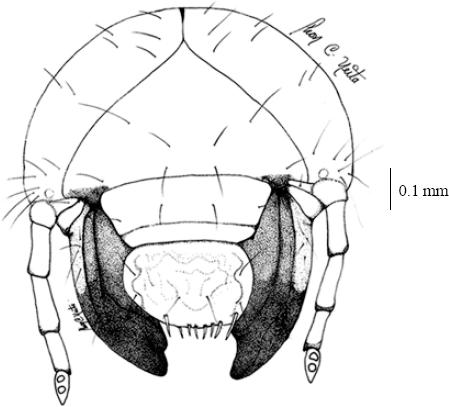
Head, frontal view.
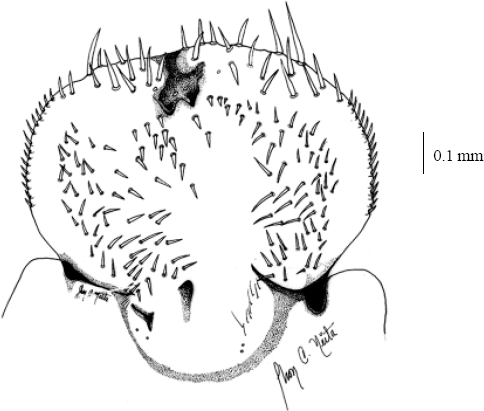
Epipharynx.
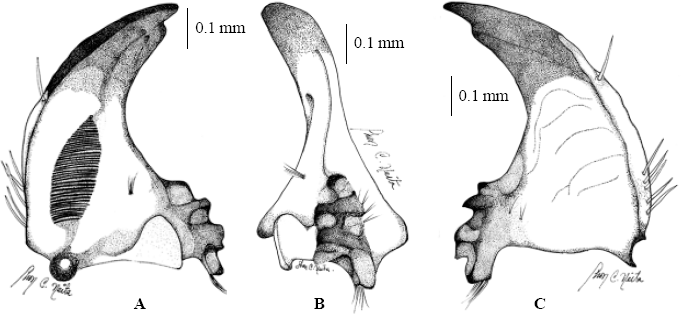
Right mandible.
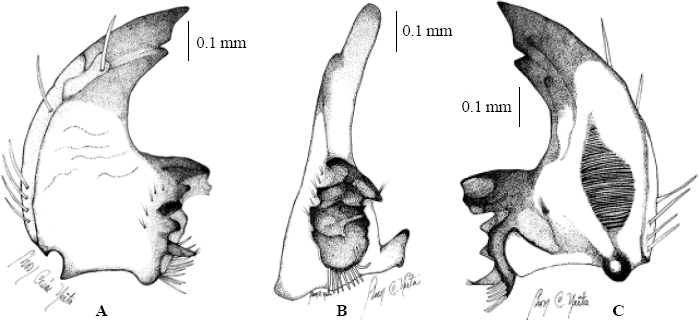
Left mandible.
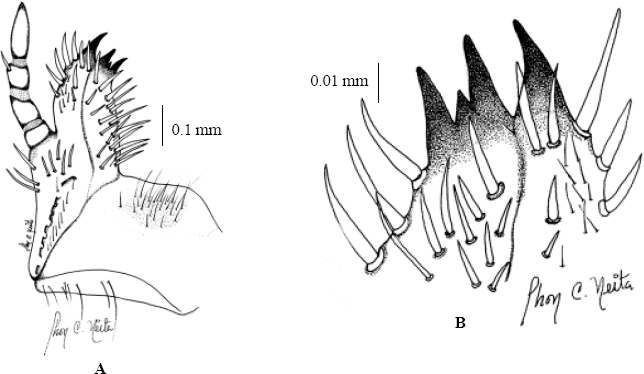
Maxila.
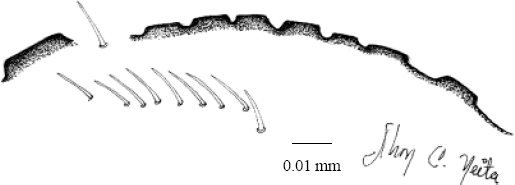
Detail of maxillary stridulatory area.
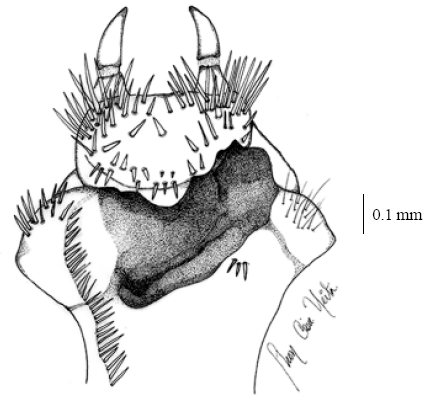
Hypopharynx.
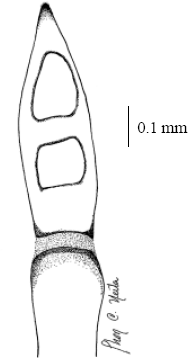
Last antennal segment, dorsal surface.
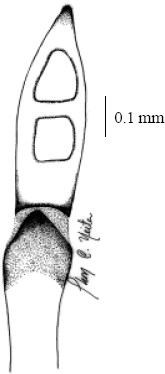
Last antennal segment, ventral surface.
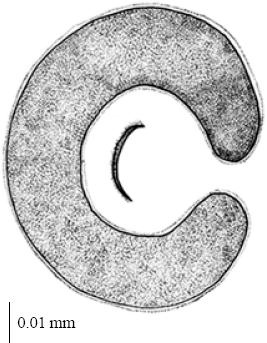
Prothoracic spiracle.
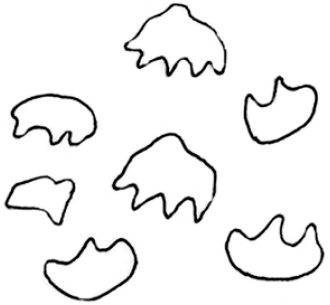
Microstructure of respiratory plate.
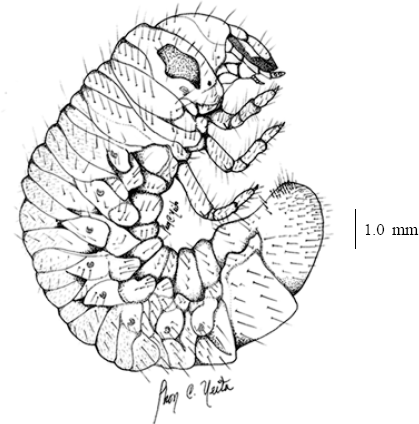
Third instar, lateral view.
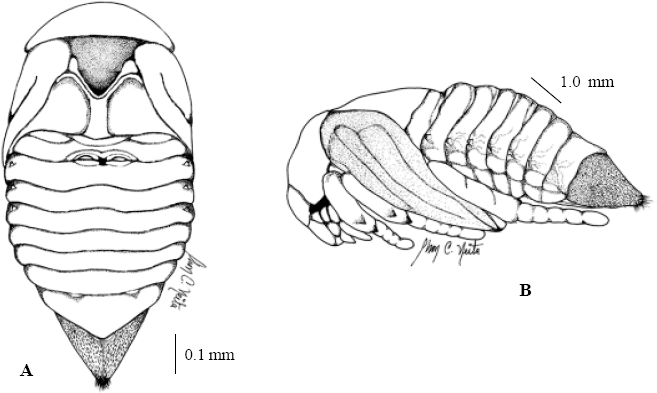
Pupa Female.
Head (Fig. 1)
Maximum width of head capsule 4.3 mm. Surface of cranium yellowish, finely punctate.
Thorax
Prothoracic spiracle (Fig. 10) 0.28 mm long, 0.18 mm wide; respiratory plate yellowish, regularly shaped as a closed “C”, bulla not prominent; distance between respiratory lobes less than diameter of bulla; plate with 21 holes across diameter at middle, holes with irregular edges (Fig. 11). Dorsum of prothorax with transverse row of 9 long, slender setae. Mesoprescutum with transverse, irregular row of 6 long, slender setae; mesoscutellum with transverse row of 4 long, slender setae and 2 stout, spine-like setae. Metaprescutum with 10 long, slender setae and 4 stout, spine-like setae; metaescutellum with 4 long, slender setae and 2 stout, spine-like setae.
Abdomen
Abdominal spiracles I 0.18 mm long and 0.12 mm wide, shorter than spiracles II-VIII. Spiracles on segments II and IV equal in size (0.19 mm long and 0.13 mm wide); spiracles on segments V and VI equal in size (0.19 mm long and 0.19 mm wide); spiracle of segments VII and VIII larger than preceding spiracles (0.2 mm long and 0.22 mm wide). Chaetotaxia on abdominal segments (Table 1).
Chaetotaxia on abdominal segments.
* Note: Abdominal segment X with approximately 80 moderate to long, slender setae.
All spiracular areas with 3 long, slender setae and 1 short, spine-like seta.
Pleural lobes with 5 long, slender setae and 2 stout, short setae.
Raster.
Surface without palidia; campus with 8 slender, long setae; teges with 53-55 short setae, barbula with 18 long, slender setae. Anal slit transverse. Approximate dorsal body length 19.5-20.5 mm (Fig. 13).
First-instar.
Description based on 6 first-instar larvae taken in soil surrounding cassava crop (
Second-instar.
Description based on 5 second-instar larvae reared from the first-instar larvae. Similar to third-instar, except width of head capsule 3.5-3.7 mm and body size smaller.
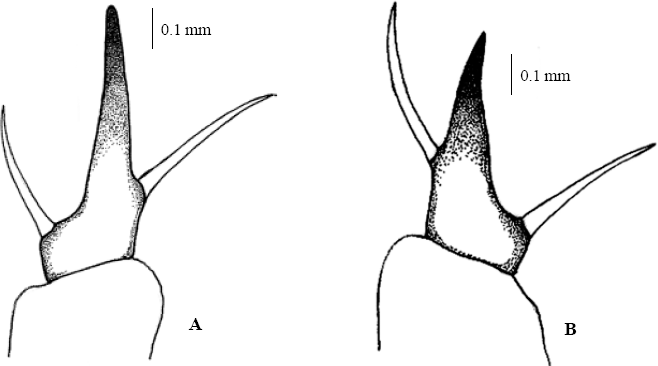
Pupa (Fig. 14A-B).
Remarks.
The following characters will separate
Biological data
The adults of both sexes were found in the soil during March and April. Adults are attracted to lights at night, especially from May to June. The larvae are saprophagous and live in soil with organic matter. First-instar larvae were collected in July. From January to February, pupae form weak cells within the soil. This species has a one-year life cycle.
Distribution
Key to the Known Third-instar Larvae of Cyclocephalini
(Modified from Ritcher 1966)
1. Left mandible lacking 4th scissorial tooth. …………………………………………………………………………………………………………………………………….. 3
1'. Left mandible with 4 scissorial teeth ……………………………………………………………………………………………………………………………………… 2
2. Cranium with posterior frontal seta present. Haptomeral process of epipharynx prominent and entire …………
2'. Cranium with posterior frontal seta absent. Haptomeral process of epipharynx notched, forming 2 teeth (entire in
3. Ocelli not pigmented. Epipharynx without sensillae among setae ………………………………………………………………………………………
3'. Ocelli pigmented. Epipharynx with many sensillae among setae ……………………………………………………………………………………
Footnotes
Acknowledgments
We thank Dr. Andreas Gaigl for his collaboration during field work. This project was supported, in part, by grants from the Bundesministerium für wirtschaftliche Zusammenarbeit und Entwicklung (Germany) and International Center for Tropical Agriculture-“Soil Pests” (Colombia) to Jhon César Neita and Germán Calberto. We thank Juan Carlos Pinzón (Entomology Laboratory Assistant) and Edison Torrado (Head of the Laboratory of Entomology, Agronomy College, National University of Colombia). This project was supported by an NSF Biotic Surveys and Inventory grant (DEB 9870202) to B. C. Ratcliffe and R. D. Cave, and a NSF PEET grant (DEB 0118669) to M. L. Jameson and B. C. Ratcliffe.