






Abstract
From July 1999 to June 2000, 1.307 specimens of phytophagous Scarabaeidae representing four subfamilies, 11 tribes, and 57 species of the following genera were collected:
Scarabaeidae fauna of the Mexican Pacific slope and in the Balsas Basin is composed of 29 to 48 genera and 70 to 120 species (Deloya et al. 1993). The location, size, orography, and biogeographical history of the state of Guerrero have created a mosaic of different vegetation associations: xerophilous brush,
Study areas
The central region of the state of Guerrero, Mexico, is located between 17°30' and 17°39'N and 99°23' and 99°42'W. Climatic characteristics, altitude, annual rainfall, and mean annual temperature for the study areas are shown in Table 1. Vegetation type per region is as follows: a) Chilpancingo: pine forest, pine-oak, oak, tropical deciduous forest, palm grove, riparian forest, and pasture land; b) Mochitlán: tropical semideciduous forest, oak, induced pasture, thorny brush, riparian forest; c) Tixtla: oak, palm grove, tropical deciduous forest, riparian forest, and pasture land; d) Chichihualco: tropical deciduous forest featuring trees less than 15 m high with robust, twisted trunks.
Abiotic factors for study areas in the central region of the State of Guerrero, Mexico (García 1988).
Material and Methods
From July 1999 to June 2000, monthly sampling was done in Chilpancingo, Mochitlán, Tixtla, and Atlixtac (Chichihualco). Samples were collected both day and night from the arboreal, brush, and herbaceous strata as well as from flowers and fruits. Samples were taken from public lighting installations at night and by using fermented fruit traps (banana and pineapple with beer) during the day (Morón 1997). Voucher specimens were deposited in the Entomological Collection (IEXA) of the Instituto de Ecología, A.C. and M. A. Morón (MXAL) in Xalapa, Veracruz, Mexico.
For the data analysis, the number of species obtained was recorded (species richness; S = alpha diversity), as was the total number of specimens (N) for each site. Sørensen's (1948) Similarity Index was used to determine beta diversity QS = 2(c) / a + b, where a is the number of species in community A, b is the number of species in community B and c is the number of species shared by communities A and B. The key was prepared following the taxonomic criteria used by Morón (1984) and Deloya et al. (1995).
Results
A total of 1.307 specimens of phytophagous Scarabaeidae were collected, representing 4 subfamilies, 11 tribes, 19 genera, and 57 species (Table 2).
Species of Scarabaeidae pleurosticti from the central region of the state of Guerrero, Mexico, captured between July 1999 and June 2000.
Melolonthinae from the central part of Guerrero were recorded year round except for February and April (Table 3, Fig. 1). Specific richness (S) and abundance (a) throughout the year were as follows: July S=8, a=1.68%; August S=4, a=0.91%; September S=7, a=1.29%; October S=19, a=37.69%; November S=12, a=8.33%; December S=7, a=1.83%; January S=3, a=0.99%; March S=1, a=0.15%; May S=36, a=29.96%, and June S=25, a =17.12%. As for seasonal richness, 14 species coexisted in summer, 23 in autumn, 4 in winter, and 39 in spring.
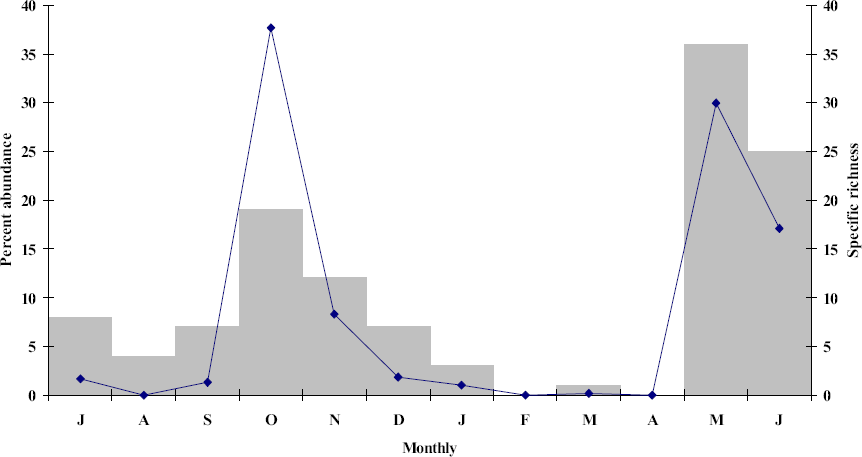
Monthly relation between the percent abundance (Line; N=1307) and specific richness (bars; S= 57 species) of the phytophagous Scarabaeidae (Melolonthinae, Rutelinae, Dynastinae Cetoniinae) from the Central Region of Guerrero, Mexico, July 1999-June 2000.
Phytophagous Scarabaeidae (Melolonthinae, Rutelinae, Dynastinae, Cetoniinae) species captured by region in Central Guerrero, Mexico. (Numbers correspond to abundance).
The following species constituted 89.15% of the total sampling (N=1307) and were represented by 15 or more specimens:
Key for the identification of phytophagous Scarabaeidae species found in the central part of Guerrero
Base of antennal scape covered by the anterior angle of front and ocular canthus, not visible from above 2
Base of antennal scape visible from above through anteocular indentation. Mesepimeres not covered by base of elytra. Lateral borders of elytra with wide indentation and short, abundant setae. Metatarsus shorter than metatibia CETONIINAE 4
All tarsal claws equal in length and thickness, dentate, bifid, or entire. 3
All tarsal claws differing in length and thickness, the majority grooved and the minority entire RUTELINAE 17
Claws entire or bifid. Mandible apex hidden under clypeus, not dorsally visible MELOLONTHINAE 34
Claws entire or single (at least intermediate and posterior claws). Apex of mandible visible from dorsum DYNASTINAE 27
Scutellum covered by the basal lobe of pronotum. Gymnetini 5
Scutellum exposed from above Cetoniini
Head with frontal projection fused or partially free
Head lacking frontal projection. Anterior margin of clypeus highly marginate. Mesometasternal projection with sharp apex internally projected
Frontal projection free, less than 50% of length. Apically enlarged in dorsal view. Projection of clypeus variable. Coloration opaque, black, greenish, and velvety. Total length 22-30 mm
Frontal projection fused for 65% of its length from vertex to clypeus. Dorsal coloration dark green. Mesometasternal projection rounded. Total length 19-22.5 mm
Species longer than 15 mm 8
Species shorter than 15 mm 11
Clypeus square with rounded lateral margins 9
Clypeus trapezoidal 10
Dorsal surface with long setae. Antennal club shorter than rest of antennomeres. Pronotum with two pairs of longitudinal bands and dark parallels; each pair with anterior convergence. Total length 18 mm.
Dorsal surface with short setae. Antennal club much longer than the rest of the antennomeres. Pronotum with one pair of dark longitudinal bands in a “db” shape; each pair with anterior convergence. Total length 18 mm
Anterior tibia externally tridentate, all teeth equidistant and basal tooth smaller. Dorsal coloration green, elytra with whitish sculpture. Total length 21.0-21.5 mm
Anterior tibia externally tridentate, with two anterior teeth close together and basal tooth slightly smaller. Total length 15-18 mm
Basal half of elytra reddish, the rest black with or without variable sculpture 12
Basal half of elytra always lacking reddish spots 14
Clypeus almost square; posterior half of elytra black and lacking sculpture
Clypeus triangular; posterior half of black elytra with sculpture 13
Anterior margin of clypeus rounded; sides of pronotum rounded and with whitish sculpture
Anterior margin of clypeus truncate; sides of pronotum angled and lacking whitish sculpture
Pronotum black 15
Pronotum reddish 16
Elytra bicolored, black with yellow
Elytra black with irregular whitish sculpture on posterior half and sides. Total length 10-11 mm
Anterior margin of clypeus straight, projected upward and curved in a “u” shape; sides of pronotum with whitish sculpture
Anterior margin of clypeus slightly rounded, never projected upward; sides of pronotum lacking whitish sculpture
External border of elytra with membranous margin Anomalini 18
External border of elytra lacking membranous margin 24
Elytrae wider than posterior region. Dorsum convex
Elytrae longer in humeral than in posterior region. Dorsum flat and glabrous
Pronotum blackish-red 20
Pronotum green or yellowish-brown 22
Elytra red-brown
Elytra yellowish-brown 21
Second protarsal joint situated at same level as apical tooth of protibia
Third protarsal joint situated at same height as apical tooth of protibia.
Pronotum and scutellum green; protibia tridentate
Pronotum yellowish-brown with a blackish-red anterocentral spot variable in shape; protibia bidentate
Pronotum with a longitudinal furrow and two diagonal furrows on each side; pronotal setae widely spaced
Pronotum lacking furrows and setiferous, setae abundant and erect
Basal margin line of pronotum complete. Exterior border of mandibles clearly indented. Dorsal coloration yellow with green highlights. Total length 22-26 mm
Basal margin line of pronotum incomplete or absent 25
Basal margin of pronotum incomplete
Basal margin line of pronotum absent 26
Scutellum longer than pronotum. Color shiny black. Metaepisternum rugose and punctate. Total length 23-29 mm
Scutellum shorter than pronotum. Clypeus semitrapezoidal. Labrum visible above. Protibia bidentate in males, tridentate in females, with very small basal tooth. Dorsal coloration bright metallic green. Total length 14-16 mm
Protarsus equal to or larger than protibia. Male pronotum with tubercle; head with thin horn
Protarsus shorter than protibia. 28
Head and pronotum without carinae, tubercles, or depressions. Tarsomeres semicylindrical. Meso- and metatibiae with wide apex
Head and pronotum with carinae, tubercles, and depressions. Tarsomeres triangular or semicylindrical. Meso- and metatibiae apex, scalloped or dentate 31
Elytra glabrous. Anterior margin of clypeus straight. Pronotum and elytra with irregular spots
Elytra setiferous. Anterior margin of clypeus sinuate. Pronotum and elytra with a more or less defined pattern 30
Each elytra with three irregular black points. Disc of pronotum with two black spots
Each elytra with three longitudinal spots: two short lateral spots and one large spot that widens at the posterior half
Apex of meso- and metatibiae truncate or with dorsolateral projection; sexual dimorphism rare. Head with carinae or tubercles. Pentodontini 32
Apex of metatibiae denticulate or scalloped. Sexual dimorphism accentuated. Males and females without horns on head, only two transversal tubercles. Male pronotum with three horns or bumps that surround a wide central fovea. Total length 30-50 mm
Apex of meso- and metatibiae extended dorsolaterally; propygidium extended towards the back with a stridulatory area. Pronotum with one tubercle and a postapical concavity. Total length 27-36 mm
Apex of meso- and metatibiae truncate; propygidium not extended backwards and lacking stridulatory area. Pronotum lacking tubercles and depressions. Clypeus lacking preapical carina; front with transversal carina
Protibia tetradentate with a well-formed denticle between the second and third tooth. Frontal carina bituberculate. Pygidium smooth, polished, and punctate. Total length 20-21 mm
Protibia tridentate, lacking denticles between teeth. Frontal carina continuous. Pygidium smooth, polished, with three scattered punctures. Total length 17-19 mm.
Dorsal and ventral region covered with yellow scale-like setae
Dorsal region smooth or covered with setae of varying lengths 35
Anterior coxae more or less conical, prominent. Length less than 12 mm. Sexual dimorphism rare 37
Anterior coxae transversal. Total length generally greater than 12 mm (except in
Antennal club formed by three antennomeres, both in males and females. Sexual dimorphism apparent or quite noticeable.
Antennal club formed by seven antennomeres in males and five in females
Antennal club small and oval. Abdominal sternites totally or partially fused to each other at medial thirds. Head, pronotum, and ventral regions dark brown, elytra shiny straw-yellow. Total length 3 mm
Antennal club elongate. Abdominal sternites never totally or partially fused to each other at medial thirds
Species longer than 8 mm. Clypeus: trapezoidal, anterior margin truncate with rounded lateral angles 39
Small species, length less than 8 mm. Clypeus trapezoidal, anterior margin sinuate and sharply elevated with lateral angles projected. Lateral margins of elytra with long setae 40
Elytra twice as long as pronotum. Second elytral interval unipunctate. Lateral margins of pronotum near apex not strongly marginate or elevated. Color black with red highlights. Total length 9 mm
Elytra three times longer than pronotum. Second elytral interval multipunctate. Lateral margins of pronotum near apex strongly marginate and slightly elevated. Color reddish black. Total length 9 mm.
Pygidium setiferous, setae long and abundant. Total length 7.5-8.2 mm
Pygidium setiferous, setae short and sparse. Total length 8.0 mm
Vertex generally with a well-marked transversal carina. Claws serrate or pectinate
Vertex lacking transversal carina. All three pairs of claws bifid, grooved, or dentate, especially in males 42
Tarsal claws unidentate
Tarsal claws grooved or bifid 43
Ventral region of tarsomeres with abundant setae (more conspicuous in males). Dorsum glabrous, shiny. Body elongate and yellow
Ventral region of tarsomeres with sparse or no setae. Dorsal appearance variable
Pronotum opaque. Front with abundant, erect, medium-length setae; pronotum and elytra setiferous, setae short; anterior region of pronotum with sparse, long setae in anterior region and area in front of apical callus of elytra
Pronotum shiny 45
Elytra and scutellum shiny. Front and anterocentral region of pronotum with short setae, conspicuous and/or inconspicuous
Elytra and scutellum opaque. Long setae on front and anterocentral region of pronotum
Claws with dilated and dentate base, intermediate tooth flanked by narrow, deep indentations. External claws of male mesotarsus with apical portion curved or angled downward so that intermediate tooth juts out laterally causing deformation
Claws with intermediate tooth far from apex or base or from both ends. Claws with intermediate denticle variable in structure and position, inferior border seldom serrate 49
External claws of male mesotarsus deformed with a distal bifurcate appearance due to their great length and sharpness of intermediate tooth. Body length 14 to 19 mm (
External claws of male mesotarsus slightly deformed and lacking distal bifurcate appearance, as intermediate tooth is very short and rounded. Body length 16 to 23 mm (
Clypeus semicircular, slightly sinuate. Tegument shiny. Antennal lamella in males as long as the first seven antennomeres combined. Pygidium with long setae
Clypeus with anterior margin sinuate. Tegument shiny. Antennal lamella in males shorter than first seven antennomeres combined. Pygidium with short setae. Color reddish-chestnut. Total length 21-22.5 mm
Claws of intermediate denticle as long as or longer than apical denticle; widely separated from both ends, with a slight, rounded basal dilation. Tropical species 50
Claws with intermediate denticle of variable length and position. Both male metatibial spurs articulate with apical border. 51
Exterior spur of male metatibiae fused to apical border and at least 60% shorter than interior spur. Parameres short, compact, fused to base and apex. Dorsal surface variable although generally velvety. Aedeagus slightly sclerotized and lacking complex ornamentation
Exterior spur of male metatibiae articulate with apical border, length greater than 50% that of interior spur. Dorsal and pygidial dressing velvety or setiferous. Dorsal and pygidial surface formed by short, very abundant setae. Male and female claws similar. Parameres short, wide, fused at base and apex. Aedeagus long, sclerotized, with thick, very conspicuous setiferous ornaments.
Male anal plate with anterior flange that reaches lateral ends, middle section indented, one sinus or bilobed or bidentate projection. Frequently fifth sternite visible with dark, grainy medial area. Dorsum pruinose or setiferous dorsum. Parameres short, fused, ring-like, with a small ventral bidentate projection and symmetrical latero-distal denticles. Aedeagus highly ornamented, with thorns, setae, and curved filaments
Male anal plate narrow and slightly excavated, but lacking notable flange in anterior margin. Parameres short, fused, ring-shaped. Dorsal region with velvety or setiferous cover. Aedeagus sclerotized, highly ornamented with plates and groups of macroscopic setae
Antennae formed by 10 antennomeres. Dorsum opaque
Antennae formed by 9 antennomeres. Dorsum shiny. Total length 15-16 mm
Superior metatibial spur curved in an open “s” shape. 3-6 antennal antennomeres of equal length, 7 shorter
Superior metatibial spur curved. 3-4 antennomeres of equal length, 5-7 shorter
General comments about phytophagous Scarabaeidae found in the Central Region of the State of Guerrero, Mexico
Discussion
With regard to specific richness in each region, 22 species were captured in Mochitlán, 34 in Atlixtac, 32 in Chilpancingo, and 23 in Tixtla (Table 3; Fig. 2); 43.65% of the specimens were obtained in Atlixtac, 36.92% in Chilpancingo, 11.39% in Mochitlán, and only 8.02% in Tixtla. Of the 57 species studied,
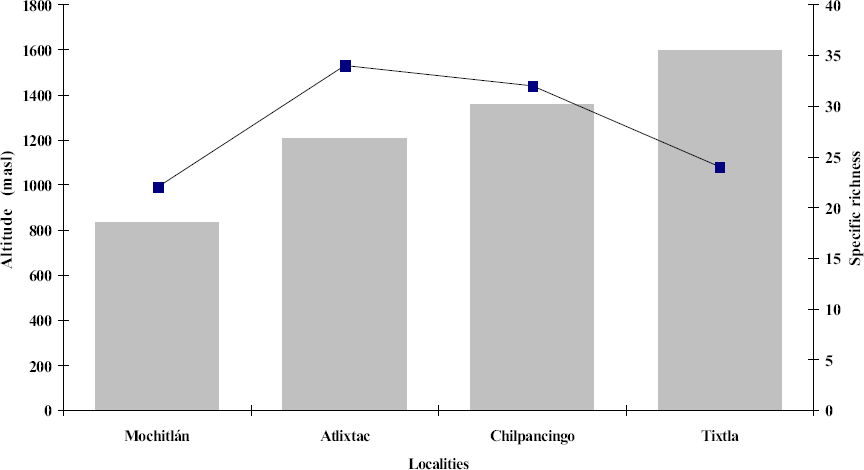
Relation between altitude (bars) and specific richness (line) by locality of the phytophagous Scarabaeidae (Melolonthinae, Rutelinae, Dynastinae Cetoniinae) from the Central Region of Guerrero, Mexico (July 1999-June 2000).
The vegetation of Balsas River Basin and the Mexican Pacific slope is mainly deciduous tropical forest, xerophyllous scrub, and lowland oak forest mixed with pine forest at intermediate altitudes. As such, studies of Scarabaeidae Pleurosticti were carried out in the south of Morelos and Tepic, Nayarit between 800 and 1.200 masl, where there is deciduous tropical forest. Species richness was 72 and 78 species in these two locales, respectively. In Cuernavaca, Morelos (1.250-1.850 masl) for tropical deciduous forest and
Based on the feeding habits of Scarab larvae and adults in the regions studied, the following guilds were represented: a) phylo-rizophagous (61.4%), covering
The structure of the trophic guilds in central Guerrero suggests that there is a predominance of phylo-rhizophages during spring owing to the reproductive habits of the Melolonthinae: larvae must feed and make it to the third larval instar as quickly as possible because the rainy season – when vegetation renews its foliage and roots are produced – is very short. Sapromeliphages predominate during autumn when the Asteraceae are flowering and when the cellulose based material that the larvae consume has accumulated (decomposing litter and wood) on the soil. The limited representation of the phylorhizophages and the sapro-meliphages could be an indication that small scale removal of wood from the forest could be contributing to the extinction of these populations on a local scale.
New Records
Of the total species captured (N=57), 30% (17) represent new records for Guerrero; they correspond to the genera
New records of phytophagous Scarabaeidae species for the State of Guerrero, Mexico (Melolonthinae, Rutelinae, Dynastinae, Cetoniinae).
Agricultural aspects
In the central part of Guerrero, the so-called “wire worms” (Coleoptera: Elateridae) and “white grubs” (Coleoptera: Scarabaeidae) are serious agricultural pests, having caused great economic losses to basic crops in most temporal zones (Morón 1999, 1988; Cortés et al. 1994). Species of
Zoogeographical aspects
The fauna obtained from the central region of Guerrero makes up 5.6% of all phytophagous scarabs recorded in the country and 13.47% of all species recorded in the state. Melolonthinae (24) and Cetoniinae (14) are the subfamilies with the greatest specific richness;
Acknowledgments
We are grateful to Miguel Angel Morón and Leonardo Delgado for determinations of