






Abstract
A new ant species, Carebara coqueta sp.nov. from Colombia, is described, based on the soldier and worker castes. Carebara semistriata Fernández is considered a junior synonym of Carebara reina Fernández (syn. n.). Carebara guineana is proposed as a new name for Oligomyrmex silvestrii Santschi, 1914.
Introduction
The recent revision of the myrmicine ant genus Carebara Westwood for the Western Hemisphere (Fernández 2004) broadened the generic limits of this name with the incorporation of Oligomyrmex, Paedalgus, Afroxyidris and Neoblepharidatta, as synonyms of Carebara. The genus in its new sense was split in three sections, the concinna, lignata and escherischi species groups. The first one, the concinna species group, corresponds to the concept of Oligomyrmex; the second, the lignata species group to the traditional Carebara s. str., and the escherischi species group to Paedalgus. The first two groups are probably paraphyletic taxa, with only the escherischi species group apparently monophyletic (Bolton and Belshaw 1993). This paper includes the description of a new species along with some other taxonomic changes and comments.
Materials and Methods
Measurements were made using a micrometer in a Nikon SMZ 2T stereomicroscope at 80X magnifications, with a fiber ring lamp. All measurements are in mm: HL - Head length: Maximum length, in full face view, from the apex of the clypeal apron to the middle of vertex; HW - Head width: Maximum width in full face view; SL - Scape length (excluding basal condyle and neck), in straight line distance; PW - Pronotal width: Maximum width across pronotum in dorsal view; WL - Weber's length: In lateral view of mesosoma, the line from posteroventral corner of mesosoma to farthest point on anterior face of pronotum; GL - Gaster length: In lateral view, the line from anterior edge of first gastral tergum to posteriormost point; TL - Total length (HL + Mandible length + WL + Petiole length + Postpetiole length + GL); CI - Cephalic index: HW/HL; SI - Scape index: SL/HW.
Collections
IAvH. Insect Collection, Instituto Humboldt, Claustro de San Agustín, Villa de Leyva, Colombia.
INBio. Instituto Nacional de Biodiversidad, San José, Costa Rica.
Taxonomic section
Carebara lignata species complex
This complex comprises those dimorphic and monomorphic Carebara whose minor workers are always eyeless. In the Carebara revision (Fernández 2004) the name of the group was incorrectly written as “Carebara concinna species complex” in the heading of the section of this group in the page 211, the name must be changed to Carebara lignata species complex.
Carebara coqueta new species
(Fig. 1)
Holotype major worker measurements: HW 0.48 HL 0.64 SL 0.25 PW 0.25 WL 0.53 GL 0.49 TL 2.03 CI 75 SI 52.
Minor worker measurements (n=1) Paratype. HW 0.26 HL 0.31 SL 0.18 PW 0.15 WL 0.29 GL 0.35 TL 1.04 CI 84 SI 69.
Longino (2004) calls attention to the paucity of samples of Carebara (lignata group) with both workers and soldiers. In other myrmicine ants like Pheidole or Solenopsis it is not difficult to find workers and soldiers in the field, which suggests that soldiers of Carebara are not present in the same foraging strata as workers. This suggests that, to obtain soldiers of Carebara, we need to dig in the soil or look for them in rotten logs (Longino 2004). The fact that many museums only have minor workers of the typical Carebara (that is, the lignata species group) could be due to the reason pointed out above, and in reality all of the species of this complex may be dimorphic. The exasperating monotony of the minor workers of the lignata species group (some of them only 0.90 mm long!) makes it desirable to obtain and to study collections that include soldiers, besides females and males. If my prediction is correct, and all the species of the lignata group possess major workers (although difficult to collect), it should be possible to revise the group on a global scale.
Finally, I want to call attention to the interesting intercaste phenomenon in this group. Kusnezov (1952) and Wheeler (1925) pointed out and described cases of intermediates between major workers (soldiers) and females. The great plasticity in the external attributes of the soldiers of the lignata species group (such as the presence / absence of ocelli and eyes, and vestigial alary sclerites) make this an ideal group for the study of the evolution of caste intergradations; as proposed by Baroni Urbani and Passera (1996), who suggest that in some cases the soldier developed not from the worker, but from the female (see Ward 1997 for a reply).
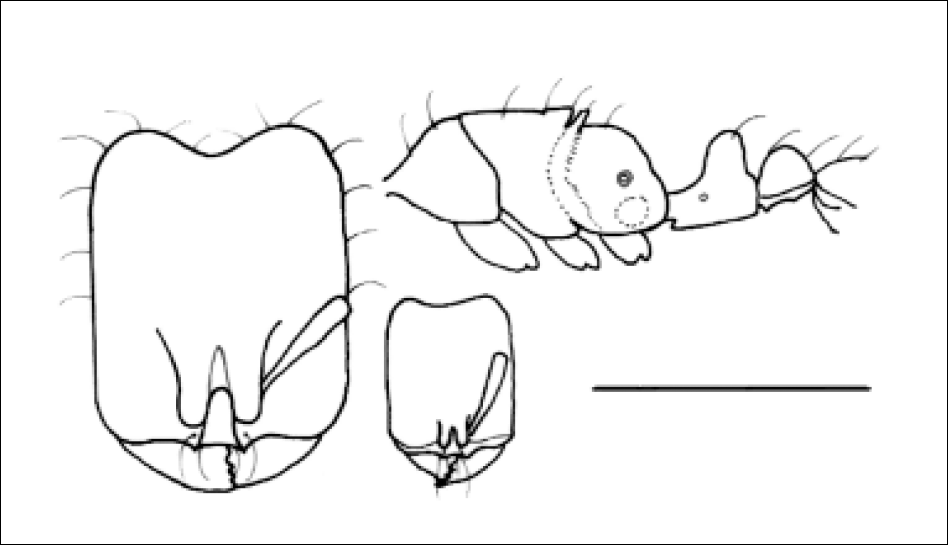
Carebara coqueta new species. Major worker head (left, HW 0.48 mm), mesosoma, petiole and postpetiole in lateral view (top); head of minor worker in full face view (lower right, HW 0.26 mm). Scale bar 0.5mm
Escherischi species complex
The species in this complex (except by the enigmatic C. intermedia Fernández) correspond to the previously recognized genus Paedalgus sensu Bolton & Belshaw (1993). The head is slightly narrower anteriorly, the eyes, always present, are reduced to a few ommatidia and the propodeum is very short. In the treatment of the species of this complex (Fernandez 2004) there is an error in the description of Carebara reina; moreover, new recent evidence throw suspicion on the validity of Carebara semistriata as good species. For these reasons, it is included the complete description of C. reina, below.
Carebara reina Fernández
Carebara reina Fernández, 2004:228 (worker)
= Carebara semistriata Fernández, 2004:229 (worker)
Eyes reduced to 1 ommatidium. Lamellae of metapleural lobes low. Dorsum of head densely sculptured with very small, shallow foveolate punctures, broadly separated; mid dorsum to almost all of promesonotum with dense, fine longitudinal striations mixed with scattered small punctures, periphery of promesonotum, dorsal and posterior face of propodeum and petiole densely reticulated. Postpetiole and gaster smooth and shining. Scapes, dorsum of head, promesonotum and legs with appressed pubescence, denser on head. Body nearly naked of long hairs, with only few (about 0.05 mm) distributed as follows: four on clypeal area; two on each frontal lobe; two on head (each one near occipital corner), eight on promesonotum, two on propodeum, none on legs; two on petiole, four on postpetiole, several on first tergal dorsum. Body brown, appendages lighter, most of gaster dark brown.
The key for the species in this complex (Fernández 2004) should be modified as follow:
9. Mid and hind tibiae without standing hairs ……………………………………………. 10
9’. Mid and hind tibiae with standing hairs (Southwestern Colombia) …………………………………. C. kofana
10. Standing hairs: none on dorsum of head, four in promesonotum, none on propodeum, two on first tergum of gaster (Colombia, Trinidad, Perú, Brazil) …………………………………. C. striata
10’. Standing hairs: two in head dorsum, eight in promesonotum, two in propodeum, several in first tergum of gaster (Nicaragua, Costa Rica, Colombia) …………………………… C. reina
Carebara inca Fernández
Originally described from workers from Perú, Longino (2004) records this species for first time for Central America.
Final note
Gary Alpert (Museum of Comparative Zoology, Cambridge) and Barry Bolton (The Natural History Museum, London) alerted me to a unresolved junior secondary homonym between Carebara silvestrii Santschi and Aneleus silvestrii Santschi. The name Carebara guineana is proposed as new name for Carebara silvestrii Santschi 1914:362.
Footnotes
Acknowledgements
Special thanks are due to Dr. John T. Longino (INBio) and Mauricio Alvarez (IAVH) for the loan of critical material. Partial support came from NSF grant DEBS Nos. 9972024 and 0205982 to Dr. Michael Sharkey (University of Kentucky) and Dr. Brian Brown (LACM) by way of the Instituto Humboldt, Colombia. Thanks to Fernando Gast (General Director), Mauricio Alvarez (Biodiversity Inventories Program) and GEMA team of the Humboldt Institute for their continuous support and the Parks Unit of the Ministerio del Medio Ambiente de Colombia for collecting and maintaining facilities in Colombia. William P. MacKay (University of Texas at El Paso) offered several corrections and suggestions and improve the English of the text. Thanks also to three anonymous reviewers for their comments. This paper is dedicated to the memory of my friend Favio Quevedo, collector of the samples from Chiribiquete, who recently past away in an accident in Caquetá.