






Abstract
Background
Interleukin 7R (IL-7R), a cytokine receptor gene, plays an important role in the development of innate and adaptive inflammatory response in asthma etiology.
Objective
IL-7R is a heterodimeric protein composed of α chain and γ chain. The α chain of IL-7R has a range of single nucleotide polymorphisms, which give rise to nonsynonymous amino-acid substitutions that might result in an increased production of inflammatory cytokines and cause asthma.
Methods
A case-control study was conducted with a total of 964 subjects, including 483 healthy controls and 481 patients with asthma. DNA samples were extracted from blood, and genotyping was done by using sequence-specific-primer–polymerase chain reaction.
Results
Statistical analysis revealed that IL-7R + 1237A/G (rs1494555) gene polymorphism shows a highly protective association toward asthma (odds ratio [OR] 0.56, p < 0.001) in AG genotype as well as in mutant GG genotype (OR 0.64, p = 0.029). However, IL-7R + 2087T/C (rs6897932) polymorphism showed an increased risk toward asthma in TC genotype (OR 1.70, p = 0.002) as well as in the CC genotype (OR 1.68, p = 0.002). Furthermore, the GT and AC haplotypes in the IL-7R polymorphisms were also found to be significantly associated with asthma (p = 0.001 and p = 0.037, respectively).
Conclusions
The study conducted in a north Indian population indicated that the protective association was observed for the + 1237A/G position, and a significant risk was observed for the + 2087T/C position in asthma.
Interleukin (IL) 7, a 25-kDa glycoprotein, is a well-known essential factor for the development and maintenance of the immune system. IL-7 function is mediated through its receptor, IL-7R receptor, which is a heterodimeric protein composed of a 60–90 kDa α chain and 72 kDa γ chain that regulate signaling of IL-7 as well as type 2 T-helper cell cytokine viz. IL-2, IL-4, IL-9, IL-15, and IL-21 receptors. 4 They are mostly expressed on immature B and T cells, and transduce transmembrane signals through the cytoplasmic tail. 5 In addition, mutation of IL-7Rα (encoded as IL-7R) has been implicated in the development of autosomal recessive severe combined immunodeficiency. 6 Functionally, IL-7R plays an important role in the development of innate and adaptive inflammatory as well as immunologic response. This signaling is critical for the development, survival, and homeostatic proliferation of T cells, 7 production of several proinflammatory (IFN γ, IL-2) and anti-inflammatory cytokines (IL-4). 8 The thymic stromal lymphopoietin (TSLP) cytokine also acts through IL-7R, which is associated with allergy 9 and regulation of inflammatory processes. 10
The human IL-7R gene is present on chromosome 5p13, and by using the positional cloning method, it was identified that this region harbors at least two asthma susceptibility loci. 11 Sequencing of the IL-7R has revealed the existence of a range of single nucleotide polymorphisms (+510C/T, +1237A/G, +2087T/C, and +3110A/ G), which all result in amino-acid substitutions. 12 However, of these single nucleotide polymorphisms, +1237A/ G(rs1494555) and +2087T/C (rs6897932) are related to inhalation allergy. 9 In addition, the IL-7/IL-7R pathway is also associated with the pathogenesis of various autoimmune diseases, such as multiple sclerosis, rheumatoid arthritis, systemic lupus erythematosus, sarcoidosis, and psoriasis.13,14
Because only +1237A/G and +2087T/C polymorphisms in IL-7R are associated with inhalation allergy, this study was conducted to investigate the association of IL-7R polymorphisms to asthma in a north Indian population through a case-control study and to assess its correlation to several disease-associated parameters, e.g., sex, age, disease duration, atopic status, smoking status, family history of asthma, immunoglobulin E (IgE) level, pulmonary function.
Materials and Methods
Ethical Clearance
Ethical clearance, was granted by the Ethics Committee, Postgraduate Institute of Medical Education and Research, Chandigarh, India, for conducting the research work on human blood samples (memo no. PG-1Trg-10 on September 21, 2010). After the physician's diagnosis, only patients who fulfilled the criteria of the Global Initiative for Asthma guidelines were recruited for the study.
Inclusion-Exclusion Criteria
Recruitment of patients for this study was from different states of north India, including Chandigarh, Punjab, Haryana, Himachal Pradesh, Uttaranchal, Jammu and Kashmir, Rajasthan, Uttar Pradesh, and New Delhi. A total of 481 patients (191 men and 290 women) were enrolled of those who visited the Out Patient Department, Pulmonary Medicine, Postgraduate Institute of Medical Education and Research, Chandigarh, and 483 (189 men and 294 women) agematched, healthy individuals, without any symptoms of atopy, pulmonary disease, any other comorbid disease, or smoking habits were recruited as controls.
Lung Function Test
Spirometry tests were performed according to the Association of Respiratory Technician and Physiologists guidelines 15 for generating pneumotachographs, which are helpful in assessing conditions such as asthma, chronic obstructive pulmonary disease, etc., by using Spiro 233 (PK Morgan, Rainham, Kent, U.K.). Of 481 patients with asthma, spirometry was done in 377 patients with asthma, who were further categorized according to asthma severity. The frequency of mild obstruction and heterozygous alleles in both polymorphisms was found to be higher in the studied population (Table 1).
Characteristic of the study population

SD = standard deviation; nd = not done; FVC = forced vital capacity; FEV1 = forced expiratory volume in 1 second; BSA = body surface area; t = Student's t-test; BMI = body mass index; IgE = immunoglobulin E; %pred = frequency predicted.
Significant.
Spirometry test was conducted for 377 patients with asthma.
IgE levels were confirmed for 213 patients with asthma and 125 controls.
Total Immunoglobulin IgE Measurement
Total immunoglobulin E (IgE) was measured by using ImmunoCAPS with Phadia 100 IDM version 5.43 (Thermo Fisher Scientific Inc., Waltham, MA) in serum samples of both controls and patients with asthma to screen for allergy. Skin-prick and serum-specific IgE testing against Aspergillus fumigatus were also done in some patients to distinguish asthma and allergic bronchopulmonary aspergillosis. Only patients with negative skin-prick test results with specific IgE of <0.35 kUA/L were recruited for the study. The usually accepted upper limit is between 150 and 300 IU/mL but can range from 150 to 1000 IU/mL. 16 These variations in the range are due to changes in diet, genetic background, geographic location, and other factors. 17
Blood Sample Collection
Approximately 5 mL of blood was collected from both the patients and the control subjects into EDTA coated vials and stored at −80°C until extraction of genomic DNA was done. DNA was isolated from frozen whole blood samples by using the saline sodium citrate buffer method 18 and assessed on 0.8% agarose gel before storage at −20°C for further use.
Genotyping
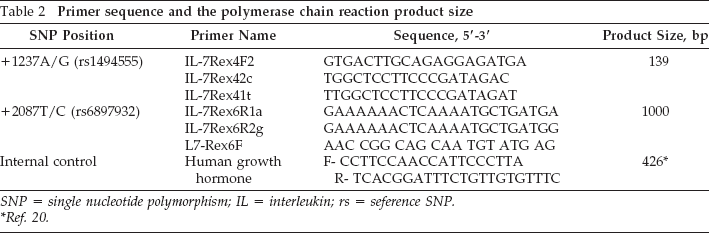
The IL-7R +1237A/G and +2087T/C polymorphisms were detected by using sequence-specific primer polymerase chain reaction (SSP-PCR), with specific primers, 19 shown in Table 2. Briefly, PCR was carried out in a thermal cycler (Eppendorf Mastercycler gradient; USA Scientific, Inc., Ocala, FL) in a total volume of 25 μL that contained 10× PCR Buffer (100 mM Tris-HCl, pH 8.3, 500 mM KCl), 3 mM MgCl2, 1 mg/mL nuclease free bovine serum albumin, 50 pmol of each primer, 10 mM of each deoxynucleotide, 0.125 U Taq polymerase and 2 μL genomic DNA. To assess the success of PCR, an internal control (human growth hormone) of 426 base pairs (bp) was used (Table 2). The PCR conditions for both the positions were 94°C for 5 minutes, followed by 35 cycles of 94°C for 60 seconds, 58°C (annealing temperature) for 60 seconds, 72°C for 60 seconds, and 72°C for 10 minutes for final extension.
Primer sequence and the polymerase chain reaction product size
SNP = single nucleotide polymorphism; IL = interleukin; rs = seference SNP.
Ref. 20.
PCR was carried out separately for both the alleles of one single nucleotide polymorphism, and the results then were observed directly by electrophoresis on 2% agarose gels stained with ethidium bromide and visualized by ultraviolet transillumination (Figs. 1 and 2). For Fig. 1, if allele (A/G) specific band (139 bp) in sample 1 was absent, then it was GG genotype (A–G+; homozygous as in lanes 1A and 1G). Similarly, if the reverse was present (A–G+ in sample 2), then it indicated AA genotype (homozygous as in Fig. 1, lanes 2A and 2G). However, if both the allele specific bands (139 bp) were present (A–G+ in sample 3), then it was AG genotype (heterozygous as in Fig. 2, lanes 3A and 3G). The same pattern was followed in Fig. 2 for allele T/C specific band (1000 bp).

SSP-PCR products of IL-7R (+1237 A/G) polymorphism on 2% Agarose gel. Lanes 1A&1G, 4A&4G: homozygous mutant GG genotype (426 and 139 bp), lanes 2A&2G: Homozygous wild AA (426 and 139 bp), lanes 3A&3G: heterozygous AG genotype (426 and 139 bp), lane M:100 bp ladder.
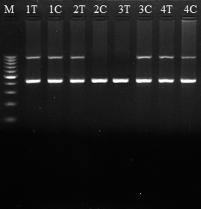
SSP-PCR products of IL-7R (+2087 T/C) polymorphism on 2% Agarose gel. Lane M:100 bp ladder, lanes 1T&1C, 4T&4C: heterozygous TC genotype (1000 and 426 bp), lanes 2T&2C: Homozygous wild TT (1000 and 426 bp), lanes 3T&3C: homozygous mutant CC genotype (1000 and 426 bp).
Statistical Analysis
All the statistical analyses were performed by using the SPSS software for Windows version 20.0 (SPSS, Inc., Chicago, IL) and Epi Info version 3.4.7 (Centers for Disease Control and Prevention, Atlanta, GA). A χ 2 analysis was used to check the deviation from the Hardy-Weinberg equilibrium and to compare the genotype and allele frequency between asthma and control groups. Odds ratio (OR) and 95% confidence interval were used for the assessment of risk factors, and a p value <0.05 was considered as statistically significant. PLINK v1.07 21 was used for the calculation of haplotype frequencies.
Results
Demographic Characteristics
In this study, IL-7R +1237A/G (rs1494555) and +2087T/C (rs6897932) polymorphisms were genotyped in a total of 964 subjects, including 483 healthy controls and 481 patients with asthma. Various characteristics, e.g., sex, age, disease duration, atopic status, IgE level, smoke exposure, family history of asthma, spirometry diagnosis, cough, severity, body mass index, were examined. The mean age for patients with asthma was found to be 37.22 years and for healthy adults was 34.29 years. Also, women outnumbered the men in both the patient and the control groups. The mean disease duration was >9 years, and 28% of patients with asthma had a family history of asthma. The total serum IgE concentration (IU/mL) was assessed for 213 of patients with asthma and 125 control subjects, and the average total IgE was found to be higher in the patients with asthma (2651.7 IU/mL) than in the controls (776.1 IU/mL) (Table 1).
Prevalence of Allelic and Genotypic Frequencies in IL-7R + 1237A/G and + 2087T/C Polymorphisms
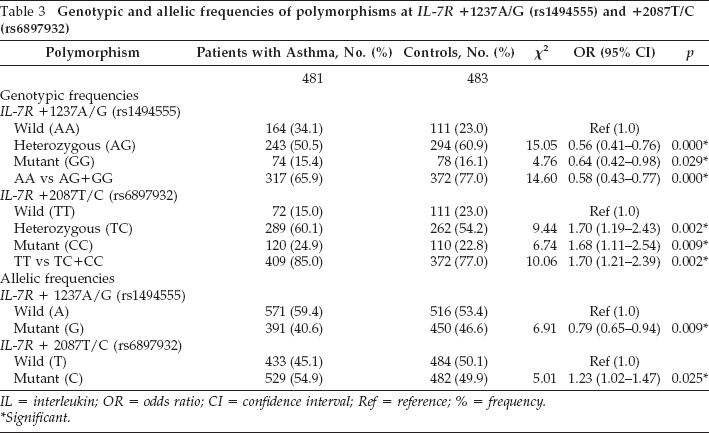
Statistical analysis of the allelic frequencies for IL-7R +1237A/G indicated that the mutant G allele was more prevalent among the controls (46.6%) than in the patients with asthma (40.6%), having protective association toward the disease (OR 0.79, p = 0.009). However, the mutant C allele of IL-7R +2087T/C was more prevalent among the asthmatics (54.9%) than in the controls (49.9%) and had a significant association for the disease (OR 01.23, p = 0.025) (Table 3). When comparing the genotypic frequencies, the results revealed that, for IL-7R +1237A/G polymorphism, the heterozygous genotype AG (OR 0.56, p = 0.001) and homozygous mutant GG genotype (OR 0.64, p = 0.029) showed a highly protective association. The AG+GG genotypic combination again conferred protection from asthma (OR 0.58, p = 0.001) (Table 3).
Genotypic and allelic frequencies of polymorphisms at IL-7R +1237A/G (rs1494555) and + 2087T/C (rs6897932)
IL = interleukin; OR = odds ratio; CI = confidence interval; Ref = reference; % = frequency.
Significant.
Statistical data for the genotypic frequencies in IL-7R +2087T/C revealed that the heterozygous genotype TC (OR 1.70, p = 0.002) and the homozygous mutant CC genotype (OR 1.68, p = 0.009) was more prevalent among asthmatics with a highly significant risk toward the disease. The TC+CC genotypic combination again conferred significant risk in asthmatics (OR 1.70, p = 0.002) (Table 3). Both the polymorphisms (IL-7R +1237A/G and +2087T/C) in the studied population followed the Hardy-Weinberg equilibrium. In addition, the GT and AC haplotypes in the IL-7R polymorphisms were found to be highly significant for asthma, with p < 0.001 and p = 0.037, respectively (Table 4).
Haplotype frequency of polymorphisms at IL-7R + 1237A/G and + 2087T/C

IL = interleukin.
Significant.
Phenotypic Characteristics of IL-7R + 1237A/G and + 2087T/C Polymorphisms in Asthma
Further categorizing the patients with asthma based on the phenotypic characteristics of the disease (Table 5), data obtained from the proforma of patients filled during the collection of blood sample, a protective association was found between IL-7R +1237A/G polymorphism and asthma when comparing mutant allele against the wild-type allele of controls and patients with asthma in the clinical parameters, e.g., female sex (OR 0.79, p = 0.042), throughout the year occurrence of the symptoms (OR 0.72, p = 0.007), wheeze at rest (OR 0.76, p = 0.005), no family history of asthma (OR 0.77, p = 0.008), allergy (OR 0.78, p = 0.009), rhinitis (OR 0.77, p = 0.006), nonsmoker (OR 0.79, p = 0.016), long-standing cough for 3–8 weeks (OR 0.76, p = 0.031), and the patient without cough (OR 0.76, p = 0.032).
Phenotypic characteristics and IL-7R + 1237A/G polymorphism

IL = interleukin; OR = odds ratio; CI = confidence interval; Ref = reference; % = frequency; Nil = absent; +ve = present.
Significant.
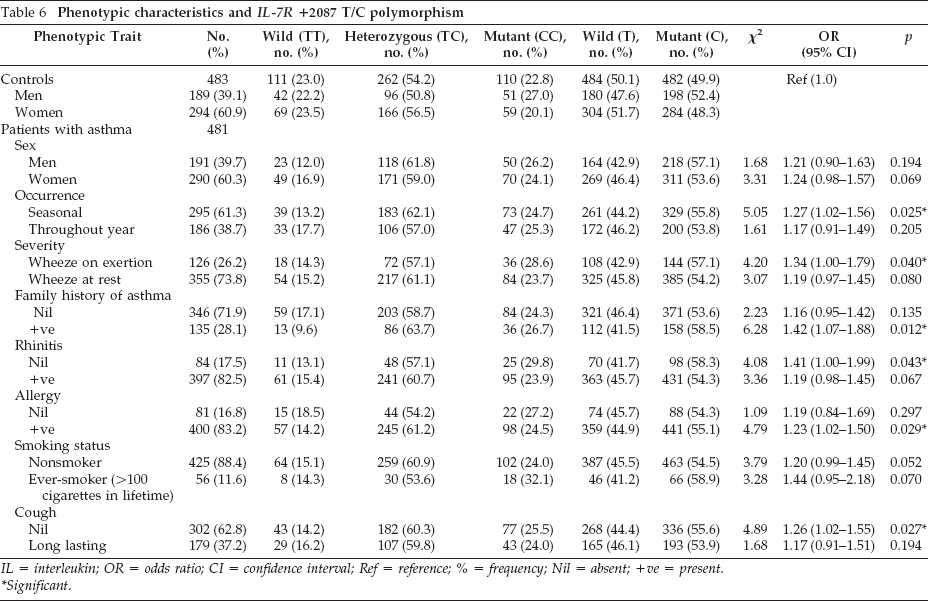
In addition, a significant risk was found between IL-7R +2087T/C and asthma when comparing the mutant allele with the wild-type allele of controls and patients with asthma in the clinical parameters such as seasonal (summer, winter, spring, and autumn) occurrence of the symptoms (OR 1.27, p = 0.025), wheeze on exertion (OR 1.34, p = 0.040), family history of asthma (OR 1.42, p = 0.012), allergy (OR 1.23, p = 0.029), rhinitis (OR 1.41, p = 0.043), and patient without cough (OR 1.26, p = 0.027) (Table 6).
Phenotypic characteristics and IL-7R + 2087 T/C polymorphism
IL = interleukin; OR = odds ratio; CI = confidence interval; Ref = reference; % = frequency; Nil = absent; +ve = present.
Significant.
Discussion
This is the first report on evaluation of the genetic association of IL-7R +1237A/G (rs1494555) and +2087T/C (rs6897932) gene polymorphisms toward asthma etiology in a north Indian population, and allelic as well as genotypic frequencies revealed that the +1237A/G polymorphism confers protection whereas the +2087T/C position increases the risk of the disease, as presented in Table 3. The phenotypic characteristics of +1237A/G polymorphism also conferred protection, as shown in Table 5, whereas +2087T/C polymorphism was associated with risk toward asthma, as observed in Table 6 with p = 0.05. The total serum IgE level was also found to be highly elevated in patients with asthma than in the healthy controls. Spirometry data was only available for patients with asthma so we are unable to apply the statistics in Table 1.
The crucial role of the IL-7R +1237A/G and +2087T/C polymorphisms in asthma is still not known. It is possible that these polymorphisms result in amino-acid substitution in the receptor, which may be associated with changes in the folded protein that affect intracellular signaling pathways. 22 IL-7 mainly induces T-cell activation but can also directly stimulate monocytes to produce a number of proinflammatory cytokines,23,24 and its function is mediated by IL-7R. A current scenario shows that the thymic stromal lymphopoietin (TSLP), considered as an IL-7–related cytokine, has emerged as a crucial contributor to allergic inflammation, e.g., asthma.25,26 The receptor for TSLP is a heterodimeric complex and composed of both the TSLP receptor and the IL-7R chain, which increases their binding affinity.27–29 TSLP is predominantly expressed on lung airway epithelial cells and are also involved in the differentiation and production of type 2 T-helper cell cytokines, such as IL-4, IL-5, IL-9, and IL-13, from naive T cells.30,31 It is also associated with allergic rhinitis, which exacerbates asthma in children. 32 These factors indicate that IL-7R and/or TSLP might trigger the inflammatory cascade in asthma.
In our study, we found that +2087T/C was significantly associated and that +1237A/G had decreased risk of the disease. This result is in accordance with the study conducted with a Danish population that reported IL-7R +1237A/G and +2087T/C as candidate genes for inhalation allergy, in which patients with allergy compared with controls showed a significant association. 9 When comparing the genotypic frequencies of wild, hetero, and mutant in the Danish population with the present study, the same order was observed for +1237A/G polymorphism, whereas a wide difference was observed for +2087T/C polymorphism. 9 A fine mapping and positional candidate studies on Hutterites from Germany was done to identify a 5p-linked asthma or bronchial hyperresponsiveness locus. Hutterites from Germany also revealed that the region on chromosome 5p13 that encodes IL-7R harbors at least two asthma or bronchial hyperresponsiveness susceptibility loci. 11
The present study also found phenotypic parameters to be protective in asthma for IL-7R +1237A/G polymorphism when comparing the following versus controls: female sex, throughout the year occurrence of the symptoms, wheeze at rest, no family history of asthma, allergy, rhinitis, nonsmoker, long-standing cough that lasted for 3–8 weeks, and no cough problem (Table 5). However, a significant risk was found between IL-7R +2087T/C and asthma when comparing patients versus controls for the following: seasonal (summer, winter, spring, and autumn) occurrence of the symptoms, wheeze on exertion, family history of asthma, allergy, rhinitis, and no cough problem (Table 6).
The present study indicated that IL-7R +1237A/G and +2087T/C polymorphisms have a significant association with asthma in a north Indian population. One study, conducted with 282 Taiwanese children (82 controls and 200 patients with allergic asthma) of revealed that IL-7R is a potential candidate gene that confers susceptibility to mite-sensitized asthma. 33 Although the authors could not find any direct evidence among the genetic polymorphisms of IL-7R and the immunologic function of IL-7 and/or TSLP, the author indicated that IL-7R might trigger the early allergic immune cascade when in contact with mite allergens. 33 These results mark IL-7R +1237A/G and +2087T/C polymorphisms as a potential candidate gene in asthma.
With the development of molecular genetics, the field of genetics has evolved to better understand the human genome and its regulation, and to enlighten the contribution of single sequence variance to the progression of diseases. 34 The asthma-related gene polymorphisms are poorly understood, and, due to complex interplay of genetic and environmental factors in asthma, this field has become very challenging for the researchers.
Conclusions
The genetic findings of this study aimed to shed light on the association of IL-7R +1237A/G and +2087T/C polymorphisms and asthma in a north Indian population. Our results showed a highly significant association of asthma in heterozygous and in mutant genotype, together with the phenotypic parameters in +2087T/C polymorphism and protection from asthma in +1237A/G polymorphism, which indicated that both the polymorphisms of IL-7R might act as a predictive marker in the disease pathogenesis.
Footnotes
The authors have no conflicts of interest to declare pertaining to this article