






Abstract
Management of inferior turbinate hypertrophy includes surgical options in case of failure with medical treatment and the main goal of turbinate surgery is to relieve the patient's symptoms of chronic nasal congestion while preserving mucosal surfaces with reduction of the submucosal and bony tissue. In this regard, radiofrequency volumetric tissue reduction has been a thermal technique associated with satisfactory results and fewer side effects. Historical detail on onset, timing, duration, and severity of symptoms and aggravating and relieving factors are important in the differential diagnosis of postnasal drip (PND). Here, we report development of intractable PND due to inferior turbinate perforation after radiofrequency turbinate surgery for the first time in the literature and the successful improvement via removal of pathological anatomic structure under nasal endoscopy-directed surgery in a 35-year-old female patient. The patient had a good functional outcome postoperatively with no further complications or signs of recurrence occurring, to date, within a postoperative follow-up period of 1 year.
Because turbinate surgery ideally should result in an improvement in nasal breathing with mucosal preservation that would maintain normal functioning of the turbinate enabling quicker recovery and less likelihood of atrophic rhinitis and complications,3,6 less destructive techniques, such as radiofrequency volumetric tissue reduction (RFVTR), have been introduced,7–9 which also has its application in turbinate reduction. 10 It is increasingly used to reduce the volume of turbinate mucosa with minimal disruption of mucociliary clearance,7,11 and satisfactory results with fewer side effects have been reported.12–14 Nevertheless, the long-term efficacy of still is unknown 2 because most studies are observational and/or have relatively short follow-up 15 with a few studies showing the long-term efficacy during follow-up for 1 16 and 2 years. 2
Postnasal drip (PND) sensation may be caused by excessive sinonasal mucous secretions, an increase in the viscosity of sinonasal secretions, or abnormal mucociliary function. 17 Although conditions such as allergic and nonallergic rhinitis, viral upper respiratory infections, and acute and chronic sinusitis can commonly cause PND sensation, patients with these conditions rarely present with PND as their chief complaint. 17 Hence, historical details obtained from the patient provide the most important clues to the possible underlying process with the spectrum of PND that may point to a sinonasal or reflux-related source of the symptom complaints. 17
Although many studies describe subjective improvement in nasal obstruction reported by the patient and the physician after RFVTR 13 with fewer side effects,12–14 to our knowledge, this is the first report on perforation of inferior turbinate developing as an unusual complication of RFVTR manifesting with the complaint of PND in a patient after surgery for inferior turbinate hypertrophy. Here, we report development of intractable PND due to inferior turbinate perforation after radiofrequency turbinate surgery and the successful improvement via removal of pathological anatomic structure under nasal endoscopy-directed surgery in a 35-year-old female patient who gave written informed consent.
Case Report
A 35-year-old female patient was referred to our outpatient clinic in 2010 with the complaint of de novo intractable PND that emerged as a complication of septorhinoplasty and inferior turbinoplasty (coblation turbinate reduction) operations performed for nasal obstruction and deformity in 2009. She had no complaint of PND before surgery and medical treatment administered for rhinosinusitis did not ameliorate her symptoms. Medical record of a past operation revealed inferior concha lateralization (outfractured) secondary to insufficiently reduced concha despite radiofrequency application. Bipolar cauterization applied for uncontrolled bleeding at the juncture of 1/3 posterior and 2/3 anterior regions, while the combined effect of lack of mucosal nutritional supply and necrosis of bone tissue in concha as well as an erroneous insertion of the probe through the bone of the inferior turbinate or an excessive thermal effect may have resulted in perforation. Radiofrequency energy was delivered from Ellman device (Ellman International, Inc., Oceanside, NY) and transferred via the radiofrequency electrode (Ellman Vari-Tip electrode; Ellman International, Inc.) with an 8-mm clad proximal segment and a 2-mm unclad distal active segment. High frequency (4.0 MHz) radio waves were applied via electrode that was inserted submucosally under endoscopic guidance, and the 50-W energy was delivered to three different sites of each inferior conchae (to the medial wall, inferior wall, and tail regions) at cut-coagulate mixed mode for 20 seconds each time. In our clinical examination, direct rhinoscopy revealed normal findings while the paranasal sinus tomography revealed preserved integrity of nasal conchae with a perforation in the posterior part of the inferior nasal concha (Fig 1). Endoscopic investigation revealed mucoid discharge accumulated within the perforated mucosal area in 1/3 posterior-inferior region of the left inferior nasal concha. After aspiration of the discharge, 1 mm-wide perforation was detected and the thickness of the inferior mucosal layer was also 1 mm (Fig 2). Inferior mucosa of the perforated region was cut using scissors via rigid endoscopy-directed surgery under local anesthesia and hemostasis was maintained by bipolar cauterization (Fig 3). The patient had a good functional outcome postoperatively with complete recovery from PND on the postoperative day 20 and no further complications or signs of recurrence occurred to date within a postoperative follow-up period of 1 year.
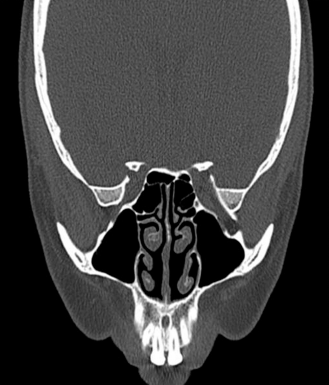
Paranasal sinus tomography. Preserved integrity of nasal conchae with a perforation in the posterior part of the inferior nasal concha.

Endoscopic investigation. Perforated mucosal area in 1/3 posterior-inferior region of the left inferior nasal concha with 1 mm-wide perforation and 1-mm-thick free mucosal layer.

Disintegration of perforation under rigid endoscopy–directed surgery.
Discussion
Successful surgical treatment of the inferior turbinate requires appropriate reduction of tissue volume to prevent persistence of the obstruction and the preservation of mucociliary function to avoid crusting due to mucociliary dysfunction. RFVTR has been indicated to achieve both goals by inducing a localized submucosal injury, resulting in fibrosis and tissue contraction while preserving the structure and function of overlying mucosa. 18
In our case the procedure involved coblation turbination reduction, which is preferred when a patient's turbinate is abnormally large and does not respond to traditional therapies such as antihistamines or antibiotics requiring the surgical intervention. In this technique, the turbinate is shrunk through the placement of a surgical probe and with radiofrequency; the submucosal tissue is vaporized while the mucosal layer is preserved to allow for continued nasal humidification. 19
In fact, ability to perform in an office based setting with minimal discomfort, reduced cost, decreased thermal insult to tissues (60–90°C) 2 and decreased postoperative crusting and care were reported among the several advantages to RFVTR identified by previous authors.2,9,16,18,20–22
Accordingly, although the complications of other surgical techniques for inferior turbinate hypertrophy include infection, crusting, bleeding adhesions, and perforations in the inferior turbinectomy 6 ; bleeding, synechiae, and mucosal tears in patients undergoing submucosal resection using a microdebrider 5 ; crusting in laser treatments and crusting and synechiae in electrocautery, 6 RFVTR was reported in past studies conducted with 32,9,11,14, 16,18 108,20,22,23 and 10 24 patients, respectively, to show 0% in all of these complication categories.2,8
Hence, RFTVR exhibits favorable complication rates compared with other techniques 25 with no atrophy or synechia development after surgery 1 while the rate of transient minor complications can be as high as 14% including edema (14.2%), crusting (22.8%), and bleeding (28.5%), postprocedural obstruction, mild pain controlled with over-the-counter analgesics (12%), feeling faint (7%), and numbness of the maxillary teeth (20.4–40.9%).1,2,20,24
In our 35-year-old female patient, intractable PND was the late postoperative complication, caused by inferior turbinate perforation after RFVTR, an effect not reported elsewhere. Nevertheless, the successful management was achieved by removal of pathological anatomic structure under nasal endoscopy-directed surgery, leading to good functional outcome postoperatively with complete recovery from PND on postoperative day 20, and no further complications or signs of recurrence have occurred, to date, within a postoperative follow-up period of 1 year.
Because surgery is more invasive than other types of treatment such as medication, it is important that the surgery results in sustained improvement in the patient's quality of life. 26 Accordingly, surgical procedures toward the inferior turbinate are now, more than ever, concentrating on minimal disturbance toward the nasal mucosa with growing interest in minimally invasive surgical procedures. 27 In this respect, RFVTR has been suggested as a new standard of care for an effective long-term treatment of patients with nasal obstruction caused by inferior turbinate hypertrophy with no significant return of symptoms within 2-year follow-up and similar or greater symptom reduction as well as fewer complications than other commonly used surgical techniques. 2
Furthermore, in a past study concerning comparison of radiofrequency applied to the total inferior concha with application to its anterior third, radiofrequency applied to the anterior 1/3 of the inferior turbinate, the main component of the inferior turbinate included in this area, was shown to be equally as effective in decreasing obstruction and improving patient complaints as application toward the whole concha. 27
Our findings emphasize not only the creation of perforation as a complication of RFVTR but also the amelioration of PND after excising the perforated inferior turbinate. Given the lack of such complications in our clinical experience and promising results we obtained, to date, with RFVTR we recommend this technique. However, based on development of inferior concha perforation in our patient with inferior hypertrophy-related nasal obstruction after RFVTR, possibly because of misplacement of electrode tip to concha passing from medial to lateral instead of submucosal direction, it seems reasonable to take precautions for avoiding complete layer and directly perpendicular application of unnecessarily prolonged and high energy to conchae to minimize such complications necessitating subsequent surgical interventions. Hence, to prevent manipulations extending beyond the mucosa, saline injections might help keep mucosa safe during endoscopy-directed procedures that enable close visualization of the area.
In conclusion, emergence of PND as the sole presenting symptom of inferior concha perforation, an unusual complication of RFVTR surgery for inferior turbinate hypertrophy-related nasal obstruction, seems to indicate that inferior concha perforation should be considered in the differential diagnosis of PND in patients with a history of nasal surgeries. Furthermore, based on the normal findings in direct rhinoscopy and the likelihood of preserved integrity of nasal conchae in paranasal sinus tomography, the endoscopic investigation seems to be crucial in the accurate diagnosis of postoperative complications in inferior turbinate hypertrophy surgery. Although the overall evidence level in the literature supporting the efficacy of RFVTR in inferior turbinate surgery for hypertrophy is improving, future large-scale prospective studies with validated outcome measures on efficacy and detailed evaluation of complications within the long-term follow-up would strengthen the level of evidence.
Footnotes
The authors have no conflicts of interest to declare pertaining to this article