






Abstract
Nonadherence with anti-inflammatory treatment is a frequent cause of continued symptoms in asthmatic patients. Clinical assessments including patient-reported medication administration may provide the asthma specialist incomplete information regarding actual adherence to anti-inflammatory medications. The objective of this report was to describe the first case where adherence to inhaled asthma therapy was assessed by direct analysis of glucocorticoids in induced sputum. The patient's blood, urine, and sputum were tested for synthetic corticosteroids using mass spectrometry. To evaluate a clinical suspicion of poor adherence, sputum, urine, and blood were used to assess for current compliance to medication use. We report a case where asthma specialists attributed poorly controlled asthma to nonadherence to medical therapy. After modification of the medical regimen, adherence with oral and inhaled steroids was assessed–via examination of the urine, blood, and sputum. Direct analysis of glucocorticoids in sputum is feasible and in theory could provide a novel tool to document current medication adherence. Concomitant assessment of glucocorticoids and eosinophils in the same induced sputum specimen could provide insight into possible steroid resistance in select referral patients with difficult asthma.
Inhaled corticosteroids are currently the most effective long-term control medication for asthma and provide control for the majority of asthmatic patients. 6 Unfortunately, the morbidity, mortality, and costs of asthma remain elevated, in part because of patient nonadherence. Asthma specialists perform clinical assessments of adherence while attempting to optimize anti-inflammatory therapy. These clinical assessments are thought for the most part to be accurate. Direct analysis of eosinophils in induced sputum has been beneficial in tailoring anti-inflammatory therapy in asthma.7,8 Although there has been an increase in the number of publications involving sputum studies in the diagnosis and treatment of asthma, 9 most studies provide limited information regarding adherence of inhaler use in study subjects. In select, refractory asthmatic patients and in patients undergoing asthma studies involving inflammation, there may be a role for a gold standard to monitor adherence of inhaled corticosteroid therapy.
Case Report
Nonadherence was considered in a 47-year-old man with severe, prednisone-dependent eosinophilic asthma because he had persistent symptoms despite treatment with fluticasone propionate/salmeterol xinafoate, 500/50 μg twice daily; prednisone, 20–40 mg daily; and budesonide (200 μg/puff), 2 puffs twice daily. With the differential diagnosis of poor adherence versus steroid resistance, inhaled budesonide and prednisone were discontinued. On May 18, 2004, methylprednisolone, 16 mg twice daily for 24 hours and then 16 mg daily, and beclomethasone dipropionate, 2 puffs (80 μg) hydroflouroalkane twice daily with a spacer, were initiated. To assess current compliance to therapy, the patient underwent analysis of the blood and urine for synthetic steroids on May 19, 2004. Whole sputum was available because of sputum induction for eosinophilia on May 20,2004. This sample was also analyzed for the presence of synthetic glucocorticoids. Clinical improvement was unexpectedly abrupt. The forced expiratory volume in 1 second increased from 58 to 90% of predicted. Sputum eosinophil counts decreased from 78 to 2%.
Sputum Induction and Processing
After 3% hypertonic saline sputum induction, ~1 mL of whole sputum was used for evaluation for synthetic glucocorticoids and the remainder was processed as previously described. 9
Evaluation for Synthetic Glucocorticoids
Half a milliliter of urine, blood, and whole sputum were used for extraction. The synthetic glucocorticoids were extracted from the sample via an acetonitrile protein precipitation followed by methylene chloride liquid extraction of the supernatant. A portion of the reconstituted sample (17 μL) was injected into a high-performance liquid chromatography system and analyzed by tandem mass spectrometry operated in the multiple-reaction monitoring positive mode.
The blood level of methylprednisolone was 2.6/μg/dL and prednisolone was 0.35 μg/dL, documenting use of methylprednisolone and the recently discontinued prednisone. The urine levels were 13 μg/dL of methylprednisolone, 1.3 μg/dL of prednisolone, and 0.74 μg/dL of prednisone that further confirmed recent use of prednisone. Testing for steroid in sputum revealed 0.8 μg/dL of beclomethasone, 33 μg/dL of fluticasone, and 1.8 μg/dL of methylprednisolone and confirmed recent use of inhaled fluticasone and beclomethasone at the time of the test (Table 1). Although not indicative of long-term compliance, the patient was indeed shown to be compliant with his inhaled glucocorticoids, prednisone, and methylprednisolone at the time of testing.
Synthetic glucocorticoids
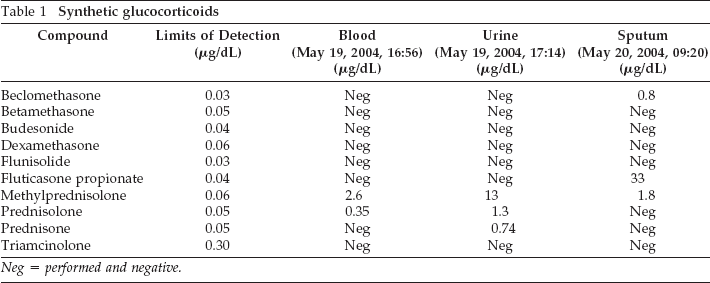
Neg = performed and negative.
Discussion
This is the first report to our knowledge showing the feasibility of assessing synthetic glucocorticoids in induced sputum of an asthmatic patient to document current compliance to therapy. The patient was shown to be compliant with his medication regimen at the time of sample analysis. Corresponding evidence of adherence included a reduction in symptoms, improvement in spirometry, and a decrease in sputum eosinophilia from 78 to 2%. Although before this episode of care the patient's clinical course had been refractory to both inhaled and oral corticosteroids, suggesting possible steroid resistance, with documented compliant administration of treatment he was shown to improve clinically, confirmed by reductions in airflow obstruction and sputum eosinophils. 10
Use of sputum induction in the evaluation and treatment of asthma has been shown to be safe and reproducible.11,12 Greene et al. suggest that treatment of eosinophilic inflammation detected through induced sputum would lead to better control of moderate to severe asthma. 7 This suggestion has been supported by meta-analysis in adults. 13 Also, several published studies show that induced sputum reveals information qualitatively similar to bronchoscopy and bronchial washings. 9 Thus, through sputum induction we can measure airway inflammation, adherence with therapy, and, by repeat testing, response to treatment. 14
Milgrom et al. showed that patient-reported use of their inhaled corticosteroids in diaries was 95.4% whereas their median actual use was 58.4%. The majority of the patients (90%) in that study exaggerated their adherence with inhaled steroids. Furthermore, children who required a steroid burst for an exacerbation had much lower rates of adherence (14%) than those who did not experience exacerbations (68%). 5 Guilbert's thoughtful analysis of the long-term effects of inhaled corticosteroids in children was limited by a 25–30% nonadherence rate. 15 Rates of nonadherence with asthma therapy have been reported as 20% to 80%. 2 The consequences of poor adherence with asthma include absences from work or school, increased emergency room visits, more severe attacks, increased drug side effects, greater cost of care, and death. 16 According to the National Asthma Education and Prevention Program Expert Panel Report 3 Guidelines, adherence to medications should be assessed before “stepping up” asthma care. Referral to an asthma specialist should be considered if there are concerns over poor adherence. However, specific tools to document nonadherence are not outlined for either the primary or the specialty physician in these guidelines. 17
Inhaled corticosteroids are currently the most effective long-term control medications for asthma and, fortunately, provide control for the majority of asthmatic patients. 6 Appropriate use and avoidance of systemic corticosteroid overuse is essential to providing optimal asthma care. Regular use of inhaled corticosteroids is associated with a decreased risk of death from asthma. 18 Because we rely on these drugs for the majority of patients with asthma and the ability of clinicians to determine adherence is not perfect, a gold standard for assessing adherence could provide useful information in select patients. In addition, direct analysis of glucocorticoids in sputum could provide a tool to augment the reliability of sputum eosinophil assessments. We report the first case to our knowledge where sputum as well as blood and urine were used to determine adherence with therapy.
This is the first report to our knowledge where direct measurements of synthetic glucocorticoids were performed in asthmatic sputum to assess current compliance to inhaled therapy. This novel method to assess inhaled steroids in sputum has potential value such as documenting current compliance to inhaled steroids when considering “step up care” or improving the interpretation of sputum eosinophilia in a specific patient. This methodology could be particularly important in differentiating poor adherence from steroid resistance in a specific patient. Concomitant measurements of airway inflammation, adherence with therapy, and response to treatment may have applicability in a tertiary referral center for asthma.
Footnotes
The authors have no conflicts to declare pertaining to this article
Acknowledgments
The authors thank Gladys M. Hebl for editorial assistance in the preparation of this article.