






Abstract
This study documented the major factors of scholarly influence of kinesiology journals: impact and prestige. Four citation-based biblometric indicators were extracted for kinesiology journals from three databases: Thompson-Reuters Journal Citation Reports, SCImago Journal and Country Rank, and Eigenfactor.org. Two metrics (Eigenfactor™ and Hirsch index) estimated journal prestige, while SCImago Journal Rank and the Impact Factor estimated impact. Correlations and curve fits confirmed the impact and prestige structure in kinesiology journals that has been reported in other fields. Combined impact and prestige scores showed some journals with high influence, but about twenty percent of the journals with ratings of either impact or prestige higher (0.5 SD) than the other. Kinesiology journals may make different contributions to the knowledge generation and storage roles of scholarly publications.
Kinesiology is the study of human movement or physical activity. A large, diverse meta-disciplinary field like kinesiology has a variety of multi-disciplinary and sub-disciplinary journals publishing research. Kinesiology research can be found indexed in major databases like Scopus or Journal Citation Reports under subject areas like education, physiology, rehabilitation, sports medicine, and sports science. These subject areas or categories of databases are just a small subset of the many sub-disciplinary areas related to Kinesiology (e.g., athletic training, biomechanics, exercise physiology, psychology, leisure, measurement, motor behavior, public health, sociology). Unfortunately there has been limited investigation defining the core journals in kinesiology or their bibliometric properties.
Considerable research has been conducted on numerous bibliometric variables based on citation analysis that has been used to document journal influence. Factor analysis and correlation studies of these variables in several disciplines indicates that the academic influence of a journal can be represented by a combination of two different factors: one representing the data archive function of journals and the other representing the frontiers of knowledge advancement function (Bollen, Van de Sompel, Hagberg, & Chute, 2009) Leydesdorff 2009) Zhou, Lu, & Li, 2012). Some bibliometric variables describe journals that capture numerous citations, expressing the productivity, popularity, or utility of results archived in a field. This factor will be referred to as “impact” in this paper. Other bibliometric variables capture the importance or prestige of journals in creating new knowledge and is referred to as “prestige.”
The first study of the core physical education and sport journals was based on ratings from 82 faculty. Miranda and Mongeau (1991) reported perceptions of five journal characteristics for 45 physical education and sport journals, noting the need for additional research since the area had been relatively neglected in bibliometric research. The perception of influence of journals in the biomechanics sub-discipline of kinesiology has been reported from surveys of North American and international scholars (Knudson & Chow, 2008; Knudson & Ostarello, 2008).
More recently, Tsigillis, Grouios, Tsorbatzoudis, and Koidou (2010) reported seven-year trends in the impact factor (IF) of “sports sciences” journals. Knudson (in press, a) reported that the top 40 ranked kinesiology-related journals based on metrics from three bibliometric databases had considerable variation, but had range and mean values qualitatively similar to related academic disciplines of allied health and education. A follow-up study of the top 60 journals indexed in the SCImago database also reported similar bibliometric indicators and moderate associations (r2 = 44 to 58%) between them (Knudson, in press, b). Patterns in journals publishing social science research in sports over 15 years has been reported by Gau (2013). No studies have explored a combination of bibliometric variables to specifically examine the impact and prestige of journals related to kinesiology.
Despite about 130 years of history in the United States, there are limited data on impact and prestige of kinesiology journals and the many sub-disciplines of the field. An improved understanding is needed of the most influential kinesiology journals from both the impact and prestige they contribute to the scientific community. This study documented four bibliometric variables previously noted to measure impact and prestige in a large sample of kinesiology-related journals.
Hypothesis. Bibliometric variables studied in kinesiology journals would show different impact and prestige factors documenting journal influence.
Method
The most recent data from three databases were searched for kinesiology-related journals: Thompson-Reuters' Journal Citation Reports for 2011, SCImago Journal and Country Rank using Elsevier's Scopus for 2011, and Eigenfactor.org as of June 17, 2013. A sample of 82 kinesiology-related journals (Table 1) was identified by the author through analysis of subject categories used in these databases and journals reported in previous studies (Miranda & Mongeau, 1991; Knudson & Chow, 2008; Knudson, in press a, b).
Mean Standard (Z) Scores For Impact and Prestige of Kinesiology Journals
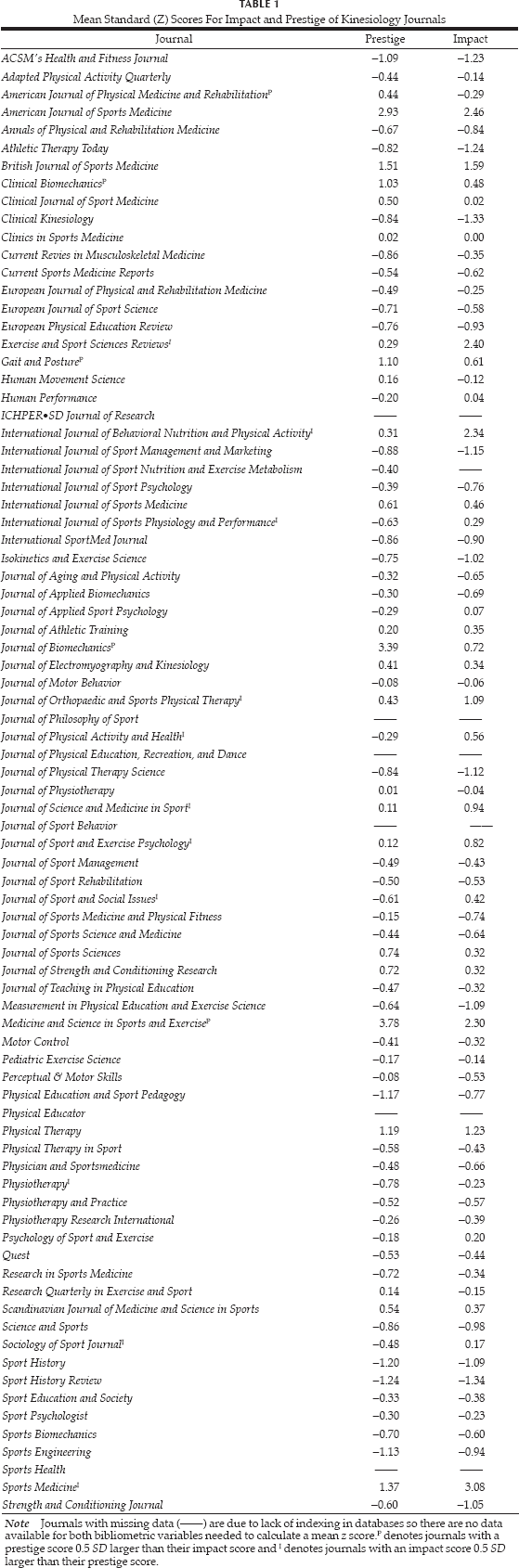
Note Journals with missing data (—–) are due to lack of indexing in databases so there are no data available for both bibliometric variables needed to calculate a mean z score.P denotes journals with a prestige score 0.5 SD larger than their impact score and I denotes journals with an impact score 0.5 SD larger than their prestige score.
Four bibliometric variables were extracted from the databases, two hypothesized to align with impact and two aligned with prestige. The prestige variables were 10-year h index (h10) from SCImago and the five-year Eigenfactor™ (EF5) which are based on the distribution of total citations of a journal. The impact variables were the 3-year SCImago Journal Rank (SJR3) and the two-year Impact Factor (IF2) from the Journal Citation Reports which focus on the average/normalized citations to articles in a journal. The Hirsch index (h10) applied to journals is the number of papers published in a journal in a target year that have been cited by at least the same number of times in a reference window (10 years in the SCImago index of the Scopus database). The IF2 represents the mean number of citations that occurred in the target year in journals indexed by Journal Citation Reports to number of articles published in the journal during the previous two years. The EF5 and SJR3 are based on the Google PageRank algorithm, i.e., designed to account for the ranking/distance of citing documents through eigenvector centrality methods. SJR3 is interpreted as the average impact of papers in the journal during the target year based on the centrality of citations in Scopus indexed journals in the last three years. EF5 is a modification of the eigenvector method to adapt to journal citation behavior and is interpreted as the percentage of time that average research readers spend with that journal in searching for articles.
Descriptive statistics were calculated for each dependent variable and the associations between them examined by correlations and curve fitting with SPSS 20. Standard (z) scores were calculated for each bibliometric variable. Composite impact and prestige scores were calculated as the mean of the z scores for SRJ3 and IF2, and EF5 and h10, respectively. Composite impact and prestige scores for a journal were considered different if the difference was greater than 0.5 standard deviations (Table 1). Statistical significance was accepted at the p < .05 level.
Results
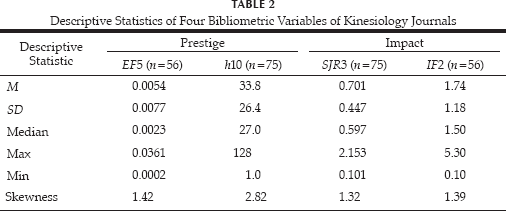
Descriptive statistics for the bibliometric variables for the kinesiology journals are reported in Table 2. All four variables had a small to moderately positive skews. Due to differences in journals indexed by the three databases, some journals did not have all dependent variables so there were unequal numbers of journals for each variable.
Descriptive Statistics of Four Bibliometric Variables of Kinesiology Journals
Correlations and scatterplots confirmed the hypothesized factor structure of impact and prestige for the four bibliometric variables in kinesiology journals (Table 3). The impact variables SRJ3 and IF2 had a strong linear (r = .86, p <. 05) association. The prestige variables EF5 and h10 also had a strong linear (r = .88, p < .05) association, although there was also a quadratic trend that accounted for slightly more variance (r = .95). Associations between EF5 and SJR3, as well as IF2 and h10 were heteroscedastic and highly non-linear, indicating that these variables were not measuring similar parameters (Fig. 1). The association (r = .77, p < .001) between SJR3 and h10 was significant, but smaller than the associations between the impact and prestige variables.

Nonlinearity and heteroscedasticity between EF5 and SJR3 indicating that Pearson correlation is not an appropriate index of the association between these variables.
Correlation Matrix of Bibliometric Variables

Note ζindicates correlation significant P < 0.001 and *indicates that correlation coefficients should not be considered accurate given non-linearity and heteroscedasticity of the scatterplots of these variables.
The mean standardized (z) scores for the combined impact and prestige parameters for the kinesiology journals studied are reported in Table 1. Missing data for seven journals were a result of a journal not being indexed so the bibliometric variables could not be retrieved and the standardized impact and prestige variables calculated.
Discussion
The data in the present study supported the journal impact and prestige factor structure hypothesized in kinesiology journals that has been reported in other disciplines (Bollen, et al., 2009; Leydesdorff, 2009; Franceschet 2010; Zhou, Lu, & Li, 2012). Strong (r2 = 74 to 77%) positive associations were observed within the prestige variables (EF5 and h10) and the impact variables (SRJ3 and IF2), but curvilinear or weaker associations (r = .77 between SJR3 and h10) between these two domains of journal influence. It may be that there remains about 50% of shared variance between the impact and prestige bibliometric variables in kinesiology-related journals.
These bibliometric indicators confirm that there are a small number of highly influential kinesiology journals, with both strong prestige and impact scores (Table 1). The small positive skews in the raw bibliometric variables were also evident in the composite impact and prestige scores, with only 27 journals with positive impact z-scores and 25 journals with positive prestige z-scores. These high-influence journals related to kinesiology were dominated by basic, biological, and clinical sciences.
There were also, however, 20% of the journals that made relatively greater contributions in one of the areas (impact or prestige) of scholarly influence relative to the other. Inspection of Table 1 shows five journals that had z scores for prestige larger (greater than 0.5 SD) than their impact scores, and eleven journals with impact scores larger than their prestige scores, e.g., the American Journal of Physical Medicine and Rehabilitation has higher and positive prestige z score than in impact z score. Review journals that serve important data integration and storage roles (Exercise and Sport Science Reviews or Sports Medicine) had larger impact scores than prestige scores. This variation in impact and prestige of journals related to kinesiology is not surprising because there are a variety of missions of these journals. There is bound to be variation the research and citation behavior across different multi-disciplinary and sub-disciplinary journals in kinesiology. Previous bibliometric research in kinesiology has reported significant variation in authorship and sampling practices across sub-disciplines (Knudson, 2011, 2012). There are also likely differences in citation and indexing patterns between journals focused on applied/professional research, basic science/disciplinary, or across the various kinds of sciences and humanities represented in a broad field like kinesiology. Scholars have noted that the abuse of biblometric variables like the IF devalue publications of professional and applied kinesiology journals that might actually have higher societal impact than journals with a larger IF (Allford, 2012; Cardinal, 2013).
While the present data could be interpreted by some as bibliometric evidence of a ranking of core journals in kinesiology, the associations observed and previous bibliometric research argue for a more nuanced application of these data. Bibliometric indicators like the IF2 have many well-known limitations (Seglen, 1997; Cameron, 2005; Garfield, 2006; e.g., Brumback, 2012) that make them inappropriate to use alone as an indicator of journal influence. Many of these weaknesses in the IF2 also apply to other bibliometric variables. Scholars can use the combination of bibliometric variables to better identify the impact and prestige profiles of journals. This impact and prestige data can be used to help select kinesiology-related journals that align with the purpose of their research. Journals can be selected that are aligned with high prestige and recognition of knowledge generation or journals can be selected that are more aligned with impact, utility, and storage of important observations. For example, a researcher looking to publish applied work on the scholarship of teaching and learning might seek kinesiology journals with stronger impact scores than prestige scores.
Since journal influence is a multi-dimensional phenomenon (Coleman, 2007; West & Rich, 2012), it would be desirable for future research to extend these results with scholars' ratings of the impact and prestige of kinesiology journals. There is a particular need to expand knowledge of the influential and prestigious of journals within specific sub-disciplines of kinesiology beyond the initial work in the sub-discipline of biomechanics. This previous research in biomechanics consistently observed that disciplinary and research interests (e.g., biology, ergonomics, sport) are quite influential in shaping scholars' ratings of journal importance (Knudson, 2007; Knudson & Chow, 2008; Knudson & Ostarello, 2008, 2010).
Limitations of the present study include the accuracy and consistency of indexing the original research within the databases searched. There was also potential bias in the journals selected as related to kinesiology, e.g., there are smaller numbers of kinesiology-related journals in the behavioral sciences and humanities, and these disciplines represent a minority of the journals indexed in many databases. Given the large number of journals studied, it is likely that the journal descriptive data and associations observed are robust descriptions of the current state of English language kinesiology journals. The standardization of the prestige variables (EF5 and h10) that had greater positive skew may have reduced the number of journals that were identified as prestigious.
It can be concluded that the scholarly influence of the kinesiology journals studied using four bibliometric measures matched the two factor structure of impact and prestige observed in research on journals in other disciplines. The bibliometric variables identified a small number of highly influential kinesiology journals, with both strong composite impact and prestige scores. There were also 20% of these kinesiology journals with different impact and prestige scores based on a standard of 0.5 SD difference in composite impact and prestige scores. Scholars have choices of kinesiology-related journals that have great scholarly influence (both impact and prestige), but also journals that have relative strengths in either the knowledge generation (prestige) or storage (impact) roles of scientific publications.