






Abstract
In order to be dynamically equivalent, different translations of the same text must have the same effects (including emotional effects) on an audience. In this research, six English translations of the Bible (four entire Bibles, one Tanakh, and one nearly complete translation) were scored with the Dictionary of Affect in Language, which quantifies the Pleasant, Active, and Imaging undertones of words, and were compared in terms of these undertones. In spite of small differences among them (translations into simpler modern English were significantly more Pleasant, Active, and Concrete), the translations were emotionally consistent and therefore dynamically equivalent to one another with respect to emotion and imagery. The median correlation among translations for Pleasantness, Activation, and Imagery was .9. The greatest variation in scores was associated with chapters. Emotional and imagery differences between books and chapters of the Bible are described and discussed.
The distinguishing characteristic of a first-class translation is the faithful conveyance of meaning from an original to a target language. One of the most-translated texts of all time is the Bible, and arguments as to how its meaning should be translated continue to occupy scholars (e.g., Thomas, 1990; Joubert, 2001; Naudé, 2004; Karlik, 2010). This paper examines the conveyance of emotional meaning in several English translations of the Bible.
The Christian Bible (66 books, Old and New Testaments) took something resembling its present form several hundred years after the birth of Christ. Its contents derive from a variety of source documents—all of them copies rather than originals—written mainly in Aramaic, Hebrew, and Greek. Different translations of the Bible have relied on different though overlapping source documents (e.g., the Alexandrian and Byzantine texts, Gilmore, 2000, pp. 16, 36). An early translation of the complete Bible into a single language was the Latin Vulgate of the late 4th century C. E. (Gilmore, p. 177) and the first complete English translation (Wycliffe's) did not appear until the 14th century (Bruce, 1961, p. 12). At present, there are several English translations extant which differ in terms of privileged source documents (de Vries, 2007), target populations (e.g., Catholic, Protestant, and Jewish; Appendix A), and translation philosophies.
A key distinction among translation philosophies (Nida, 1964, pp. 159–162; Nida & Taber, 1969, pp. 5, 8; Zasyekin, 2010; Kerr, 2011) rests on the contrast between translations designed to be literally or formally equivalent to their sources and those designed to be functionally or dynamically equivalent to them. More literal translations (e.g., the ASV or American Standard Version; Tables 1 and 2) focus on reproducing the exact words and word meanings of the source, as far as possible. More dynamic translations (e.g. BBE, or the Bible in Basic English; Tables 1 and 2) are designed to communicate the same effect as the source, but may do so by employing different words. Emotional equivalence is defined as a form of dynamic equivalence (Nida, 1964, p. 152; Nida & Taber, 1969, pp. 91–98; Zasyekin, 2010; Kerr, 2011). Two translations creating the same emotional effect in the reader are dynamically equivalent with respect to emotion.
English translations of the Bible studied a
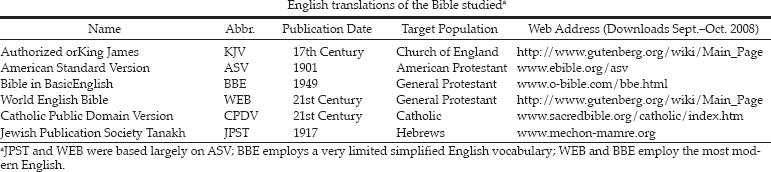
JPST and WEB were based largely on ASV; BBE employs a very limited simplified English vocabulary; WEB and BBE employ the most modern English.
Six different translations of text from the beginning of Psalm 100 a

Translations are arranged roughly in order from the most literally equivalent to the most dynamically equivalent.
In this research, five English translations of the Bible and one of the Jewish Tanakh (JPST, equivalent to the Christian Old Testament; Tables 1 and 2) were compared to one another in terms of the emotions represented in their words. If such emotions are similar, then the various translations can be considered dynamically equivalent, even though the actual words in each translation (see Table 2 for examples) may differ. The translations studied were prepared for Protestant, Catholic, and Jewish populations and two of them were simpler modern language translations. They ranged in age from the 400-year-old Authorized Version (KJV or King James Bible; Tables 1 and 2) to the in-progress 21st century WEB and CPDV (Catholic Public Domain Version; Tables 1 and 2). The translators of the six versions were sensitive to the issues of translation such as the valuing of different source documents, the relative importance of literal and dynamic equivalence, the population of believers being served, and the employment of archaic language. This awareness is illustrated by the quotes included in Appendix A.
The texts in Table 2, which all represent the first few lines of Psalm 100, come from each of the translations studied and highlight both similarities and differences among them. This text was chosen as an illustration because it is a familiar one. One rather obvious difference is the name used to refer to the deity (God, Lord, LORD, Jehovah, Yahweh). Another is the employment of archaic language (e.g., “ye,” “hath”) in some translations. More subtle differences are reflected in the words used to represent feelings or actions. In the first line, an imperative to emotional action is rendered as “make a joyful noise,” “shout unto,” “shout joyfully to,” “shout for joy to,” or “make a glad sound.” In the third line of the psalm, people are instructed to come before God with “singing,” with “exultation,” or with “joy.” In spite of these differences at the level of individual words, the generally positive and active tone of the doxology is obvious in all translations. The employment of different words means that the translations are not strict literal equivalents of one another, but the common effect that their language has on readers suggests a degree of dynamic emotional equivalence which is the result of the matching emotional undertones of alternative words employed to represent the same concept.
The emotional undertones of English words can be assessed with the help of the Dictionary of Affect in Language (Whissell, 2009). The Dictionary was developed on the basis of semantic theories of emotion (e.g., Osgood, 1969) that maintain that words carry two levels of meaning: an obvious or denotative layer and a less obvious but nevertheless powerful connotative one. In this research, the sense that people in general have of a word's valence (Pleasantness) and its arousal (Activation) comprise the connotative or emotional meaning of the word. Words differ from one another in terms of their imagery—their tendency to suggest mental images, as well. Imagery is important to the ways in which we process, understand, and remember words (e.g., Paivio, Yuille, & Rogers, 1969). For any one translation to be dynamically equivalent to another, it should be similar to it in terms of the dimensions of Pleasantness, Activation, and Imagery.
The Dictionary of Affect in Language 1 contains volunteers' rated impressions of Pleasantness, Activation, and Imagery for close to 9,000 words which were rated in context-free tasks. The words were sampled from everyday natural English sources such as books, newspapers, and essays. In this research, whenever a word in an English translation of the Bible was found in the Dictionary, the values for these three variables were imported into a data file describing the translation. An example of this procedure is included in Table 3, where matches were found in the Dictionary for 22 of 24 words from the familiar beginning lines of 1 Corinthians Chapter 13 in WEB.
An example of Dictionary of Affect Scoring for the first 24 words of 1 Corinthians Chapter 13 in WEB a
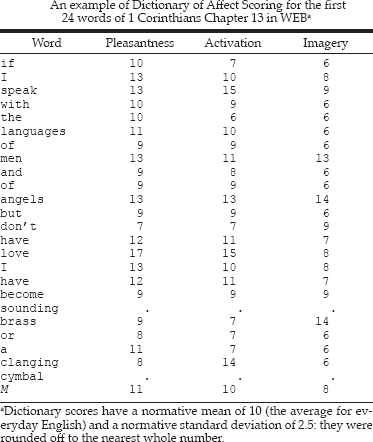
Dictionary scores have a normative mean of 10 (the average for everyday English) and a normative standard deviation of 2.5: they were rounded off to the nearest whole number.
Each scored word in Table 3 is accompanied by a value for Pleasantness (how pleasant the undertones of the word were perceived to be by participants who created the Dictionary), Activation (how active or arousing the undertones were perceived to be), and Imagery (how easily participants perceived that the word could be envisioned, and therefore how concrete it was). For ease of interpretation, scores in Table 3 have been transformed (from original scales ranging from 1 to 3) so that the normative mean for everyday English is 10 for each dimension and the standard deviation is 2.5 (Whissell, 1998, 2009). The most Pleasant word in the passage is “love” and the least Pleasant, or most Unpleasant, is “don't.” The most Active word is also “love” and the most Passive is the article “the.” “Angels” and “brass” are easy to envision (Concrete) and earned the highest Imagery scores, while many English function words including “if” and “the” are difficult to envision (Abstract), and received the lowest scores. Although it is sometimes assumed that English function words have no distinct emotional undertones, research (Whissell, 2009) has indicated otherwise. In Table 3, for example, the word “of” is rated as more Active than the word “the,” while the word “if” is rated as more Pleasant than the word “or.” Function words are scored along with more obviously emotionally toned words such as “love” and “angels” in Dictionary of Affect applications. The means at the bottom of Table 3 describe the passage as a whole: it is of slightly above average Pleasantness (11), and of average Activation (10), but its words are quite abstract or difficult to envision (Imagery = 8).
Method
All English translations analyzed were downloaded from the web in the autumn of 2008 (Table 1). Two of them had not been finalized (WEB and CPDV, see Table 1 for acronyms), and CPDV did not include four books (1, 2 Kings and 1, 2 Chronicles). Deuterocanonical books (e.g., 1, 2 Maccabees, Tobit) were not included in the analysis. Chapter divisions employed were those of KJV and ASV. Because of differences in the division of the Psalms into chapters, CPDV psalm chapters were renumbered to match ASV chapters. CPDV contained minor additional materials within chapters in the book of Daniel, which were scored as they stood, and major additional materials in chapters in the book of Esther, which were omitted from some analyses.
The six translations contained a total of more than four million words. The percentage of words in each translation for which scores were identified in the Dictionary of Affect was 87 for KJV, 86 for ASV, 85 for JPST, 93 for BBE, 88 for WEB, and 86 for CPDV, so that the results described below were based on the Dictionary of Affect scores for more than three and a half million words. There were thousands of words with no matches in the Dictionary. A large proportion of unmatched words were names such as Achaicus and Zuriel which occurred only once in a translation, while others were more important names such as Yahweh (or Jehovah) and Israel which occurred thousands of times. Because the Dictionary was created from samples of everyday English, the words God, Jesus, and Christ were all included in it, and were therefore matched. Table 4 lists the 20 most common unmatched words for each of the four complete translations. Although different translations have some different unmatched words (for example, ASV and KJV have several archaic words in their lists), there is a considerable degree of overlap. The order of words may differ, but generally similar words (e.g., righteousness, sword, kings) were unmatched in many translations.
The 20 most frequent words not matched by the Dictionary of Affect in each complete translation (words are listed in decreasing order of frequency, proper names were omitted)

The analyses discussed in this article are based on matched words. The basic unit of analysis was the chapter. There were 1,189 chapters in ASV, KJV, WEB, and BBE, 1067 in CPDV, and 929 in JPST. Means were calculated for each chapter for each Dictionary dimension (Pleasantness, Activation, and Imagery; Appendix B).
Results
Three within-subjects analyses of variance (ANOVAs) with chapters as cases were performed for each of Pleasantness, Activation, and Imagery (Table 5). One analysis focused on the Old Testament, another on the New Testament, and a third on complete translations (it excluded JPST and CPDV).

Cronbach's alphas for each analysis (Table 5) ranged from .95 to .99 with a median of .98. Such extreme alpha values indicated an enormous degree of consistent variation in the scores associated with the same chapter in alternative translations. The proportion of variation attributable to differences among chapters was also very high (median: 86%). Differences among translations (Table 5) were extremely small in comparison to differences among chapters. Translations accounted for 2% to 5% of the variation, with a median of 4%, while chapters accounted for 79% to 93% with a median of 86%. Differences among chapters were 21 times as strong (86/4) as differences among translations. There were high pair-wise correlations among translations for Pleasantness, Activation, and Imagery. These ranged from .79 to .97 with a median of .9 (p < .0001 in all cases).
Table 5 reports means for the Old and New Testaments in the various translations. Translations were, by and large, significantly different from one another. For the whole Bible, all post hoc t tests involving the Pleasantness of pairs of translations were significant except for the one comparing the Pleasantness of BBE and CPDV. For Activation, all paired t tests yielded significant results, and for Imagery the only exception was the non-significant difference between ASV and CPDV. Translations containing the most Pleasant undertones were WEB, BBE, and CPDV, which also had the highest means for Activation. WEB and BBE, the translations into simpler modern English, had the highest means for Imagery. The fact that most means in Table 5 are below 10 indicates that the contents of the Bible translations were, by and large, slightly less Pleasant (9.4), considerably less Active (7.4), and somewhat more abstract (9.2) than everyday English (t tests comparing a sample to a population mean, p < .001).
The main analyses of this article indicated that the dominant differences in the data were those associated with chapters. Because it would be somewhat unwieldy to display results from over 1,000 chapters, Table 6 encapsulates some of the differences among them in a comparison of Bible books for a composite (mean) of three complete translations (ASV, KJV, and WEB). KJV has been in use for several centuries and ASV for one. WEB is the most recent translation of the triad. Translators of each successive translation included previous translations in their considerations (Appendix A). Intercorrelations among these translations for Pleasantness, Activation, and Imagery were extremely strong, ranging from .89 to .97 with a median of .95.
The emotional and imaging undertones of books of the Bible, based on a composite of KJV, ASV, and WEB a

An ◯ describes a book not significantly different from the mean for the whole Bible. A + represents a distance of two standard errors above the mean and a - of two standard errors below it: such differences are statistically significant (t≤ |2|). Additional signs of the same kind represent multiplicatively greater distances. A difference two or more signs between books is statistically significant (t≥ |2|). Raw means on which this Table is based can be found in Appendix C.
As noted above, the greatest source of variation in the data was associated with individual chapters. These chapters and their scores are included in Appendix B. Table 6 addresses differences among larger units—the books of the Bible. In Table 6 books can be compared to one another visually with the help of the symbols o, + and -. An o represents books that are not significantly different from the average for the entire Bible. A + represents books that are significantly above this average, and a - those that are significantly below it, with t comparing a sample to a population mean ≥ |2| in either case. Each + or - sign represents a distance of two standard errors (based on a mean Bible book length of approximately 10,000 Dictionary-scored words), with multiple signs of the same type representing a multiplicatively greater distance to a maximum of 10 signs. Differences of two or more signs between books are significant, as they represent a difference of four standard errors with t comparing two means ≥ |2|. For example, in Table 6 the book of Isaiah has significantly more Pleasant undertones (+) than the whole Bible, but it does not differ from the overall average in terms of Activation and Imagery (◯, ◯). The book of Acts is less Pleasant (- -) more Active (+) and more abstract (-) than the Bible average in terms of its undertones. Extreme emotional undertones are evident for the Song of Songs (or Song of Solomon), which is very Pleasant and Active and very Concrete, and for the book of Joshua which is Unpleasant and Passive as well as quite Abstract. Among the gospels, Mark has the most Unpleasant undertones (- - - -) and John the most Pleasant ones (+ + + + +).
Several additional patterns of interest can be visually identified in Table 6. The books of the Old Testament have undertones which are less Pleasant and less Active (more - signs), but more Concrete (more + signs for Imagery) than those of the New Testament. Especially abstract are the Pauline epistles, with the book of Romans having the lowest Imagery mean (most - signs), and therefore being the most abstractly-worded book in the whole Bible. 1 John and Revelation are the most Concrete books of the New Testament. Within the Old Testament, the wisdom books (Job through Song of Songs) all have similarly Pleasant, Active, and Concrete undertones. In spite of its name, and its location among prophetic works (Table 6), the book of Lamentations also fits this pattern: it is a collection of poems which is often classified with the wisdom books. Three of the minor prophetic works (Micah, Zephaniah, Zechariah) have overall values very similar to the average of the entire Bible. Each of these books is composed of an opening segment of warning and judgment (for transgression of the covenant), and a closing section describing the hope for future restoration, salvation, and joy. In this two-part structure, these books mirror the Old and New Testaments.
Discussion
Although it has had its critics (e.g., Thomas, 1990; Joubert, 2001), Nida and Taber's (1969) emphasis on dynamic equivalence has provided the “basic framework” for Bible translation for several decades (Wilt, 2002, p. 140). Translators of the 21st century agree that “translation invariably implies a degree of manipulation of the source text in order to achieve a certain purpose” (Naudé, 2004, p. 59). There are no guarantees of exact equivalence in different languages, so every translation is a negotiation, with decisions being taken as to which aspects of meaning should be most importantly communicated; translations of the Bible might appropriately be labeled as interpretations (Karlik, 2010, p. 160). The research described in this paper demonstrates that English Bible translations produced in different historical eras, with different priorities in communication, and for different populations of believers, are remarkably consistent in their emotional effect on today's readers. These (implied) readers are not expert exegetes: exegetes would read the Bible in a much different manner, and their highly elaborated sense of meaning would be strongly tied to particular ecclesiastic traditions. 2
Is it possible for a translation to be too dynamic? Although differences among translations were minimal, translations focusing on accessible language (WEB, BBE) were fractionally more pleasant, active, and concrete than older standard translations. “Accessible” translations may be emphasizing readers' need to understand the Bible over “the right of biblical texts to be heard on their own terms” (Joubert, 2001, p. 324). Joubert observes that by focusing on dynamic equivalence at the expense of literality, modern translations may be failing to communicate a sense of distance from the reader appropriate to the unique cultural milieu in which the Bible was generated.
Zasyekin (2010, pp. 225–226) interprets emotional consistency as a form of dynamic equivalence, and specifically as one allocated to the right cerebral hemisphere, in accordance with Paivio's dual processing model (Paivio, 1990). Zasyekin employed semantic differential ratings of entire passages to evaluate the equivalence of various translations (p. 230), while the present study employed ratings of individual component words to address the same issue. In addition, the present study included ratings of imagery which are part and parcel of right-brain processing in the dual model. Left-brain processing focuses on linear temporal sequences and on logical interpretations of meaning. In terms of Zasyekin's application of the dual processing model to translation, the Bible translations studied are right-brain equivalents to one another, but not necessarily left-brain equivalents. Although the findings of this research involve translations of the Bible, the issue of dynamic emotional equivalence applies to all forms of translation (e.g, to poetry and literature, Zasyekin, 2010, or to modern translations of Beowulf, Whissell, 2006), and is part and parcel of any discussion focusing on the meaning of words.
Footnotes
1
The Dictionary of Affect is available from the author (
2
3
All quotations were taken from the web sites mentioned in Table 1 except for those associated with KJV, which are from the 1968 Oxford edition of that Bible, and those for WEB which are from  .
.
Appendix A
Bible translators address issues of translation 3
Appendix B
Scores for individual chapters of the Bible in various translations
This appendix includes scores for each chapter of each book in each available translation for Pleasantness, Activation, and Imagery. Scores were obtained by matching words to the Dictionary of Affect in Language (Whissell, 2009).
APPENDIX C
Untransformed Dictionary of Affect means and standard deviations for books of the Bible in a combination of three translations: King James (Authorized) Version, American Standard Version, and the World English Bible