






Abstract
Numerous authors have reported that people cannot create a tickling reaction in themselves. However, Provine (2000) claimed that ticklishness was felt even if he stimulated his own leg with his fingers. Ticklishness was stronger when the hand and leg were on opposite sides of the body. Provine's findings were replicated with 30 university students. Two types of stimulus presentation methods were adopted: a participant's fingers and a paintbrush. Ticklishness was assessed by self-rating and evaluation by observers. Provine's claim was supported only by the self-rating of stimulation with the fingers.
Although ticklishness is a sensation in humans, its physiological basis and mechanism still remain obscure. Many authors have emphasized that people cannot tickle themselves (e.g., Darwin, 1872; Harris, 1999; Weiskrantz, Elliot, & Darlington, 1971), which is presumed to be evidence for the hypothesis that ticklishness is not merely a physiological response but is also a social phenomenon. Blakemore and colleagues (Blakemore, Wolpert, & Frith, 1998; Blakemore, Frith, & Wolpert, 1999; Blakemore, Smith, Steel, Johnstone, & Frith, 2000) investigated how the brain distinguishes between self-produced and externally produced sensations. Functional MRI data suggest that two brain regions are involved in processing the sensation of tickling: the somatosensory cortex processes touch sensations, and the anterior cingulate cortex processes pleasant information. The researchers found that both regions are less active during self-tickling than during tickling by another. Further studies using robots showed that a short delay between the participants' own movement and the resulting tickle can make a sensation feel ticklish (Blakemore, Frith, & Wolpert, 2001). The longer the delay, the more ticklish it feels. They presumed that the cerebellum might be implicated in distinguishing between self-generated and externally generated sensations based on cerebral blood flow data. The cerebellum functions in motor control by coordinating, so it might be involved in predicting what effect movement of one part of the body has on other body parts.
However, it is possible that one can actually tickle oneself, as argued by Provine (2000). In anecdotal studies, Provine claimed he experienced ticklishness while soaping the sole of his foot with his fingers in the shower. Furthermore, the ticklishness was stronger when he tickled his left foot with his right hand or his right foot with his left hand, and was weaker when he tickled his left foot with his left hand or his right foot with his right hand. He tested these findings in a semi-formal experiment with his students. Participants stroked the naked soles of their feet with their five fingers, first with one hand and then with the other. Participants rated contralateral stimulation as more ticklish than ipsilateral stimulation, with the most intense self-tickle occurring when the left foot was stimulated by the right hand. Provine (2000) interpreted the results as follows: relative to ipsilateral stimulation, the human brain is less likely to recognize contralateral stimulation as self-produced; therefore, this generates a more potent tickling sensation. In sum, Provine's predictions were that a stronger tickle sensation will be related to the difference in arrival time of the sensory signal to the two halves of the brain, and resulting in greater otherness/lower selfness.
In the current study, we added a condition to test Provine's suggestion about the importance of “otherness” in creating the tickle response. Because he assumed that tickling done contralaterally creates a greater sense of “otherness,” and this underlies the increased sensation of tickling, conditions that increase the “otherness” (i.e., that somebody else is doing the tickling, and not the person him or herself) might be expected to increase the tickling sensation as well. Thus, when tickling is done using tools the sense of otherness is increased, and the tickle sensation should increase.
Hypothesis. The tickle sensation will be stronger when tickling with an object compared to tickling with one's own fingers.
Although some questionnaire surveys have reported quantitative and qualitative differences between men and women in response to tickling (e.g., Provine, 2000; Juárez-Ramos, Salazar-López, Artacho, Chmielowiec, Riquelme, Fernández-Gómez, et al., 2014), there are no experimental studies in which the sex difference was significant (e.g., Claxton, 1975; Pridmore, Garry, Karst, Rahe-Meyer & Rybak (2006). For example, Harris and Alvarado (2005) reported that 70% of men and 75% of women laughed in response to a tickle manipulation in their experiment.
Research goal; Sex differences in the tickle response by self-stimulation was examined.
Method
Participants
Thirty right-handed university students (15 women, 15 men; M age = 20.6 yr., SD = 1.7) volunteered for the study. Right-handedness of all participants was assured using the Hatta-Nakatsuka Handedness Inventory (HNI). The HNI, which has been widely used in Japanese handedness-related studies, consists of 10 items regarding hand preference for daily activities. One point is counted when the right hand is used for an activity, and one point is subtracted when the left hand is used; 0 points are counted when either hand is used in equally. The handedness score of HNI can range from −10 to+10. Right-handedness is operationally defined as a score ≥ +8 (Hatta & Nakatsuka, 1975).
All participants gave written informed consent. All the procedures in this study conformed to the code of ethics and conduct of the Japanese Psychological Association.
Materials
Two types of stimulus presentation methods were adopted: (1) the participant's five fingers lightly stroking up and down the foot in a tickling manner and (2) a paintbrush with a 1-cm wide tip moving in the same manner.
For the participants' self-evaluation of ticklishness, we used a five-point rating scale, modified from Hoshikawa (1991): 4: Very ticklish; 3: Rather ticklish; 2: Ticklish; 1: Slightly ticklish; and 0: Hardly ticklish. For objective evaluation of ticklishness, two raters (including the first author) evaluated video images using a five-point rating scale to quantify the behavior to progressively greater tickling response, also modified from Hoshikawa (1991): 4: Pulling back one's foot or laughing; 3: Twisting the body without pulling back the foot; 2: Suppressing a laugh; 1: Voiceless smiling; and 0: No response.
Procedure
The experiment was carried out individually, in a quiet room. Each participant sat in a chair with the ankle of one leg resting on the knee of the other, the position adopted in Provine's (2000) study. They stroked the naked sole of their own foot with five fingers or a paintbrush. There were eight conditions, each involving 10 sec. of stimulation: four combinations of foot and hand × two types of stimulation. Specifically, the participants were asked in a random sequence, according to the one-time instruction of the experimenter (first author) to (1) tickle the left foot with the fingers of the left hand, (2) tickle the left foot with the fingers of the right hand, (3) tickle the right foot with the fingers of the left hand, (4) tickle the right foot with the fingers of the right hand, (5) tickle the left foot with the paintbrush held in the left hand, (6) tickle the left foot with the paintbrush held in the right hand, (7) tickle the right foot with the paintbrush held in the left hand, and (8) tickle the right foot with the paintbrush held in the right hand. Immediately after each stimulus presentation, the participants were asked to estimate the magnitude of the tickle sensation on a 5-point scale, which they had to write down on a standard answer form. The experimenter told participants which stimulation to use and so guided them through the conditions and stimuli, and indicated the beginning and ending of the stimulation. The stimulation order was random, one at a time. The experiment was recorded with a digital video camera.
Data Analysis
The self-rated ticklishness of participants in the four foot-hand combinations (left foot-left hand, LF/LH; left foot-right hand, LF/RH; right foot-left hand, RF/LH; and right foot-right hand RF/LH) was analyzed by a two-way analysis of variance (ANOVA; 2 sex × 4 combination) for the use of their own fingers or the paintbrush. A similar analysis was also conducted with respect to the objective evaluation of ticklishness as determined from scoring the video record. Inter-scorer reliability of the two raters was evaluated by intra-class correlation (ICC) of all reactions by all participants.
Results
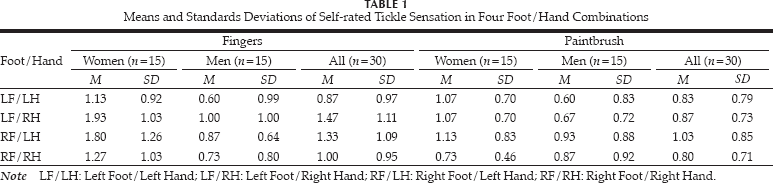
The means and standard deviations for self-rated ticklishness of each condition, by fingers or paintbrush, are displayed in Table 1. For finger stimulation, a two-way ANOVA indicated significant effects of sex (F1, 28 = 6.36, p =.02, η2 =0.19) and foot/hand combinations (F3, 84 = 5.62, p =.001, η2 =0.17). The interaction of sex × foot/hand combinations was non-significant (F3, 84 = 0.95, p =.42, η2p =.05). Pairwise comparison with a Bonferroni correction among four combinations identified significant differences between LF/RH vs RF/RH (p <. 05), between LF/RH vs LF/LH (p <.05), between RF/LH vs LF/LH (p <.05), and between RF/LH vs RF/RH (p <. 05). For paintbrush stimulation, there was a non-significant effect of sex (F1, 28 = 1.49, p =.23, η2 = 0.05) and foot/hand combinations (F3, 84 = 0.77, p =.52, η2p=0.03). The interaction of sex × 4 foot/hand combinations was also non-significant (F3, 84 = 1.29, p =.28, η2p = 0.04).
Means and Standards Deviations of Self-rated Tickle Sensation in Four Foot/Hand Combinations
Means and standard deviations of objectively evaluated ticklishness for each condition, by self-fingers or paintbrush, are shown in Table 2. Although the ICC using a two-way random effects model for all reactions of all participants was sufficiently high (ICC =.93), protocols rated by the first author were used in the following data analysis.
Means and Standards Deviations of Objectively Evaluated Ticklishness in Four Foot/Hand Combinations
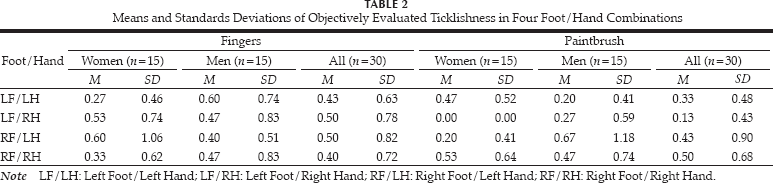
For stimulation with fingers, there was no significant effect of sex (F1, 28 = 0.10, p = 0.76, η2p = 0.003) and foot/hand combinations (F3, 84 = 0.15, p =.93, η2p= 0.005). The interaction of sex × foot/hand combinations was also non-significant (F3, 84 = 0.84, p=.48, η2p = 0.03). For paintbrush stimulation, there was no significant sex difference (F128 = 0.58, p =.45, η2 = 0.02) or difference for foot/hand combinations (F384= 2.03, p =.12, η2p = 0.07). The interaction of sex × foot/hand combinations was also non-significant (F3, 84 = 2.14, p =.10, η2p= 0.07).
Discussion
Provine's (2000) findings were supported only by self-ratings when participants tickled themselves with their fingers; i.e., participants rated contralateral stimulation as more ticklish than ipsilateral stimulation, with the most intense self-tickle occurring when the left foot was stimulated by the right hand. Provine claimed that relative to ipsilateral stimulation, the human brain is less likely to recognize contralateral stimulation as self-produced, and therefore generates a more intense feeling of ticklishness. The ability to extend one arm across the midline to reach for laterally positioned objects emerges at approximately 18 weeks, and all infants older than 20 weeks of age managed to reach for and touch single objects placed in the contralateral space (Provine & Westerman, 1979). Based on these findings, Provine (2000) insisted that even in adulthood the two sides of the brain may have harmonious but not perfectly synchronous communication. The differences from expected arrival time of afferent signals in contralateral stimulation may be associated with greater tickle sensation.
Furthermore, according to Provine (2000), using tools to tickle should increase the “otherness” and hence increase the tickle sensation. In particular, the sensation should be greater for the tool (paintbrush) than if tickling with one's own fingers. Contrary to this hypothesis, stimulation with a paintbrush did not produce ticklishness as strong when tickling was done with the fingers, either as measured by self-ratings or as measured by the videoed responses of facial expressions or bodily action. In our preliminary experiments, unlike other parts of the body (e.g., cheek, neck, or palm), the feet showed particularly strong reaction when feet were tickled by another person, rather than with a paintbrush or cotton swab. For the hypothesis of Provine (2000), it is necessary to permore detailed studies.
Sex differences were observed only in the self-rated tickle sensation stimulated by the participant's own fingers. This was the first experimental study, to our knowledge, to find evidence of sex differences in tickle responses. However, the present study did not have a male experimenter, the sexes of the experimenter and participants may have affected the results. Whether the observer is the same sex or the opposite sex of the participants could affect the embarrassment and social desirability behavior of the participants. To study the sex differences in detail, it is necessary to have more participants and both experimenters of both sexes.
Despite the limitations, the present study contributes to a better understanding of the physiological and psychological mechanism of tickling and laughter. Recently, many researchers have suspected whether schizophrenic patients with auditory hallucinations or the feeling of being controlled by an external agent, have the capacity to tickle themselves (e.g., Blakemore, et al., 2000; Provine, 2000; Pridmore, et al., 2006). Our findings can also be useful as reference data for such studies identifying markers for various disorders.