




Abstract
This study aims to evaluate hand grip strength with respect to handedness in Turkish male and female athletes. Data were collected from 268 female and 1,234 male participants. There was no significant difference between right- and left-hand grip strength only in male left-handers. Right-hand grip strength was greater than left-hand grip strength without regard to handedness in both genders, but left-handed athletes had stronger non-dominant hands.
Most daily and some sporting activities require strong concentric contractions of flexor muscles of the forearms and hands. Hence, hand grip strength is one of the stronger predictors for general body strength (Mathiowetz, Kashman, Volland, Weber, Dowe & Rogers, 1985; Bassey & Harries, 1991; Fraser, Vallow, Preston, & Cooper, 1999; Groslambert, Nachon, & Rouillon, 2002; Häger-Ross & Rösblad, 2002). These muscles are frequently used in sports including basketball, handball, baseball, judo, wrestling, tennis, and football. Hand grip strength is necessary for success in these sports, depending on the amount of hand usage as well as the athlete's hand preference.
Fewer people have a stronger left-hand preference than right-hand preference. Far more people are classified as right-handed (Bechtol, 1954; Tan, 1988). Hand grip strength is strongly associated with physical activity; e.g., heavy manual workers have greater hand grip strength than office workers (Josty, Tyler, Shewell, and Roberts, 1997; Nevill & Holder, 2000). Bechtol (1954) reported a significant difference of 10% between hand grip strength in dominant and nondominant hands.
The ratio of left-handers has been reported as higher in trained and elite athletes in different sports including rock climbing, handball, baseball, tennis, fencing, cricket, boxing, and wrestling, in contrast to the sedentary population (McLean & Ciurczak, 1982; Azemar, Ripoll, Simonet, & Stein, 1983; Bisiacchi, Ripoll, Stein, Simonet, & Azemar, 1985; Maughan, Abel, Watson, & Weir, 1986; Wood & Aggleton, 1989; Margonato, Roi, Cerizza, & Galdab, 1994; Holtzen, 2000; Grant, Hasler, Davies, Aitchison, Wilson, & Whittaker, 2001; Leyk, Gorges, Ridder, Wunderlich, Rüther, Sievert, & Essfeld, 2007; Gürsoy, 2008; Ziyagil, Gürsoy, Dane, & Yüksel, 2010). Left-handedness seems to have some advantage in sport (e.g., Loffing, Hagemann, & Strauss, 2012): almost 50% of the most successful 2003 cricket World Cup athletes were left-handed (Brooks, Bussière, Jennions, & Hunt, 2004). Left-handers might have an innate neurologic advantage compared to right handers, possibly because of superior spatio-motor skills (Annett, 1985; Geschwind & Galaburda, 1985; Dane & Erzurumluoglu, 2003).
Geschwind and Galaburda (1985) proposed that prenatal testosterone may contribute to the development of hand preference and cerebral functional asymmetry in humans. Witelson (1985) has also suggested that low prenatal testosterone levels may contribute to the development of left-handedness and reduce functional asymmetry in males.
Although the effect of handedness on hand grip strength has been examined by many researchers (Incel, Ceceli, Durukan, Erdem, & Yorgancioglu, 2002; Leyk, et al., 2007; Koley & Yadav, 2009; Koley & Singh, 2010), no study has specifically addressed the existence of a handedness-related difference in hand grip strength in a general athlete population.
Research goal.—To evaluate the effects of handedness on the hand grip strength asymmetry in male and female Turkish athletes from different sports.
Method
Participants
Participants (N = 1,502; 268 females, 1,234 males; ages 16–32 yr) engaged in 10 different sports at national level including soccer, handball, basketball, track and field, volleyball, wrestling, judo, gymnastics, and taekwondo branches participated during the entrance examination for schools of physical education and sports in 76 Turkish cities. A hand grip strength variable is used in talent identification for the entrance examination criteria for the School of Physical Education and Sports. Data on anthropometric characteristics including age, body weight, height, and body mass index (BMI) were obtained. The body height of the participants was measured using a metal scale with 0.1 cm sensitivity, and the body weight measurement was measured using a digital weight scale with 0.1 kg sensitivity. The participants' mean body height, body weight, and body mass index were 174.09cm, 65.20kg, and 21.41 kg/m2, respectively.
Measures
Handedness was determined by using the Edinburgh Handedness Scale (Oldfield, 1971).
Grip strength of right and left hands was measured by using a standard adjustable digital hand grip dynamometer (Takei Scientific Instruments Co. Ltd., Japan). The participant was standing in an erect position with shoulder adducted and neutrally rotated and elbow in full extension. The participants were asked to put maximum force on the dynamometer three times from both dominant and non-dominant hands. The mean value of the highest two trials was recorded (ICC > .93).
Analyses
All statistical analyses were performed using SPSS Version 21. Results of descriptive statistics in this study were presented as means, standard deviations, and percentages. The data were normally distributed. An independent samples t test was used to compare the hand grip strength between right- and left-handers, while a paired t test compared between right- and left-hand grip strength in each handedness group in both genders. Correlation coefficients were also calculated among handedness scores and hand grip strength. A 0.05 level of probability was used to indicate statistical significance.
Results
There were no differences between left-handers and right-handers on anthropometric characteristics in the male and female groups.
Of the participants, 6.7% were left-handed while 93.3% were right-handed. In male and female groups, 5.6% and 7.0% were left-handed and 94.4% and 93.0% were right-handed, respectively. The frequency of left-handedness was 1.4% greater in males than females. Left-handed and right-handed groups had similar physical characteristics including age, body weight, body height, and BMI (Table 1).
Comparison of Physical Characteristics Between Left- and Right-handed Males and Females

Note LH=Left Handed. RH=Right Handed. HGS=Hand Grip Strength.
The ratio of left- to right-hand grip strength was lower in females (0.93) than males (0.97). In right-hand grip strength, no significant difference was found between left- and right-handers in males and females, whereas a significant difference was observed between right- and left-handers in left-hand grip strength in males only, as shown in Table 2.
Comparison of Handedness Groups on Right-, Left-, and Mean Hand Grip Strengths, For Males and Females Separately
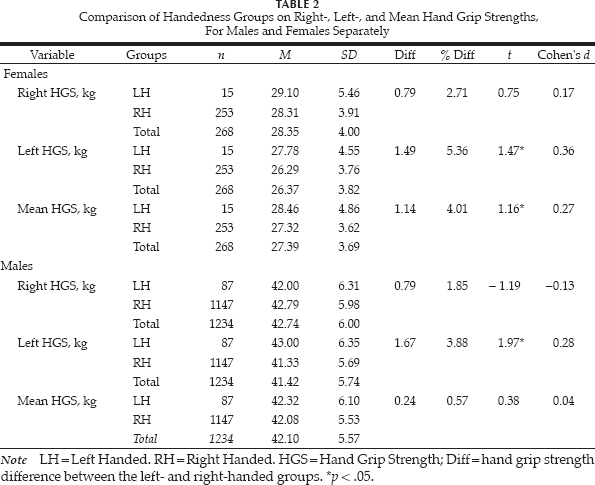
Note LH=Left Handed. RH=Right Handed. HGS=Hand Grip Strength; Diff=hand grip strength difference between the left- and right-handed groups. *p < .05.
No significant difference was observed between right- and left-hand grip strength in left-handed males, but right-handed males and females showed significant differences between right- and left-hand grip strength (Table 3). Right-hand grip strength was greater than left-hand grip strength in both males and females, and right-hand grip strength was greater than left-hand grip strength regardless of gender or handedness, as shown in Table 3.
Comparison of Right- and Left-hand Grip Strengths, For Hand Dominance and Gender Groups and Total Sample

Note LHGS = Left hand grip strength; RHGS = Right hand grip strength; Diff = hand grip strength difference between the two hands; Effect size, Cohen's d. * p < .05. ‡ p < .001.
Hand dominance was weakly correlated with right HGS (r=−.13, p<.05), left HGS (r = -.14, p<.05) strength (r = -.14, p < .05) and mean hand grip strength (r = -.14, p < .05) in males, while only left-hand grip strength was significantly (but extremely weakly) correlated with handedness (r = -.06, p<.05) in females.
Discussion
Measurement of hand grip strength is not only the most common assessment method for upper extremity muscle strength (Vespa, 1992), but also it is an important indicator of sport performance (Fry, Ciroslan, Fry, Leroux, Schilling, & Chiu, 2006). Hand grip strength is heritable, indicative of health status, overall masculinity, and reproductive fitness with a substantial genetic component (Miller & Freivalds, 1987; Häger-Ross & Rösblad, 2002; Gallup, White, & Gallup, 2007; Koley & Singh, 2010). The current study was designed to identify the effects of gender and handedness during talent scouting by the School of Physical Education and Sports. As expected, there were significant differences between males and females on mean handgrip strength, cf. Koley and Singh (2010).
In all handedness and gender groups, right-hand grip strength was greater than left-hand grip strength except in male left-handers. The findings were in line with the literature regarding right-hand grip strength and the strength difference between the two hands, but not with the results for left-hand grip strength (Incel, et al;, 2002; Ozcan, Tulum, Pinar, & Baskurt, 2004; Koley & Singh, 2010). While no significant difference was observed between left-handers and right-handers in the mean hand grip strength, the mean left-hand grip strength of left-handers was significantly higher than that of right-handers in this study. No similar difference was observed in the studies of Incel, et al. (2002) and Koley and Singh (2010), perhaps due to the characteristics of the participants; e.g., this sample comprised athletes, while participants of Incel, et al. (2002) and Koley and Singh (2010) were from a general non-athletic population. Bilateral physical activities could be factors in hand grip-strength characteristics.
In the current sample, 5.6% of females and 7.0% of males were left-handed. Ziyagil and Dane (2009) reported that frequency of left-handedness in young participants was 2.33% among 2,737 females and 3.1% among 4,385 males. Similar to previous findings, among athletes there is a higher proportion of left-handers. Here, right- and left-hand grip strengths were not significantly different for females (6.98%) or males (2.92%), so the commonly reported 10% difference in hand grip strength is not general (Bechtol, 1954; Lunde, Brewer, & Gracia, 1972; Jarit, 1991; Crosby, Wehbe, & Mawr, 1994). Other studies also have reported this difference as less than 10% (Harkonen, Piirotomaa, & Alaranta, 1993; Harth & Vetter, 1994; Jarjour, Lathrop, Meller, Roberts, Sopezak, Van Genderen, et al., 1997; Incel, et al., 2002; Bansal, 2008).
The literature is equivocal regarding whether there is a consistent difference in hand grip strength between dominant and nondominant hands. In Bechtol (1954), hand grip strength of the dominant hand was 10% greater than that of the non-dominant hand. Bansal (2008) found that hand grip strength of right-handers was 8.20% higher for the dominant hand, and in lefthanders was 3.20% higher. Petersen, Petrick, Connor, and Conklin (1989) reported a 12.7% difference in grip strengths of right-handed and a −0.08% difference in left-handed participants, concluding that the two hand grip strengths of left-handed persons should be considered equivalent. In the current study, the differences in dominant and nondominant hand grip strengths of right-handed participants were 7.10% for females and 3.26% for males, respectively; for left-handed participants these differences were 1.37% and 1.39% (Table 3). Thus, the current data show that left-handed athletes' grip strengths are equivalent between the two hands. Equivalent hand grip strengths in left-handers may be attributed to the fact that left-handed people are forced to use their nondominant hands for many daily activities (Crosby, et al. 1994). This is also true in sports, since many sports require physical, technical, and tactical executions on both right and left sides.
There was no significant difference in the mean of the right-hand grip strength between right- and left-handed females and males. Left-hand grip strength was only differentiated in left- vs. right-handed males, but that moderate difference is likely due to low prenatal testosterone levels (Table 2). In consistency with the hand grip strength symmetry of male left handers in our study, Witelson (1985) provides a possible explanation of these differences, suggesting that low prenatal testosterone levels may contribute to the development of left-handedness and reduced functional asymmetry in males.
Conclusion
Among a sample of university athletes, the frequency of left-handedness was higher than in the general population, as has been observed previously in athletes in very high competitive classes. Females had more asymmetric hand grip strengths. The similar bilateral grip strengths in left-handers may be not only due to reduced functional asymmetry from sports practice but also adaptation to a “right-handed” environment. Hand dominance was reliably correlated with hand strength, so the data provide support for hypotheses about differences in testosterone levels between left- and right-handers. Further research is required to assess whether handedness associated with hand grip strength can differentiate top level and talented athletes in various sports.