






Abstract
Prinzmetal criticized the explanation provided by Pressey's assimilation theory of Ponzo's illusion on the basis of an experiment designed to test the theory However, it is demonstrated that their test was faulty because it did not take into account the manner in which a gap between fins and shaft alters Müller-Lyer's illusion. Additional criticisms are shown to be unfounded because implications from assimilation theory were not properly derived. Tilt-constancy theory itself was shown to be inadequate because observations about Holding's illusion, Morinaga's paradox, and a modified Ponzo illusion all contradict the theory.
A common version of Ponzo's illusion (Ponzo, 1912) is illustrated in Fig. 1A. The upper horizontal line appears longer than the physically equal horizontal line beneath it.
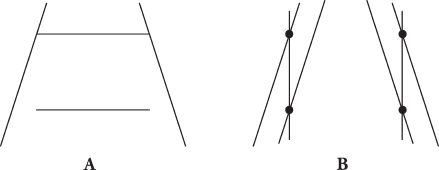
(A) A Ponzo figure in which the upper horizontal line appears longer than the horizontal line beneath it and (B) the tilt induction effect: opposing frames tilt the subjective vertical lines so that the apparent distance between the upper dots increases to yield a Ponzo illusion (adapted from Prinzmetal, Shimamura, & Mikolinski, 2001, p. 100)
In 2001, Prinzmetal, Shimamura and Mikolinski provided a new theory of Ponzo's illusion. They based their explanation on Gibson's (1937) tilt induction effect (Fig. 1B) and argued that Ponzo's illusion was not due to distortion of size—as Pressey and his colleagues proposed (e.g., Pressey & Epp, 1992)—but to changes in orientation of implicit lines. Results from an experimentum crucis that they devised were purported to support tilt-constancy theory and to contradict assimilation theory.
They also argued that the latter theory did not account for facts that had been reported by previous investigators. The present paper illustrates that their experimental results were actually inconclusive, and that their remaining arguments were either weak or misinterpreted assimilation theory.
The Crucial Experiment
The experiment that Prinzmetal, et al. (2001) designed compared the size of illusions produced by a Ponzo pattern shown in Fig. 2A and the variant shown in Fig. 2B. They wrote, “Pressey's theory predicts that the version with only Müller-Lyer-consistent line segments should have an illusion as great or greater than the standard version (which contains both consistent and inconsistent line segments). The tilt-constancy theory would make the opposite prediction…”. The latter prediction was empirically supported.

Targets employed by Prinzmetal, et al. (2001): (A) Ponzo's illusion and (B) variant of Ponzo's illusion
A striking feature in Fig. 2B is the component in the lower half of the target. It represents a configuration that elicits what has been called an “enclosure effect,” in which increasing the size of the gap between the end of a shaft and the apex of the inward-pointing fins in a Müller-Lyer target reverses the illusion from one of shrinkage to one of expansion (Yanagisawa, 1939; Fellows, 1967; Pressey & Bross, 1973; Pressey, DiLollo & Tait, 1976; Predebon, 1992). Under certain conditions, the effect is robust. Estimates of the largest extent of reversal were obtained from graphic presentations of data in prior studies (Fellows, 1967; Pressey & Bross, 1973; Pressey, DiLollo & Tait, 1976; Pressey & DiLollo, 1978; Predebon, 1992, 1994). The illusion from nine estimates ranged from about 3.5% to about 10.0% of the standard shaft. However, these data probably overestimate the size of illusion which would be obtained were a target similar to the one in the lower half of Fig. 2B used. The estimates are from displays with smaller gaps and more acute interior angles, variables that are known to enhance the reversal; however, there are two cases in which an estimate could be made from conditions that are roughly comparable. Pressey, et al. (1976) used interior angles of 90°, 120°, 150°, and 180°. The average of these four conditions at the largest gap yielded an estimated illusion of about 2.7%. In a 1992 study, Predebon used a perpendicular straight line as a fin and, at a gap comparable to the one shown in Fig. 2B, he reported a reversed illusion of about 6.0%.
Why are these data important? Because, if the lower line in Fig. 2B does expand phenomenally, the effect will reduce the measured illusion. A Ponzo illusion is defined as the difference between a phenomenally expanded upper line and the apparent size of the line beneath it. If the line beneath the upper one also expands, the measured score will decrease. Prinzmetal, et al. (2001) reported a difference of 2.7% between illusions produced by their Ponzo pattern and its variant, a difference that is somewhat smaller than the sizes of reversed Müller-Lyer illusions reported above. Therefore, it is possible that the entire difference found between Fig. 2A and 2B can be explained by existing facts and that an appeal to a tilt-component operating in a Ponzo configuration may not be necessary.
It should be noted that different patterns of Müller-Lyer reversals result from changes in length of fin, angle of fin and distance between shafts (Pressey & Bross, 1973; Pressey, DiLollo & Tait, 1976; Pressey & DiLollo, 1978) and that these patterns have been successfully simulated by the quantitative version of assimilation theory. Predebon (1992, 1994), after extensive investigations of his own, concluded that assimilation theories provide the most satisfactory explanations of reversed Müller-Lyer illusions.
Assimilation Theory Recounted
Prinzmetal, et al. (2001) list additional criticisms of assimilation theory but, because their critique reflects an acute misunderstanding of the theory, a brief description of assimilation theory is necessary.
Fig. 3A depicts a partial wedge in which a standard line is located in three different places within the wedge. A comparison line, used to measure the apparent size of the standard lines, is located beneath. The upper line (S1) forms one-half of an expansion form of a Müller-Lyer figure because the fins point outward. The lower line (S3) forms one half of a shrinkage form because the fins point inward, and the middle line (S2) forms an ambiguous Müller-Lyer pattern (Pressey, 1974a) because a shrinkage form and an expansion form are both present.

(A) A partial wedge that depicts two forms of a Müller-Lyer and a Ponzo illusion and (B) a parallel lines version of Fig. 3A
Figure 3B illustrates how the theory explains various phenomena and predicts quantitative functions. Because the standard is a horizontal line, it is assumed that the critical contextual features will be horizontal distances that are triggered by what are called “fins” in Müller-Lyer figures and “wedges” in Ponzo figures. Clearly, solid fins yield an infinite number of contextual horizontal distances but, for purposes of illustration, only a few extents are shown. Fig. 3B now becomes a complicated version of a parallel lines illusion (Jaeger & Long, 2009), but it exemplifies the basic tenet of assimilation theory, viz., “In a series of entities the extremes take on the properties of the mean.” Therefore if, for example, S1 is judged, it will take on the properties of the contextual lines (which are all longer than it is) and will appear elongated. S3 is judged in the context of shorter lines and will appear to shrink. In S2, on the other hand, contexts are both longer and shorter which means that they cancel each other out and produce no illusion. Thus, averaging alone cannot explain Ponzo's effect.
The problem is resolved by appealing to what assimilation theory deems to be an axiomatic proposition. If one looks at an object, it will probably be noticed. If one does not look at an object, it cannot be noticed. And, the probability of noticing an object will decrease as the distance between the object and where one is looking increases. It is critically important to distinguish between the idea of “looking” and the idea of “noticing.” Looking at something is a necessary condition for noticing it, but noticing something does not necessarily occur just because one looks at it. The process of looking is captured by the idea of a visual field, whereas the process of noticing is captured by the notion of an attentive field.
In a Ponzo task, the phenomenal size of S2 is measured by means of the comparison line below it. Therefore, in carrying out the task, the observer must attend to the standard and comparison lines, possibly simultaneously but most probably, by repeatedly looking at one and then the other. When the observer behaves this way, the long contextual lines are processed more heavily; the short contextual lines are farther away from where the observer is looking and are, therefore, less influential in forming the percept. The net result is that the standard line, embedded as it is within longer contextual lines, will appear elongated which is what defines a Ponzo illusion.
Additional Criticisms of Assimilation Theory
Prinzmetal, et al. (2001) advanced three more criticisms of assimilation theory. The first was that a Ponzo and a Müller-Lyer illusion cannot be due to a common factor because “The Müller-Lyer generally increases monotonically as the angle becomes more acute…, whereas the strength of the Ponzo first increases then decreases with angle (p. 107).”
According to assimilation theory, the reason that both forms of a Müller-Lyer illusion increase as angles become more acute is because each is embedded in unidirectional contexts, the shrinkage form in shorter contexts and the expansion form in longer contexts. However, in a Ponzo drawing the direction of the effect depends upon which contexts dominate, whereas the amount of illusion depends upon the magnitude of the difference between the standard and the contextual lengths within which the standard is embedded. The greater the difference (i.e., the range or spread) between the standard and contextual extents the greater is the amount of assimilation and the greater is the illusion (Pressey, 1972). In quantitative terms, the greater spread results in a greater regression to the average and, therefore, a larger illusion.
With a small apical angle, the longer contextual lengths are near the center of attention, but the spread is small and, therefore, the illusion is small. As the angle increases, the dominant longer contexts continue be near the region the observer is looking, but the spread is larger and the illusion increases. The increase continues until the lower portion of the wedge begins to fall well outside the region that is being attended. At this point, the array of contexts that are effective decreases with a concomitant decrease in assimilation. The decrease continues until the apical angle is very large, at which point the shorter contexts which fall closest to the center of attention cause a reversed Ponzo illusion. A pictorial representation of what has just been described appears in Pressey, Butchard, and Scrivner (1971), a paper cited by Prinzmetal, et al. (2001). 2
Both the inverted U-function and the reversed illusion that result from deceasing the apical angle in a Ponzo figure were replicated by Pressey (1974b) and by Pressey and Murray (1976), but an alternative explanation of these facts never has been offered either by adherents to existing theories (e.g., Gregory, 1963) or by those of more recent accounts (Prinzmetal, et al., 2001; Howe & Purves, 2005).
A second criticism Prinzmetal and his colleagues (2001) offered is that, according to Coren (1986), longer arrowheads and more acute angles are equivalent in their effect on the Müller-Lyer illusion. From the point of view of assimilation theory, this must be true. According to the theory, angles and fin lengths do not intrinsically cause illusions as they do in other theories (e.g., Gillam, 1980, Redding & Vinson, 2010). Rather, they produce contextual features that cause distortion and, if equivalent features can be produced by different methods, then those different methods will cause the same amount of distortion.
A third weakness, according to Prinzmetal, et al. (2001) is that Coren, Girgus, Erlichman and Hakstian (1976) found, in a factor analytic study, that Müller-Lyer and Ponzo figures were not classified together. But, if a Ponzo drawing contains both longer and shorter features, which cancel each other, and Müller-Lyer figures contain only unidirectional redundant features, they may not load on the same factor because, in this narrow sense, they are different illusions.
Tilt-constancy Theory Contradicted
The arguments just presented are designed to show that the empirical and theoretical criticisms provided by the authors of tilt-constancy theory were improperly construed. But their own theory contains difficulties they did not consider. Configurations with features that appear much like Gibson's inducing lines, such as Holding's and Morinaga's illusions, were not evaluated from the perspective of tilt-constancy theory.
In Holding's display (1970), shown in Fig. 4, the upper line appears displaced to the left of the line below it. The interior fins on the left of the figure are similar to the two inducing lines on the left in Fig. 1B except that they are more widely separated and rotated more severely in a clockwise direction. Therefore, according to tilt-constancy theory, the subjective vertical formed by the ends of the two shafts should rotate counterclockwise. The interior fins on the right portion of the figure simply replicate the effect with the result that the entire upper shaft should appear shifted to the left of the one below it.
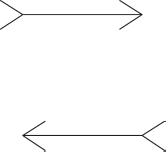
Holding's figure (1970), the upper line appears displaced to the left of the lower one
A different interpretation of Holding's illusion is provided by assimilation theory (Pressey & Smith Martin, 1990). The basic contention is that each standard shaft is embedded in contextual extents that differ in location because the fins are oriented in the same direction. The standard lines assimilate to these contextual locations and thereby cause an apparent shift toward the average. For example, if the upper part in Fig. 4 is converted to a parallel lines configuration, the contextual lines are all located to the left of the standard line and should appear to shift that line to the left. Because fins at the ends of the lower shaft point in an opposite direction, the contextual lines are positioned to the right of the standard so the lower standard line appears to shift to the right. Thus a strong illusion of lateral displacement occurs. Pressey and Smith Martin (1990) also showed that Holding's illusion responds to changes in fin angle and fin length in much the same way as a Müller-Lyer illusion does. That is, small angles and long fins each enhance the illusion.
A simple manipulation provides a powerful test between the two theories. If the interior angle between fins is enlarged, then according to tilt-constancy theory, the frame formed by the fins should strongly enhance rotation so the illusion is strong. On the other hand, according to assimilation theory, the larger angle should reduce the illusion. Since larger interior angles do reduce Holding's illusion, tilt-constancy theory is not supported.
Morinaga's illustration (Morinaga & Ikeda, 1965), shown in Fig. 5A, was called a paradox because the apices of the two expansion targets of a Müller-Lyer pattern should appear to extend outward whereas those of the single shrinkage target should appear to be closer together. But, perceptually, just the opposite happens. The apices of the shrinkage Müller-Lyer target appear to be located in positions had that target produced phenomenal expansion of an even greater magnitude than was produced by the expansion target.

(A) Morinaga's paradox and (B) induction lines in Morinaga's figure
The difficulty for tilt-constancy theory is that the inner fins of, say, the upper and the middle Müller-Lyer figures form Gibsonian induction lines as illustrated in Fig. 5B. Therefore, the subjective vertical should appear rotated counterclockwise and, if anything, displace the apparent endpoints in the opposite direction to what happens in the illusion. Once again, a prediction derived from tilt-constancy theory is not confirmed.
Assimilation theory does not consider that the two different illusions exhibited in Fig. 5A represent a paradox. Morinaga's logic tacitly assumes a copy theory of perception in which distortion of one feature must result in a distortion of all congruent features to maintain a coherent whole. Assimilation theory takes a different approach. When relative size is judged, the entire configuration falls within the attentive field but, when the endpoints only are judged, the attentive field encompasses only the fins on one side at a time (Fig. 6). Thus, one task requires judgments of size, and the other requires judgments of position or location, tasks that are different with no necessary connection between them. 3

Minimum attentive fields as defined by assimilation theory (Pressey & Pressey, 1992) for a task involving a judgment of length (large circle) as opposed to a judgment of location (small circle)
An experiment carried out some 40 years ago (Pressey, 1974c) provided a more appropriate “crucial test” between the assimilation and tilt-constancy theories of Ponzo's illusion than the study conducted by Prinzmetal, et al. (2001). Fig. 7 illustrates a Ponzo-like pattern with comparison shafts below and above the standard shaft. The dotted lines represent the rotation of a subjective vertical line induced by the slanted induction lines. The dotted lines intersect the lower shaft at two points within the shaft. Since the intersections represent the subjective endpoints of the shaft, it appears too short in relation to the standard line. The observer must enlarge the lower line if that the two are to appear equal, which is what occurs in a Ponzo test situation.

Representation of a Ponzo figure with two comparison lines
The opposite is true of the line above the standard shaft. The subjective verticals deem the upper line to be too large so it must be made shorter to appear equal. The critical prediction from tilt-constancy theory is this: the measured illusion above the standard line must be equal to the amount of illusion that is measured with the lower line. Moreover, if the measurement is made with a comparison line located directly to the right or the left of the standard line, no illusion should be recorded.
Pressey (1974) measured the illusion by the method of production at locations corresponding to shafts above, below and to the right of the standard line. The fins at the ends of the standard line of the Ponzo figure were equal to each other. Each illusion score was calculated as a deviation from a control measurement. When the measurement was taken above the standard, the Ponzo illusion was 1.8%; to the right of the standard, it was 6.1% and below the standard, it was 13.1%. Thus, none of the predictions from tilt-constancy theory was verified and, generally speaking, the data were consistent with the idea that the Ponzo illusion is reducible to a Müller-Lyer illusion.
A Question of Naming
It is possible that Prinzmetal, et al. (2001) would deny that the above study is a test of their theory because a true Ponzo illusion was not being investigated. They broached a perplexing problem that has been troublesome in research on illusions. They wrote: “… the Ponzo is normally drawn with a gap between the top line and the context lines. In this regard, it is interesting to note that the ‘Ponzo’ stimuli used by Pressey and his colleagues do not contain a gap between the context lines and the top horizontal line (e.g., Pressey, et al., 1971; Pressey & Epp, 1992). Thus, both our standard and Müller-Lyer versions are more similar to the Ponzo illusion, as it is normally depicted, than is that used by Pressey and his colleagues” (p. 107).
It seems that Prinzmetal et al., by using the word “the” Müller-Lyer and “the” Ponzo instead of the word “a”, imply that there is a prototypical pattern for each figure, the defining characteristics of which can be specified easily. Furthermore, they appear to claim that certain changes, such as apical angles, do not fundamentally alter the model and are true variables, but others, such as gaps between shaft and fin, do alter it. Thus, it would appear that, from their point of view, amputations might not be valid variables because the prototype would be violated.
Nevertheless, suppose that, in Fig. 2A, portions of the wedge between the two shafts were removed progressively until what remained were fins equal in size to the two fins above the shaft. Would this figure still be called a “Ponzo”? Finally, if the entire wedge between shafts were eliminated, would the remaining part above the shaft be an amputated Ponzo figure or an amputated shrinkage form of a Müller-Lyer figure?
What to call Fig. 8A illustrates a similar conundrum. At first blush, the figure consists of one-half of each form of a “Müller-Lyer” target, one located directly above the other. On the other hand, the two sets of fins appear to represent Gibsonian frames, which are the paradigmatic features of tilt-constancy theory, in which case it would be called a “Ponzo” figure. Or, perhaps, a scene- or picture-based theorist (see Redding & Vinson, 2010; might see Fig. 8A as a 2-D representation of a lady's torso (Fig. 8B) in the same way that Gregory (1963) has seen Müller-Lyer figures as representing corners of flat-roofed buildings.

(A) Is this an amputated Müller-Lyer or an amputated Ponzo figure? (B) Molly Lyer. The reader may obtain this image from: www.awpressey.com/uploads/1/1/5/5/11553586/molly_lyer.pdf
Conclusions
The arguments developed in this report are designed to show that the criticisms of assimilation theory enumerated by Prinzmetal, et al. (2001) are baseless. Furthermore, because assimilation theory explains both a Müller-Lyer and a Ponzo illusion by the same principles, whereas tilt-constancy theory remains silent on Müller-Lyer's illusion, by the rule of parsimony, the former is a superior theory.
Footnotes
2
A simple demonstration can help to understand the idea. Draw a large circle with a dot at the very top. Orient a pencil vertically and place the tip on the dot. Lightly secure the tip at the dot and slowly rotate the pencil upward and to the right. Observe the manner in which the arc of the circle amputates the pencil. Next, draw dots on the pencil at various locations and repeat the procedure. This time note how the dots move away from the center of the circle.
3
An anonymous reviewer stated, more definitively, “Morinaga's figure is a demonstration that judging the distance between the arrowheads and arrowfeathers is a matter of encoding and representing length that occurs independently of representing the spatial location of the constituent contours of the figure. They have merged a problem of length with a problem of spatial location and thereby committed the same mistake I think that Morinaga committed in describing his figure as a paradox.”