






Abstract
Astrology is a popular and resilient heuristic scheme for making sense of complex patterns in nature. Astrological heuristics are conveyed through communication in print and online media. Recent research found that the ecliptic longitude of sun signs predicts the frequency of celebrities-per-sign. A subsequent critique, however, attributed this large positive effect to methodological artifacts. The present study puts the alleged artifact hypotheses to an empirical test. One of the artifact hypotheses was sharply rejected, and no empirical support could be found for the second. Causal modeling indicated that although relative age in school (comparative maturity) increased the number of celebrities-per-sign, this effect on fame was largely mediated by ecliptic longitude sequence (ELS) and two other seasonal birth heuristics—wetness of sign (determined by astrological elements) and brightness of sign (determined by sign duality). Birth during depth of season, calculated from quality of sign, also increased celebrities-per-sign. The analysis found strong support for a mediation model with astrological aspects acting as personality proxies, although further research is needed to replicate these effects on celebrity.
Opinion polls indicate that 29% of Americans believe in astrology (Harris Poll, 2013). It originated as a system of beliefs about the seasons and other divinely controlled events that can be traced back to the astronomy of the ancient Egyptians (Mure, 1832) and Babylonians (Koch-Westenholz, 1995). For Bronze Age societies struggling to survive, discerning patterns of precipitation, humidity, temperature, wind, and sunshine would have been invaluable for making sense of the natural world. Babylonians thought the movement of celestial objects was an omen from divinities that would allow the prediction of terrestrial events, even if such events could not be explained (Rochberg-Halton, 1988; Rochberg, 2010). The ability to predict nature would be essential to successfully farm; cope with flooding, infestation, or disease; and wage war—pattern recognition was a matter of life and death. The Egyptians, Babylonians, Greeks, and Romans lived in northern latitudes, so the March equinox signaled the onset of spring (Mure, 1832; Sachs, 1952). The equinox in spring was of paramount importance to these civilizations because it represented the start of the Astrological New Year—a sign that they should prepare to plant their crops.
The intricate environmental patterns largely influenced by the sun and moon that ancient civilizations observed taxed their capacity for explanation. This was true even for the Hellenistic Greeks with their concern with causal agency (Rochberg-Halton, 1988). Without the systematic deduction from observable facts that science can produce, the civilizations of the Near East were left to explain what they observed in nature with heuristics. These heuristics incorporated background assumptions about supernatural forces, including the effect that the planets and distant star clusters have on earthly events. This scheme of heuristics became known as astrology. Eschewing systematic processing in favor of heuristic processing when faced with an inability to handle complex tasks has been well documented (Chaiken & Eagly, 1993).
To survive, ancient civilizations would have had to convey their seasonal heuristics from one generation to the next. They needed a popular mechanism to transmit essential information about the environment so that it would become part of collective memory. The pervasiveness of astrology across the ancient world speaks to its perceived value and ease of assimilation. Numinous archetypical imagery would have been an effective means of transmitting this information within the culture (Jung, 1960). Myths imbued the signs of the zodiac with numinosity, drawing on archetypes projected from the collective unconscious (Jung, von Franz, Joseph, Henderson, Jacobi, & Jaffe, 1964). As symbols of the myths that accompany them, signs of the zodiac can be located relative to archetypes within a collective unconscious defined by culture (Kalnova & Hamilton, 2014). Astrological predictions related to personality and occupation, when aggregated across a vast number of observations at the societal level, may yield accurate predictions because they are the equivalent of historical folk wisdom about seasonality effects (Smithers & Cooper, 1978, p. 240).
The Debate Over the Association Between Sun Sign and Celebrity
As astrology has developed over the past four millennia, it has often been the object of academic study and considered vital to governance. The attraction of a heuristic scheme that provides answers in a complex world persists for approximately one-third of the population. The tendency for so many people across cultures to check their daily horoscopes reflects a compelling motivation to rely on heuristic processing as they cope with life's daily stresses. Daily horoscopes promulgated in print and online media represent the cultural reification of astrological sun signs, implicitly making the case that the zodiac predicts personality and behavior. Hence, modern communication has allowed astrology to hold its value as a heuristic scheme for understanding the complicated universe in which we live (Truzzi, 1972).
Not long ago, a study by Adel, Hossain, and Johnson (2013) found a link between astrological sun sign and celebrity. Adel, et al. drew a sample of 300 celebrities whose fame derived from politics, science, public service, literature, the arts, or sports. The celebrities were mainly from the U.S. (M. M. Adel, personal communication, October, 2014). Information about the celebrities' birthdays was collected so that they could be categorized by sun sign. As part of the introduction to their study, Adel, et al. (2013, p. 164) provided an explanation of the physics behind the apparent movement of the sun within the celestial sphere. They illustrated how the zodiac is an invention of human perception while acknowledging the prominence of astrology within the culture. Thus, Adel, et al. were simply reporting a curious finding rather than advocating for astrology as a belief system.
The sequence of sun signs that Adel, et al. (2013) used corresponds to increases in longitude within the celestial sphere. This sequence begins on March 20 at the equinox when the amounts of daylight and night are approximately equal. 2 In the language of astrology, March 20 is the First Point of Aries. Each of the 12 signs is described by 30° of ecliptic longitude. As the first sign of the zodiac, Aries has an ecliptic longitude of 0°. As the last sign, Pisces has an ecliptic longitude value of 330°. The Adel, et al. data showed a substantial linear correlation (β = 0.59, p =.04) between this ecliptic longitude sequence (ELS) and celebrities-per-sign. Recently, Genovese (2014) offered a critique of the Adel, et al. study, arguing that their sun sign sequence effect was due to methodological artifact.
Confusion over prediction in regression.—The main point of Genovese's (2014) critique of the Adel, et al. (2013) study turns on their key phrase, “Aries was arbitrarily assigned the number ‘1’” (p. 172). This key phrase is ambiguous in that it might mean either that the sign assigned to the number “1” is arbitrary or that the value of “1” assigned to Aries is arbitrary. Adel, et al. 's next sentence disambiguated their key phrase, by stating that the regression results would not change as a consequence of this assignment process. As part of their pedagogical demonstration of bivariate regression, the authors noted that that the values they assigned to the signs in their sequence were arbitrary in that a constant could be added to each of the values of the predictor variable and the results would be the same. That is, adding a constant to the values of a predictor variable in regression will not change the slope of the line of best fit. In that strict sense, they meant that the values of the predictor variable × were arbitrary (M. M. Adel, personal communication, October, 2014). Genovese (p. 1) misunderstood this key phrase, interpreting it to mean that the sun sign assigned to the number “1” was arbitrary.
To justify his re-analysis of the Adel, et al. (2013) data, Genovese (2014, p. 1) asserted that “there is no real zero point in the zodiac.” He acknowledged the long tradition of beginning the zodiac with Aries but argued that the Adel, et al. choice was still arbitrary because it has not been the universal choice. Genovese offered a counterexample from Ancient Greece to demonstrate that Cancer (the June solstice) was once the starting point instead of Aries (the March equinox). Even if the Greeks altered the start of their zodiac to begin with Cancer for a brief period of time, this would mean that they began their zodiac with the summer solstice rather than the spring equinox. That is, for social convenience, they may have moved from one seasonal marker to the next. Like Adel, et al., virtually all of the academic research on astrology and references within Western popular culture have marked the beginning of the zodiac with the March equinox. Yet the precession of the equinoxes has caused the constellations to drift away from their original positions within the tropical zodiac, so the correlation of ELS with celebrity could be due to seasonality but not distant star clusters.
Suppose that the serendipitous Adel, et al. (2013) finding is a seasonality effect. Randomly shuffling the starting point of the zodiac in order to generate alternative sign sequences would not likely show the same sun sign effect. Genovese's (2014) analysis was designed to show that the starting point of the zodiac determines the value of the correlation between sun sign and celebrities-per-sign. He lagged the starting point of the zodiac so that all 12 possible starting points were covered. He reported that the correlations vary dramatically from large negative (r=−.45) to large positive (r =.59). This lag sequential analysis is easily replicated, and the values he reported are correct. Unfortunately, this analysis rests on a misunderstanding of Adel, et al.'s key phrase that was disambiguated by the rest of their text. His lag sequential analysis made the modest contribution of demonstrating that the sun sign effect is indeed limited to the particular sequence that begins with Aries, tied to the March equinox.
Potential debunking hypotheses.—Following his lag sequential analysis, Genovese (2014) sought to debunk the observed ELS effect with three rival hypotheses. First, he proposed that the ELS effect might be inflated by the fact that the number of celebrities for certain signs are higher because the overall number of births in the population for that sign is higher. Second, he speculated that the ELS effect is inflated because some signs are associated with more days than others; he suggests that more celebrities just happen to belong to signs with more days. That is, more celebrities should occur under some signs because more people are born under those signs. The present study tested the two simple dunking hypotheses, although both would entail only minor adjustments to the size of the observed ELS effect on celebrity. The third debunking hypothesis Genovese offers could, in principle, have explained away the ELS effect on celebrity. He points out that relative age has been shown to produce differential mental and physical abilities within educational cohorts and this might account for the observed correlation of.59 between sun sign ELS and celebrity. That is, the correlation between ELS and celebrities-per-sign could be spurious, caused by the common causal antecedent (CCA) variable relative age, as shown on the left side of Fig. 1. The product rule of causal modeling can be used to predict the degree of spuriousness between two consequent variables based on their correlation with a CCA. If Genovese is correct, then the ELS could be dismissed as tangential to the important finding that relative age enormously increases the odds that a person will become famous.
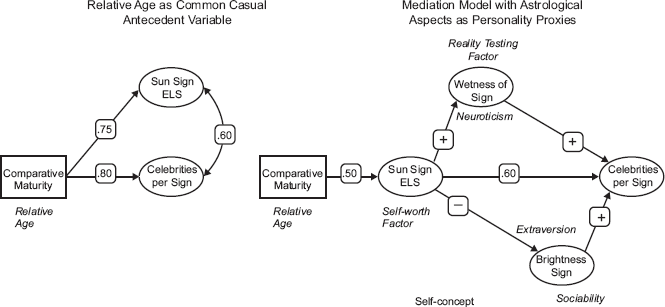
Competing models of relative age effects on celebrity
Past studies have indicated that the effect of relative age on sports, academics, and mental adjustment is pervasive but indirect rather than direct (Thompson, Barnsley, & Battle, 2004; Pierson, Addona, & Yates, 2014). Relative age effects on performance tend to be limited (Loffing, Schorer, & Cobley, 2010; Romann & Fuchslocher, 2014), becoming smaller with maturation. Enormous relative age effects are rare. Hence, a more viable model would propose that the ELS is a proxy for personality factors that mediate the effect of relative age on celebrity as shown on the right side of Fig. 1. The proposed associations among the personality variables shown in Fig. 1 are based on Belief Systems Theory (Hamilton & Veksler, 2014). Astrologers posit that sun signs indicate the center of personality, representing a person's self-concept. If the folk wisdom of astrology were to have roughly captured this self-concept factor as part of its sun sign descriptions, then this would explain the persistent popularity of sun signs over the other main astrological aspects such as moon signs and ascendant signs. The predicted correlation between relative age and celebrity in the mediated proxy model would be r =. 30. Thus, the goodness of fit of the two models shown in Fig. 1 turns on whether the size of the observed correlation between relative age and celebrities-per-sign is closer to.30 or.80.
The Effect of Relative Age on Self-worth
The later a child's birthday is from the traditional start day of kindergarten (most often September 1), the younger his age relative to the rest of his school cohort. Research using birth quartiles indicates that the effect of relative age on academic attainment is often nonlinear (Cobley, McKenna, Baker, & Wattie, 2009): comparative youth (days past the start day) within a cohort has a negative effect on apparent outcomes; comparative maturity within a cohort has a positive effect on apparent outcomes; and those toward the middle of the age range show less differential outcomes. These negative life events lead to a more depressive condition, although this effect is nonlinear (Thompson, Barnsley, & Dyck, 1999). The inverse relationship between relative age and depression might take the form of the cubic function as illustrated in Fig. 2. By contrast, the effect of life events on self-esteem is linear (Thompson, et al., 2004): more positive outcomes increase self-esteem, whereas more negative outcomes decrease self-esteem. Figure 2 illustrates the additive effect of self-esteem and depression on a person's sense of self-worth. The sum would be a depressed cubic function of comparative maturity. Note that the point at which the self-esteem and depression functions intersect is at the middle of the academic year, the midpoint of the relative age domain shown in Fig. 2. This midpoint approximates the March equinox.

The effect of relative age on ecliptic longitude as a proxy for self-worth.
Why would depression be a cubic function of relative age? Suppose that social judgment processes (Hovland, Harvey, & Sherif, 1957) occur among children evaluating their apparent outcomes in school. Mundane events could form a latitude of expected outcomes centered at the midpoint of the domain of days (which stretches from −182 to + 182). Students at the middle of the relative age distribution should show a predominance of mundane events with the modicum of success and failure events assimilated into an otherwise ordinary life. Their school experience would be typified by a preponderance of neither stress nor achievement; they should therefore emerge from childhood with a middling self-worth.
Children at the extremes of the relative age distribution would, by comparison, show contrasting effects on self-worth. The youngest children are more likely to have prevalent failure events in school because they are competing against older children. They might contrast their performance with the average performance of their cohort or with the impressive performance of the most mature students. They would tend to experience a life with greater stress and less achievement, emerging from childhood as more depressive and with lower self-worth. The oldest children are more likely to have prevalent success events in school because they are competing against younger children. They might contrast their performance with the average performance of their cohort or with the disappointing performance of the most juvenile students. They would tend to experience a life with greater achievement and less stress, emerging from childhood as less depressive and with higher self-worth.
A Mediation Model With Astrological Aspects as Personality Proxies
Moving beyond the Adel, et al. (2013) study, Genovese (2014) offered a more general critique of astrology as a belief system. He cited two studies—one testing astrological prediction and the other testing astrological theory as explanation. In general, astrology prediction studies examine astrologers' prognostications of volunteers' personality and occupational profiles. These are mainly small sample studies (see Carlson, 1985; McGrew & McFall, 1990; that employ a natal chart (horoscope)-matching task. These studies showed that the predictions of individual astrologers have very low reliability. The matching task appears questionable since participants have difficulty matching their own personality descriptions (Carlson, 1985). Even with a more valid task, random individual client differences could render the predictions of astrologers unreliable.
Astrological aspect effects at the level of individual observations should therefore be substantially attenuated due to unreliability, yielding small effect sizes. On the other hand, averaging across a large number of less reliable observations can potentially generate estimates of adequate reliability (Winer, 1971). If observations are aggregated across individuals to allow a comparison of signs on a consequent variable like obtaining celebrity, the resulting effects should be much larger. Trends from these aggregate observations can be the basis for collective folk wisdom linking seasonality to personality and behavior such as occupation. The explanatory studies of astrology correlate temperament with celestial events at time of birth. Many of these studies have focused on the Eysenck factors of extroversion, neuroticism, and psychoticism.
Sun sign as a proxy for self-worth.—If astrology is a heuristic scheme for seasonality effects, then there should be a periodicity to the ELS as well as other major astrological aspects such as duality (brightness–darkness), elements (Earth, Air, Fire, and Water), and quality of a sign (Cardinal, Fixed, and Mutable). In fact, ELS is a cubic function of relative age that resembles a sine wave. 3 Personality variables often exert linear effects on one another, so covariation among the various astrological aspects might be more parsimoniously reducible to linear effects. Suppose that ELS is a proxy for a self-worth factor consisting of the variables self-esteem and depression.
Belief Systems Theory (BST) proposes that self-esteem decreases depression, with both variables directly contributing to neuroticism. The size of the relationships among the three variables is sufficiently large that they appear to form a factor (Hamilton & Veksler, 2014). The negative effect of self-esteem on depression is on average very large (r=−.55), although the size of this negative effect varies considerably across studies (Watson, Suls, & Haig, 2002; Kling, Ryff, Love, & Essex, 2003; Hamilton & Veksler, 2014). Thus, the efficacy of self-esteem as a buffer against depression (Greenberg, Solomon, Pyszczynski, Rosenblatt, Burling, Lyon, et al., 1992) appears to vary by setting. The positive effect of depression on neuroticism is also quite large (Finch & Graziano, 2001; Kling, et al., 2003). Self-esteem also has a sizeable negative effect on neuroticism (Francis, 1997; Joshanloo & Afshari, 2011; Hebert & Weaver, 2014); the magnitude of this effect suggests that self-esteem influences neuroticism directly, not just via reduced depression. Neurotic temperament is driven by the individualistic affect system (Hamilton, Buck, Chory, Beatty, & Patrylak, 2008).
Wetness of season as a proxy for reality testing.—Citing meta-analytic evidence, Genovese (2014) noted that cold and wet season births (winter to early spring) slightly increase the odds of schizophrenia (Davies, Welham, Chant, Torrey, & McGrath, 2003). Other studies have found a small positive but homogeneous correlation between water signs and neuroticism (Mayo, White, & Eysenck, 1978; Smithers & Cooper, 1978; Veno & Pamment, 1979; Clarke, Gabriels, & Barnes, 1996). The notion of wet signs (those associated with the elements of air and water) 4 captures a portion of the overlap between the months associated with schizotypy and those associated with neuroticism. Those born under wet signs seem to have more maladaptive thoughts than those born under dry signs (Torrey, Miller, Rawlings, & Yolken, 1997). This difference could be due to meteorological variables (temperature, humidity, and daylight duration), seasonal epidemics, maternal hormones, sperm quality, and infant development (Tochigi, Okazaki, Kato, & Sasaki, 2004).
The type of maladaptive thought that is obliquely linked to wet signs is distinguished by diminished reality testing. The mediation model in Fig. 1 posits that neurotic temperament ties variables in the self-concept factor to the reality-testing factor. Neuroticism has been found to be a major precursor to psychoticism (Iwawaki, Eysenck, & Eysenck, 1977; Krabbendam, Janssen, Bak, Bijl, de Graaf, & van Os, 2002). Specifically, neuroticism shows a positive correlation with magical ideation, perceptual aberration, and fantasy—precursors to schizophrenia (Gruzeller, 1996; Ross, Lutz, & Bailey, 2002; Kerns, 2005; Cicero & Kerns, 2010; Macare, Bates, Heath, Martin, & Ettinger, 2012). In turn, schizotypy is an antecedent to negative affect such as suspiciousness (Ross, et al., 2002; Kerns, 2005; Cicero, Becker, Martin, Docherty, & Kerns, 2013). In tests of BST, neuroticism has been found to massively increase hostility (Hamilton & Mineo, 1999; Hamilton & Veksler, 2014). The unusual experiences associated with schizotypy appear to mediate the effect of neuroticism on visual artistry (Burch, Pavelis, Hemsley, & Corr, 2006; Michalica & Hunt, 2013). A fanciful mindset could facilitate a more positive attitude toward becoming famous. The hypothesized effect of wetness of sign on celebrity appears in the Fig. 1 mediation model.
Duality as a proxy for extroversion.—People born under bright signs (odd numbered) have been found to be more extroverted than those born under dark signs (even numbered). Across studies, this sign duality effect size is positive and homogeneous (Mayo, et al., 1978) Smithers & Cooper, 1978) Jackson, 1979) Veno & Pamment, 1979; Jackson & Fiebert, 1980; Saklofske, Kelly, & McKerracher, 1982) van Rooij, Brak, & Commandeur, 1988) Clarke, et al, 1996). The mediation model in Fig. 1 posits that extroverted temperament ties variables in the self-concept factor to the positive emotions of warmth, contentment, and sociability (Von Dras & Siegler, 1997) Lucas, Le, & Dyrenforth, 2008) Watson, Stasik, Ellickson-Larew, & Stanton, 2015). Extroverted temperament is driven by the cooperative affect system (Hamilton, et al., 2008). In tests of BST, indicators of self-esteem are antecedent to empathy, with empathy increasing bonding (Tafoya & Hamilton, 2010). Sociability, in turn, should facilitate fame. The hypothesized effect of brightness of sign (as a proxy for extroversion and subsequent sociability) on celebrity appears as part of the mediation model shown in Fig. 1.
BST proposes that self-esteem and neuroticism have opposing effects on bonding (sociability). Extroversion has been found to have a positive correlation with selfesteem (Kamath & Kanekar, 1993) Hebert & Weaver, 2014) and a negative correlation with depression (Finch & Graziano, 2001) Kling, et al, 2003). Neuroticism and extroversion are inversely related (Kling, et al., 2003; Jashanloo & Afshari, 2011), and within temperament negative affect tends to inhibit positive affect (Hamilton & Veksler, 2014). If neuroticism has a negative effect on extroversion, then the overall effect of the self-worth factor shown in Fig. 1 on extroversion and sociability should be negative.
Other astrological aspects.—The quality of a sign (Cardinal, Fixed, & Mutable) may also function as a proxy for personality variables—as might the ascendant sign, moon sign, or planetary position. The position of the planet Mars at time of birth has been tied to hostility (Tiggle & Fiebert, 1979) and psychoticism (Gauquelin, Gauquelin, & Eysenck, 1979) 1981). These personality differences can be tied to seasonality but not remote celestial events at birth. That is, the celestial explanations are rivaled by terrestrial third-variable explanations. Indeed, the small size of the astrological aspect effects observed at the individual level could be attributed to common causal antecedent (CCA) variables that produce a spurious correlation between astrological aspects and personality or occupation. At the aggregate level, however, the large size of the ELS effect in the Adel, et al (2013) data (r=.60) presents a problem for CCA variable accounts.
Method
The Adel, et al (2013) frequency of celebrities-per-sign data used for the present study was the same used by Genovese (2014)—the larger sample of 300 celebrities. To enable a test of the first hypothesis, days per sign was calculated across the 365 days of the year. To enable a test of the second hypothesis, two estimates of birthsper-month data were obtained. The first estimate was for U.S. births from 1995 to 2002 (James, 2005). The second estimate was for worldwide births from 1967 to 2013 (United Nations, 2014). Average births per day for each month was used to estimate births for each of the 12 signs. First, the number of celebrities-per-sign was divided by the number of U.S. births-per-sign to generate the U.S. percentage of celebrities-per-sign values. Second, the number of celebrities-per-sign was divided by the number of U.N. births per sign to generate the worldwide percentage of celebrities-per-sign values.
To enable a test of the third hypothesis, age within educational cohort was calculated for those born across the 365 days of the year. Most states (29) have a start date or cutoff point for admission to school of September 1 (plus or minus a day). The relative age in school variable takes into account the supposed disadvantage of having a birthday later than September 1, with values that range from 0 to 364. For greater precision, comparative youth was adjusted by computing the start dates for each of the 50 states plus the District of Columbia, weighted by the frequency of those various start dates across the U.S. The comparative youth variable was then inverted to determine the comparative maturity variable.
Results
In order to test the first debunking hypothesis, days-per-sign was correlated with celebrities-per-sign. The correlation was negative (r=−.25). Adding days-per-sign as a predictor along with ELS in a regression actually increased the size of the ELS effect (β = −0.74). Thus, the first debunking hypothesis was sharply rejected. To provide an initial test of the second debunking hypothesis, the percentage of celebrities-per-sign values was regressed on ELS. The effect of ELS on the U.S. percent of the celebrities-per-sign variable was larger (r =.62) than it was on raw celebrities-per-sign variable (r =.59). Similarly, the effect of ELS on the worldwide percent of celebrities-per-sign variable was larger (r =.60) than it was on raw celebrities-per-sign variable (r =.59). Thus, the second debunking hypothesis holds little promise of accounting for the observed ELS effect on celebrity.
Adjusted relative age indicated by comparative maturity increased celebrities-per-sign (r=.34, N=365, p <.001). This effect is impressive compared to other recorded relative age effects that hover around.10. The observed relative age effect was thus much closer to.30 predicted by the mediation model than to the.80 predicted by the CCA model. Thus, the data provided much strong support for the mediation model than the CCA model. When ELS and adjusted relative age were simultaneously entered as predictors of celebrities-per-sign, the relative age effect disappeared entirely (β = 0.00) and the effect of ELS remained very large (β = 0.59). Next, three proxies for personality were considered as partial mediators of the ELS effect on celebrity: duality, elements, and qualities.
Additional Astrological Sign Effects
The effect of element on celebrities-per-sign was tested with a one-way analysis of variance (ANOVA). The element effect was massive (η = 0.77). The omnibus test (F3, 361 = 174.50, p<. 001) was followed by a post hoc comparison of the means using a Scheffé contrast. The means for the four elements appear in Table 1. The post hoc tests indicated that Fire and Earth were not significantly different from one another but that both were smaller than Water and Air, and that Air was greater than Water (p <. 001). Note that air signs have twice as many months associated with schizotypy (Aquarius and Gemini) than water signs (Pisces). Within the Aristotelian lexicon of astrology, this finding means that drier elements (Fire and Earth) are less likely to be associated with fame than wetter elements (Water and Air). Astrologers do claim that those born in wintertime and particularly springtime are more evasive, unstable, and eccentric, whereas those born in drier seasons are alleged to be more realistic and direct. Thus, the wet signs could be acting as a proxy for a personality factor associated with instability and low reality testing, driven by neuroticism.
Mean differences in celebrities-per-sign by element and qualities

Next, the effect of duality (brightness–darkness) on celebrities-per-sign was examined with a t test. As predicted in Fig. 1, those with bright sign births (M = 26.33, SD = 10.56) were more likely to be celebrities than those with dark sign births (M = 23.67, SD = 6.44). This brightness effect was modest in size (t304.59 = 3.27, p <.001, η = 0.16). The variances for the two types of sign were significantly different (Levene's F = 25.45, p <.001). The standard deviations indicate that the bright signs are substantially more heterogeneous than the dark signs. If sign brightness is a proxy for extroversion or sociability, it may be that the effect of these variables on celebrity is multiplicative rather than additive.
Finally, a one-way ANOVA was used to test the effect of sign qualities on celebrities-per-sign. The qualities effect was midsized (η2 = 0.27). The omnibus test (F2, 362 = 14.08, p<.001) was followed with a post hoc comparison of the means using a Scheffé contrast. The means for the three qualities appear in Table 1. The post hoc tests indicated that the Cardinal and Mutable signs were not significantly different from one another but that both were smaller than Fixed signs. This depth of season effect suggest that those born in the midst of each of the four seasons (February, May, August, or November) are more likely to become famous. Astrologers claim that those born under Fixed quality signs are stubborn and persistent. Thus, depth of season might be a proxy for a personality factor associated with a preference for the status quo such as rigidity or even one of its consequences, aggressiveness.
Modeling Astrological Heuristics Effects
In order to test the mediation model proposed in Fig. 1, relative age, ELS, brightness of sign, wetness of sign, and depth of season were correlated along with celebrities-per-sign. The resulting correlation matrix appears in Table 2. A causal model that had excellent fit was constructed showing a root mean squared error of 0.05 (χ27, 365 = 2.50, p =.93, RMSEA=00).
Correlations Among the Six Variables in the Causal Model

Comparative maturity increased ELS (ϱ =.57), as shown in Fig. 3. This effect is consistent with a very large positive effect of relative age on self-worth. ELS increased wetness of season (ϱ =.28), with wetness increasing celebrity (ϱ =.59). Within the mediation model, this finding is consistent with self-worth influencing reality testing via neuroticism. That is, neuroticism would increase schizotypy, with schizotypy increasing celebrity. ELS decreased brightness of sign (ϱ = -.15), with brightness increasing celebrity (ϱ =.24). Within the mediation model, this finding is consistent with neuroticism, as the variable within the self-worth factor most salient to temperament, decreasing extroversion. Extroversion, in turn, would increase celebrity through sociability. ELS had a positive effect on celebrity-per-sign (ϱ =. 46) that was not mediated by the other astrological aspects. Summing across the three indirect effects shown in Fig. 3, relative age had a combined effect of.36 on celebrity. This effect was diminished by the mediating role of brightness of sign, although that diminishing effect was slight (−.04). Finally, comparative maturity directly increased depth of season (ϱ =.14), with depth of season increasing celebrity-per-sign (ϱ =.26). If depth of season were a proxy for rigidity or aggression, then this would suggest that the positive outcomes that relative age brings could generate a single-minded, dogmatic, and aggressive pursuit of fame.

Test of proposed model
Relative age advantage did have the effect on celebrities-per-sign predicted by Genovese (R =.34). However, adding the four astrological aspects to the prediction equation resulted in a large increase in variance explained (R =.87); this increase was substantial (ΔF3, 360 = 309.66, p <.001). Thus, seasonal birth heuristics fully mediated the effect of relative age advantage on celebrities-per-sign.
Discussion
The findings of the present study provide support for the hypothesis that relative age in school increases the odds that a person will become a celebrity. However, ELS, brightness of sign, wetness of sign, and depth of season were useful seasonal heuristics for predicting the likelihood that people will become celebrities based on the astrological sign of their birth. These heuristics function as mediating variables in the model depicted in Fig. 3. Preliminary analysis had indicated that there was no support for the rival hypotheses that the effect of ELS on celebrities-per-sign was due to simple artifacts like number of celebrities born under each sign or number of days-per-sign. Again, the lagged analysis of signs Genovese conducted merely established that zodiac sequences other than the ELS cannot account for celebrity. Thus, his attempts to discredit the ELS effect were not successful.
Toward a Personality-mediated Model of Relative Age Effects
The very large effect of relative age on self-worth shown in Fig. 3 is of the same magnitude as the average life event effects observed in studies of stress effects (Hamilton & Veksler, 2014). Comparative maturity would increase self-esteem and decrease depression as shown in Fig. 2. How could relative age generate such a large effect on self-concept? Higher performance on mental and physical tasks during childhood development would promote ambition. Accumulated across at least 12 years of education, this prolonged achievement could result in a sense of personal triumph. Conversely, comparative youth should lead to more negative outcomes. Lower performance on mental and physical tasks during childhood development would promote apathy. Accumulated across at least 12 years of education, this prolonged stress could result in a sense of personal trauma. BST proposes that stressors such as poor occupational, academic, or athletic performance decrease self-esteem while increasing depression and anxiety (Hamilton & Veksler, 2014). Future research should directly assess the effect of self-esteem, depression, and anxiety on people's attitude toward celebrity. Their attitude toward celebrity should exert considerable influence on the likelihood that they will become a celebrity. It is difficult to obtain self-reports of personality from famous individuals, so the celebrity-per-sign numbers provided an opportune initial test of the proposed mediation model.
BST proposes that life events influence personality and its social consequences (Hamilton & Tafoya, 2012). Seasonal events are likely to have multiple, interconnected outcomes, whether they be stressors or achievements. BST describes three types of stressors (Hamilton & Veksler, 2014;. Personal trauma can be a single devastating event with repercussions or a frequently recurring condition associated with negative outcomes. Trauma is the stressor with the most impetus, since it tends to lead to the other two forms of stress. Students who are relatively younger than the rest of their class for the duration of their time in school may feel traumatized by chronic disappointment. Need impedance is the loss of status and diminished potential for future rewards that are relevant to a person's values or ego. Personal trauma can lead to competitive failure as the person becomes incapacitated from their trauma. Social undermining consists of conflictladen messages that express negative affect and criticism (Rook, 1984; Abbey, Abramis, & Caplan, 1985). Students with the disadvantage of comparative youth are more likely to be criticized by their teachers, coaches, and peers (Pierson, et al, 2014). This triad of stress variables would provide multiple, mediating paths through which comparative youth would damage a child's self-concept.
The three types of stressors represent a hierarchy of life events—episodes of chronic arousal, experiences pertaining to the pursuit of needs, and meaningful social interactions. Thus, there should be a corresponding triad of achievements. Personal triumph is a propitious event with payoffs or a frequently recurring condition associated with positive outcomes. Triumph is the achievement with the most momentum, since it tends to lead to the other two forms of achievement. Students who are relatively older than the rest of their class for the duration of their time in school may feel exuberance from sustained accomplishment. Need attainment is the gain of status and enhanced potential for future rewards that are relevant to a person's values or ego. Personal triumph can lead to competitive success as the person gains confidence from their gratifying accomplishments. Social support consists of nurturing messages that express positive affect and encouragement (Cobb, 1976a; 1976b). Students with the advantage of comparative maturity are more likely to be praised by their teachers and their peers (Pierson, et al., 2014). This triad of achievement variables would provide multiple, mediating paths through which comparative maturity would enhance a child's self-concept.
Conclusions and Future Directions
The present study probed the intriguing finding by Adel, et al (2013) that astrological sun sign predicts celebrity. The standing of the model shown in Fig. 3 depends on whether additional celebrity data show that the same seasonal heuristics mediate the effect of comparative maturity on celebrities-per-sign. Replicating the prediction of celebrity would lend credence to the model while predicting different occupations and other behaviors from these seasonal birth heuristics would address the generality of the model. Other methods of examining the effect of season of birth heuristics on celebrity are available. Researchers might, for instance, explore variability in the various dimensions of fame among established celebrities to see if the nature of their fame is related to seasonal birth heuristics. Ultimately, researchers should be able to translate astrological aspects into specific monthly and annual patterns to better explain the link between personality and celebrity. In sum, the results of the present study provided strong empirical support for the Adel, et al. finding and qualified support for the Genovese (2014) hypothesis that relative age influences celebrity. The interlocutors in this exchange would surely agree that distant star clusters do not exert mystical effects on earthly events. Whether they agree on the mediating role of seasonal birth heuristics is harder to foresee.
The sequence reaches its midpoint on September 23 at the Southward equinox when the amounts of daylight and night are again approximately equal. In astrological terms, September 23 is the First Point of Libra.
Depth of season, wetness of sign, and brightness of sign are all cosine functions of ELS although each has a distinctive period, amplitude, and phase shift.
Connecting signs to personality temperaments can be traced back to the Arabicera astrologer Abu Masher (Greenbaum, 2005). The astrological concept of a “wet” sign is based on combining Aristotelian elements. Early Greek writing on astrology (Manilius, 10 A.D./1977, 1997) describes wet signs as those produced by joining water with air. Astrologers subsequently described people born under water signs as emotional, imaginative, and creative. If this characterization is correct, then water signs should be associated with artistic celebrity. Conversely, astrologers described people born under air signs as intellectual, curious, and analytic. If this characterization is correct, then air signs should be associated with practical celebrity.