






Abstract
This paper is a description of the current situation of Vocational Education in Brazil, to indicate directions and perspectives for teaching practice and research, under the Federal Network of Vocational, Scientific and Technological Education of Brazil. Issues discussed include the history of university education in Brazil, how students are selected for university training, the role of government regulation in encouraging university education, and problems with the educational system. Of special interest are programs related to international cooperation such as the Thousand Women Program and Science Without Borders.
In the last decade, Brazil has experienced a wave of growth in social services, economics, and infrastructure. One of the fastest growing fields, yet often unknown outside of Brazil, is in the area of education. National programs such as Science Without Borders (SWB) have facilitated collaborations between Brazilian universities and those in the United States, Europe, Africa, and Asia.
The purpose of this article is to acquaint the reader with the history of the Brazilian educational system, especially as it relates to the Federal Institutes and vocational training. We hope that such knowledge will facilitate meaningful exchanges between Brazilian universities and those outside of Brazil. It has been our experience that efforts at collaboration can be facilitated if our foreign partners know more about our educational system and its history. For example, as a necessary first step in seeking collaborations in psychology, studies were designed that revealed Brazilian students differed greatly in their beliefs about psychology as a science. Those in the northeast of Brazil generally did not consider psychology as a science, while students in the south of Brazil did consider it a science. This difference between the two regions of Brazil is linked with the ability of students to do research; the more research a student does, the greater the belief that psychology is a science (Bartoszeck, Abramson, & Place, 2005; Morales, Abramson, Nain, Junior, & Bartoszeck, 2005). Foreign professors trying to improve psychology training in Brazil have been hampered by a lack of understanding of the educational system (Abramson & Bartoszeck, 2006).
This article seeks to provide foreign professors some context of our educational system by providing in English material that is currently only available in Portuguese and difficult to locate. We believe that such a context will allow foreign professors and students to better interact with Brazilian colleagues in such areas as writing cooperative proposals, e.g., to the National Science Foundation (Page, Abramson, & Jacobs-Lawson, 2004). We provide the reader with an informative picture of the current situation of Vocational Education in Brazil, indicating directions and perspectives for teaching and investigative activities within the Federal Network of Vocational, Scientific and Technological Education of Brazil – VSTE Federal Network. This paper is divided into four sections. The first is a brief historical overview of Brazilian vocational education. This is necessary because the Brazilian university system has an important vocational component, unlike many American and European universities. Moreover, vocational training is one area where Brazilian and non-Brazilian universities can develop new training programs. Second, we discuss the new legal system recently put in place to monitor and evaluate our educational system. Next, we provide an analysis of the Brazilian educational system. We close with a discussion of the future of our educational system.
History of Vocational Education in Brazil
Vocational Education in Brazil is marked by several relevant themes. The main themes are presented below. The material in this section is based upon a Portuguese language document entitled “Vocational Education History in Brazil” published by the Ministry of Education of Brazil and available on the website http://portal.mec.gov.br/Setec/files/centennial/historico_educacao_profissional.pdf.
Schools of Apprentices Craftsmen
Historically, the first systematic initiatives of vocational education in Brazil occurred in the late 17th century, with the advent of the Gold Cycle in the State of Minas Gerais, and with the creation of learning centers devoted to crafts attached to the arsenals of the Brazilian navy. In the early 18th century, with the arrival of the Portuguese Royal Family in Brazil, the College of Factories was created by King Joäo VI. Historical records indicate that the training of workers in Brazil began at the time of Portuguese colonization. In 1800, with the aim of supporting the less privileged sections of Brazilian society, the apprentice model was used to train children and young people in such areas as typography, binding, tailoring, carpentry, and shoemaking. In the early twentieth century, Mr. Nilo Peçanha, President of the State of Rio de Janeiro, formally established technical education in Brazil on September 11, 1906 by means of Decree No. 787. This decree created four vocational schools: Campos, Petrópolis, Niterói, and Paraíba do Sul. The first three schools were established to teach crafts and the last to teach agriculture.
The year 1906 also marked the consolidation of industrial-technical education in Brazil in at least three ways: (1) the proposed “Congress of Instruction.” This presented to Congress a project to promote practical training in industry, agriculture, and commerce. The project was to be maintained with the joint support of the Federal Government and the States. (2) The Finance Committee of the Federal Government increased the budget allocation for States to establish technical and vocational schools. (3) Brazilian President Afonso Pena claimed that the “creation and multiplication of technical and vocational education institutes can also contribute much to the progress of industries, providing them with teachers and educated and skilled workers” (inaugural speech of November 15, 1906).
From 1909 onward, under the jurisdiction of the Ministry of Agricultural Affairs, Industry and Trade, 19 Schools of Apprentice Craftsmen were created. These schools were designed to provide free vocational education (Decree No. 7566 of September 23, 1909 – Brazil, 1909). In 1927, Congress enacted the Fidélis Reis Project which provided the mandatory offering of vocational education in Brazil. With the creation of the Ministry of Education and Public Health in 1930, the Province of Professional Technical Education was structured to supervise the various Schools of Apprentices Craftsmen, which were attached to the Ministry of Agriculture. It was a period of great expansion of industrial training, driven by a policy of creating new industrial schools and introduction of new specializations in existing schools.
The Brazilian Constitution of 1937 (Brazil, 1937a) was the first to deal specifically with technical, vocational, and industrial education, establishing in Article 129:
The pre-vocational and vocational education for the lower classes is, in education, the first duty of the state. It must comply with that duty, founding vocational education institutes and subsidizing the initiative of states, municipalities and individuals or private and professional associations. It is the duty of industries and economic unions to create within the sphere of their specialty schools for the children of their workers or their associates. The law shall regulate the fulfillment of this duty and powers that will fit to the State on these schools, as well as aid, facilities and subsidies for them to be granted by the government.
The Schools of Apprentices Craftsmen were then transformed into high schools through Law 378, signed on January 13, 1937 (Brazil, 1937b). In 1941, a set of laws called the “Reforma Capanema” remodeled the entire education system in Brazil. Its main points were: (1) vocational education was associated with high school education; (2) entrance examinations were required for admission to the industrial schools; (3) courses were divided into two levels: basic industrial courses, and additional course work with either a three-year or one-year supervised internship in industry.
On February 25, 1942, Law-Decree No. 4127 (Brazil, 1942) permitted the Schools of Apprentices and Craftsmen (Industrial and Technical Schools), to serve as a gateway into colleges and universities. Students now trained in technical courses were allowed to receive higher education. This decree had the immediate effect of incorporating vocational training into colleges and universities as part of an overall government strategy of education.
Federal Technical and Agro Technical Schools
The government of Juscelino Kubitschek, (1956–1961) brought important changes to the country. In this period, auto manufacturing was the great icon of national industry. The Target Plan of the Government whose slogan was “50 years in 5” predicted massive investments in infrastructure (73% of total investments were for the production of energy and transportation). The education sector was allocated 3.4% of the total national investment, in order to train professionals to support the country's development goals. In 1959, an important step was taken towards didactic autonomy and management of technical education. The local industrial and technical schools were taken over by the federal government and became known as Federal Technical Schools. The training of technicians was considered by the government as a necessary step in the acceleration of the industrialization process.
The increase in enrollment in technical education, the emergence of new courses, and the increase in the number of Federal Technical Schools was stimulated by the passage of the “Law of Guidelines and Bases of Brazilian Education – LDB,” No. 5692, August 11, 1971 (Brazil, 1971), which made compulsory the offering of technical courses as part of the high school curriculum.
Federal Centers of Technological Education
The creation of university centers in technical education began in 1978, with Law No. 6545 (Brazil, 1978). The three Federal Technical Schools (located in the states of Paraná, Minas Gerais, and Rio de Janeiro) were transformed into Federal Centers of Technological Education – CEFETs. Figure 1 provides a map of where these Centers were located in Brazil. These centers focused on the training of engineers and technicians. The National System of Technological Education was established in 1994, with Law No. 8948 (Brazil, 1994). From this legal framework, some Federal Technical and Agro Technical Schools were transformed into CEFETs by specific decree for each institution and, according to criteria established by the Ministry of Education, were given autonomy to offer new undergraduate courses.

Locations of the “Centros Federais de Educação Tecnológica” (CEFET, Federal Centers of Technological Education), created from Technical Schools in Brazil in 2009. Source: http://redefederal.mec.gov.br.
The Law of Guidelines and Bases of Brazilian Education was enacted on November 20, 1996 (Law 9394), with a chapter on Professional Education (Brazil, 1996). Law 9394/96 also defined the professional certification system that allowed the recognition of skills acquired by people outside the school system. In 1997, it created the Professional Education Expansion Program - PROEP, with Decree 2208/1997, which regulates vocational education in the country, making vocational and technical education independent of high school. In this sense, the technical courses could now be offered concurrently or sequentially in high school.
For many, this separation meant a step back in vocational education, since the integration of high school and technical education activities provided a comprehensive education from the point of view of the development of skills and competencies while at the same time providing the student with basic science training in high school. In this context, the process of transformation of Technical and Agro Technical Schools in CE-FETs started in 1978 was resumed.
In 2004, technical education was again changed, permitting integration of technical education and high school (Decree 5154/2004). Faced with the pressure of establishing benchmarks for the performance of the Federal Centers of Technological Education, Decree No. 5224 was signed, providing for evaluations of teaching and practice, applied research, and the integration of educational activities with society's expectations. In 2005, with the publication of Law 11,195, the first phase of the expansion plan of the Federal Technological Education Network began with the construction of 64 new technical units. Also, in 2005 there was the transformation of CEFET - Paraná into the Federal Technological University of Paraná, the first university specializing in technological education in Brazil.
The Advent of the Federal Institutes of Education, Science and Technology
In 2007, several technical schools were already seeking the status of CEFETs or Technological Universities. Faced with heterogeneity of the Federal Network, which made it difficult to effectively manage vocational education in Brazil, a new structure was proposed. This new structure led to the creation of Federal Institutes that would integrate vocational education into university level training. Thus, given the desire of various educational units to be transformed into CEFET institutions, a Public Call MEC/SETEC No. 2/2007 (Brazil, 2007) was launched to receive proposals. These proposals led to the creation of the Federal Education, Science and Technology institutes known as IFET initially, and subsequently shortened to IF (Federal Institutes). The Public Call No. 2/2007 originally forecast a maximum of 37 Federal Institutes in Brazil. After adjustments to the proposed names and the inclusion of another federal institute for the State of Minas Gerais (the Federal Institute of South of Minas Gerais, due to its regional peculiarities), made public by Ordinance No. 116 of March 31, 2008 (Brazil, 2008a), Law No. 11,892 was published on December 29, 2008, creating the Federal Institutes of Education, Science and Technology (IF) (Brazil, 2008b).
The 38 IFs, with at least one located in each Brazilian State, are characterized as institutions of higher education that offer basic and professional courses in vocational and professional training. Unlike many institutions of higher education in the United States and Europe, IFs build campuses where the students are (rather than a central main campus), often with limited or no dormitory space. With the creation of IFs, the Federal Network of Vocational, Scientific and Technological Education takes on a new social role that henceforth makes it truly a vector of the “education for coexistence,” precept that guides inclusive education and subsidizes the didactic and pedagogical procedure that meets this target audience (MEC, 2010a).
In short, the purposes of IFs comprise: (1) offering vocational and technological education with an emphasis on socioeconomic development at local, regional and national levels; (2) developing vocational and technological education as solutions to meet social demands according to regional peculiarities; (3) forming themselves into centers of excellence in science education in general and applied sciences, in particular, while encouraging the development of critical thinking and empirical research; (4) qualifying as reference centers to support science education in public schools and to provide training for public school teachers; (5) developing outreach programs and promoting science and technology; (6) conducting and encouraging applied research, cultural production, entrepreneurship, cooperatives, and scientific and technological development; and (7) promoting the production, development, and the transfer of social technologies, notably those aimed at preserving the environment (Brazil, 2008a).
Brazilian Higher Education
The Brazilian Federal Constitution of 1988 (Article 5) provides that education—a right of all and duty of the State and the family—will be promoted and encouraged, with the cooperation of society, seeking the full development of the people, their preparation for the exercise of citizenship, and their qualification for work. Article 206, items I to VII of the Carta Magna determines that the university will be based on the principles of equal conditions for access and permanence in school, with coexisting public and private institutions, ensuring the gratuity and democratic management of public education. Importantly, Article 211, §1–4 of the Constitution states that education systems in Brazil are organized in collaboration between the Union, the States, and the Federal District.
Andrade (2012) has documented the changes in the Brazilian educational system since the 1990s. These changes include universal primary education, the growth of high schools and universities, and an increase in enrollment, which has almost tripled. However, as she mentioned, the strong growth in higher education still reaches only about 19% of those aged 18–24 yr. 2 , according to the National Household Sample Survey of the Brazilian Institute of Geography and Statistics and I NEP (2013). Comparing the Brazilian situation with that of other developed countries, access to higher education in 1997 had already reached 45% of young people 18–21 yr. in the United States and 69% in South Korea. 3
Entering Brazilian Universities
For those interested in studying in Brazilian institutions of higher education, there are several ways to enroll. Taking a test known as the Vestibular is the most traditional way and tests knowledge in courses taken in high school. The Vestibular is similar to the SAT or ACT test. A competing test to the Vestibular is the High School National Examination (ENEM). This test also covers material from high school and contains both objective questions and an essay. This test has become popular in recent years. The Serial Evaluation is another form of test. In this case, the student is tested after each year in high school. Some colleges and universities also include as part of the selection process interviews, the level of education, courses, transcripts, or experience and professional performance.
SiSU, ENEM, and Vestibular
The Unified Selection System (SiSU), created and managed by the Ministry of Education since 2010, is a selective process for entry of new students in public institutions of higher education. The SiSU uses the High School National Examination as selection criteria. Thus, colleges and universities can administer the unified test and then, based on the scores, give candidates a choice of where to study. Because of this tool, students can compete for seats in SiSU member institutions; unlike the older Vestibular, the student first takes the test and then chooses where to attend.
The ENEM (High School National Examination) emerged in 1998 to measure the performance of high school students. In 2009, the test was modified to have 180 questions and a writing component presented over two consecutive days. The ENEM is also used in the first stage of the traditional college entrance examination (as part of the final grade) and to select candidates if the educational institution has vacancies remaining after its selection process. In turn, the traditional Vestibular takes into account the candidate's classification after the test and is specific to each educational institution. The Vestibular varies between institutions. In some cases, a candidate can be tested for up to four days. Among the tests, the candidate must show evidence of writing ability. The higher the score on these standardized tests, the greater the probability of being selected to a particular university or educational institution.
In addition, there are some special arrangements for access to higher education, provided by law. Under special circumstances, such as military and civil service, students can transfer to other institutions (defined by Law No. 9536 of 11/12/97 regulating part 49 of Law No. 9394/96, by Ministerial Decree No. 975/92 and Resolution No. 12/94 of the Federal Council of Education). The ability of students to transfer is independent of any existing university vacancy and can occur at any time during their university studies. Another special arrangement is through the Graduate Student Agreement Program (PEC-G), which is a priority cooperation activity with developing countries in the form of human resources.
The PEC-G program is a form of access to higher education that enables citizens of countries with which Brazil maintains educational or cultural agreements to pursue university studies in Brazil. The PEC-G is administered in partnership between member universities, the Ministry of Foreign Affairs (through the Educational Cooperation Division of the Department of Scientific and Technical Cooperation), and the Ministry of Education (MEC) through its Division of International Affairs of Higher Education. There are also provisions made for special access (known as the “student courtesy mode”) for foreign students who are international civil servants, their dependents, or diplomatic or consular officials (Decree 89,785 of 06/06/84 and Ordinance 121 of 02/10/84).
Levels and Modalities of Higher Education
Higher education in Brazil is offered by universities, colleges, technology education centers, and institutes. Students can choose from three types of degrees: bachelor, professors training (licenciatura), and technological training. Graduate courses are divided into lato sensu courses (specializations and MBAs) and stricto sensu courses (masters and doctorates). Figure 2 provides an outline of the system.

Structure of the Brazilian Educational System. Adapted from OEI (2002) and UNESCO (2010).
Evaluation of Higher Education in Brazil
In order to increase the quality of Brazilian educational institutions, the government deploys the Higher Education Evaluation National System (SINAES). It is important to note that this evaluation process is the result of constant reforms in education occurring worldwide and is intended to meet the new requirements of a capitalist system. SINAES was begun by the former government of President Fernando Henrique Cardoso, under the guidance of Normative Acts isolates that were promulgated between 1995 and 2001. 4 The evaluation system attempts to ensure educational quality by regulatory control and properly distributed public resources (SINAES, 2004).
National Catalogue of Higher Technology Courses
Because of the expansion of technological courses (CST), Brazil had a very large number of different names for technological degrees. The large number of courses made it particularly difficult to evaluate quality across educational institutions in Brazil. Another point that hindered the regulation of technological courses was the multiplicity of concentrations within the same subject area (e.g., Agriculture or Industry).
The Ministry of Education of Brazil (MEC) took the initiative to address this problem by conducting targeted meetings of working groups. As a result MEC produced an important document to regulate technological courses. Pursuant to Decree No. 5773/2006, MEC introduced the National Catalogue of Higher Technology Courses (MEC, 2010b). This is a guide made available to students, educators, institutions, employers, and the general public. The National Catalogue of CST organizes and directs the provision of technological undergraduate courses, respecting the National Curriculum Guidelines for Vocational and Technological Training to take into account the importance of production and respecting the environment.
The final document of the National Catalogue of CST (MEC, 2010b) states, in its introduction, that the initiative represents a gain for students, parents, teachers, educational institutions, business enterprises, and society for having at its disposal an instrument that presents a common framework for technological courses. It brings together essential information needed to evaluate an undergraduate's professional technology profile. The CST also provides important information for vocational decisions, curriculum matrices, and training strategies, and promotes the exercise of citizenship in monitoring the quality of the courses. The catalog lists names, minimum hours, and recommended technological infrastructure of 112 courses organized in 13 technological areas, namely: Environment and Health; School Support; Control and Industrial Processes; Business and Management; Hospitality and Leisure; Information and Communication; Infrastructure; Military; Food Production; Cultural Design and Production; Industrial Production; Natural Resources; and Security.
Currently, Science and Technology policies in Brazil are being developed to promote the so called popularization of science. 5 Issues such as the environment and sustainability are taking center stage in Brazil. The Brazilian educational infrastructure has made it possible for greater dissemination of scientific results, and has facilitated the flow of information between universities, research centers, and society. On the other hand, the “science of results” has limited the development of a standard for scientific research in Brazil (Newsletter of the Brazilian Society of Soil Science, 38, 3, Set-Dec 2013).
The first initiatives to offer graduate courses (Master's and Ph.D.) in federal institutions of technical education are little more than 10 years old and only with the advent of the Federal Institutes did it become possible to strengthen institutional research and seek approval for new graduate programs. It is expected that with the increase of scientific and technological research coupled with the efforts of internationalization by the Federal Institutes, research in Brazil can be strengthened. We expect that in the coming decades it will be possible to increase the number of Masters and Doctoral courses in the Federal Institutes.
Challenges for Brazilian Education
Before we report some data related to higher education in Brazil, it is prudent to clarify some data from the Brazilian educational reality in broader context. The IBGE (2010) pointed out that Brazil with a population of 190,755,799 inhabitants has 45,364,276 people of school age. At the same time the country had a Gross Domestic Product (GDP) of $3.6 trillion (expressed in U.S. dollars), representing an average yearly income of R$ 668.00 ($256.92). In addition, the IBGE report indicated a 1.9% illiteracy rate in students between the ages of 10 and 14 and an 8.6% rate of illiteracy for those above 15 yr of age. These data show how far Brazil must go to ensure quality education. In addition to the low average yearly income and literacy issues, other data indicate that despite government initiatives the training of many teachers remains poor (Table 1).
Profile of Teachers in the Brazilian Educational System With Undergraduate Degrees in 2010 [Perfil Docente – Docentes no sistema educacional brasileiro com escolaridade superior em 2010]. Adapted from INEP/DTDIE (2010)

Numbers of Undergraduate Students in Brazil
The Census of Higher Education, published by the National Institute of Educational Studies and Research Anísio Teixeira (INEP, 2013) indicates a total of 7,526,681 students enrolled in vocational, undergraduate, and graduate courses. The document highlights the trend of increasing enrollment rates in Brazilian institutes of higher education from 2003 to 2012: the percentage of people attending higher education increased from 16.6% to 28.70%. In 2012, 15.1% of university students were considered to be in the standard age range for undergraduate students. Despite the offering of several free undergraduate courses by federal institutions of education, the demand for higher education is such that Brazil is experiencing an increase in the number of private universities. Private institutions account for 74% of total enrollment. The census also indicates that the Bachelor's degrees predominate in Brazilian higher education with 67.5% of enrollments, followed by teacher training courses (undergraduate), with about 18.9%, and technological courses, with 13.7% enrollment (data 2012). Because of the ease generally required for management and business degrees as opposed to those associated with natural science degrees, private schools hold 85.6% of the technological enrollments. In 2013, the three largest courses in Brazil were, in decreasing order of enrollment: Education, Business, and Law (for female students) and Law, Business, and Civil Engineering (for male students).
Federal Network of Vocational, Scientific, and Technological Education Expansion
The Vocational, Scientific and Technological Education (VSTE) Federal Network is experiencing the largest expansion in its history. The Ministry of Education (MEC) indicates that, from 1909 to 2002, 140 technical schools were built. In addition, MEC plans on expanding the Federal Vocational Education Network. In some cases, expansion of vocational training will be accomplished by federalizing technological institutes. MEC has invested more than US $1.1 billion in the expansion of education. Currently, there are more than 400,000 teaching jobs across Brazil (Figs. 3 and 4), with 208 new schools built in the period from 2011 to 2014, totaling 562 fully operational schools that will generate space for 600,000 students (http://redefederal.mec.gov.br/expansao-da-rede-federal).
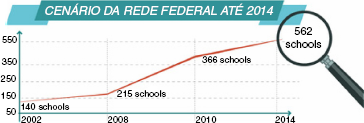
Numbers of units of the Federal Network of Vocational, Scientific and Technological Education from 2002–2010 (Scenario of the Federal Network up to 2014). Source: http://redefederal.mec.gov.br/expansao-da-rede-federal

Vocational, Scientific and Technological Education Federal Network map in 2010. Source: http://redefederal.mec.gov.br/expansao-da-rede-federal
The Internationalization of Federal Institutes
Higher Education Institutions (IES) in Brazil recognize the need to internationalize education to prepare students for a globalized world. The internationalization of higher education in Brazil has advanced in recent years and is directly related to market globalization. IES have created practices, policies, strategies, and actions aimed at introducing the international dimension to their activities in the framework of cultural relations, training/education, research, innovation, and extension.
Currently internationalization is a very important dimension in the list of institutional strategies of the best universities in the world. Many universities designate an “office of international affairs” to facilitate internationalization. In general, Brazilian universities are only recently seeking international opportunities in research and teaching and there is much work to be done.
A milestone in the internationalization of Brazilian universities was the creation in 1988 of the Brazilian Association of International Education (FAUBAI). However, the Federal Institutes did not have an association of their own or a forum to discuss internationalization. Therefore many IF faculty participated in FAUBAI meetings. However, because Federal Institutes generally have a different mission than other Brazilian universities, the VSTE Federal Network decided they needed to create a separate forum for Federal Institutes to discuss internationalization.
One of the milestones in international actions taken by the VSTE Federal Network was the creation of the Thousand Women Program. 6 The program was started in 2007 as a pilot project and formally transformed into a program in 2011. The Thousand Women Program was implemented in collaboration with Institutes and Colleges represented by the Association of Canadian Community Colleges (ACCC) and the Brazilian Federal Institutes, represented by the secretary of Vocational and Technological Education of the Ministry of Education (MEC, 2008). The Thousand Women Program has as its goals the eradication of extreme poverty and hunger, promotion of gender equality, empowerment of women, and ensuring environmental sustainability. To promote vocational and technological training, about one thousand disadvantaged women in the northeast and north of Brazil received access to vocational education. As a result of this program, the educational level in these women rose and some of the economic needs of each community and region were met. In 2009 the project was expanded to other regions of the country, enabling the social inclusion of women through the provision of vocational training to help their communities and enter the labor market. When the project was completed, the results were such that it became public policy and is now a government program.
However, it was only in 2009 that representatives of the Federal Institutes met to discuss and debate the internationalization of the VSTE Federal Network. As a result of these discussions, in 2010 the International Forum of the institutions of the VSTE Federal Network International Affairs (FORINTER) was created. The FORINTER promotes debate on the internationalization process, in addition to creating strategies to enable internationalization (http://forinter.conif.org.br/pt/forinter.html). From the creation of the FORINTER, the Federal Institutes began to designate a person to coordinate the section of international affairs at the institution. However, few institutions had an office with staff and financial resources to do this properly. It was in this context that the Science Without Borders program (SWB) was created in 2011.
The Science Without Borders Program and Advances in Internationalization
When the SWB program was established in July 26, 2011, many institutions had to adapt to a new context. The VSTE Federal Network created a sector within the Federal Institute system responsible for the care of international affairs. The current trend is to have an International Relations Office to coordinate international outreach efforts across the various campuses of a given Federal Institute. With the creation of the SWB program, the FORINTER became the official government organ of the International Relations of the National Council of the Institutions of VEST Federal Network (CONIF).
One of the impasses to sending Brazilian students abroad is the issue of appropriate language proficiency in the host country. Brazilian students must pass proficiency tests in the language required by the host university. However, many students cannot achieve the minimum required; for these students, the program provides a grant of up to 6 mo to study the destination country's language prior to the academic year. This federal program has been in effect for 3 yr and has a budget of more than US $3 billion dollars. Science Without Boarders has provided an opportunity for thousands of students to increase their academic skills. The program is open to students in the natural sciences and technical fields at the undergraduate and graduate levels. Post-doctoral students and those seeking a “sandwich” year are also eligible.
Currently there is a greater demand on the part of Brazilian students to learn a foreign language. The Federal Government has sought to create free online language courses for the Science Without Boarders program. With regard to classroom courses, the government has created conditions for universities to provide foreign language writing courses and language centers to prepare students for the program. Many Federal Institutes are trying to create traditional classroom based language centers to prepare students to participate in international exchanges.
Another initiative of the VSTE Federal Network is the creation of programs to teach foreigners working in Brazil Portuguese. This initiative belongs to the CONIF (Conselho Nacional das Instituições da Rede Federal de Educação Profissional, Científica e Tecnológica – National Council of Institutions of Technological, Scientific and Vocational Education) and the SETEC (Secretaria de Educação Profissional e Tecnológica do Ministério da Educação – Vocational and Technological Education Secretary of Education Ministry) and developed by IFSul, IFCE, and IFRN. This program is a first for the VSTE Network.
The Science Without Boarders Program has agreements and partnerships with various educational and research institutions from different regions of the world. Currently, the countries include: Australia, Austria, Belgium, Canada, China, the Czech Republic, Denmark, Finland, France, Holland, Hungary, India, Ireland, Israel, Japan, Norway, New Zealand, Poland, Portugal, Russia, Singapore, South Korea, Spain, Switzerland, the United Kingdom, the United States, and Ukraine. The main destination countries for SWB Fellows are the United States (22.2%), Portugal (13.0%), France (11.9%), Spain (10.9%), Canada (9.5%), the United Kingdom (8.6%), Germany (7.7%), and Australia (3.9%). The program is very popular in Brazil. For example, the home institution of the Brazilian authors of this paper (The Federal Institute of Education, Science and Technology of Paraíba [IFPB]) has signed 22 agreements with foreign institutes of higher education as of 2014. These agreements had already led to 101 students studying in foreign universities. Before the SWB program, the IFPB had approximately 10 students who participated in exchange programs primarily through the Fulbright program. As a result of the SWB program, the Federal Institutes have greatly increased the number of institutional agreements.
Perspectives to Higher Education in Brazil
Recent debates about higher education in Brazil have focused on two central questions: What is the meaning of a university and what is the social relevance of the university to the challenges facing Brazilian society in the early twenty-first century? According to Speller, Robl, and Meneghel (2012), recent events such as the National Forum on Higher Education (FNES), the National Conference on Education (CONAE, 2010), and the workshop Challenges and Prospects of the Brazilian Higher Education the Next Decade, promoted by the Board of Higher Education of the National Education Council (CES/CNE) in December 2010, brought together experts who have dedicated themselves to addressing these issues. These events have led to reflections on the main demands and challenges of higher education policy for the next decade, especially in light of the development of a new National Education Plan, the PNE 2011-2020 (MEC, 2011).
The most recent Higher Education Analysis of Indicators in Brazil, which is based on data from the last decade, as well as preparatory documents of the PNE 2011-2020, illustrates the complexity and challenges faced by universities and institutes in Brazil. Among the main challenges are: (1) democratization of student access to higher education; (2) encouraging student success; (3) expansion of universities and institutes; (4) reducing regional inequalities; (5) increasing the quality of training and coursework; (6) social inclusion; (7) professional qualification of teachers; (8) financing university education; (9) social relevance of programs; and (10) encouragement of scientific and technological research. The PNE 2011–2020 attempts to address at least some of these challenges. For example, it identifies a need for increased enrollment of adults aged 18 to 24 yr., to ensure a supply of students for the university system. There is also a movement to improve the quality of instruction by expanding the role of teachers and doctors in universities.
Training Professors and International Cooperation Actions: An Example From the Federal Institute of Paraiba
The Federal Institute of Paraíba (IFPB) made important advances in the area of international cooperation in 2010 with the establishment of an international affairs office, called Institutional and International Relations Affairs (ARINTER). 7 By July 2014, 24 agreements were signed with partner institutions in Argentina, Canada, Chile, United States, Ireland, and Portugal. These agreements have led to 111 IFPB undergraduate students studying at foreign universities under the Science Without Borders Program. Moreover, faculty have also been sent to foreign universities as part of exchange agreements. However, much more can be done. In this context of cooperation, the Ministry of Education (Notice SETEC/MEC No. 02/2012) approved a project that allowed the technological upgrading of 10 teachers and two IFPB students in Portugal in the areas of Agroecology and Environment Sciences in November and December 2012. Through the CITAB-IFPB institutional memorandum of understanding signed in December 2012, IFPB acts as an international partner in the doctoral program Ph.D. Agrichains. 8
Conclusion
This description of the Brazilian Educational System and its history demonstrates how national education has advanced in the last two decades – exactly at the moment that Brazil is cast on the world stage. We emphasize in this history of Brazilian higher education the advent of the Federal Institutes as the driving force of vocational education, science, and technology of Brazil.
Innovations in teaching and research by Brazilian institutions in recent years are mainly supported by the increase in federal investment in the field of education, including the Science Without Boarders Program. It is expected that in the coming decades Brazil will establish itself as a country of outstanding participation in science and technology. Finally, the importance of the country's internationalization process in the education sector should be emphasized as a key element in the construction of economic and social development of a free and sovereign nation.
The author took as reference the age group 18–24 years to be on the population considered an adequate demand for higher education and be the indicator used by international agencies.
Digest of Education Statistics 2010, Tab 406 (NCES, 2010). Retrieved November 21, 2014, from http://nces.ed.gov/programs/digest/d10/tables/dt10_406.asp.
Among the main normative acts, we cite the following. The first one is the Provisional Measure No. 1159 of October 26, 1995, subsequently converted into Law No. 9131 of November 24, 1995. This Act amends the 1961 LDB in two respects: it extinguishes the Federal Council of Education and creates the National Council of Education. It requires the periodic evaluation of undergraduate courses as the responsibility of the Ministry of Education (MEC) and also creates the National Course Examination (Provão). The second is Decree No. 2021 of October 10, 1996, whose purpose is to regulate the assessment procedures. The third is the MEC Ordinance No. 755 of May 11, 1999, determining the Secretary of Higher Education the establishment of the accreditation renewal process of graduate students who had obtained concepts D or E in three consecutive evaluations conducted by the National Course Exam. The fourth is Decree No. 3860 of July 9, 2001, which provides for the organization of higher education and an evaluation of courses and institutions.
See more at http://www.cnpq.br/web/guest/por-que-popularizar